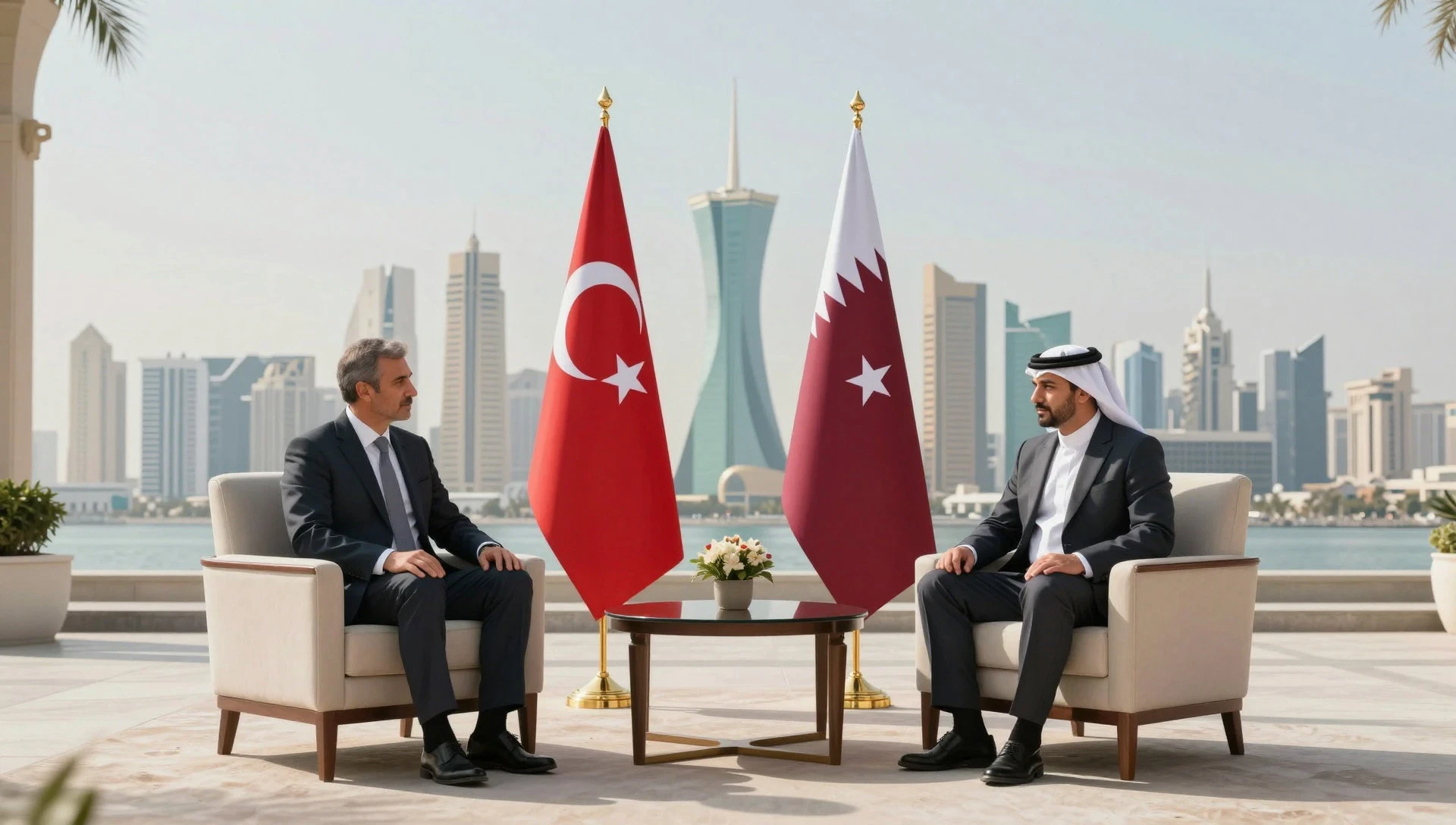
When the Turkish President and the Qatari Amir convene a standing bilateral committee for the twelfth consecutive year, the gesture itself carries more analytical weight than any single document signed on the day. The 12th Supreme Strategic Committee, held in Istanbul on November 13, 2026, represents a decade of deliberate institutional architecture between Ankara and Doha, built through recurring summits, ministerial tracks and a shared diplomatic vocabulary.
What began as a crisis-driven alignment has matured into a structured partnership with its own calendar, its own agreements and its own logic of regional order.
The meeting produced commitments aimed at a $5 billion trade threshold, joint defense projects and coordinated diplomatic mediation for regional conflicts. Each of these three pillars speaks to a different dimension of the relationship: economic depth, security interdependence and diplomatic co-authorship. Together they illustrate how two mid-sized powers can construct a durable axis without formal treaty alliance, relying instead on repetition, procedure and mutual necessity. The institutional form is the message, and the message is that this partnership intends to outlast the personalities who built it.
On This Page
Understanding the Ankara-Doha axis requires looking past the headline figures to the machinery beneath them. Bilateral committees, joint economic commissions and recurring leadership summits create what scholars of international relations call institutionalized alignment, a pattern in which cooperation becomes routine rather than episodic.
This analysis examines the committee's structure, the economic and defense dimensions, the mediation role both states have carved out, and the wider question of whether such axes genuinely constitute alternative geopolitical poles independent of Western alliances.
TL;DR Türkiye and Qatar convened the 12th Supreme Strategic Committee in Istanbul on November 13, 2026, signing agreements aimed at a $5 billion trade threshold, joint defense projects and coordinated regional mediation, extending a decade-old institutionalized partnership.
The Architecture of a Decade-Old Partnership
The Supreme Strategic Committee was established in 2014 as a high-level coordination mechanism chaired jointly by the Turkish President and the Qatari Amir. Its design is deliberately comprehensive, drawing together foreign ministers, defense officials, trade authorities and cultural representatives under a single recurring framework. Each annual session reviews progress against prior commitments and adds new agreements, creating a cumulative body of bilateral arrangements that spans nearly every sphere of state activity.
This cumulative structure distinguishes the committee from ad hoc summitry. Because each session builds on the last, the partnership accumulates institutional memory and procedural habit. Officials on both sides know their counterparts, understand the negotiating rhythm and can plan multi-year projects with reasonable confidence.
The twelfth session in Istanbul therefore represents not a fresh beginning but a mature phase, in which the relationship's durability is tested by whether it can deliver on long-standing ambitions rather than merely announce new ones.
From Crisis Alignment to Structural Cooperation
The partnership's origins lie in a period of regional turbulence, when both states found themselves aligned against common pressures and isolated from some traditional partners. That shared predicament created the initial political will for close coordination. Over time, however, the relationship shifted from reactive solidarity to proactive construction, as the two governments began building economic, military and diplomatic linkages that would function regardless of the immediate regional weather.
This transition matters analytically because crisis-driven alliances often dissolve once the crisis passes. The Ankara-Doha relationship has instead deepened, suggesting that the two capitals have identified durable complementarities. Qatar's financial capacity and energy wealth pair with Türkiye's industrial base, defense manufacturing sector and diplomatic reach. Each side supplies something the other values structurally, not merely tactically, which helps explain why the committee has survived leadership changes, regional realignments and shifting global pressures.
The Committee's Institutional Machinery
Beneath the leadership summit sits a layered apparatus of working groups and ministerial tracks. Trade and investment committees meet between summits to negotiate commercial frameworks, defense officials coordinate procurement and joint production, and diplomatic teams align positions ahead of multilateral gatherings. This machinery gives the partnership operational substance, translating political declarations into concrete administrative action across multiple bureaucracies.
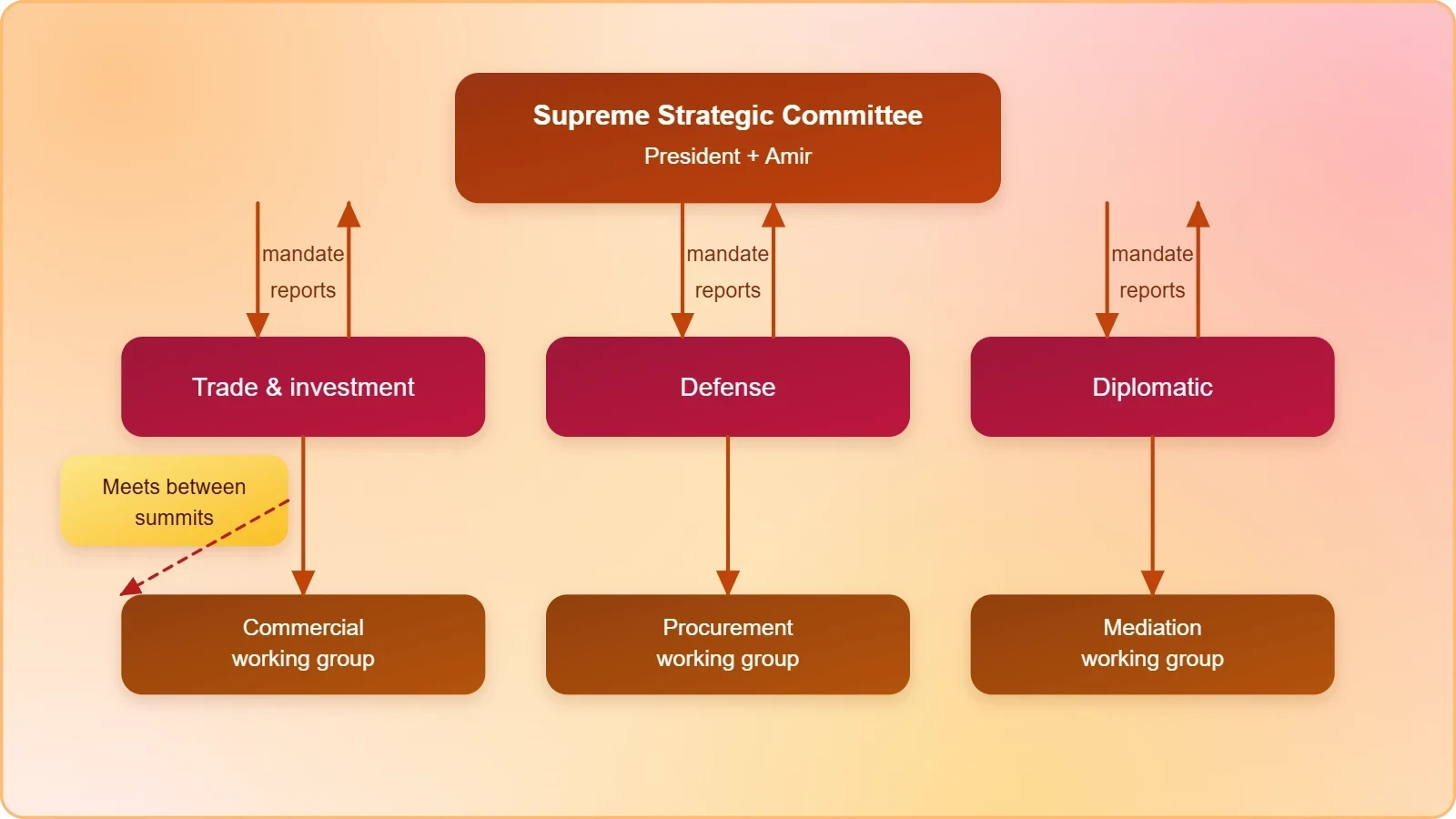
The recurring nature of these meetings creates what might be called bureaucratic interdependence. Ministries on both sides develop working relationships, share information and coordinate planning in ways that outlast any single government's priorities. This is the quiet strength of institutionalized bilateralism: it embeds cooperation in routine practice, making the relationship resilient to political friction and ensuring that the partnership continues to function even when headline diplomacy encounters obstacles.
We Also Published
Economic Depth and the $5 Billion Trade Threshold
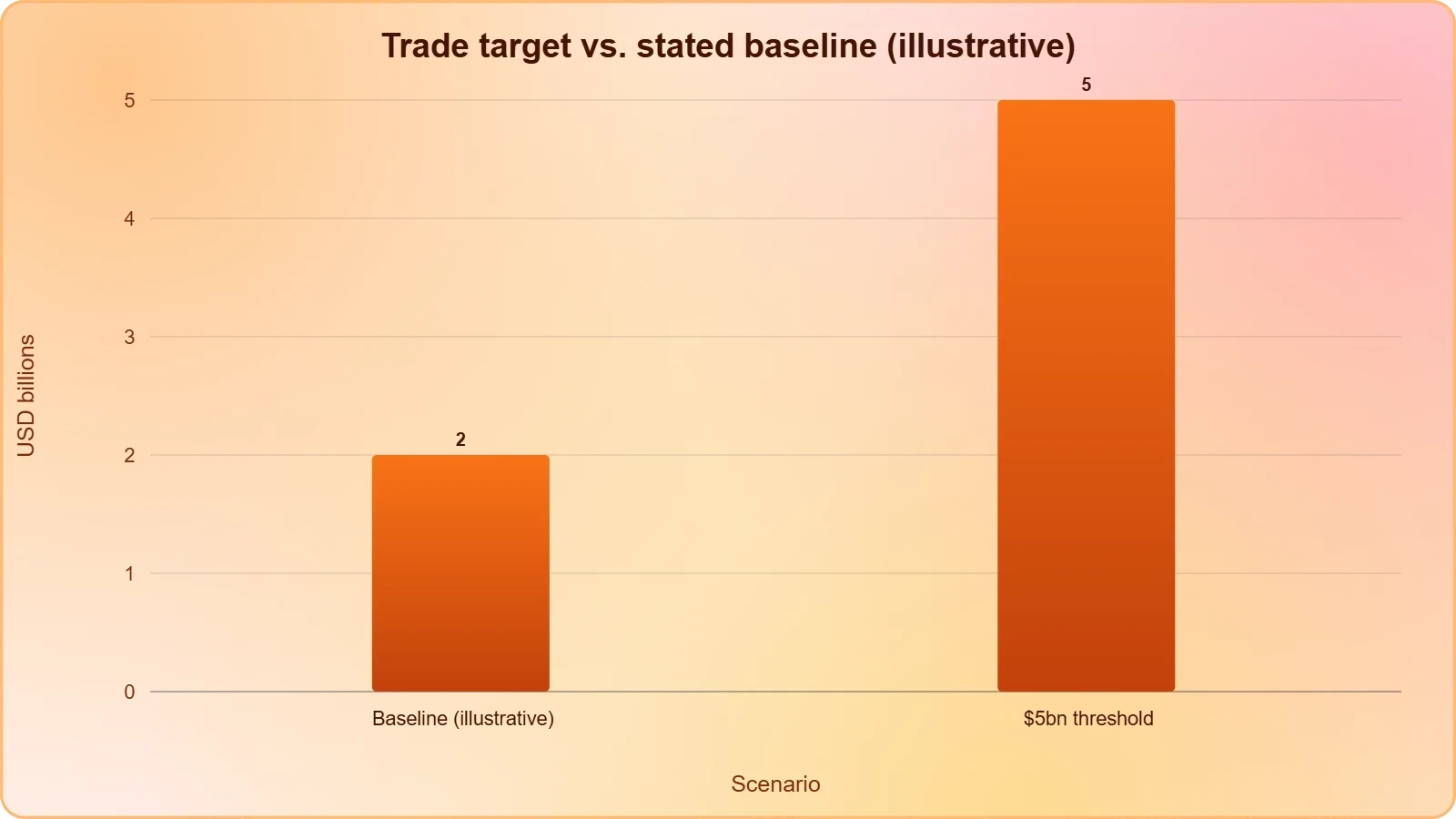
Trade and investment form the material backbone of the Ankara-Doha relationship. The 2026 session set a $5 billion trade threshold as a shared target, signalling that both governments regard commercial exchange as a strategic priority rather than a residual outcome of political goodwill.
Qatar's capital surpluses and Türkiye's productive capacity create natural complementarities, and the committee provides the institutional channel through which those complementarities are converted into contracts, joint ventures and investment flows.
The threshold figure should be read as an aspiration rather than a forecast. Bilateral trade targets of this kind function as coordination devices, giving officials and businesses a shared benchmark against which to measure progress. They also signal political commitment to the private sectors in both countries, encouraging firms to invest in market knowledge, logistics and partnerships on the assumption that the policy environment will remain supportive. The committee's recurring format allows both sides to review whether the target is being approached and to adjust the mechanisms accordingly.
Investment Flows and Sovereign Capital
Qatari sovereign wealth has been a visible presence in the Turkish economy, with investments spanning banking, retail, real estate and infrastructure. These flows reflect a strategic logic beyond pure financial return: Qatar gains exposure to a large, dynamic market and a manufacturing base, while Türkiye gains a reliable source of long-term capital that is less sensitive to short-term market sentiment than portfolio investment. The committee framework gives both sides a structured venue for discussing these flows and for addressing regulatory or commercial obstacles.
The investment relationship also has a defensive dimension. By anchoring capital in a partner economy, both states reduce their exposure to external financial pressure and diversify their dependencies. This is particularly relevant for Türkiye, which has experienced currency volatility and external financing pressures in recent years, and for Qatar, which has sought to broaden its global investment footprint beyond traditional Western markets. The committee's economic track therefore serves both commercial and strategic purposes simultaneously.
Trade Composition and Sectoral Priorities
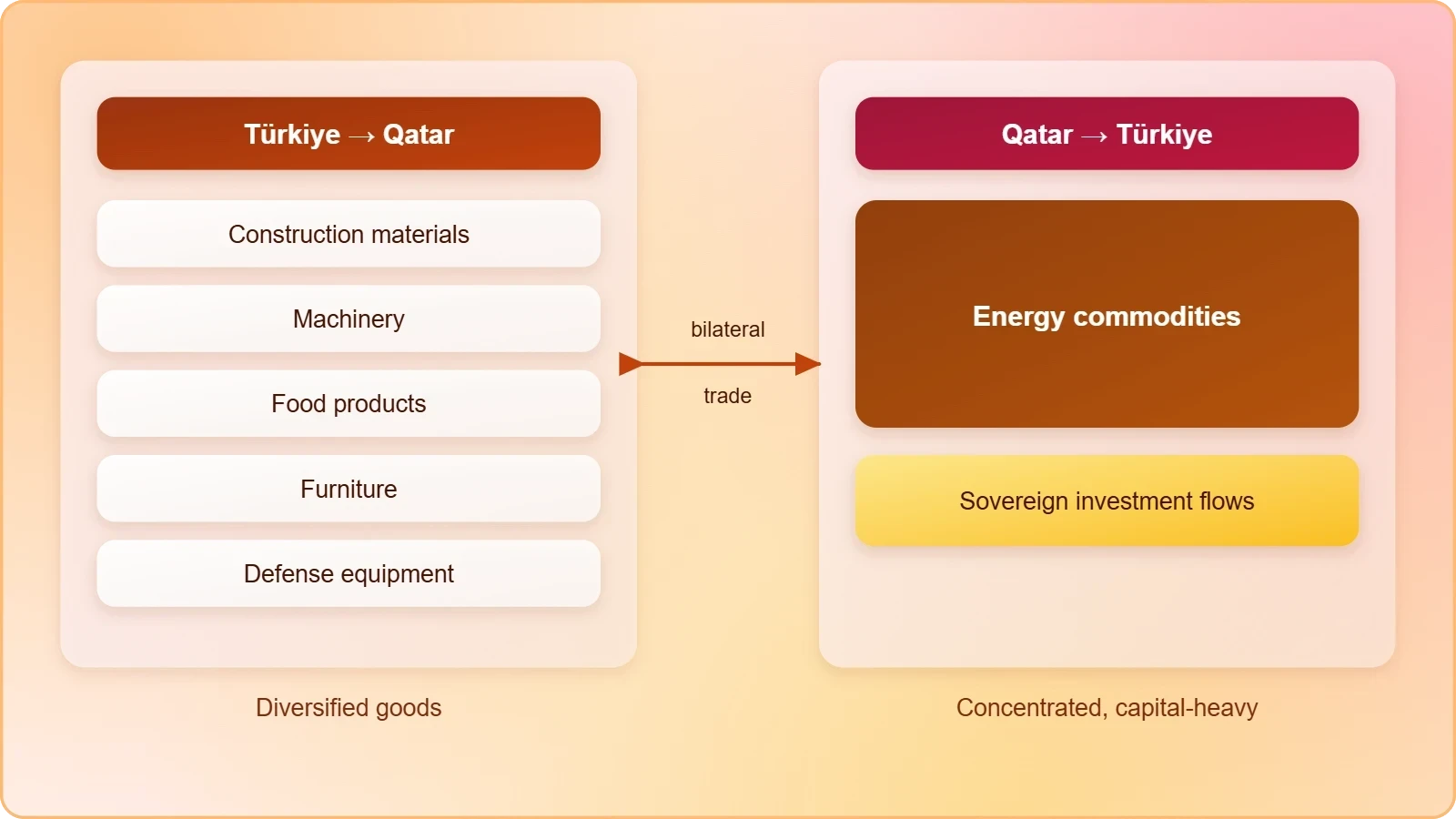
The composition of bilateral trade reveals the underlying complementarity. Turkish exports to Qatar include construction materials, machinery, food products, furniture and defense equipment, while Qatari exports to Türkiye are dominated by energy commodities, particularly liquefied natural gas. This pattern reflects the two economies' structural differences and provides a stable foundation for exchange, since each side supplies goods the other genuinely needs rather than competing in the same sectors.
Beyond raw trade, the committee has encouraged sectoral cooperation in areas such as logistics, tourism, healthcare and technology. Turkish construction firms have been prominent in Qatari infrastructure projects, including preparations for major sporting events, while Qatari investors have shown interest in Turkish technology and consumer sectors. These sectoral linkages deepen the relationship beyond commodity exchange and create constituencies in both countries with a direct stake in the partnership's continuation.
Defense Cooperation and Strategic Interdependence
Defense collaboration has become one of the most consequential dimensions of the Ankara-Doha relationship. The 2026 session's joint defense projects build on years of procurement cooperation, joint exercises and training arrangements. Türkiye's defense industry has expanded significantly, producing drones, armored vehicles and naval platforms that have attracted Qatari interest, while Qatar has sought to diversify its defense suppliers beyond traditional Western sources. The committee provides a political umbrella under which these transactions and collaborations are negotiated and reviewed.
The strategic logic of defense cooperation runs deeper than procurement. Shared defense projects create interoperability, shared doctrine and personal networks among military officers, all of which increase the practical value of the partnership in a crisis. They also signal commitment: a state that co-produces weapons with a partner has made a long-term bet on that relationship, since supply chains, maintenance arrangements and training pipelines create dependencies that are costly to unwind. Defense cooperation thus functions as a credibility mechanism for the broader alliance.
Joint Production and Technology Transfer
Joint production arrangements represent a step beyond simple buyer-seller transactions. When Qatari entities participate in Turkish defense manufacturing, whether through co-production agreements, joint ventures or technology transfer provisions, the relationship acquires an industrial dimension that generates jobs, skills and political constituencies in both countries. These arrangements also reduce Qatar's dependence on single suppliers and give Türkiye access to capital and markets that strengthen its defense export position.
Technology transfer is particularly significant because it addresses a persistent concern among smaller states: the risk of being locked into a supplier's ecosystem without developing indigenous capabilities. By partnering with Türkiye, Qatar can access defense technology on terms that may include local assembly, maintenance and eventually design participation. For Türkiye, such partnerships validate its defense industry's maturity and provide reference customers that support further export ambitions in other markets.
Training, Exercises and Interoperability
Beyond hardware, the defense relationship encompasses training programs, joint exercises and officer exchanges. Turkish military academies have hosted Qatari officers, and joint exercises have tested coordination between the two forces. These activities build the human and procedural foundations of interoperability, ensuring that the two militaries can operate together effectively if circumstances require it. They also foster personal relationships among officers that can facilitate communication during crises.
Interoperability is often underestimated in analyses of alliances, yet it is one of the most tangible forms of strategic interdependence. Forces that have trained together, share doctrine and understand each other's procedures can act in concert far more effectively than those that have not. The committee's defense track therefore contributes to something more durable than any single procurement deal: a habit of military cooperation that becomes part of both states' planning assumptions.
Coordinated Mediation and Diplomatic Co-Authorship
The third pillar announced at the Istanbul session, coordinated diplomatic mediation for regional conflicts, reflects a distinctive feature of the Ankara-Doha axis. Both states have developed active mediation profiles in recent years, engaging with parties across regional divides and positioning themselves as interlocutors capable of bridging gaps that larger powers cannot. The committee's decision to coordinate these efforts formally elevates mediation from parallel activity to joint enterprise.
Mediation is an unusual diplomatic commodity because it depends on relationships rather than material power. A mediator must be trusted by multiple parties, must have channels of communication that others lack, and must be perceived as having interests in a settlement rather than in victory for one side. Türkiye and Qatar have each cultivated such relationships in different contexts, and their combined network is broader than either could deploy alone. Coordinating their mediation efforts therefore multiplies their diplomatic reach.
The Logic of Joint Mediation
Joint mediation offers practical advantages over unilateral efforts. Two mediators can divide labor, with one engaging one party while the other engages its adversary, and can compare notes to identify openings that a single mediator might miss. They can also share the political risk of a failed process and the credit of a successful one, reducing the reputational stakes for each. The committee framework provides a structured setting for this coordination, ensuring that the two capitals align their approaches rather than competing for influence.
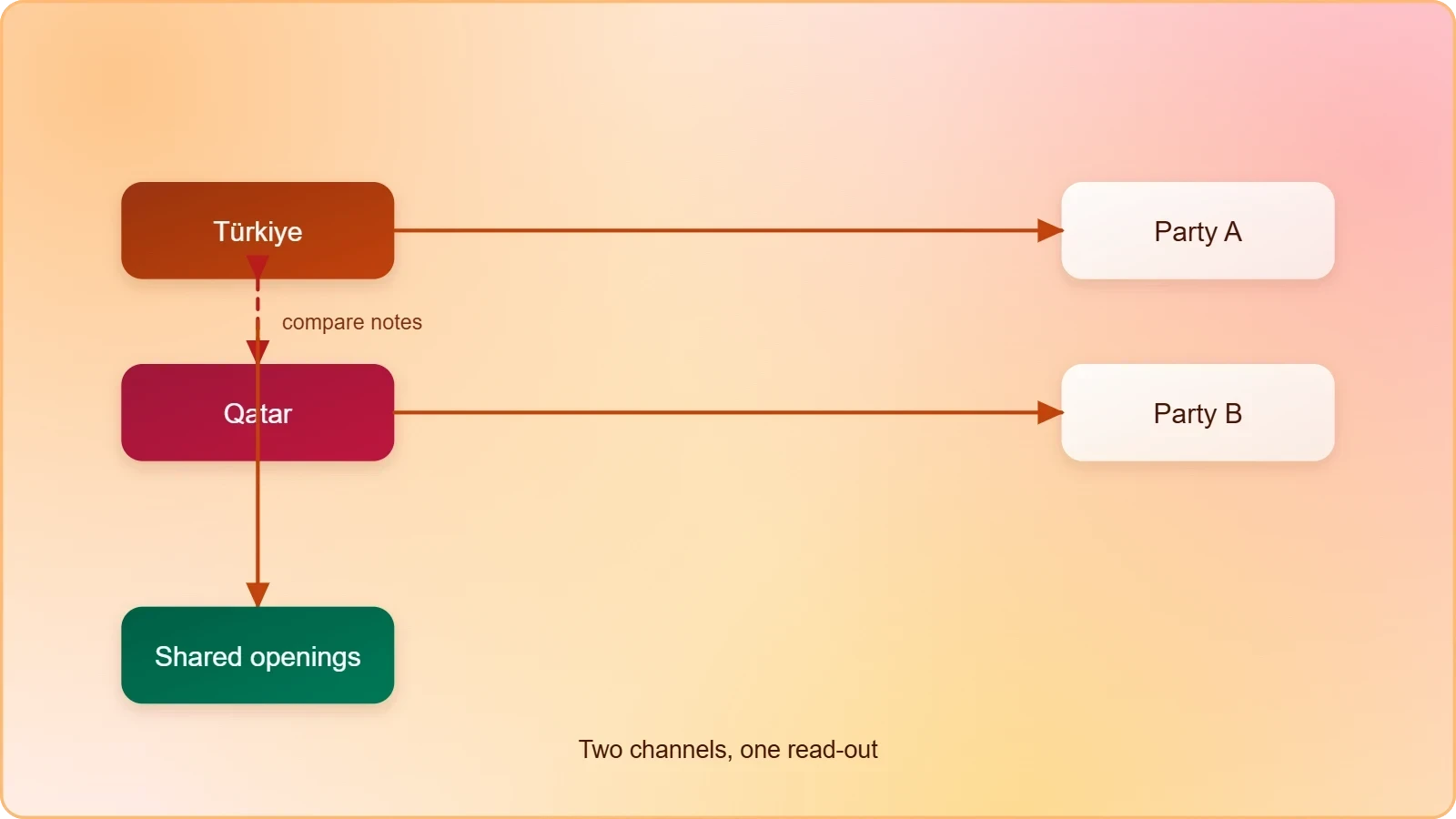
There is also a strategic dimension. By positioning themselves as indispensable mediators, Türkiye and Qatar enhance their diplomatic relevance and make themselves harder to marginalise in regional settlements. Mediation becomes a form of influence that does not depend on military power or economic leverage, and it generates goodwill among parties that may later be useful partners. The committee's mediation track thus serves both conflict-resolution and status-building purposes.
Mediation as Strategic Capital
Successful mediation builds a reputation that attracts future requests and enhances a state's standing in multilateral forums. Both Ankara and Doha have invested in this reputation, hosting talks, maintaining channels to diverse actors and presenting themselves as honest brokers. The committee's formal coordination of these efforts signals that the two states intend to present a united diplomatic front, pooling their credibility and their contacts to increase the likelihood of success.
This pooling also creates a distinctive diplomatic identity. The Ankara-Doha axis becomes known not merely as an economic and defense partnership but as a mediation partnership, a brand that carries weight in regional diplomacy. That identity is difficult for rivals to replicate because it rests on accumulated relationships and trust rather than on resources that can be purchased. It is, in effect, a form of strategic capital that appreciates with use.
Alternative Geopolitical Poles and the Wider Order
The Ankara-Doha axis raises a broader question about the structure of the international order. Institutionalized bilateral committees of this kind create dense networks of cooperation that operate alongside, rather than within, established Western-led frameworks. They do not necessarily challenge those frameworks directly, but they reduce dependence on them and create alternative channels for trade, defense and diplomacy. Over time, such networks can accumulate into something resembling a parallel architecture.
This does not mean that the Ankara-Doha partnership constitutes a bloc in the traditional sense. It lacks a formal charter, a collective defense clause and a unified command structure. What it has instead is repetition, procedure and mutual necessity, which in some respects are more durable than formal commitments because they are embedded in daily practice.
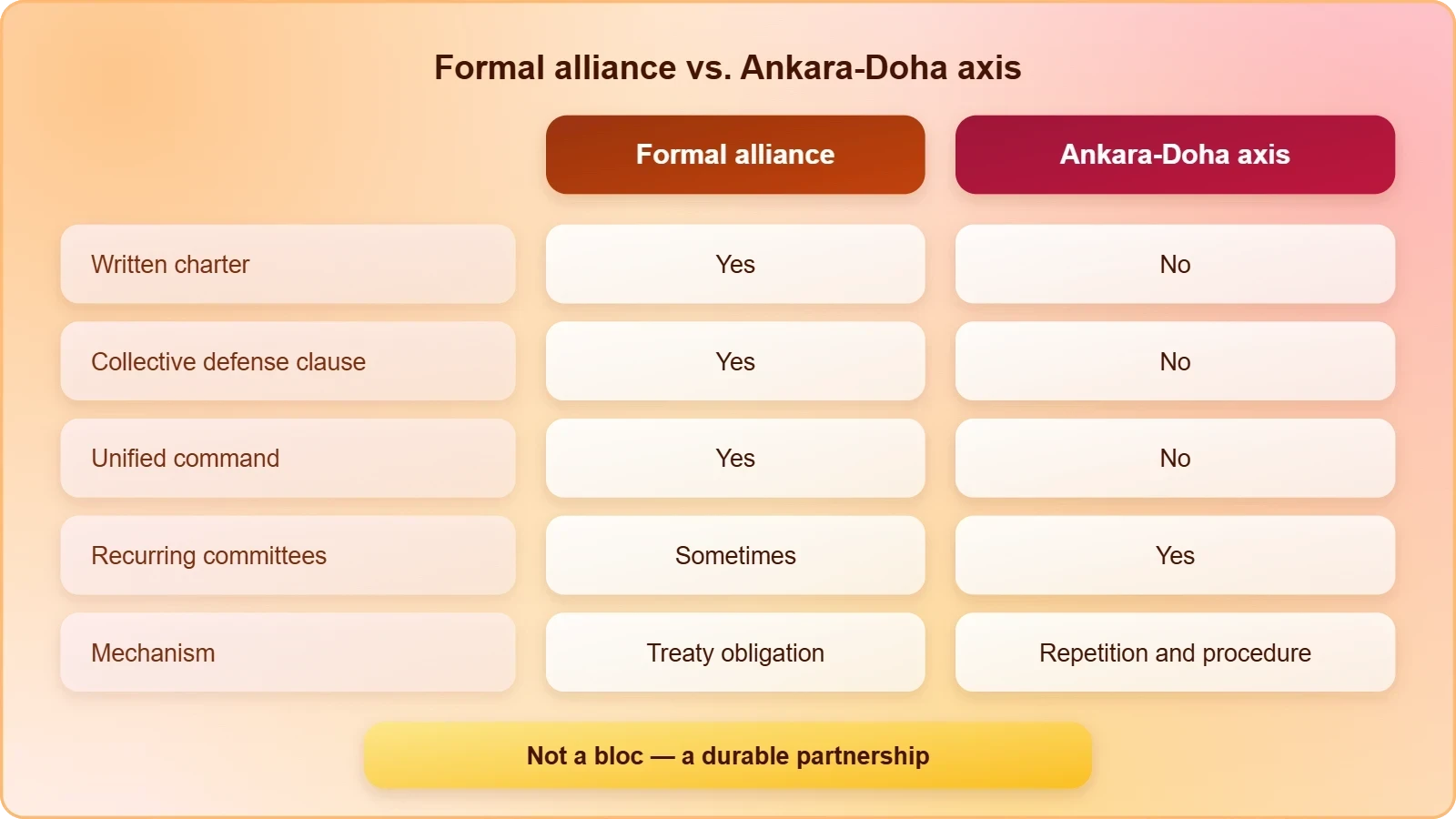
The committee's twelfth session demonstrates that this model can sustain itself across a decade, which is itself a significant finding about how alternative poles might form.
Institutionalized Bilateralism as a Model
The committee model is potentially replicable. Other middle powers observing the Ankara-Doha relationship may see a template for building durable partnerships without the costs and constraints of formal alliance. The key elements are a recurring high-level forum, a layered bureaucratic apparatus beneath it, and a cumulative body of agreements that creates mutual stake. This model is flexible enough to accommodate differences in partners' interests and robust enough to survive political change.
Whether such models proliferate depends on whether they deliver results. If the Ankara-Doha committee continues to produce tangible economic, defense and diplomatic outcomes, it will serve as a proof of concept that others may emulate. If it stalls, the model will lose appeal.
The 2026 session's commitments to a $5 billion trade threshold, joint defense projects and coordinated mediation are therefore tests of the model's viability as much as they are bilateral deliverables.
Implications for Western Alliances
For Western alliances, the rise of institutionalized bilateral partnerships presents both a challenge and an opportunity. The challenge is that such partnerships can dilute the cohesion of established frameworks by offering members alternative venues for cooperation. The opportunity is that they can serve as complements, addressing regional issues that larger alliances are poorly structured to handle. How Western capitals respond to the Ankara-Doha model will shape whether it is seen as competitive or complementary.
The more significant implication may be ideational. The Ankara-Doha axis demonstrates that middle powers can construct meaningful international architecture without waiting for great-power permission. That demonstration has value beyond the two states involved, offering a template for agency in a multipolar order.
Whether that template is widely adopted remains an open question, but the committee's decade-long record suggests that the model is at least viable, and viability is the first test any alternative architecture must pass.
Reading the Twelfth Session in Context
The 12th Supreme Strategic Committee should be read as a milestone in a longer process rather than as a standalone event. Its significance lies in what it confirms about the partnership's trajectory: that the relationship has matured to the point where both governments can commit to ambitious targets and coordinated strategies across multiple domains.
The $5 billion trade threshold, the joint defense projects and the mediation framework are not isolated announcements but expressions of a partnership that has developed the institutional capacity to pursue them.
For observers of regional politics, the session offers a case study in how middle powers construct durable relationships in a multipolar order. The Ankara-Doha axis is neither a formal alliance nor a mere transactional arrangement; it is something in between, sustained by institutional habit and mutual necessity.
Understanding this model is essential for anyone seeking to grasp how the international system is being reshaped by actors who are not content to wait for great-power initiative.
Disclaimer: This article is an analytical commentary on publicly reported diplomatic developments and does not constitute investment, legal or political advice. Readers should consult primary sources and official statements for verification.
Disclaimer: This article is for general information and education only. It describes what historical prices and technical indicators showed on the date mentioned and does not predict future movements. It is not investment advice, a recommendation, or an offer to buy or sell any security. Indicators are calculated from past data and can mislead, and all investments carry risk. Please consult a SEBI-registered investment adviser before making any financial decision.
From our network :
- University Language Proficiency Exams: Why Institutional Tests Demand Different Preparation Than IELTS and TOEFLDiscover why university-specific language proficiency examinations differ fundamentally from IELTS and TOEFL, and learn strategic preparation approaches for institutional assessment success.
- CISA’s Ten-Advisory Wave: Why Generic Patching Fails in OT and How to Build Product-Specific PlaybooksCISA released ten ICS advisories in one week, exposing critical infrastructure risks. Generic patching fails in OT. Learn to build product-specific remediation playbooks.
- The Hidden Cost of AI Convenience: Why Over-Permissioned Agents Are a Security Time BombDiscover why AI agents with excessive permissions create dangerous single points of failure, and learn how implementing least privilege principles can protect your organization from exploitation.
- Mobile Learning and VR in English: What Global Evidence Reveals About Effective Language TechnologyA systematic review across 14 countries reveals which language-learning technologies genuinely work. Mobile learning, AI, and VR show measurable benefits when pedagogically integrated. This evidence-based guide helps educators and learners select technology that delivers real return on investment.
- The Final Descent: How ESA Retired the Legendary Cluster Constellation After 24 Years of Space Weather ScienceAfter 24 years mapping Earth’s magnetosphere, ESA’s Cluster mission concluded with a precisely controlled reentry over the South Pacific. This analysis explores the scientific legacy, engineering decisions, and debris mitigation principles behind one of space exploration’s most responsible retirements.
- How AI Agents Will Change the Way We Manage Personal FinancesExplore how AI agents are transforming personal finance through automated budgeting, bill payment, and investment management, while examining the critical security protocols and governance frameworks required for safe deployment.
- Committed Mediterranean Precipitation Decline: Why Emissions Cuts Alone Cannot Restore Winter RainsNew NOAA research reveals that Mediterranean winter rains may decline irreversibly even with emissions cuts. Explore the science of committed climate change and regional impacts.
- Forbidden Matrix Patterns and Visible Lattice Points: A Geometric DictionaryExplore how multidimensional 0–1 matrices encode geometric truths, linking forbidden patterns to visible lattice points and hypergraph theory, with applications in combinatorics and computational geometry.
- Live Online English Classes for Kids: Do They Actually Reduce Anxiety?A ten-week study reveals that synchronous online English classes can significantly reduce child language anxiety while improving listening and reading skills. Discover what makes these programs effective and how parents can select the right one.
RESOURCES
- The Türkiye‐Qatar Partnership: From Ottoman Roots to Strategic ...onlinelibrary.wiley.comJul 24, 2026 ... The Qatar-Türkiye relationship was formalized by the creation of the Supreme Strategic Committee ... Ultimately, the Ankara-Doha axis stands as…
- Ankara's Ambiguous Policy toward a Divided GCCarabcenterdc.orgTurkey's Ever Strong Ties with Qatar. Turkish and Qatari officials recently held the third meeting of the Turkey-Qatar Supreme Strategic Committee—which was ...
- Qatar–Türkiye relations during the embargo of Qatar: a case study in ...link.springer.comAug 14, 2024 ... ... Türkiye-Qatar Supreme Strategic Committee in Doha (Al Jazeera 2018b). Such unwavering Turkish support was 'very important and necessary' (Al ...
- Ideational Factors in Turkey's Alignment with Qatar and Their Impact ...tandfonline.comDec 8, 2021 ... ... Qatar, also intensified relations between Ankara and Doha ... And speaking at the 4th meeting of the Turkey-Qatar Supreme…
- Ambassador of the Republic of #Turkiye to the State of #Qatar HE Dr ...facebook.comNov 13, 2024 ... Qatar and Turkiye signed multiple MoUs at the 11th Supreme Strategic Committee meeting in Doha ... Ankara. Following the meeting,…
- qatar relations in a shifting regional order: friends through thick and ...aub.edu.lbWhile in the 2000s, the Ankara-Doha collaboration was nested in the framework of the. Türkiye-GCC rapprochement, it has gradually grown into a strategic ...
- Türkiye and Qatar are further strengthening their strategic ...facebook.comNov 4, 2026 ... Türkiye and Qatar are further strengthening their strategic partnership through expanding cooperation in diplomacy, defence, trade and ...
- (PDF) Strategic shifts: the role of the Gulf Crisis in transforming ...researchgate.netAug 21, 2025 ... It examines the political, military, and economic implications of Turkey's support for Qatar during the blockade, and how this realignment ...
- The impact of the Turkish regional role in the Middle East after the ...emerald.comJul 13, 2026 ... On 4th and 5th of December 2023, Erdoğan traveled to Doha to participate in the ninth Turkey–Qatar Supreme Strategic Committee…
- The Turkey-Qatar alliance and an independent future for the Middle ...middleeastmonitor.comDec 7, 2018 ... ... Turkey-Qatar axis. This is a necessary generalisation of the battle for ... The Turkey-Qatar High Strategic Committee overseeing the ...
- GCC: The Process and Achievementsgcc-sg.orgThe agreement was signed with initials, the final signing of the agreement was made in Doha, Qatar (November 2008). XI. Australia. The Supreme Council…
- Erdoğan to attend World Cup opening ceremony in Qatardailysabah.comNov 19, 2022 ... Ankara and Doha enjoy strong relations, particularly since the ... Annual meetings of “The Supreme Strategic Committee,” established in ...
- Hamas at a Crossroads in the Post-Ali Khamenei Eramei.eduMar 23, 2026 ... ... Turkey and Qatar in coordination with the US. The Contradiction: Pro ... While Hamas' political leadership in Qatar maintained…
- How the Muslim Brotherhood Funds Iran's Proxies - JINSAjinsa.orgMar 11, 2026 ... The Axis's financial flows have pivoted to three dispersed, non-state networks: The Qatar-Turkey Hub: Despite being targeted by Iranian ...
- Erdoğan's Failure on the Nile - The Cairo Review of Global Affairsthecairoreview.com... Turkey–Qatar axis supports Hamas. ... Egypt and its allies have already recognized the post-Bashir government in Khartoum, potentially undermining the Doha–Ankara ...
- 01
- 02
- 03
- 04
- 05
- 06
- 07
- 08
0 Comments