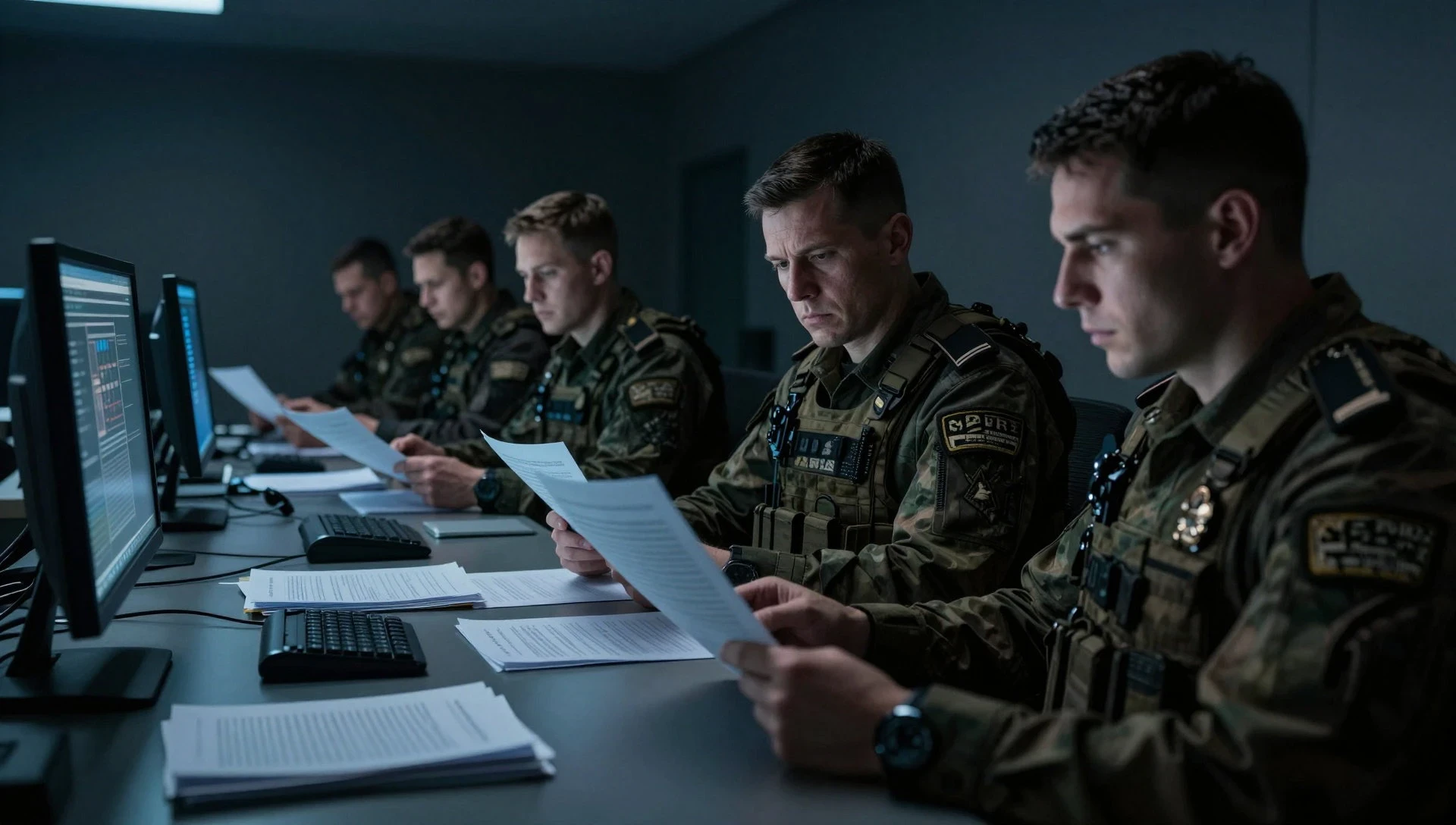
The admission by a former senior investigating officer with the Royal Military Police that he withheld potentially valuable information from a war crimes inquiry lands with unusual force, because it strikes at the one institution soldiers and civilians alike are told to trust when the battlefield falls silent. War crimes investigations are not ordinary criminal probes; they are the mechanism through which a state demonstrates that its own armed forces remain answerable to law, even when the alleged conduct occurred in the chaos of conflict. When the person tasked with gathering and preserving evidence concedes that material was kept back, the damage radiates outward from a single case toward the credibility of the entire military justice apparatus.
What makes this disclosure especially consequential is its modesty. The original reporting, carried by Sky News, records the admission without embellishment and offers no further detail about the underlying case, the nature of the withheld material, or the circumstances that prompted the disclosure. That restraint is itself instructive. In the ecosystem of war crimes accountability, silence and omission are rarely neutral acts; they are the quiet instruments through which evidence decays, witnesses lose confidence, and prosecutions that might have succeeded quietly expire. A senior investigator's admission therefore functions as a rare window into how investigative failures can occur not through dramatic misconduct but through the ordinary human machinery of judgment, discretion, and institutional pressure.
This analysis examines the admission from several angles: the professional architecture of military police investigations, the legal and ethical weight of disclosure duties, the institutional culture that can make withholding seem defensible, and the wider consequences for accountability in conflict zones. It draws on established frameworks of investigative practice and the public record surrounding military justice systems, while treating the sparse source material with the care it demands. The aim is not to speculate about facts that remain undisclosed, but to map the terrain on which such an admission acquires meaning, and to consider what it signals about the fragile machinery of justice when war is the backdrop.
On This Page
TL;DR A former senior investigating officer with the Royal Military Police has admitted withholding potentially valuable information from a war crimes inquiry, a disclosure that raises profound questions about investigative integrity, disclosure obligations, and institutional accountability within military justice. The admission, reported without further detail, underscores how omissions by those entrusted with evidence can undermine prosecutions and public trust. This analysis explores the professional, legal, and ethical dimensions of the case, the culture that can normalize withholding, and the reforms that accountability demands.
The Architecture of Military Police Investigations
Military police investigations occupy a peculiar institutional space, sitting at the intersection of criminal justice and military command. Investigators are trained to professional policing standards, yet they operate within a hierarchy that prizes operational security, chain-of-command loyalty, and reputational protection. The Royal Military Police, like its counterparts in allied nations, maintains a specialist branch for serious and complex investigations, including alleged war crimes, and its officers are expected to gather evidence with the same rigor as civilian detectives. That dual identity, however, creates structural tensions that shape every decision an investigator makes about what to record, what to share, and what to hold back.
The role of a senior investigating officer is particularly exposed. Such officers carry responsibility for case strategy, evidence management, and the integrity of the investigative file, and they are expected to exercise judgment about relevance and disclosure. In practice, that judgment is exercised under pressure: limited resources, political sensitivity, and the knowledge that findings may embarrass the institution or the state. The admission in this case suggests that somewhere within that chain of judgment, material that could have mattered to a war crimes inquiry was deliberately or negligently kept from those who needed it. Whether the motive was protective, bureaucratic, or simply mistaken remains unknown, but the structural conditions that make such withholding conceivable are well documented.
Disclosure Duties and the Legal Framework
Disclosure is the backbone of fair investigation. In criminal proceedings across common law jurisdictions, investigators and prosecutors carry a continuing duty to identify and share material that may assist the defense or undermine the prosecution case. For war crimes inquiries, the stakes are higher still, because the evidence base is often fragile, dispersed across conflict zones, and dependent on witnesses who may be vulnerable or reluctant. International humanitarian law and domestic military justice systems both presume that investigators will err on the side of preservation and transparency, not selective silence. An admission of withholding therefore represents not a technical lapse but a potential breach of the foundational obligation on which the legitimacy of the inquiry rests.
The legal consequences of such a breach can be severe. Withheld material can invalidate a prosecution, trigger appeals, or, in the most serious cases, amount to an offense in its own right, such as perverting the course of justice or misconduct in public office. Beyond the individual, the institutional consequences ripple through the military justice system, inviting external scrutiny, parliamentary questions, and loss of confidence among victims and their representatives. The precise legal characterisation of the admission in this case will depend on facts not yet public, but the principle is clear: disclosure is not a discretionary courtesy extended by investigators, it is a duty owed to the process and to the public.
The Psychology of Omission in Investigative Work
Why would an experienced investigator withhold information? The question invites uncomfortable answers. Research on organizational behavior and professional ethics suggests that omission rarely arrives as a single dramatic decision; it accumulates through small, rationalized choices. An investigator may judge material irrelevant, unreliable, or too sensitive to circulate, and each judgment feels defensible in isolation. Over time, those judgments can harden into a pattern in which the investigative file becomes a curated narrative rather than a complete record. The admission in this case, whatever its specific facts, fits a recognizable pattern in which professional discretion shades into something closer to suppression.
Institutional culture amplifies these tendencies. Military organizations reward loyalty, discretion, and mission focus, and investigators who raise uncomfortable evidence may find themselves isolated or career-limited. The result is a quiet incentive structure in which withholding can feel like protecting the team rather than obstructing justice. Recognizing this psychology is essential to reform, because rules alone cannot counteract a culture that treats transparency as disloyalty. The admission by a former senior officer is significant precisely because it punctures that culture from within, demonstrating that the pressure to conceal is real and that its consequences eventually surface.
We Also Published
War Crimes Inquiries and the Weight of Evidence
War crimes inquiries are among the most demanding investigations a legal system can undertake. Evidence is gathered in environments where records are destroyed, witnesses are displaced or intimidated, and the passage of time erodes memory and physical traces. Investigators must navigate language barriers, cultural distance, and the political sensitivities of allied and adversary states alike. In such conditions, every piece of material carries disproportionate weight, and the decision to withhold even a single item can alter the trajectory of an entire case. The admission in this instance therefore matters not merely as an individual failing but as a reminder of how fragile the evidentiary foundations of accountability truly are.
The international dimension compounds the difficulty. War crimes inquiries frequently feed into broader accountability mechanisms, including international tribunals, universal jurisdiction proceedings, and human rights monitoring. Material withheld from a domestic inquiry may never reach those forums, and the resulting gaps can persist for decades. Survivors and victims' families build their expectations on the promise that evidence will be pursued wherever it leads. When a senior investigator admits to withholding information, that promise is visibly weakened, and the credibility of future inquiries is diminished in the eyes of precisely the communities whose cooperation investigators most need.
Accountability Mechanisms and Their Limits
Accountability for war crimes rests on a layered architecture: domestic military justice, civilian oversight, international humanitarian law, and, where applicable, the jurisdiction of international courts. Each layer depends on the integrity of the one beneath it. A domestic inquiry that withholds evidence undermines the foundation on which international mechanisms rely, because those mechanisms typically defer to national proceedings that appear genuine. The principle of complementarity, central to the Rome Statute system, presumes that states will investigate honestly; an admission of withholding calls that presumption into question and may, in principle, open the door to external scrutiny where none was expected.
The limits of these mechanisms are equally important to acknowledge. International courts have limited resources and jurisdictional reach, and domestic oversight bodies often lack the powers or the political backing to compel cooperation from military institutions. The result is a system in which accountability depends heavily on the willingness of insiders to speak honestly, sometimes against their own institutional interests. The former investigator's admission is, in that sense, both a symptom of systemic weakness and a rare act of candor that the system should be capable of absorbing and learning from rather than merely punishing.
The Human Cost of Withheld Evidence
Behind every war crimes inquiry stand people who have suffered loss that most readers will never experience. For victims and their families, the investigative process is often the only forum in which their account can be formally heard and tested. When evidence is withheld, the harm is not abstract; it manifests as cases that collapse, allegations that go unproven, and a lingering sense that the system was never truly on their side. The admission in this case, however limited in detail, will be read by those communities as confirmation of suspicions they have long held about how military institutions manage uncomfortable truths.
That human dimension should anchor any discussion of reform. Procedural fixes, training programs, and oversight bodies matter, but they matter because of the people whose lives depend on them. A war crimes inquiry that functions properly offers victims something rare: the possibility that the truth will be established through evidence rather than negotiated through power. Withholding information forecloses that possibility, and the cost is borne disproportionately by those with the least capacity to challenge it. Any serious response to this admission must begin from that recognition.
Institutional Culture and the Pressure to Conceal
Military institutions are built on cohesion, and cohesion depends on a degree of internal discretion. That same discretion, when applied to evidence in a war crimes inquiry, becomes a liability. Investigators who spend their careers inside such institutions absorb its norms, including the instinct to protect the organization from external embarrassment. The admission by a former senior officer suggests that this instinct can override formal obligations, even in matters as grave as war crimes. Understanding that dynamic is essential, because it explains why disclosure failures recur across jurisdictions and eras despite repeated reform efforts and public commitments to transparency.
The pressure is not always explicit. It can appear as subtle signals about career progression, as informal guidance about what to include in briefings, or as a general atmosphere in which raising difficult evidence is treated as disloyalty. Senior officers are especially susceptible, because their careers are intertwined with the institution's reputation and because they are expected to exercise judgment on behalf of the organization. The admission in this case invites a searching question: how many similar decisions are made every year, in inquiries that never attract public attention, by officers who believe they are acting in good faith?
Leadership, Loyalty, and Ethical Boundaries
Leadership in military policing requires a difficult balance between loyalty to colleagues and fidelity to the law. The two are not inherently opposed, but they can diverge sharply when evidence threatens to expose misconduct by the institution itself. Ethical leadership demands that officers recognize the divergence and choose the law, even at personal cost. The admission by a former senior investigator is a reminder that this choice is not theoretical; it is made, repeatedly, in real investigations with real consequences. Institutions that fail to support officers who make the harder choice should not be surprised when others make the easier one.
Training and doctrine can help, but they cannot substitute for a culture in which disclosure is actively rewarded rather than grudgingly tolerated. Some military justice systems have introduced independent disclosure review, whistleblower protections, and external oversight precisely to counterbalance institutional pressure. The effectiveness of these measures depends on whether they are resourced and respected, or treated as box-ticking exercises. The admission in this case should prompt a candid audit of whether existing safeguards would have caught the omission earlier, and whether they are strong enough to deter repetition.
Whistleblowing and the Cost of Candor
The fact that the admission was made at all is significant. Whistleblowing within military institutions carries well-documented risks: isolation, career stagnation, and in some cases formal retaliation. That a former senior officer chose to acknowledge withholding suggests either that the internal accountability process functioned, or that external pressure made silence untenable. Either way, the case highlights the importance of protected channels through which insiders can report concerns without destroying their livelihoods. Systems that rely solely on individual courage are fragile; systems that institutionalize candor are more resilient.
Public reporting plays a role here as well. The Sky News account, though brief, places the admission on the record and invites scrutiny that might otherwise have remained internal. Media attention is not a substitute for legal accountability, but it can create the conditions in which accountability becomes possible. The challenge is to ensure that such attention translates into durable reform rather than a temporary scandal cycle that fades before the underlying culture changes. The admission is a starting point, not a conclusion, and its value depends on what institutions do next.
Legal and Professional Consequences for the Investigator
An admission of withholding information exposes the investigator to a range of legal and professional consequences, the precise shape of which depends on facts that remain undisclosed. At the professional level, misconduct proceedings may follow, potentially resulting in dismissal, loss of pension entitlements, or removal from the register of accredited investigators. At the legal level, depending on the nature of the material and the intent behind its suppression, the conduct could amount to an offense. The admission itself may also be treated as a mitigating factor, demonstrating candor that the system should recognize even as it imposes consequences.
Beyond the individual, the case raises questions about the responsibility of supervisors and institutions. If a senior investigating officer withheld material, what did the oversight mechanisms do, or fail to do, in response? Were there warning signs that went unheeded? Did the command chain create conditions in which withholding seemed necessary or safe? These questions matter because accountability that stops at the individual level leaves the underlying system untouched. A thorough response would examine the full chain of responsibility, from the investigator to the institution, and would publish findings in a way that allows public confidence to be rebuilt.
Proportionality and the Purpose of Sanction
Sanctions serve multiple purposes: punishment, deterrence, rehabilitation, and the restoration of public confidence. In cases involving withholding of evidence in a war crimes inquiry, deterrence and confidence are paramount, because the harm extends far beyond the individual case. A sanction that is too lenient risks signaling that disclosure failures carry little cost; one that is disproportionate may discourage future candor. The right balance depends on a careful assessment of intent, harm, and cooperation, and on a process that is transparent enough for victims and the public to understand why a particular outcome was reached.
There is also a forward-looking dimension. Investigators who admit mistakes early can help preserve evidence, identify systemic weaknesses, and prevent similar failures in other cases. A legal and professional framework that recognizes timely candor as a genuine mitigating factor, while still imposing meaningful consequences, is more likely to produce the cooperation on which accountability depends. The admission in this case offers an opportunity to test whether the existing framework achieves that balance, or whether it remains oriented primarily toward blame rather than learning.
Rebuilding Trust After Disclosure Failure
Trust, once damaged, is rebuilt through consistent action rather than statements of intent. For the military justice system, that means demonstrating that disclosure obligations are enforced, that oversight is independent, and that victims' interests are genuinely central to investigations. It also means acknowledging publicly when failures occur, rather than allowing them to be discovered through leaks or litigation. The admission by a former senior officer provides an opening for precisely that kind of acknowledgment, and the institutional response will be read as a signal of whether the system is capable of honest self-correction.
Rebuilding trust also requires engagement with the communities most affected by war crimes allegations. Their confidence cannot be assumed; it must be earned through transparency about processes, outcomes, and reforms. Independent monitoring, published statistics on disclosure compliance, and accessible complaint mechanisms are practical steps that signal seriousness. None of these measures is sufficient on its own, but together they create an environment in which withholding is harder to conceal and candor is easier to sustain. The alternative, a system that responds to disclosure failures with defensiveness, invites the very external scrutiny it seeks to avoid.
Reform Pathways for Military Justice Systems
Reform of military justice systems is a long-term project, but the admission in this case identifies specific pressure points where change could yield disproportionate benefit. The first is disclosure governance: independent review of evidence schedules, mandatory sign-off by officers outside the command chain, and routine audits of what was withheld and why. The second is cultural: appraisal and promotion criteria that reward transparency, and leadership messaging that treats disclosure as a professional virtue rather than a risk. The third is external: oversight bodies with real powers, published compliance data, and accessible channels for victims and whistleblowers to raise concerns.
International comparison offers useful lessons. Several jurisdictions have moved toward greater independence for military investigators, separating them from operational command and subjecting their disclosure decisions to judicial or quasi-judicial oversight. Others have introduced statutory duties to preserve and disclose material, backed by criminal sanctions for deliberate suppression. No model is perfect, and transplanting institutions between legal cultures is rarely straightforward, but the direction of travel is clear: systems that build in external checks are more resilient than those that rely on internal virtue alone.
Technology, Evidence Management, and Transparency
Digital evidence management offers practical tools for reducing the risk of inadvertent withholding. Centralized case management systems can log every item of material, record decisions about relevance and disclosure, and generate audit trails that make omissions visible. Such systems are not a panacea, because deliberate suppression can occur even within well-designed platforms, but they raise the cost of concealment and make accidental loss less likely. Investment in these systems, and in the training needed to use them properly, is a concrete reform that military justice organizations can pursue without waiting for legislative change.
Transparency can also be enhanced through structured public reporting. Publishing aggregate data on disclosure compliance, investigation timelines, and outcomes would allow external researchers and oversight bodies to identify patterns that individual cases obscure. It would also give victims and their representatives a basis for assessing whether the system is functioning as promised. The admission in this case demonstrates that disclosure failures are not hypothetical; regular reporting would help establish whether they are rare exceptions or symptoms of a broader pattern, and would create accountability pressure that operates continuously rather than only after a scandal.
International Cooperation and Standards
War crimes rarely respect national borders, and neither should the standards governing their investigation. International cooperation, including mutual legal assistance, shared evidence protocols, and adherence to common disclosure standards, can strengthen domestic inquiries and reduce the space in which withholding goes unnoticed. Bodies such as the International Criminal Court and regional human rights mechanisms have developed detailed guidance on evidence handling, and domestic military justice systems would benefit from aligning their practices with those standards rather than treating them as external impositions.
Standard-setting also matters for legitimacy. When a state's military justice system is seen to meet internationally recognized benchmarks, its findings carry greater weight with victims, allies, and international institutions. Conversely, an admission of withholding in a high-profile inquiry invites questions about whether domestic processes are genuinely capable of delivering accountability. Aligning with international standards is therefore not merely a technical exercise; it is a strategic investment in the credibility of the entire accountability architecture, and one that the current case makes more urgent.
What This Admission Means for Accountability
The admission by a former senior investigating officer is a small disclosure with large implications. It confirms that the machinery of war crimes accountability is operated by people who face the same pressures, loyalties, and rationalizations as anyone else, and that those pressures can produce decisions that undermine the very inquiries they are meant to serve. It also demonstrates that such decisions can surface, sometimes years later, through internal processes or public reporting. The lesson is not that military justice is hopeless, but that it requires constant vigilance, independent checks, and a culture in which disclosure is treated as a professional obligation rather than a discretionary choice.
For victims and their representatives, the admission is likely to be read as validation of long-held concerns and as a test of whether the system will respond with genuine reform or with procedural deflection. For institutions, it is an opportunity to demonstrate that accountability is not merely a slogan invoked after scandals but a working principle embedded in everyday practice. For the wider public, it is a reminder that the rule of law in conflict depends on unglamorous, technical commitments, such as evidence schedules, disclosure logs, and audit trails, that rarely attract attention until they fail.
The most constructive response would combine a thorough examination of the specific case with a broader review of disclosure practices across military investigations. That review should be independent, published, and accompanied by measurable commitments. It should also engage with international standards and with the communities most affected by war crimes allegations. None of this will undo the harm caused by the withholding itself, but it can reduce the likelihood of repetition and begin the slow work of rebuilding confidence. The admission is a moment of reckoning; what follows will determine whether it becomes a turning point or another entry in a longer record of missed opportunities.
Also Read
From our network :
- Live Online English Classes for Kids: Do They Actually Reduce Anxiety?A ten-week study reveals that synchronous online English classes can significantly reduce child language anxiety while improving listening and reading skills. Discover what makes these programs effective and how parents can select the right one.
- The Final Descent: How ESA Retired the Legendary Cluster Constellation After 24 Years of Space Weather ScienceAfter 24 years mapping Earth’s magnetosphere, ESA’s Cluster mission concluded with a precisely controlled reentry over the South Pacific. This analysis explores the scientific legacy, engineering decisions, and debris mitigation principles behind one of space exploration’s most responsible retirements.
- Committed Mediterranean Precipitation Decline: Why Emissions Cuts Alone Cannot Restore Winter RainsNew NOAA research reveals that Mediterranean winter rains may decline irreversibly even with emissions cuts. Explore the science of committed climate change and regional impacts.
- University Language Proficiency Exams: Why Institutional Tests Demand Different Preparation Than IELTS and TOEFLDiscover why university-specific language proficiency examinations differ fundamentally from IELTS and TOEFL, and learn strategic preparation approaches for institutional assessment success.
- How AI Agents Will Change the Way We Manage Personal FinancesExplore how AI agents are transforming personal finance through automated budgeting, bill payment, and investment management, while examining the critical security protocols and governance frameworks required for safe deployment.
- Forbidden Matrix Patterns and Visible Lattice Points: A Geometric DictionaryExplore how multidimensional 0–1 matrices encode geometric truths, linking forbidden patterns to visible lattice points and hypergraph theory, with applications in combinatorics and computational geometry.
- Mobile Learning and VR in English: What Global Evidence Reveals About Effective Language TechnologyA systematic review across 14 countries reveals which language-learning technologies genuinely work. Mobile learning, AI, and VR show measurable benefits when pedagogically integrated. This evidence-based guide helps educators and learners select technology that delivers real return on investment.
- CISA’s Ten-Advisory Wave: Why Generic Patching Fails in OT and How to Build Product-Specific PlaybooksCISA released ten ICS advisories in one week, exposing critical infrastructure risks. Generic patching fails in OT. Learn to build product-specific remediation playbooks.
- The Hidden Cost of AI Convenience: Why Over-Permissioned Agents Are a Security Time BombDiscover why AI agents with excessive permissions create dangerous single points of failure, and learn how implementing least privilege principles can protect your organization from exploitation.
RESOURCES
- AR 190–45 Law Enforcement Reporting - Army Resiliencearmyresilience.army.milSep 27, 2016 ... ... military police investigator's reports, or other information ... crimes of violence for which an active military police investigation has…
- Hotline - DoDIG.mil.dodig.milCriminal Investigations · Defense Criminal Investigative Service · Law ... information. Army IG Hotline: (800) 752-9747 DSN: (312) 865-1845. Marine Corps IG ...
- Records-Request - cid.army.milcid.army.mil... Army Criminal Investigation Division. The U.S. Army's ... Federal Bureau of Investigation (FBI) National Crime Information Center (NCIC) Correction Requests: ...
- MoD asked why it withheld evidence on 33 suspected Afghan ...theguardian.comAug 2, 2020 ... The case was investigated by military police from March 2014 ... investigation into 675 alleged war crimes in Afghanistan. No…
- Japanese Interim Report | National Archivesarchives.govWhile investigating and prosecuting Japanese war criminals, the U.S. Army ... This study reveals no classified information related to war crimes among the ...
- FM 3-39 Military Police Operations - Army Garrisonshome.army.milApr 9, 2019 ... police focus their investigative capability on war crimes, the prevention of profiteering and loss through theft in supply lines, the ...
- ARTICLE 15-6 INVESTIGATION OF THE 800th MILITARY POLICE ...nsarchive2.gwu.eduJan 19, 2004 ... initiation of a criminal investigation by the US Army Criminal Investigation. Command (USACIDC) into specific allegations of detainee abuse ...
- IGA | 2026 Indiana Codeiga.in.gov... military, semi-military, or police bodies;. to equip the superintendent ... Investigation's National Crime Information Center upon: (1) the submission ...
- Battlefield Evidence in the Age of Artificial Intelligence-Enabled ...cjil.uchicago.edu... Investigate Russian War Crimes, Wash. Post (Apr. 22, 2025). Hide. Separately, the military took on a leading role in the fight against terrorism…
- FOIA - U.S. Army Combat Readiness Centersafety.army.milInformation will be withheld from the public only if ... For Military Police Reports, please submit FOIA requests to U.S. Army Criminal Investigation ...
- 32 CFR Part 635 -- Law Enforcement Reporting - eCFRecfr.govPolice intelligence aids criminal investigators in developing and investigating criminal cases. 32 CFR part 633 designates the U.S. Army Criminal Investigation ...
- The Syrian Government Detention System as a Tool of Violent ... - IIIMiiim.un.org... military hospitals and military police. Impact on Families. The Detention ... The Detention Report relies on information and evidence from the IIIM's Structural ...
- DoD Instruction 7050.05, "Coordination of Remedies for Fraud and ...esd.whs.milJun 18, 2025 ... Investigation units, and the U.S. Marine Corps Military Police and. Criminal Investigation Division units. product substitution Substitution ...
- Advancing Global Accountability: The Role of Universal Jurisdiction ...ictj.orgThe investigation into the alleged crimes is ongoing. 1 Information ... the War Crimes Unit of the Swedish Police alleging, among others, war crimes ...
- PART III MILITARY RULES OF EVIDENCEjsc.defense.govor police duties, any criminal investigator, member of the Air Force security forces, military police, or shore patrol, or person designated by proper ...
- 01
- 02
- 03
- 04
- 05
- 06
- 07
- 08
0 Comments