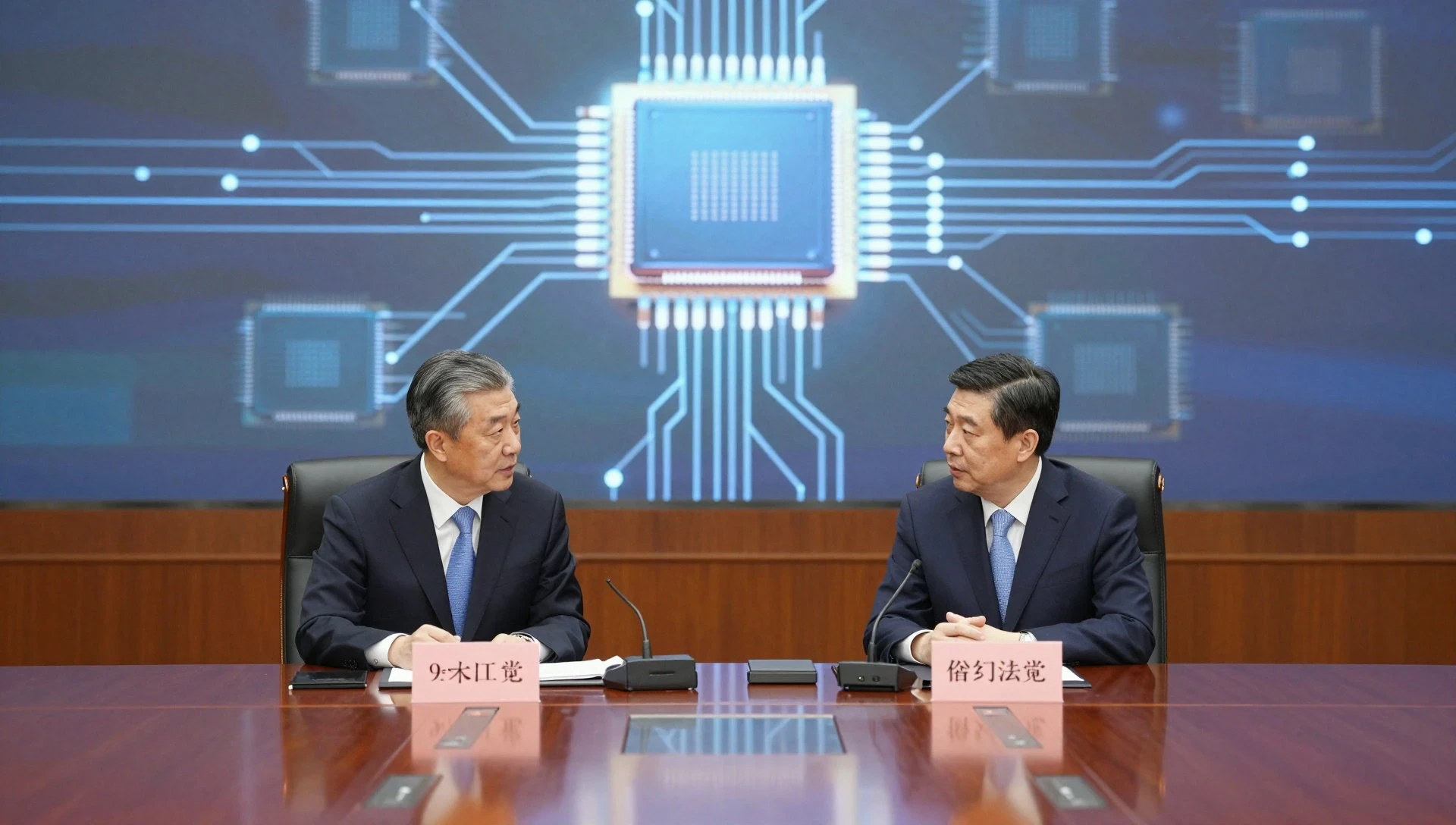
When Chinese Foreign Minister Wang Yi received South Korean Foreign Minister Cho Hyun in Beijing on November 13, 2026, the meeting carried a significance that extended well beyond the customary courtesies of bilateral diplomacy. Two neighbours whose economies are deeply interwoven were meeting at a moment when the architecture of global technology trade is being redrawn, and when the distance between security alliances and commercial necessity has become the defining tension of East Asian statecraft.
The talks were framed around stabilising trade ties, coordinating positions on Northeast Asian strategic friction, and preparing the ground for the approaching 35th anniversary of diplomatic relations, yet each of those headings conceals a more delicate calculation about how a middle power survives between competing great powers.
Seoul's position is instructive precisely because it is uncomfortable. South Korea has aligned itself closely with Western export controls on advanced semiconductors and the equipment used to manufacture them, a stance driven by its alliance with Washington and by the structure of its own industrial base. At the same time, China remains its largest trading partner and a critical market for the memory chips, display panels and petrochemicals that anchor Korean exports.
On This Page
- The Diplomatic Context Behind the Beijing Meeting
- Semiconductor Supply Chains as the Central Fault Line
- Northeast Asian Strategic Friction and the Security Dimension
- Economic Interdependence and the Trade Stabilisation Agenda
- The Hedging Template and Its Implications for Other U.S. Allies
- What the November Talks Reveal About the Future of Middle-Power Diplomacy
Managing that contradiction is not a matter of choosing sides but of sequencing concessions, calibrating public language, and preserving channels of communication even when the strategic weather turns foul. The Beijing meeting was an exercise in exactly that discipline.
What makes the November encounter worth close reading is the template it may establish. Other U.S. allies in Asia and Europe face a version of the same dilemma, and many are watching to see whether Seoul can maintain technology alignment with the West while sustaining pragmatic detente with Beijing. If the formula works, it becomes a reference point for capitals from The Hague to Canberra.
If it fails, it becomes a cautionary tale about the limits of hedging. The analysis that follows examines the meeting's substance, the economic and security pressures behind it, and the wider question of whether middle powers can still write their own scripts in an era of bloc politics.
TL;DR Chinese Foreign Minister Wang Yi met South Korean Foreign Minister Cho Hyun in Beijing on November 13, 2026, to stabilise trade ties, coordinate on Northeast Asian strategic friction, and prepare for the 35th anniversary of diplomatic relations, as Seoul balances Western semiconductor alignment with pragmatic detente toward Beijing.
The Diplomatic Context Behind the Beijing Meeting
The November 13 meeting did not emerge from a vacuum. It followed a period in which Seoul had tightened its participation in multilateral export-control arrangements covering advanced chipmaking tools, a decision that drew predictable irritation from Beijing. Diplomatic channels between the two foreign ministries had remained open but had grown thinner, and the approach of the 35th anniversary of normalisation in 2027 gave both sides a face-saving occasion to re-engage.
Anniversaries in East Asian diplomacy are rarely merely ceremonial; they function as deadlines that create political cover for recalibration, allowing governments to present pragmatic adjustments as gestures of friendship rather than concessions.
Wang Yi's decision to host Cho Hyun in the Chinese capital, rather than meeting on the margins of a multilateral summit, signalled a desire to treat the relationship as consequential in its own right. For Beijing, the meeting served several purposes at once: it demonstrated that China remains a diplomatic destination of choice for U.S. allies, it created an opportunity to press Seoul on technology controls, and it allowed Chinese officials to project an image of regional leadership at a time of friction with Washington and Tokyo. For Seoul, the visit offered a channel to raise concerns about economic coercion and to seek assurances on supply-chain continuity.
Reading the Signals in the Timing and Venue
Diplomatic analysts pay close attention to the choreography of such encounters because the details often reveal more than the communiqués. A ministerial visit to Beijing, conducted with full protocol and public warmth, suggests that both governments judged the relationship to be worth visible investment. The timing, roughly a year before the anniversary, leaves room for further ministerial exchanges, possible summit-level contact, and the incremental rebuilding of trust that precedes any substantive agreement.
It also places the meeting before the next cycle of export-control reviews in Washington, giving Seoul a diplomatic data point to cite when arguing that it retains independent channels in the region.
The venue choice carries its own message. By receiving Cho in Beijing rather than meeting at a neutral multilateral setting, Wang Yi underscored that China views South Korea as a bilateral partner deserving direct attention, not merely as a participant in a larger alliance system.
For domestic audiences in both countries, the imagery of cordial talks serves a legitimising function, reassuring business communities that political friction will not be allowed to overwhelm commercial ties. Such symbolism is not trivial; in relationships where trust has eroded, the visible restoration of normal diplomatic rhythm is itself a form of substance.
The Anniversary as a Diplomatic Anchor
The 35th anniversary of China–South Korea normalisation, which falls in 2027, provides a natural framework for the current phase of engagement. Anniversaries create what diplomats sometimes call a "constructive pretext" for resolving accumulated irritants, because both governments can present compromises as gifts to the occasion rather than capitulations to pressure.
Officials in Seoul and Beijing have reason to want a deliverable by then, whether a renewed cultural-exchange programme, a high-level economic dialogue, or a set of confidence-building measures on supply chains. The November meeting can be understood as the opening move in that longer sequence.
Historical memory also shapes how the anniversary is approached. Since normalisation in 1992, the relationship has weathered the THAAD missile-defence dispute, the 2016–17 economic retaliation that followed it, and repeated friction over cultural and historical claims. Each crisis left institutional scar tissue, but each was also followed by a pragmatic recovery, often brokered through business channels before politics caught up.
The anniversary offers an opportunity to consolidate those lessons into a more resilient framework, one that anticipates friction rather than being surprised by it. Whether that opportunity is taken depends on the willingness of both capitals to prioritise management over victory.
Semiconductor Supply Chains as the Central Fault Line
No issue dominated the agenda more than semiconductors, and for good reason. South Korea is home to two of the world's largest memory-chip manufacturers, whose products feed everything from data centres to smartphones, and whose fabrication depends on equipment and materials sourced across a tightly controlled global network.
When Washington tightened restrictions on advanced chipmaking tools and on exports to Chinese customers, Seoul found itself caught between an alliance commitment and an industrial reality. The Beijing talks provided a forum to discuss how those controls are implemented, how exceptions are granted, and whether supply chains can be kept functioning without triggering further escalation.
The economics are difficult to overstate. China accounts for a substantial share of Korean semiconductor exports, and Korean firms operate major fabrication and packaging facilities on Chinese soil. Any disruption to that footprint carries immediate balance-sheet consequences, but the deeper risk lies in the erosion of long-term market position if Korean suppliers are gradually displaced by domestic Chinese alternatives.
Beijing has invested heavily in building its own chip capacity, and every year of friction accelerates that substitution. Seoul's negotiators therefore carry two messages to Beijing: a reassurance that commercial ties remain valued, and a quiet warning that aggressive industrial policy will eventually make the relationship less complementary.
The Export-Control Squeeze and Its Commercial Cost
Export controls are, at their core, instruments of foreign policy that operate through commercial channels, and their costs are borne unevenly. Korean chipmakers must navigate licensing regimes that determine which customers they may serve, which equipment they may import, and which technologies they may transfer. Each restriction adds compliance overhead and introduces uncertainty into capital planning.
The November talks did not resolve these questions, but they opened a channel through which Seoul can communicate the commercial damage of specific measures and seek informal understandings about enforcement. In the absence of formal treaty change, such channels are often the only mechanism available.
Beijing's perspective is equally transactional. Chinese officials view technology controls as an attempt to lock in a structural advantage, and they have responded by accelerating domestic substitution and by signalling that foreign firms operating in China must align with local priorities. For Korean companies, this creates a pincer effect: tighter Western rules on one side, and rising Chinese expectations on the other.
The diplomatic task is to prevent either side from treating Korean industry as a lever to be pulled. That requires constant engagement, which is precisely what the ministerial meeting was designed to sustain.
Diversification and the Search for Resilience
Seoul has not stood still while the great powers manoeuvre. Korean firms have expanded fabrication capacity in the United States, Europe and Southeast Asia, and the government has promoted research into advanced packaging and next-generation memory as a way of staying ahead of commoditisation. Diversification is not a rejection of the Chinese market but an insurance policy against its disruption.
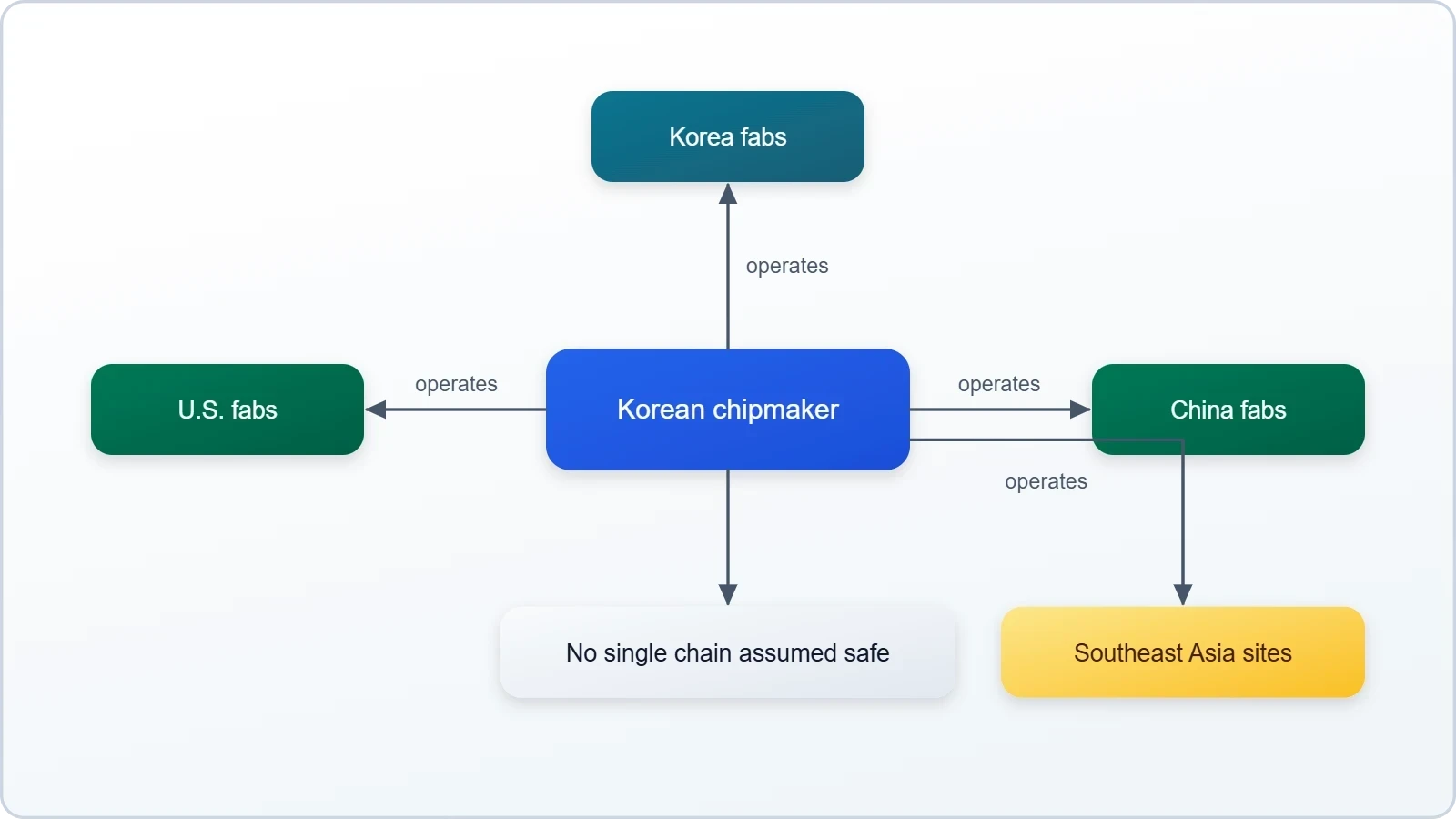
The strategy acknowledges a hard truth: in a world of competing technology blocs, no single supply chain can be assumed safe, and resilience must be built through redundancy rather than through the hope that politics will subside.
This diversification also gives Seoul diplomatic leverage. A Korea with credible alternative production sites is less vulnerable to coercion and more able to negotiate from a position of strength. It can assure Beijing that its commercial commitment endures while simultaneously reassuring Washington that its technology alignment is genuine. The balancing act is delicate, and it depends on maintaining the perception that Korea is a reliable partner to both sides. The Beijing meeting was, in part, an exercise in preserving that perception at a moment when the underlying realities are shifting.
Northeast Asian Strategic Friction and the Security Dimension
The Beijing talks were not confined to trade. Northeast Asia is a theatre of overlapping security dilemmas, from the Korean Peninsula's unresolved armistice to the Taiwan Strait's mounting tension and the deepening trilateral cooperation among Washington, Tokyo and Seoul. Wang Yi and Cho Hyun had reason to discuss how these flashpoints interact, because each has the potential to drag the bilateral relationship into crisis.
For Seoul, the priority is to prevent security developments from automatically triggering economic retaliation, a pattern that has scarred the relationship before. For Beijing, the priority is to discourage South Korea from deepening its participation in U.S.-led security frameworks.
The conversation likely touched on the trilateral security cooperation that has expanded in recent years, including intelligence-sharing arrangements and joint exercises. Seoul has been careful to frame such cooperation as defensive and alliance-bound rather than directed at China, but Beijing views the architecture with suspicion. The diplomatic challenge is to maintain the alliance relationship while reassuring China that it is not a precursor to containment.
That reassurance is difficult to sustain when the alliance itself is evolving, and it requires constant diplomatic maintenance of the kind the November meeting provided.
The Korean Peninsula and the Limits of Coordination
On the peninsula, both China and South Korea share an interest in stability, though they define it differently. Seoul seeks to deter provocation and to preserve the conditions for eventual dialogue, while Beijing prioritises the avoidance of regime collapse and the preservation of its strategic buffer. These interests overlap enough to permit coordination on crisis management but diverge on the ultimate political settlement.
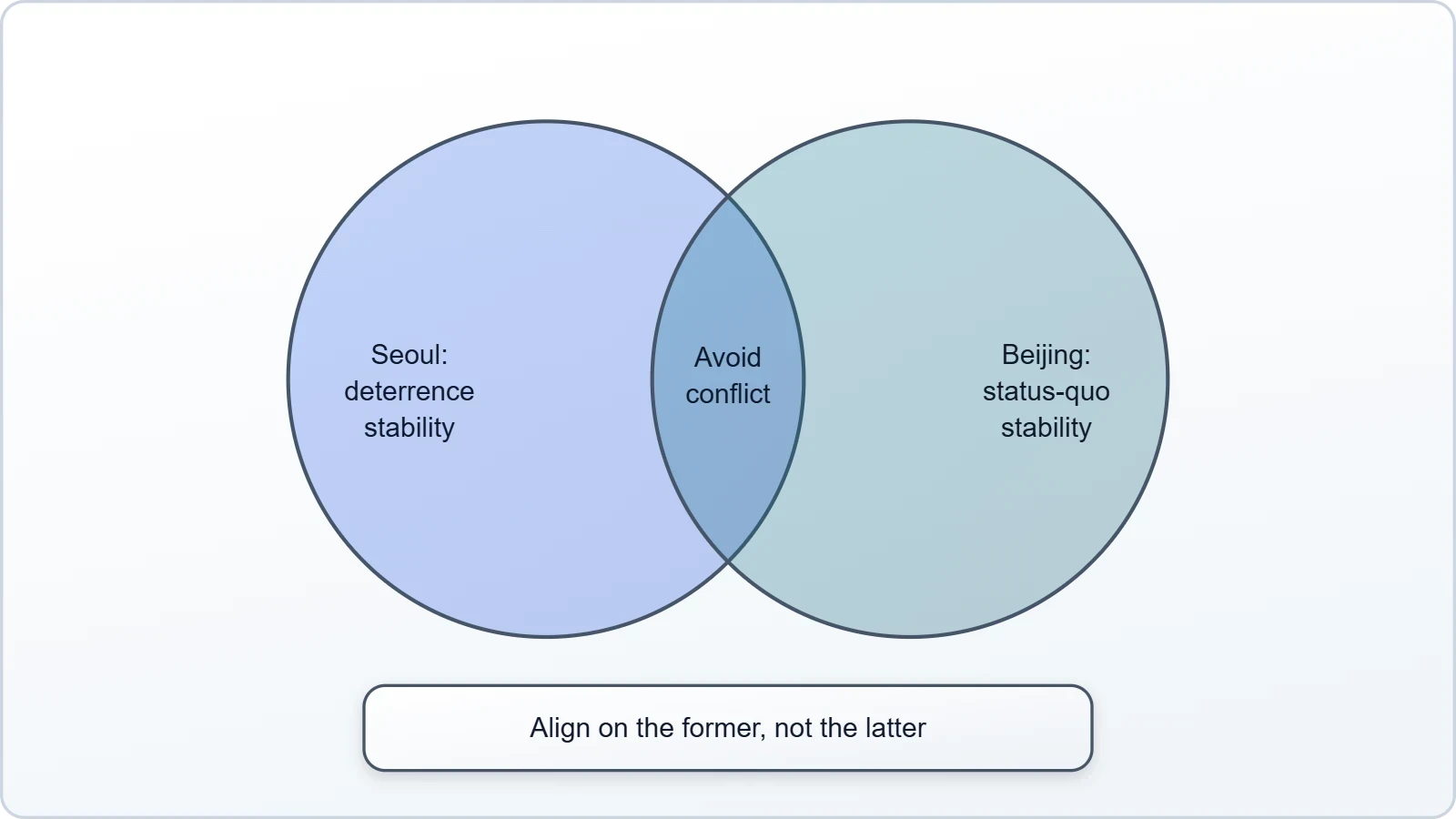
The ministerial talks offered an opportunity to align on the former without pretending to resolve the latter, a pragmatic approach that reflects the maturity of the relationship even amid friction.
Coordination on the peninsula also has a signalling function. When Beijing and Seoul communicate about security, they demonstrate to Washington and Pyongyang alike that the region's diplomacy is not purely transactional. Such communication can reduce the risk of miscalculation during a crisis, when misread intentions can escalate quickly. The value of these channels is difficult to quantify but easy to appreciate in retrospect, when their absence is blamed for avoidable escalation. Maintaining them is a quiet achievement of the kind that rarely makes headlines but shapes outcomes.
Taiwan, Alliances and the Boundaries of Hedging
The Taiwan question represents the outer limit of Seoul's hedging strategy. South Korea maintains a careful distance from the issue, adhering to a one-China position while avoiding statements that would draw it into the dispute. Beijing would prefer clearer alignment, while Washington would welcome more explicit support.
Seoul's approach is to say as little as possible while doing enough to satisfy both, a posture that is sustainable only as long as the issue remains below the threshold of active crisis. The November talks likely reinforced this understanding without resolving the underlying tension.
The broader lesson is that hedging has boundaries. A middle power can maintain relationships with competing powers, but it cannot do so indefinitely if the powers themselves escalate toward confrontation. Seoul's strategy works best in a world of managed competition and fails in a world of open conflict.
Recognising this, Korean diplomats have invested in crisis-communication mechanisms and in the kind of personal relationships that can be activated when formal channels seize up. The Beijing meeting was an investment in that infrastructure, made in the hope that it will never need to be used.
Economic Interdependence and the Trade Stabilisation Agenda
Trade stabilisation was the most concrete item on the agenda, and the one with the clearest deliverables. China and South Korea are bound by supply chains that neither can easily replace, from petrochemicals and steel to consumer electronics and cultural content. The meeting sought to keep those channels open, to reduce the risk of arbitrary regulatory action, and to restore some of the business confidence that has eroded during years of friction.
For Korean exporters, the priority is predictability; for Chinese importers, it is reliability. Both sides have an interest in preventing the relationship from becoming a casualty of wider geopolitical competition.
The economic relationship has also been reshaped by structural change. China has moved up the value chain, and its demand for Korean intermediate goods has evolved accordingly. Korean firms that once supplied components for Chinese assembly now compete with Chinese firms in third markets. This shift is not a crisis but a transition, and it requires both governments to manage the adjustment rather than pretend it is not happening.
The Beijing talks provided a venue to discuss how to keep the relationship complementary even as the underlying economics change, a task that will occupy diplomats for years.
Beyond Chips: Services, Culture and Consumer Goods
The trade agenda extends well beyond semiconductors. Korean cultural exports, from music to television drama, have a large and lucrative following in China, and their flow has been constrained by political friction. Consumer brands, cosmetics and food products similarly depend on Chinese demand. The November meeting offered an opportunity to discuss the gradual restoration of these flows, which are less sensitive than technology but no less important to the broader relationship.
Cultural exchange is often the first casualty of political tension and the first beneficiary of detente, making it a useful barometer of the relationship's temperature.
Services trade, including tourism and education, has also been affected by the diplomatic climate. Chinese visitor numbers to Korea remain below their historical peaks, and Korean students and businesses in China face a more complex operating environment. Restoring these flows requires not only government agreement but also the rebuilding of public confidence, which is slower and harder to engineer.
The ministerial talks can open doors, but it is the private sector and civil society that must walk through them. Diplomats understand this, which is why they often speak of "people-to-people" ties as the foundation of stable relations.
Investment Flows and the Business Community's Calculus
Korean businesses operating in China have learned to read the diplomatic weather closely, because it determines everything from regulatory approvals to tax treatment. The November meeting was watched with particular attention by corporate strategists, who see ministerial engagement as a signal that the operating environment may stabilise. Investment decisions are made over multi-year horizons, and the confidence that comes from predictable diplomacy is a genuine economic asset.
A single meeting cannot restore that confidence, but a sustained pattern of engagement can, and the business community is looking for evidence that the pattern will hold.
Chinese investment in Korea, though smaller, follows a similar logic. Chinese firms have invested in Korean technology, real estate and consumer sectors, and they too are sensitive to political risk. The mutual interest in protecting these flows creates a constituency for stability that operates below the level of high politics.
Diplomats often rely on such constituencies to sustain relationships through difficult periods, and the November talks can be understood as an effort to mobilise them. When governments cannot agree, businesses can sometimes keep the channels warm, and that warmth can be reactivated when politics allows.
- 01
- 02
- 03
- 04
We Also Published
The Hedging Template and Its Implications for Other U.S. Allies
Seoul's approach has attracted attention far beyond Northeast Asia because it offers a possible model for other middle powers facing the same structural dilemma. Countries such as the Netherlands, Japan and Australia have all confronted the tension between technology alignment with Washington and commercial dependence on Beijing, and each has managed it differently.
The Korean formula, which combines firm participation in export-control regimes with active diplomatic engagement and supply-chain diversification, is neither pure alignment nor pure neutrality. It is a calibrated posture that seeks to preserve both relationships by preventing either from becoming exclusive.
The template's appeal lies in its realism. It does not pretend that the tension can be resolved, only that it can be managed. It accepts that some friction is unavoidable and focuses on limiting its scope. It invests in communication channels that can be activated during crises. And it builds redundancy into supply chains so that no single disruption becomes existential.
These are unglamorous measures, but they are the substance of statecraft in an era when grand strategies are constrained by interdependence. Other capitals are studying them closely, not because they are novel, but because they are practical.
Lessons for Europe and the Indo-Pacific
European allies face a version of the same problem, particularly in the technology sector. The Netherlands, home to the world's leading lithography manufacturer, has had to balance export-control participation with the commercial interests of its flagship firm. Germany's automotive and chemical industries depend heavily on Chinese demand.
The Korean experience suggests that the key variable is not the depth of alignment but the quality of communication: allies that maintain active diplomatic channels with Beijing are better able to manage the fallout from restrictive measures than those that do not. This is a lesson that resonates in capitals from The Hague to Berlin.
In the Indo-Pacific, the stakes are even higher. Countries such as Australia, Japan and the Southeast Asian states are navigating the same currents, and each has developed its own variant of hedging. The Korean model is distinctive in its combination of alliance depth and diplomatic breadth, and it may be most relevant to states that share both characteristics.
For smaller states without the same economic weight, the lesson is more modest: maintain channels, diversify where possible, and avoid making irreversible commitments that foreclose future options. These are principles that apply across the region, regardless of size.
Risks and Limits of the Strategy
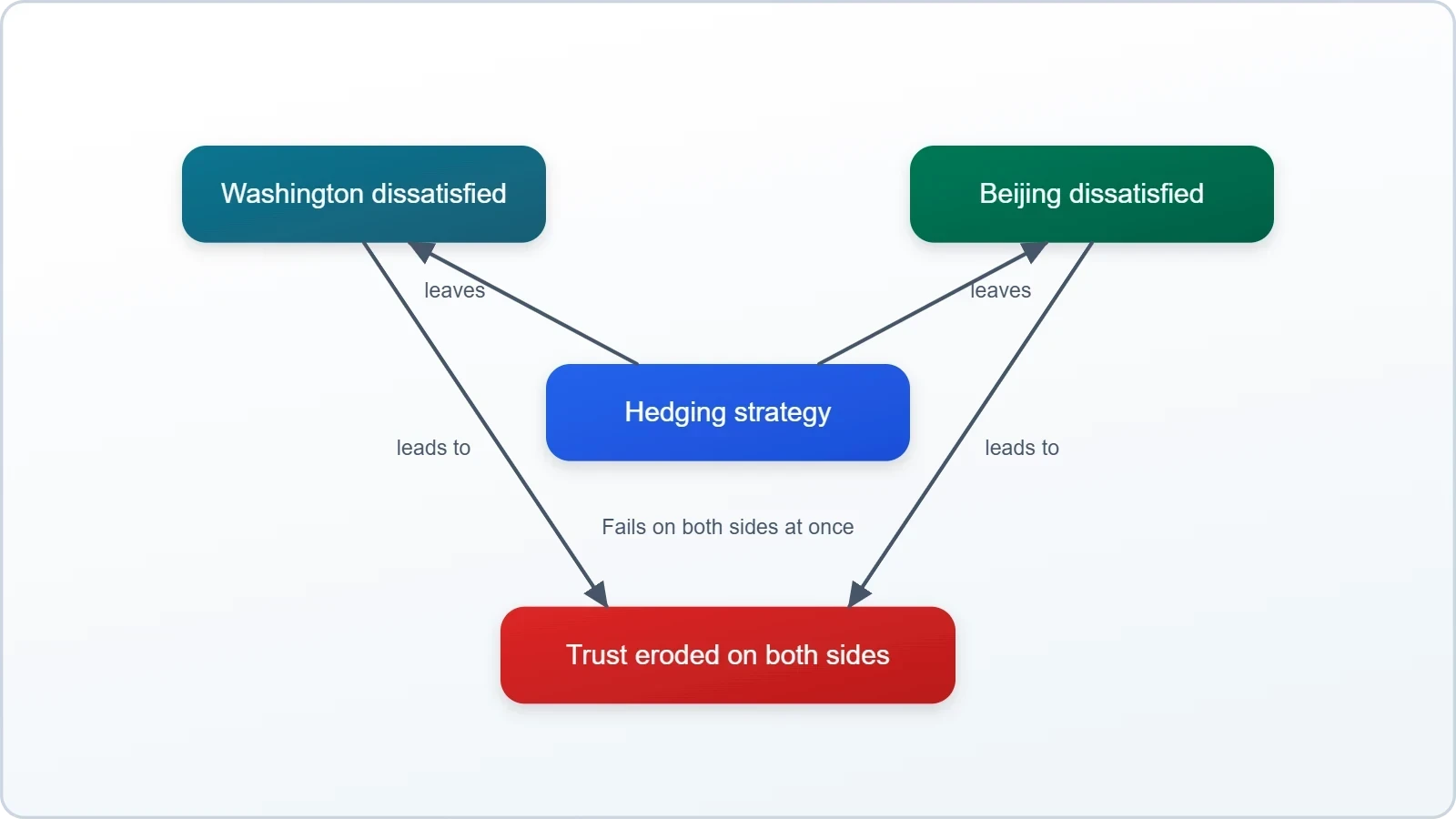
Hedging is not without risks. The most obvious is that it can fail on both sides simultaneously, satisfying neither Washington nor Beijing. If Seoul is seen as insufficiently committed to export controls, it may face pressure from its ally; if it is seen as too closely aligned, it may face retaliation from its neighbour. The strategy requires constant calibration and a tolerance for ambiguity that democratic politics does not always supply. Domestic audiences may demand clarity, and leaders may be tempted to deliver it, undermining the very flexibility that makes hedging work.
A second risk is that the strategy depends on conditions that may not hold. It assumes that the great powers will continue to manage their competition rather than escalate toward confrontation, and that both will value the relationship with Seoul enough to avoid forcing a choice. If either assumption fails, the hedging strategy becomes untenable.
Korean diplomats are aware of this and have invested in contingency planning, but no amount of planning can fully insulate a middle power from a world in which the great powers stop managing their rivalry. The November meeting was, in this sense, an act of faith as much as strategy.
What the November Talks Reveal About the Future of Middle-Power Diplomacy
The Beijing meeting is best understood as a data point in a longer trend rather than a turning point in itself. It confirms that middle powers are not passive objects of great-power competition but active agents seeking to preserve room for manoeuvre. It shows that diplomatic engagement remains possible even when strategic positions diverge, and that communication channels can be maintained through periods of friction.
And it illustrates the limits of those channels, which can manage tension but cannot resolve the underlying contradictions. The talks were a success in the modest sense that they kept the relationship on track, which in the current environment is no small achievement.
The wider significance lies in what it suggests about the future of the international order. If middle powers can sustain hedging strategies, the world may avoid the clean division into blocs that many analysts fear. If they cannot, the drift toward bloc politics will accelerate. Seoul's experiment is therefore being watched not only for its own sake but as a test of whether the post-Cold War space for non-aligned manoeuvre can survive.
The answer will not be determined by a single meeting, but by the cumulative pattern of engagement over the coming years, of which the November talks are one element.
Scenarios for the Road to 2027
Looking ahead to the anniversary, several scenarios are plausible. In the most optimistic, the two governments build on the November meeting to restore cultural exchanges, resume high-level economic dialogue, and establish a framework for managing technology disputes. In a middle scenario, engagement continues but delivers little beyond symbolism, with underlying tensions unresolved.
In the least optimistic, a new crisis, whether on the peninsula, in the Taiwan Strait, or in the technology sector, derails the process and returns the relationship to a colder footing. The probability of each depends on factors beyond Seoul's control, which is precisely why hedging is necessary.
The scenarios are not mutually exclusive, and elements of each may coexist. Engagement can continue even as tensions persist, and symbolism can have real value in preventing deterioration. The key variable is likely to be the trajectory of U.S.–China relations, which sets the parameters within which Seoul operates. If Washington and Beijing stabilise their own relationship, the space for Korean hedging expands; if they escalate, it contracts.
Seoul's diplomacy is therefore partly an exercise in reading the great-power weather and adjusting accordingly, a skill that Korean diplomats have honed over decades of navigating between larger neighbours.
The Enduring Logic of Pragmatic Detente
Beneath the specific issues lies a simple logic that has guided Korean foreign policy for decades: geography is permanent, and neighbours must be lived with. South Korea cannot relocate away from China, nor can it sever its alliance with the United States. Its prosperity depends on both, and its security depends on one.
The pragmatic response is to maintain the alliance while managing the neighbourhood, accepting that neither relationship will ever be entirely comfortable. This logic is not glamorous, but it is durable, and it explains why Seoul keeps returning to the negotiating table even when the atmosphere is unfavourable.
The November talks were an expression of that logic. They did not resolve the semiconductor dispute, settle the security dilemmas, or produce a grand bargain. They did something more modest and more important: they kept the channels open, reaffirmed the value of the relationship, and laid groundwork for future engagement. In a world of escalating competition, such modest achievements may be the most that diplomacy can deliver.
The measure of their success will be seen in whether the relationship holds when the next crisis arrives, and whether the hedging strategy proves resilient enough to survive it.
Disclaimer: This article is an analytical commentary on publicly reported diplomatic developments and does not constitute investment, legal or policy advice. Readers should consult primary sources and qualified professionals before acting on any information discussed here.
Disclaimer: This article is for general information and education only. It describes what historical prices and technical indicators showed on the date mentioned and does not predict future movements. It is not investment advice, a recommendation, or an offer to buy or sell any security. Indicators are calculated from past data and can mislead, and all investments carry risk. Please consult a SEBI-registered investment adviser before making any financial decision.
From our network :
- The Final Descent: How ESA Retired the Legendary Cluster Constellation After 24 Years of Space Weather ScienceAfter 24 years mapping Earth’s magnetosphere, ESA’s Cluster mission concluded with a precisely controlled reentry over the South Pacific. This analysis explores the scientific legacy, engineering decisions, and debris mitigation principles behind one of space exploration’s most responsible retirements.
- University Language Proficiency Exams: Why Institutional Tests Demand Different Preparation Than IELTS and TOEFLDiscover why university-specific language proficiency examinations differ fundamentally from IELTS and TOEFL, and learn strategic preparation approaches for institutional assessment success.
- Live Online English Classes for Kids: Do They Actually Reduce Anxiety?A ten-week study reveals that synchronous online English classes can significantly reduce child language anxiety while improving listening and reading skills. Discover what makes these programs effective and how parents can select the right one.
- How AI Agents Will Change the Way We Manage Personal FinancesExplore how AI agents are transforming personal finance through automated budgeting, bill payment, and investment management, while examining the critical security protocols and governance frameworks required for safe deployment.
- Committed Mediterranean Precipitation Decline: Why Emissions Cuts Alone Cannot Restore Winter RainsNew NOAA research reveals that Mediterranean winter rains may decline irreversibly even with emissions cuts. Explore the science of committed climate change and regional impacts.
- Forbidden Matrix Patterns and Visible Lattice Points: A Geometric DictionaryExplore how multidimensional 0–1 matrices encode geometric truths, linking forbidden patterns to visible lattice points and hypergraph theory, with applications in combinatorics and computational geometry.
- CISA’s Ten-Advisory Wave: Why Generic Patching Fails in OT and How to Build Product-Specific PlaybooksCISA released ten ICS advisories in one week, exposing critical infrastructure risks. Generic patching fails in OT. Learn to build product-specific remediation playbooks.
- The Hidden Cost of AI Convenience: Why Over-Permissioned Agents Are a Security Time BombDiscover why AI agents with excessive permissions create dangerous single points of failure, and learn how implementing least privilege principles can protect your organization from exploitation.
- Mobile Learning and VR in English: What Global Evidence Reveals About Effective Language TechnologyA systematic review across 14 countries reveals which language-learning technologies genuinely work. Mobile learning, AI, and VR show measurable benefits when pedagogically integrated. This evidence-based guide helps educators and learners select technology that delivers real return on investment.
RESOURCES
- Minister of Foreign Affairs Cho Hyun held his first telephone ...facebook.comAug 7, 2025 ... Chinese, South Korean FMs hold phone talks on promoting bilateral cooperation Chinese Foreign Minister Wang Yi on Thursday spoke by…
- What Happened: Q4 2023 - Korea Economic Institute of Americakeia.orgJan 24, 2024 ... ... and academic discussed cooperation on semiconductors, green energy, and supply chains. ... and Wang Yi occur in Busan, Korea.…
- South Korea should not fear China's rise, foreign minister saysfacebook.com11 hours ago ... Chinese Foreign Minister Wang Yi urged South Korea ... and a key node in advanced supply chains, including semiconductors and…
- [Chinese Foreign Minister Wang Yi Visits South Korea] Wang Yi ...globalkoreapost.co.krAug 19, 2026 ... Speaking to reporters after talks with South Korean Foreign Minister Cho Hyun in Seoul on Wednesday, Wang said that a…
- Wang Yi, the head of the Chinese Communist Party's Central ...mk.co.kr14 hours ago ... to convey concerns about the 'second Yalta talks' in South Korea , ... On the 14th, Foreign Minister Cho Hyun…
- Alliance First and Mutual Respect: Yoon's Foreign Policy Approach ...theasanforum.orgDec 26, 2022 ... In August, the foreign ministers of South Korea and China met, only to have Wang Yi warn Park Jin of…
- CiCM 13th November 2026orcasia.org9 hours ago ... NEWS IN CHINA. Wang Yi Meets with South Korean Counterpart in Beijing: Foreign Minister Wang Yi held talks with the…
- Manufacturing strength requires more than industrial policykoreajoongangdaily.comOct 23, 2026 ... industrial policy manufacturing cho yoon-je opinion semiconductors china south korea columns ... Foreign Minister Cho Hyun will meet Wang Yi ...
- Keynote Address by H.E. Cho Hyun Minister of Foreign Affairs of the ...mofa.go.krOct 27, 2026 ... economic factors like semiconductors and global supply chains, are ... Most recently, when I received my Chinese counterpart,. Wang Yi,…
- Full article: Semiconductor supply chain resilience and disruptiontandfonline.comFirst, our review focuses on security issues caused by geopolitics, industrial shifts, and the US–China trade war. By examining the relevant literature, this ...
- South Korea: Latest News and Updatesscmp.comChinese Foreign Minister Wang Yi with South Korean counterpart Cho Hyun in Beijing on November 13. China-South Korea relations · China, South Korea vow…
- How South Korea can balance its US commitments with global ...chathamhouse.orgDec 4, 2025 ... ... of South Korean foreign minister, Cho Hyun, to China on 17 September, to meet his Chinese counterpart, Wang Yi.57…
- Seoul Says U.S.-North Korea Summit Still Possible at APECen.sedaily.com14 hours ago ... ... Chinese Foreign Minister Wang Yi before their talks in Beijing on Jan. ... China supply chain tensions, including semiconductor…
- Trump-Kim Summit Talks Revisited Amid Asia Tourchosun.com2 days ago ... ◇Foreign Minister's Visit to China, Likely to Coordinate South Korea-China Summit ... Chinese Foreign Minister Wang Yi. This visit is ...
- California governor Newsom meets China's President Xi | Reutersreuters.comOct 25, 2023 ... ... talks with Foreign Minister Wang ... South Korea should neither fear China's rise nor underestimate its capabilities, Foreign Minister…
- 01
- 02
- 03
- 04
- 05
- 06
- 07
- 08
0 Comments