Death is the one event that visits every household with absolute certainty, yet the paperwork that follows it is distributed with striking inequality across India. A report by Margubur Rahaman in Frontline examines how caste, gender, geography, and age quietly determine whether a death is officially recorded, and the findings are uncomfortable for a state that prides itself on digital governance. The article argues that these intersecting factors shape not merely statistics but the lived aftermath of loss, deciding which families can claim inheritance, pensions, and insurance, and which are left without legal proof that a person ever existed.
What makes the analysis compelling is its insistence that registration is not a neutral administrative act. A death certificate is a gateway document: it unlocks succession rights, widow pensions, life insurance settlements, and the correction of land records. When a family cannot produce one, the burden cascades across generations, trapping survivors in disputes they cannot legally resolve. The Frontline piece, part of the magazine's science and technology coverage, situates this bureaucratic gap within a wider public health architecture that is only as reliable as the data feeding into it.
This analysis unpacks the report's central claims, extends them with contemporary registration data and institutional context, and examines why the uneven recording of mortality remains one of India's most consequential blind spots. It considers the machinery of the Civil Registration System, the social gradients that distort it, and the practical reforms that could narrow the gap between who dies and who is counted.
On This Page
TL;DR India's Civil Registration System records deaths unevenly, and the Frontline report by Margubur Rahaman shows that caste, gender, geography, and age all influence whose passing is officially documented. Unregistered deaths deprive families of inheritance, pensions, and insurance claims, while simultaneously corrupting the mortality data on which public health planning depends. The gap is largest among marginalised castes, women, remote rural populations, and the very young and very old. Closing it requires decentralised registration, stronger local incentives, and a shift from treating certificates as paperwork to recognising them as instruments of social justice.
The Architecture of Death Registration in India
India's Civil Registration System, governed by the Registration of Births and Deaths Act of 1969, places the legal duty of reporting a death on the family, with the registrar of the local municipal or panchayat jurisdiction responsible for issuing the certificate. In principle the chain is simple: a medical certificate of cause of death, a report to the registrar within twenty-one days, and a formal extract that becomes the legal record. In practice, the chain breaks at multiple points, and the Frontline report identifies precisely where those fractures concentrate.
How the Civil Registration System Functions
The system operates through state-appointed registrars, typically at the level of municipalities, notified areas, and rural panchayats. Urban local bodies generally maintain functional offices with digital portals, while rural registrars often double as revenue officials with competing responsibilities. The Registrar General of India compiles annual reports drawing on these local submissions, and the resulting statistics feed into sample registration surveys, health ministry planning, and international reporting obligations. The architecture is decentralised by design, which makes it responsive in well-resourced districts and fragile in those with thin administrative capacity.
Digitisation through the Civil Registration System portal has improved urban compliance and enabled online certificate issuance in many states, but connectivity and literacy remain barriers in remote blocks. Where a family cannot navigate a portal or reach a registrar's office, the death simply disappears from the ledger. The Frontline analysis stresses that this is not a failure of individual diligence but a structural feature of a system that assumes a literate, mobile, and legally informed citizenry.
The Legal Weight of a Death Certificate
A death certificate is far more than an administrative formality. It is the evidentiary foundation for succession, the trigger for survivor pensions under schemes such as the National Social Assistance Programme, and a mandatory document for insurance claims and bank account settlements. Without it, widows can be denied monthly assistance, heirs can be locked out of ancestral property, and families can be pushed into protracted civil litigation simply to prove that a relative has died.
The report's emphasis on inheritance is particularly pointed. In rural India, where land records are often outdated and succession is informal, the absence of a death certificate can freeze a family's principal asset for years. Women, who already face customary exclusion from inheritance, are doubly disadvantaged when the documentary trail is missing. The certificate thus functions as a gatekeeping instrument, and its uneven distribution reproduces the very inequalities the state claims to redress.
Caste, Gender, and the Social Gradient of Recorded Mortality
The Frontline report's most significant contribution is its insistence that registration gaps follow social hierarchies rather than random administrative failure. Caste operates as a powerful predictor: households from Scheduled Castes and Scheduled Tribes, particularly in rural areas, register deaths at markedly lower rates than upper-caste households in comparable locations. The reasons are layered, combining distance from administrative offices, lower literacy, weaker engagement with formal institutions, and a historical mistrust of state record-keeping that dates back to colonial enumeration practices.
Why Marginalised Communities Register Fewer Deaths
For many Dalit and Adivasi families, the registrar's office is not a neutral service point but an institution associated with land disputes, caste violence complaints, and bureaucratic indifference. When a family has experienced hostility in official spaces, the incentive to voluntarily approach them after a bereavement is diminished. Add to this the practical costs of travel, lost wages, and documentation fees, and non-registration becomes a rational response to an unwelcoming system rather than simple negligence.
Geographic remoteness compounds the caste penalty. In forested and hill districts, the nearest registrar may be several hours away, and the medical certification required for cause-of-death reporting may be entirely unavailable. The report notes that these are often the same districts where health infrastructure is weakest, meaning that the deaths least likely to be recorded are also the deaths least likely to have been medically attended. The data gap and the health gap reinforce each other in a closed loop.
The Gendered Silence Around Women's Deaths
Gender introduces a distinct distortion. Women's deaths are less likely to be registered than men's, particularly in older age cohorts and in states with pronounced patriarchal norms. The report links this to the weaker legal and economic visibility of women: where a woman holds no property, earns no formal income, and is not a named beneficiary of state schemes, the urgency of documenting her death diminishes for a household already stretched by loss and expense.
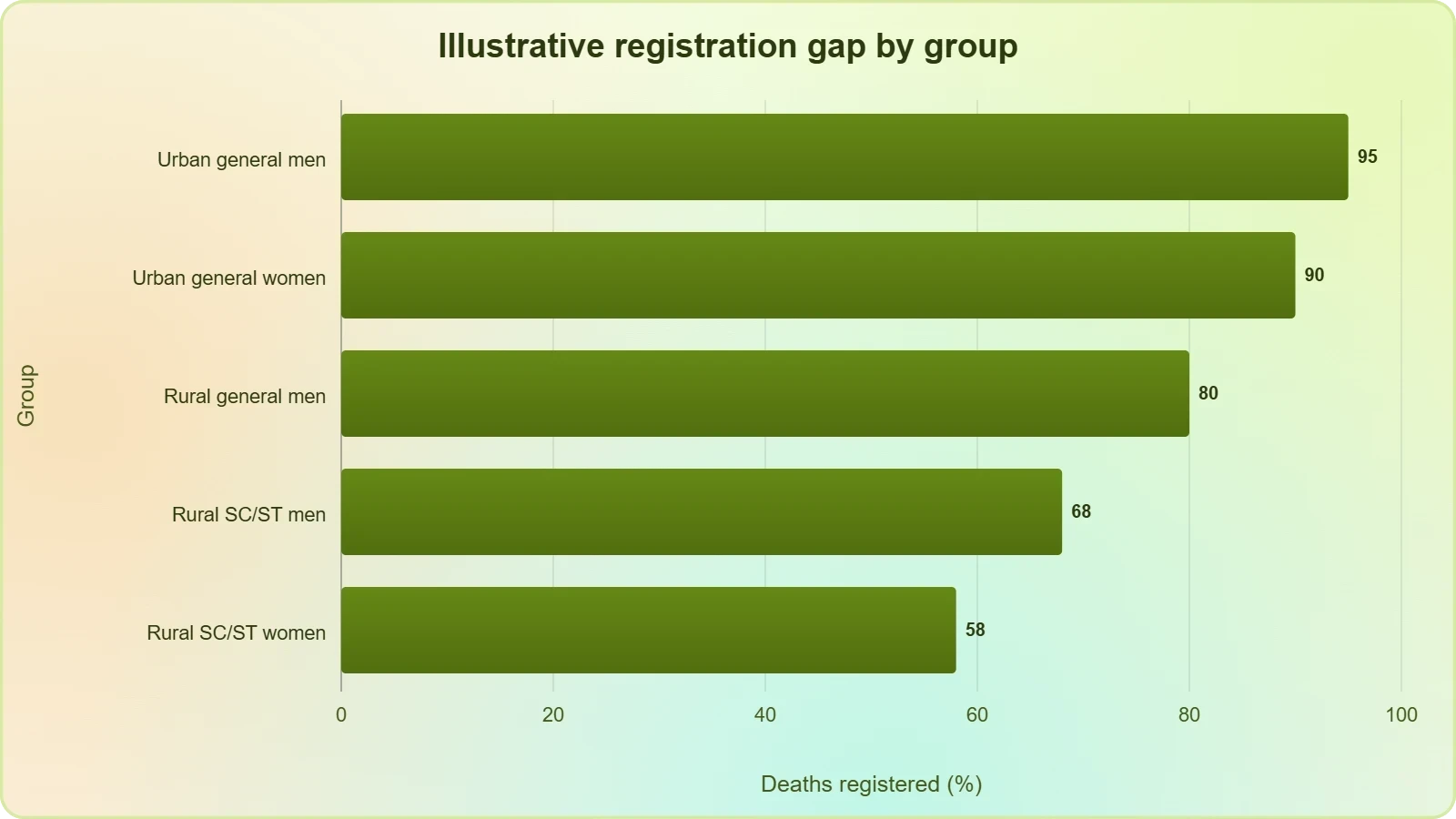
Maternal mortality presents a paradox. Deaths during or after childbirth are more likely to be captured because they occur in health facilities and trigger institutional reporting, yet deaths of women from chronic illness, neglect, or violence in the home often vanish from the record. The result is a statistical portrait that overrepresents women who die in the presence of the state and underrepresents those who die beyond its gaze, distorting both health planning and the measurement of gender-based disadvantage.
We Also Published
Geography and Age as Compounding Disadvantages
Where a person dies matters as much as who they were in life. The Frontline report documents a persistent urban-rural divide in registration completeness, with metropolitan municipalities approaching near-universal recording while remote rural blocks lag far behind. This is not merely a question of distance, though distance is real; it is also a question of institutional density, since urban areas concentrate hospitals, registrars, and digital infrastructure within a few kilometres while rural families may navigate all three across a full day of travel.
The Rural Registration Deficit
Rural registration is further complicated by the dual role of panchayat officials, who are expected to maintain birth and death registers alongside revenue, welfare, and electoral duties. When a single official is responsible for dozens of functions, death registration becomes a low-priority clerical task, particularly when no penalty attaches to under-reporting. The report suggests that this incentive structure, rather than any shortage of legal authority, explains much of the rural deficit.
Seasonal migration adds another layer. Families whose members die while working in distant cities may face jurisdictional confusion, with neither the origin nor the destination registrar accepting clear responsibility. The result is a category of deaths that are legally invisible, occurring in the interstices of a system designed for settled populations. As internal migration intensifies, this gap is likely to widen unless registration rules are explicitly adapted to mobile livelihoods.
Age and the Erasure of the Very Young and Very Old
Age produces its own distortions. Infant deaths, particularly neonatal deaths occurring within hours or days of birth, are frequently unregistered, especially when the birth itself was never recorded. The report notes that the registration of births and deaths is administratively linked, so a child who enters the world without documentation is likely to leave it the same way. This creates a statistical invisibility that masks the true scale of infant mortality in the poorest districts.
At the other end of life, deaths of the elderly in multigenerational households are sometimes treated as natural and unremarkable, with families forgoing registration because no immediate pension or insurance claim appears to require it. Yet these are precisely the deaths that matter for actuarial planning, geriatric health policy, and the accurate measurement of life expectancy. The report's attention to age is a reminder that registration gaps are not uniform across the lifespan but cluster at its margins.
- 01
- 02
- 03
- 04
Consequences for Inheritance, Pensions, and Public Health
The Frontline report is careful to trace the downstream effects of unregistered deaths, and these effects are both private and collective. For the family, the absence of a certificate is a legal disability that can persist for years, blocking succession, delaying insurance payouts, and complicating the transfer of pensions and bank deposits. For the state, the absence of records is an information failure that distorts everything from disease surveillance to the allocation of health budgets across districts.
The Private Cost of Missing Documentation
Consider a widow in a rural district whose husband dies without a certificate. To claim a survivor pension she must prove the death, which requires a certificate she does not have, which requires a report she never filed, which may now attract a late fee she cannot afford. The circularity is Kafkaesque, and it is resolved only through informal channels, local influence, or the intervention of a sympathetic official. Families without such connections simply forgo the entitlement.
Inheritance disputes follow a similar pattern. Where land records remain in the name of a deceased patriarch, heirs cannot partition property, obtain credit against it, or defend it against encroachment. Women are disproportionately affected because their claims are already contested by custom. The report's framing is apt: the death certificate is not a bureaucratic nicety but a precondition for economic citizenship, and its absence is a form of quiet dispossession.
The Collective Cost of Distorted Mortality Data
Public health planning depends on knowing who dies, where, and from what. When a substantial share of deaths goes unrecorded, the resulting statistics systematically understate mortality in the poorest districts and among the most marginalised groups. Resource allocation follows the data, which means that the areas with the greatest need may receive the smallest share of attention because their suffering is statistically invisible.
The distortion extends to cause-of-death reporting, which is weak even where deaths are registered. Medical certification requires a physician, and many rural deaths occur without medical attendance, leaving the cause blank or attributed vaguely to old age. Epidemiologists have long warned that this produces unreliable estimates for non-communicable diseases, maternal mortality, and injury deaths. The Frontline report's contribution is to connect this technical weakness to the social inequalities that determine whose death is documented at all.
Reforming a System That Counts Unevenly
If the diagnosis is structural, the remedies must be structural as well. The Frontline report implies, without prescribing in detail, that incremental fixes such as awareness campaigns will not suffice while the underlying incentives and access barriers remain unchanged. Reform must address the registrar's workload, the family's cost of compliance, and the legal consequences of non-registration simultaneously, because each reinforces the others in a self-sustaining pattern of exclusion.
Decentralisation and Local Accountability
One promising direction is to strengthen local registration capacity by separating it from unrelated revenue and welfare duties, giving panchayat registrars dedicated staff and clear performance targets. Where registrars are evaluated on registration completeness, and where under-reporting carries consequences, the clerical neglect that drives rural deficits becomes harder to sustain. Digital tools can support this by allowing offline data capture that syncs when connectivity permits, rather than requiring real-time portal access that many rural offices cannot guarantee.
Community intermediaries offer another lever. Accredited social health activists and village health workers already visit households during illness and after death, and they could be authorised to facilitate registration, bridging the gap between the family and the registrar. The report's emphasis on trust is relevant here: a familiar local health worker is more likely to be approached than an unfamiliar official, and the resulting record is more likely to be accurate.
Linking Registration to Entitlements
The most powerful incentive, however, may be to make registration visibly valuable. Where families understand that a death certificate is the key to a pension, an insurance settlement, or a land transfer, the demand for registration rises. States that have linked registration to welfare delivery report higher compliance, suggesting that the problem is partly one of information and partly one of perceived benefit. Publicising these linkages, and simplifying the process of claiming them, could shift behaviour without heavy enforcement.
There is also a case for retrospective regularisation. Millions of deaths from past decades remain unrecorded, and their families continue to face legal obstacles. Amnesties that allow late registration without penalty, combined with mobile registration camps in underserved districts, could clear the backlog while building habits of compliance. The report's underlying message is that a state serious about social justice must treat the death certificate as a right rather than a privilege.
Why the Unequal Burden Matters Beyond the Ledger
The deeper significance of the Frontline report lies in what it reveals about the relationship between the Indian state and its poorest citizens. A death certificate is a small document, but it is also a recognition that a life mattered enough to be recorded. When that recognition is withheld systematically from Dalits, Adivasis, women, and remote rural populations, the state is not merely failing at administration; it is reproducing a hierarchy of whose existence is legible and whose is not.
This has implications that reach beyond the families immediately affected. Mortality data underpins the calculation of life expectancy, the design of health insurance schemes, the allocation of district health budgets, and the evaluation of maternal and child health programmes. A system that undercounts deaths among the marginalised will systematically misdirect resources away from them, entrenching the very disparities that produced the undercount in the first place.
The report also invites reflection on the meaning of evidence in public policy. India has invested heavily in digital infrastructure and data-driven governance, yet the foundational dataset of who dies remains incomplete and skewed. Closing this gap is not a technical exercise alone; it requires political will to treat registration as a matter of equity rather than convenience. Until then, the unequal burden of unregistered deaths will remain a quiet but persistent feature of Indian public life.
From our network :
- Live Online English Classes for Kids: Do They Actually Reduce Anxiety?A ten-week study reveals that synchronous online English classes can significantly reduce child language anxiety while improving listening and reading skills. Discover what makes these programs effective and how parents can select the right one.
- Committed Mediterranean Precipitation Decline: Why Emissions Cuts Alone Cannot Restore Winter RainsNew NOAA research reveals that Mediterranean winter rains may decline irreversibly even with emissions cuts. Explore the science of committed climate change and regional impacts.
- The Final Descent: How ESA Retired the Legendary Cluster Constellation After 24 Years of Space Weather ScienceAfter 24 years mapping Earth’s magnetosphere, ESA’s Cluster mission concluded with a precisely controlled reentry over the South Pacific. This analysis explores the scientific legacy, engineering decisions, and debris mitigation principles behind one of space exploration’s most responsible retirements.
- Mobile Learning and VR in English: What Global Evidence Reveals About Effective Language TechnologyA systematic review across 14 countries reveals which language-learning technologies genuinely work. Mobile learning, AI, and VR show measurable benefits when pedagogically integrated. This evidence-based guide helps educators and learners select technology that delivers real return on investment.
- The Hidden Cost of AI Convenience: Why Over-Permissioned Agents Are a Security Time BombDiscover why AI agents with excessive permissions create dangerous single points of failure, and learn how implementing least privilege principles can protect your organization from exploitation.
- CISA’s Ten-Advisory Wave: Why Generic Patching Fails in OT and How to Build Product-Specific PlaybooksCISA released ten ICS advisories in one week, exposing critical infrastructure risks. Generic patching fails in OT. Learn to build product-specific remediation playbooks.
- Forbidden Matrix Patterns and Visible Lattice Points: A Geometric DictionaryExplore how multidimensional 0–1 matrices encode geometric truths, linking forbidden patterns to visible lattice points and hypergraph theory, with applications in combinatorics and computational geometry.
- How AI Agents Will Change the Way We Manage Personal FinancesExplore how AI agents are transforming personal finance through automated budgeting, bill payment, and investment management, while examining the critical security protocols and governance frameworks required for safe deployment.
- University Language Proficiency Exams: Why Institutional Tests Demand Different Preparation Than IELTS and TOEFLDiscover why university-specific language proficiency examinations differ fundamentally from IELTS and TOEFL, and learn strategic preparation approaches for institutional assessment success.
RESOURCES
- India's Missing Deaths: Gender, Class and Inequality - Frontlinefrontline.thehindu.com24 hours ago ... ... India; PUBLIC HEALTH. DIGITAL EXCLUSIVE. India's unequal burden of unregistered deaths. Caste, gender, geography and age influence whose death ...
- Post - Xx.com23 hours ago ... NEW | India's unequal burden of unregistered deaths Caste, gender, geography and age influence whose death is officially recorded, ...
- From delivery to identity: applying transaction cost economics ... - PMCpmc.ncbi.nlm.nih.govUnregistered births and deaths lead to incomplete demographic data, poor ... Office of Registrar General India The registration of births and deaths act, 1969…
- Substandard and falsified medical productswho.intDec 3, 2024 ... Health inequality · Global Health ... This can lead to serious health risks, treatment failures and even death. The economic…
- Frontline - India's National Magazine – Telegramt.meIndia's unequal burden of unregistered deaths. Om Prakash Bera ,Margubur ... Nearly 3 in 10 deaths go unregistered in India, exposing gender bias, rural…
- Persistent COVID-19 Vaccine Inequity Has Significant Implications ...migrationpolicy.orgApr 19, 2022 ... India has recorded the second highest number of total confirmed COVID-19 cases globally and the third most confirmed deaths, although…
- World Drug Report 2025 - unodcunodc.orgJun 13, 2025 ... ... India and Pakistan. The ... In Canada in 2023, fentanyl was involved in 7,057 deaths, and fentanyl analogues were…
- Abortion Worldwide 2017: Uneven Progress and Unequal Accessguttmacher.orgMar 19, 2018 ... ... burden of providing postabortion care that poor countries ... deaths and the proportions of all maternal deaths that these…
- A scoping review of maternal mortality, its health determinants, and ...sciencedirect.comThe burden of high maternal mortality is more ... showed that sepsis was a major cause of maternal deaths, contributing about 70.1 % of…
- Are there sex differences in completeness of death registration and ...gh.bmj.comOct 8, 2021 ... ... Burden of Disease database and the WHO Mortality Database (see ... However, in India, 59% of unregistered deaths are…
- Double Burden, Unequal Ground: Childcare Challenges and Workopenknowledge.worldbank.orgJun 26, 2025 ... We then present estimates of the numbers of unregistered ... The risk of developing NCDs and deaths from them can…
- A state wise analysis of the socioeconomic and health impacts of the ...frontiersin.orgIndia has recorded the highest number of confirmed cases and deaths in Asia, although the spread has been uneven across the country, with certain…
- Regional Estimates of Death Registration Completeness: 2023 Updaterepository.unescap.orgThe rate was then applied to UNWPP estimates of total deaths for 2023 to derive registered and unregistered deaths. It is a significant increase…
- Health equity through action on the social determinants of healthafro.who.int... India, Islamic Republic of Iran, Japan, Kenya,. Switzerland, and the United ... unequal distribution of power, income, goods, and services, globally and ...
- 2023 Global Hunger Indexglobalhungerindex.orgGiven the vast inequality in today's world, these burdens will be disproportion- ately shouldered by those who already suffer the most from hunger, poverty ...
- 01
- 02
- 03
- 04
- 05
- 06
- 07
- 08
0 Comments