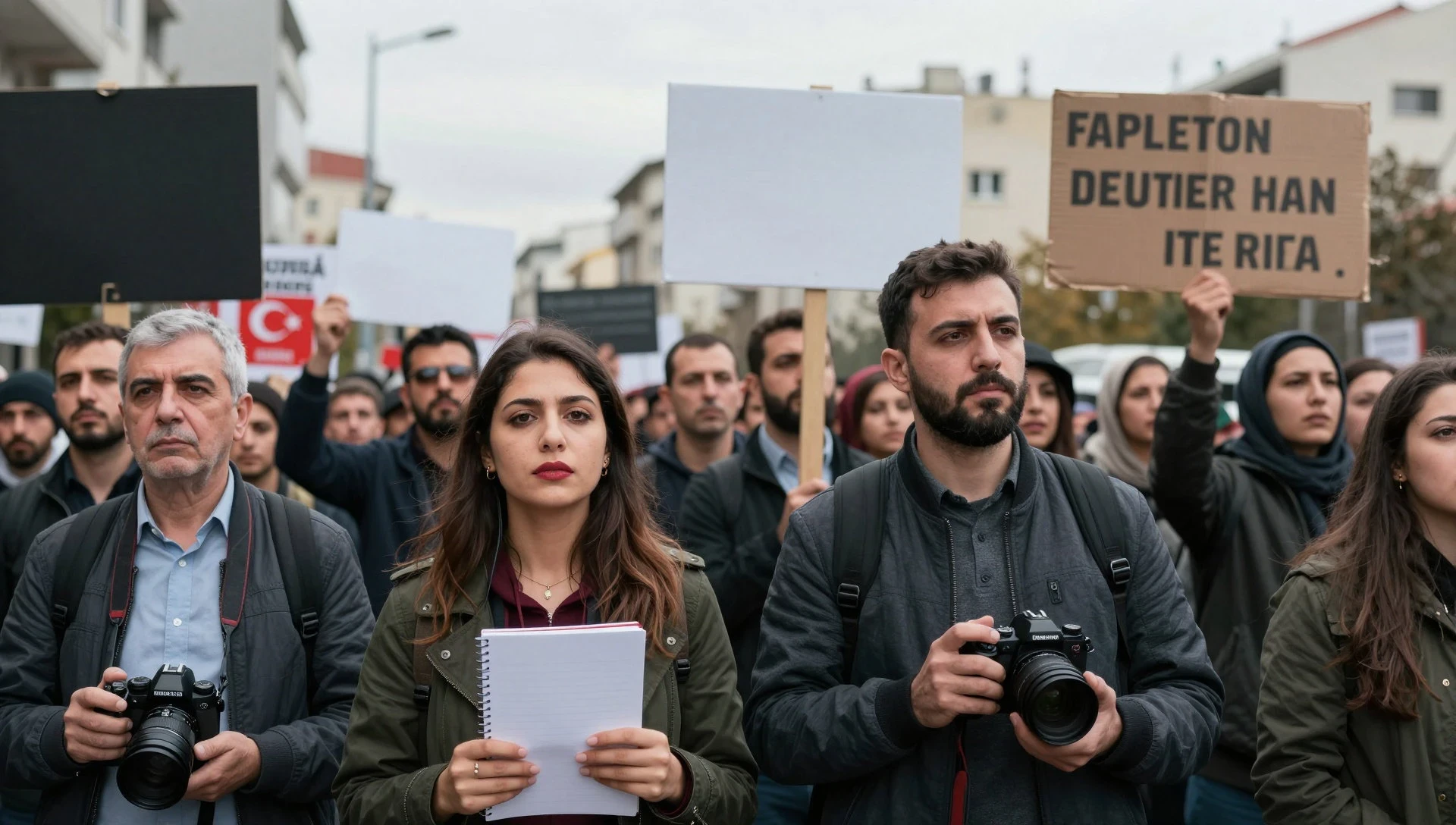
Thousands of demonstrators assembled in Istanbul and Ankara on a single Saturday, carrying photographs of imprisoned reporters and demanding an end to what they characterize as a sustained campaign against independent journalism in Turkey.
Police estimates placed attendance at a minimum of 3,000 people at each rally, a figure that underscores how press freedom has become a mobilizing issue beyond the newsroom itself.
The gatherings drew journalists, human rights activists and opposition party representatives, forming a coalition that framed the crackdown as a threat to the public rather than to a single profession.
On This Page
The proximate trigger was a rapid sequence of enforcement actions. Earlier in the month, police raided Halk TV, one of the country's most-watched news channels, halting broadcasts and installing a government-appointed administrator.
That operation followed the closure of the website and social media accounts of digital outlet T24, which authorities justified under the banner of "LGBT propaganda." The Turkish Journalists' Union reports that 11 journalists have been jailed in the past two months, alongside the shuttering of several media outlets.
What distinguishes this episode is the argument advanced by organizers: that silencing reporters is functionally identical to denying citizens access to information. Veteran journalist Zafer Arapkirli told AFP the protests defended the public's right to independent news, not merely the careers of those detained.
Gokhan Durmus, president of the Turkish Journalists' Union, described an emerging architecture of "one voice, one source of news, one centralised operation" — a structural consolidation of narrative control rather than isolated legal action.
TL;DR Mass protests in Istanbul and Ankara drew at least 3,000 people each against Turkey's escalating pressure on journalists, following the Halk TV raid, the T24 shutdown and the jailing of 11 reporters in two months. Organizers frame the crackdown as an attack on the public's right to information, warning of a centralized media system with "one voice, one source of news." The government denies imprisoning journalists for their work, while press freedom advocates trace the trajectory back to the post-2016 coup purges.
The Anatomy of a Media Crackdown
The Turkish case illustrates how modern censorship operates through layered instruments rather than a single decree. Broadcast raids, digital account closures, judicial detention and administrative receivership reinforce one another, producing a cumulative effect that is greater than the sum of individual actions.
Each measure targets a different distribution channel, narrowing the space in which independent reporting can reach an audience.
From Broadcast Raid to Digital Shutdown
The Halk TV operation represents the most visible escalation, because a live broadcast interruption is immediately observable and difficult to characterize as routine regulation. Installing a government-appointed administrator converts an editorial entity into a supervised asset, effectively transferring control without formally seizing ownership. The signal to other outlets is unmistakable and requires no explicit directive.
The T24 closure operated through a different mechanism, targeting the outlet's website and social media presence rather than its broadcast license. Authorities cited "LGBT propaganda" as the rationale, a justification that expands the permissible grounds for suppression beyond security framing.
Digital-first outlets are especially vulnerable because platform compliance and hosting dependencies create single points of failure that regulators can exploit quickly.
Together, these actions demonstrate a portfolio approach to media control. Legacy broadcasters face licensing and administrative pressure; digital natives face platform-level removal; individual journalists face criminal detention. The Turkish Journalists' Union's count of 11 jailed reporters in two months suggests the judicial track is being used at a pace that outruns public awareness of individual cases.
The Post-2016 Trajectory
Press freedom in Turkey has contracted steadily since the failed coup attempt of 2016, when mass prosecutions followed the emergency powers granted to the state. What began as security-driven purges of suspected coup networks gradually broadened into a general apparatus for disciplining dissent. The legal categories shifted over time, but the operational logic of deterrence remained constant.
Authorities now routinely accuse journalists of spreading false news, a charge elastic enough to cover ordinary investigative reporting. This framing matters because it recasts reporting as a public harm rather than a public good, legitimizing restrictions in the eyes of a segment of the electorate.
The accusation also shifts the burden of proof onto the journalist, who must demonstrate accuracy against a state narrative.
Digital censorship has become the fastest-moving instrument in this toolkit, because platform takedowns require no courtroom and generate limited public spectacle. The T24 case shows how a single administrative decision can erase an outlet's entire online footprint within hours.
Traditional legal defenses are poorly suited to contesting actions that occur at the infrastructure layer rather than in open court.
Why the Street Became the Venue
With courts and regulators aligned against them, journalists and rights groups turned to public assembly as the remaining channel for contestation. The Istanbul and Ankara rallies were notable for their scale and for the breadth of participants, which included opposition party figures alongside working reporters. Police attendance estimates of 3,000 per city provide a conservative baseline for measuring mobilization.
Protesters in Istanbul held photographs of jailed colleagues and chanted slogans including "We will not be silenced" and "Enough is enough." In Ankara, the demands centered on ending censorship and securing the release of imprisoned journalists.
The symbolic weight of carrying a colleague's portrait converts an abstract legal dispute into a visible, human claim on public sympathy.
The reading of a letter from jailed BirGun journalist Ismail Ari gave the Ankara rally its emotional center. Ari wrote that he is being held for doing his job and that "days are being stolen" from his life.
Such testimony is difficult for authorities to rebut without engaging the specific facts of the detention, which is precisely why it travels well.
We Also Published
Information Access as a Civic Right
The most consequential claim advanced by organizers is that press freedom is a public entitlement rather than a professional privilege. Gokcer Tahincioglu of T24 argued the Ankara protest mattered because it defended citizens' right to information, not only journalists' interests.
This reframing widens the constituency for media freedom and makes restrictions harder to dismiss as internal industry disputes.
The "One Voice" Warning
Durmus's description of an emerging system with "one voice, one source of news, one centralised operation" is analytically precise. It describes consolidation of the information supply chain rather than episodic harassment of individual reporters.
When the number of independent editorial decision-makers shrinks below a threshold, the public loses the redundancy needed to verify competing claims.
Centralized news production has measurable downstream effects on public discourse. Citizens exposed to a single narrative source show reduced ability to identify contradictory evidence and diminished trust in institutions once discrepancies surface. The cost is not merely political; it degrades the informational foundation on which markets, courts and elections depend for legitimacy.
The union's framing also implies a sequence: first the loudest broadcasters are disciplined, then digital platforms are removed, then individual journalists are detained. Each step reduces the number of witnesses available to document the next.
By the time the pattern is legible, the capacity to report on it has already been substantially diminished.
Government Denial and the Evidence Gap
The government has repeatedly stated that it does not arrest or imprison journalists for doing their work. This denial is central to the dispute, because it determines whether the crackdown is characterized as lawful regulation or political suppression. Verifying the claim requires examining individual case files, which are frequently sealed or delayed.
Independent counts, such as the union's tally of 11 jailed reporters in two months, provide a partial counterweight to official statements. Such figures are imperfect but useful because they establish a baseline that can be compared across periods. A rising count during a period of declared non-prosecution is itself a form of evidence.
The gap between official denial and documented detention is where international credibility is decided. Allies and investors read press freedom indicators as proxies for rule-of-law reliability, which affects sovereign risk assessments. Turkey's media environment therefore carries economic consequences that extend well beyond editorial offices.
Comparative Context and Consequences
Turkey's trajectory invites comparison with other states where media consolidation followed security crises. The pattern is familiar: emergency powers normalize exceptional measures, which then persist after the emergency lapses. What varies is the speed of consolidation and the degree to which courts retain independent review capacity over executive action.
Measuring Press Freedom Decline
Quantitative indices offer one way to situate Turkey's position relative to peers. Such rankings aggregate expert assessments of legal frameworks, political pressure, economic constraints and physical safety. They are imperfect instruments, but their year-over-year movement captures directional change that individual incidents obscure.
The value of these metrics lies in comparability rather than precision. A country that falls several places in a single year is signaling institutional deterioration that markets and diplomats can price. Conversely, stable rankings despite high-profile incidents suggest that underlying legal protections remain partially intact.
For analysts, the more useful signal is the composition of restrictions rather than the aggregate score. A country relying mainly on judicial prosecution differs from one relying on administrative shutdowns, because the remedies available to journalists differ sharply. Turkey's current mix leans heavily toward administrative and platform-level action.
- 01
- 02
- 03
- 04
Economic and Diplomatic Spillovers
Media repression carries measurable economic costs, because investors price legal predictability into capital allocation decisions. When administrative action can override property rights without judicial review, risk premiums rise across sectors. The effect is gradual and diffuse, appearing in currency volatility and foreign direct investment trends rather than in headline statistics.
Diplomatically, press freedom disputes complicate alliance management. Partners that publicly emphasize democratic norms face domestic pressure to respond, while strategic interests counsel restraint. Turkey's position between Europe and the Middle East amplifies this tension, making its media environment a recurring agenda item in bilateral talks.
For the journalists themselves, the practical consequence is a narrowing of career options and increasing reliance on exile reporting. Diaspora newsrooms have expanded to cover stories that domestic outlets cannot, creating a parallel information ecosystem.
This adaptation preserves some reporting capacity but fragments the domestic audience that such reporting most needs to reach.
What the Protests Signal
The rallies demonstrate that public attachment to independent information persists despite sustained pressure. Attendance of at least 3,000 in each city is modest in absolute terms but significant given the risks of assembly. The participation of opposition parties suggests media freedom is being absorbed into broader political contestation.
Whether street protest can alter the trajectory remains uncertain, since the instruments of control operate largely outside legislative arenas. Protests influence outcomes mainly by raising the political cost of further action and by sustaining international attention. Both effects are real but slow-acting relative to the pace of administrative crackdowns.
The clearest takeaway is structural: Turkey's restrictions now operate as a coordinated system rather than a series of isolated incidents. Recognizing that architecture is essential for any effective response, whether legal, diplomatic or journalistic. The protesters' central claim — that information access belongs to the public — reframes the debate accordingly.
From our network :
- CISA’s Ten-Advisory Wave: Why Generic Patching Fails in OT and How to Build Product-Specific PlaybooksCISA released ten ICS advisories in one week, exposing critical infrastructure risks. Generic patching fails in OT. Learn to build product-specific remediation playbooks.
- Forbidden Matrix Patterns and Visible Lattice Points: A Geometric DictionaryExplore how multidimensional 0–1 matrices encode geometric truths, linking forbidden patterns to visible lattice points and hypergraph theory, with applications in combinatorics and computational geometry.
- University Language Proficiency Exams: Why Institutional Tests Demand Different Preparation Than IELTS and TOEFLDiscover why university-specific language proficiency examinations differ fundamentally from IELTS and TOEFL, and learn strategic preparation approaches for institutional assessment success.
- Live Online English Classes for Kids: Do They Actually Reduce Anxiety?A ten-week study reveals that synchronous online English classes can significantly reduce child language anxiety while improving listening and reading skills. Discover what makes these programs effective and how parents can select the right one.
- The Hidden Cost of AI Convenience: Why Over-Permissioned Agents Are a Security Time BombDiscover why AI agents with excessive permissions create dangerous single points of failure, and learn how implementing least privilege principles can protect your organization from exploitation.
- The Final Descent: How ESA Retired the Legendary Cluster Constellation After 24 Years of Space Weather ScienceAfter 24 years mapping Earth’s magnetosphere, ESA’s Cluster mission concluded with a precisely controlled reentry over the South Pacific. This analysis explores the scientific legacy, engineering decisions, and debris mitigation principles behind one of space exploration’s most responsible retirements.
- Committed Mediterranean Precipitation Decline: Why Emissions Cuts Alone Cannot Restore Winter RainsNew NOAA research reveals that Mediterranean winter rains may decline irreversibly even with emissions cuts. Explore the science of committed climate change and regional impacts.
- Mobile Learning and VR in English: What Global Evidence Reveals About Effective Language TechnologyA systematic review across 14 countries reveals which language-learning technologies genuinely work. Mobile learning, AI, and VR show measurable benefits when pedagogically integrated. This evidence-based guide helps educators and learners select technology that delivers real return on investment.
- How AI Agents Will Change the Way We Manage Personal FinancesExplore how AI agents are transforming personal finance through automated budgeting, bill payment, and investment management, while examining the critical security protocols and governance frameworks required for safe deployment.
RESOURCES
- Türkiye: Crackdown on freedom of expression and assembly ...amnesty.orgSep 10, 2025 ... “The Turkish authorities' crackdown on protestors in Istanbul on ... media posts in relation to the protests. The General Directorate ...
- Turkey's Intensifying Media Crackdown Threatens Press Freedomecpmf.eu... press freedom violations has emerged: At least 12 journalists have been physically attacked by police forces while covering protests; More than 13 ...
- Turkey: journalism is not a crime - Amnesty Internationalamnesty.orgFeb 1, 2017 ... The erosion of media freedom is not new in Turkey. In 2013 when huge protests erupted in Istanbul against the…
- Turkey must End Crackdown on Journalists Covering Protestsecpmf.euMar 28, 2025 ... European Federation of Journalists (EFJ); European Centre for Press and Media Freedom (ECPMF); Free Press Unlimited (FPU); ARTICLE 19 Europe ...
- Turkey: MFRR partners call for an end to crackdown on journalists ...ipi.mediaMar 28, 2025 ... Turkey: MFRR partners call for an end to crackdown on journalists covering political protests · Join the fight for press…
- Thousands protest crackdown on media in Turkey - AFP.comafp.comOct 24, 2026 ... ... Turkey, including arrests, media shutdowns and the appointment of state administrators. Press freedom has been increasingly constrained in ...
- Turkey: Ensure peaceful assembly, free speech during protestscrd.orgMar 28, 2025 ... ... crackdown on online speech, a group of 15 international human rights and media freedom groups, including Civil Rights Defenders,…
- Press Freedom's Dark Horizon | Freedom Housefreedomhouse.orgOfficials in more authoritarian settings such as Turkey, Ethiopia, and Venezuela used political or social unrest as a pretext for new crackdowns on independent ...
- Turkey media crackdown: Who to blame? - BBC Newsbbc.comAug 13, 2013 ... Press freedom has become a burning issue in Turkey after the police crackdown on protesters in Istanbul's Gezi Park and…
- Thousands protest media crackdown in Turkeystockholmcf.orgOct 25, 2026 ... Press freedom has been increasingly constrained in Turkey since a failed coup attempt in 2016, with sweeping prosecutions, digital censorship ...
- Türkiye: Tuğba Tekerek detained as press freedom suffers in ... - RSFrsf.orgSep 25, 2026 ... Türkiye: Tuğba Tekerek detained as press freedom suffers in LGBTQ+ crackdown ... media professionals critical of the Turkish authorities ...
- Journalists in Turkey arrested, beaten, deported amid government ...cpj.orgApr 2, 2025 ... Journalists in Turkey arrested, beaten, deported amid government crackdown ... protesters, according to the local media freedom group MLSA. Police ...
- Turkey: Government silences last critical media outlets - DW.comdw.comJul 9, 2025 ... The non-governmental organization Reporters Without Borders has ranked Turkey 159 out of 180 countries in its global press freedom index…
- How Turkey is cracking down on the media - The Conversationtheconversation.comOct 29, 2025 ... Reporters Without Borders ranks Turkey 159th out of 180 countries worldwide for press freedom ... Protestors waving Turkish flags gather…
- Turkey's crackdown propels number of journalists in jail worldwide ...cpj.orgDec 13, 2016 ... Journalists who document human rights abuses or protests are at risk of jail in China. (AFP/Greg Baker). In Turkey, media…
- 01
- 02
- 03
- 04
- 05
- 06
- 07
- 08
0 Comments