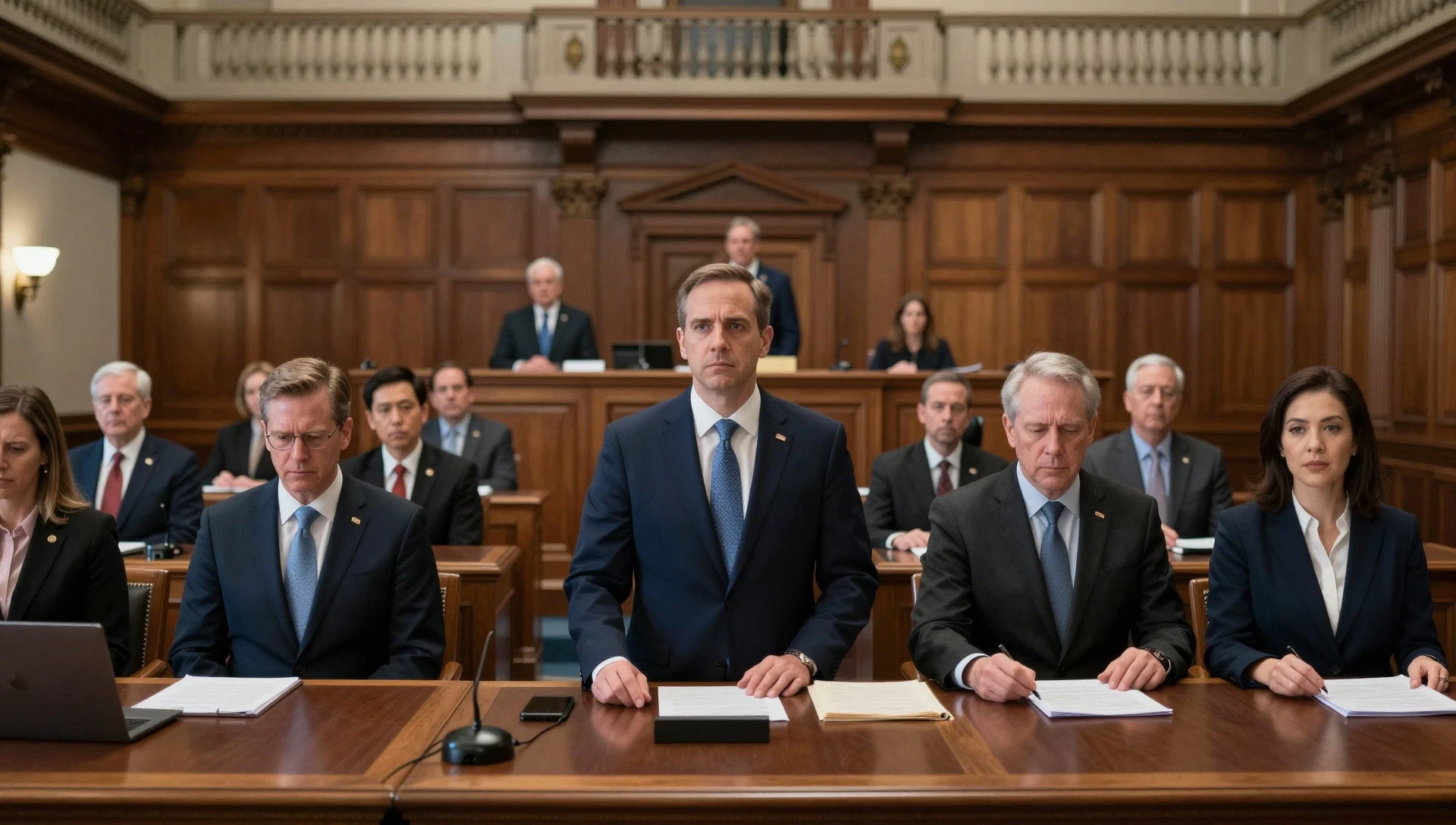
The House of Representatives has once again demonstrated that institutional loyalty, not ideological consistency, remains the organizing principle of the modern Republican Party. When Representative Thomas Massie forced a floor vote on articles of impeachment against Defense Secretary Pete Hegseth, he expected his colleagues to weigh evidence and constitutional duty. Instead, they dispatched the resolution to the Judiciary Committee by a 211-204 margin, effectively burying it without substantive debate. The maneuver spared the party an uncomfortable reckoning with a cabinet secretary whose tenure has been shadowed by controversy, and it revealed how thoroughly the post-midterm Republican caucus has tethered its fortunes to Donald Trump's continued endorsement of Hegseth.
What makes the episode analytically rich is its timing. Republicans had just surrendered both chambers of Congress in midterm elections widely described as their worst showing in more than half a century. Rather than treating that defeat as a mandate for introspection, the caucus closed ranks around a defense secretary whose confirmation had already required extraordinary political capital. Massie, who lost his own primary after breaking with Trump, framed the moment with a nautical metaphor that has since circulated widely: his colleagues, he suggested, know the ship is sinking yet remain committed to staying aboard. The image captures something genuine about coalition psychology under electoral stress, where exit costs appear higher than the price of continued association.
Beyond the Hegseth vote, the same news cycle carried several threads that illuminate the broader architecture of American power in late 2026. Jim Jordan's closed-door victory over Steve Scalise for House minority leader signaled that the party's incoming opposition posture will be combative rather than conciliatory. The Kennedy family's lawsuit against a planned 250-foot triumphal arch near Arlington National Cemetery opened a fresh front in the long contest over memorial space and presidential self-commemoration. And a federal judge's decision to let Trump's $10 billion defamation suit against the BBC proceed pushed questions of transnational libel and broadcast editing into active litigation. Each thread deserves careful reading.
On This Page
- The Hegseth Impeachment Vote and the Machinery of Congressional Burial
- Leadership Reshuffles Signal the Party's Opposition Posture
- The Kennedy Family Lawsuit and the Politics of Memorial Space
- The BBC Defamation Ruling and Transnational Libel
- Reading the Cycle Together: Institutional Deference Under Electoral Stress
- Frequently Asked Questions
TL;DR House Republicans blocked a Democratic-aligned impeachment effort against Defense Secretary Pete Hegseth by referring the resolution to the Judiciary Committee on a 211-204 vote, with Thomas Massie the lone Republican dissenter. The vote came days after the party lost both chambers in midterm elections, underscoring continued deference to Donald Trump's preferences. The same cycle produced Jim Jordan's elevation to House minority leader, John Thune's re-election as Senate minority leader, a Kennedy family lawsuit over a planned triumphal arch near Arlington, and judicial clearance for Trump's $10 billion defamation case against the BBC.
The Hegseth Impeachment Vote and the Machinery of Congressional Burial
The procedural mechanics of the Hegseth vote matter as much as its outcome. Rather than defeating the impeachment resolution outright, Republicans voted to refer it to the Judiciary Committee, a maneuver that allows members to claim they honored the process while ensuring the measure never reaches a substantive floor debate. This technique, sometimes called a motion to commit, has a long pedigree in congressional practice. It converts a binary question of guilt or innocence into a question of scheduling, and scheduling is where majorities exercise quiet control. The 211-204 margin, largely along party lines, confirmed that the referral was a partisan instrument rather than a neutral procedural courtesy.
Massie's solitary dissent deserves particular attention because it illustrates the narrowing space for internal Republican criticism. Having already lost his primary after breaking with Trump, Massie had little electoral incentive to remain loyal and considerable rhetorical freedom to speak plainly. His comparison of colleagues to passengers on a sinking ship resonated because it named a dynamic that many observers had sensed but few sitting members would articulate on the record. The remark also carried an implicit prediction about the party's trajectory, suggesting that continued association with Trump-aligned positions may prove costly in future elections.
Why the Referral Strategy Worked
The referral strategy succeeded because it offered something to nearly every faction. Moderates could tell constituents they had not voted to protect a controversial cabinet secretary, since the resolution technically remained alive in committee. Hardliners could claim victory because the impeachment effort had been neutralized. Leadership avoided a recorded vote on the underlying articles, which would have forced members to take positions that could be weaponized in primaries. The arrangement was efficient, if transparent, and it demonstrated that procedural creativity often substitutes for substantive resolution in modern legislative politics.
Democratic absences complicated the arithmetic in ways that will likely be revisited. According to reporting from the Daily Beast, eleven Democratic representatives missed the vote, including Nancy Pelosi. Had eight of those members been present and voting with their colleagues, the referral could have failed and the impeachment articles could have advanced. House Democratic leader Hakeem Jeffries acknowledged that the caucus would discuss whether to renew the effort in the next Congress, when newly elected Democrats take their seats in January. His measured language, promising conversation "at the appropriate time," suggested that leadership views the matter as unfinished rather than closed.
The Trump Factor in Cabinet Loyalty
Donald Trump's reaction framed the vote as vindication. He described the outcome as the exoneration of a great American patriot and used his social media platform to criticize Massie for forcing the vote, arguing that opponents continue to weaponize and abuse the United States of America. The Pentagon echoed this framing, with spokesperson Sean Parnell characterizing the referral of what he called baseless impeachment articles as a victory for Hegseth, the department, and service members. The synchronized messaging revealed how thoroughly the defense secretary's political standing has been fused with the former president's personal endorsement, making any challenge to Hegseth functionally a challenge to Trump.
This fusion has structural consequences for civil-military relations. When a defense secretary's tenure depends more on political patronage than on congressional confidence, the traditional firewall between military leadership and partisan contestation weakens. The Pentagon's public celebration of a legislative maneuver is itself noteworthy, since defense departments historically maintain studied neutrality toward congressional votes. That the department's spokesperson framed the referral as a victory suggests an institutional comfort with partisan alignment that would have been unusual in earlier eras. Analysts of civil-military affairs will be watching whether this posture persists as the new Congress convenes.
Leadership Reshuffles Signal the Party's Opposition Posture
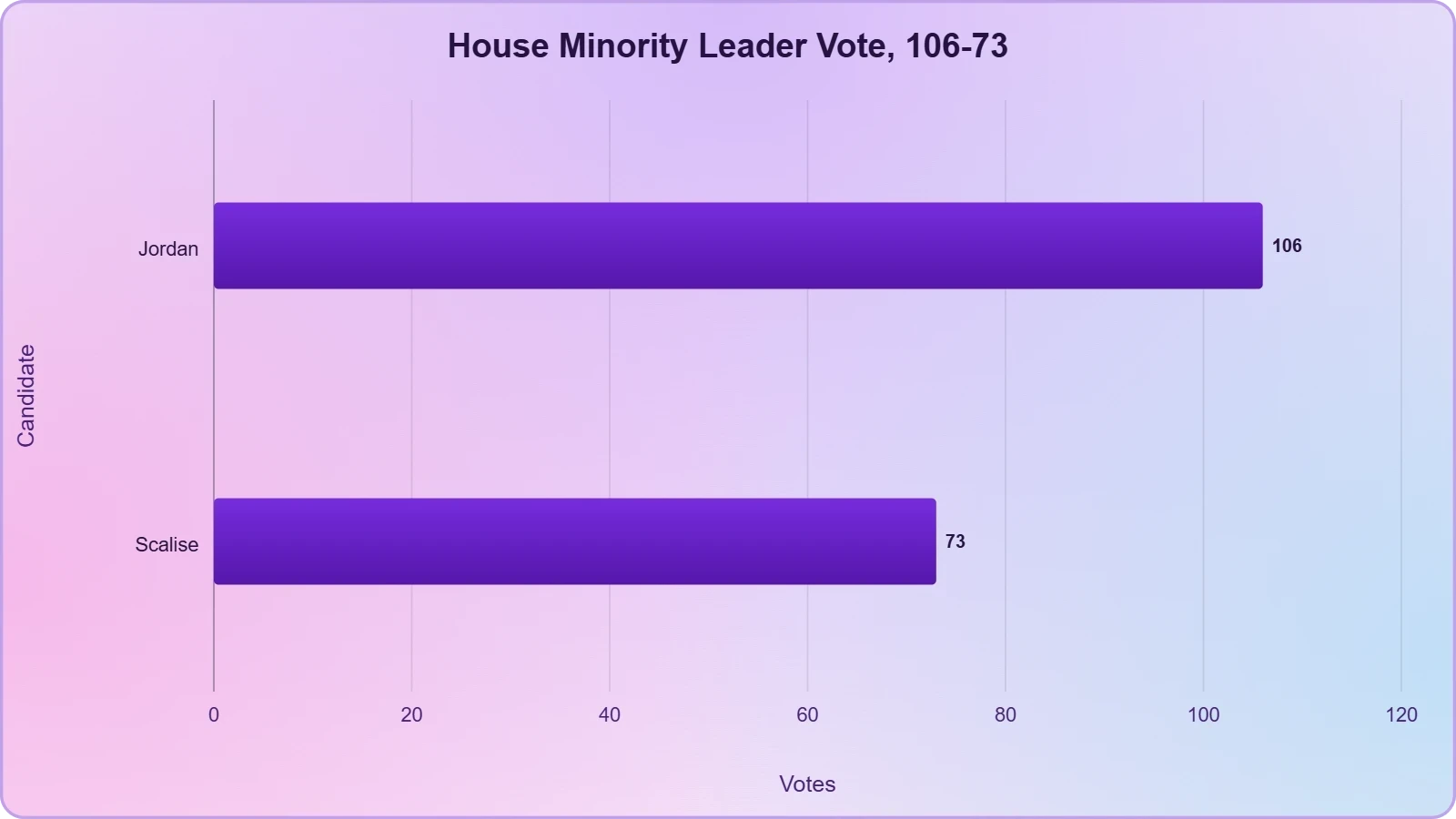
Leadership elections rarely attract public attention, yet they encode the strategic assumptions that will govern a caucus for years. Jim Jordan's closed-door victory over Steve Scalise for House minority leader, by a vote of 106-73, represents a decisive turn toward confrontational politics. Jordan has built his reputation as an investigator and agitator rather than a legislator, and his elevation suggests that House Republicans intend to contest the incoming Democratic majority through oversight, subpoena, and procedural warfare. Scalise, by contrast, embodied a more transactional style of leadership. The margin of 33 votes indicates that the conference preferred combativeness to accommodation as it enters opposition.
The transition also resolves an awkward leadership question. Current Speaker Mike Johnson had already announced he would not seek the minority leader position once Republicans hand control to Democrats in the new year. Jordan's victory therefore fills a vacuum rather than displacing an incumbent, which may explain the relatively smooth process. In the Senate, Republicans re-elected John Thune as minority leader without a challenger, reflecting a conference preparing for at least a ten-seat Democratic majority. Thune's uncontested status contrasts sharply with the House contest and suggests that Senate Republicans value continuity and institutional relationships more than rhetorical aggression.
Jordan's Rise and the Oversight Agenda
Jordan's background as a former Judiciary Committee chairman positions him to weaponize the committee system against the incoming administration. Minority leaders in the House wield limited legislative power, but they control messaging, committee assignments, and the pace of investigations. Jordan has signaled that he intends to use those levers aggressively, and his narrow victory over Scalise suggests that a substantial minority of the conference preferred a more conciliatory approach. Managing that internal division will be his first test, since a minority leader who cannot hold his conference together cannot credibly negotiate with the majority.
The contrast between House and Senate leadership styles will shape how Republicans present themselves nationally. Thune's Senate conference will likely pursue targeted negotiations on appropriations and defense authorization, while Jordan's House conference will generate headlines through hearings and subpoenas. This bifurcation is not new in American politics, but the gap between the chambers appears wider than usual. Whether voters reward confrontation or competence in the 2028 cycle will depend partly on how these two strategies perform in parallel, and partly on whether the Democratic majority can govern effectively enough to claim credit for legislative output.
Thune's Uncontested Re-election
Thune's uncontested re-election carries its own signal. A leader who faces no challenger after a catastrophic electoral defeat is either unusually secure or unusually uncontested because no one wants the job. Both readings may be true. Senate Republicans face a daunting arithmetic in the new Congress, with at least a ten-seat Democratic majority limiting their ability to advance legislation. In that environment, leadership becomes a matter of managing expectations and protecting incumbents rather than setting the agenda. Thune's experience and temperament suit that task, and his colleagues evidently concluded that a leadership fight would only compound their difficulties.
The Senate's institutional rhythms also favor continuity. Unlike the House, where a determined faction can force floor votes through discharge petitions and procedural motions, the Senate's cloture requirements and unanimous consent practices concentrate power in leadership. A leader who understands those mechanics can protect the conference from damaging votes, which is precisely what Thune's colleagues need as they enter the minority. His re-election therefore reflects a pragmatic assessment of what the job requires rather than an endorsement of any particular ideological direction.
We Also Published
The Kennedy Family Lawsuit and the Politics of Memorial Space
Nine members of the Kennedy family have sued the Trump administration to block construction of a 250-foot triumphal arch near Arlington National Cemetery. The complaint argues that the structure would obstruct the Kennedy gravesites, the JFK Eternal Flame, and broader views of the cemetery, permanently diminishing these memorials. The lawsuit is notable less for its legal novelty than for what it reveals about the contest over public memory. Memorial landscapes are never politically neutral, and the decision to place a monumental arch in proximity to the graves of a slain president carries symbolic weight that transcends architectural taste.
The scale of the proposed arch invites comparison with classical triumphal monuments, which historically celebrated military victory and imperial expansion. Placing such a structure adjacent to a cemetery dedicated to fallen service members and a president assassinated in office creates a layered symbolism that the plaintiffs argue is disrespectful. The complaint's language about permanently diminishing the memorials suggests that the family views the arch not merely as an aesthetic intrusion but as an act of narrative appropriation, reframing the cemetery's meaning around a different political story.
Legal Grounds and Procedural Prospects
The legal grounds for the suit will likely center on environmental and historic preservation statutes rather than constitutional claims. Federal construction near national cemeteries typically requires review under the National Historic Preservation Act and the National Environmental Policy Act, and plaintiffs can challenge whether those reviews were conducted properly. The Kennedy family's standing is strengthened by their direct connection to the affected gravesites, which distinguishes them from general plaintiffs who might struggle to demonstrate particularized injury. Whether a court will grant preliminary relief depends on how convincingly the complaint establishes irreparable harm.
Procedural timing matters enormously in construction disputes. If the administration has already begun site preparation, a court may be reluctant to halt work absent a strong showing of legal deficiency. Conversely, if the project remains in planning stages, judicial review can proceed without the urgency of an emergency injunction. The complaint's emphasis on permanent diminishment suggests that plaintiffs are preparing for a longer litigation horizon rather than seeking immediate stoppage. Either way, the case will generate discovery into how the project was approved and who advocated for its location.
Memory, Monument, and Political Signal
Monuments are political speech in stone, and the arch's placement sends a signal about which historical narratives the current administration wishes to elevate. The Kennedy family's opposition transforms a land-use dispute into a referendum on how the nation commemorates its dead. Supporters of the arch may argue that triumphal monuments are a legitimate expression of national confidence, while critics contend that proximity to Arlington imposes obligations of restraint. The litigation will not resolve that cultural argument, but it will determine whether the arch is built, and that outcome will itself become part of the memorial landscape's meaning.
The timing of the lawsuit, arriving in the same news cycle as the Hegseth vote and the BBC defamation ruling, illustrates how thoroughly cultural and legal contests have become entangled with partisan identity. The Kennedy name retains enormous symbolic capital in American politics, and the family's willingness to sue the administration directly signals that some boundaries are worth litigating. Whether the suit succeeds or fails, it establishes a record of opposition that future historians will consult when assessing how this era negotiated the relationship between commemoration and political power.
- 01
- 02
- 03
- 04
The BBC Defamation Ruling and Transnational Libel
A federal judge has allowed Donald Trump's defamation lawsuit against the BBC to proceed, clearing the way for a $10 billion claim over an edited clip that made it appear he told supporters to storm the US Capitol on January 6, 2021. The ruling is significant because it tests whether American courts will exercise jurisdiction over a publicly funded foreign broadcaster's editorial decisions. Defamation law varies dramatically across jurisdictions, and the prospect of a US court adjudicating the BBC's editing practices raises questions about forum shopping, speech protections, and the reach of American legal norms into foreign newsrooms.
The underlying dispute concerns an edited clip, and editing is where defamation claims often turn. Broadcasters routinely condense lengthy speeches, and the question is whether a particular edit materially misrepresents the speaker's meaning. Trump's complaint alleges that the clip created a false impression that he incited the Capitol breach, a claim the BBC is expected to contest vigorously. The judge's decision to allow the case to proceed does not resolve the merits; it merely establishes that the complaint clears the threshold for litigation, which in defamation cases is a meaningful hurdle given robust First Amendment protections.
Jurisdiction, Forum, and the Public Figure Standard
American defamation law imposes a demanding actual malice standard on public figures, requiring proof that the defendant knew the statement was false or acted with reckless disregard for the truth. Trump, as a public figure, must satisfy that standard, which historically has shielded news organizations from liability in all but the most egregious cases. The BBC will likely argue that its editing reflected reasonable editorial judgment rather than reckless disregard, and that the clip, viewed in context, did not materially mislead viewers. Whether a US court accepts that defense will shape how foreign broadcasters approach American political coverage.
Jurisdictional questions add another layer of complexity. The BBC broadcasts globally, and its content reaches American audiences through multiple channels. Courts have generally held that foreign defendants who target US audiences can be subject to jurisdiction, but the analysis is fact-specific. The judge's ruling permitting the case to proceed suggests that the court found sufficient contacts between the BBC's distribution practices and the United States. That finding will be scrutinized on appeal, and its resolution could establish precedent for how transnational media disputes are litigated in American courts.
Implications for Broadcasters and Political Speech
The case arrives at a moment when trust in media editing practices is already under strain. Deepfake technology and sophisticated video manipulation have made audiences more skeptical of edited content, and broadcasters face heightened scrutiny for any cut that could alter meaning. A ruling against the BBC would chill aggressive editing of political speeches, while a ruling in its favor would reaffirm editorial discretion. Either outcome will influence how newsrooms handle the tension between concision and accuracy when covering public figures whose remarks are frequently inflammatory and easily misconstrued.
The $10 billion figure also deserves attention. Damages claims of that magnitude are unusual in defamation cases and serve partly as political messaging. Even if the claim is ultimately reduced or dismissed, the number itself generates headlines and reinforces the plaintiff's narrative of victimization. Legal analysts will watch whether the court treats the damages claim as a serious measure of reputational harm or as an inflated figure subject to reduction. The answer will tell us something about how courts are adapting defamation doctrine to an era of polarized media and global distribution.
Reading the Cycle Together: Institutional Deference Under Electoral Stress
Viewed in isolation, each story in this cycle appears discrete: a failed impeachment referral, two leadership elections, a monument lawsuit, a defamation ruling. Read together, they describe a political system in which institutional actors consistently defer to established power centers even after electoral rebukes. House Republicans protected a cabinet secretary rather than confront the former president who supports him. Senate Republicans re-elected a leader without debate. The Kennedy family turned to the courts because legislative and executive channels appeared closed. And a federal judge allowed a transnational defamation claim to proceed, testing whether courts will serve as the venue of last resort for reputational disputes.
The common thread is the migration of contested questions from legislatures to courts. When Congress declines to adjudicate an impeachment, the question of accountability does not disappear; it relocates. When memorial disputes cannot be resolved through administrative process, they become litigation. When media practices are contested, defamation suits become the mechanism of reckoning. This judicialization of politics is not new, but its acceleration is notable. Courts are being asked to resolve questions that legislatures have declined to answer, and that shift carries consequences for both institutional legitimacy and democratic accountability.
Accountability Gaps and Their Consequences
Accountability gaps do not remain empty for long. When formal mechanisms fail, informal ones fill the space: primary challenges, media investigations, litigation, and public pressure campaigns. Massie's loss of his primary illustrates how informal accountability can punish dissent as readily as it punishes misconduct. The Hegseth episode suggests that the informal mechanisms currently reward loyalty to Trump over institutional independence, which means that future Republican officeholders will calibrate their behavior accordingly. Whether that calibration serves the party's long-term interests is a question the midterm results have already begun to answer.
The Democratic response will matter as much as the Republican one. Jeffries has signaled that impeachment may be revisited in the next Congress, but renewed efforts will face the same structural obstacles unless Democratic absences are resolved and Republican defections increase. The more consequential question is whether Democrats can translate their midterm victories into governing achievements that demonstrate competence rather than mere opposition. If they cannot, the accountability gap will persist regardless of which party controls which chamber, and the migration of disputes to the courts will continue unabated.
What to Watch as the New Congress Convenes
Several indicators will reveal how these dynamics evolve. First, whether Jordan's leadership produces substantive oversight or merely spectacle will signal whether House Republicans have a governing strategy or only a messaging one. Second, whether the Kennedy family's lawsuit secures preliminary relief will indicate how courts weigh preservation claims against executive construction priorities. Third, whether the BBC case survives jurisdictional appeal will determine how exposed foreign broadcasters are to American defamation law. Each indicator carries implications beyond its immediate subject, and together they will map the boundaries of institutional behavior in the coming year.
The broader lesson is that political systems reveal their priorities through what they refuse to decide. The Hegseth referral, the uncontested Senate leadership vote, and the resort to litigation over memorial space all reflect choices about which questions are worth answering and which are better deferred. Those choices are rarely announced explicitly, but they shape outcomes more powerfully than any floor speech. Reading them requires attention to procedure as much as to rhetoric, and to the quiet decisions that determine which disputes reach a vote and which are buried in committee.
Frequently Asked Questions
Readers encountering this cycle of news often have questions about the procedural mechanics that determine outcomes. The following section addresses the most common points of confusion, from the difference between impeachment and a motion to commit to the legal standards governing defamation claims by public figures. Each answer is designed to clarify the institutional logic behind the headlines, so that readers can evaluate future developments with a clearer understanding of how congressional and judicial processes actually operate.
What does it mean to refer an impeachment resolution to committee?
A motion to refer sends a resolution to a standing committee for further review, which in practice often means indefinite delay. The committee can hold hearings, request documents, or simply take no action. Because the resolution remains technically alive, supporters can claim the process continues, while opponents can claim the matter has been handled. This procedural device allows members to avoid a direct vote on the underlying question, which is precisely why it is frequently used when a chamber wants to dispose of a controversial measure without recording a clear position.
Why did Democratic absences matter so much?
The vote margin was 211-204, meaning seven votes separated the two sides. With eleven Democrats absent, the potential existed for the outcome to flip if eight of those members had been present and voted with their party. Absences occur for many reasons, including illness, travel, and scheduling conflicts, but in closely divided chambers they can determine legislative outcomes. The fact that a former speaker was among the absentees drew particular attention, since her presence would have narrowed the gap and intensified pressure on wavering members.
What is the actual malice standard in defamation law?
Actual malice requires a public figure to prove that a defendant published a false statement with knowledge of its falsity or with reckless disregard for whether it was true. The standard comes from the Supreme Court's decision in New York Times v. Sullivan and has been extended to public figures generally. It is a demanding threshold designed to protect robust debate about public officials. In practice, plaintiffs must produce evidence of the defendant's subjective state of mind, often through internal communications, which makes such cases difficult to win without documentary proof of intent.
Can a foreign broadcaster be sued in US courts?
Foreign defendants can be subject to US jurisdiction if they have sufficient contacts with the forum, such as targeting American audiences or maintaining distribution relationships in the country. Courts apply a minimum contacts analysis and consider whether exercising jurisdiction comports with fair play and substantial justice. For global broadcasters, the analysis often turns on whether their content was specifically directed at US audiences or merely available to them. The BBC's extensive American distribution makes jurisdiction plausible, though the broadcaster will likely contest the scope of any judgment.
What happens to the impeachment effort next?
The resolution remains in the Judiciary Committee, where it can be revived if political conditions change. Jeffries has indicated that Democrats will discuss whether to pursue impeachment again in the next Congress, when newly elected members take their seats. A renewed effort would face the same structural obstacles unless Democratic attendance improves and Republican defections increase. The more likely path is that the issue becomes a campaign theme rather than a legislative priority, used to motivate voters rather than to remove an official from office.
From our network :
- Forbidden Matrix Patterns and Visible Lattice Points: A Geometric DictionaryExplore how multidimensional 0–1 matrices encode geometric truths, linking forbidden patterns to visible lattice points and hypergraph theory, with applications in combinatorics and computational geometry.
- The Hidden Cost of AI Convenience: Why Over-Permissioned Agents Are a Security Time BombDiscover why AI agents with excessive permissions create dangerous single points of failure, and learn how implementing least privilege principles can protect your organization from exploitation.
- Committed Mediterranean Precipitation Decline: Why Emissions Cuts Alone Cannot Restore Winter RainsNew NOAA research reveals that Mediterranean winter rains may decline irreversibly even with emissions cuts. Explore the science of committed climate change and regional impacts.
- University Language Proficiency Exams: Why Institutional Tests Demand Different Preparation Than IELTS and TOEFLDiscover why university-specific language proficiency examinations differ fundamentally from IELTS and TOEFL, and learn strategic preparation approaches for institutional assessment success.
- Live Online English Classes for Kids: Do They Actually Reduce Anxiety?A ten-week study reveals that synchronous online English classes can significantly reduce child language anxiety while improving listening and reading skills. Discover what makes these programs effective and how parents can select the right one.
- The Final Descent: How ESA Retired the Legendary Cluster Constellation After 24 Years of Space Weather ScienceAfter 24 years mapping Earth’s magnetosphere, ESA’s Cluster mission concluded with a precisely controlled reentry over the South Pacific. This analysis explores the scientific legacy, engineering decisions, and debris mitigation principles behind one of space exploration’s most responsible retirements.
- How AI Agents Will Change the Way We Manage Personal FinancesExplore how AI agents are transforming personal finance through automated budgeting, bill payment, and investment management, while examining the critical security protocols and governance frameworks required for safe deployment.
- Mobile Learning and VR in English: What Global Evidence Reveals About Effective Language TechnologyA systematic review across 14 countries reveals which language-learning technologies genuinely work. Mobile learning, AI, and VR show measurable benefits when pedagogically integrated. This evidence-based guide helps educators and learners select technology that delivers real return on investment.
- CISA’s Ten-Advisory Wave: Why Generic Patching Fails in OT and How to Build Product-Specific PlaybooksCISA released ten ICS advisories in one week, exposing critical infrastructure risks. Generic patching fails in OT. Learn to build product-specific remediation playbooks.
RESOURCES
- House Republicans Block Hegseth Impeachment, but Democrats ...time.com17 hours ago ... The House voted 211-204 to defeat a resolution brought by Rep. Thomas Massie. Another vote could come after Democrats take…
- House Republicans block effort to impeach Pentagon chief Pete ...theguardian.com17 hours ago ... House Republicans on Tuesday blocked an effort to impeach Pete Hegseth, rejecting allegations that the defense secretary had repeatedly violated ...
- McClellan Statement on House Republicans Blocking Hegseth ...mcclellan.house.gov14 hours ago ... Thomas Massie (KY-04)'s eight privileged articles of impeachment against Secretary of Defense Pete Hegseth from coming up for a vote…
- House GOP blocks move to impeach Hegseth, handing embattled ...latimes.com16 hours ago ... House Republicans on Tuesday successfully blocked an effort to impeach Defense Secretary Pete Hegseth over his handling of the Iran…
- US House blocks bid to impeach Defence Secretary Pete Hegseth ...bbc.com4 hours ago ... Watch: Republicans vote to block Hegseth impeachment from reaching full vote ... A majority of the House of Representatives voted…
- GOP House rejects Hegseth impeachment effort - Axiosaxios.com3 hours ago ... House Republicans voted Tuesday evening to block an effort to impeach Defense Secretary Pete Hegseth, shielding a top Trump administration ...
- Larsen Denounces Republicans Protecting Hegseth from ...larsen.house.gov15 hours ago ... Instead of allowing a yes or no vote on impeachment, House Republicans today blocked ... block consideration of impeaching Secretary…
- House Republicans block Pete Hegseth impeachment effortaljazeera.com16 hours ago ... The final vote on Tuesday was 211 in favour and 204 against, with Massie the lone Republican to vote against…
- House Republicans block Hegseth impeachment - MS NOWms.now17 hours ago ... Thomas Massie was the only Republican to vote with Democrats to keep the impeachment resolution alive, allowing GOP leaders to…
- House Republicans vote to block impeachment of Defense ...scrippsnews.com4 hours ago ... House Republicans on Tuesday stalled an effort to impeach Defense Secretary Pete Hegseth by voting to refer the articles of…
- Costa Statement Following House Vote on Impeachment of Defense ...costa.house.gov16 hours ago ... ... impeachment against Secretary of Defense Pete Hegseth to the House Judiciary Committee, effectively blocking the impeachment effort:
- House blocks Massie's effort to impeach Hegseth, voting to kill ...cbsnews.com17 hours ago ... GOP Rep. Thomas Massie said Monday he would not bring up another resolution to impeach Defense Secretary Pete Hegseth.
- Speaker Johnson recesses House early, blocking Massie's push to ...pbs.orgSep 16, 2026 ... Massie's resolution to impeach Defense Secretary Pete Hegseth over the war in Iran and his bipartisan effort to force the…
- Impeachment Live Updates: House Reads Accusations Against Pete ...nytimes.com17 hours ago ... ... Hegseth and a challenge by Republican leaders to attempt to block the effort. ... Defense Secretary Pete Hegseth could…
- US House GOP blocks effort to impeach Hegsethnewsfromthestates.com17 hours ago ... U.S. Defense Secretary Pete Hegseth has survived an impeachment effort, at least for now, after the U.S. House on Tuesday…
- 01
- 02
- 03
- 04
- 05
- 06
- 07
- 08
0 Comments