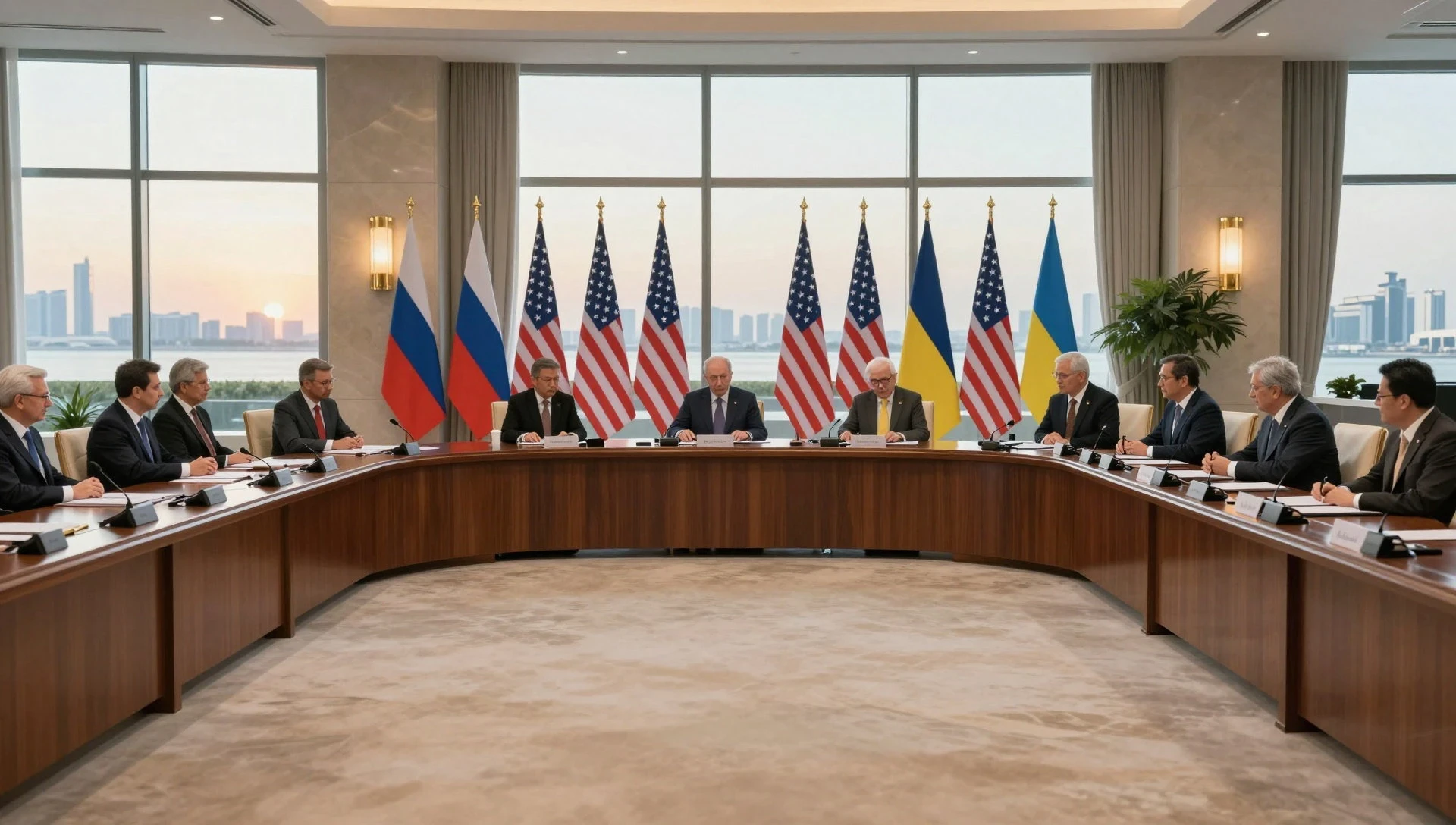
Diplomacy rarely announces itself with a single dramatic gesture; more often it advances through the quiet mechanics of calendars, venues and procedural notes. The confirmation that Russia and the United States have begun working out the exact date for three-way talks involving Ukraine in Abu Dhabi belongs to that second category.
It is a procedural signal, not a settlement, yet procedural signals carry weight because they reveal whether parties are willing to invest political capital in a shared format.
Yury Ushakov, an aide to the Russian president, confirmed that the meeting will take place in November, that only mid-November had been mentioned so far, and that no specific dates had been fixed. He added that Moscow has passed some of its ideas to the American side and is awaiting a response.
On This Page
The timing, he said, will depend on many factors, both within the countries involved and internationally — a formulation that keeps every option open.
What follows examines the structure of this announcement rather than its speculation: the venue logic behind Abu Dhabi, the sequencing problem of a three-way format, and the conditions under which a date becomes a decision. The analytical frame is deliberately narrow.
A confirmed month with an unconfirmed day is a specific diplomatic instrument, and it deserves to be read as one.
TL;DR Russia and the United States have started negotiating the precise date for trilateral talks with Ukraine in Abu Dhabi, with Kremlin aide Yury Ushakov confirming a November window and mid-November as the only reference point so far. No fixed date exists, Moscow has forwarded proposals to Washington and awaits a reply, and the timing is explicitly contingent on domestic and international factors. The announcement is a procedural milestone rather than a breakthrough: it establishes a format, a venue and a month, while leaving the decisive variable — the day — unresolved and politically loaded.
The Procedural Architecture of a Three-Way Format
A trilateral meeting involving Russia, the United States and Ukraine is not a single negotiation but three overlapping ones. Each pair carries its own agenda, its own red lines and its own domestic audience, and the three-way table only works when the bilateral tracks have produced enough alignment to make a joint session useful. The date is therefore the visible tip of a much larger preparatory structure.
Why the Venue Choice Carries Analytical Weight
Abu Dhabi has become a recurring host for sensitive multilateral contact because it offers three practical advantages: geographic distance from all capitals involved, a track record of hosting discreet security and economic dialogues, and a host government with established channels to Washington, Moscow and Kyiv alike. Venue neutrality is not decorative; it lowers the political cost of attendance for every delegation.
The Emirati model also provides logistical discretion that European capitals struggle to match. Media access can be managed, arrival and departure schedules can be staggered, and bilateral side meetings can occur without becoming front-page events.
For parties testing whether a format is viable, that discretion is a functional requirement rather than a courtesy.
Comparisons with earlier rounds are instructive. Talks hosted in European cities have repeatedly become hostage to protest dynamics, parliamentary pressure and press saturation, which raises the domestic price of participation. A Gulf venue decouples the negotiation from that pressure cycle, allowing delegations to meet before positions harden publicly.
None of this guarantees outcomes. It simply means the venue selection tells us the parties are optimizing for confidentiality and continuity rather than for symbolic visibility — a preference consistent with a preparatory phase rather than a signing ceremony.
The Difference Between a Month and a Date
Ushakov's wording is precise in a way that rewards close reading. A confirmed month establishes political intent; an unconfirmed day preserves optionality. By anchoring November while declining to name a date, Moscow signals willingness to convene without committing to a schedule it may later need to adjust.
This is standard practice in high-stakes diplomacy. Fixed dates create public expectations that can be embarrassed by a single unresolved technical question, whereas a month functions as a flexible container. It allows preparatory working groups to finish without the pressure of a countdown clock.
The distinction also distributes responsibility. If talks slip, no party has broken a specific commitment, because none was made. That ambiguity is not evasion; it is a deliberate risk-management device used when the underlying agenda remains contested.
Analysts should therefore treat "November" as a statement about format viability and "mid-November" as the working hypothesis, not as a schedule. The gap between the two is where the actual negotiation currently sits.
Proposals Passed, Response Pending
The most substantive element of the disclosure is that Moscow has transmitted ideas to the American side and is awaiting a reply. This establishes direction of travel: Russia has put something on paper, and Washington now holds the next move in the preparatory sequence.
Awaiting a response is itself informative. It suggests the American side is consulting internally and with partners before engaging on specifics, which is consistent with a format that requires Ukrainian alignment. A rapid reply would imply pre-agreement; a measured one implies genuine deliberation.
Ushakov's reference to "many factors, both within the countries involved and internationally" is a diplomatic catch-all, but it is not empty. Domestic politics in all three capitals, allied consultations and broader security conditions all constrain the calendar simultaneously.
The practical implication is that the date will be the last variable settled, not the first. Preparatory substance typically precedes scheduling in successful multilateral formats, and the sequence described here follows that pattern.
Reading the Signal: What the Announcement Does and Does Not Establish
Announcements of this type are frequently over-interpreted in both directions. Sceptics dismiss them as atmospherics; optimists treat them as breakthroughs. A more disciplined reading separates what has been established procedurally from what remains substantively unresolved, and then asks which of the two is doing the analytical work.
Procedural Progress Versus Substantive Progress
Procedural progress is real progress, but it is a different currency. Agreeing a format, a venue and a month demonstrates that the parties can coordinate logistics and accept a shared table. It does not demonstrate convergence on the issues that made the table necessary in the first place.
History offers a useful benchmark. Multilateral formats frequently convene on schedule while producing limited substantive output, and occasionally produce unexpected output precisely because expectations were low. The correlation between procedural readiness and substantive agreement is positive but far from deterministic.
The correct inference is modest: the probability of a meeting occurring has risen, and the probability of a settlement has not measurably changed. Conflating the two is the most common analytical error in coverage of this kind.
For observers, the practical test is whether preparatory working groups report convergence before the date is fixed. If they do, the meeting is likely to be consequential. If they do not, the meeting is likely to be a format-establishing session.
The Domestic and International Constraint Set
Ushakov's reference to factors "within the countries involved" points to a constraint that is often underestimated: each government must sell participation at home. A three-way format requires three separate domestic narratives to hold simultaneously, and any one of them can delay a calendar.
International factors add a second layer. Allied consultations, sanctions architecture and broader security conditions all shape what each delegation can accept in Abu Dhabi. A date that works diplomatically may still fail commercially or politically once those layers are priced in.
This is why the timing question is genuinely open rather than merely unannounced. The parties are not withholding a date they have already chosen; they are waiting for the constraint set to narrow enough that a date becomes defensible.
That distinction matters for forecasting. A withheld date implies a decision exists; an undetermined date implies the decision has not yet been made. The language used here supports the second reading.
How to Track Whether the Talks Are Real
Rather than waiting for a date announcement, observers can monitor a set of leading indicators that reliably precede a confirmed schedule. These include the appointment of named delegation leads, the opening of logistical channels, and public language shifting from conditional to declarative.
A second indicator is the tone of secondary commentary from each capital. When officials begin describing the meeting as expected rather than possible, preparatory work has usually advanced. When language remains conditional, the constraint set has not yet narrowed.
A third is the treatment of the agenda. Formats that convene without a pre-agreed agenda tend to produce communiqués rather than commitments. Formats that convene with a narrow, technical agenda tend to produce measurable outcomes, even if modest.
Tracking these indicators is more informative than reacting to each scheduling rumour. The date, when it comes, will confirm a process that was already visible in these quieter signals.
- 01
- 02
- 03
- 04
We Also Published
Strategic Context and the Wider Diplomatic Ledger
Placing the announcement in a wider frame clarifies why a scheduling detail merits attention. Three-way formats involving major powers and a directly affected state are rare, and each one establishes precedents about recognition, sequencing and the role of external hosts. Those precedents outlast individual meetings.
Why Abu Dhabi Keeps Appearing in Sensitive Diplomacy
The Emirati capital has accumulated a portfolio of hosting roles across security, energy and humanitarian dossiers. That portfolio functions as institutional capital: each successful hosting engagement lowers the perceived risk of the next, creating a self-reinforcing reputation for discretion and reliability.
For the parties involved, this reputation has practical value. A host with established channels can facilitate bilateral contact that would be politically costly elsewhere, and can absorb logistical friction that would otherwise become a negotiating issue in its own right.
The comparison with European hosting is not a judgement about capability but about political exposure. Proximity to the conflict increases domestic scrutiny in host countries, which in turn increases the cost of quiet preparatory work that multilateral formats depend upon.
This is why venue selection is a substantive variable rather than a footnote. It shapes what can be discussed, by whom, and at what political price — all of which feed directly into the scheduling question.
What a November Window Implies for the Broader Calendar
A November window compresses the preparatory timeline considerably. Working groups must complete their alignment within weeks, and any unresolved technical question becomes a scheduling risk rather than a background concern. Compressed timelines tend to favour narrow agendas over ambitious ones.
The window also interacts with other diplomatic and political calendars that are not publicly linked but are privately relevant. Competing multilateral events, budget cycles and domestic political schedules all compete for the same limited attention of senior officials.
If the talks convene in mid-November, the most realistic expectation is a format-establishing session with a defined follow-on mechanism. If they slip, the format itself may need renegotiation, which is a more significant setback than a simple delay.
Either outcome will be informative. The scheduling question is therefore a proxy for a larger one: whether the three parties can sustain a shared process long enough for substance to become possible.
Conclusion: A Date Is a Decision, Not a Detail
The announcement establishes that Russia and the United States are actively coordinating a trilateral format with Ukraine in Abu Dhabi, that November is the target month, and that Moscow has submitted proposals while awaiting a Washington response. Those are concrete, verifiable procedural facts.
Everything beyond them remains contingent. The exact date will be settled last because it depends on domestic narratives in three capitals, allied consultations and international conditions that no single party controls. Reading the announcement as a breakthrough overstates it; reading it as noise understates it.
The disciplined conclusion is that a format now exists on paper, a venue is agreed, and a month is anchored. Whether that becomes a meeting depends on the pending response and the constraint set. The date, when it arrives, will confirm a decision that has already been made elsewhere.
From our network :
- The Hidden Cost of AI Convenience: Why Over-Permissioned Agents Are a Security Time BombDiscover why AI agents with excessive permissions create dangerous single points of failure, and learn how implementing least privilege principles can protect your organization from exploitation.
- Mobile Learning and VR in English: What Global Evidence Reveals About Effective Language TechnologyA systematic review across 14 countries reveals which language-learning technologies genuinely work. Mobile learning, AI, and VR show measurable benefits when pedagogically integrated. This evidence-based guide helps educators and learners select technology that delivers real return on investment.
- Live Online English Classes for Kids: Do They Actually Reduce Anxiety?A ten-week study reveals that synchronous online English classes can significantly reduce child language anxiety while improving listening and reading skills. Discover what makes these programs effective and how parents can select the right one.
- How AI Agents Will Change the Way We Manage Personal FinancesExplore how AI agents are transforming personal finance through automated budgeting, bill payment, and investment management, while examining the critical security protocols and governance frameworks required for safe deployment.
- University Language Proficiency Exams: Why Institutional Tests Demand Different Preparation Than IELTS and TOEFLDiscover why university-specific language proficiency examinations differ fundamentally from IELTS and TOEFL, and learn strategic preparation approaches for institutional assessment success.
- Committed Mediterranean Precipitation Decline: Why Emissions Cuts Alone Cannot Restore Winter RainsNew NOAA research reveals that Mediterranean winter rains may decline irreversibly even with emissions cuts. Explore the science of committed climate change and regional impacts.
- The Final Descent: How ESA Retired the Legendary Cluster Constellation After 24 Years of Space Weather ScienceAfter 24 years mapping Earth’s magnetosphere, ESA’s Cluster mission concluded with a precisely controlled reentry over the South Pacific. This analysis explores the scientific legacy, engineering decisions, and debris mitigation principles behind one of space exploration’s most responsible retirements.
- CISA’s Ten-Advisory Wave: Why Generic Patching Fails in OT and How to Build Product-Specific PlaybooksCISA released ten ICS advisories in one week, exposing critical infrastructure risks. Generic patching fails in OT. Learn to build product-specific remediation playbooks.
- Forbidden Matrix Patterns and Visible Lattice Points: A Geometric DictionaryExplore how multidimensional 0–1 matrices encode geometric truths, linking forbidden patterns to visible lattice points and hypergraph theory, with applications in combinatorics and computational geometry.
RESOURCES
- US to send envoy to Moscow to discuss proposals to end Ukraine wartheguardian.comNov 25, 2025 ... ... US, Russian and Ukrainian officials in Abu Dhabi. ... On Monday night, Driscoll met a Russian delegation in Abu…
- US and Russia in Abu Dhabi for Ukraine peace talks after ... - BBCbbc.comNov 24, 2025 ... "We look forward to organising a visit of Ukraine's president to the US at the earliest suitable date in November."…
- Putin agrees to resume 3-way peace talks with Ukraine and USreuters.comOct 21, 2026 ... Russia says 3-way talks could start on or after November 10; Russia ... Abu Dhabi and would be focused on…
- U.S. meets Russia in UAE after "understanding" reached with Ukraineaxios.comNov 25, 2025 - World. U.S. meets Russia in UAE after "understanding" reached with Ukraine ... Army Secretary Dan Driscoll is holding talks with…
- Russia, Ukraine sit for tense talks on thorny territorial issue | Reutersreuters.comJan 23, 2026 ... Ukrainian and Russian negotiators met in Abu Dhabi on Friday to ... talks with U.S. and Russian delegations in Abu…
- US holds Russia-Ukraine peace talks in Abu Dhabi - Financial Timesft.comNov 25, 2025 ... “We look forward to organising a visit of Ukraine's President to the US at the earliest suitable date in November…
- U.S. and Russia hold new talks as Ukraine hopes to finalize peace ...nbcnews.comNov 25, 2025 ... The United States held meetings with a Russian delegation in Abu Dhabi ... date in November to complete final steps…
- Trump Sending Envoy Witkoff To Meet Putin As Peace Talks Appear ...rferl.orgNov 25, 2025 ... ... Ukrainians," he added. Driscoll met with a Russian delegation in Abu Dhabi earlier on November 25, according to a…
- Ukrainian and Russian negotiators are set to join for a second round ...instagram.comFeb 4, 2026 ... Russia-Ukraine-US Talks Could Resume in Abu Dhabi Around November 10 ... The date and participation remain subject to official confirmation.
- Ukraine agrees to peace proposal, with only "minor details" to settle ...cbsnews.comNov 26, 2025 ... ... talks between Ukraine, Russia, and the United States." There was no ... It is not clear who else is…
- Kremlin says U.S.-Russia-Ukraine peace talks will take place in Abu ...meduza.io4 days ago ... ... Ukraine will take place in Abu Dhabi after November 4, Russian presidential aide Yuri Ushakov said. Ushakov did not…
- Trump says peace plan 'fine-tuned' and he's sending envoys to meet ...pbs.orgNov 25, 2025 ... Trump spoke after U.S. Army Secretary Dan Driscoll held talks late Monday and throughout Tuesday with Russian officials in Abu…
- Russia and Ukraine envoys meet in Abu Dhabi for US-brokered talksapnews.comFeb 4, 2026 ... Envoys from Moscow and Kyiv have met in Abu Dhabi for U.S.-brokered talks to end the nearly four-year war.
- Updates: First day of trilateral talks on Russia-Ukraine war ends in ...aljazeera.comJan 23, 2026 ... ... November 2022, when Russia first began bombing energy infrastructure. ... January 23: Russian, Ukrainian and US delegates hold talks…
- Putin agrees to resume trilateral Russia-Ukraine-U.S. talks next monthpbs.orgOct 21, 2026 ... The Russian leader has agreed “in principle” to resume the talks after Nov. 10, Putin's foreign affairs adviser Yuri Ushakov…
- 01
- 02
- 03
- 04
- 05
- 06
- 07
- 08
0 Comments