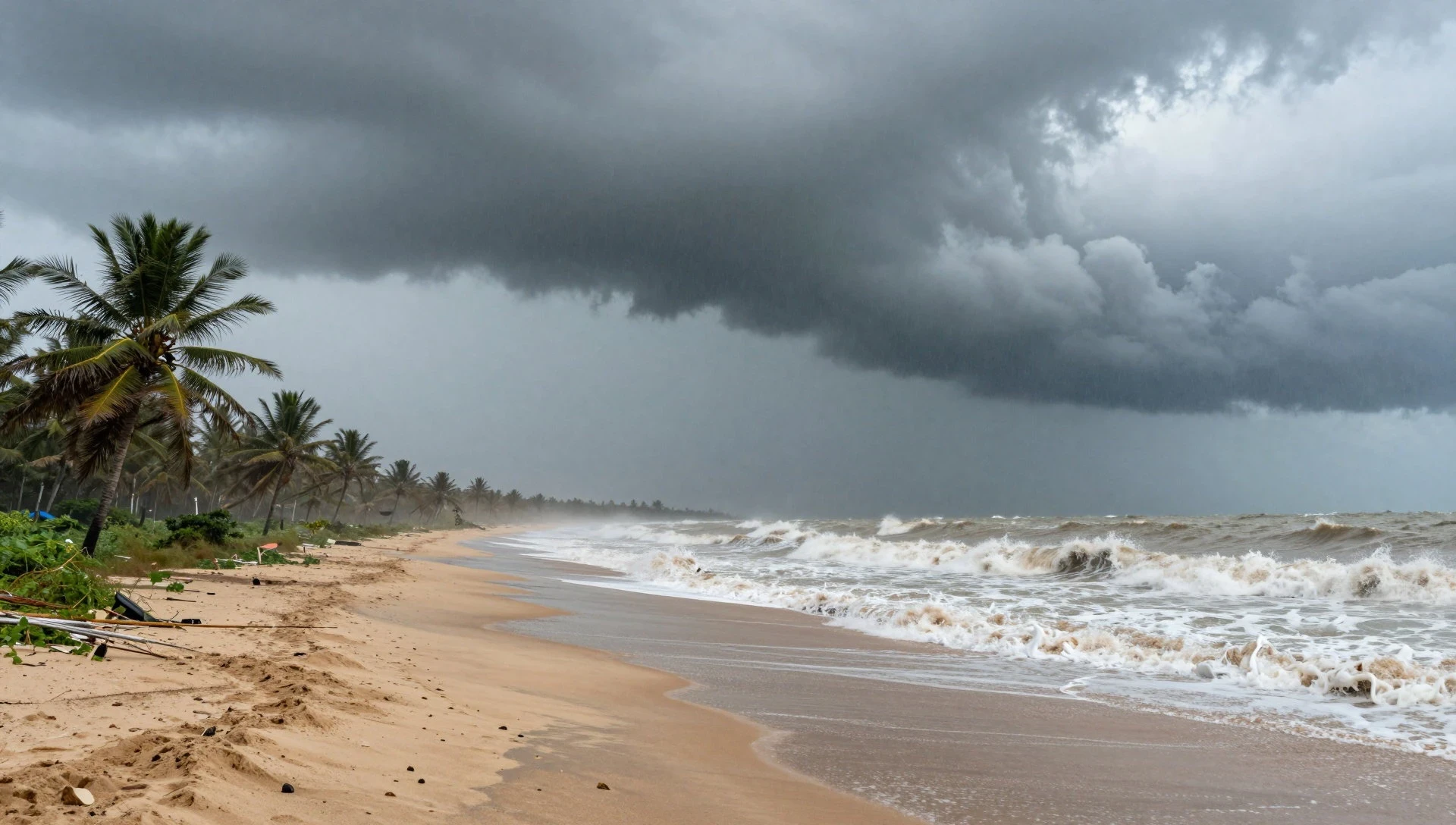
Cyclone Murasu made landfall near Ongole in Andhra Pradesh's Prakasam district in the early hours of Tuesday, arriving with sustained winds of 100 to 120 kilometres per hour and torrential rain that reshaped the coastline within hours.
The India Meteorological Department confirmed that the system uprooted thousands of trees, brought down power lines and flattened standing crops across a wide agricultural belt. Schools and colleges were shut in at least eight districts as a precautionary measure, while forecasters warned of continued heavy rain over south coastal Andhra Pradesh for the following twelve hours.
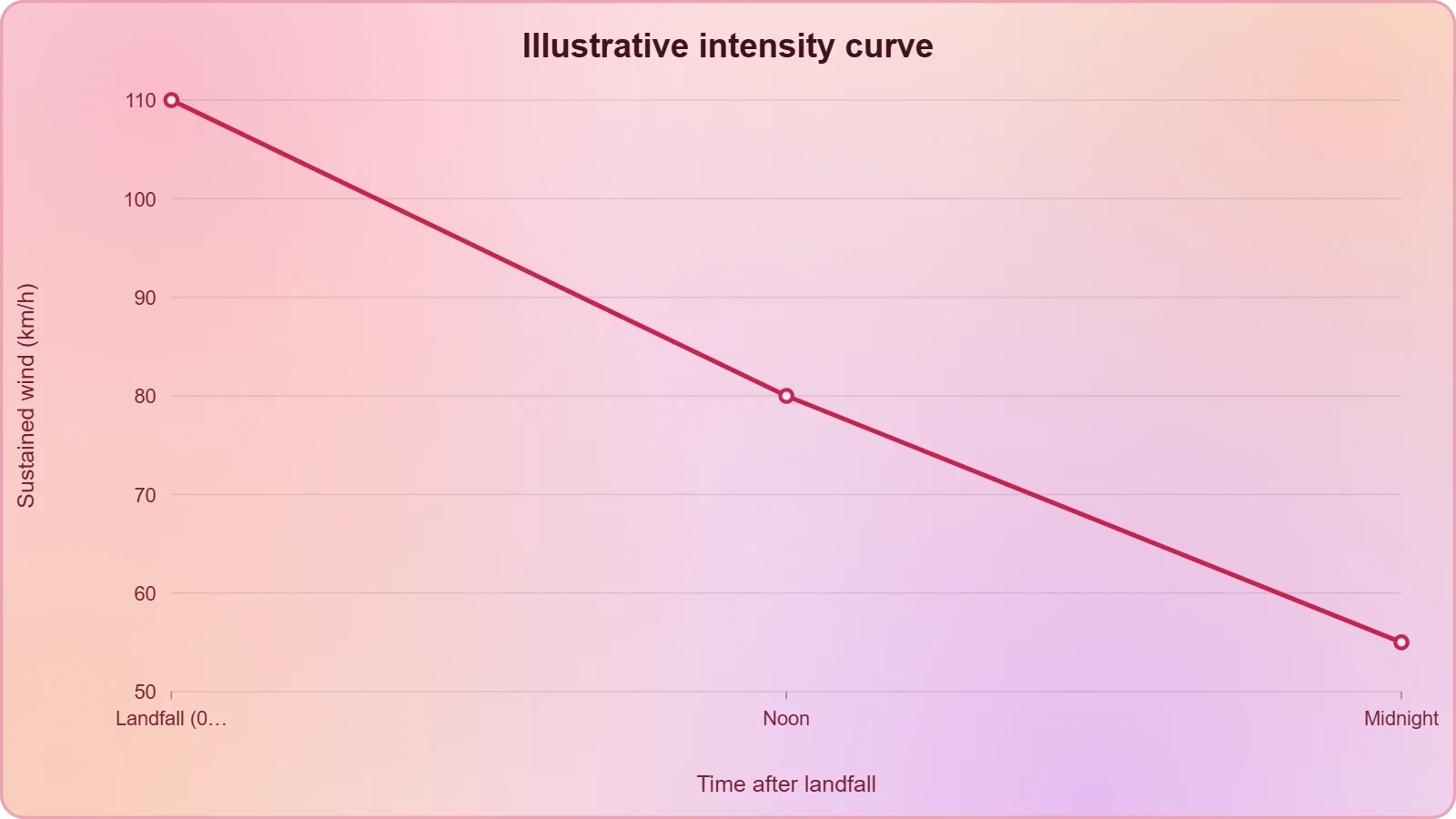
The storm's trajectory tells a story of rapid intensification and equally rapid decay. Moving north-northwest across the west-central Bay of Bengal, Murasu was expected to weaken into a cyclonic storm by noon and further into a deep depression by midnight.
On This Page
That compression of intensity within a single day is characteristic of Bay of Bengal systems, which draw energy from warm sea-surface temperatures before losing momentum once cut off from oceanic moisture. The damage left behind, however, outlasts the wind speeds that caused it.
Beyond the cyclone itself, the same news cycle carried two quieter but equally telling developments: residents of Karjat in Maharashtra protesting the planned felling of 32,000 trees for a pumped storage power plant, and the Indian Navy rescuing twenty Iranian crew members from Somali pirates in a 48-hour operation.
Together these threads sketch a broader portrait of a subcontinent negotiating natural hazard, energy transition and maritime security simultaneously. This analysis unpacks what the Murasu landfall reveals about disaster preparedness, infrastructure fragility and the competing pressures shaping India's coastal future.
TL;DR Cyclone Murasu struck near Ongole, Andhra Pradesh, with 100–120 km/h winds, damaging trees, power infrastructure and crops across at least eight districts before weakening over land. The event exposes the recurring vulnerability of India's eastern coast, where rapid intensification cycles, agricultural dependence and grid fragility compound storm damage. Alongside the landfall, tree-felling protests in Maharashtra and a Navy anti-piracy rescue illustrate how environmental, energy and security pressures converge on the same governance apparatus.
Anatomy of the Murasu Landfall
Landfall is the moment a cyclone's stored energy meets human settlement, and Murasu delivered that collision with unusual force near Ongole. Wind speeds of 100 to 120 kilometres per hour place the system in the severe cyclonic storm bracket, strong enough to shear roofs, snap utility poles and scatter unharvested grain.
The IMD's warning of twelve further hours of heavy rain signalled that the hydrological threat would persist well after the peak winds subsided.
Storm Mechanics and Intensity Curve
Bay of Bengal cyclones derive their power from sea-surface temperatures that routinely exceed 28 degrees Celsius during the post-monsoon window. Murasu followed the classic intensification pattern, gathering moisture over open water before making landfall and then losing its oceanic energy source.
The forecast weakening to a deep depression by midnight reflects this thermodynamic cutoff rather than any sudden dissipation of rainfall risk.
Meteorologists track such systems through a combination of satellite imagery, Doppler radar and ocean buoys, but the decisive variable remains the landfall point. A shift of even fifty kilometres can redirect the heaviest rain band onto a different district, changing which communities bear the burden.
Murasu's path through Prakasam district placed the storm surge and wind damage squarely on an economy built around agriculture.
Damage Assessment Across Eight Districts
The immediate tally includes thousands of uprooted trees, damaged power lines and crop losses that will take weeks to quantify fully. Educational institutions across at least eight districts closed as authorities prioritised public safety over continuity.
Such closures, while prudent, carry their own cost in disrupted examinations and lost instruction days for students already navigating an uneven academic calendar.
Power infrastructure emerges as the most fragile link in the chain. Fallen lines and damaged transformers can leave entire mandals without electricity for days, affecting water pumping, cold storage and hospital operations.
Restoration crews face the compounded challenge of accessing rural roads blocked by fallen timber, a logistical bottleneck that often determines how quickly normalcy returns.
Why India's Eastern Coast Absorbs Repeated Blows
The Bay of Bengal is among the world's most cyclone-prone basins, and Andhra Pradesh's coastline sits directly in its firing line. Warm shallow waters, favourable wind shear and a funnel-shaped geography conspire to channel storms toward the same districts year after year.
Murasu is not an anomaly but the latest entry in a long ledger of landfalls that have shaped how coastal communities build, farm and insure.
The Geography of Exposure
Prakasam and its neighbouring districts combine dense rural settlement with extensive paddy and aquaculture operations, both acutely sensitive to saline intrusion and flooding. When a cyclone pushes seawater inland, the damage extends beyond the immediate storm into soil chemistry and groundwater quality. Recovery therefore involves not just rebuilding structures but rehabilitating the agricultural base that sustains local livelihoods.
Coastal Andhra's population density amplifies every hazard. Villages cluster near river mouths and estuaries where fishing and farming intersect, placing people and productive assets in the highest-risk zones. Early warning systems have improved evacuation rates considerably, yet the economic losses from each event continue to climb as infrastructure accumulates in vulnerable areas.
Institutional Response and Its Limits
The IMD's forecasting apparatus has grown notably more precise, issuing district-level warnings that allow targeted closures and evacuations. Eight districts shutting schools within hours of landfall demonstrates a functioning early-warning-to-action pipeline.
Yet forecasting accuracy does not automatically translate into protective infrastructure, and the gap between warning and resilience remains the critical policy question.
Relief operations typically mobilise quickly, but the reconstruction phase is where momentum often stalls. Power restoration, road clearance and crop compensation each require coordinated effort across departments that may operate on different timelines.
Communities that recover fastest tend to be those with pre-existing local institutions capable of organising mutual aid before formal assistance arrives.
The Karjat Tree-Felling Dispute and Energy Transition Tensions
While Andhra Pradesh counted its losses, residents of Karjat in Maharashtra were mounting a different kind of resistance against the planned felling of 32,000 trees for a pumped storage power plant.
The project embodies the central tension of India's energy transition: storage capacity is essential for integrating renewable power, yet the infrastructure required often collides with local ecosystems and community attachment to forested land.
Pumped Storage and the Land Question
Pumped storage plants work by moving water between reservoirs at different elevations, storing surplus grid energy as gravitational potential and releasing it during peak demand. The technology is among the most mature forms of grid-scale storage, prized for its long operational life and rapid response. Its footprint, however, is substantial, requiring reservoir construction and the associated clearing of catchment vegetation.
For Karjat residents, the arithmetic of 32,000 trees is not abstract. Forests regulate local water tables, moderate temperatures and support biodiversity that sustains surrounding agriculture. Protesters argue that the carbon benefits of storage infrastructure must be weighed against the ecological services lost when mature woodland is cleared, a calculation that rarely appears in project feasibility studies.
Balancing Decarbonisation With Local Consent
India's renewable buildout depends on storage to smooth the intermittency of solar and wind generation, making projects like Karjat's strategically important. Yet the legitimacy of the transition hinges on how costs and benefits are distributed.
When communities bear environmental burdens while benefits accrue to distant grids, resistance becomes a rational response rather than an obstacle to be managed.
Consent-based project design, compensatory afforestation with genuine survival rates, and transparent environmental impact assessment offer partial remedies. The deeper challenge is procedural: ensuring that affected communities have meaningful voice before decisions are finalised. Karjat's protest is a test case for whether India's energy ambitions can be reconciled with democratic environmental governance.
Maritime Security: The Navy's Anti-Piracy Rescue
The Indian Navy's rescue of twenty Iranian crew members from Somali pirates during a 48-hour operation adds a maritime dimension to a news cycle otherwise dominated by weather and land disputes.
The operation underscores how piracy has resurged in the western Indian Ocean and Gulf of Aden, threatening the shipping lanes on which India's energy imports and export trade depend.
Piracy's Revival and Regional Risk
Somali piracy, once suppressed by international naval patrols, has re-emerged as a serious hazard following disruptions to maritime security in the Red Sea corridor. Hijacked vessels and crews held for ransom impose direct costs on shipping companies and indirect costs on global supply chains. The Indian Navy's deployment reflects a strategic recognition that sea-lane security is inseparable from national economic interest.
Rescuing twenty crew members in a two-day window requires intelligence, aerial surveillance and boarding capability operating in coordination. Such operations also carry diplomatic weight, particularly when the rescued sailors are foreign nationals.
India's willingness to act as a regional security provider strengthens its standing among Indian Ocean littoral states and shipping nations alike.
Connecting the Threads of a Single News Day
Cyclone, protest and rescue may appear unrelated, but they share a common substrate: the capacity of Indian institutions to respond to compound pressures. A cyclone tests disaster management, a tree-felling dispute tests environmental governance, and a piracy rescue tests maritime capability. Each demands coordination across agencies with different mandates and timelines.
The deeper lesson is that resilience is systemic rather than sectoral. A district recovering from a cyclone needs functioning ports, secure shipping and stable energy, just as a coastal economy needs predictable weather and legitimate infrastructure decisions. Fragmentation across these domains is where vulnerability accumulates, often invisibly until a crisis exposes it.
What the Murasu Episode Teaches About Preparedness
Cyclone Murasu will eventually recede into the statistical record, but the questions it raises about preparedness will persist through the next season and the one after. The storm's rapid weakening does not diminish the damage it inflicted, nor does the efficiency of school closures offset the vulnerability of power grids and cropping systems. Preparedness is measured not by warnings issued but by losses avoided.
- 01
- 02
- 03
- 04
From Forecast Accuracy to Structural Resilience
India's meteorological capability has advanced considerably, with numerical models and satellite monitoring delivering forecasts that would have seemed remarkable a generation ago. The remaining gap lies in translating those forecasts into physical resilience: undergrounding critical power lines, reinforcing structures and diversifying coastal livelihoods away from climate-sensitive crops. These are capital-intensive undertakings requiring sustained political commitment.
Insurance penetration in coastal districts remains low, leaving households to absorb losses through informal borrowing and asset sales. Parametric insurance products, which pay out automatically when wind speeds or rainfall exceed thresholds, offer a promising mechanism for faster recovery. Scaling such instruments requires data infrastructure and trust-building among communities unfamiliar with formal risk transfer.
The Long Horizon of Coastal Adaptation
Rising sea levels and warming ocean temperatures are likely to intensify the cyclones that reach Andhra Pradesh's coast, making adaptation an ongoing project rather than a finite goal. Mangrove restoration, setback zones and climate-resilient housing design each contribute incrementally to reducing exposure. None is sufficient alone, and all require coordination between state agencies, local governments and communities.
The most durable lesson from Murasu may be that disaster response and development policy cannot be separated. A district's ability to withstand a cyclone depends on the quality of its roads, the reliability of its grid and the diversity of its economy. Building back better is not a slogan but a specification for how reconstruction funds should be deployed.
Reading a Single News Day in Full
The Murasu landfall, the Karjat protest and the Navy's rescue arrived in the same news cycle, and reading them together yields more insight than treating each in isolation. A cyclone exposes the physical vulnerability of a coast, a tree-felling dispute exposes the political friction of energy transition, and a piracy operation exposes the security dependencies of trade. All three are symptoms of a nation managing multiple transitions at once.
Compound Crises and Institutional Bandwidth
Governments possess finite attention and administrative capacity, and simultaneous demands compete for both. A cyclone response consumes emergency resources, a protest absorbs political capital, and a maritime operation draws on naval assets that may be needed elsewhere. The art of governance lies in sequencing and prioritising without allowing any single front to collapse.
For citizens, the practical implication is that resilience is built locally, long before any crisis arrives. Communities with strong institutions, diversified economies and trusted information channels recover faster from whatever form the next shock takes.
The news of a single day is a reminder that preparedness is cumulative, and that the work done in quiet seasons determines outcomes in dramatic ones.
What to Watch Next
Several indicators merit attention in the coming weeks. The pace of power restoration across Prakasam district will reveal the true depth of grid vulnerability, while crop loss assessments will shape compensation claims and rural sentiment.
In Karjat, the fate of the tree-felling plan will signal how seriously environmental objections are weighed against energy targets.
On the maritime front, the frequency of anti-piracy deployments will indicate whether the resurgence is a temporary spike or a structural shift in Indian Ocean security. Each of these threads connects back to the same underlying question: whether India's institutions can absorb simultaneous shocks without sacrificing long-term development goals. Murasu is one data point in that ongoing assessment.
From our network :
- Committed Mediterranean Precipitation Decline: Why Emissions Cuts Alone Cannot Restore Winter RainsNew NOAA research reveals that Mediterranean winter rains may decline irreversibly even with emissions cuts. Explore the science of committed climate change and regional impacts.
- How AI Agents Will Change the Way We Manage Personal FinancesExplore how AI agents are transforming personal finance through automated budgeting, bill payment, and investment management, while examining the critical security protocols and governance frameworks required for safe deployment.
- Forbidden Matrix Patterns and Visible Lattice Points: A Geometric DictionaryExplore how multidimensional 0–1 matrices encode geometric truths, linking forbidden patterns to visible lattice points and hypergraph theory, with applications in combinatorics and computational geometry.
- The Final Descent: How ESA Retired the Legendary Cluster Constellation After 24 Years of Space Weather ScienceAfter 24 years mapping Earth’s magnetosphere, ESA’s Cluster mission concluded with a precisely controlled reentry over the South Pacific. This analysis explores the scientific legacy, engineering decisions, and debris mitigation principles behind one of space exploration’s most responsible retirements.
- Mobile Learning and VR in English: What Global Evidence Reveals About Effective Language TechnologyA systematic review across 14 countries reveals which language-learning technologies genuinely work. Mobile learning, AI, and VR show measurable benefits when pedagogically integrated. This evidence-based guide helps educators and learners select technology that delivers real return on investment.
- University Language Proficiency Exams: Why Institutional Tests Demand Different Preparation Than IELTS and TOEFLDiscover why university-specific language proficiency examinations differ fundamentally from IELTS and TOEFL, and learn strategic preparation approaches for institutional assessment success.
- Live Online English Classes for Kids: Do They Actually Reduce Anxiety?A ten-week study reveals that synchronous online English classes can significantly reduce child language anxiety while improving listening and reading skills. Discover what makes these programs effective and how parents can select the right one.
- CISA’s Ten-Advisory Wave: Why Generic Patching Fails in OT and How to Build Product-Specific PlaybooksCISA released ten ICS advisories in one week, exposing critical infrastructure risks. Generic patching fails in OT. Learn to build product-specific remediation playbooks.
- The Hidden Cost of AI Convenience: Why Over-Permissioned Agents Are a Security Time BombDiscover why AI agents with excessive permissions create dangerous single points of failure, and learn how implementing least privilege principles can protect your organization from exploitation.
RESOURCES
- Cyclone Murasu makes landfall on India's eastern coast | Reutersreuters.com22 hours ago ... The India Meteorological Department said the severe cyclonic storm crossed the coast of the south-eastern state of Andhra Pradesh between…
- Cyclone Murasu makes landfall on India's eastern coast - Al Jazeeraaljazeera.com10 hours ago ... Indian Home Minister Amit Shah said on X that he had spoken to Andhra Pradesh Chief Minister N Chandrababu Naidu…
- Severe Cyclonic Storm Murasu Bears Down on South Andhra ...sea.weathernews.com2 days ago ... Severe Cyclonic Storm Murasu is forecast to make landfall on the south Andhra Pradesh ... IMPACTS & THREATS. A storm…
- Cyclone Murasu LIVE updates: Eye of cyclone crosses Andhra ...thehindu.com3 hours ago ... Key Updates. The path of Cyclone Murasu; Cyclonic storm Murasu wreaks havoc in coastal Andhra Pradesh; Landfall to be completed…
- Cyclone Murasu Makes Landfall in Andhra Pradesh - Facebookfacebook.com9 hours ago ... Cyclone Murasu Makes Landfall in Andhra Pradesh: Full Timeline, Origin, and Impact* Severe Cyclonic Storm Murasu, the second cyclone to…
- Cyclone Murasu wreaks havoc in Andhra Pradesh, days after ...downtoearth.org.in13 hours ago ... The severe cyclonic storm's landfall began after midnight and was nearly complete by 10 am on November 3; the system…
- Can Andhra Pradesh Escape Another Cyclone's Impact as Murasu ...instagram.com1 day ago ... ... cyclone warning, November 3 landfall, Cyclone Murasu landfall, Cyclone Arnab aftermath, Andhra Pradesh weather update]. View all 8 comments…
- We are tracking Cyclone #Murasu, which is expected to ... - Facebookfacebook.com21 hours ago ... We are tracking Cyclone #Murasu, which is expected to make landfall in #AndhraPradesh, #India. Check our travel advice often in…
- Main Impact is moving in. . Follow @andhrapradeshweatherman for ...instagram.com14 hours ago ... Photo by VIJAYAWADA WEATHERMAN on November 01, 2026. May be an image of text. CYCLONE 'MURASU' ALERT FOR CENTRAL Andhrapradesh…
- Cyclone Murasu Makes Landfall Near Ongole, Andhra Pradeshmappr.co12 hours ago ... Severe Cyclonic Storm Murasu crossed the Andhra Pradesh coast near Ongole early on 3 November, the second cyclone to hit…
- Cyclone Murasu makes landfall in Andhra Pradesh, triggers heavy rainhindustantimes.com22 hours ago ... ... impact of Cyclone Murasu. (ANI). The cyclone made landfall between Nellore and Narsapur, south of Ongole, after moving across…
- Cyclone Murasu wreaks havoc along eastern coast of Indiaaa.com.tr16 hours ago ... Severe cyclonic storm Murasu has left a trail of destruction in coastal Andhra Pradesh in southern India, after making landfall…
- IndiaToday on X: "Cyclone Murasu Set for Midnight Landfallx.com1 day ago ... Cyclone Murasu Set for Midnight Landfall: Andhra Pradesh on High Alert, Coastal Districts Brace for Impact With less than 12…
- Cyclone Murasu crosses southern Andhra with wind speed of upto ...thesouthfirst.com17 hours ago ... ... cyclone's impact. Google. Make Us Your Preferred Source on Google. Cyclone Murasu made landfall near Andhra Pradesh's Ongole in…
- Vijayawada Roads Flooded Amid Heavy Rain and 120 kmph Windsopenthemagazine.com16 hours ago ... ... Cyclone Murasu brought intense rainfall to several parts of Andhra Pradesh. ... The cyclone's impact extends beyond the immediate…
- 01
- 02
- 03
- 04
- 05
- 06
- 07
- 08
0 Comments