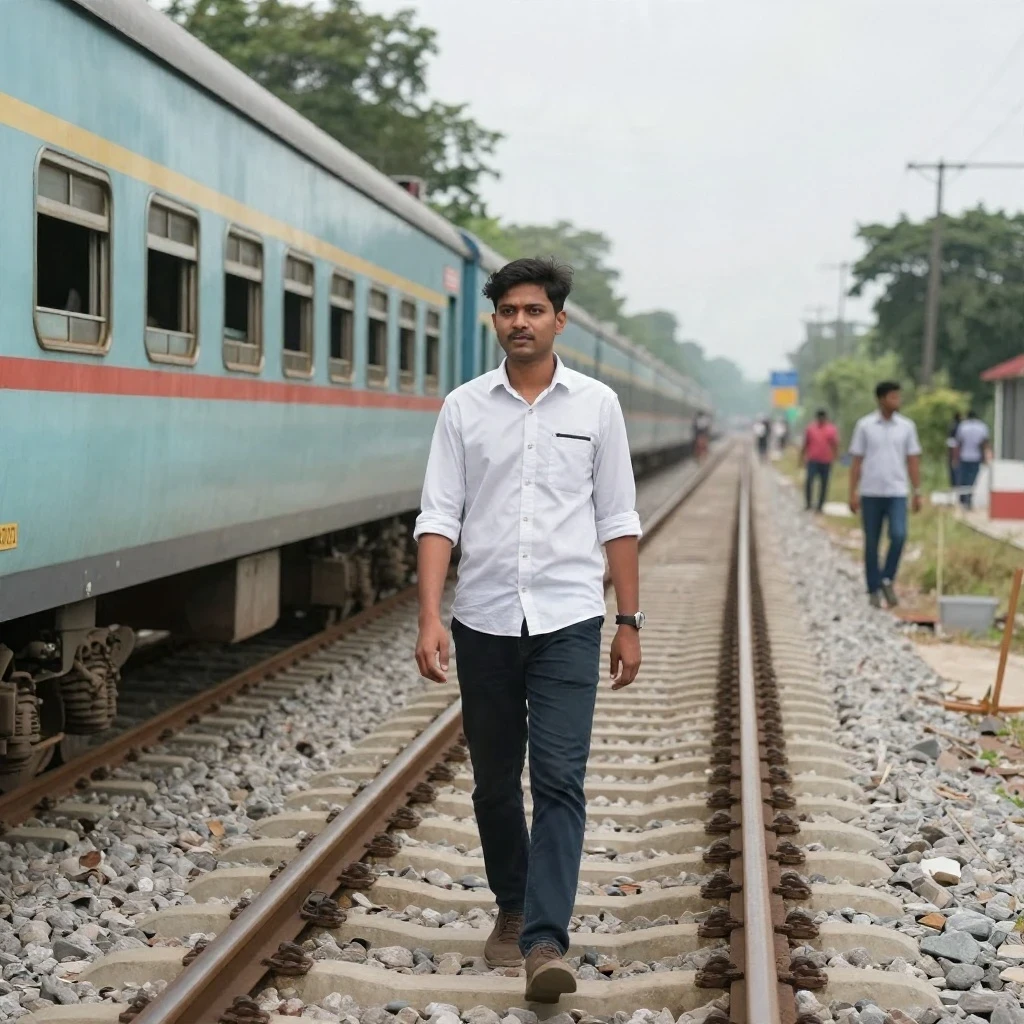
The disappearance and subsequent recovery of a young political communications professional's body along a railway corridor in Jharkhand has thrust questions of passenger safety, institutional duty, and investigative transparency into sharp public focus.
Devpalik Gupta, aged thirty-one, served as digital communication manager for the Jan Suraaj Party, the political outfit founded by strategist Prashant Kishor, and his death near the Angara-Muri section of Ranchi district has left colleagues, family, and party leadership demanding clarity.
The case sits at the intersection of routine rail travel and unexplained fatality, a combination that historically invites scrutiny of both railway policing and forensic follow-through.
On This Page
What distinguishes this incident is the sheer ordinariness of its beginnings. Gupta boarded the Jan Shatabdi Express at Ranchi railway station on a Monday afternoon, accompanied by a friend and colleague, Gautam Kumar, and reportedly seated in coach C-2, seat 50, with two associates nearby.
He reportedly walked toward the pantry car around three o'clock, before the train reached Muri station, and simply never returned. His companions could not locate him, his mobile phone was switched off, and a complaint was eventually lodged at the Muri Government Railway Police station, triggering a joint search by the GRP and the Railway Protection Force.
The recovery of the body in a forested stretch near the tracks, identified partly through an identity card bearing his photograph, has done little to resolve the central mystery of how a passenger vanished from a moving train.
Ranchi Rural Superintendent of Police Gaurav Goswami confirmed the discovery and stated that a police team had begun investigating the circumstances of death. For a party operating in Bihar's charged political environment, the loss of a young communications operative carries professional and emotional weight, while for the broader public it raises uncomfortable questions about how quickly and rigorously such cases are pursued.
TL;DR Devpalik Gupta, the thirty-one-year-old digital communication manager of Prashant Kishor's Jan Suraaj Party, was reported missing from the Ranchi–Patna Jan Shatabdi Express after leaving his coach for the pantry car near Muri. His body was later recovered in a forested area along the Angara-Muri railway section, identified through an identity card found nearby. The GRP and RPF conducted a joint search, and Ranchi Rural SP Gaurav Goswami confirmed an active investigation. The case remains unresolved on the pivotal question of how Gupta exited a moving train, and it has renewed attention on railway passenger safety, political staff welfare, and the transparency of preliminary police findings in Jharkhand.
The Anatomy of an Unexplained Disappearance
Reconstructing the timeline is essential to understanding why this case has resisted easy explanation. Gupta's journey began at Ranchi railway station with a companion, proceeded through a scheduled departure at approximately 2:25 pm, and unravelled within roughly forty minutes, well before the train's arrival at Muri.
The narrow window between his departure for the pantry car and the discovery of his absence compresses the entire mystery into a few kilometres of track, a geography that investigators must now map with precision.
The Final Recorded Movements
According to accounts circulating on social media from a friend, Gupta occupied seat 50 in coach C-2 alongside two associates. He reportedly rose to order food from the pantry car around 3 pm, a mundane errand that placed him in the vestibule and corridor spaces between coaches.
When he failed to return, companions searched the train, found his phone switched off, and alerted authorities upon reaching Muri, where the complaint was formally registered with the Government Railway Police.
These details matter because they establish that Gupta was not travelling alone and that his absence was noticed promptly rather than hours later. The presence of colleagues who could describe his last known position gives investigators a defined starting point, yet the absence of any confirmed sighting after his departure for the pantry car leaves the critical interval undocumented.
Whether CCTV footage from the coach or station platforms exists and has been secured remains a question the public record does not yet answer.
Recovery and Identification
The body was located in a forested area near the railway tracks in the Angara-Muri section, a stretch where dense vegetation runs close to the corridor. Identification was facilitated by an identity card bearing Gupta's photograph found near the body, a detail confirmed by Ranchi Rural Superintendent of Police Gaurav Goswami.
A police team reached the site and commenced an investigation into the circumstances surrounding the death, though no official cause has been publicly established.
The reliance on a photographic identity card for preliminary identification underscores how quickly field procedures move in such cases, and it also signals that formal forensic confirmation may still be pending.
For the family in Kushinagar district of Uttar Pradesh, the confirmation brought grief without closure, since the manner and mechanism of death remain unexplained. The gap between identifying a body and explaining a death is precisely where investigative diligence is tested.
We Also Published
Who Was Devpalik Gupta
Beyond the procedural questions, the case concerns a specific career cut short. Gupta, thirty-one, hailed from Kushinagar district in Uttar Pradesh and was a 2018 alumnus of the Indian Institute of Mass Communication in Delhi, one of the country's most respected journalism and mass communication institutions.
His professional trajectory placed him at the centre of political messaging for Jan Suraaj, a party that has positioned itself as a disruptor in Bihar's electoral landscape under Prashant Kishor's direction.
A Communications Career in Political Terrain
The role of digital communication manager in a modern political party is far from clerical. It involves shaping narrative across platforms, managing rapid response to controversy, coordinating content teams, and translating strategy into daily public messaging.
For a young party seeking traction, such operatives function as the connective tissue between leadership intent and voter perception, often working irregular hours under intense scrutiny and pressure.
Gupta's IIMC background suggests formal training in media ethics, reporting practice, and audience analysis, credentials that likely informed his approach to political communication. Colleagues in the party have described him as part of a young cohort drawn to Kishor's political project, which recruits heavily from professional and student communities.
His death therefore registers not merely as a personal tragedy but as a loss to a nascent political organisation still building its institutional memory.
The Jan Suraaj Context
Jan Suraaj, launched by Prashant Kishor after his departure from active advisory roles with major national parties, has cultivated an image of grassroots engagement and youth participation. Its organisational culture emphasises direct contact with constituents and heavy digital outreach, making communications staff central to its public identity.
The party operates in a state where political competition is fierce and where the personal security of workers is not always guaranteed.
The death of a senior communications figure in such an environment inevitably invites reflection on duty of care. Political parties rarely publish protocols for staff safety during travel, and the informal nature of campaign work often means late journeys, shared transport, and minimal oversight.
Whether Gupta's case prompts any internal review within Jan Suraaj remains to be seen, but the question of institutional responsibility is now part of the public conversation.
Railway Policing and the Mechanics of Search
The institutional response to Gupta's disappearance illustrates how railway security architecture operates in practice. The Government Railway Police, responsible for law and order and crime on railway property, received the complaint at Muri, while the Railway Protection Force, a separate force focused on railway property and passenger security, joined the search.
This dual structure is designed for coverage but can complicate coordination when a case demands rapid, unified action across jurisdictions.
GRP and RPF: Divided Mandates
The GRP functions under state police authority for incidents occurring on railway land, handling registration of FIRs, investigation, and coordination with district police. The RPF, by contrast, operates under the Railway Board and concentrates on protecting railway assets, assisting passengers, and enforcing railway regulations.
When a passenger goes missing from a moving train, both forces have legitimate roles, yet neither holds exclusive ownership of the investigative narrative.
In Gupta's case, the joint search produced a recovery within the Angara-Muri section, a stretch falling under the jurisdiction of Ranchi Rural police for the land adjacent to the tracks. This layering of authority, spanning GRP, RPF, and district police, means that evidence handling and witness coordination require deliberate handoffs.
Whether those handoffs occurred smoothly is a question that only a formal investigation report can answer, but the structural complexity is worth understanding.
Investigating a Moving-Train Disappearance
Establishing how a passenger leaves a moving train requires reconstructing physical possibilities against testimony. Investigators typically examine coach vestibules, door latches, platform footage at intervening stations, and the testimony of co-passengers and railway staff.
In this instance, the reported absence of any confirmed sighting after Gupta left for the pantry car means the investigative burden rests heavily on forensic examination of the recovery site and on digital records.
Mobile phone data, including tower location and last active timestamp, could prove decisive in narrowing the window during which Gupta exited the train. The reported fact that his phone was switched off adds a layer of complexity, since deliberate powering down and battery exhaustion produce different forensic signatures.
The distance between the point of disappearance and the recovery site will also inform reconstructions of trajectory, whether accidental or otherwise.
Forensic Questions and the Burden of Proof
Every unexplained death eventually reduces to a set of forensic questions that must be answered with evidence rather than inference. In this case, the post-mortem examination will be pivotal, addressing cause of death, the presence of injuries consistent with a fall from a moving train, and any indications of ante-mortem trauma.
The timing of the examination and the completeness of documentation will shape the credibility of whatever conclusion authorities eventually reach.
What a Post-Mortem Can and Cannot Establish
A post-mortem can distinguish between injuries sustained before death and those inflicted after, identify the mechanism of fatal trauma, and estimate the interval since death. It can also reveal whether drowning, strangulation, or blunt force contributed, and whether toxicological factors were present.
What it cannot do, on its own, is determine intent, which is why scene evidence and witness testimony remain indispensable.
In railway fatalities, the pattern of injuries often provides strong circumstantial signals. Abrasions consistent with contact with ballast, fractures aligned with a fall trajectory, and the distribution of injuries across the body can support or contradict accounts of accidental exit.
The recovery of the body in a forested area near the tracks, rather than on the tracks themselves, adds a spatial variable that investigators must reconcile with the physics of a fall.
Digital and Circumstantial Evidence
Digital evidence in this case spans mobile network records, messaging activity, and any available CCTV footage from Ranchi station, the train itself, and intervening stations. The reported switching off of Gupta's phone is a critical data point, since network logs can establish the precise time of disconnection and the last cell tower with which the device communicated. Such records are routinely obtainable through legal process.
Circumstantial evidence, including the testimony of the two associates in coach C-2 and the colleague who boarded with him, will require careful corroboration. Discrepancies in timing, seating, and movement can either strengthen or undermine the emerging narrative.
Investigators must also consider whether any prior threat, dispute, or professional conflict existed, though no such information has entered the public domain.
Political Reaction and Public Trust
The political dimension of this case cannot be separated from its human one. Jan Suraaj operates in a competitive environment where public perception of competence and integrity shapes electoral fortunes, and the death of a communications manager invites scrutiny of how the party responds.
Statements of condolence are expected, but the more consequential question is whether the party presses for a transparent investigation and supports the family through the process.
- 01
- 02
- 03
- 04
Party Response and Expectations
Prashant Kishor's political brand rests on claims of clean governance and systemic reform, which raises the bar for how his organisation handles internal crises. A party that campaigns against opacity is expected to demand clarity from authorities and to communicate openly with its own workers.
Whether Jan Suraaj converts grief into advocacy for a thorough inquiry will be watched closely by supporters and critics alike.
For the family in Kushinagar, the immediate needs are practical: information, access to the investigation, and support for the return of the body and the performance of last rites.
Political parties often mobilise resources in such moments, and the extent of institutional backing offered to Gupta's family will be read as a measure of the party's internal culture. Public sympathy alone does not substitute for material and legal assistance.
Broader Questions of Worker Safety
Political work in India frequently involves travel across states, irregular schedules, and limited formal safety infrastructure. Communications staff, in particular, travel to cover events, coordinate with media, and manage rapid-response messaging, often without dedicated security arrangements.
Gupta's case highlights a gap that parties rarely address publicly: the absence of standardised travel safety protocols for political employees.
Beyond politics, the case resonates with broader concerns about passenger safety on Indian Railways, particularly for solo travellers on long-distance trains. While overall safety metrics have improved with electrification, CCTV expansion, and dedicated helplines, incidents involving missing passengers continue to test public confidence. Each such case becomes a referendum on whether institutional responsiveness matches the scale of the network.
What Comes Next in the Investigation
The path forward depends on several procedural milestones that will determine whether the case achieves resolution or drifts into ambiguity. The post-mortem report, the findings of the scene examination, and the availability of digital records will collectively shape the investigative direction.
Each milestone carries its own timeline, and delays at any stage can erode public confidence and complicate the family's search for answers.
Procedural Milestones to Watch
The first milestone is the formal post-mortem examination and the release of its findings to investigating officers. The second is the compilation of witness statements from co-passengers, railway staff, and the two associates who travelled with Gupta.
The third is the forensic analysis of the recovery site, including documentation of the body's position relative to the track and surrounding vegetation.
Digital evidence acquisition forms a fourth milestone, encompassing mobile network records and any CCTV footage from Ranchi station, the train's coach cameras if equipped, and platforms at Muri and intervening stops.
Finally, the consolidation of these streams into a coherent investigative conclusion will determine whether the case is classified as accidental, suicidal, or criminal, each carrying distinct legal consequences.
The Case for Transparency
Public confidence in such investigations depends heavily on communication. When authorities release periodic, factual updates without prejudicing the inquiry, speculation is contained and the family is spared the distress of rumour.
Conversely, silence creates space for conjecture, and in politically sensitive cases, conjecture can harden into competing narratives that outlast the investigation itself.
The Ranchi Rural police and the GRP would serve all parties well by establishing a clear channel for verified information. This does not require disclosing investigative details prematurely, but it does require acknowledging the public interest in a case involving a young professional's death on a routine journey. Transparency, handled with discretion, is the most reliable safeguard against the erosion of trust.
The death of Devpalik Gupta is, at its core, a human loss that no amount of procedural analysis can fully address. A thirty-one-year-old professional with formal training in mass communication, a young family in Uttar Pradesh, and a role at the centre of a rising political organisation has died in circumstances that remain unexplained.
The obligation of the state is to provide answers grounded in evidence, and the obligation of the public is to demand those answers without prejudging them.
For Jan Suraaj, the case is a test of institutional character. For Indian Railways, it is another reminder that passenger safety is a continuous obligation rather than a periodic achievement. For the family, it is the hardest kind of waiting.
The investigation now carries the weight of all three, and its credibility will be measured not by the speed of its conclusions but by the rigour of its process.
From our network :
- Live Online English Classes for Kids: Do They Actually Reduce Anxiety?A ten-week study reveals that synchronous online English classes can significantly reduce child language anxiety while improving listening and reading skills. Discover what makes these programs effective and how parents can select the right one.
- Forbidden Matrix Patterns and Visible Lattice Points: A Geometric DictionaryExplore how multidimensional 0–1 matrices encode geometric truths, linking forbidden patterns to visible lattice points and hypergraph theory, with applications in combinatorics and computational geometry.
- CISA’s Ten-Advisory Wave: Why Generic Patching Fails in OT and How to Build Product-Specific PlaybooksCISA released ten ICS advisories in one week, exposing critical infrastructure risks. Generic patching fails in OT. Learn to build product-specific remediation playbooks.
- The Final Descent: How ESA Retired the Legendary Cluster Constellation After 24 Years of Space Weather ScienceAfter 24 years mapping Earth’s magnetosphere, ESA’s Cluster mission concluded with a precisely controlled reentry over the South Pacific. This analysis explores the scientific legacy, engineering decisions, and debris mitigation principles behind one of space exploration’s most responsible retirements.
- The Hidden Cost of AI Convenience: Why Over-Permissioned Agents Are a Security Time BombDiscover why AI agents with excessive permissions create dangerous single points of failure, and learn how implementing least privilege principles can protect your organization from exploitation.
- Mobile Learning and VR in English: What Global Evidence Reveals About Effective Language TechnologyA systematic review across 14 countries reveals which language-learning technologies genuinely work. Mobile learning, AI, and VR show measurable benefits when pedagogically integrated. This evidence-based guide helps educators and learners select technology that delivers real return on investment.
- University Language Proficiency Exams: Why Institutional Tests Demand Different Preparation Than IELTS and TOEFLDiscover why university-specific language proficiency examinations differ fundamentally from IELTS and TOEFL, and learn strategic preparation approaches for institutional assessment success.
- Committed Mediterranean Precipitation Decline: Why Emissions Cuts Alone Cannot Restore Winter RainsNew NOAA research reveals that Mediterranean winter rains may decline irreversibly even with emissions cuts. Explore the science of committed climate change and regional impacts.
- How AI Agents Will Change the Way We Manage Personal FinancesExplore how AI agents are transforming personal finance through automated budgeting, bill payment, and investment management, while examining the critical security protocols and governance frameworks required for safe deployment.
RESOURCES
- In a tragic incident, 31-year-old Devpalik Gupta, the digital ...instagram.com4 days ago ... ... investigation, with questions surrounding Gupta's sudden ... Devpalik Gupta, Jan Suraaj Party, Prashant Kishor, Ranchi Railway Track Death.
- Devpalik Gupta, 31, the digital communications manager ... - Facebookfacebook.com3 days ago ... Devpalik Gupta, 31, the digital communications manager of Prashant Kishor's Jan Suraaj Party, was found dead near railway tracks in…
- Mojo Story on X: "In a tragic incident, 31-year-old Devpalik Gupta ...x.com4 days ago ... ... Jan Suraaj Party, was found dead near railway tracks in Ranchi on Tuesday, nearly 24 hours after mysteriously disappearing…
- Jan Suraaj Party's social media head goes missing in Ranchiindiatoday.in4 days ago ... Jan Suraaj Party functionary Devpalik Gupta was found dead beside railway tracks near Ranchi. Police suspect an accidental fall from…
- IndiaToday on Xx.com3 days ago ... Devpalik Gupta, 31, the digital media manager of Prashant Kishor's Jan Suraaj Party, was found dead near railway tracks in…
- Jan Suraaj Party Digital Communication Manager Found Dead Near ...etvbharat.com4 days ago ... Ranchi: The digital communication manager for the Jan Suraaj Party, Devpalik Gupta, was found dead on Tuesday along the railway…
- Jan Suraaj Party digital team member and aide of Prashant Kishor ...opindia.com3 days ago ... Prashant Kishor's oarty functionary found dead near railway tracks in Ranchi. Devpalik Gupta (via India Today) and Prashant Kishor (PTI).…
- Jan Suraaj functionary Devpalik Gupta found dead near railway ...timesofindia.indiatimes.com4 days ago ... RANCHI: The body of a functionary of the Prashant Kishor-led Jan Suraaj Party, who went missing while travelling on a…
- Jan Suraaj Party digital manager Devpalik Gupta found dead near ...thenewsmill.com4 days ago ... Jan Suraaj Party digital manager Devpalik Gupta found dead near railway track in Ranchi ... death are under investigation. His…
- Jan Suraaj Party functionary Devpalik Gupta was found dead near ...threads.com3 days ago ... The Logical Indian (@thelogicalindian). 57 Views. Jan Suraaj Party functionary Devpalik Gupta was found dead near railway tracks in Ranchi, ...
- Ranchi GRP after Jan Suraaj staffer found deadbignewsnetwork.com3 days ago ... The Government Railway Police (GRP) in Ranchi on Wednesday said an investigation is underway and the body has been sent…
- Communications manager of Prashant Kishor's party found dead ...m.economictimes.com4 days ago ... Devpalik Gupta, a communications manager for the Jan Suraaj Party, went missing from a train on Monday. His body was…
- Jan Suraaj's Devpalik found dead near Ranchi - Jharkhand Inc.jharkhandinc.com4 days ago ... Jan Suraaj communication manager Devpalik Gupta was found dead near Barwadag in Ranchi district a day after going missing from…
- Jan Suraaj Party functionary, who went missing from train, found ...nationalheraldindia.com4 days ago ... ... dead near railway tracks in Ranchi. Devpalik Gupta, 31, went missing from the Ranchi-Patna Janshatabdi Express on Monday. Police…
- Jan Suraaj Leader Devpalik Gupta Found Dead Near Ranchi-Muri ...bhaskarenglish.in4 days ago ... ... Jarwadih, in the Angara police station area. The Angara police and the Government Railway Police (GRP) are jointly investigating…
- 01
- 02
- 03
- 04
- 05
- 06
- 07
- 08
0 Comments