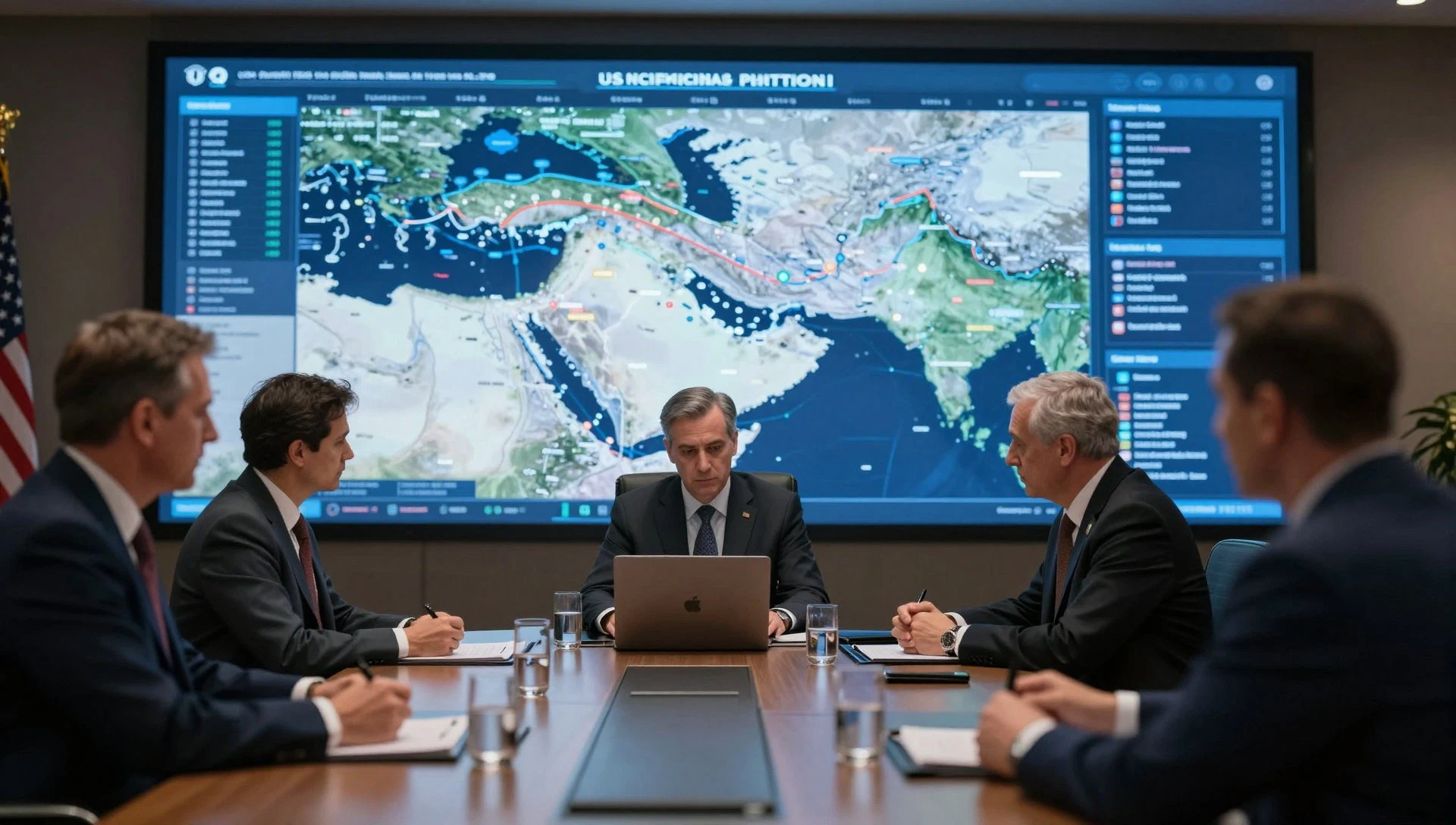
The reporting attributed to United States officials concerning an alleged Iranian programme of attacks against American personnel constitutes a significant, if thinly substantiated, development in the security discourse surrounding West Asia.
According to accounts circulating through The New York Times, unnamed officials have characterised the planning as being at an advanced stage, yet the same reporting concedes that no operational specifics—targets, timing, or method—have been disclosed.
This asymmetry between the gravity of the claim and the paucity of verifiable detail is itself analytically consequential, because it shapes how publics, markets, and allied governments interpret the signal.
On This Page
- The Epistemic Foundations of Unattributed Intelligence Claims
- Institutional Pathways of Threat Disclosure
- Strategic Signalling and Regional Escalation Dynamics
- Methodological Challenges in Assessing Covert Intentions
- Implications for Policy, Publics, and the Future of Regional Order
- Synthesis: Reading the Warning Responsibly
Intelligence claims of this character rarely enter the public domain in isolation. They typically function within a broader communicative ecosystem in which strategic signalling, domestic political positioning, and alliance management intersect with genuine threat assessment.
The absence of corroborating evidence in the initial report does not establish that the underlying intelligence is unsound, but it does mean that any responsible analysis must distinguish carefully between what is asserted, what is evidenced, and what remains conjecture. The epistemic status of the claim is therefore central to its interpretation.
The following examination situates the report within the longer arc of United States–Iran relations, evaluates the institutional mechanics by which such warnings are produced and disseminated, and considers the plausible strategic purposes that public disclosure may serve.
It also addresses the methodological difficulties inherent in assessing covert intentions, the implications for regional escalation dynamics, and the standards of evidence that ought to govern public deliberation on matters of war and peace.
TL;DR United States officials, cited by The New York Times, have alleged that Iran is in advanced stages of planning attacks on Americans, without disclosing targets, timing, or supporting evidence. This analysis examines the claim's epistemic status, the institutional pathways of intelligence disclosure, the strategic signalling functions such warnings may perform, and the regional escalation risks involved. It argues that public deliberation should distinguish rigorously between assertion and evidence, while acknowledging that covert intent is inherently difficult to verify and that historical precedent offers only probabilistic guidance.
The Epistemic Foundations of Unattributed Intelligence Claims
Claims advanced by unnamed officials occupy a peculiar position in public discourse: they carry the authority of the state while remaining insulated from direct accountability. The New York Times report exemplifies this structure, attributing the assertion to "US officials" collectively rather than to identifiable individuals or institutions.
Such anonymisation is sometimes necessary to protect sources, yet it simultaneously renders independent verification difficult and complicates any assessment of the claim's reliability.
The Structural Logic of Source Protection
Journalistic conventions permit the attribution of sensitive national security information to anonymous officials when disclosure could endanger sources or compromise ongoing operations. This practice is defensible in principle, since without it much legitimate reporting on intelligence matters would be impossible.
However, the convention also creates conditions in which claims may be advanced without the evidentiary scrutiny that named attribution would invite.
The consequence is that readers must evaluate not the evidence itself but the credibility of an institutional process they cannot observe. This asymmetry places a substantial interpretive burden on the public and on allied governments attempting to calibrate their responses. The report's silence on targets, timing, and method intensifies rather than resolves this difficulty.
Scholars of intelligence studies have long noted that the credibility of a warning depends on the specificity of the threat and the track record of the disclosing institution. A general assertion of advanced planning, unaccompanied by corroborating indicators, falls toward the weaker end of this spectrum. It may nonetheless be accurate, but its accuracy cannot be established from the report alone.
Comparative cases illustrate the range of outcomes. Some historical warnings of imminent attack proved prescient and enabled preventive action; others reflected incomplete intelligence, political pressure, or institutional bias. The base rate of accuracy for such warnings is therefore neither negligible nor assured, and prudent analysis must hold both possibilities in view.
Verification Asymmetries and the Problem of Covert Intent
Intentions, unlike capabilities, are not directly observable. Satellite imagery can reveal missile deployments; signals intelligence may intercept communications; but the translation of intention into action depends on decision-making processes that remain opaque even to sophisticated collection. This inherent opacity means that assessments of "advanced stages" rest on inference rather than direct observation.
The phrase itself is analytically imprecise. "Advanced stages" could denote operational readiness, political authorisation, or merely the intensification of contingency planning that may never be executed. Without specification, the term functions rhetorically as much as descriptively, conveying urgency while resisting falsification. Precise terminology would distinguish among these possibilities, but the report does not do so.
Verification is further complicated by the adversarial context. Iran has obvious incentives to conceal genuine preparations and, equally, to permit ambiguity about its intentions to function as deterrence. The United States has incentives to publicise threats it perceives, both to warn its citizens and to build international support for countermeasures. Neither party's communications can be taken at face value.
Under such conditions, the responsible analytical posture is one of qualified uncertainty. The claim should be treated as a serious signal warranting attention and precautionary measures, while remaining explicitly provisional pending corroboration. Collapsing this uncertainty into either confident assertion or dismissive scepticism would misrepresent the evidentiary situation.
Historical Precedents and Their Limits
History offers numerous instances in which public warnings of impending attack preceded actual violence, and others in which warnings proved unfounded or were later revealed to rest on flawed intelligence. The 2003 Iraq assessments remain the paradigmatic cautionary case, demonstrating how institutional pressures can distort the interpretation of ambiguous evidence. Iran-related warnings have their own contested history.
These precedents counsel against both credulity and reflexive dismissal. They suggest that the institutional processes generating threat assessments require robust internal challenge, congressional oversight, and transparency wherever feasible. Where such safeguards are weak, the probability of error—in either direction—increases correspondingly, and public confidence in the warning becomes harder to sustain.
It must also be acknowledged that historical analogy has limits. Each crisis possesses distinctive features: the specific capabilities involved, the regional configuration of allies and adversaries, the domestic political constraints on decision-makers. Precedent informs probabilistic judgment but cannot substitute for case-specific evidence, which in this instance remains largely undisclosed.
The analytical task, therefore, is to hold the claim at its proper evidentiary weight—neither inflated into certainty nor deflated into insignificance—while attending to the institutional and political contexts that shape how such warnings are produced, circulated, and received.
Institutional Pathways of Threat Disclosure
Public warnings concerning foreign threats emerge from a complex institutional ecosystem encompassing intelligence agencies, the executive branch, congressional oversight bodies, and the press. Understanding this ecosystem illuminates why certain claims become public and others do not, and why the form in which they appear carries interpretive significance.
Disclosure is rarely a neutral transmission of fact; it is a governed process shaped by law, policy, and institutional interest.
Intelligence Collection and Analytic Tradecraft
Assessments of foreign intentions are produced through structured analytic techniques designed to mitigate cognitive bias and incorporate diverse sources. These techniques include competing hypotheses analysis, red-team challenge, and probabilistic language calibrated to express confidence levels.
The published report, however, conveys none of this granularity, presenting a binary assertion stripped of the qualifying apparatus that professional tradecraft requires.
This compression is partly a function of journalistic format, which favours clarity over nuance. Yet it also reflects the political utility of unambiguous messaging. A warning hedged with confidence intervals and alternative explanations commands less public attention than a declarative statement of imminent danger. The incentives of communication therefore pull toward simplification, with attendant risks of distortion.
Analysts within the intelligence community are typically careful to distinguish between what is known, what is assessed, and what is speculated. When such distinctions disappear in public reporting, the audience loses the information necessary to calibrate its response. The resulting discourse tends toward alarm or dismissal rather than measured precaution.
Improving this situation would require greater transparency about analytic confidence where disclosure is feasible, and clearer journalistic conventions for conveying uncertainty. Neither reform is straightforward, but both are relevant to the quality of public deliberation on security matters.
Executive Branch Signalling and Deterrence
Public disclosure of a threat can serve deterrent purposes. By announcing that hostile preparations have been detected, a government may signal its awareness and thereby raise the adversary's expected costs. This logic of deterrence by disclosure is well established in strategic theory and may operate even when the underlying intelligence is incomplete.
Disclosure may also serve alliance management functions, reassuring partners that the disclosing state is attentive to shared threats and preparing coordinated responses. In the present case, the report's appearance in a major American newspaper ensures visibility to allied capitals and domestic audiences alike, potentially catalysing diplomatic activity and precautionary measures.
Domestic political considerations may also intrude, though their influence is difficult to establish empirically. Governments sometimes publicise threats to demonstrate vigilance, to justify policy initiatives, or to shape public opinion ahead of contested decisions. Such motives need not be cynical; they may coexist with genuine concern. But their presence complicates interpretation.
Distinguishing among these purposes from outside the decision-making process is inherently difficult. The analyst can identify the functions that disclosure might serve but cannot readily determine which, if any, motivated it in a particular instance. This indeterminacy should temper confident causal claims.
Congressional Oversight and Legal Frameworks
In the United States, intelligence activities are subject to congressional oversight through committees with access to classified information. This oversight provides a mechanism for challenging assessments and examining their evidentiary basis, though its effectiveness varies with political conditions and the willingness of members to exercise scrutiny.
Legal frameworks governing covert action and the use of force impose procedural requirements that shape how threats are addressed. Public warnings may interact with these frameworks by building the political predicate for subsequent action. The relationship is not deterministic, but it is consequential for how crises unfold.
Where oversight is robust, the probability that unfounded claims will drive policy diminishes. Where it is weak or politicised, the risk of error increases. Strengthening oversight mechanisms is therefore a structural safeguard against the misuse of threat assessments, independent of the merits of any particular claim.
The public dimension of oversight is equally important. Citizens cannot evaluate what they cannot see, and the press serves as an intermediary translating classified assessments into public discourse. The quality of that translation materially affects democratic accountability.
The Press as Intermediary and Amplifier
Journalists reporting on national security navigate competing obligations: to inform the public, to protect sources, and to avoid amplifying unverified claims in ways that could precipitate conflict. These obligations can conflict, and the resolution adopted in any given report reflects editorial judgment that is itself subject to critique.
The New York Times report, by attributing the claim to officials while noting the absence of detail, adopts a cautious formulation. It conveys the assertion without endorsing it, leaving readers to assess its weight. This approach is defensible, though it inevitably confers visibility and implicit credibility on the claim.
Media amplification can generate feedback effects, prompting official statements, market reactions, and diplomatic activity that in turn reinforce the perception of crisis. Such dynamics are not necessarily irrational, but they can accelerate escalation independently of the underlying facts. Awareness of these effects should inform both reporting and reading practices.
The proliferation of information across digital platforms further complicates the picture, as claims circulate rapidly and often without the contextual qualifications present in the original report. Fragments travel farther than nuance, and the resulting public understanding may diverge substantially from the source material.
We Also Published
Strategic Signalling and Regional Escalation Dynamics
The disclosure of an alleged Iranian attack plan occurs within a regional environment already characterised by elevated tension, proxy competition, and contested maritime spaces. In such conditions, public warnings can function as instruments of crisis management or as accelerants of confrontation, depending on how recipients interpret and respond to them. The distinction is not academic; it bears directly on the probability of inadvertent escalation.
Deterrence, Compellence, and Ambiguity
Strategic theory distinguishes deterrence—dissuading action by threatening costs—from compellence, which seeks to induce action or change behaviour. Public warnings may serve either function. By announcing detection of hostile preparations, a state signals both its awareness and its potential readiness to respond, thereby raising the adversary's anticipated costs.
Ambiguity can enhance or undermine these effects. Deliberate ambiguity about response thresholds may deter by leaving the adversary uncertain, but it can also invite miscalculation if the adversary misjudges resolve. The present report's vagueness about targets and timing contributes to this ambient uncertainty without resolving it in either direction.
Iran's own strategic culture emphasises asymmetric responses, proxy networks, and deniable operations. These features complicate attribution and retaliation, creating conditions in which warnings may be genuine yet difficult to act upon. The interaction between Iranian doctrine and American signalling produces a complex game in which public statements are themselves moves.
Analysts should therefore resist treating the report as a simple factual bulletin. It is better understood as an element within an ongoing strategic interaction, whose effects depend on how multiple audiences—domestic, allied, adversarial—interpret and respond to it.
Proxy Networks and Attribution Challenges
Much of Iran's regional influence operates through aligned non-state actors whose actions are formally deniable. This structure complicates both the assessment of threat and the design of responses, since attribution to state direction is often inferential rather than direct. Warnings about "attacks on Americans" may encompass actions by such proxies.
Attribution difficulties cut both ways. They permit Iran to exert pressure while limiting escalation risk, and they permit adversaries to attribute hostile acts to Iranian direction even where evidence is circumstantial. The resulting epistemic fog is a structural feature of the security environment, not a temporary aberration.
In such conditions, the credibility of warnings depends heavily on the specificity of intelligence and the transparency of the inferential chain. General assertions of proxy plotting are easier to make than to substantiate, and their repetition can create an impression of certainty that the underlying evidence may not support.
Responsible analysis must therefore attend to the mechanisms of attribution, the quality of the evidence adduced, and the institutional interests of those making the claim. These considerations do not resolve the question but they structure a more disciplined approach to it.
Escalation Pathways and Inadvertence
Crises escalate through mechanisms that are often unintended: misperception, bureaucratic momentum, honour-driven commitment, and the logic of security dilemmas. Public warnings can activate several of these mechanisms simultaneously, raising the salience of the threat and constraining the options available to decision-makers.
Once a threat is publicly announced, backing down becomes politically costly. Governments that have warned of imminent danger face pressure to act if the danger materialises, and to explain if it does not. This dynamic can create incentives for pre-emptive measures that might otherwise have been avoided.
Conversely, warnings can enable de-escalation by prompting precautionary measures, diplomatic engagement, and the clarification of red lines. The net effect depends on the specific configuration of actors, the credibility of the warning, and the availability of communication channels. No general rule determines the outcome.
Prudent crisis management therefore requires maintaining multiple channels of communication, avoiding public commitments that foreclose diplomatic options, and preserving the capacity for calibrated responses. These are demanding requirements, and their neglect has historically contributed to unintended wars.
Allied Coordination and Burden Sharing
United States warnings of regional threats are typically communicated to allies through diplomatic and intelligence channels, enabling coordinated responses. The public dimension of the present report may serve to align allied publics and governments behind a common assessment, though it may also generate divergent interpretations.
Allies with substantial regional exposure—particularly Gulf states and Israel—have strong interests in the accuracy of such assessments and in the coordination of defensive measures. Their responses provide a partial test of the warning's credibility, since governments with access to their own intelligence can form independent judgments.
Burden-sharing arrangements, including missile defence cooperation and maritime security patrols, are sensitive to threat perceptions. Public warnings can facilitate the political legitimation of such arrangements, though they may also strain them if allies judge the threat overstated or the consultation inadequate.
The coordination dimension thus adds another layer of complexity to the analysis, reminding us that threat disclosure is embedded in alliance politics as well as adversarial dynamics.
Methodological Challenges in Assessing Covert Intentions
Evaluating claims about covert intentions requires methodological discipline that public discourse rarely sustains. The relevant questions concern the reliability of sources, the validity of inferential chains, the calibration of confidence, and the susceptibility of assessments to political distortion. Each of these dimensions presents distinctive difficulties that warrant explicit treatment rather than implicit assumption.
Source Reliability and Corroboration
Intelligence assessments rest on sources of varying reliability, from human informants to technical collection to open-source analysis. The reliability of any given source is itself an estimate, subject to error and manipulation. Corroboration across independent sources increases confidence, but independence is often difficult to establish.
In the present case, the public report provides no information about the number, nature, or reliability of the sources underlying the claim. This omission is standard practice but it leaves the external analyst unable to assess evidentiary quality. The claim must therefore be treated as an assertion whose basis is opaque.
This opacity is not unique to the case at hand; it is characteristic of public discourse about intelligence. The appropriate response is neither to ignore the claim nor to accept it uncritically, but to hold it provisionally while seeking additional information and attending to institutional signals.
Over time, corroboration may emerge through subsequent reporting, official statements, or observable events. Until then, the claim's status remains contested, and analysis should reflect that contestation rather than resolving it prematurely.
Inference, Probability, and Calibrated Language
Professional intelligence assessments employ probabilistic language calibrated to express confidence: "likely," "probably," "almost certainly," and their negations. These terms have established meanings within the analytic community, though they are often interpreted differently by lay audiences. The translation between professional and public registers is therefore fraught.
When such calibration is stripped away, as it typically is in news reporting, the resulting statement appears more definitive than the underlying assessment may warrant. This inflation of certainty can distort public understanding and, in extreme cases, contribute to policy errors. Attention to linguistic precision is thus not pedantry but a substantive safeguard.
Formally, an assessment of intent can be represented as a conditional probability: ##P(\text{attack} \mid \text{evidence})##, which depends on both the prior probability of attack and the likelihood of observing the evidence under competing hypotheses. Public reports rarely convey either quantity, leaving the audience unable to update rationally.
Improving public communication would require conveying at least qualitative information about these components. This is difficult but not impossible, and some official documents have moved in this direction. The practice deserves wider adoption in reporting on security matters.
Political Distortion and Institutional Bias
Intelligence agencies are not immune to the political environments in which they operate. Pressures to support policy preferences, to align with dominant narratives, or to avoid contradicting senior officials can distort assessments. These pressures are well documented in the scholarly literature and in post-mortem investigations of intelligence failures.
Conversely, agencies may resist political pressure and produce assessments that challenge prevailing assumptions. The balance depends on institutional culture, leadership, and the strength of oversight mechanisms. Where these are robust, the probability of distortion diminishes, though it never disappears entirely.
External analysts cannot directly observe these internal dynamics, but they can attend to structural indicators: the presence of dissent, the transparency of methodology, the responsiveness to congressional inquiry. Such indicators provide indirect evidence about the quality of the assessment process.
In the present case, the available public information is insufficient to assess these dimensions. The claim must therefore be treated with the epistemic humility that such insufficiency demands, without thereby dismissing its potential seriousness.
Standards of Evidence for Public Deliberation
Democratic deliberation on matters of war and peace requires standards of evidence that are both rigorous and publicly intelligible. These standards should specify what counts as adequate support for a claim, how uncertainty is to be communicated, and what mechanisms exist for challenge and correction. Their absence leaves deliberation vulnerable to manipulation.
Developing such standards is a task for legislatures, professional bodies, and the press collectively. It involves trade-offs between transparency and source protection, between speed and accuracy, between clarity and nuance. These trade-offs cannot be resolved once and for all, but they can be managed through institutional design.
The alternative is a discourse in which claims circulate without accountability, publics oscillate between alarm and cynicism, and policy proceeds on foundations that are neither examined nor defended. Such a discourse ill serves the security interests it purports to protect.
Attending to these methodological considerations does not resolve the substantive question of whether Iran is planning attacks. It does, however, clarify what would be required to answer that question responsibly, and it identifies the gaps that currently prevent such an answer.
Implications for Policy, Publics, and the Future of Regional Order
The report's significance extends beyond its immediate content to encompass its implications for how security policy is conducted, how publics are informed, and how regional order evolves. These implications are interconnected: policy responses shape public perceptions, which in turn constrain or enable subsequent policy, while the cumulative effect influences the trajectory of regional relations. Analysis must therefore operate at multiple levels simultaneously.
Precautionary Measures and Civilian Protection
Governments receiving credible threat information have obligations to protect their personnel and citizens, including through enhanced security at diplomatic facilities, revised travel advisories, and contingency planning. Such measures are prudent responses to uncertainty and need not await definitive confirmation of the threat.
The proportionality of precautionary measures matters, however. Excessive or highly visible measures can themselves signal crisis, prompting reciprocal actions and contributing to escalation. The calibration of response to threat is therefore a delicate exercise requiring judgment under uncertainty.
Civilian populations, including diaspora communities, may be affected by heightened tensions irrespective of the accuracy of the underlying claim. Attention to their protection and to the avoidance of stigmatisation is an ethical imperative that should accompany security measures.
These considerations suggest that precaution and restraint are not opposed but complementary. The goal is to reduce vulnerability without generating the very confrontation that precaution seeks to avert.
Diplomatic Channels and De-escalation
Amid heightened threat perceptions, the preservation of diplomatic channels becomes especially important. Direct and indirect communication can clarify intentions, correct misperceptions, and establish parameters for restraint. The absence of such channels increases the risk that misunderstandings escalate uncontrollably.
Historical cases demonstrate that even adversarial states can communicate through intermediaries, back channels, and multilateral forums. Maintaining these avenues requires political will and institutional memory, both of which can erode during prolonged hostility. Their preservation is a form of strategic prudence.
Third parties—including regional powers and international organisations—can play constructive roles by facilitating communication and proposing confidence-building measures. Their involvement may be limited by the preferences of the principal adversaries, but it remains a resource worth cultivating.
The public disclosure of threats can complicate diplomacy by raising the political cost of engagement. Decision-makers must therefore weigh the benefits of transparency against the risks to communication, a trade-off that admits no universal solution.
Public Opinion and Democratic Accountability
Public opinion on foreign threats is shaped by media coverage, elite cues, and prior beliefs. Warnings of imminent danger tend to increase support for assertive policies, at least in the short term, though the effect may dissipate if the threat fails to materialise. These dynamics create incentives for leaders to emphasise threats and disincentives to acknowledge uncertainty.
Democratic accountability requires that publics have access to information sufficient to evaluate policy choices. Where information is withheld or distorted, accountability is weakened, and the risk of policy error increases. Strengthening transparency where feasible is therefore both a democratic and a prudential imperative.
At the same time, complete transparency in security matters is neither possible nor desirable. The challenge is to design institutions that balance secrecy with oversight, speed with deliberation, and clarity with nuance. This is an ongoing institutional project rather than a solved problem.
Citizens, for their part, can cultivate the dispositions appropriate to life in an uncertain security environment: attentiveness without alarmism, scepticism without cynicism, and a willingness to revise beliefs in light of evidence.
Trajectories of Regional Order
The longer-term trajectory of West Asian order depends on multiple factors beyond any single warning: the evolution of Iran's nuclear programme, the configuration of alliances, the dynamics of proxy conflict, and the domestic politics of the states involved. The present report is one element within this complex field, not a determinant of its outcome.
Scenarios range from managed competition, in which adversaries establish tacit rules of the game, to open confrontation, in which those rules collapse. Intermediate scenarios include prolonged stalemate, episodic crisis, and negotiated accommodation. The probabilities attached to these scenarios are inherently uncertain and should be treated as such.
Policy choices can influence which scenario materialises, though they cannot determine it. Investments in deterrence, diplomacy, and regional institution-building shape the probability distribution without guaranteeing any particular outcome. Recognition of this contingency is essential to realistic strategy.
The analytical task is thus to map the space of possibilities, identify the factors that push toward or away from confrontation, and design policies robust across a range of scenarios. Such an approach is more demanding than prediction but more useful for decision-making under uncertainty.
Synthesis: Reading the Warning Responsibly
The report attributing to United States officials a claim that Iran is in advanced stages of planning attacks on Americans presents a case study in the interpretation of security information under conditions of uncertainty.
Its significance lies less in any single factual assertion than in the interpretive demands it places on analysts, policymakers, and publics alike. Meeting those demands requires disciplined attention to evidence, language, institutions, and context.
Balancing Seriousness and Scepticism
The claim deserves serious attention because the consequences of dismissing a genuine threat could be severe. It also warrants scepticism because the consequences of acting on an unfounded claim could be equally severe. These considerations are not symmetrical in every respect, but they are both weighty and must be held together.
Holding them together means resisting the pull toward premature resolution. The analyst should neither declare the threat established nor dismiss it as propaganda, but should instead specify what is known, what is inferred, and what would be required to move from one to the other. This is the posture of calibrated uncertainty.
Such a posture is difficult to sustain in public discourse, which rewards confidence and penalises nuance. Yet it is the posture most likely to serve the public interest, because it preserves the capacity for correction as new information emerges. Institutions that cultivate it are more resilient than those that do not.
The alternative—oscillating between alarm and complacency—leaves publics vulnerable to manipulation and policymakers vulnerable to error. Cultivating the dispositions and institutions that support calibrated judgment is therefore a matter of some urgency.
Institutional Safeguards and Their Limits
Oversight, transparency, and adversarial challenge are the principal safeguards against the misuse of threat assessments. Each has limits: oversight can be captured or politicised, transparency can compromise sources, and challenge can be overwhelmed by consensus. Recognising these limits is the first step toward designing better safeguards.
Design improvements might include stronger protections for dissenting analysts, more systematic reporting of confidence levels, and clearer mechanisms for congressional access to underlying evidence. None of these is a panacea, but together they could improve the quality of both assessment and public deliberation.
The press has a complementary role, translating technical assessments into public discourse while preserving essential qualifications. This requires specialised expertise and institutional commitment, both of which are unevenly distributed across outlets. Supporting quality journalism is therefore a component of national security policy, broadly conceived.
Ultimately, safeguards are only as effective as the political culture that sustains them. A culture that rewards candour and tolerates uncertainty is more likely to produce sound judgments than one that punishes dissent and demands certainty.
The Longer View
Individual warnings are episodes within longer trajectories. The trajectory of United States–Iran relations has oscillated between confrontation and engagement for more than four decades, with periods of intense crisis interspersed with diplomatic openings. The present episode should be situated within this longer pattern rather than treated as unprecedented.
Structural factors—geography, resources, ideology, alliance commitments—shape the pattern without determining its specific manifestations. Understanding these factors provides context for interpreting particular events and for anticipating the range of plausible futures. It does not, however, yield precise predictions.
The analytical value of the longer view lies in its capacity to temper both alarmism and complacency. It reminds us that crises have been navigated before and that outcomes depend on choices as well as circumstances. This is a modest but genuine basis for measured optimism.
It also underscores the importance of institutional memory and strategic patience, qualities that are difficult to maintain in media environments that reward immediacy. Cultivating them is a collective task that extends beyond any single report or crisis.
Conclusion: Evidence, Language, and Responsibility
The responsible interpretation of the reported warning requires attention to three interconnected domains: evidence, language, and responsibility. Evidence concerns what is known and how confidently; language concerns how that knowledge is communicated; responsibility concerns who bears the consequences of communication and action. Each domain has its own standards and its own failure modes.
Failures in any domain can produce harm. Overconfident language can generate unnecessary fear; underconfident language can leave publics unprepared; irresponsible action can precipitate the very conflicts it seeks to prevent. The integration of the three domains is therefore not optional but essential to sound practice.
In the present case, the available evidence is thin, the language of the report is appropriately hedged, and the responsibility for further action rests with institutions subject to oversight. These features are grounds for cautious engagement rather than either alarm or dismissal. They are also grounds for continued scrutiny as further information emerges.
The broader lesson is that security discourse is a form of public reasoning, subject to the same demands of rigour, honesty, and accountability as any other. Treating it as such is a precondition for both effective policy and democratic legitimacy. The present report, whatever its ultimate factual status, provides an occasion to reaffirm that commitment.
From our network :
- Forbidden Matrix Patterns and Visible Lattice Points: A Geometric DictionaryExplore how multidimensional 0–1 matrices encode geometric truths, linking forbidden patterns to visible lattice points and hypergraph theory, with applications in combinatorics and computational geometry.
- Mobile Learning and VR in English: What Global Evidence Reveals About Effective Language TechnologyA systematic review across 14 countries reveals which language-learning technologies genuinely work. Mobile learning, AI, and VR show measurable benefits when pedagogically integrated. This evidence-based guide helps educators and learners select technology that delivers real return on investment.
- How AI Agents Will Change the Way We Manage Personal FinancesExplore how AI agents are transforming personal finance through automated budgeting, bill payment, and investment management, while examining the critical security protocols and governance frameworks required for safe deployment.
- Committed Mediterranean Precipitation Decline: Why Emissions Cuts Alone Cannot Restore Winter RainsNew NOAA research reveals that Mediterranean winter rains may decline irreversibly even with emissions cuts. Explore the science of committed climate change and regional impacts.
- The Final Descent: How ESA Retired the Legendary Cluster Constellation After 24 Years of Space Weather ScienceAfter 24 years mapping Earth’s magnetosphere, ESA’s Cluster mission concluded with a precisely controlled reentry over the South Pacific. This analysis explores the scientific legacy, engineering decisions, and debris mitigation principles behind one of space exploration’s most responsible retirements.
- CISA’s Ten-Advisory Wave: Why Generic Patching Fails in OT and How to Build Product-Specific PlaybooksCISA released ten ICS advisories in one week, exposing critical infrastructure risks. Generic patching fails in OT. Learn to build product-specific remediation playbooks.
- The Hidden Cost of AI Convenience: Why Over-Permissioned Agents Are a Security Time BombDiscover why AI agents with excessive permissions create dangerous single points of failure, and learn how implementing least privilege principles can protect your organization from exploitation.
- University Language Proficiency Exams: Why Institutional Tests Demand Different Preparation Than IELTS and TOEFLDiscover why university-specific language proficiency examinations differ fundamentally from IELTS and TOEFL, and learn strategic preparation approaches for institutional assessment success.
- Live Online English Classes for Kids: Do They Actually Reduce Anxiety?A ten-week study reveals that synchronous online English classes can significantly reduce child language anxiety while improving listening and reading skills. Discover what makes these programs effective and how parents can select the right one.
RESOURCES
- Iran in 'Advanced Stages' of Planning Attacks Against Americans ...nytimes.com4 days ago ... The U.S. government has put employees on heightened alert across ... Iranian attack plans, U.S. officials said. After the United…
- Iran warns of retaliation if Trump strikes, US withdraws ... - Reutersreuters.comJan 15, 2026 ... It can take a few minutes, so please check back soon. Summary. 'All the signals are that a US attack…
- Trump doubles down on Iran threats as US puts more sanctionsaljazeera.comJan 30, 2026 ... ... plans” and is on high alert to “repel any threat”. 30 Jan 2026 - 21:30. (21:30 GMT). Analysis. How…
- Gulf allies disappointed U.S. didn't notify about Iran attacks ... - PBSpbs.orgMar 6, 2026 ... Officials from two Gulf countries said their governments were disappointed in the way the U.S. has handled the war, particularly…
- Potential US military strikes on Iran: This won't be another 12-Day Warmei.eduJan 16, 2026 ... With signs pointing to the possibility of some sort of looming kinetic strike against Iran, the situation warrants at least…
- Iran Update, February 23, 2026 | ISWunderstandingwar.orgFeb 23, 2026 ... A senior US official told Axios on Feb. 22 that the US and Iran may discuss an interim deal during…
- 'No intention of negotiating for now,' says Iranian minister, as US ...bbc.comMar 23, 2026 ... ... Iran had received a 15-point plan from the US for reaching a ceasefire; For its part, an Iranian “senior…
- Homeland Threat Assessment 2025dhs.govIn August 2024, a Pakistani national with ties to Iran was indicted for a planned assassination of US government officials. In June 2023, the…
- Iran warns it will respond if Israeli attacks on Lebanon don't stop ...bbc.comApr 7, 2026 ... Israel and the US say Lebanon is not included in a two-week ceasefire deal with Iran. PM Benjamin Netanyahu says…
- The Iran Threat - FBIfbi.gov... U.S. officials. Featured news and stories. Three Iranian Nationals Charged ... officials in Iran's Qods Force. Industry alerts. Industry alerts ...
- Experts react: The US and Israel just unleashed a major attack on ...atlanticcouncil.orgFeb 28, 2026 ... Iran's retaliation signals that it is not planning ... officials, strikes on regime institutions, and attacks against Iran's strategic military ...
- Iran and the U.S. Exchange Retaliation Threatscfr.orgApr 20, 2026 ... Iran's semi-official Tasnim News reported yesterday that Iran had responded by launching drone attacks on U.S. ships in the Gulf…
- Trump warns of "critical period" in Iran war, threatening severe ...cbsnews.comApr 7, 2026 ... ... planned or previous attacks against U.S. diplomatic facilities worldwide. By Tucker Reals. 9:22 AM / April 6, 2026. Iranian…
- U.S. intelligence warns Israel is likely to undermine Iran peace deal ...washingtonpost.comJun 19, 2026 ... Israeli Prime Minister Benjamin Netanyahu faces pressure to continue a military campaign in Lebanon, current and former U.S. officials said.
- What If the United States Doesn't Strike Iran?washingtoninstitute.orgFeb 3, 2026 ... ... warnings about the dangers of another strike have fallen on receptive ears in Tehran. Contrary to U.S. perceptions, Iranian…
- 01
- 02
- 03
- 04
- 05
- 06
- 07
- 08
0 Comments