
The ethnographic vignette drawn from a Friday-night high school football fixture in Deer Park, a suburban municipality within the Houston metropolitan area, offers a compact but analytically rich window into the shifting political psychology of Texas voters ahead of the 2026 midterm elections.
The setting itself is significant: scholastic football functions in much of the American South as a civic ritual comparable to religious observance, and the source material explicitly invokes this parallel through the testimony of one Republican-leaning attendee.
Within such communal spaces, political sentiment is expressed not through formal polling instruments but through informal conversation, signage, and the visible distribution of campaign materials. The reported observations therefore constitute qualitative evidence of grassroots attitudinal change rather than statistically representative data, and should be interpreted with appropriate methodological caution.
On This Page
- The Civic Function of Friday-Night Football in Suburban Political Life
- Three Decades of Republican Dominance and the Specter of Competitiveness
- Issue Salience and the Composition of Voter Concern
- Signage, Enthusiasm, and the Measurement of Partisan Momentum
- Methodological Caveats and the Interpretation of Local Political Testimony
- Synthesis: Local Testimony as a Lens on National Electoral Dynamics
Texas has constituted a reliably Republican stronghold at the statewide level for approximately three decades, a partisan dominance reinforced by demographic growth, suburban consolidation, and the structural advantages of incumbency.
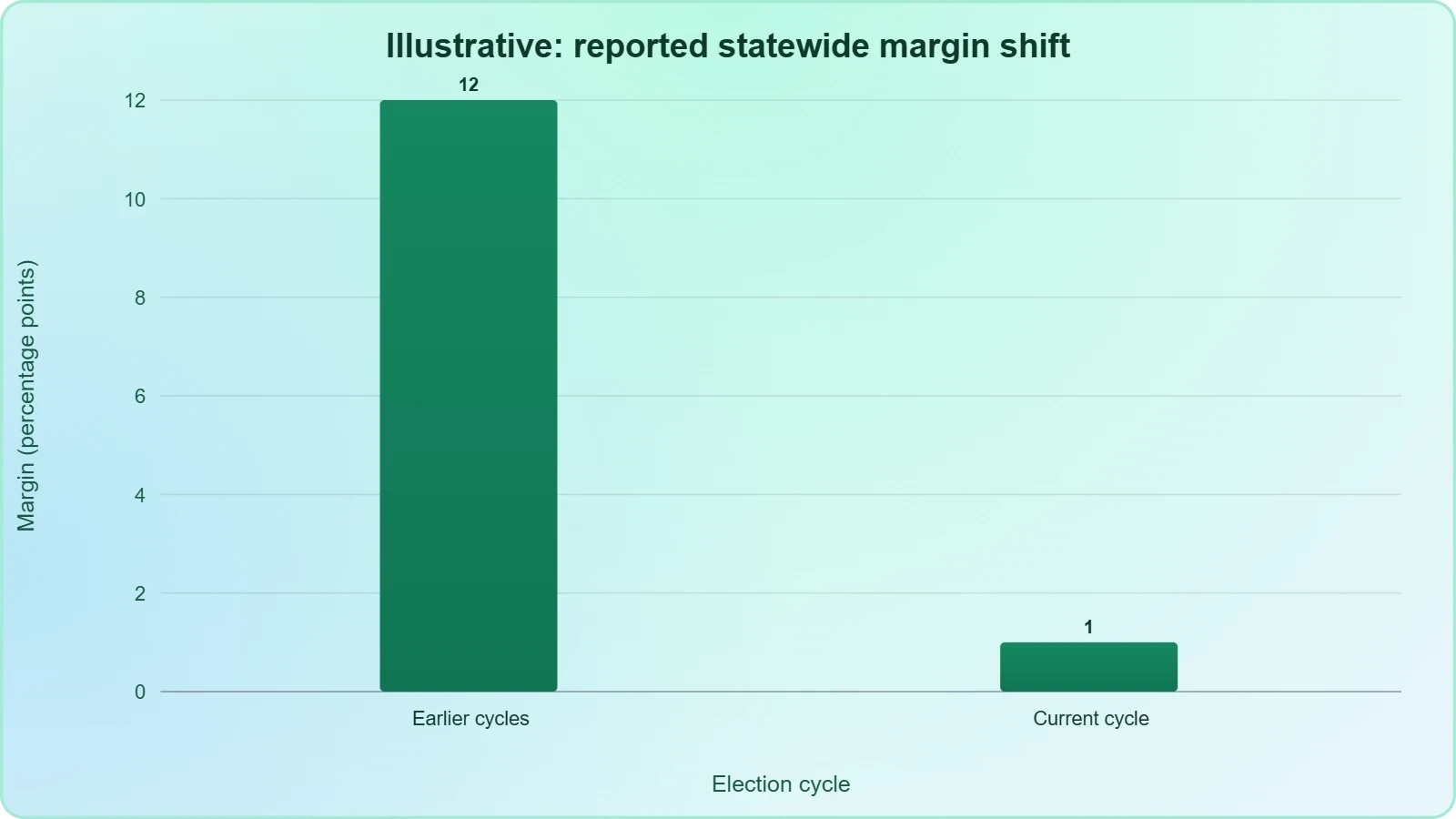
Recent polling, however, indicates that several statewide contests in the current cycle have narrowed to competitive margins, with the gubernatorial and attorney general races reportedly tied. This convergence of long-term partisan stability with short-term electoral volatility forms the central analytical tension of the source material.
The testimony of voters at the Deer Park game illustrates how national issues—inflation, energy prices, immigration enforcement, and the rights of transgender, gay, and minority citizens—are being processed and articulated within local community settings.
The divergence of perspectives within a single suburban community is itself instructive. One Democrat residing in a conservative suburb reports an unprecedented proliferation of Democratic campaign signage, a visible indicator of heightened partisan mobilization.
Conversely, a Republican attendee anticipates continued GOP dominance while acknowledging that urban centers diverge from smaller communities in their political preferences. A third voter expresses support for change while conceding that his views may be minority positions within his immediate social environment.
Taken together, these accounts suggest an electorate characterized by internal heterogeneity, affective polarization, and uncertain turnout dynamics rather than monolithic partisan identity.
TL;DR A reported snapshot from a Texas high school football game in Deer Park reveals an electorate in flux ahead of the 2026 midterms. Although Texas has voted Republican statewide for roughly three decades, polling indicates that the gubernatorial and attorney general races have become effectively tied. Voter testimony highlights competing concerns—inflation, energy costs, immigration enforcement, and equal rights—alongside visible increases in Democratic signage and persistent Republican confidence. The vignette illustrates how national political currents are mediated through local civic institutions, and it underscores the analytical value of qualitative, community-level observation in interpreting electoral volatility.
The Civic Function of Friday-Night Football in Suburban Political Life
High school football occupies a distinctive position within the civic architecture of suburban Texas, functioning simultaneously as entertainment, communal bonding mechanism, and informal public sphere. The source material records an attendee comparing the gathering to church, an analogy that illuminates the ritualistic and integrative character of the event.
Such settings are analytically valuable because they lower the social barriers that ordinarily constrain political discussion, permitting researchers and journalists to observe attitudinal expression in relatively naturalistic conditions. The stadium thus becomes a site where abstract national debates acquire local texture and where partisan identities are performed, negotiated, and occasionally contested.
Ritual, Community, and the Informal Public Sphere
Scholars of American civic life have long noted that voluntary associations and communal gatherings serve as intermediaries between the individual and the state, cultivating social trust and facilitating political communication. The football stadium exemplifies this intermediary function, assembling residents across occupational, generational, and partisan lines within a shared physical space.
The attendee's comparison to religious observance is sociologically apt, since both institutions deploy collective ritual to reinforce communal identity. Political discourse conducted within such settings tends to be affectively charged yet socially moderated, producing testimony that reflects communal norms as much as individual conviction.
The presence of children and older residents at these events further shapes the tenor of political expression, as the Republican attendee's stated consideration of these groups demonstrates. Voters frequently frame their preferences in terms of intergenerational responsibility, invoking the welfare of dependents and elders as a legitimating rationale for partisan choice.
This rhetorical strategy serves to elevate self-interested calculation into a moral register, rendering political preference appear as stewardship rather than factional allegiance. The source material captures this dynamic with unusual clarity, since the attendee explicitly links his voting intention to the wellbeing of younger and older community members.
Suburban spaces have become the principal battleground of contemporary American electoral politics, and Deer Park exemplifies the demographic and cultural characteristics that define this contested terrain. Once reliably Republican, many such suburbs have experienced diversification in educational attainment, occupation, and ethnic composition, producing gradual partisan realignment.
The source material's observation that larger cities differ from smaller communities reflects an intuitive grasp of this geographic gradient. Analysts should therefore treat suburban testimony as a leading indicator of statewide movement rather than as an echo of either urban or rural sentiment.
The informal character of stadium conversation also introduces methodological complications that warrant acknowledgment. Statements elicited in convivial settings may reflect social desirability pressures, conversational framing effects, or the influence of immediate interlocutors rather than stable underlying preferences.
Journalistic observation of this kind cannot substitute for probability sampling, and the reported views should be treated as illustrative rather than representative. Nevertheless, such qualitative evidence possesses diagnostic value, particularly when it corroborates trends identified through formal polling and when it illuminates the reasoning processes underlying voter decision-making.
Finally, the communal setting highlights the role of visible partisan cues—yard signs, bumper stickers, apparel—in signaling the distribution of political preferences within a locality. The Democrat's observation that Democratic signage has proliferated relative to previous cycles constitutes a form of informal precinct-level intelligence.
Such cues influence turnout by conveying information about the likely competitiveness of races and the social acceptability of partisan expression. The stadium, as a gathering point for residents from across the locality, functions as an amplifier for these signals.
Three Decades of Republican Dominance and the Specter of Competitiveness
Texas has delivered its electoral votes and statewide offices to Republican candidates for approximately thirty years, a period during which the party consolidated control over the legislature, the executive branch, and the judiciary. This durability reflects a combination of demographic composition, economic orientation, and the organizational advantages accruing to long-entrenched incumbents.
The source material's Republican interlocutor articulates confidence in the continuation of this pattern, grounding his expectation in the perceived divergence between metropolitan and non-metropolitan communities. Such confidence is analytically meaningful because perceived inevitability can itself depress opposition turnout and sustain incumbent advantage.
Structural Sources of Partisan Durability
The Republican advantage in Texas rests upon several reinforcing structural pillars, including a substantial suburban and exurban electorate, a business-friendly regulatory environment, and a donor network of considerable depth. These factors generate incumbency advantages that compound over successive electoral cycles, making statewide upsets historically rare.
The source material's reference to thirty years of Republican voting captures this structural continuity, which analysts typically treat as the baseline against which any competitive challenge must be assessed. Deviations from this baseline therefore attract disproportionate scholarly and journalistic attention.
Demographic change constitutes the principal long-term pressure on this equilibrium, as migration into metropolitan areas alters the composition of the electorate and, with it, the geography of partisan competition.
Educational attainment, occupational structure, and ethnic diversity all correlate with partisan preference, and their spatial concentration in urban and inner-suburban areas produces increasingly Democratic constituencies. The source material's observation that larger cities differ from smaller communities reflects this spatial sorting.
Whether such demographic drift translates into statewide competitiveness depends upon turnout differentials and the distribution of the electorate across districts.
Recent polling indicating that statewide races have narrowed to effective ties suggests that the structural baseline may be under strain, at least in the current cycle. The reported competitiveness of the gubernatorial and attorney general contests is notable because these offices have historically been among the most secure Republican holdings.
When down-ballot statewide offices become competitive, the phenomenon typically signals either a national partisan wave or a durable realignment in the state's electorate. Distinguishing between cyclical and structural explanations requires longitudinal data extending beyond a single election cycle.
The Republican attendee's expectation of continued dominance also illustrates the role of reference-group reasoning in voter cognition. By contrasting large cities with smaller communities, he constructs a mental map of the state in which his own locality occupies a politically representative position.
Such heuristics are cognitively efficient but can produce systematic misestimation of statewide sentiment, particularly when local environments are politically homogeneous. The source material thus documents not only partisan preference but also the inferential strategies through which voters interpret electoral geography.
Analysts should note that the source material does not provide quantitative polling data, and its characterization of races as tied derives from secondary reporting rather than primary survey evidence.
The appropriate interpretive posture is therefore one of qualified inference: the reported competitiveness is consistent with broader national trends toward suburban volatility, but the magnitude and durability of any shift remain uncertain. Longitudinal polling, district-level results, and turnout data will be required to adjudicate between competing explanations of the current cycle's dynamics.
Issue Salience and the Composition of Voter Concern
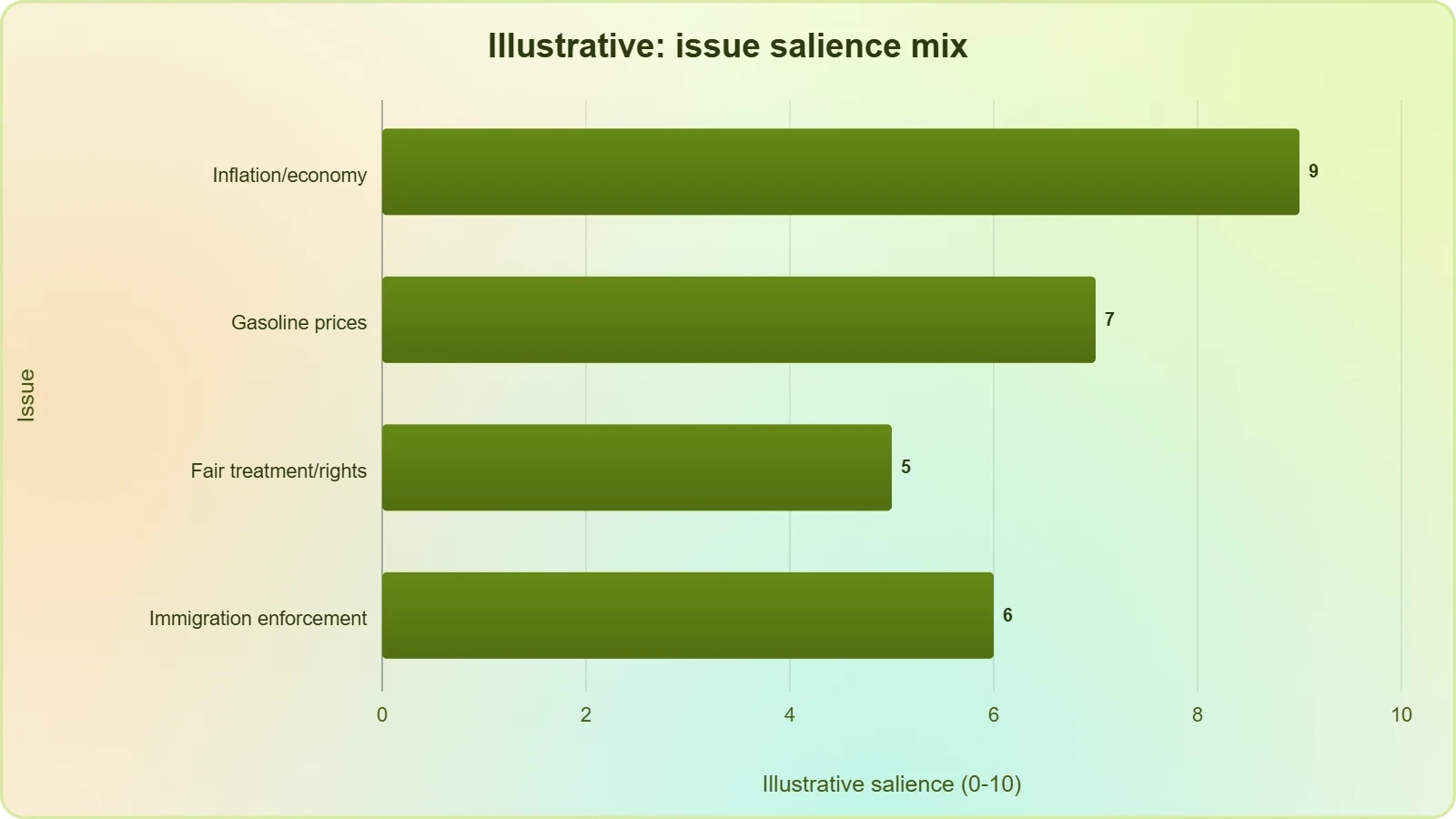
The concerns enumerated by the change-oriented attendee—inflation, the economy, gasoline prices, fair treatment, equal rights for transgender and gay citizens and people of color, and immigration enforcement—map closely onto the issue agenda that national surveys have identified as salient in the current cycle.
Economic concerns predominate, consistent with the well-documented tendency of voters to prioritize material conditions during periods of price instability. Social and civil-rights concerns occupy a secondary but non-trivial position, reflecting the salience of identity-related controversies in contemporary partisan competition. Immigration enforcement completes the triad, functioning as a mobilizing issue for both coalitions.
Economic Anxiety and Price-Level Politics
Inflation and energy costs constitute the most consistently cited economic concerns in American electoral research, and their salience intensifies when price increases are concentrated in frequently purchased categories such as fuel and food. The attendee's explicit reference to gasoline prices illustrates how voters translate aggregate price indices into concrete household experience.
Because fuel prices are highly visible and frequently updated, they function as a cognitive proxy for broader economic conditions, shaping perceptions of governmental competence irrespective of the underlying causal mechanisms.
The relationship between objective economic indicators and subjective economic sentiment is mediated by partisan affiliation, a phenomenon extensively documented in political psychology. Voters aligned with the party out of power tend to perceive economic conditions more negatively, while supporters of the incumbent administration report more favorable assessments.
This partisan asymmetry complicates the interpretation of economic issue salience, since expressed concern may reflect motivated reasoning as much as material circumstance. The source material's testimony should therefore be read as evidence of perceived, rather than necessarily objective, economic distress.
Energy prices occupy a distinctive position within Texas political discourse given the state's substantial petroleum and natural gas industries. Fluctuations in fuel costs affect both household budgets and the regional economic base, producing cross-cutting pressures on voter sentiment.
A voter concerned simultaneously with gasoline prices and environmental regulation must reconcile competing considerations, and the resulting preference formation is rarely reducible to simple partisan alignment. The source material captures this complexity indirectly through the juxtaposition of economic and civil-rights concerns within a single voter's testimony.
Fair treatment and equal rights for transgender, gay, and minority citizens represent a cluster of concerns that have risen in salience alongside legislative activity at the state level. Such issues mobilize voters on both sides of the partisan divide, generating intensity that can translate into turnout advantages.
The attendee's inclusion of these concerns alongside economic grievances suggests a multidimensional preference structure in which material and normative considerations coexist. Analysts should resist the temptation to reduce such testimony to a single explanatory dimension.
Immigration enforcement completes the issue profile and has historically functioned as a high-salience mobilizing theme in Texas politics, given the state's extensive border with Mexico. The attendee's criticism of enforcement practices positions him within the more permissive end of the policy spectrum, a stance that may place him at odds with the modal preference in his community.
This perceived minority status is itself politically consequential, since voters who believe their views are locally atypical may be less likely to engage in visible political expression.
- 01
- 02
- 03
- 04
Signage, Enthusiasm, and the Measurement of Partisan Momentum
The Democrat's observation that Democratic campaign signage has proliferated relative to previous cycles constitutes a form of informal electoral intelligence with a respectable methodological pedigree. Political scientists have long used lawn-sign density as a proxy for local organizational strength and candidate enthusiasm, although the relationship between signage and vote share remains contested.
Signage signals the presence of active supporters willing to incur social and material costs, and its distribution can influence perceptions of viability among undecided voters. The reported increase therefore merits attention as a possible indicator of heightened Democratic mobilization in a conservative suburb.
Lawn Signs as Indicators of Organizational Strength
Lawn signs perform multiple functions within electoral competition: they advertise candidate name recognition, signal the social acceptability of partisan expression, and provide visible evidence of campaign organization. Their density in a given neighborhood reflects the interaction of supporter enthusiasm, campaign resource allocation, and the perceived competitiveness of the race.
An increase in signage relative to prior cycles may therefore indicate any combination of these factors, and attribution to a single cause requires corroborating evidence. The source material's testimony is suggestive rather than conclusive on this point.
The Democrat's expressed hopefulness illustrates the affective dimension of electoral participation, which research has shown to influence turnout independently of cognitive assessments of candidate viability. Hope functions as a mobilizing emotion, sustaining volunteer activity and political engagement during the arduous months of a campaign.
Conversely, confidence among the incumbent party's supporters can breed complacency and depress turnout, a dynamic that has contributed to unexpected electoral outcomes in past cycles. The juxtaposition of Democratic hope and Republican confidence in the source material is therefore analytically significant.
Signage also functions as a communicative act directed at neighbors, conveying information about the political composition of the immediate environment. In homogeneous communities, visible support for the minority party may carry social costs, and the willingness to display such support can indicate shifting norms of acceptable political expression.
The reported proliferation of Democratic signs in a conservative suburb may therefore signal not only organizational strength but also a relaxation of the social constraints that previously suppressed visible dissent.
Enthusiasm gaps between partisan coalitions have become an increasingly prominent explanatory variable in electoral analysis, particularly in contests where the underlying partisan balance is close. Differential enthusiasm can produce turnout disparities that overwhelm small shifts in preference distribution, and it is therefore monitored closely by campaign strategists.
The source material's testimony provides qualitative evidence of an enthusiasm differential favoring Democratic voters, although the sample is far too small to support quantitative inference.
Finally, the observation that Democratic candidates for governor and attorney general have made their races competitive suggests that signage proliferation may reflect genuine electoral dynamics rather than isolated enthusiasm. When down-ballot races tighten, resource allocation to those contests increases, producing additional visible campaign activity.
The convergence of reported polling competitiveness and observed signage density is therefore mutually reinforcing, although both derive from the same underlying political conditions and cannot be treated as independent confirmation.
We Also Published
Methodological Caveats and the Interpretation of Local Political Testimony
The evidentiary status of the source material requires careful specification, since journalistic vignettes of community sentiment occupy an ambiguous position between anecdote and systematic evidence. The reported testimony derives from a small, self-selected group of attendees at a single event in a single locality, and no claim of representativeness is warranted.
Nevertheless, such material possesses genuine analytical value when situated within broader quantitative evidence, functioning as illustrative confirmation of trends identified through more rigorous methods. The appropriate interpretive posture combines receptivity to qualitative insight with disciplined acknowledgment of inferential limits.
Selection Effects and the Limits of Anecdotal Evidence
Selection effects pervade the collection of political testimony at public events, since individuals who volunteer their views differ systematically from those who decline to engage. Those willing to speak with journalists may possess stronger opinions, greater political interest, or heightened confidence in the social acceptability of their views.
The resulting sample is therefore biased toward the politically engaged and the socially secure, and its composition cannot be assumed to mirror the underlying electorate. These considerations counsel against treating reported testimony as a proxy for local opinion distributions.
Conversational framing effects introduce a further layer of complexity, since the questions posed and the sequence in which topics are raised can shape the responses elicited. Respondents may emphasize issues they believe the interviewer considers important, or they may construct coherent narratives that impose order on inchoate preferences.
The resulting testimony is therefore a joint product of genuine conviction and situational performance, and its interpretation requires attention to the conditions of its production. Journalistic accounts rarely document these conditions in sufficient detail to permit rigorous assessment.
Despite these limitations, qualitative testimony retains distinctive value in illuminating the reasoning processes through which voters connect abstract principles to concrete electoral choices. Survey instruments capture preference distributions but rarely reveal the deliberative pathways that generate them, whereas open-ended conversation can expose the heuristics, analogies, and moral framings that structure political cognition.
The source material's documentation of intergenerational responsibility, geographic reference-group reasoning, and perceived minority status exemplifies this diagnostic capacity.
The temporal proximity of the reported observations to the upcoming midterm elections enhances their relevance while simultaneously introducing volatility, since preferences may shift as campaigns conclude and information environments evolve.
Testimony collected weeks before an election cannot be assumed to predict behavior at the ballot box, particularly in contests where late-breaking developments alter the issue agenda. Analysts should therefore treat the reported sentiment as a snapshot of a dynamic process rather than a forecast of its outcome.
Finally, the geographic specificity of the source material warrants emphasis, since Deer Park's characteristics as a suburban municipality within the Houston metropolitan area condition the testimony's significance. Findings from this locality cannot be generalized to Texas as a whole, nor to suburban America more broadly, without substantial qualification.
The appropriate use of such material is comparative and illustrative: it enriches understanding of how national political currents manifest locally, while remaining subordinate to systematic evidence in the formation of analytical judgments.
Synthesis: Local Testimony as a Lens on National Electoral Dynamics
The Deer Park vignette ultimately functions as a microcosm of broader electoral dynamics, condensing into a single communal setting the tensions between partisan durability and competitive pressure, between economic grievance and normative commitment, and between confident incumbency and hopeful opposition.
Its analytical value lies not in the representativeness of its sample but in the clarity with which it renders visible the cognitive and social processes through which voters construct political preferences. Such material complements quantitative evidence by illuminating the mechanisms that aggregate data can only describe.
From Anecdote to Analytical Inference
The disciplined use of qualitative testimony requires explicit specification of the inferential chain connecting observation to conclusion, together with acknowledgment of the assumptions that chain entails. In the present case, the observation of divergent partisan sentiment within a single community supports the inference that the local electorate is heterogeneous and potentially volatile, but it cannot establish the magnitude or direction of aggregate change.
The conclusion must therefore be framed conditionally, as a hypothesis consistent with available evidence rather than as an established finding.
Triangulation across multiple evidentiary sources—polling, signage, conversational testimony, and historical baseline—strengthens confidence in the general characterization of Texas as a state experiencing competitive pressure on a long-standing partisan equilibrium.
Each source possesses distinct limitations, but their convergence on a common characterization reduces the probability that any single source's deficiencies account for the observed pattern. The source material thus contributes one strand to a broader evidentiary web rather than standing alone as proof.
The comparison between urban and smaller communities articulated by the Republican attendee reflects a genuine feature of Texas electoral geography, in which metropolitan counties have trended Democratic while exurban and rural areas have consolidated Republican. This spatial polarization structures the strategic calculations of both parties and determines where campaign resources are concentrated.
The attendee's heuristic, while cognitively efficient, oversimplifies a gradient that varies continuously across the urban-rural continuum rather than exhibiting a sharp binary division.
Finally, the source material's emphasis on the communal character of political discussion serves as a reminder that electoral behavior is embedded within social relationships rather than occurring in atomized isolation. Voters construct preferences through conversation with neighbors, family members, and co-religionists, and these interactions mediate the influence of national messaging.
The football stadium, as a site of such interaction, thus participates in the very processes that electoral analysis seeks to explain, rendering it both an object of study and a mechanism of political life.
The broader implication for electoral analysis is that local, qualitative observation retains irreplaceable value alongside increasingly sophisticated quantitative methods. Aggregated polling and predictive modeling can forecast outcomes with growing precision, but they cannot fully capture the texture of voter reasoning or the social dynamics through which preferences crystallize.
The Deer Park vignette, modest in scope and limited in evidentiary weight, nonetheless exemplifies this complementary function and justifies continued attention to community-level political reporting.
From our network :
- Committed Mediterranean Precipitation Decline: Why Emissions Cuts Alone Cannot Restore Winter RainsNew NOAA research reveals that Mediterranean winter rains may decline irreversibly even with emissions cuts. Explore the science of committed climate change and regional impacts.
- Live Online English Classes for Kids: Do They Actually Reduce Anxiety?A ten-week study reveals that synchronous online English classes can significantly reduce child language anxiety while improving listening and reading skills. Discover what makes these programs effective and how parents can select the right one.
- University Language Proficiency Exams: Why Institutional Tests Demand Different Preparation Than IELTS and TOEFLDiscover why university-specific language proficiency examinations differ fundamentally from IELTS and TOEFL, and learn strategic preparation approaches for institutional assessment success.
- How AI Agents Will Change the Way We Manage Personal FinancesExplore how AI agents are transforming personal finance through automated budgeting, bill payment, and investment management, while examining the critical security protocols and governance frameworks required for safe deployment.
- CISA’s Ten-Advisory Wave: Why Generic Patching Fails in OT and How to Build Product-Specific PlaybooksCISA released ten ICS advisories in one week, exposing critical infrastructure risks. Generic patching fails in OT. Learn to build product-specific remediation playbooks.
- Mobile Learning and VR in English: What Global Evidence Reveals About Effective Language TechnologyA systematic review across 14 countries reveals which language-learning technologies genuinely work. Mobile learning, AI, and VR show measurable benefits when pedagogically integrated. This evidence-based guide helps educators and learners select technology that delivers real return on investment.
- The Final Descent: How ESA Retired the Legendary Cluster Constellation After 24 Years of Space Weather ScienceAfter 24 years mapping Earth’s magnetosphere, ESA’s Cluster mission concluded with a precisely controlled reentry over the South Pacific. This analysis explores the scientific legacy, engineering decisions, and debris mitigation principles behind one of space exploration’s most responsible retirements.
- Forbidden Matrix Patterns and Visible Lattice Points: A Geometric DictionaryExplore how multidimensional 0–1 matrices encode geometric truths, linking forbidden patterns to visible lattice points and hypergraph theory, with applications in combinatorics and computational geometry.
- The Hidden Cost of AI Convenience: Why Over-Permissioned Agents Are a Security Time BombDiscover why AI agents with excessive permissions create dangerous single points of failure, and learn how implementing least privilege principles can protect your organization from exploitation.
RESOURCES
- LWV details 17 propositions on the midterm election ballotlwvtexas.orgOct 9, 2025 ... “The constitutional amendment clarifying that a voter must be a United States citizen.” Proposition 16 Ballot Text The Texas Constitution…
- Analysis: Texas Mapmakers Built The GOP's Political House On ...houstonpublicmedia.orgApr 9, 2018 ... Instead of drawing maps that are sensitive to changes in voter sentiment, Texas ... Where to vote early in Harris…
- The League of Women Voters of Texas: Homelwvtexas.org2026 Midterm Election Voters Guide. The Voters Guide for the General Election is now available! In addition to the PDF version of the Guide…
- Voters Guide - The League of Women Voters of Texas - ClubExpresslwvtx.clubexpress.comCall us if you have any voting questions or concerns. election protection 866-our-vote. 866-OUR-VOTE (866-687 ...
- Proposition 50 [Ballot] - Legislative Analyst's Office - CA.govlao.ca.govNov 4, 2025 ... Voters who live in each congressional district elect one member of the House every two years to represent them. The…
- Latest UT/Texas Politics Poll Finds Historic Levels of Competition in ...texaspolitics.utexas.eduOct 13, 2026 ... While these gaps are notably small, more notable is the role that enthusiasm is playing in this election (more below),…
- What Texas Voters Need to Know About the 2026 Midterm Electiontha.orgSep 3, 2026 ... ... Texas. Historically, voter participation tends to be lower in midterm elections than in presidential elections. With fewer people casting ...
- The Texas Politics Projecttexaspolitics.utexas.eduLatest UT/Texas Politics Poll Finds Historic Levels of Competition in Texas Midterm Elections ... Texas Midterms: What Are Voters Telling Us? Soomo ...
- Elections - Tarrant Countytarrantcountytx.govIt is the mission of the Tarrant County Elections Administration to register eligible voters and to provide free, fair, accurate, and secure elections in…
- Studies and Reports - U.S. Election Assistance Commissioneac.govOn June 30, 2025, the EAC published the biennial Election Administration and Voting Survey (EAVS) Comprehensive Report, an analysis ... voting and election ...
- Elections | Wise County, TXco.wise.tx.usFind your Early Voting or Election Day Polling Location and Review a Sample Ballot. · Wise County Voting Precinct Map (2025) Enacted by the…
- Texas Voters Weigh Their Options Before Election Daytexas2036.orgSep 22, 2026 ... Our latest Texas 2036 newsletter discusses Texas voters and their approach to the ballot in the upcoming midterm elections.
- How a fraction of voters decide who runs Texas - The Texas Tribuneapps.texastribune.orgMar 4, 2024 ... That's especially true in legislative and congressional races, thanks to gerrymandering and noncompetitive elections. Let's take a look at ...
- Welcome to Texas Elections - the Texas Secretary of Statesos.state.tx.usWe also provide assistance to the general public on voter registration and other election issues through our 1-800 toll-free number, 1-800-252-VOTE (8683), and ...
- Midterm Elections in Texas, September 2026 - Marist Pollmaristpoll.marist.eduSep 23, 2026 ... In the race for U.S. Senate in Texas, James Talarico edges Republican Ken Paxton among registered voters statewide, and Democrats…
- 01
- 02
- 03
- 04
- 05
- 06
- 07
- 08
0 Comments