
The governance architecture of concentrated corporate ownership has rarely intersected so visibly with the fiscal machinery of a subnational jurisdiction. In October 2026, regulatory filings disclosed that Mark Zuckerberg had reached an arrangement with Meta's board permitting him to liquidate a newly created class of non-voting shares expressly to satisfy a proposed California wealth tax, while preserving his majority voting control over the company.
The disclosure constitutes an instructive case study in how ultra-high-net-worth individuals restructure personal balance sheets in anticipation of redistributive taxation, and how corporate boards accommodate such contingencies without diluting founder control.
The proposed measure, subject to voter ratification on 3 November, would levy a one-time five percent assessment on the net worth of California residents exceeding one billion dollars. Forbes estimates Zuckerberg's personal fortune above $220 billion, implying a potential liability exceeding $11 billion.
On This Page
- The Architecture of the Zuckerberg–Meta Arrangement
- Fiscal Context and the Political Economy of Wealth Taxation
- Comparative Strategies of Ultra-High-Net-Worth Individuals
- Corporate Governance and Control Preservation Under Fiscal Pressure
- Legal, Constitutional, and Administrative Questions
- Broader Implications for Wealth Taxation and Elite Behaviour
- Synthesis: What the Arrangement Reveals
The arrangement therefore represents not merely a personal financial decision but a structural precedent: it demonstrates that wealth taxation on unrealised gains can be absorbed through equity monetisation rather than residency relocation, a distinction with substantial implications for tax policy design and capital mobility theory.
Beyond the immediate transaction, the episode illuminates competing hypotheses regarding elite behavioural responses to progressive taxation. Proponents, including SEIU United Healthcare Workers West and Senator Bernie Sanders, interpret the deal as empirical refutation of the "capital flight" argument.
Opponents, notably Governor Gavin Newsom, caution that reliance on income tax revenue from affluent residents renders the state fiscally fragile. The following analysis examines the deal's mechanics, its fiscal context, the divergent strategies of other billionaires, and the broader jurisprudential questions it raises.
TL;DR Mark Zuckerberg has secured a board-approved mechanism allowing him to sell a new class of non-voting Meta shares to fund a potential $11 billion liability under California's proposed 5% billionaire wealth tax, while retaining majority voting control and committing to eight years of state residency. The arrangement is presented by supporters as decisive evidence against capital-flight warnings and by critics as an insufficient answer to fiscal fragility. The episode functions as a natural experiment in elite tax responsiveness, equity monetisation, and the governance of dual-class corporate structures under redistributive pressure.
The Architecture of the Zuckerberg–Meta Arrangement
The transaction disclosed in the regulatory filings represents a carefully calibrated instrument of personal liquidity engineering. By authorising a new class of non-voting equity, Meta's board created a mechanism through which Zuckerberg may convert unrealised paper wealth into liquid capital without surrendering voting control.
The arrangement is contingent, reversible in principle, and explicitly framed as a contingency plan rather than an executed sale, which distinguishes it from conventional insider divestment.
Structural Mechanics of the Non-Voting Share Class
The creation of a non-voting share class is a well-established instrument in corporate finance, frequently deployed to permit founder liquidity while insulating control rights from market dilution. Meta's existing dual-class structure already concentrated voting power in Zuckerberg's hands; the new instrument extends this logic by decoupling economic disposal from governance retention. The filings indicate that proceeds may be applied "for any reason," a permissive formulation that preserves optionality.
Analytically, the mechanism resembles a contingent convertible structure in reverse: rather than converting debt to equity under stress, it converts control-protected equity into disposable equity under fiscal stress. The board's approval signals a fiduciary judgment that founder continuity outweighs the dilution concerns that ordinarily accompany expanded share classes. Whether minority shareholders will contest this judgment remains an open question requiring empirical observation.
The arrangement also embeds a residency commitment of eight years, subject to a "material unforeseen circumstances" carve-out. This clause functions as a quasi-contractual assurance to the state and to the board, mitigating the political risk that the mechanism could be read as facilitating departure. The qualifier, however, preserves substantial discretion, and its legal enforceability is uncertain.
Quantifying the Prospective Tax Liability
Forbes' valuation exceeding $220 billion implies a gross liability above $11 billion under a five percent assessment. Because the tax targets net worth rather than realised income, the liability accrues irrespective of cash flow, a feature that distinguishes wealth taxation from conventional income taxation and generates the liquidity problem the share mechanism is designed to solve.
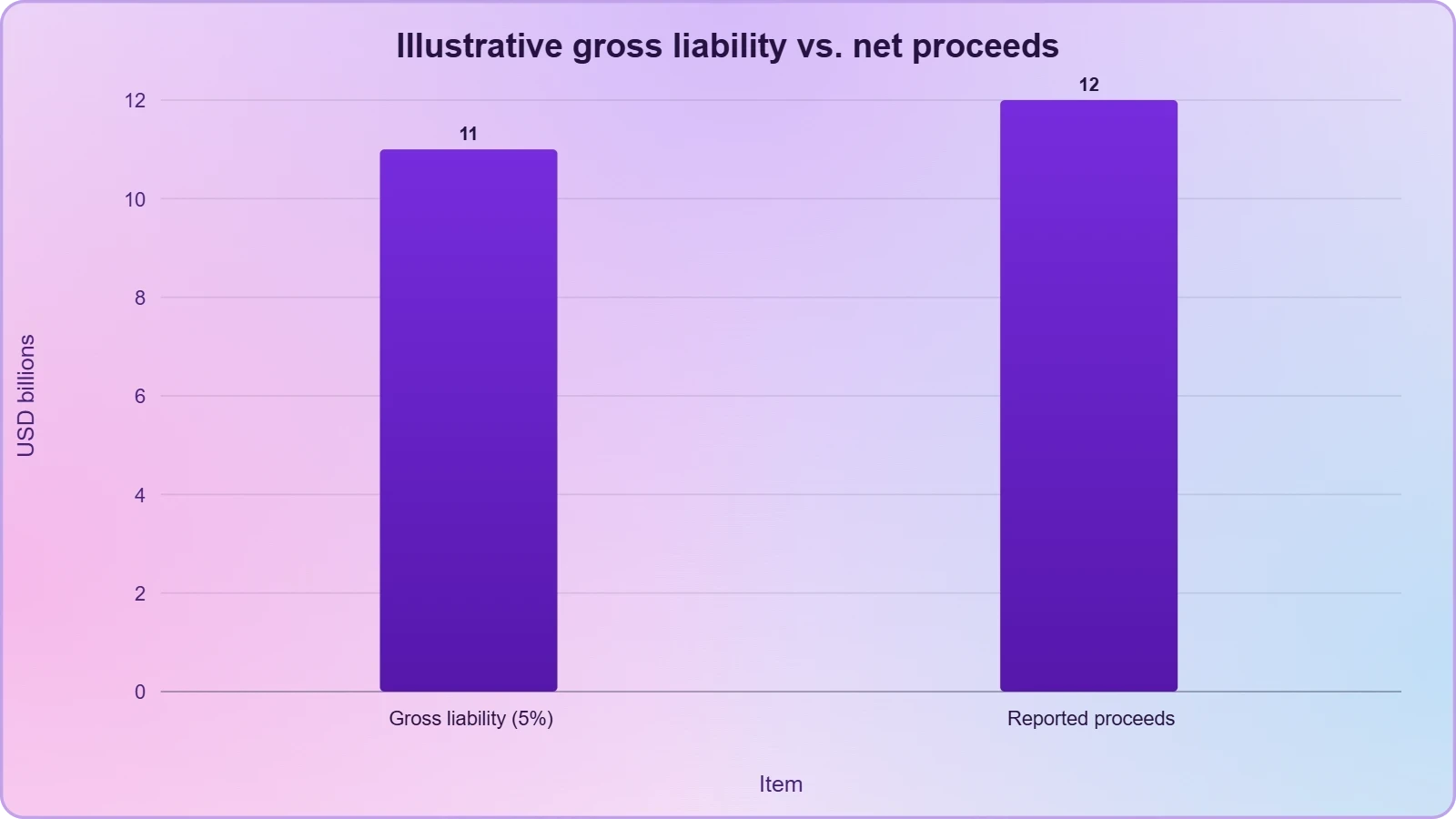
The following table summarises the principal quantitative parameters of the proposed measure as reported.
The Residency Commitment and Its Legal Contours
The eight-year residency undertaking constitutes the most politically salient element of the arrangement. It functions simultaneously as reassurance to California policymakers and as a reputational hedge for the company, which faces stakeholder scrutiny over founder conduct.
The "material unforeseen circumstances" exception, however, renders the commitment soft rather than absolute, and its enforceability is doubtful.
From a comparative perspective, such commitments resemble the domicile undertakings occasionally extracted in merger agreements and tax rulings. Their evidentiary value lies less in legal compulsion than in signalling: they communicate intent and raise the reputational cost of reversal.
Whether they meaningfully constrain behaviour under future fiscal stress remains an empirical question rather than a settled proposition.
Board Fiduciary Considerations
The board's approval raises conventional fiduciary questions regarding the equal treatment of shareholders and the potential entrenchment of control. Expanding a non-voting class to facilitate founder liquidity may be defensible where it preserves strategic continuity, yet it also entrenches a governance asymmetry that institutional investors have historically contested. The filings do not disclose the extent of dissent, if any.
Corporate governance scholarship suggests that dual-class structures trade accountability for stability, and that their legitimacy depends on periodic review and sunset provisions. The Zuckerberg arrangement extends this trade-off into the domain of personal taxation, effectively socialising the governance cost of a private fiscal contingency. This dimension merits scrutiny beyond the immediate political controversy.
Fiscal Context and the Political Economy of Wealth Taxation
The proposed levy must be situated within California's broader fiscal architecture, which depends disproportionately on progressive income taxation and capital gains realisations. This dependence renders state revenue acutely sensitive to the location decisions of a small cohort of affluent taxpayers.
The measure's proponents and opponents therefore disagree less about arithmetic than about behavioural elasticity and its fiscal consequences.
Revenue Dependence and Volatility Exposure
California's revenue system is structurally exposed to equity market cycles because capital gains constitute a substantial share of receipts. A one-time wealth assessment would diversify this base marginally, but its non-recurring character limits its value as a stabiliser. The measure is therefore better understood as a redistributive instrument than as a durable fiscal remedy.
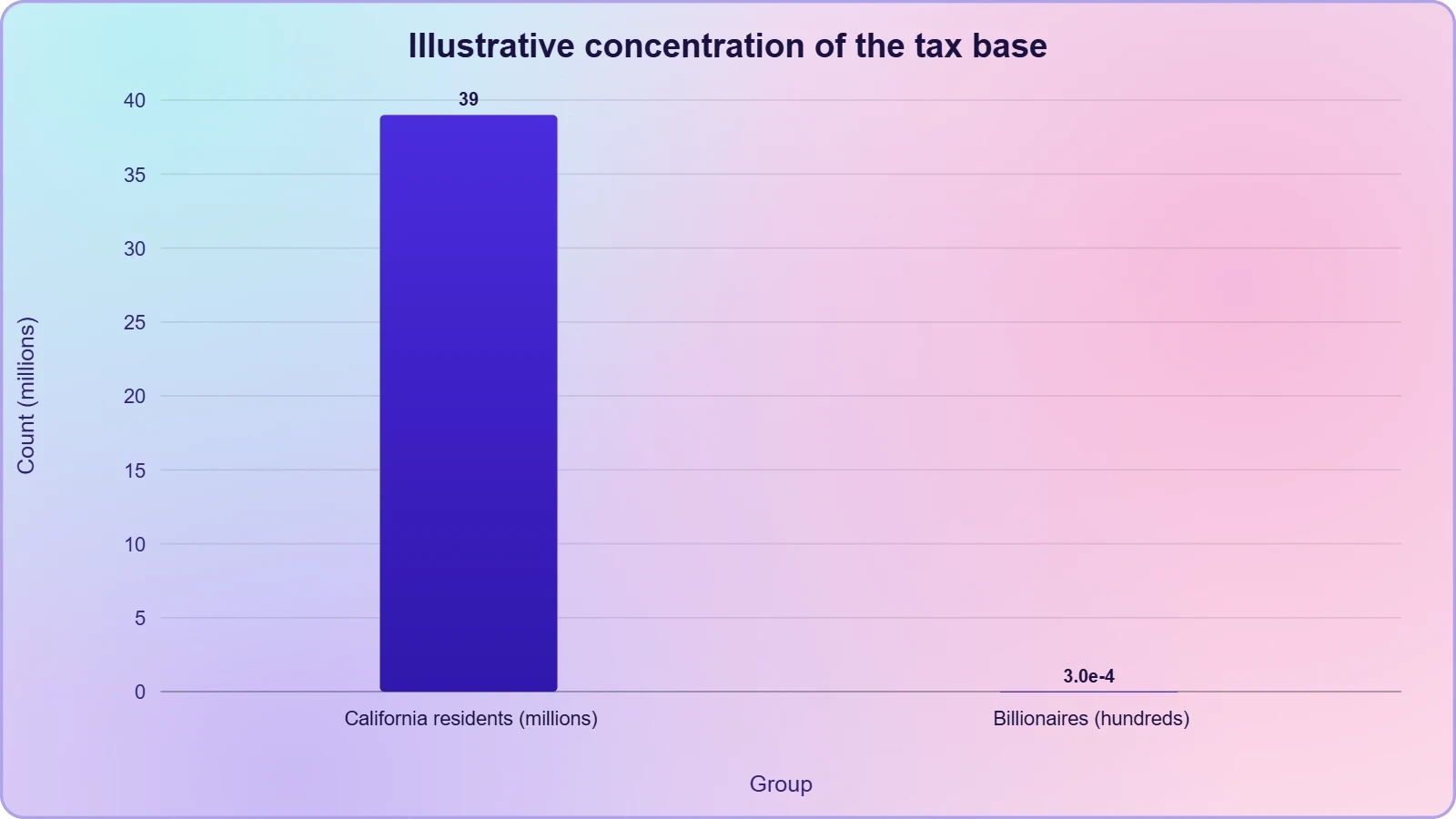
The Legislative Analyst's Office estimates that a few hundred billionaires reside in the state, implying a narrow taxpayer base. Revenue projections consequently exhibit high variance, since the departure or valuation decline of even a handful of individuals could materially alter receipts. This concentration risk is central to the opponents' argument and cannot be dismissed on purely distributional grounds.
Designated Expenditure Priorities
The measure earmarks most proceeds to replace federal funding reductions in healthcare, with ten percent directed toward education and food assistance. This earmarking structure reflects the political coalition behind the initiative, which unites healthcare labour unions with progressive legislators. It also constrains legislative discretion over allocation, embedding a durable expenditure commitment within a one-time revenue stream.
Fiscal analysts have long cautioned against financing recurring obligations with non-recurring receipts, a practice that can generate structural deficits once the initial inflow dissipates. Whether the measure's architects have addressed this mismatch is unclear from the reported details. The question is material to any assessment of the initiative's long-run fiscal sustainability.
Contested Empirical Claims Regarding Capital Flight
The central empirical dispute concerns whether wealthy residents respond to taxation by relocating. Opponents cite the departures of Google co-founders Sergey Brin and Larry Page as evidence of elasticity; supporters counter that a single high-profile accommodation demonstrates the opposite. Neither anecdote constitutes systematic evidence, and the scholarly literature remains divided on the magnitude of behavioural responses.
Comparative research on millionaire migration suggests that tax differentials exert modest effects relative to quality-of-life, network, and business-location considerations, though effects are larger for the extremely wealthy. The California case may therefore prove instructive precisely because its taxpayer base is so concentrated and its tax base so mobile. Generalisation from a single episode should nonetheless remain qualified.
Distributional Arguments and Their Limits
Proponents frame the measure as an instrument of tax justice, arguing that investment-derived wealth escapes the income tax system that burdens wage earners. This argument has normative force, particularly where unrealised gains accumulate indefinitely. Critics respond that wealth taxation raises valuation, liquidity, and administration problems that income taxation largely avoids.
The Zuckerberg arrangement illustrates the liquidity objection concretely: a liability exceeding $11 billion cannot be discharged from salary, necessitating equity monetisation. Whether such monetisation is socially costly depends on market conditions and the depth of demand for the relevant securities.
The arrangement suggests that, for founders of large public companies, the liquidity constraint is manageable rather than prohibitive.
Comparative Strategies of Ultra-High-Net-Worth Individuals
The Zuckerberg response is best understood as one strategy within a broader repertoire of elite adaptations to redistributive taxation. Other billionaires have pursued residency relocation, trust restructuring, or accelerated realisation of gains.
The heterogeneity of responses complicates any monocausal account of capital mobility and suggests that individual circumstances, corporate roles, and family ties mediate behaviour.
Relocation as an Alternative Response
The reported departures of Brin and Page exemplify the relocation strategy, in which domicile itself becomes the variable of adjustment. Relocation avoids the liquidity problem entirely but imposes personal and professional costs, including separation from established networks. Its availability depends on the absence of binding ties such as corporate leadership roles or family obligations.
For a founder-chief executive with majority voting control, relocation is comparatively costly because it may complicate corporate governance and invite political scrutiny. This asymmetry may explain why Zuckerberg negotiated an accommodation rather than departing, and it suggests that attachment to a firm moderates tax-induced mobility among founder-owners specifically.
Equity Monetisation and Liquidity Engineering
Monetisation strategies convert illiquid equity into cash through structured sales, margin arrangements, or new share classes. The Zuckerberg mechanism belongs to this family, distinguished by its explicit linkage to a prospective tax liability and its preservation of voting control. Such engineering is available primarily to controlling shareholders of publicly traded firms.
The prevalence of these techniques implies that wealth taxes on concentrated equity holdings may be more administrable than critics contend, at least for founders of listed companies. For owners of private, illiquid businesses, however, the liquidity constraint remains severe, and forced sales may be value-destructive. Policy design should therefore attend to heterogeneity in asset composition.
Trust and Domicile Restructuring
Trust structures and domicile changes represent longer-horizon adaptations that alter legal residence or beneficial ownership without immediate asset sales. These strategies are frequently deployed in anticipation of tax changes and are difficult to observe systematically. Their existence complicates revenue estimation and underscores the importance of residency rules and anti-avoidance provisions.
The proposed measure's reliance on a fixed residency test date of 1 January 2026 creates incentives for anticipatory restructuring, a phenomenon well documented in the international tax literature. Whether the initiative includes robust anti-avoidance safeguards is not evident from the reported details, and this omission may prove consequential for realised revenue.
Implications for Tax Base Erosion
If accommodation strategies predominate, the tax base may prove more resilient than critics predict; if relocation predominates, revenue may disappoint. The balance likely varies with the composition of wealth and the strength of local ties. The California experiment may therefore yield evidence on the conditions under which each response dominates.
For policymakers elsewhere, the lesson is that behavioural responses are heterogeneous and contingent rather than uniform. Blanket predictions of capital flight or of effortless compliance are equally unsupported. Careful empirical evaluation of the California episode, once data become available, would materially advance the evidence base for subnational wealth taxation.
Corporate Governance and Control Preservation Under Fiscal Pressure
The arrangement raises questions that extend beyond tax policy into the theory of the firm. Dual-class share structures concentrate control in founders, and their stability depends on mechanisms that permit economic diversification without governance dilution.
The new non-voting class extends this logic, but it also intensifies the separation between ownership and control that critics of founder-led governance have long identified.
Dual-Class Structures and Founder Control
Meta's capital structure already exemplifies the founder-control model, in which a minority economic stake commands majority voting power. The new instrument preserves this asymmetry while expanding the founder's capacity to liquidate. Institutional investors have historically opposed such expansions, citing accountability deficits and the risk of entrenchment.
Empirical research on dual-class firms yields mixed findings: some studies associate the structure with long-term strategic orientation, others with weaker governance and higher agency costs. The Zuckerberg arrangement adds a novel dimension by linking control preservation to personal tax planning, a purpose not contemplated in conventional justifications for dual-class equity.
Signalling Effects for Minority Shareholders
Minority shareholders may interpret the arrangement as a signal that founder interests can override conventional dilution norms when personal fiscal exposure arises. Alternatively, they may view it as value-preserving, since it retains a leader with substantial accumulated firm-specific capital. The net effect on valuation is theoretically ambiguous and empirically unresolved.
Disclosure quality is central to this assessment. The filings reportedly describe the mechanism and the residency commitment but may omit details on pricing, timing, and board deliberation. Greater transparency would permit investors to evaluate whether the arrangement serves shareholder interests or primarily insulates the founder from personal liability.
Precedential Value for Founder-Led Firms
If the arrangement proves durable, it may become a template for founder-led firms facing similar fiscal exposures in other jurisdictions. The template's transferability depends on local corporate law, exchange listing rules, and investor tolerance for control-preserving instruments. Jurisdictions with strong minority protections may constrain replication.
The precedent also invites regulatory attention. Securities regulators may examine whether such arrangements require enhanced disclosure or shareholder approval. The outcome will shape the boundary between permissible founder liquidity planning and impermissible entrenchment, a boundary of considerable consequence for capital markets.
Stakeholder and Public Perception Dimensions
Public perception of the arrangement is likely to be polarised. Supporters of wealth taxation may cite it as evidence that the wealthy can comply without departing, while critics may characterise it as sophisticated avoidance. The company's reputational exposure is therefore substantial, and its communication strategy will matter.
Labour unions and advocacy groups have already framed the deal as a rebuttal to capital-flight rhetoric, indicating that the episode has entered political discourse. Whether this framing persists depends on subsequent evidence regarding aggregate billionaire behaviour. The arrangement is thus simultaneously a financial instrument and a political symbol.
We Also Published
- 01
- 02
- 03
- 04
Legal, Constitutional, and Administrative Questions
Beyond economics and governance, the measure implicates constitutional and administrative law. Wealth taxation raises questions of valuation methodology, due process, and potential challenges under state and federal constitutions. These questions are not merely technical; they determine whether the measure can be implemented as designed and whether revenue projections are credible.
Valuation Methodologies for Concentrated Holdings
Assessing the net worth of individuals whose wealth is concentrated in publicly traded equity is comparatively tractable, since market prices provide observable valuations. Privately held businesses, real estate, and complex financial instruments present greater difficulty, requiring appraisal methodologies that are contestable and administratively costly.
The Zuckerberg case is unusually simple because Meta's shares are publicly traded and his holdings are disclosed. Most wealthy residents do not present such transparency, and the administrative burden of universal valuation may be substantial. This asymmetry suggests that the measure's effective incidence could differ from its statutory design.
Constitutional Challenges and Federal Preemption
Opponents may challenge the measure on constitutional grounds, including claims regarding retroactivity, interstate commerce, and equal protection. The residency test date of 1 January 2026, if applied to individuals who subsequently depart, may invite litigation over retroactive taxation. The strength of such challenges is uncertain and would depend on state constitutional doctrine.
Federal preemption arguments are less clearly applicable, since wealth taxation is generally within state taxing power absent specific federal prohibitions. Nonetheless, the novelty of the measure invites legal contestation, and the resulting uncertainty may itself affect revenue realisation and taxpayer behaviour during the interim period.
Administrative Feasibility and Compliance Costs
Administering a wealth tax requires a valuation apparatus that most state revenue agencies do not possess. Building such capacity entails fixed costs that may be disproportionate to the narrow taxpayer base. Compliance costs for affected individuals would also be substantial, potentially encouraging avoidance and litigation.
Comparative experience with European wealth taxes suggests that administrative complexity and capital flight contributed to their repeal in several jurisdictions. Whether California's concentrated and technologically sophisticated taxpayer base would respond similarly is an open question, but the historical record counsels caution regarding implementation optimism.
Interaction With Existing Tax Instruments
The measure would interact with federal income taxation, state income taxation, and property taxation in ways that may produce double counting or unintended burdens. For example, gains already subject to income tax upon realisation could be taxed again as wealth, raising questions of vertical equity and economic efficiency.
Designers of wealth taxes typically address such interactions through credits or exclusions, but the reported details of the California measure do not indicate whether such provisions exist. This omission is significant for evaluating both fairness and efficiency, and it may become a focal point in post-election implementation debates.
Broader Implications for Wealth Taxation and Elite Behaviour
The California episode carries significance beyond its jurisdictional boundaries. It provides a rare observable instance in which a proposed wealth tax elicited a documented corporate response from a controlling shareholder. Such instances are scarce because wealth taxes are uncommon at the subnational level and because elite responses are typically opaque. The case therefore contributes to a thin empirical literature.
Evidence on Taxpayer Elasticity at the Top
Estimates of behavioural elasticity among the very wealthy vary widely across studies, reflecting differences in data, methodology, and institutional context. The California case may eventually supply quasi-experimental evidence if migration and compliance data become available. Until then, inferences must remain provisional and appropriately qualified.
The Zuckerberg accommodation suggests that elasticity is not infinite: at least one billionaire chose to remain and restructure rather than depart. This single observation does not establish a general pattern, but it weakens strong claims that wealth taxation necessarily triggers immediate exit by all affected parties.
Design Lessons for Subnational Wealth Taxes
Several design lessons emerge tentatively. First, liquidity mechanisms matter: permitting structured monetisation may improve compliance among founders of listed firms. Second, residency rules should anticipate anticipatory restructuring. Third, earmarking to popular programmes may build political durability but risks fiscal mismatch if revenue is non-recurring.
These lessons are provisional and require validation across jurisdictions. Nonetheless, they suggest that the binary debate between wealth taxation and capital flight obscures a more nuanced reality in which design choices materially shape behavioural responses. Careful institutional engineering may therefore expand the feasible policy space.
Reputational and Political Economy Consequences
The political economy of the episode extends beyond revenue. The deal has been deployed rhetorically by both sides, illustrating how individual transactions become symbols in broader ideological contests. Such symbolic politics can influence voter behaviour independently of the measure's fiscal merits, complicating empirical evaluation.
For corporations, the episode underscores that founder-related tax planning can become a reputational issue. Stakeholders increasingly evaluate firms on the perceived fairness of their principals' arrangements. Companies may therefore need to anticipate reputational spillovers when facilitating founder liquidity, particularly where the underlying purpose is tax-related.
Comparative Jurisdictional Outlook
Other jurisdictions contemplating wealth taxation will observe California's experience closely. If the measure passes and revenue meets projections without substantial flight, the policy space may widen; if revenue disappoints or litigation delays implementation, caution may prevail. The outcome thus has demonstration effects beyond the state's borders.
International developments, including debates within European and Latin American jurisdictions, will interact with the California precedent. The global policy environment for wealth taxation is therefore in flux, and the Zuckerberg arrangement constitutes one data point within a broader re-evaluation of how progressive taxation applies to capital.
Synthesis: What the Arrangement Reveals
The Zuckerberg–Meta arrangement constitutes a revealing case at the intersection of corporate governance, personal tax planning, and redistributive policy. Its significance lies less in the specific sums involved than in the demonstration that concentrated ownership can be adapted to absorb wealth taxation without immediate relocation. This finding qualifies, though it does not refute, capital-flight arguments.
Reconciling Competing Interpretations
Supporters and opponents draw opposite conclusions from the same facts, reflecting deeper disagreements about behavioural elasticity and fiscal sustainability. A dispassionate reading suggests that both contain partial truths: accommodation is feasible for some taxpayers, while relocation remains available and consequential for others. The aggregate effect is an empirical question.
Resolution requires data that are not yet available, including migration records, compliance rates, and revenue outcomes. Until such evidence accumulates, claims about the measure's effects should be advanced with appropriate epistemic humility. The case is instructive precisely because it complicates simple narratives on both sides.
Unresolved Empirical and Normative Questions
Several questions remain unresolved. How many wealthy residents would relocate in response to enactment? What proportion of potential revenue would be lost to avoidance and litigation? Would the measure's earmarked expenditures be sustained if receipts disappoint? These questions are empirical, but their answers carry normative weight.
Normatively, the episode invites reflection on the legitimacy of wealth taxation and the obligations of corporate leaders to the polities in which they reside. These are contestable questions on which reasonable observers disagree.
The arrangement does not settle them, but it renders them concrete and politically salient in a manner that abstract debate cannot.
Anticipated Developments and Monitoring Priorities
The November 3 vote will determine whether the measure proceeds, and subsequent litigation and implementation will shape its realised effects. Analysts should monitor residency decisions, share sales, revenue receipts, and legal challenges as the policy unfolds. Each provides evidence relevant to the broader debate.
Corporate disclosures will also merit attention, particularly regarding the pricing and timing of any non-voting share sales. Such disclosures may illuminate whether the mechanism functions as intended or generates unintended governance consequences. Systematic observation over the coming years will be essential to any rigorous evaluation.
Concluding Assessment
The arrangement demonstrates that elite responses to redistributive taxation are heterogeneous and mediated by institutional context. It neither vindicates nor invalidates strong claims about capital flight; rather, it illustrates the conditional nature of taxpayer behaviour. This conditional character is the central analytical insight the episode affords.
For policymakers, the implication is that design details—liquidity provisions, residency rules, valuation methods, and expenditure earmarks—materially shape outcomes. For scholars, the case offers a rare observable instance warranting careful longitudinal study. For the public, it presents a concrete illustration of how the ultrawealthy navigate fiscal obligations.
From our network :
- University Language Proficiency Exams: Why Institutional Tests Demand Different Preparation Than IELTS and TOEFLDiscover why university-specific language proficiency examinations differ fundamentally from IELTS and TOEFL, and learn strategic preparation approaches for institutional assessment success.
- CISA’s Ten-Advisory Wave: Why Generic Patching Fails in OT and How to Build Product-Specific PlaybooksCISA released ten ICS advisories in one week, exposing critical infrastructure risks. Generic patching fails in OT. Learn to build product-specific remediation playbooks.
- The Final Descent: How ESA Retired the Legendary Cluster Constellation After 24 Years of Space Weather ScienceAfter 24 years mapping Earth’s magnetosphere, ESA’s Cluster mission concluded with a precisely controlled reentry over the South Pacific. This analysis explores the scientific legacy, engineering decisions, and debris mitigation principles behind one of space exploration’s most responsible retirements.
- The Hidden Cost of AI Convenience: Why Over-Permissioned Agents Are a Security Time BombDiscover why AI agents with excessive permissions create dangerous single points of failure, and learn how implementing least privilege principles can protect your organization from exploitation.
- Committed Mediterranean Precipitation Decline: Why Emissions Cuts Alone Cannot Restore Winter RainsNew NOAA research reveals that Mediterranean winter rains may decline irreversibly even with emissions cuts. Explore the science of committed climate change and regional impacts.
- Live Online English Classes for Kids: Do They Actually Reduce Anxiety?A ten-week study reveals that synchronous online English classes can significantly reduce child language anxiety while improving listening and reading skills. Discover what makes these programs effective and how parents can select the right one.
- How AI Agents Will Change the Way We Manage Personal FinancesExplore how AI agents are transforming personal finance through automated budgeting, bill payment, and investment management, while examining the critical security protocols and governance frameworks required for safe deployment.
- Mobile Learning and VR in English: What Global Evidence Reveals About Effective Language TechnologyA systematic review across 14 countries reveals which language-learning technologies genuinely work. Mobile learning, AI, and VR show measurable benefits when pedagogically integrated. This evidence-based guide helps educators and learners select technology that delivers real return on investment.
- Forbidden Matrix Patterns and Visible Lattice Points: A Geometric DictionaryExplore how multidimensional 0–1 matrices encode geometric truths, linking forbidden patterns to visible lattice points and hypergraph theory, with applications in combinatorics and computational geometry.
RESOURCES
- Meta strikes deal to keep Zuckerberg in California after wealth tax ...reuters.com6 days ago ... Proposition 40, which asks Californians whether to impose a one-time 5% tax on the state's billionaires, is far from certain…
- Meta's deal to keep Zuckerberg in California adds to wealth tax debatecnbc.com5 days ago ... With less than two weeks before the midterm elections, Meta made clear that Mark Zuckerberg is staying in California if…
- Meta strikes deal with Mark Zuckerberg to help him foot billionaire ...theguardian.com6 days ago ... Chief executive agrees to remain in California for eight years even if state brings in one-off 5% wealth tax.
- Zuckerberg wins Meta deal to help him foot bill for possible ... - BBCbbc.com5 days ago ... ... Zuckerberg to prevent him from leaving California over a proposed state tax on billionaires. The agreement gives Zuckerberg, whose…
- Meta agrees deal to keep Mark Zuckerberg in California despite ...ft.com6 days ago ... Zuckerberg indicated he had planned to leave California because of a proposed billionaire wealth tax on the state's ballot next…
- How Mark Zuckerberg Pushed Meta to Shield Him From California's ...nytimes.com6 days ago ... How Mark Zuckerberg Pushed Meta to Shield Him From California's Proposed Wealth Tax. The billionaire told Meta's board that he…
- Zuckerberg makes deal with Meta to help him pay billionaire tax if it ...abcnews.com5 days ago ... ... California” if the state's wealth tax is enacted. The company said the new stock he will be allowed to…
- Meta agrees to let Mark Zuckerberg remain in California amid ...foxbusiness.com6 days ago ... Under the agreement, Zuckerberg will receive non-voting shares that he could sell to help cover a potential wealth tax bill…
- Mark Zuckerberg Plots Deal to Pay Wealth Tax, Keep Meta Controlbloomberg.com5 days ago ... He was also getting increasingly worried about how he might pay California's proposed one-time 5% tax on billionaires, which will…
- Mark Zuckerberg Discussed Leaving California Over Billionaire Taxwsj.com6 days ago ... Mark Zuckerberg Threatened to Leave California. Meta's Board Cut Him a Deal. Meta's CEO feared a proposed billionaire tax would…
- Mark Zuckerberg threatened to leave California over proposed ...cbsnews.com6 days ago ... Meta CEO Mark Zuckerberg threatened to move out of California if residents of the state approve a first-of-its-kind billionaire wealth…
- Meta Stock Split Deal Will Keep Mark Zuckerberg In California Amid ...forbes.com6 days ago ... The billionaire considered leaving California over a proposed wealth tax that could have forced him to sell shares and weaken…
- Meta board placates Zuckerberg after threat to leave California if ...cbc.ca5 days ago ... ... deal with Mark Zuckerberg, Reuters ... Meta board placates Zuckerberg after threat to leave California if voters approve wealth…
- Zuckerberg considered leaving CA over wealth tax, Meta sayspolitico.com6 days ago ... Meta warned Wednesday that its CEO Mark Zuckerberg could leave California if the state enacts a billionaire tax. The company…
- Zuckerberg weighed leaving California, then struck a deal with Metaqz.com6 days ago ... Zuckerberg weighed leaving California over billionaire tax, then struck a deal with Meta ... wealth tax. Under the agreement, Zuckerberg ...
- 01
- 02
- 03
- 04
- 05
- 06
- 07
- 08
0 Comments