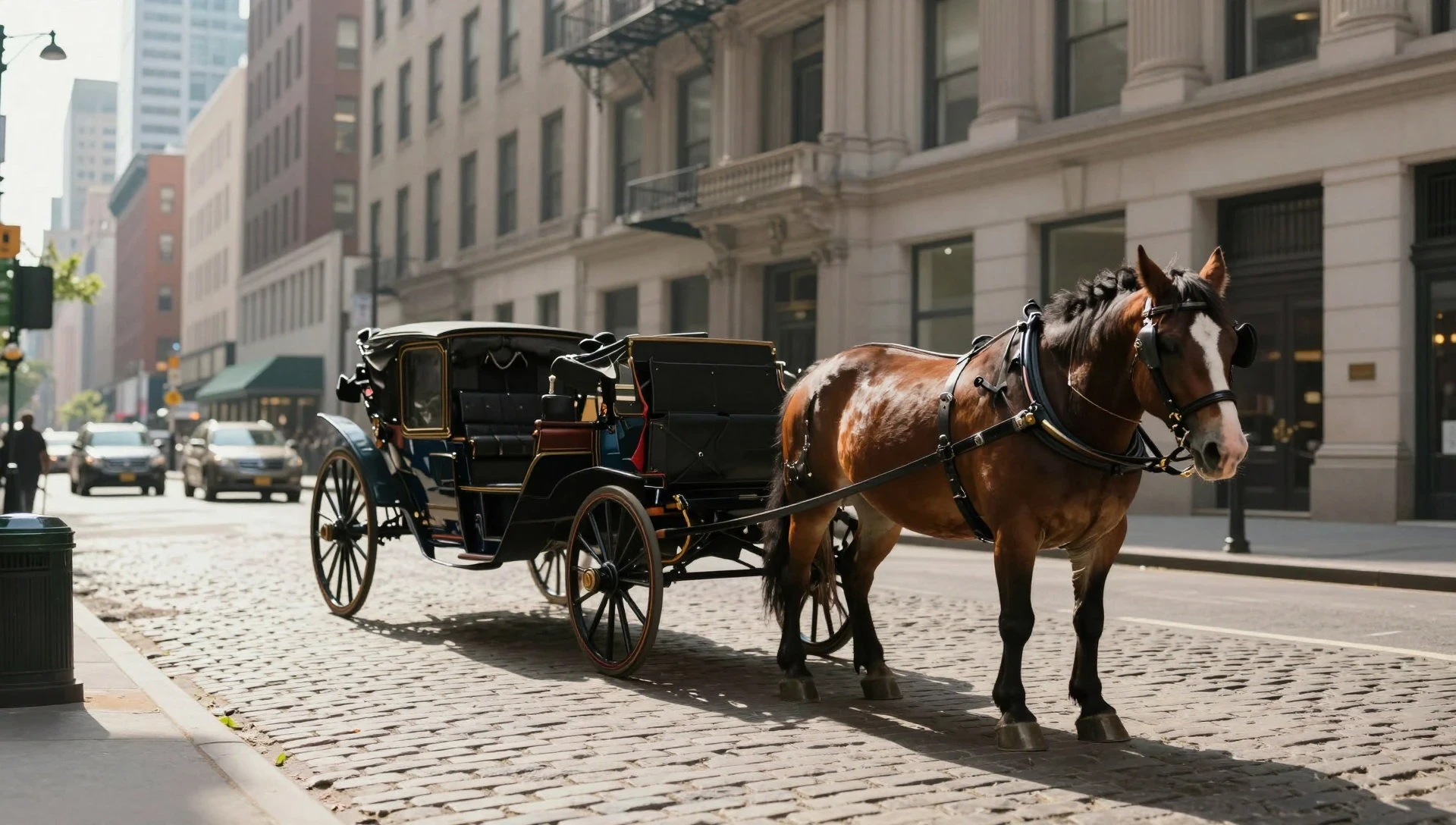
The New York City Council's decision to prohibit horse-drawn carriages from city streets and Central Park, effective June 2028, represents a consequential intersection of animal welfare advocacy, municipal labour policy, and contested cultural heritage.
The measure secured 40 votes in favour within the 51-member chamber, with seven opposed and two abstentions, a margin that signals substantial but not unanimous political consensus. Mayor Zohran Mamdani has endorsed the legislation and is expected to sign it into law, thereby formalising a transition period intended to afford roughly 150 active carriage drivers sufficient time to secure alternative employment.
The legislative package extends beyond a simple prohibition, incorporating provisions to explore compensation for licence holders and restrictions preventing owners of nearly 200 horses from selling the animals for slaughter or to other carriage operations.
On This Page
- Legislative Architecture and the Mechanics of a Phased Prohibition
- The Evidentiary Record: Animal Welfare, Public Safety, and Triggering Events
- Legal Contestation: Takings Doctrine and the Licensed Profession Question
- Economic Consequences and the Political Economy of Prohibition
- Synthesis: Regulatory Legitimacy, Evidence, and the Limits of Certainty
These ancillary clauses reflect an attempt to reconcile competing claims: the welfare interests of equines, the economic interests of a licensed workforce, and the broader public safety obligations of a municipality managing a park that records approximately 42 million visits annually.
The debate itself is far from novel, having persisted for decades without resolution until a fatal incident in June 2026 altered the political calculus.
That incident involved Romanch Mahajan, an eighteen-year-old tourist from India, who was thrown from a carriage and died after the horse bolted when the driver stepped away to take a photograph. Subsequent horse deaths and additional incidents reinforced the case advanced by critics, while supporters continued to emphasise employment and heritage.
The Central Park Conservancy backed the ban on public health and safety grounds, whereas the Transport Workers Union signalled imminent litigation, and President Donald Trump publicly questioned the rationale. The following analysis examines the legislative mechanics, the evidentiary record, and the legal and economic questions that the enactment now raises.
TL;DR The New York City Council has voted 40–7, with two abstentions, to ban horse-drawn carriages from city streets and Central Park from June 2028, with Mayor Zohran Mamdani expected to sign the bill. The legislation provides a transition period for approximately 150 drivers, explores compensation for licence holders, and bars the sale of nearly 200 horses for slaughter or to rival carriage businesses. Support intensified following the June 2026 death of Indian tourist Romanch Mahajan, alongside earlier equine fatalities and incidents. The Central Park Conservancy endorsed the measure on safety grounds; the Transport Workers Union opposes it and has threatened litigation, arguing the bill extinguishes all economically beneficial use of licensed property.
Legislative Architecture and the Mechanics of a Phased Prohibition
The ordinance constitutes a structured regulatory sunset rather than an immediate interdiction, and its design reveals deliberate attention to administrative feasibility and political durability. By fixing the commencement date at June 2028, the Council creates a defined horizon within which affected operators may adjust their commercial arrangements.
The vote distribution, 40 in favour against seven opposed and two abstentions, indicates cross-factional support exceeding a simple majority, which arguably strengthens the legislation against subsequent challenge.
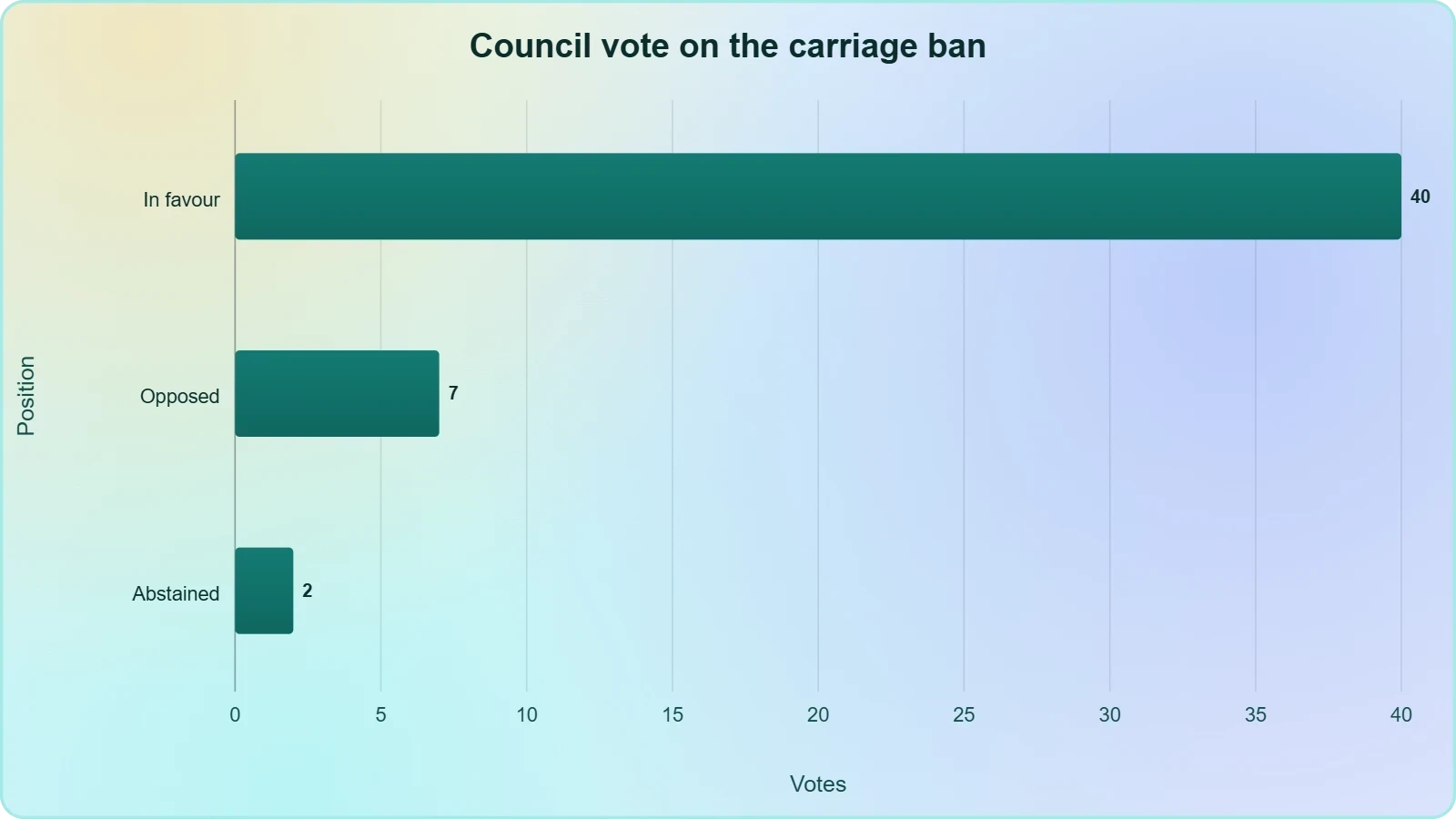
Composition of the Council Vote and Its Political Significance
The numerical margin carries analytical weight beyond mere passage. A supermajority of approximately 78 per cent of the chamber reduces the plausibility of claims that the outcome reflected narrow factional pressure rather than considered deliberation.
The two abstentions are equally instructive, suggesting residual unease among some members regarding the economic consequences for a licensed workforce.
Comparative municipal practice indicates that prohibitions affecting established trades typically attract closer scrutiny when margins are slender. Here, the breadth of support may insulate the measure from accusations of arbitrary governance.
Nevertheless, the presence of dissent within the chamber provides a rhetorical foundation for the litigation that the Transport Workers Union has signalled.
Political scientists frequently observe that legislative coalitions of this size emerge when a salient triggering event aligns with pre-existing advocacy momentum. The Mahajan fatality plausibly performed precisely this function, converting a long-running normative dispute into an actionable policy window.
The vote therefore illustrates how concentrated harm can accelerate regulatory intervention that decades of argument had failed to produce.
It remains uncertain whether the margin reflects durable conviction or transient electoral calculation. Council members facing constituencies with concentrated carriage interests may have weighed reputational risks against constituent service obligations. The recorded abstentions may indicate such calculations rather than principled opposition, a distinction relevant to subsequent electoral accountability.
The Transition Period and Workforce Adjustment
City Council Speaker Julie Menin characterised the interval before implementation as an opportunity for approximately 150 active drivers to identify alternative employment. This framing positions the legislation as a managed transition rather than an abrupt expropriation of livelihood, a distinction with both ethical and legal implications. The adequacy of the adjustment window remains empirically contestable.
Labour economists note that occupational transitions involving specialised skills and ageing workforces typically require more than eighteen months to achieve comparable earnings. Carriage driving entails equine handling competencies that do not map neatly onto adjacent sectors. Whether the transition period proves sufficient is therefore a matter for longitudinal observation rather than legislative assertion.
The absence of a statutory retraining programme is notable. The bill appears to rely on general labour market absorption rather than targeted reskilling, a design choice that may attract criticism if displaced drivers experience prolonged unemployment.
Comparative evidence from other municipal trade prohibitions suggests that outcomes vary considerably according to the specificity of support mechanisms.
Furthermore, the transition period coincides with broader economic uncertainty in the hospitality and tourism sectors upon which carriage operations depend. Macroeconomic conditions during 2026–2028 will materially influence whether the adjustment window functions as intended. The legislation's effectiveness therefore depends partly on variables beyond municipal control.
Compensation Provisions and Property Rights Questions
The bill includes a provision to explore possible compensation for licence holders, a clause whose exploratory character falls short of a binding entitlement. This formulation likely reflects legal caution regarding the constitutional status of carriage licences under takings jurisprudence. The distinction between study and guarantee is legally consequential.
Under prevailing regulatory takings doctrine, the dispositive question is whether a measure deprives an owner of all economically beneficial use of property. The union's letter to Corporation counsel Steve Banks advances precisely this argument, contending that the bill may be the first instance in city history of a previously licensed profession being prohibited outright.
Licences, however, are frequently characterised as revocable privileges subject to the police power rather than as compensable property interests. Courts have generally upheld substantial restrictions where a legitimate public welfare rationale is demonstrated. The strength of the safety evidence will therefore be central to any adjudication.
The exploratory compensation clause may serve a dual function: signalling good faith toward affected operators while preserving flexibility should litigation compel a remedy. Its practical value to licence holders depends entirely on subsequent appropriation decisions. As drafted, the provision creates expectation without obligation.
Animal Disposal Restrictions and Enforcement Design
The prohibition on selling horses for slaughter or to other carriage businesses addresses a foreseeable consequence of market exit. Without such a restriction, owners facing stranded assets might realise residual value through channels inconsistent with the legislation's welfare objectives. The clause thus closes an obvious regulatory gap.
Enforcement of animal disposal restrictions presents practical difficulties, however. Monitoring the ultimate destination of nearly 200 equines requires administrative capacity and interjurisdictional cooperation, particularly where sales occur beyond municipal boundaries. The bill's effectiveness in this respect will depend on implementation resources not specified in the reported text.
Animal welfare scholars have documented that slaughter-bound equine markets operate through networks resistant to straightforward oversight. A municipal prohibition may displace rather than eliminate such transactions. Whether the restriction achieves its stated purpose is therefore an empirical question requiring post-implementation audit.
The provision nonetheless establishes an important normative baseline. By treating horses as subjects of welfare concern rather than mere commercial assets, the Council aligns municipal policy with contemporary animal protection frameworks. This symbolic dimension may influence comparable jurisdictions considering analogous measures.
The Evidentiary Record: Animal Welfare, Public Safety, and Triggering Events
The legislative outcome cannot be understood without attending to the evidentiary record that accumulated over decades and culminated in a single fatal incident. Critics of the carriage industry have long cited episodes in which horses collapsed, bolted, or escaped, arguing that urban environments are intrinsically unsuitable for equine labour.
Supporters countered by emphasising the industry's heritage and the livelihoods it sustains, a framing that proved increasingly untenable as incidents accumulated.
The Mahajan Fatality and Its Catalytic Role
The death of Romanch Mahajan on 17 June 2026 supplied the decisive catalyst. The eighteen-year-old tourist from India was thrown from a carriage and died after the horse bolted when the driver stepped away to take a photograph. The circumstances combined a foreseeable operational lapse with catastrophic consequence.
Policy scholars recognise such events as focusing moments capable of converting latent public concern into legislative action. The Mahajan case possessed particular salience because the victim was a visitor unfamiliar with the risks, and the precipitating conduct was readily intelligible to lay observers. These features rendered the incident unusually persuasive in public discourse.
It would be reductive, however, to attribute the outcome solely to a single tragedy. The fatality operated upon a substrate of accumulated incidents and sustained advocacy. Without that prior groundwork, the event might have generated sympathy without legislative consequence. The interaction between chronic concern and acute harm is therefore the more defensible explanatory framework.
The international dimension of the case also merits attention. That a tourist from India suffered a fatal injury in a premier American visitor destination raised reputational questions for the city's tourism economy. Such considerations plausibly reinforced the inclination of members to support decisive action.
Equine Welfare Evidence and the Limits of Inference
Documented horse deaths and injuries formed a substantial component of the welfare case. Critics argued that carriages subject animals to traffic noise, hard paving, and unpredictable conditions inconsistent with equine physiology. These claims align with veterinary literature concerning the stressors of urban work for horses.
Quantification remains contested, however. Reliable denominators for injury and mortality rates within the carriage population are not consistently published, complicating comparative assessment. Claims that the industry is uniquely hazardous therefore rest partly on incident catalogues rather than systematic epidemiological data. This evidentiary limitation does not invalidate the welfare concern but qualifies its precision.
Supporters of the industry have argued that many reported incidents involve operator error rather than inherent unsuitability, suggesting that enhanced regulation might suffice. The Council evidently rejected this alternative, preferring prohibition. Whether a stricter regulatory regime could have achieved comparable welfare outcomes is a counterfactual that cannot be empirically resolved.
Comparative jurisdictions offer instructive but inconclusive evidence. Several cities have restricted or eliminated carriage operations, while others maintain them under tightened oversight. The absence of a standardised international dataset means that policy transfer must proceed cautiously, with attention to local conditions and enforcement capacity.
The Central Park Conservancy's Institutional Endorsement
The Central Park Conservancy, which manages the park and reports approximately 42 million visits annually, endorsed the ban as a matter of public health and safety. Institutional backing of this kind carries considerable weight in municipal decision-making, lending technical credibility to welfare arguments. The Conservancy's stewardship mandate aligns naturally with risk reduction.
Its endorsement also reframes the issue from animal welfare alone to encompass visitor safety across a vast user population. When an institution responsible for managing millions of annual visits identifies a hazard, legislators face heightened accountability for inaction. The Conservancy's intervention thus altered the political risk calculus for Council members.
Critics might observe that the Conservancy's institutional interests favour reduced operational complexity within its jurisdiction. Such considerations do not diminish the substance of its safety assessment but suggest that institutional endorsements should be weighed alongside independent evidence. The convergence of multiple sources nonetheless strengthens the overall case.
The scale of visitation cited, 42 million annually, provides context for probabilistic risk assessment. Even low per-visit probabilities of serious incident aggregate into non-trivial expected harm across such volumes. This actuarial framing likely informed the Conservancy's position and, by extension, the Council's deliberations.
Contested Narratives: Heritage, Employment, and Tradition
Opponents of the ban advanced two principal arguments: that the industry provides valued employment and that it constitutes a heritage tradition integral to the city's identity. President Donald Trump articulated the tradition argument, comparing the prohibition to halting cars after traffic accidents and describing the carriages as a great tradition. Such reasoning appeals to continuity and proportionality.
The employment argument carries genuine weight, particularly given the approximately 150 drivers whose livelihoods are affected. However, the Council's transition provisions indicate that this concern was acknowledged rather than dismissed. The legislative design attempts to reconcile workforce interests with welfare imperatives through temporal缓冲 and exploratory compensation.
Heritage claims are inherently contestable in pluralistic societies. Traditions that impose measurable risks on third parties frequently yield to safety regulation, as historical precedent in transport, construction, and recreation demonstrates. The carriage case therefore participates in a broader pattern of tradition being renegotiated against contemporary harm thresholds.
Notably, the cultural visibility of carriage rides, reinforced by popular media depictions, may have sustained public tolerance longer than the underlying risk profile warranted. The Mahajan fatality disrupted that tolerance by making the hazard concrete. Cultural attachment proved insufficient to withstand evidence of preventable death.
We Also Published
Legal Contestation: Takings Doctrine and the Licensed Profession Question
The Transport Workers Union's announced intention to seek a temporary restraining order, communicated the day before the vote, signals that the legislative outcome will likely be followed by adjudication.
Union attorney Arthur Schwartz advanced a specific constitutional argument in correspondence with Corporation counsel Steve Banks, contending that the bill may represent the first instance in city history of a previously licensed profession being prohibited. This framing invites judicial scrutiny of the boundary between legitimate regulation and compensable expropriation.
The Takings Claim and Economically Beneficial Use
The union's central contention is that the prohibition deprives owners of all economically beneficial use of their property, a formulation tracking established regulatory takings jurisprudence. Under this doctrine, measures that eliminate essentially all productive use of an asset may require compensation irrespective of legitimate public purpose. The argument's force depends on how the relevant property interest is characterised.
If the property interest is defined narrowly as the carriage licence itself, the claim is stronger, since the licence's sole function is to authorise the prohibited activity. If defined more broadly as the owners' general commercial assets and capacities, the deprivation appears less total. Courts have considerable discretion in selecting the relevant denominator.
Precedent suggests that courts frequently uphold prohibitions of specific uses where alternative uses of the underlying property remain available. Carriage operators may own stables, vehicles, and equipment capable of other deployment. Whether such alternatives constitute economically beneficial use is a factual question requiring evidentiary development.
The union's characterisation of the bill as unprecedented may carry rhetorical rather than doctrinal weight. Novelty does not itself establish constitutional infirmity, though it may prompt heightened judicial attention. The decisive issue remains the extent of deprivation measured against the legitimate exercise of police power.
Police Power, Public Safety, and Deference
Municipal authority to regulate for public health and safety is well established, and courts typically accord substantial deference to legislative findings in this domain. The Council's reliance on documented fatalities and the Conservancy's safety assessment provides a defensible evidentiary foundation. This deference materially strengthens the city's litigating position.
Deference is not unlimited, however. Where a measure appears to single out a small class for disproportionate burden while conferring diffuse benefits, courts may scrutinise the means-ends relationship more closely. The carriage industry's small size and visibility render it susceptible to such characterisation, though the safety rationale is facially legitimate.
The availability of less restrictive alternatives, such as enhanced operational regulation, may be raised by challengers. Courts generally do not require legislatures to adopt the least restrictive means, but the existence of viable alternatives can inform proportionality analysis. The Council's implicit rejection of stricter regulation may therefore face examination.
Timing considerations also bear on the litigation. The eighteen-month transition period reduces the immediacy of harm and may weaken claims for preliminary injunctive relief. A temporary restraining order requires demonstration of imminent irreparable injury, a standard harder to satisfy when implementation is deferred.
Compensation, Transition, and the Remedial Question
The exploratory compensation provision complicates the legal landscape. By acknowledging the possibility of compensation, the Council may inadvertently concede that some deprivation warrants remedy. Conversely, the provision may be characterised as a discretionary goodwill measure rather than an admission of legal obligation.
Should litigation succeed on takings grounds, the remedial question becomes central. Compensation could take the form of lump-sum payments, extended transition support, or purchase of licences at assessed value. Each approach carries distinct fiscal and administrative implications for the municipality.
The union's letter to Corporation counsel represents an attempt to establish a record favouring its characterisation of the measure. Such correspondence often serves both negotiation and litigation preparation functions. Its public disclosure suggests a strategy of political and legal pressure operating in parallel.
Ultimately, the resolution will depend on judicial interpretation of property interests in occupational licences, an area of law characterised by doctrinal variation across jurisdictions. The outcome is genuinely uncertain, and predictions should be advanced with appropriate caution pending pleadings and evidentiary submissions.
Comparative Perspective on Occupational Prohibitions
Prohibitions of previously licensed occupations are uncommon but not unprecedented. Historical examples include restrictions on certain forms of street trading, animal-based entertainment, and hazardous industrial practices. These cases suggest that legislatures can extinguish licensed activities where compelling public interests are demonstrated.
Comparative analysis indicates that compensation arrangements vary widely. Some jurisdictions provide statutory buyouts, while others rely on transition periods alone. The absence of a uniform international standard means that New York's approach will be observed as a potential model rather than measured against settled practice.
Scholars of regulatory transitions emphasise that legitimacy depends partly on procedural fairness and the reasonableness of adjustment support. A well-designed transition can mitigate both political resistance and legal risk. The Council's combination of a deferred effective date and exploratory compensation reflects awareness of these considerations.
The broader significance extends beyond carriage operations. How municipalities manage the phase-out of contested licensed activities will inform expectations across other sectors facing safety-driven prohibition. The New York precedent may therefore possess influence disproportionate to the industry's modest economic scale.
- 01
- 02
- 03
- 04
Economic Consequences and the Political Economy of Prohibition
The economic dimensions of the prohibition extend beyond the approximately 150 drivers directly affected, encompassing licence valuation, equine asset disposal, tourism sector adjustment, and municipal fiscal exposure. These consequences are frequently underweighted in welfare-focused policy discourse, yet they determine the practical fairness of the transition. A comprehensive assessment must therefore integrate economic analysis with the safety rationale that animated the legislation.
Licence Valuation and Asset Stranding
Carriage licences represent transferable economic assets whose value derives from anticipated future earnings. Prohibition extinguishes that value prospectively, potentially stranding capital that owners may have acquired through purchase rather than original allocation. The magnitude of such losses depends on historical licence market prices, which are not publicly standardised.
Asset stranding is a recognised phenomenon in regulatory transitions, and its distributional effects merit attention. Owners who purchased licences at market rates bear losses distinct from those who received them administratively. Equity considerations might therefore favour differentiated compensation, though the bill's exploratory provision does not specify such differentiation.
Equine assets present a further complication. Horses used in carriage work may have limited alternative employment, and the prohibition on sale for slaughter or to other carriage businesses restricts disposal options. Owners may face ongoing maintenance costs without corresponding revenue, an outcome that could paradoxically harm animal welfare if care standards decline.
This tension illustrates a broader principle in animal welfare regulation: restrictions on disposal must be accompanied by support for continued humane care. Without such support, well-intentioned prohibitions may produce unintended welfare consequences. The legislation's silence on maintenance funding is therefore a notable gap.
Tourism Sector and Visitor Experience
Carriage rides have functioned as a recognisable component of the city's visitor offering, particularly within Central Park. Their removal may marginally alter the tourism product, though the park's 42 million annual visits suggest that carriage rides constitute a small fraction of overall visitor activity. Substitution effects are therefore likely to be modest.
Tourism economists note that iconic experiences contribute to destination branding even when their direct economic contribution is limited. The loss of carriage rides may therefore have symbolic rather than material significance for the visitor economy. Whether alternative attractions emerge to fill the niche remains to be observed.
The Mahajan fatality itself may have affected tourism perceptions, particularly among Indian visitors. A destination associated with a preventable tourist death faces reputational risk that can exceed the economic value of the activity causing it. From this perspective, the ban may protect rather than diminish tourism interests.
Municipal authorities must weigh such reputational considerations against the interests of affected operators. The Council's decision suggests that safety and reputational factors were assigned greater weight than the preservation of a niche visitor experience. This prioritisation is defensible but not self-evidently correct in all respects.
Municipal Fiscal Exposure and Compensation Scenarios
Should litigation establish a compensation obligation, the municipality faces fiscal exposure whose scale is presently indeterminate. The number of licence holders, their acquisition costs, and the valuation methodology would all influence the ultimate liability. Prudent fiscal planning would provision for such contingency.
Alternatively, a negotiated settlement could cap exposure while avoiding prolonged litigation. Settlement discussions are common in regulatory transition disputes, and the exploratory compensation clause provides a legislative basis for such negotiations. The union's legal correspondence may be read as an opening position in a bargaining sequence.
The fiscal calculus also includes administrative costs of enforcement, monitoring of animal disposal, and potential retraining programmes. These indirect costs are frequently underestimated in legislative impact assessments. A complete accounting would compare them against the expected benefits of reduced incident risk and liability.
Cost-benefit analysis in this domain is complicated by the difficulty of monetising avoided fatalities and injuries. Nevertheless, the exercise remains valuable for transparency and accountability. The absence of a published impact assessment is a notable deficiency in the available public record.
Precedent Effects Across Regulated Industries
The prohibition establishes a precedent for extinguishing licensed activities on safety grounds, with implications extending beyond carriage operations. Industries reliant on municipal licences may reassess their regulatory risk exposure. The precedent's influence will depend on how courts and future councils interpret its scope.
Industry associations in adjacent sectors, including certain tour operations and animal-based entertainment, may anticipate heightened scrutiny. The carriage case demonstrates that sustained advocacy combined with a salient incident can overcome entrenched interests. This realisation may alter strategic behaviour across comparable industries.
Conversely, the precedent may be confined to its facts, particularly the combination of animal welfare concerns and demonstrated human fatality. Sectors without comparable risk profiles may remain unaffected. The precedent's breadth is therefore a matter of interpretive contestation rather than settled doctrine.
Regulatory scholars will likely study the case as an example of how municipalities manage contested transitions. The interplay of advocacy, triggering events, institutional endorsements, and legal challenge provides a rich case study. Its influence on future policy design may prove more significant than its immediate economic effects.
Synthesis: Regulatory Legitimacy, Evidence, and the Limits of Certainty
The New York City Council's prohibition of horse-drawn carriages exemplifies a broader pattern in contemporary municipal governance, wherein accumulated welfare concerns, a salient triggering event, and institutional endorsement converge to overcome entrenched commercial interests.
The measure's legitimacy rests on a defensible evidentiary foundation, yet several analytical questions remain unresolved and warrant cautious treatment in public discourse. A balanced assessment must acknowledge both the strength of the safety rationale and the genuine uncertainties surrounding implementation and legal challenge.
Weighing the Evidence and Its Limitations
The evidentiary record supporting the ban is substantial but not exhaustive. Documented fatalities, equine incidents, and the Conservancy's safety assessment provide a credible basis for legislative action. However, the absence of systematic epidemiological data on carriage-related injury rates limits the precision of comparative risk claims. Policymakers and commentators should therefore avoid overstating the certainty of quantitative assertions.
Qualified claims are nonetheless sufficient to justify precautionary regulation where catastrophic outcomes are foreseeable. The Mahajan fatality demonstrates that the risk, however probabilistically small, is real and consequential. Regulatory legitimacy does not require exhaustive quantification when the harm is severe and the preventive measure proportionate.
The counterfactual question of whether enhanced regulation could have achieved comparable safety outcomes remains unanswered. The Council evidently preferred prohibition, but this preference reflects political judgment rather than definitive empirical superiority. Acknowledging this distinction strengthens rather than weakens the case for the chosen policy.
Transparency regarding evidentiary limitations would enhance public trust in the decision. Legislative findings that candidly address uncertainty are more resilient to challenge than overconfident assertions. The available record does not indicate whether such findings accompanied the bill, a matter of some importance for subsequent accountability.
Distributional Justice and Transition Design
The distributional consequences of the prohibition fall disproportionately on a small class of drivers and owners, while benefits accrue diffusely across the public and animal population. This asymmetry is characteristic of safety regulation but nonetheless raises questions of fairness that transition design must address. The eighteen-month window and exploratory compensation represent partial responses.
Whether these responses are adequate depends on labour market conditions and the specificity of support provided. General transition periods without targeted retraining may prove insufficient for workers with specialised skills. A more robust adjustment programme would include skills assessment, placement services, and income support during retraining.
The animal welfare dimension of transition also requires attention. Restrictions on disposal without maintenance support may create perverse incentives affecting equine care. A comprehensive policy would pair disposal restrictions with funding for sanctuaries or responsible rehoming. The reported bill does not specify such arrangements.
These gaps do not necessarily invalidate the legislation but indicate areas where implementation could be strengthened. Administrative discretion during the transition period offers opportunities for corrective measures. Whether the municipality exercises that discretion generously will materially affect the policy's perceived fairness.
Legal Uncertainty and Institutional Roles
The anticipated litigation introduces genuine uncertainty regarding the prohibition's final form and fiscal consequences. Takings doctrine in this context is not settled, and outcomes depend on factual development and judicial characterisation of the relevant property interest. Predictions of invalidation or affirmation should therefore be advanced with appropriate qualification.
The courts' role in reviewing safety-based prohibitions is necessarily limited, given deference to legislative findings. However, the union's argument that the measure extinguishes all economically beneficial use presents a recognised doctrinal pathway that cannot be dismissed. The litigation will likely clarify the boundary between regulation and expropriation in occupational licensing.
Institutional actors beyond the Council and courts also shape outcomes. The Conservancy's endorsement, the Mayor's support, and the union's opposition each influence public perception and political durability. The interaction among these institutions will determine whether the policy is consolidated or contested over the coming years.
Federal commentary, including President Trump's public scepticism, illustrates the potential for national political figures to intervene in municipal debates. Such interventions may galvanise opposition or, conversely, strengthen local resolve. Their practical effect on implementation remains speculative.
Implications for Comparative Urban Policy
The New York case offers instructive lessons for other municipalities considering similar prohibitions. The combination of sustained advocacy, a triggering incident, and institutional endorsement appears to have been decisive. Jurisdictions lacking any one of these elements may find comparable measures more difficult to enact.
The design features of the legislation, including the deferred effective date and exploratory compensation, provide a template that balances welfare imperatives with transition support. Whether this template proves effective will depend on implementation experience. Early evaluation would inform adaptation in other contexts.
Comparative policy transfer requires attention to local conditions, including the scale of affected industries, the strength of animal welfare movements, and the structure of municipal authority. The New York model is therefore instructive rather than directly replicable. Its influence will be mediated by these contextual factors.
The case also illustrates the growing salience of animal welfare in urban governance, a trend likely to intensify. Municipalities increasingly treat animal protection as a public policy domain rather than a matter of private morality. The carriage prohibition may be remembered as an early expression of this shift.
Concluding Observations on Evidence-Led Regulation
The carriage prohibition demonstrates that evidence-led regulation can prevail over entrenched interests when harm is documented and publicly intelligible. The convergence of welfare advocacy, a fatal incident, and institutional endorsement created a policy window that decades of debate had not produced. This pattern is likely to recur in other contested domains.
Yet the case also reveals the limits of evidence in policy formation. Quantitative precision was incomplete, counterfactual alternatives were not systematically evaluated, and distributional consequences received only partial mitigation. These limitations do not invalidate the decision but counsel humility in its interpretation and in claims about its broader lessons.
Responsible analysis therefore treats the prohibition as a defensible but imperfect exercise of municipal authority, whose ultimate evaluation depends on implementation experience and judicial resolution. Observers should monitor the transition, the litigation, and the welfare outcomes for affected horses. These empirical developments will provide the evidence that current debate necessarily lacks.
The broader significance lies in what the case reveals about how cities negotiate competing claims to public space, animal welfare, and economic livelihood. Such negotiations are inherently contestable and rarely admit of fully satisfactory resolutions. The New York decision represents one such resolution, advanced with reasonable justification and subject to continuing scrutiny.
From our network :
- How AI Agents Will Change the Way We Manage Personal FinancesExplore how AI agents are transforming personal finance through automated budgeting, bill payment, and investment management, while examining the critical security protocols and governance frameworks required for safe deployment.
- The Hidden Cost of AI Convenience: Why Over-Permissioned Agents Are a Security Time BombDiscover why AI agents with excessive permissions create dangerous single points of failure, and learn how implementing least privilege principles can protect your organization from exploitation.
- The Final Descent: How ESA Retired the Legendary Cluster Constellation After 24 Years of Space Weather ScienceAfter 24 years mapping Earth’s magnetosphere, ESA’s Cluster mission concluded with a precisely controlled reentry over the South Pacific. This analysis explores the scientific legacy, engineering decisions, and debris mitigation principles behind one of space exploration’s most responsible retirements.
- Forbidden Matrix Patterns and Visible Lattice Points: A Geometric DictionaryExplore how multidimensional 0–1 matrices encode geometric truths, linking forbidden patterns to visible lattice points and hypergraph theory, with applications in combinatorics and computational geometry.
- Committed Mediterranean Precipitation Decline: Why Emissions Cuts Alone Cannot Restore Winter RainsNew NOAA research reveals that Mediterranean winter rains may decline irreversibly even with emissions cuts. Explore the science of committed climate change and regional impacts.
- CISA’s Ten-Advisory Wave: Why Generic Patching Fails in OT and How to Build Product-Specific PlaybooksCISA released ten ICS advisories in one week, exposing critical infrastructure risks. Generic patching fails in OT. Learn to build product-specific remediation playbooks.
- Mobile Learning and VR in English: What Global Evidence Reveals About Effective Language TechnologyA systematic review across 14 countries reveals which language-learning technologies genuinely work. Mobile learning, AI, and VR show measurable benefits when pedagogically integrated. This evidence-based guide helps educators and learners select technology that delivers real return on investment.
- Live Online English Classes for Kids: Do They Actually Reduce Anxiety?A ten-week study reveals that synchronous online English classes can significantly reduce child language anxiety while improving listening and reading skills. Discover what makes these programs effective and how parents can select the right one.
- University Language Proficiency Exams: Why Institutional Tests Demand Different Preparation Than IELTS and TOEFLDiscover why university-specific language proficiency examinations differ fundamentally from IELTS and TOEFL, and learn strategic preparation approaches for institutional assessment success.
RESOURCES
- New York City to ban horse-drawn carriages in 2028, City Council ...abc7.comOct 14, 2026 ... New York City will ban horse drawn carriages in less than two years, City Council Speaker Julie Menin announced Tuesday.
- NYC Council passes law to phase out horse-drawn carriages by 2028abc7ny.com5 days ago ... The New York City Council is expected to vote on a horse carriage ban that would phase out the industry…
- New York City to ban horse-drawn carriages in 2028 ... - ABC Newsabcnews.com4 hours ago ... New York City to ban horse-drawn carriages in 2028, City Council speaker says. The bill would prohibit horses from being…
- New York City horse carriages to be banned in 2028 under deal with ...reddit.comOct 14, 2026 ... 1.1K votes, 122 comments. Mayor Zohran Mamdani and the New York City Council speaker reached a deal on legislation to…
- New York City Council passes bill to ban horse-drawn carriage rides ...cbsnews.com6 days ago ... The New York City Council voted Thursday on Romanch's Law, which will ban horse-drawn carriage rides in the city by…
- New York City bans horse-drawn carriages from June 2028 - Reutersreuters.com5 days ago ... The New York City Council voted on Thursday to ban horse-drawn carriages from city streets and Central Park beginning in…
- Central Park's horse-drawn carriage drivers fear for their future as ...nbcnews.com5 days ago ... The horse-drawn carriage rides will be banned by June 2028. The latest push to remove the carriages from Central Park…
- New York City Council passes law to phase out horse-drawn ...abc30.com5 days ago ... The law will phase out the industry by June 1, 2028. NYC Council set for historic horse carriage ban vote.
- New York City Council votes to ban horse-drawn carriage rides ... - UPIupi.com5 days ago ... New York's governing body voted Thursday to ban horse-drawn carriage rides in the city in 2028.
- New York City Passes Horse Carriage Ban, Ending a Central Park ...nytimes.com5 days ago ... The New York City Council on Thursday passed a bill that bans horse-drawn carriages from operating in the city after…
- New York City bans horse-drawn carriages from 2028 - ABC Newsabc.net.au5 days ago ... The New York City council has voted to ban horse-drawn carriages from city streets and Central Park from June 2028.
- The New York City Carriage Horse Ban - ASPCAaspca.org... to phase out horse-drawn carriage operations in New York City. Romanch's Law will take effect on June 1, 2028, creating a two-year transition…
- NYC Council Passes Romanch's Law in Historic Vote to End Horse ...aldf.org5 days ago ... ... drawn carriage licenses and phases out the industry entirely by June 1, 2028. ... and Key West have already…
- New York City Bans Horse-Drawn Carriages From June 2028usnews.com5 days ago ... NEW YORK, Oct 22 (Reuters) - The New York City Council voted on Thursday to ban horse-drawn carriages from city…
- Speaker Julie Menin Announces New York City Council Will Vote on ...council.nyc.govOct 14, 2026 ... Full Council will vote October 22 on legislation to ban horse-drawn carriage industry from Central Park. NEW YORK – New…
- 01
- 02
- 03
- 04
- 05
- 06
- 07
- 08
0 Comments