
The designation of Confucius Institutes as a national security threat by the United States Department of Defense represents a significant escalation in the long-running scrutiny of Chinese state-affiliated cultural programming within American higher education.
Announced by Defense Secretary Pete Hegseth in a video circulated via social media on a Friday, the classification reframes an academic and cultural exchange apparatus as an instrument of strategic competition.
The institutes, historically funded through Hanban and linked to China's Ministry of Education, have operated on university campuses for nearly two decades, and their reclassification signals a shift from regulatory oversight toward securitised treatment.
On This Page
- The Strategic Reclassification of Cultural Exchange Infrastructure
- The Historical Evolution of Federal Scrutiny
- Chronology of Federal Actions Against Confucius Institutes
- The Evidentiary Claims and Their Verification
- Institutional Responses from Universities and Professional Bodies
- Comparative Frameworks for Cultural Diplomacy
- Comparative Analysis of Cultural Diplomacy Organisations
- The Geopolitical Context of Educational Securitisation
- Evidentiary Standards and the Politics of Classification
- Conclusion: Balancing Security, Openness, and Academic Mission
The core allegation advanced by the Pentagon concerns the persistence and adaptation of these organisations under alternative names and charters. Hegseth asserted that approximately eighty successor entities had emerged across thirty universities, ostensibly preserving the original mission of acquiring intellectual property and shaping the perspectives of American students.
The Defense Department further claimed to have dismantled all such organisations over a two-month period, although the evidentiary basis for this assertion has not been publicly documented in detail. The Chinese embassy in Washington did not immediately respond to requests for comment, leaving the diplomatic dimension unresolved.
This development must be situated within a broader trajectory of federal scrutiny dating back more than a decade. The State Department designated the Confucius Institute US Center as a foreign mission of China in August 2020, citing insufficient transparency and governmental direction, and required detailed reporting on personnel, recruitment, funding, and operations.
Earlier investigations, including a 2017 study by the National Association of Scholars and a 2019 analysis by University College Dublin researchers, documented contractual secrecy, financial incentives to avoid criticism of Beijing, and measurable shifts in local media coverage.
The present designation therefore consolidates and intensifies an established policy trajectory rather than inaugurating an entirely novel posture.
TL;DR The Pentagon's classification of Confucius Institutes as a national security threat marks a decisive escalation in US scrutiny of Chinese-funded academic programming. The designation rests on allegations of intellectual property acquisition, propaganda influence, and the proliferation of successor organisations operating under alternative names across American universities. This analysis examines the historical trajectory of federal oversight, the evidentiary claims advanced by defence officials, the institutional responses from universities and professional associations, and the broader geopolitical implications for academic freedom and Sino-American educational exchange.
The Strategic Reclassification of Cultural Exchange Infrastructure
The reclassification of Confucius Institutes as a national security concern reflects a fundamental reconceptualisation of cultural diplomacy as a vector for strategic influence. Where previous federal actions relied on transparency requirements and foreign agent registration, the Pentagon's designation introduces a securitised framing that potentially authorises more aggressive countermeasures.
This shift parallels broader trends in great-power competition, wherein educational and cultural exchanges are increasingly evaluated through the lens of intelligence gathering and influence operations rather than mutual understanding.
The Historical Evolution of Federal Scrutiny
Federal attention to Confucius Institutes emerged gradually, beginning with congressional hearings and investigative reporting in the late 2000s and intensifying through the 2010s. Early concerns centred on contractual opacity and the terms governing host universities, particularly provisions that reportedly restricted discussion of sensitive topics such as Taiwan and human rights.
These initial inquiries established a documentary foundation upon which subsequent regulatory and legislative actions would build, culminating in the 2020 foreign mission designation.
The State Department's 2020 findings represented a pivotal moment, formally articulating the linkage between Hanban, the Ministry of Education, and the United Front Work Department. This institutional chain provided the evidentiary architecture for characterising the institutes as instruments of party-state influence rather than autonomous academic partnerships.
The requirement to report on personnel, recruitment, funding, and operations effectively subjected the network to a transparency regime analogous to that applied to foreign government missions.
By the peak of federal scrutiny in mid-2020, seventy-five Confucius Institutes operated within the United States, including sixty-five hosted directly on university campuses, alongside approximately five hundred affiliated Confucius Classrooms in K-12 districts. This extensive footprint underscored the scale of the network and the potential reach of its programming.
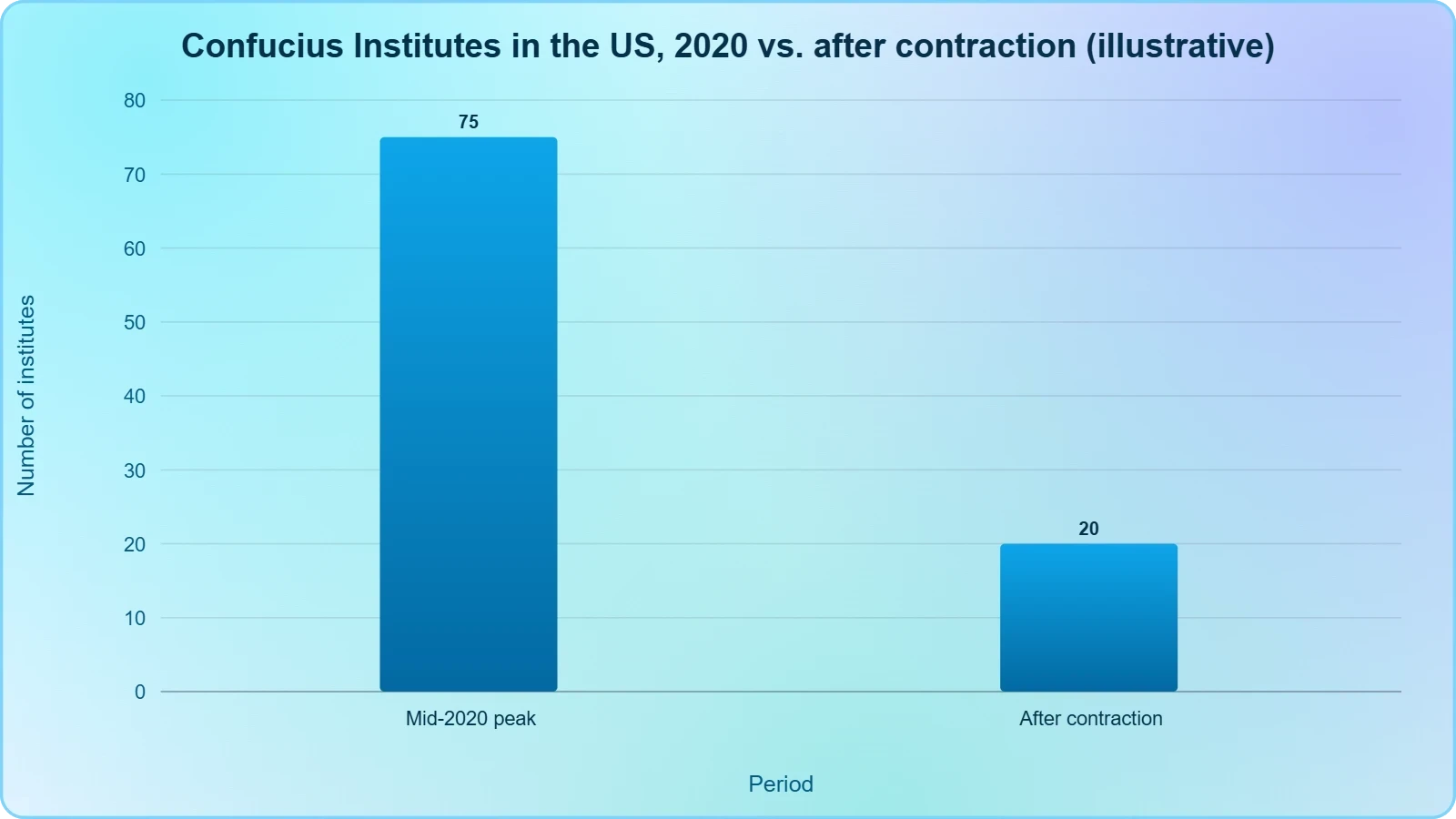
The subsequent contraction of the network, driven by both federal pressure and voluntary university withdrawals, set the stage for the Pentagon's assertion that successor organisations had emerged to fill the vacated space.
Secretary Hegseth's announcement explicitly referenced the proliferation of entities operating under different names and charters while purportedly retaining the original mission. The claim that eighty such groups appeared across thirty universities suggests a deliberate strategy of rebranding to evade scrutiny.
However, the absence of published documentation identifying these successor entities, their funding sources, and their operational structures leaves the assertion open to scholarly verification and potential contestation.
The Evidentiary Claims and Their Verification
The Pentagon's assertion that eighty successor organisations emerged across thirty universities constitutes the central empirical claim underpinning the designation. Verification of this figure would require identification of specific entities, their founding dates, funding arrangements, and operational mandates.
In the absence of a published annex or supporting documentation, independent researchers face substantial obstacles in corroborating or challenging the assertion, which remains a matter of official contention rather than established scholarly consensus.
Historical precedents lend partial credence to concerns about rebranding. Following the closure or withdrawal of numerous Confucius Institutes after 2020, reports emerged of alternative arrangements, including Chinese language programmes funded through different channels and partnerships with other Chinese institutions.
Whether these constitute a coordinated evasion strategy or merely the normal diversification of educational partnerships is a question that demands granular institutional analysis rather than aggregate characterisation.
The claim that the Defense Department dismantled all such organisations over a two-month period raises questions about the mechanisms employed. The Department of Defense possesses limited direct authority over university-hosted programmes, which typically fall under institutional governance and, in some cases, state oversight.
The assertion of dismantlement therefore implies either voluntary compliance by universities, the exercise of funding leverage, or coordination with other federal agencies possessing relevant regulatory authority.
Intellectual property acquisition represents a particularly sensitive allegation, given the broader context of technology competition between the United States and China. Confucius Institutes primarily focused on language instruction and cultural programming, and their direct involvement in scientific or technological research has not been extensively documented.
The linkage between language and culture programming and intellectual property theft therefore requires careful articulation to avoid conflating distinct categories of concern.
Institutional Responses from Universities and Professional Bodies
American universities have occupied an ambiguous position throughout the controversy, balancing the educational benefits of Chinese language instruction against reputational and regulatory risks. Many institutions voluntarily closed their Confucius Institutes between 2018 and 2022, citing concerns about academic freedom and external influence.
Others maintained partnerships while implementing revised governance arrangements intended to preserve institutional autonomy over curriculum and personnel decisions.
The American Association of University Professors articulated early and sustained concerns, warning in 2014 that the institutes served Beijing's political agenda and compromised the independence of higher education. This position reflected broader academic anxieties about the corporatisation of universities and the influence of external funders, whether governmental or private.
The AAUP's stance provided intellectual legitimacy to subsequent federal actions, even as some institutions defended their partnerships as beneficial to students.
University administrators have generally resisted characterisations of their Chinese partnerships as security threats, arguing that academic freedom encompasses the freedom to engage with a wide range of international partners. This perspective emphasises the importance of reciprocal understanding and the risks of isolating American students from Chinese language and cultural competence.
The tension between security concerns and educational mission remains unresolved and is likely to intensify under the new designation.
The Chinese embassy's initial non-response to requests for comment reflects the diplomatic sensitivity of the issue. Beijing has consistently rejected allegations that Confucius Institutes serve propaganda purposes, characterising them as benign cultural and linguistic exchange programmes.
The absence of immediate rebuttal may indicate a strategic decision to avoid escalating rhetoric, or alternatively, a delay in formulating an official response to an unexpected classification.
Comparative Frameworks for Cultural Diplomacy
Confucius Institutes are frequently compared to Western cultural diplomacy organisations such as the British Council, the Alliance Française, and the Goethe-Institut. Proponents of the institutes argue that China is merely emulating established models of cultural promotion, and that singling out Chinese programmes reflects geopolitical bias rather than principled concern.
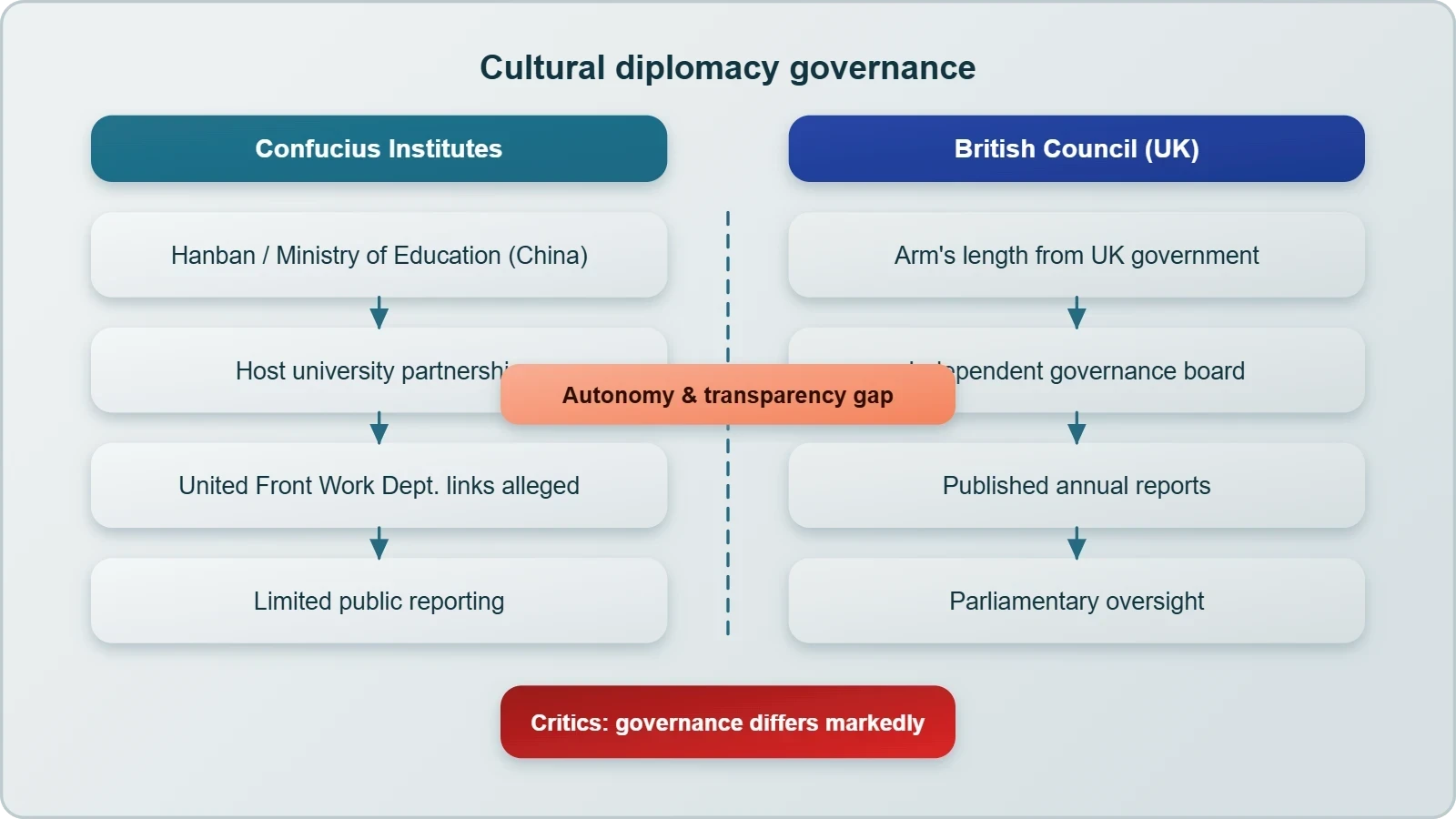
Critics counter that the governance structures, funding arrangements, and oversight mechanisms of Confucius Institutes differ materially from their Western counterparts.
The British Council, for instance, operates at arm's length from the UK government, with a governance structure designed to insulate cultural programming from direct political direction. The Goethe-Institut similarly maintains institutional independence, notwithstanding substantial public funding.
Whether Confucius Institutes possess comparable autonomy, or whether their integration into the United Front Work Department apparatus distinguishes them qualitatively, is a central question in the comparative analysis.
Transparency constitutes another axis of differentiation. Western cultural organisations typically publish annual reports, disclose funding sources, and operate under legal frameworks that permit public scrutiny. The National Association of Scholars' 2017 finding that Confucius Institute contracts were often kept secret suggests a divergence from these norms, although some host universities have since published their agreements in response to public pressure.
The broader geopolitical context shapes perceptions of all cultural diplomacy programmes, but the intensity of scrutiny directed at Chinese initiatives reflects the specific dynamics of US-China competition. As strategic rivalry intensifies across technology, military, and economic domains, educational and cultural exchanges become entangled in securitised logics that may overlook their potential contributions to mutual understanding and conflict mitigation.
The Geopolitical Context of Educational Securitisation
The Pentagon's designation cannot be understood in isolation from the broader deterioration of US-China relations across multiple domains. Technological competition, military tensions in the Indo-Pacific, and disputes over trade and human rights have created an environment in which educational exchanges are increasingly evaluated through security lenses.
This securitisation of academic life raises profound questions about the future of international scholarly collaboration and the principles of academic freedom that have historically governed university partnerships.
The Logic of Securitisation and Its Limits
Securitisation theory, as developed in international relations scholarship, describes the process by which issues are moved from the realm of normal politics into the realm of existential threat, thereby justifying extraordinary measures.
The Pentagon's classification of Confucius Institutes exemplifies this process, transforming what was previously a matter of educational policy and transparency regulation into a national security concern. Such framing potentially authorises actions that would be difficult to justify under ordinary political discourse.
The limits of securitisation become apparent when considering the empirical record. Confucius Institutes primarily provided Chinese language instruction, teacher training, and cultural programming, activities that are not inherently threatening to national security.
The alleged risks, including censorship, intellectual property acquisition, and political influence, are serious but may be addressable through transparency requirements, contractual safeguards, and institutional oversight rather than securitised classification.
Moreover, the securitisation of educational exchanges may produce unintended consequences, including the reduction of Chinese language competence among American students and the erosion of people-to-people ties that could contribute to long-term stability.
The capacity to understand and engage with China, including its language, culture, and political system, is arguably a strategic asset rather than a vulnerability, and policies that diminish this capacity may prove counterproductive.
The designation also raises questions about the appropriate role of the Department of Defense in matters of educational policy. While the Pentagon possesses legitimate interests in protecting sensitive research and technology, the classification of cultural programming falls outside its traditional remit.
The involvement of defence officials in academic oversight may set a precedent for expanded military engagement in civilian education, with implications for institutional autonomy and academic freedom.
Implications for Academic Freedom and Institutional Autonomy
Academic freedom encompasses the freedom to teach, research, and engage with a wide range of perspectives and partners, subject to institutional governance and professional norms. The Pentagon's designation challenges this principle by asserting that certain partnerships are inherently incompatible with national security, regardless of their educational content or institutional safeguards.
Universities may face pressure to terminate partnerships that they would otherwise maintain, potentially compromising their autonomy in international engagement.
The American Association of University Professors' 2014 warning that Confucius Institutes compromised the independence of higher education anticipated these tensions, albeit from a different perspective. The AAUP's concern focused on external influence over curriculum and personnel decisions, whereas the Pentagon's designation introduces a security dimension that may justify more sweeping restrictions.
Both perspectives, however, converge on the importance of institutional autonomy and the risks of external control over academic matters.
Universities must now navigate between competing pressures: federal expectations regarding security compliance, faculty concerns about academic freedom, and student demand for Chinese language and cultural education. The resolution of these tensions will vary across institutions, reflecting differences in governance structures, risk tolerance, and strategic priorities.
Some universities may choose to discontinue Chinese partnerships entirely, while others may seek alternative arrangements that preserve educational benefits while addressing security concerns.
The precedent established by the Pentagon's designation may extend beyond Confucius Institutes to other forms of international academic collaboration. Research partnerships with Chinese universities, joint degree programmes, and faculty exchanges could face heightened scrutiny under the expanded security framework.
The chilling effect on academic engagement with China may be substantial, potentially reducing the diversity of perspectives available to American students and scholars.
The Diplomatic Dimension and Bilateral Relations
The Chinese embassy's initial silence on the designation may reflect a strategic calculation about how to respond to an action that Beijing likely views as politically motivated and factually unfounded.
China has consistently rejected allegations that Confucius Institutes serve propaganda purposes, and may seek to frame the Pentagon's action as evidence of American hostility toward Chinese cultural expression. The diplomatic response, when it emerges, will shape the trajectory of bilateral educational relations.
Educational exchange has historically served as a stabilising element in US-China relations, maintaining channels of communication during periods of political tension. The securitisation of these exchanges may erode this stabilising function, reducing the mutual understanding that contributes to effective diplomacy.
The long-term consequences for bilateral relations are difficult to predict but may include diminished people-to-people ties and reduced capacity for cooperative problem-solving.
The timing of the designation, occurring in the context of broader strategic competition, suggests that educational policy is being subordinated to geopolitical considerations. This subordination raises questions about the appropriate balance between security and openness in a democratic society, and about the principles that should govern international academic engagement.
The resolution of these questions will have implications beyond US-China relations, shaping the norms that govern educational exchange globally.
Allied countries have adopted varying approaches to Confucius Institutes, with some imposing restrictions similar to those in the United States and others maintaining partnerships. The divergence in national policies creates a complex landscape for universities seeking international partnerships, and may lead to the relocation of Chinese cultural programming to jurisdictions with more permissive regulatory environments. The global distribution of Confucius Institutes is likely to shift in response to these varied national approaches.
- 01
- 02
- 03
- 04
We Also Published
Evidentiary Standards and the Politics of Classification
The classification of an organisation as a national security threat carries significant consequences, including potential restrictions on activities, funding, and partnerships. Such classifications should therefore rest on robust evidentiary foundations, subject to independent verification and scholarly scrutiny.
The Pentagon's designation of Confucius Institutes raises questions about the transparency of the evidence supporting the action and the processes by which such determinations are made.
The Role of Empirical Research in Policy Formation
Empirical research on Confucius Institutes has produced a mixed picture, with some studies documenting concerning practices and others finding limited evidence of political influence. The 2017 National Association of Scholars study provided detailed documentation of contractual secrecy and curricular restrictions, while the 2019 University College Dublin analysis identified statistically significant shifts in media coverage associated with institute establishment. These findings, however, are subject to methodological limitations and interpretive debates.
The University College Dublin study, for instance, employed quantitative methods to assess media coverage patterns, but the causal mechanisms linking institute presence to coverage shifts remain underspecified. Alternative explanations, including pre-existing editorial orientations and broader geopolitical trends, may account for some of the observed variation.
The study's citation in the State Department's review suggests that its findings were considered relevant to policy formation, but the strength of the evidence warrants careful assessment.
The National Association of Scholars' findings regarding contractual secrecy and financial incentives are more directly verifiable, as they rest on documentary analysis of agreements between universities and Hanban. The extent to which these findings generalise across institutions, however, is uncertain, as the study may have focused on cases with particular characteristics. A comprehensive assessment would require systematic review of contracts across the full population of host universities.
The claim that teaching materials omitted sensitive historical topics, including human rights abuses, raises questions about curricular content and academic freedom. While such omissions would be concerning if documented, the specific materials and their treatment of contested historical events require detailed examination.
The characterisation of omissions as evidence of political influence assumes that alternative materials would have included such topics, an assumption that merits empirical testing.
Transparency and Accountability in Security Designations
The Pentagon's designation was announced via social media video rather than through formal policy documentation, raising questions about the evidentiary basis and procedural regularity of the action. Formal designations typically involve interagency review, legal analysis, and public documentation, processes that provide opportunities for scrutiny and challenge.
The informal announcement format may reflect the administration's communication strategy, but it complicates assessment of the action's legal and policy foundations.
The assertion that the Defense Department dismantled all successor organisations over a two-month period lacks supporting documentation regarding the mechanisms employed, the institutions involved, and the outcomes achieved. Without such documentation, the claim remains an assertion rather than an established fact, subject to verification through congressional oversight, freedom of information requests, and investigative journalism. The absence of immediate Chinese embassy response further complicates assessment of the action's diplomatic implications.
Accountability mechanisms for security designations include judicial review, congressional oversight, and public scrutiny through media and scholarly analysis. The effectiveness of these mechanisms depends on the availability of information about the basis for designation and the opportunities for affected parties to contest the action.
The Pentagon's announcement, by providing limited detail, may impede the exercise of these accountability mechanisms, raising concerns about the transparency of security policy formation.
The precedent established by this designation may influence future actions regarding other cultural, educational, or media organisations with foreign government affiliations. The criteria for classification, the evidentiary standards applied, and the procedural safeguards observed will shape the landscape for international engagement across multiple sectors.
Clarity regarding these criteria would benefit institutions seeking to navigate the complex regulatory environment while maintaining valuable international partnerships.
The Future of Chinese Language Education in the United States
The contraction of Confucius Institutes has implications for Chinese language education in the United States, where demand for Mandarin instruction has grown alongside China's economic and geopolitical prominence. Alternative providers, including university language departments, community organisations, and online platforms, may fill some of the gap, but the loss of subsidised instruction and teacher training may reduce access, particularly in under-resourced school districts.
The national security framing of Chinese language education may deter students from pursuing Mandarin study, perceiving it as politically sensitive or career-limiting. Such deterrence would be counterproductive from a strategic perspective, as Chinese language competence is essential for diplomacy, intelligence, business, and academic research. The tension between security concerns and the strategic value of language competence requires careful policy navigation.
Universities may develop alternative models for Chinese language instruction that preserve educational benefits while addressing security concerns, such as partnerships with Taiwanese institutions or independent Chinese language programmes. These alternatives may lack the resources and institutional support of Confucius Institutes, however, and may not fully replicate their reach. The sustainability of Chinese language education outside the Confucius Institute framework remains uncertain.
The broader question concerns the balance between openness and security in American higher education. Universities have historically served as sites of international engagement, welcoming students and scholars from around the world and fostering cross-cultural understanding.
The securitisation of educational exchanges challenges this tradition, potentially isolating American students from global perspectives and diminishing the nation's capacity for international leadership.
Conclusion: Balancing Security, Openness, and Academic Mission
The Pentagon's designation of Confucius Institutes as a national security threat represents a consequential development in the evolving relationship between national security policy and American higher education. The action consolidates years of federal scrutiny, transforming a matter of educational policy and transparency regulation into a security concern with potentially far-reaching implications.
The evidentiary basis for the designation, while drawing on documented concerns, remains incompletely specified and warrants independent verification.
The broader trajectory of US-China relations suggests that educational exchanges will continue to face heightened scrutiny, with implications extending beyond Confucius Institutes to research partnerships, student exchanges, and faculty collaborations. Universities must navigate a complex environment in which security considerations, academic freedom, and educational mission intersect, often in tension.
The resolution of these tensions will shape the character of American higher education and its engagement with the world.
The long-term consequences of securitising educational exchanges remain uncertain, but the risks of diminished Chinese language competence, reduced people-to-people ties, and eroded academic freedom merit careful consideration. Policies that address legitimate security concerns while preserving the benefits of international engagement would serve the national interest more effectively than approaches that prioritise security at the expense of openness.
The challenge lies in calibrating responses to specific risks without foreclosing the possibilities of mutual understanding and cooperation.
From our network :
- University Language Proficiency Exams: Why Institutional Tests Demand Different Preparation Than IELTS and TOEFLDiscover why university-specific language proficiency examinations differ fundamentally from IELTS and TOEFL, and learn strategic preparation approaches for institutional assessment success.
- The Hidden Cost of AI Convenience: Why Over-Permissioned Agents Are a Security Time BombDiscover why AI agents with excessive permissions create dangerous single points of failure, and learn how implementing least privilege principles can protect your organization from exploitation.
- The Final Descent: How ESA Retired the Legendary Cluster Constellation After 24 Years of Space Weather ScienceAfter 24 years mapping Earth’s magnetosphere, ESA’s Cluster mission concluded with a precisely controlled reentry over the South Pacific. This analysis explores the scientific legacy, engineering decisions, and debris mitigation principles behind one of space exploration’s most responsible retirements.
- Live Online English Classes for Kids: Do They Actually Reduce Anxiety?A ten-week study reveals that synchronous online English classes can significantly reduce child language anxiety while improving listening and reading skills. Discover what makes these programs effective and how parents can select the right one.
- Committed Mediterranean Precipitation Decline: Why Emissions Cuts Alone Cannot Restore Winter RainsNew NOAA research reveals that Mediterranean winter rains may decline irreversibly even with emissions cuts. Explore the science of committed climate change and regional impacts.
- Forbidden Matrix Patterns and Visible Lattice Points: A Geometric DictionaryExplore how multidimensional 0–1 matrices encode geometric truths, linking forbidden patterns to visible lattice points and hypergraph theory, with applications in combinatorics and computational geometry.
- How AI Agents Will Change the Way We Manage Personal FinancesExplore how AI agents are transforming personal finance through automated budgeting, bill payment, and investment management, while examining the critical security protocols and governance frameworks required for safe deployment.
- Mobile Learning and VR in English: What Global Evidence Reveals About Effective Language TechnologyA systematic review across 14 countries reveals which language-learning technologies genuinely work. Mobile learning, AI, and VR show measurable benefits when pedagogically integrated. This evidence-based guide helps educators and learners select technology that delivers real return on investment.
- CISA’s Ten-Advisory Wave: Why Generic Patching Fails in OT and How to Build Product-Specific PlaybooksCISA released ten ICS advisories in one week, exposing critical infrastructure risks. Generic patching fails in OT. Learn to build product-specific remediation playbooks.
RESOURCES
- Pentagon designates Confucius Institutes in US a national ... - Reutersreuters.com4 days ago ... Pentagon designates Confucius Institutes in US a national security threat ... WASHINGTON, Oct 23 (Reuters) - The US Defense Department…
- Pentagon designates Confucius Institutes a national security threataljazeera.com4 days ago ... The United States Department of Defense has designated Confucius Institutes, Chinese-funded cultural centres on university campuses, as a threat ...
- Pentagon calls China's Confucius Institutes a national security threatwashingtontimes.com2 days ago ... The Pentagon is designating China's Confucius Institutes as threats to U.S. national security for their role in malign activities at ...
- Pentagon designates Confucius Institute in US as national security ...voanews.com21 hours ago ... The Department of War has designated Chinese-funded Confucius Institutes on American university campuses as a national security threat.
- US labeling of Confucius Institutes a security threat exposes irony of ...globaltimes.cn2 days ago ... The US Defense Department has designated Confucius Institutes as a threat to US national security, US Defense Secretary Pete Hegseth…
- Pentagon labels Confucius Institutes in US a national security threattrtworld.comUS Defense Secretary Pete Hegseth accuses Chinese-funded cultural centres of trying to "steal intellectual property and to infiltrate the minds of American ...
- 'Systematically dismantled': Hegseth's new offensive against China's ...scmp.com3 days ago ... ... Pentagon list of threats to national security ... 'Systematically dismantled': Hegseth's new offensive against China's Confucius Institutes ...
- US Defense Department designates China's Confucius Institutes a ...arabnews.com4 days ago ... ... Confucius Institutes a national security threat. ... Pentagon had added them to its list of institutions that threaten US…
- Pentagon designates Confucius Institutes a national security threatwtvbam.com4 days ago ... WASHINGTON, Oct 23 (Reuters) - The US Defense Department has designated China's Confucius Institutes as a threat to US national ...
- Pentagon designates Confucius Institutes national security threat in ...voz.us4 days ago ... Secretary of War Pete Hegseth announced the measure in a video and accused organizations associated with these programs of attempting…
- China says it opposes US 'stigmatisation' of Confucius Institutes after ...centredaily.com1 day ago ... China says it opposes US 'stigmatisation' of Confucius Institutes after Pentagon labels them security threat ... national security threat ...
- Pentagon labels US Confucius Institutes a security threatclb.org.hk4 days ago ... The US Defense Department has designated Chinese-funded Confucius Institutes on university campuses as a national security threat.
- Calligraphy as a national security threat: the Pentagon's war on ...socialistchina.org21 hours ago ... On 23 October, US Secretary of War Pete Hegseth announced in a video posted on social media that his department…
- Pentagon designates Confucius Institutes a national security threatcentraloregondaily.com4 days ago ... WASHINGTON, Oct 23 (Reuters) - The US Defense Department has designated China's Confucius Institutes as a threat to US national…
- Pentagon designates Confucius Institutes a national security threatsg.news.yahoo.com4 days ago ... WASHINGTON, Oct 23 (Reuters) - The US Defense Department has designated China's Confucius Institutes as a threat to US national…
- 01
- 02
- 03
- 04
- 05
- 06
- 07
- 08
0 Comments