
The Archdiocese of New York has agreed to pay $800 million to settle claims from roughly 1,300 people who say they were sexually abused by clergy members and lay workers, a landmark accord that ranks among the largest institutional abuse settlements in American history.
The agreement, reached but not yet signed, was confirmed by Archbishop Ronald Hicks and by attorney Jeff Anderson, whose firm represents more than 250 of the plaintiffs.
Hicks disclosed the arrangement in an email to priests on Saturday, later shared with NPR, writing that the church is close to bringing healing and reconciliation to victim-survivors.
On This Page
Anderson described his clients' emotional state as deeply mixed: sorrow about the abuse they endured, paired with relief that a grueling legal fight has finally concluded.
He said the survivors feel a sense of achievement and believe they have done something to protect others in the future and to clean up the archdiocese.
The deal was first reported by a source omitted from the original account, and it arrives after the archdiocese entered mediation in December 2025, laid off staff, and planned to sell Manhattan properties to raise $300 million for survivors.
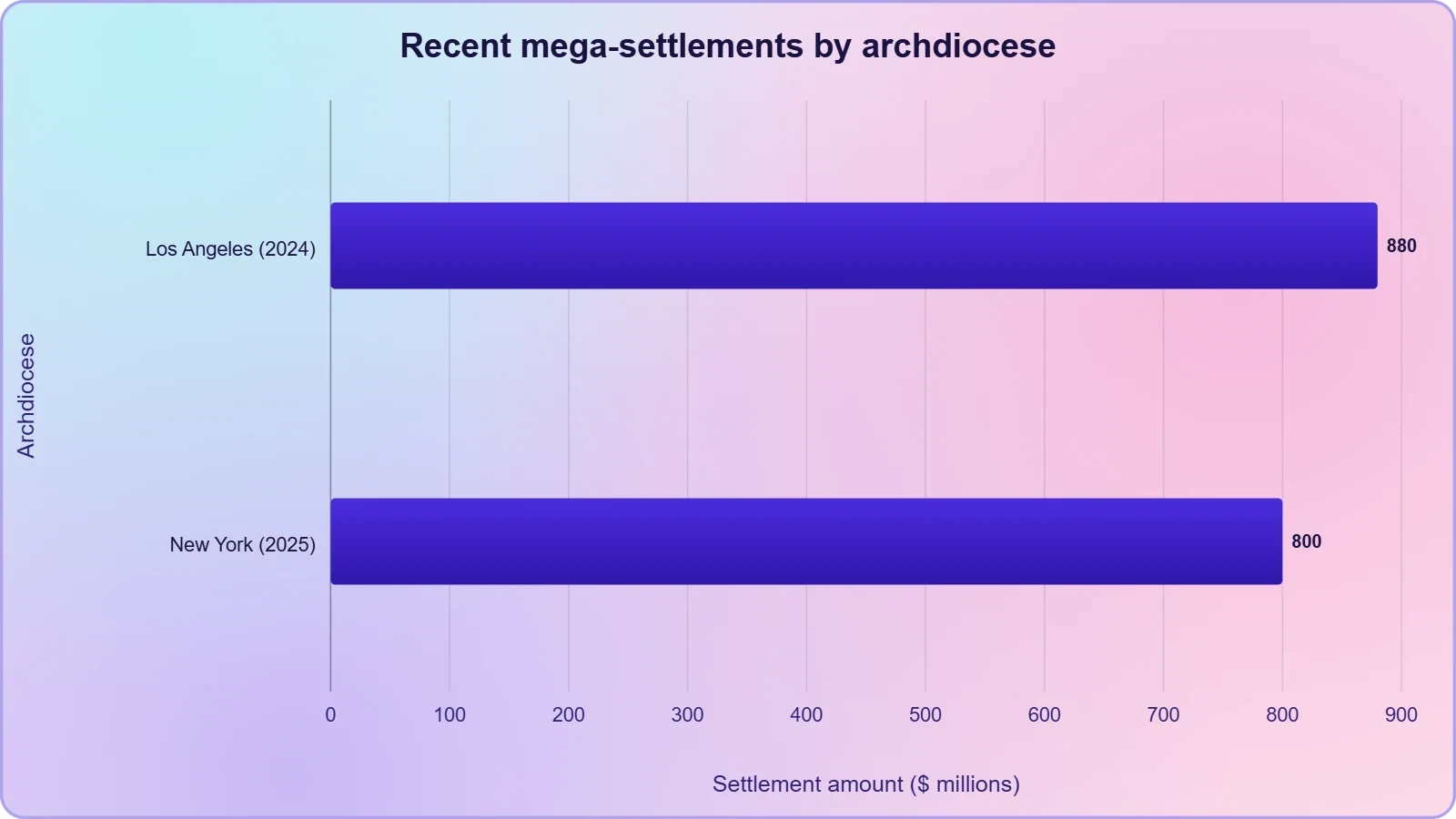
This settlement does not stand alone. In 2024, the Archdiocese of Los Angeles agreed to an $880 million settlement with victims of clergy sexual abuse, and the New York accord now sits just beneath that figure in the grim ledger of Catholic Church liability.
What follows examines the financial architecture of the deal, the mechanics of diocesan bankruptcy and property liquidation, and the broader accountability reckoning reshaping religious institutions across the United States.
TL;DR The Archdiocese of New York has agreed to an $800 million settlement covering approximately 1,300 survivors of clergy and lay-worker sexual abuse, one of the largest such accords in Catholic Church history. Confirmed by Archbishop Ronald Hicks and plaintiffs' attorney Jeff Anderson but not yet signed, the deal follows December 2025 mediation, staff layoffs, and plans to sell Manhattan real estate to fund survivor payments. It trails only the Archdiocese of Los Angeles's $880 million settlement of 2024, signaling an accelerating era of institutional financial accountability for historical abuse.
The Anatomy of an $800 Million Reckoning
The New York settlement represents far more than a headline figure; it is the product of years of litigation, mediation, and mounting institutional pressure.
Roughly 1,300 claimants stand behind the agreement, each carrying a personal history of abuse by clergy or lay workers within the archdiocese.
The scale of the claimant pool explains the scale of the payout, and it underscores how systemic the failures were across decades of institutional life.
How the Agreement Was Reached
The path to settlement ran through mediation, a process the archdiocese formally entered in December 2025 to resolve the 1,300 pending claims.
Mediation allows both sides to negotiate compensation outside open court, reducing publicity and accelerating resolution for aging survivors. Archbishop Hicks confirmed the arrangement in a Saturday email to priests, while attorney Jeff Anderson verified that all plaintiffs had agreed to terms.
Anderson's firm alone represents more than 250 of the claimants, giving him a central vantage point on the negotiations. He characterized the deal as finalized pending signed paperwork, a crucial legal distinction that keeps the accord technically incomplete.
The agreement was first reported by a source omitted from the original account, and NPR's Daniel Burke contributed reporting to the coverage.
Hicks framed the settlement in pastoral language, writing that the church is close to bringing healing and reconciliation to victim-survivors. He added that the agreement will allow the archdiocese to return its full attention to its mission.
Such framing is standard in institutional settlements, yet survivors and advocates often measure reconciliation by transparency and prevention rather than rhetoric.
For the plaintiffs, the emotional ledger is complex. Anderson said his clients carry sorrow about the abuse they experienced alongside relief that the legal fight is over.
They feel a sense of achievement and believe they have done something to protect others in the future and clean up the archdiocese, he said.
The Financial Engineering Behind the Payout
An $800 million obligation cannot be met from ordinary parish collections, so the archdiocese has been restructuring its balance sheet for years.
In December 2025, alongside entering mediation, it laid off staff and planned to sell some Manhattan properties to raise $300 million for survivors. Real estate liquidation is a familiar lever for dioceses holding valuable urban land.
Manhattan property holdings represent an unusually liquid asset base compared with rural dioceses, which often lack comparable real estate. Selling such assets converts sacred geography into compensation capital, a transaction that carries symbolic weight for parishioners.
The archdiocese must balance survivor payments against ongoing operational commitments to parishes, schools, and charitable ministries.
Insurance coverage frequently absorbs a portion of abuse settlements, though policies from decades past often contain exclusions or expired limits. Dioceses increasingly pursue coverage litigation against insurers to recover funds, adding another layer of legal complexity.
The New York accord's funding mix of property sales, reserves, and insurance remains a matter of ongoing financial scrutiny.
Layoffs announced in December 2025 signal that administrative overhead bore part of the adjustment burden. Staff reductions at the chancery level rarely affect frontline ministry directly, but they reflect the fiscal discipline imposed by large liabilities.
The archdiocese's willingness to shrink its central bureaucracy suggests the settlement's weight was anticipated well before signatures.
Survivor Perspectives and the Meaning of Closure
Survivors rarely describe settlements as victory; they describe them as endings. Anderson said his clients feel sorrow about the abuse they experienced and relief that the legal fight is over.
That duality captures the emotional reality of institutional abuse litigation, where compensation arrives long after harm and cannot restore what was lost.
The sense of achievement Anderson described stems from prevention, not payment. Survivors believe they have done something to protect others in the future and clean up the archdiocese.
Many abuse claimants frame their litigation as a public service, forcing institutional reform that internal reviews failed to deliver. Their testimony becomes a deterrent.
Closure also carries procedural weight. Signed paperwork transforms a negotiated understanding into an enforceable obligation, and until signatures are affixed, uncertainty lingers. Anderson's confirmation that all plaintiffs agreed provides reassurance, yet the formal step remains pending. Survivors awaiting payment know that legal finality and emotional finality rarely arrive together.
Public reaction to the settlement will likely split between those who see justice served and those who see an institution buying peace. Advocacy groups have long argued that financial penalties alone do not guarantee child safety.
The archdiocese's stated return to mission will be judged against concrete safeguards and transparency commitments.
Legal Precedent and Institutional Precedents
The New York accord joins a growing body of mega-settlements that are redefining ecclesiastical liability. In 2024, the Archdiocese of Los Angeles agreed to an $880 million settlement with victims of clergy sexual abuse, establishing a benchmark for California claims.
New York's $800 million figure now anchors the East Coast end of that spectrum.
These settlements reflect changes in legal doctrine as much as institutional conscience. Expanded statutes of limitations and revival windows have allowed decades-old claims to proceed, forcing dioceses to confront liabilities they once considered time-barred.
States including New York and California have led this legislative shift, opening courthouse doors to survivors.
Dioceses across the country have responded with bankruptcy filings, which consolidate claims and impose structured payout plans. Bankruptcy offers institutions breathing room but often reduces per-survivor compensation and delays resolution.
The New York archdiocese chose mediation and asset sales instead, a route that preserves more institutional control while demanding immediate liquidity.
Attorney Jeff Anderson has been a recurring figure in these negotiations, representing hundreds of claimants across dioceses. His involvement signals a coordinated legal strategy that treats settlements as systemic reform tools rather than isolated payouts.
The New York deal's structure will likely inform negotiations in other jurisdictions facing similar claim volumes.
The Financial Architecture of Institutional Accountability
Behind every headline settlement lies a balance sheet problem that dioceses must solve without dissolving their religious mission. The New York archdiocese's $800 million obligation required a funding strategy combining real estate liquidation, reserve drawdowns, and likely insurance recovery. Understanding that architecture reveals how religious institutions convert legacy assets into survivor compensation.
Real Estate as Compensation Capital
Manhattan property is among the most valuable real estate in the world, and the archdiocese holds parcels accumulated over more than two centuries.
The December 2025 plan to sell some Manhattan properties to raise $300 million for survivors converted those holdings into a compensation reserve. Such sales are complex, involving zoning, tenant considerations, and preservation concerns.
Property liquidation carries symbolic costs. Parishes and schools tied to sold buildings may face relocation or consolidation, unsettling communities that have worshipped in place for generations. The archdiocese must manage those pastoral consequences while meeting legal obligations. Survivors, meanwhile, may view property sales as evidence that accountability is finally materializing.
Real estate markets fluctuate, and the $300 million target assumes favorable sale conditions. A soft commercial market could delay transactions or reduce proceeds, complicating the payout schedule.
The archdiocese's financial planners must therefore sequence sales carefully, balancing urgency against price realization. Timing risk is a genuine variable in the settlement's execution.
Comparable dioceses have pursued similar strategies. Some have sold chancery buildings, retreat centers, and undeveloped land to fund settlements, while others have mortgaged properties.
The New York approach of targeting Manhattan holdings reflects the unique concentration of value in its portfolio. Few dioceses possess comparable liquidity levers.
Insurance, Reserves, and the Funding Mix
Insurance recovery is a critical but uncertain component of large abuse settlements. Policies purchased decades ago may cover some claims, but insurers frequently dispute coverage on grounds of late notice or policy exclusions.
Dioceses have litigated such disputes extensively, with mixed results that shape net settlement costs.
Reserves accumulated for contingencies provide another funding source, though drawing them down reduces institutional resilience. The archdiocese must maintain reserves for ongoing operations, pension obligations, and charitable commitments.
Overdrawing reserves to fund settlements could impair long-term ministry capacity, a tradeoff church leaders must weigh carefully.
Layoffs announced in December 2025 indicate that administrative costs were trimmed to free resources. Staff reductions at the chancery level rarely affect frontline ministry directly, but they reflect fiscal discipline imposed by large liabilities.
The archdiocese's willingness to shrink its central bureaucracy suggests the settlement's weight was anticipated well before signatures.
The final funding mix will likely blend property proceeds, reserves, insurance, and possibly philanthropic contributions. Donor reaction to the settlement could influence giving patterns, with some contributors withholding support in protest.
Financial transparency about the funding structure would help rebuild trust among parishioners and the public.
Mediation Versus Bankruptcy
Dioceses facing mass abuse claims typically choose between mediated settlement and Chapter 11 bankruptcy. Mediation preserves institutional control and avoids the public scrutiny of bankruptcy court, but it demands negotiated consensus among hundreds of claimants.
Bankruptcy consolidates claims under court supervision and imposes a structured plan on all parties.
The New York archdiocese chose mediation, entering it in December 2025 to resolve the 1,300 claims. That choice reflects confidence that a negotiated figure could satisfy claimants without judicial imposition.
Bankruptcy would have frozen litigation but also exposed internal finances to public examination, a prospect institutions often resist.
Mediation's advantage lies in speed and confidentiality, both valuable to aging survivors and image-conscious institutions. Its disadvantage is that holdout claimants can complicate finality, requiring near-unanimous agreement.
Anderson's confirmation that all plaintiffs agreed suggests the mediation succeeded where fragmentation could have stalled it.
Bankruptcy remains the fallback for dioceses whose liabilities exceed available assets. Several U.S. dioceses have filed Chapter 11 in recent years, producing trust funds that pay claims over time.
The New York settlement's success may encourage other dioceses to pursue mediation first, reserving bankruptcy as a last resort.
Governance Reform and Prevention Commitments
Financial settlements address past harm, but prevention commitments determine future safety. Survivor advocates argue that money without structural reform merely transfers risk to future generations.
The archdiocese's stated return to mission must therefore be paired with enforceable child protection protocols and independent oversight.
Dioceses nationwide have adopted charter commitments, background checks, and lay review boards in response to the abuse crisis. Critics contend these measures remain unevenly enforced and insufficiently independent.
The New York settlement's legacy will depend partly on whether it strengthens such mechanisms or merely closes a legal chapter.
Transparency about settlement terms, funding sources, and personnel decisions would build credibility with survivors and parishioners. Secrecy provisions common in abuse settlements often frustrate public understanding of institutional failures.
Balancing confidentiality for survivors with public accountability is a persistent tension in these negotiations.
Archbishop Hicks's email to priests emphasized healing and reconciliation, language that resonates with Catholic theology of repair. Whether that theology translates into institutional practice will be measured by audits, reporting mechanisms, and survivor inclusion in governance. The settlement is a beginning, not an endpoint, in that longer moral accounting.
- 01
- 02
- 03
- 04
We Also Published
Broader Implications for Church, Law, and Society
The New York settlement reverberates far beyond a single archdiocese, touching questions of institutional trust, legal reform, and the moral authority of religious bodies.
When an $800 million accord becomes one entry in a lengthening ledger, society must ask what accountability truly requires. The answers shape how future generations regard both the church and the legal systems that confront it.
The Expanding Statute of Limitations Landscape
Legal reform has been the quiet engine behind the settlement wave. States have enacted revival windows and extended statutes of limitations, allowing survivors to file claims decades after abuse occurred.
New York's legislative environment made the 1,300 claims legally viable, forcing the archdiocese to negotiate rather than dismiss.
These reforms reflect a societal reckoning with how law historically protected institutions over individuals. Childhood abuse claims were often barred by short filing deadlines that ignored the psychology of delayed disclosure.
Revival statutes correct that imbalance, giving survivors time to come forward without legal foreclosure.
Opponents argue that revival windows impose unpredictable liabilities on institutions and strain court systems. Supporters counter that without them, systemic abuse remains legally invisible.
The New York settlement demonstrates that revival statutes produce concrete financial consequences, not merely symbolic ones. Other states are watching closely.
Insurance and actuarial industries have adapted by pricing long-tail liability more conservatively. Dioceses now face higher premiums and stricter coverage terms, reflecting the new legal reality.
The settlement's ripple effects thus extend into insurance markets and institutional risk management far beyond church walls.
Trust, Moral Authority, and the Catholic Future
The Catholic Church's moral authority rests on credibility, and abuse settlements erode that credibility even as they deliver justice. Every headline figure reminds the faithful that institutional leaders failed in their most basic duty of protection. Rebuilding trust requires more than payments; it demands visible, sustained reform.
Parishioners react to settlements with a mixture of grief, anger, and loyalty. Some withhold donations, others redouble support, and many simply disengage. The archdiocese's financial strain may accelerate parish consolidations and school closures, further testing community bonds. Pastoral care for both survivors and faithful becomes a delicate balancing act.
Survivor advocacy groups have pushed for structural changes including independent oversight boards with real authority. They argue that internal review mechanisms historically shielded abusers and must be replaced by external accountability. The New York settlement's prevention commitments will be measured against that standard.
Pope Francis and subsequent church leadership have repeatedly apologized for abuse and pledged reform. Yet settlements continue to accumulate, suggesting that apologies alone cannot substitute for enforceable accountability.
The gap between rhetoric and practice remains the central challenge facing the institutional church in the twenty-first century.
What Comes Next for Survivors and Institutions
Survivors now await signed paperwork and the disbursement of funds, a process that can take months or years. Legal finality will not erase trauma, but it may allow survivors to redirect energy toward advocacy and healing.
Anderson's clients reportedly feel they have protected others, a sentiment that reframes compensation as prevention.
The archdiocese faces the harder task of rebuilding institutional trust while managing financial constraints. Property sales, layoffs, and reserve drawdowns will shape its operations for years, testing its capacity to sustain ministries.
Hicks's pledge to return attention to mission will be judged by outcomes, not announcements.
Other dioceses will study the New York template closely, weighing mediation against bankruptcy and asset sales against reserve depletion. The settlement's structure may become a model for jurisdictions with concentrated real estate wealth and large claim pools. Legal and financial advisors to religious institutions are already analyzing its terms.
Society's broader interest lies in whether accountability mechanisms actually prevent future abuse. Settlements can compensate harm, but only governance reform can stop it.
The New York accord's ultimate significance will be measured by what changes inside the church, not merely by what it pays.
From our network :
- University Language Proficiency Exams: Why Institutional Tests Demand Different Preparation Than IELTS and TOEFLDiscover why university-specific language proficiency examinations differ fundamentally from IELTS and TOEFL, and learn strategic preparation approaches for institutional assessment success.
- How AI Agents Will Change the Way We Manage Personal FinancesExplore how AI agents are transforming personal finance through automated budgeting, bill payment, and investment management, while examining the critical security protocols and governance frameworks required for safe deployment.
- CISA’s Ten-Advisory Wave: Why Generic Patching Fails in OT and How to Build Product-Specific PlaybooksCISA released ten ICS advisories in one week, exposing critical infrastructure risks. Generic patching fails in OT. Learn to build product-specific remediation playbooks.
- Live Online English Classes for Kids: Do They Actually Reduce Anxiety?A ten-week study reveals that synchronous online English classes can significantly reduce child language anxiety while improving listening and reading skills. Discover what makes these programs effective and how parents can select the right one.
- The Hidden Cost of AI Convenience: Why Over-Permissioned Agents Are a Security Time BombDiscover why AI agents with excessive permissions create dangerous single points of failure, and learn how implementing least privilege principles can protect your organization from exploitation.
- The Final Descent: How ESA Retired the Legendary Cluster Constellation After 24 Years of Space Weather ScienceAfter 24 years mapping Earth’s magnetosphere, ESA’s Cluster mission concluded with a precisely controlled reentry over the South Pacific. This analysis explores the scientific legacy, engineering decisions, and debris mitigation principles behind one of space exploration’s most responsible retirements.
- Forbidden Matrix Patterns and Visible Lattice Points: A Geometric DictionaryExplore how multidimensional 0–1 matrices encode geometric truths, linking forbidden patterns to visible lattice points and hypergraph theory, with applications in combinatorics and computational geometry.
- Committed Mediterranean Precipitation Decline: Why Emissions Cuts Alone Cannot Restore Winter RainsNew NOAA research reveals that Mediterranean winter rains may decline irreversibly even with emissions cuts. Explore the science of committed climate change and regional impacts.
- Mobile Learning and VR in English: What Global Evidence Reveals About Effective Language TechnologyA systematic review across 14 countries reveals which language-learning technologies genuinely work. Mobile learning, AI, and VR show measurable benefits when pedagogically integrated. This evidence-based guide helps educators and learners select technology that delivers real return on investment.
RESOURCES
- Archdiocese of New York agrees to $800 million settlement ... - NPRnpr.org1 day ago ... The 1300 survivors of sexual abuse by clergy members and lay workers have all agreed to the settlement, according to…
- New York Archdiocese agrees to $800 million settlement over abuse ...vaticannews.va20 hours ago ... New York Archdiocese agrees to $800 million settlement over abuse litigation ... The Archdiocese of New York and attorneys for…
- N.Y. Archdiocese Offers $800 Million to Settle Sex Abuse Claimssnapnetwork.orgApr 30, 2026 ... ... sexual abuse settlement process. Cardinal Dolan submitted his ... Judge Buckley negotiated a settlement between the Archdiocese of Los…
- New York's archdiocese and survivors of clergy abuse agree ... - PBSpbs.org15 hours ago ... New York's archdiocese and survivors of clergy abuse agree to $800 million legal settlement ... The only larger settlement over…
- Abuse survivors approve $800 million settlement with Archdiocese ...reuters.com1 day ago ... Survivors of clergy sexual abuse have agreed to an $800 million settlement with the Archdiocese of New York, lawyers said…
- New York Archdiocese Agrees to Settle Sexual Abuse Claims for ...nytimes.com2 days ago ... New York Archdiocese Agrees to Settle Sexual Abuse Claims for Over $800 Million. The Roman Catholic archdiocese might now avoid…
- NY Archdiocese offers $800 million to settle sex abuse survivor claimsabc7ny.comMay 1, 2026 ... New York Archdiocese offers $800 million to settle sex abuse survivor claims ... Sandra Bookman has the details. ... NEW…
- Archdiocese of NY proposes $800M settlement for abuse claimsncronline.orgMay 3, 2026 ... The Archdiocese of New York has proposed an $800 million settlement ... million for sexual abuse settlements. That effort had…
- Clergy Abuse Survivors Reach Proposed Settlement with ...andersonadvocates.comMay 1, 2026 ... (New York City, NY) – The Archdiocese of New York and the Plaintiff Liaison Committee[1] have agreed to recommend a…
- NY Archdiocese Agrees to $800M Settlement for Abuse Victimshermanlaw.comMay 4, 2026 ... The New York Archdiocese agrees to an $800 million settlement for sexual abuse victims, a significant milestone in justice efforts.
- New York Archdiocese to pay $800 million to sex abuse survivorsdw.com1 day ago ... Around 1300 survivors agreed to the $800 million payout from the Catholic Church, marking one of the largest clergy abuse…
- Archdiocese of New York offers $800 million sex abuse settlement ...cbsnews.comMay 1, 2026 ... The legislation passed in 2019 gave a one-year window for sexual abuse survivors to file civil lawsuits barred by the…
- The Archdiocese of New York and attorneys for about ... - Facebookfacebook.com9 hours ago ... ... sexually abused by clergy have agreed to an $800 ... New York's archdiocese and survivors of clergy abuse agree…
- Archdiocese of New York agrees to $800M settlement with victims of ...fox5ny.com1 day ago ... The Archdiocese of New York has agreed to an $800 million settlement with more than 1000 people who say they…
- New York Archdiocese reaches $800 million sexual abuse settlementamny.com15 hours ago ... The Archdiocese of New York and victims who said they were sexually abused by clergy have come to an $800…
- 01
- 02
- 03
- 04
- 05
- 06
- 07
- 08
0 Comments