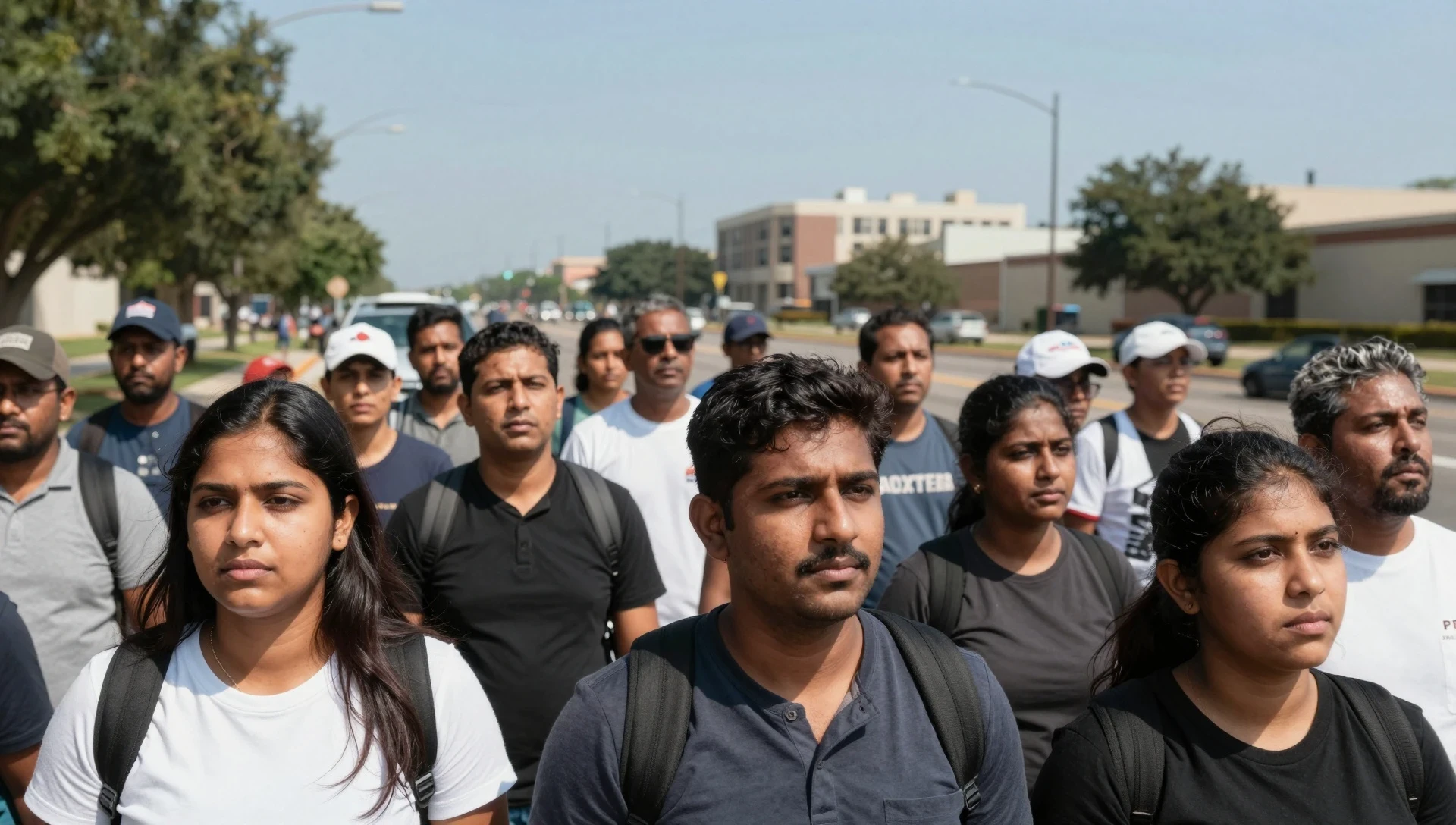
Pooja Sethi's campaign for the Texas House was designed to test a simple proposition: whether a suburban Austin district would evaluate a Democratic candidate on her record rather than her ancestry. The answer arrived within days of a social media influencer reposting a photograph of her campaign banner.
The resulting comment thread was hostile enough that Sethi left her campaign operations to be with her young son, a detail that reframes the episode as a personal safety event rather than routine political friction.
The stakes are structural, not merely symbolic. Were Sethi elected, she would become the first Asian Democratic woman and the first South Asian woman to serve in the Texas legislature, a body that has never reflected the state's fastest-growing ethnic cohort in its membership.
On This Page
Her candidacy therefore concentrates two pressures at once: the normal scrutiny applied to any first-time legislative contender, and an identity-based hostility that no opposition research file can explain or contain.
That hostility is measurable. A report by the Center for the Study of Organized Hate recorded a 240 percent increase in online rhetoric targeting South Asians between January 2024 and June 2026, attributing the surge to xenophobia, economic resentment casting South Asians as invaders or job thieves, heightened political visibility, and restrictive immigration policy.
This analysis traces how that documented rise moved from digital speech into physical violence, and what South Asian communities in Texas are doing about it.
TL;DR Racist abuse directed at Texas House candidate Pooja Sethi is the visible edge of a documented national trend. The Center for the Study of Organized Hate measured a 240 percent rise in anti-South Asian online rhetoric between January 2024 and June 2026, driven by xenophobia, economic resentment, growing political visibility, and restrictive visa policy. Official and candidate rhetoric has amplified the pattern, and the consequences have turned lethal: a Sikh truck driver stabbed 17 times in Wyoming, and a foiled mass-casualty plot against a Hindu temple in Aurora, Illinois. Texas, home to more than 600,000 South Asians, has become the focal point, and community organizations are converting outrage into voter mobilization.
The Anatomy of a Documented Surge in Anti-South Asian Hate
The Texas episode is best read as a data point inside a trend line rather than an isolated outburst. The Center for the Study of Organized Hate quantified what community advocates had reported anecdotally for two years, finding that hostile online rhetoric aimed at South Asians rose 240 percent across a 30-month window.
That figure matters because it establishes a baseline against which individual incidents can be assessed and policy responses calibrated.
What the 240 Percent Figure Actually Measures
The metric tracks volume of hostile online rhetoric, not reported hate crimes, and the distinction is analytically important. Online speech functions as a leading indicator: it normalizes language that later surfaces in workplaces, schools, and public accommodations.
A 240 percent expansion in that corpus over 30 months implies a materially larger pool of people exposed to dehumanizing framing of South Asian neighbors.
The report identifies four reinforcing drivers rather than a single cause. Xenophobia supplies the underlying prejudice; economic resentment supplies the narrative that South Asians are invaders or job thieves; increased political visibility supplies the trigger events; and anti-migrant policy supplies official legitimacy. When all four operate simultaneously, the resulting rhetoric is more durable than episodic outrage would suggest.
Visibility cuts both ways, which is the report's most counterintuitive finding. South Asians entering elected office, running campaigns, and appearing in public life raise the community's profile and simultaneously generate backlash from those who read demographic change as displacement. Sethi's campaign banner became a flashpoint precisely because it signaled political permanence rather than transient presence.
Policy design contributes measurably to the climate. A high annual fee on H-1B visa applications reframes skilled immigration as a revenue extraction mechanism and implicitly casts South Asian professionals as temporary, transactional residents.
Such measures do not cause individual acts of harassment, but they establish the governing assumption that certain residents are guests whose standing is conditional.
From Online Rhetoric to Physical Violence
Chintan Patel, executive director of Indian American Impact, argues that hostile rhetoric creates fear and can culminate in physical violence. The record supports that causal claim more directly than analysts might prefer.
Roughly a week after a federal agency posted an inflammatory image, a Sikh truck driver was stabbed 17 times at a rest stop in Wyoming, an attack that community groups linked to the prevailing climate.
The Aurora, Illinois case is more chilling because it was intercepted. The day before the Austin community meeting, authorities disclosed a planned mass shooting at a Hindu temple. The suspect, a self-described white supremacist, was armed with a rifle and body armor and intended to kill Indian people. Prevention here depended on law enforcement, not on rhetoric cooling.
These incidents share a structural feature: targets were selected by visible identity markers rather than individual conduct. A turban, a shared language, a temple congregation, a campaign banner. When violence operates through such markers, no amount of personal assimilation or professional achievement provides protection, which is precisely why the community response has focused on collective political power.
Texas as the Center of Gravity
Chanda Parbhoo, founder of the South Asian American Voter Empowerment of Texas Education Fund, states plainly that Texas has become the center of anti-South Asian hate. Demographics explain the concentration.
The 2021 US census counted more than 600,000 South Asians in Texas, the second-largest such population nationally after California, and one of the state's fastest-growing groups.
Growth at that rate changes electoral arithmetic, and incumbents notice. A community large enough to swing suburban districts becomes a target for mobilization and for backlash simultaneously. Sethi's district-level campaign is therefore a leading indicator of statewide competition, not a local curiosity, and the intensity of the reaction reflects that electoral weight.
Institutional responses have followed the demographic reality. Indian American Impact, a nonpartisan group supporting South Asian candidates and voter engagement, convened the Austin meeting, which included US Representative Pramila Jayapal. The presence of a sitting congresswoman signals that the community's political infrastructure now operates at a level capable of national coordination.
We Also Published
Official Rhetoric, Institutional Failure, and the Midterm Context
The distinguishing feature of the current cycle is not the existence of prejudice but its amplification from official platforms. Right-wing officials have used hostile rhetoric ahead of the midterm elections, and two documented examples illustrate the pattern with unusual clarity.
Both involved public figures or agencies with institutional reach, and both were disseminated through social media to large audiences before any correction occurred.
The DHS Image and the Limits of Deletion
In September, the Department of Homeland Security posted an AI-generated image on X depicting a Sikh man facing a character resembling Optimus Prime, with a caption instructing "Mr. Singh" to get off the roads. The agency deleted the image after criticism. Deletion, however, does not reverse distribution; the artifact had already circulated through networks primed to receive it.
The choice of a Sikh man is analytically significant. Sikh Americans are frequently targeted through misdirected anti-Muslim hostility, a pattern of error that compounds the harm. A federal agency deploying that imagery lends administrative authority to a stereotype, converting what might be dismissed as anonymous trolling into something closer to sanctioned messaging.
AI-generated imagery adds a distinct dimension. Synthetic content is cheap to produce, difficult to attribute, and easily detached from its origin, which means the evidentiary trail weakens even as the visual memory persists. When a government account generates such material, the credibility cost is borne by the institution regardless of subsequent retraction.
Candidate Conduct and the Cost of Silence
Days after the DHS post, Bo French, the Republican candidate for the Texas Railroad Commission, posted a photograph of South Asian American students at UT Austin celebrating a football win. His caption suggested the school's graduation now looked like that and that the problem was worse than imagined. The message equated visible presence with institutional decline.
The framing is a textbook application of the economic and cultural resentment the hate-study report identified. Students celebrating a football victory are recast as evidence of deterioration, which converts ordinary campus life into a demographic threat narrative. No policy argument is offered because none is required; the photograph performs the work.
Accountability mechanisms remain uneven. The DHS image was withdrawn; the candidate post generated coverage but no comparable institutional consequence. That asymmetry matters because it signals to other candidates that identity-based messaging carries limited professional risk, particularly in primary electorates where such content may be rewarded rather than penalized.
- 01
- 02
- 03
- 04
Political Mobilization as the Countermeasure
Community organizations have responded by treating electoral participation as the primary defensive instrument. Indian American Impact convened the Austin meeting to support South Asian candidates and voter engagement, and the South Asian American Voter Empowerment of Texas Education Fund pursues parallel work. The strategic logic is straightforward: groups large enough to determine outcomes are harder to demonize with impunity.
Candidate Support and Voter Engagement Infrastructure
Sethi's decision to address a community meeting rather than retreat from the race illustrates the intended function of that infrastructure. She told the gathering she had not expected to have to fight anti-Indian hate, a statement that captures the gap between professional preparation and racialized attack. The organization's role is to absorb some of that burden collectively.
Nonpartisan engagement groups operate under structural constraints. They can register voters, educate, and convene, but cannot coordinate directly with campaigns. That limitation shapes strategy: the work focuses on turnout infrastructure and candidate pipelines rather than message discipline, which is slower but more durable across election cycles.
Representation functions as a measurable output of this infrastructure. Sethi's potential firsts, as the first Asian Democratic woman and first South Asian woman in the Texas legislature, are not merely symbolic milestones.
They alter committee composition, constituent service priorities, and the internal calculus of a body that has historically legislated without South Asian input.
What the Midterms Will Test
The midterm elections will test whether backlash suppresses participation or accelerates it. Historical patterns suggest that targeted communities often increase turnout when hostility is explicit, though the effect depends on organizational capacity and perceived efficacy. Texas, with its 600,000-plus South Asian residents, offers the clearest test case nationally.
Policy responses remain contested. Immigration fee structures, hate-crime enforcement, and platform moderation of synthetic content all bear directly on the climate, yet none is currently calibrated to the documented 240 percent rise. The gap between measured harm and legislative response is the central unresolved question in this analysis.
For now, the evidence points to a community converting exposure into organization. The abuse directed at a single campaign banner produced a community meeting attended by a sitting congresswoman, national media coverage, and renewed attention to voter registration. Whether that conversion holds through November will determine the trajectory of the next reporting cycle.
From our network :
- The Final Descent: How ESA Retired the Legendary Cluster Constellation After 24 Years of Space Weather ScienceAfter 24 years mapping Earth’s magnetosphere, ESA’s Cluster mission concluded with a precisely controlled reentry over the South Pacific. This analysis explores the scientific legacy, engineering decisions, and debris mitigation principles behind one of space exploration’s most responsible retirements.
- The Hidden Cost of AI Convenience: Why Over-Permissioned Agents Are a Security Time BombDiscover why AI agents with excessive permissions create dangerous single points of failure, and learn how implementing least privilege principles can protect your organization from exploitation.
- Live Online English Classes for Kids: Do They Actually Reduce Anxiety?A ten-week study reveals that synchronous online English classes can significantly reduce child language anxiety while improving listening and reading skills. Discover what makes these programs effective and how parents can select the right one.
- Forbidden Matrix Patterns and Visible Lattice Points: A Geometric DictionaryExplore how multidimensional 0–1 matrices encode geometric truths, linking forbidden patterns to visible lattice points and hypergraph theory, with applications in combinatorics and computational geometry.
- University Language Proficiency Exams: Why Institutional Tests Demand Different Preparation Than IELTS and TOEFLDiscover why university-specific language proficiency examinations differ fundamentally from IELTS and TOEFL, and learn strategic preparation approaches for institutional assessment success.
- Mobile Learning and VR in English: What Global Evidence Reveals About Effective Language TechnologyA systematic review across 14 countries reveals which language-learning technologies genuinely work. Mobile learning, AI, and VR show measurable benefits when pedagogically integrated. This evidence-based guide helps educators and learners select technology that delivers real return on investment.
- CISA’s Ten-Advisory Wave: Why Generic Patching Fails in OT and How to Build Product-Specific PlaybooksCISA released ten ICS advisories in one week, exposing critical infrastructure risks. Generic patching fails in OT. Learn to build product-specific remediation playbooks.
- Committed Mediterranean Precipitation Decline: Why Emissions Cuts Alone Cannot Restore Winter RainsNew NOAA research reveals that Mediterranean winter rains may decline irreversibly even with emissions cuts. Explore the science of committed climate change and regional impacts.
- How AI Agents Will Change the Way We Manage Personal FinancesExplore how AI agents are transforming personal finance through automated budgeting, bill payment, and investment management, while examining the critical security protocols and governance frameworks required for safe deployment.
RESOURCES
- 'There's a lot of hate': rightwing racism stirs south Asian mobilization ...theguardian.com4 hours ago ... Texas has become the “ground zero” for anti-south Asian hate, says ... Texas politics. At a re-election campaign fundraising event…
- Home - Stop AAPI Hate Actionstopaapihate.orgStop AAPI Hate is a U.S.-based coalition dedicated to fighting racism and discrimination against Asian Americans and Pacific Islanders (AAs & PIs).
- Stand united alongside our Bexar County delegation of elected ...facebook.comSep 11, 2026 ... MOBILIZE. 🗳️ North Texas Asian Democrats and Asian Texans for Justice Action Fund co-hosting our No Hate Town Hall &…
- Leading Asian American Advocacy Groups Launch Campaign to ...stopaapihate.orgSep 21, 2023 ... 'Stop The Blame' campaign from Stop AAPI Hate and Chinese for Affirmative Action will mobilize support against anti-Asian political rhetoric ...
- Racist Attacks Mobilize Asian American Voters in Texas | ACoMamericancommunitymedia.org5 days ago ... Texas has a long history of anti-Asian xenophobia, including ... “We're seeing a lot of anti-South Asian hate, and you're…
- Faculty News | About the Department - Amherst Collegeamherst.edu... Texas again is making national and local headlines for anti-South Asian racism. ... In the immediate aftermath of 9/11, hate crimes against South…
- Indian American Impact - Mobilizing South Asian Voters & Electing ...iaimpact.orgImpact works to build power for Indian and South Asian Americans by mobilizing, engaging, and electing members of our communities across the United States.
- r/texas - Redditreddit.com'There's a lot of hate': rightwing racism stirs south Asian mobilization in Texas ... https://www.houstonchronicle.com/politics/texas-take/article ...
- As Anti-South Asian Hate Surges, 60% of ... - Indian American Impactiaimpact.org6 days ago ... Texas is home to more than 700,000 South Asian residents, and ... South Asian Americans step up to flex our…
- 'There's a lot of hate': rightwing racism stirs south Asian mobilization ...reddit.com3 hours ago ... Across the country, anti-south Asian hate has spiked since Trump took office. According to the Center for the Study of…
- Anti-Asian laws and policies (U.S. National Park Service)nps.govBy 1923, Washington, Arizona, Texas, Oregon, and Idaho all had similar laws. The Immigration Act of 1917. Also known as the Literacy Act, this…
- From Narrative Scarcity to Research Plenitude for Asian Americansrsfjournal.orgMore overt forms of anti-Asian hate have also surfaced. In Texas, for example, a man stabbed a Burmese American family—a father and two young…
- Feeling overwhelmed by the anti-South Asian rhetoric rampant in ...instagram.comSep 24, 2026 ... What can we learn from earlier generations of South Asian Americans? How do we mobilize and advocate for ourselves without…
- Politicized Immigrant Identity, Spanish-Language Media, and ...rsfjournal.org... mobilization continues to focus on how the immigration issue can mobilize ... anti-immigrant rhetoric from politicians and political candidates for office.
- Asian American Mobilization and Political Identities - Sara Sadhwanisarasadhwani.comMay 20, 2022 ... “Exploring the Function of the Anti-communist Ideology and Identity in the Vietnamese American Diasporic. Community.” Journal of Southeast Asian ...
- 01
- 02
- 03
- 04
- 05
- 06
- 07
- 08
0 Comments