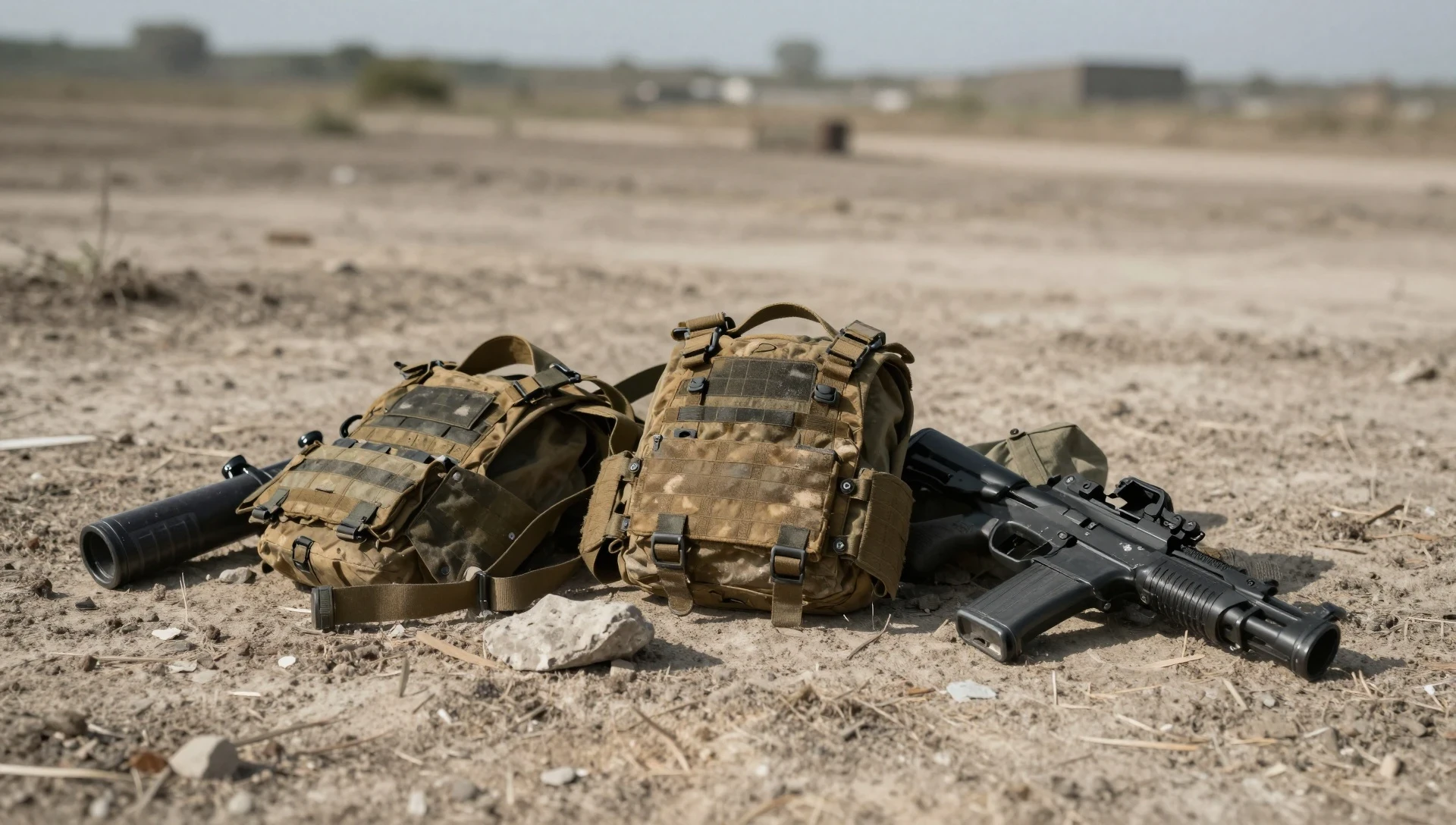
On 1 November 2026, the Russian state news agency TASS published an interview with Denis Pushilin, head of the self-declared Donetsk People's Republic, in which he alleged that Ukrainian forces are deploying Russian prisoners of war as suicide bombers.
Pushilin framed the accusation as a grave war crime and a direct violation of humanitarian law, and he asserted that the claim had been ignored by international media, the general public, and human rights organisations.
The report carries a single named source, a Moscow-funded wire service, and no independent verification of the underlying allegation has been produced.
On This Page
The item is analytically significant less for what it asserts than for how it is constructed. It arrives through a state-funded channel, relies on an official of an unrecognised entity, and pre-emptively indicts international observers for silence — a rhetorical pattern that converts an unverified claim into a grievance about coverage.
The original TASS article also bundled unrelated material: statements by Russian officials on the conflict, battlefield reports, and commentary on international relations, none of which formed part of the Pushilin interview itself.
This analysis examines the claim's evidentiary basis, the institutional incentives shaping its publication, and the broader information-warfare architecture in which prisoner-of-war allegations circulate. It separates what is documented from what is asserted, compares the reporting pattern against established verification standards, and sets out how readers and analysts should weigh single-source atrocity claims emerging from belligerent state media.
TL;DR A TASS interview with Denis Pushilin alleges that Ukraine uses Russian prisoners of war as suicide bombers, characterising the practice as a war crime and complaining that international media and human rights bodies have ignored it. The claim rests on a single official of a self-declared republic, is published by a Kremlin-funded agency, and has not been independently verified. The surrounding article mixes this allegation with unrelated conflict reporting, a packaging pattern that complicates verification and warrants cautious, source-critical reading.
The Anatomy of a Single-Source Atrocity Allegation
The Pushilin statement follows a recognisable template in conflict reporting: a senior figure aligned with one belligerent makes a specific, emotionally charged allegation of prohibited conduct, attributes it to the opposing force, and simultaneously complains that the world has looked away. Each element performs work.
The specificity lends an impression of insider knowledge; the moral framing of "war crime" raises the stakes; the grievance about silence positions the accuser as a truth-teller against a negligent international system.
What the report does not supply is equally instructive. There is no enumeration of alleged incidents, no dates, no locations, no named victims, no documentary record, and no corroborating witness testimony.
Verification of such claims normally requires forensic evidence, prisoner testimony collected under neutral auspices, or observation by monitors with access to the relevant facilities. None of these appear in the TASS account, which presents the allegation as a completed assertion rather than an evidentiary proposition.
The Source: Denis Pushilin and the Donetsk Authority
Denis Pushilin heads the Donetsk People's Republic, an entity declared in 2014 and recognised only by Russia and a small number of aligned states. Its administrative and media apparatus operates within Moscow's political and military orbit, which means statements from its leadership function simultaneously as governance communication and as instruments of the wider Russian information campaign.
The structural alignment does not automatically falsify a claim, but it establishes a clear interest in shaping narratives about Ukrainian conduct.
Officials in such positions typically enjoy limited exposure to independent scrutiny and face few domestic costs for unverified assertions. Their statements therefore carry a different evidentiary weight than testimony from monitors, defectors with documentary backing, or investigators operating under international mandate.
Analysts conventionally treat belligerent-aligned official claims as leads requiring corroboration rather than as findings, a standard applied with equal rigour to statements from Kyiv, Moscow, and their respective proxies.
The Channel: TASS and State-Funded News Infrastructure
TASS is funded by the Russian government, a fact the source text itself records. State funding does not render every item false, and wire agencies of many governments produce accurate reporting.
It does, however, shape editorial incentives: selection of stories, framing of allegations, and the decision to publish unverified claims without the caveats that independent outlets would typically attach. The absence of such caveats in the Pushilin item is itself a data point about editorial standards.
Comparative media research consistently finds that state-aligned outlets amplify atrocity allegations against adversaries while minimising or omitting documented abuses by their own side. The pattern is observable across conflicts and regimes, which is why source-critical reading treats the identity of the publisher as relevant context rather than as a neutral delivery mechanism.
Readers assessing the claim should weigh the channel's funding and alignment alongside the content of the allegation itself.
The Packaging: Bundled Content and Narrative Framing
The original TASS article was not a discrete report on the Pushilin interview. It collected other items — Russian official statements on the conflict, military action reports, and commentary on international relations — that were not part of the interview. This bundling matters analytically.
Aggregated feeds blend verified reporting, official statements, and unverified allegations into a continuous stream, and readers moving quickly through such feeds may absorb the allegation without registering its evidentiary status.
Narrative packaging also performs a cumulative function. Repeated juxtaposition of battlefield claims with atrocity allegations builds an impression of a pattern, even where no individual element has been substantiated. The technique is common to propaganda across all sides of the Ukraine conflict and beyond.
Recognising the aggregation pattern is a prerequisite for evaluating any single component of it on its own merits.
Information Warfare, Law, and the Politics of Silence
Allegations of prisoner abuse occupy a distinct position in conflict law and in information strategy. The Geneva Conventions prohibit violence to life and person against detainees, and using prisoners for purposes that expose them to lethal harm would constitute a serious breach.
Because the legal stakes are high, such allegations attract scrutiny — and because they attract scrutiny, they are valuable as narrative instruments regardless of their factual basis.
Pushilin's accompanying complaint that international media, publics, and human rights organisations have ignored the matter deserves separate attention. Claims of being silenced function rhetorically: they pre-empt scepticism by casting doubt as complicity, and they position the accuser's channel as the only honest broker.
The pattern recurs in state-aligned messaging across multiple conflicts and is a reliable marker of persuasive rather than evidentiary intent.
Legal Standards Governing Prisoner Treatment
Under the Third Geneva Convention, prisoners of war must be protected from acts of violence, intimidation, and exposure to danger, and they may not be used to shield military objectives. Compelling detainees to perform life-threatening tasks would breach these protections and could constitute a war crime under the Rome Statute framework.
The legal architecture is therefore clear; the difficulty lies entirely in establishing facts, which requires impartial investigation rather than assertion.
Competent authorities — international tribunals, mandated monitoring missions, and forensic teams — rely on physical evidence, chain-of-custody documentation, and witness testimony collected under controlled conditions. None of these mechanisms appears to have been engaged in this instance.
A claim of this gravity, if genuine, would ordinarily be routed toward such bodies; its publication instead through a state wire service invites the inference that evidentiary processing was not the objective.
The Rhetorical Function of Alleged Media Silence
The assertion that international media and human rights organisations have ignored the claim performs a specific persuasive function. It inoculates the narrative against sceptical reception: a reader who questions the allegation is invited to see themselves as part of the indifference being condemned.
This rhetorical move is documented across propaganda studies and appears in messaging from multiple state and non-state actors.
Empirically, the claim of silence is also difficult to sustain. International media and human rights organisations routinely report prisoner-abuse allegations from all sides of the Ukraine conflict, subject to verification constraints. Where coverage is absent, the usual explanation is insufficient evidentiary basis rather than political suppression. Conflating the two reverses the burden of proof and treats editorial caution as culpable neglect.
Comparative Patterns in Belligerent Media Messaging
Comparative analysis of conflict messaging reveals recurring structural features: single-source atrocity claims, moral framing, accusations of observer bias, and aggregation with unrelated material. These features appear in output from state-aligned outlets on multiple sides of the Ukraine war and in other contemporary conflicts.
Their presence does not determine truth value, but it does inform how much weight a claim can bear before corroboration arrives.
Analysts therefore apply a consistent evidentiary standard across belligerents. Allegations from Ukrainian, Russian, and proxy sources are each treated as propositions requiring independent verification, with the identity and interests of the source recorded alongside the content.
Consistency of method is what distinguishes analysis from partisanship, and it is the only defensible posture when information operations target every audience simultaneously.
We Also Published
Assessing the Claim: Verification Gaps and Analytical Method
Responsible assessment begins with a clear statement of what is known. A named official of a self-declared republic, speaking to a state-funded agency, alleged that Ukrainian forces use Russian prisoners as suicide bombers. That is a documented fact about the publication of a claim.
Whether the underlying conduct occurred is a separate question on which the available record is silent, and the distinction between the two must be maintained throughout any analysis.
The appropriate analytical posture is neither credulity nor reflexive dismissal. Atrocities occur in this war, documented by international monitors on multiple occasions, and prisoners are among the most vulnerable populations in any conflict.
The correct response to an unverified allegation is to demand the verification mechanisms that would settle it — access for monitors, forensic examination, and witness testimony — and to treat the absence of such mechanisms as a finding in itself.
What Would Constitute Corroboration
Corroboration would take identifiable forms: testimony from surviving prisoners collected by neutral interviewers, forensic evidence from alleged incident sites, documentation of orders or communications, or confirmation by a mandated monitoring mission with access to relevant facilities.
Each of these carries distinct evidentiary weight, and their convergence would substantially raise confidence in the claim. None has been presented publicly.
The absence of such material does not prove fabrication, but it does cap the confidence any careful reader can place in the allegation. In conflict reporting, the gap between assertion and proof is where most atrocity claims initially reside, and it is closed only through the slow, unglamorous work of investigation. Until then, the claim remains a proposition awaiting evidence rather than an established fact.
Reading State Media Claims Responsibly
Readers encountering such reports should apply a short, repeatable checklist: identify the source and its funding; note whether the claim is first-hand or relayed; check for dates, locations, and named victims; look for independent corroboration; and observe whether the report pre-emptively condemns sceptics.
These steps take seconds and materially improve judgement, particularly when content arrives through aggregated feeds that blend reporting genres.
The checklist should be applied symmetrically. Claims favourable to one's prior sympathies deserve the same scrutiny as claims that confirm existing distrust. Information operations succeed precisely because audiences apply rigorous standards to hostile messaging and relaxed standards to congenial messaging. Consistency is the only reliable defence, and it is a discipline rather than an instinct.
Implications for Media and Human Rights Monitoring
For media organisations, the case illustrates the cost of aggregation without labelling. When verified reporting, official statements, and unverified allegations appear in a single stream, editorial responsibility requires explicit demarcation of evidentiary status.
Outlets that fail to do so transfer the burden of source criticism to readers, many of whom encounter the material without the context needed to discharge it.
For human rights bodies, the challenge is different: they are named in the allegation as negligent, and their response — or silence — becomes part of the story. The principled position is to investigate credible claims wherever they originate, publish findings with appropriate caveats, and resist pressure to treat unverified assertions as established facts. That posture protects both the credibility of monitoring and the interests of actual victims.
The Pushilin allegation is best understood as a proposition advanced through a state-funded channel by an interested official, packaged with unrelated material and insulated from scrutiny by a pre-emptive complaint about silence. That characterisation does not settle the underlying question, which remains open pending independent investigation. It does, however, establish the appropriate level of confidence with which the claim should be received.
The broader lesson concerns method. Conflicts generate a continuous supply of atrocity claims from all parties, and the discipline of separating documented fact from assertion is what allows observers to take genuine abuses seriously without becoming instruments of any belligerent's narrative.
Applied consistently, that discipline protects the credibility of analysis and, ultimately, the interests of the prisoners whose treatment is at issue.
From our network :
- University Language Proficiency Exams: Why Institutional Tests Demand Different Preparation Than IELTS and TOEFLDiscover why university-specific language proficiency examinations differ fundamentally from IELTS and TOEFL, and learn strategic preparation approaches for institutional assessment success.
- How AI Agents Will Change the Way We Manage Personal FinancesExplore how AI agents are transforming personal finance through automated budgeting, bill payment, and investment management, while examining the critical security protocols and governance frameworks required for safe deployment.
- Forbidden Matrix Patterns and Visible Lattice Points: A Geometric DictionaryExplore how multidimensional 0–1 matrices encode geometric truths, linking forbidden patterns to visible lattice points and hypergraph theory, with applications in combinatorics and computational geometry.
- The Final Descent: How ESA Retired the Legendary Cluster Constellation After 24 Years of Space Weather ScienceAfter 24 years mapping Earth’s magnetosphere, ESA’s Cluster mission concluded with a precisely controlled reentry over the South Pacific. This analysis explores the scientific legacy, engineering decisions, and debris mitigation principles behind one of space exploration’s most responsible retirements.
- CISA’s Ten-Advisory Wave: Why Generic Patching Fails in OT and How to Build Product-Specific PlaybooksCISA released ten ICS advisories in one week, exposing critical infrastructure risks. Generic patching fails in OT. Learn to build product-specific remediation playbooks.
- The Hidden Cost of AI Convenience: Why Over-Permissioned Agents Are a Security Time BombDiscover why AI agents with excessive permissions create dangerous single points of failure, and learn how implementing least privilege principles can protect your organization from exploitation.
- Committed Mediterranean Precipitation Decline: Why Emissions Cuts Alone Cannot Restore Winter RainsNew NOAA research reveals that Mediterranean winter rains may decline irreversibly even with emissions cuts. Explore the science of committed climate change and regional impacts.
- Live Online English Classes for Kids: Do They Actually Reduce Anxiety?A ten-week study reveals that synchronous online English classes can significantly reduce child language anxiety while improving listening and reading skills. Discover what makes these programs effective and how parents can select the right one.
- Mobile Learning and VR in English: What Global Evidence Reveals About Effective Language TechnologyA systematic review across 14 countries reveals which language-learning technologies genuinely work. Mobile learning, AI, and VR show measurable benefits when pedagogically integrated. This evidence-based guide helps educators and learners select technology that delivers real return on investment.
RESOURCES
- Russian Offensive Campaign Assessment, October 23, 2025 | ISWunderstandingwar.orgOct 23, 2025 ... ... Russian servicemembers to commit suicide rather than surrender, claiming that Ukrainian forces mistreat Russian prisoners of war (POWs).[94].
- I Fought in Ukraine and Here's Why FPV Drones Kind of Suckwarontherocks.comJun 26, 2025 ... ... attacks. We've seen them striking a Russian tank on the move, flying through the open back hatch of an…
- World Report 2024: Ukraine | Human Rights Watchhrw.orgRussian forces' widespread use of torture and their continued attacks ... Ukraine's investigations of allegations of extrajudicial executions of Russian POWs.
- Ukraine Symposium – Accountability for Cyber War Crimeslieber.westpoint.eduApr 14, 2023 ... In March 2023, an article 15 communication was filed with the ICC to charge 5 Russian cyber attacks against Ukraine…
- War crimes in the Russo-Ukrainian war (2022–present) - Wikipediaen.wikipedia.orgRussian prisoners of war made credible allegations of summary executions, torture and ill-treatment by members of the Ukrainian forces. In several cases ...
- Human rights in Ukraine - Amnesty Internationalamnesty.orgIntensifying Russian aerial attacks across Ukraine included indiscriminate ... Russian prisoners of war held by Ukraine who were visited by Amnesty ...
- Assassinations escalate in Ukraine and Russia's shadow war | ACLEDacleddata.comSep 19, 2025 ... Analysis of over 150 assassination attempts (see map below), including foiled ones, in both Ukraine and Russia, illustrates how Ukraine…
- Report on human rights situation in Ukraine, 1 December 2023 to 29 ...ukraine.un.orgDec 1, 2023 ... 7. OHCHR continued to have regular access to Russian POWs in territory under Ukrainian ... suicide drone, then impacts the…
- Foreign Fighters, Foreign Volunteers and Mercenaries in the ...icct.nlJul 11, 2022 ... Shortly after the expanded Russian invasion of Ukraine on 24 February 2022, President Zelensky created the International Legion for the ...
- What exactly is Russia's justification for the invasion of Ukraine?reddit.comOct 3, 2024 ... There is also something i read about how if Ukraine joined NATO, then NATO would bomb Russia, which sounds like…
- Thematic Analysis: The use of Gender Perspective in the Conflict in ...nllp.jallc.nato.intJun 4, 2023 ... treatment of prisoners of war (POWs) by both Russia and Ukraine amounting to gross violations of IHRL and serious violations…
- 2024 Country Reports on Human Rights Practices: Russiastate.govWhile Russian authorities alleged Uspanov died by suicide ... Media reported Russian soldiers executed seven Ukrainian prisoners of war in February near Bakhmut, ...
- UN investigation finds both Russia and Ukraine tortured prisoners of ...abc.net.auNov 15, 2022 ... Ex-servicemen allege mistreatment, including dog attacks, electric shocks and sexual violence; UN official says that neither side appears to be ...
- Ukraine Invasion Updates September 2022 - Critical Threatscriticalthreats.orgSep 30, 2022 ... Russian sources claim that Russian forces hit Ukraine's Operational ... If Russian or Russian proxy forces coerced Ukrainian POWs into ...
- Ukraine-OHCHR-40th-periodic-report.pdfohchr.orgFeb 24, 2022 ... ... alleged perpetrators of torture or ill-treatment involving Ukrainian POWs by the Russian Federation.44. C. Russian POWs held by Ukraine.…
- 01
- 02
- 03
- 04
- 05
- 06
- 07
- 08
0 Comments