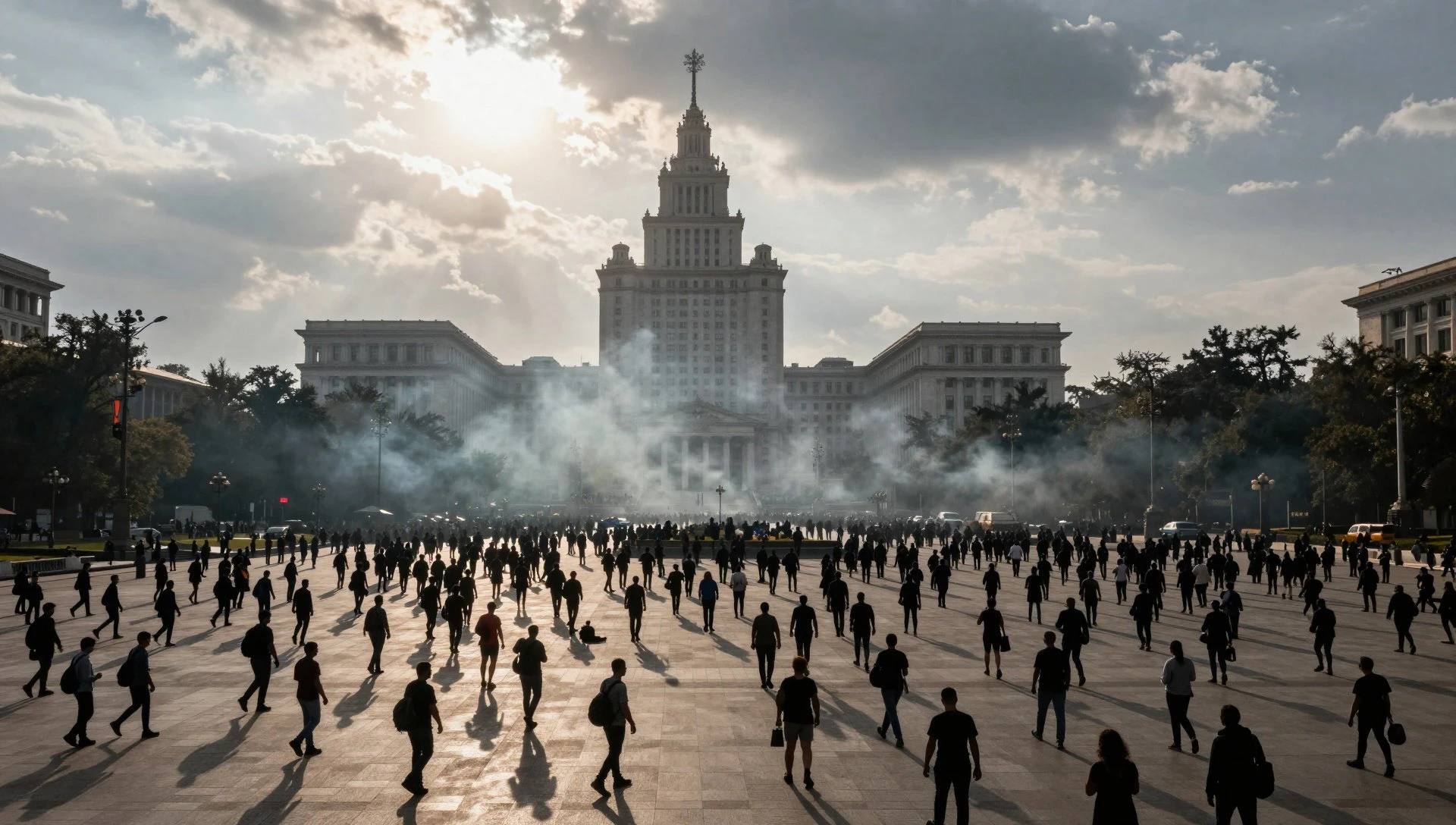
A single news cycle on 1 November 2026 compressed three distinct stress lines into one global bulletin: street-level unrest over living costs in Germany, a courtroom setback for Donald Trump in the United States, and mass arrests outside a US embassy tied to Palestine Action.
Read together, these are not isolated incidents but indicators of how economic grievance, legal accountability and foreign-policy dissent now intersect within the same 24-hour window. The simultaneity matters analytically, because it shows how quickly domestic cost-of-living pressure can migrate into public order disruption.
The German protests in Berlin, Hamburg and Frankfurt escalated into looting, and they occurred on the same day that hundreds of thousands marched in France. That parallel is the most instructive data point in the entire bulletin: two of Europe's largest economies experienced coordinated cost-of-living mobilisation within hours of each other.
On This Page
When demonstrations of that scale coincide across borders, the underlying driver is rarely a single national policy failure. It is more often a shared inflation and wage dynamic that national governments have limited room to correct.
Beyond Europe, the bulletin records a dismissed Trump lawsuit against the Wall Street Journal, more than 300 arrests at an embassy protest, a judicial order restraining threats against US election officials, a stabbing at a UK Halloween party, and the death of Olympian Ciara Mageean at 34.
Each item carries its own institutional logic, yet all share a common thread: pressure on the legitimacy of courts, elections and public assembly. This analysis separates those threads and quantifies where the evidence is strongest.
TL;DR A single global news cycle on 1 November 2026 captured three converging pressures. Cost-of-living protests in Berlin, Hamburg and Frankfurt turned violent with looting, coinciding with mass demonstrations in France. In the US, a judge dismissed Trump's lawsuit against the Wall Street Journal, more than 300 people were arrested at an embassy protest supporting Palestine Action, and a court ordered the administration to stop threatening election officials. The bulletin also recorded a UK stabbing, the death of Olympian Ciara Mageean at 34, and an Indian opposition rally demanding the election commissioner's resignation. The common thread is institutional strain across courts, elections and public assembly.
Economic Grievance and the Mechanics of European Unrest
Cost-of-living protest is a measurable phenomenon, not a vague mood. When demonstrations spread across multiple German cities and escalate into looting on the same day as French mass mobilisation, the pattern suggests organised networks rather than spontaneous anger.
Analysts typically distinguish between grievance (the underlying price and wage gap) and trigger (a specific policy announcement or symbolic date). The German events fit the grievance-driven model, where no single trigger is required because the pressure is continuous.
The German Cities and the Looting Escalation
Berlin, Hamburg and Frankfurt represent three different economic profiles: political capital, port and media hub, and financial centre. Looting in all three suggests the disorder was not confined to a single deprived district but spread across cities with divergent income structures.
That diffusion is analytically significant, because it weakens explanations based on local deprivation alone and points toward a broader national cost-of-living squeeze affecting multiple income tiers.
Retail looting also carries a distinct economic signature. It targets consumer goods and commercial premises rather than government buildings, which indicates frustration directed at visible consumption rather than at administrative authority. Historically, this pattern appears when wage growth lags behind essential prices for long enough that discretionary spending collapses.
The commercial target selection is therefore evidence about the nature of the grievance, not merely about the scale of the disorder.
Comparisons with France are unavoidable. French protest culture has a longer tradition of mass mobilisation, and hundreds of thousands on the streets sets a high baseline. Germany's more consensual labour relations make comparable unrest rarer, so the coincidence deserves weight.
When a low-unrest system produces the same outcome as a high-unrest system on the same day, the shared economic variable becomes the more plausible explanation.
Policy response will determine whether this is a spike or a trend. Short-term measures such as energy subsidies or one-off payments address the symptom but not the wage-price gap. Structural responses, including minimum wage adjustment and housing supply reform, operate on multi-year timelines.
The gap between the two is precisely where repeated unrest tends to occur, which makes the next twelve months the decisive observation window.
Why Retail Targets Signal Wage-Price Compression
Commercial looting is a rational, if unlawful, expression of a specific economic condition. When essential costs consume a rising share of household income, the visible surplus held by retailers becomes a focal point for resentment.
The selection of shops over administrative buildings therefore encodes information about which prices households feel most acutely, and it distinguishes cost-of-living unrest from political protest.
Insurance and policing costs follow predictably. Retail districts facing repeated disorder see premium increases, higher security spending and, in some cases, reduced opening hours. Those responses raise operating costs, which are partially passed to consumers, which in turn intensifies the original grievance.
This feedback loop is the mechanism by which short episodes of unrest can leave durable economic marks on a city's commercial fabric.
Wage data provides the necessary context. If nominal wages rise but real wages stagnate or fall, the gap accumulates quietly until a threshold event converts it into visible disorder. The German case fits this profile better than an explanation centred on a single unpopular policy. Sustained real-wage compression, rather than one decision, is the more defensible reading of the evidence.
Comparative research on European protest consistently finds that mobilisation intensity correlates with food and energy price movements more than with headline unemployment. That finding aligns with the German and French simultaneity.
It also implies that monitoring grocery and utility indices offers better early warning than tracking jobless claims alone, which is a practical lesson for policymakers.
The French Parallel and Cross-Border Contagion
France's tradition of mass mobilisation provides a useful control case. Hundreds of thousands on the streets is routine in the French context but exceptional in Germany, so the shared timing is the variable that requires explanation.
Contagion effects, both through media coverage and through organised networks, are plausible amplifiers once the underlying grievance is common to both countries.
Digital coordination lowers the cost of cross-border synchronisation. Protest organisers can align dates, share tactics and amplify messaging across platforms at negligible expense. This does not create grievance, but it compresses the time between grievance and action.
The result is the pattern observed here: two national systems producing comparable outcomes within a single day rather than over weeks.
Contagion also runs through expectation. Once citizens observe that large mobilisations occur elsewhere, the perceived efficacy of protest rises, lowering the threshold for participation. This is a well-documented dynamic in social movement research.
The German events should therefore be read partly as a response to French precedent, not solely as an independent national reaction.
For markets, the relevant question is duration rather than intensity. Single-day disruptions rarely move sovereign spreads or equity indices materially. Sustained unrest that disrupts retail, transport or logistics does. The observation window should therefore focus on whether mobilisation recurs within the following quarter, which would indicate structural rather than episodic pressure.
Legal Accountability and Institutional Strain in the United States
The American items in the bulletin share a common institutional theme: courts acting as the boundary between executive power and legal constraint. A dismissed Trump lawsuit, a judicial order restraining threats against election officials, and mass arrests at an embassy protest all involve institutions defining the limits of permissible conduct. Each outcome is procedural rather than political, which is precisely why the pattern deserves attention.
The Dismissed Wall Street Journal Lawsuit
Trump sued the Wall Street Journal over its publication of a letter to Jeffrey Epstein said to have been written and signed by Trump as part of a birthday book. The judge dismissed the suit.
Dismissal at this stage typically reflects a failure to state a viable claim, a jurisdictional defect, or a legal barrier such as protected reporting on a matter of public interest.
Defamation and related claims brought by public figures face a demanding standard in US law. Public figures must generally demonstrate actual malice, meaning knowledge of falsity or reckless disregard for the truth.
That threshold is deliberately high, and it explains why suits of this kind frequently fail at the pleading stage rather than reaching a jury.
The documentary nature of the underlying material matters. A signed letter is a physical artifact with provenance, and disputes over its authenticity are evidentiary rather than rhetorical. Courts are poorly suited to resolving authenticity contests quickly, which is one reason such claims are often dismissed or narrowed before substantive examination of the document itself.
The broader implication concerns press freedom. Dismissal reinforces the legal protection surrounding reporting on public figures, even when the subject is litigious and the material is damaging. Each such ruling adds to the body of precedent that shapes how newsrooms assess risk when publishing sensitive documents about powerful individuals.
Embassy Arrests and the Palestine Action Ban
More than 300 people were arrested at a protest outside the US embassy in support of Palestine Action, and more than 4,000 have been arrested for supporting the group since it was banned in July 2025.
The ratio is revealing: a single action produced roughly 7.5 percent of the cumulative total, indicating sustained enforcement rather than a one-off sweep.
Proscription creates a legal category in which support itself becomes an offence, independent of any violent act. That structure shifts enforcement from conduct to association, which raises predictable civil-liberties questions.
The volume of arrests suggests authorities are applying the prohibition broadly rather than targeting only operational involvement, a distinction that courts will eventually test.
The arithmetic of enforcement also carries resource implications. Processing 4,000-plus arrests over roughly sixteen months requires prosecutorial capacity, court time and detention space. Where those resources are finite, enforcement discretion becomes unavoidable, and the selection of which cases to pursue becomes a de facto policy decision rather than a purely legal one.
Public assembly law sits at the centre of this dispute. The right to protest is protected, but proscription narrows the lawful forms that support can take. The tension between those two principles is not unique to this case, yet the scale of arrests here makes it one of the more consequential contemporary tests of where the boundary lies.
Judicial Restraint on Election Official Pressure
A judge ordered the Trump administration to stop threatening US election officials, following letters demanding that they set aside ballots of possible non-citizen voters. The order is significant because it restrains executive communication rather than a specific administrative act.
Courts rarely intervene at that stage, so the ruling signals that the letters were treated as coercive rather than merely persuasive.
Election administration depends on the perceived independence of local officials. Direct pressure from federal actors, even when framed as guidance, can compromise that perception. The judicial order therefore protects not only the officials but the credibility of the process itself, which is a distinct and arguably more important interest.
Non-citizen voting is already unlawful, and documented instances are extremely rare relative to total ballots cast. That statistical reality makes demands to set aside ballots disproportionate to the underlying risk.
Where the remedy is far larger than the problem, courts tend to scrutinise the motive behind the demand rather than its stated justification.
The timing matters as much as the content. Orders of this kind issued ahead of an election establish expectations for conduct during the voting period itself. They function as pre-commitment devices, giving officials a legal reference point if similar pressure recurs when the stakes are highest and the window for judicial review is shortest.
We Also Published
Public Safety, Loss and Political Contestation Across Borders
The remaining items span the UK, Spain, India and the United States, and they illustrate how a single bulletin can hold personal tragedy alongside structural political contest. A stabbing at a Halloween party, the death of an Olympian at 34, a scientist killed in a train crash, and an Indian opposition rally demanding an election commissioner's resignation are not equivalent events. Their juxtaposition, however, reveals how public attention distributes across safety, grief and governance within one news cycle.
The Chandler's Ford Stabbing and Public Safety
Five teenagers were stabbed at a Halloween party in Chandler's Ford, Hampshire, and police believe an unknown group entered the party. The detail that the group was unknown to organisers is operationally important, because it points to an uninvited intrusion rather than a dispute among attendees. That distinction shapes both the investigation and the public-safety response.
Halloween events present specific risk profiles. Private parties with open invitations, temporary venues and mixed age groups are difficult to secure, and organisers rarely have professional crowd management. When an unknown group gains entry, the absence of a controlled guest list removes the primary mechanism by which such gatherings are normally protected.
Knife crime statistics in the UK have shown persistent elevation over the past decade, with the sharpest increases concentrated among younger age cohorts. Incidents involving multiple teenage victims therefore fit an established pattern rather than an anomaly. That framing matters because it directs attention toward prevention programmes rather than treating each event as inexplicable.
Community response typically follows a predictable sequence: immediate shock, appeals for information, and then debate over sentencing and prevention. The most consequential phase is the third, because it determines whether resources shift toward youth services, school-based intervention or enforcement. Evidence from prior incidents suggests prevention spending delivers better marginal returns than additional policing alone.
Ciara Mageean, Marta Shahbazi and the Weight of Premature Loss
Ciara Mageean, a former European champion and Olympian, died at 34. Elite middle-distance athletes typically compete into their early thirties, so her death falls within an active or recently active career window.
Tributes from the athletics community reflect both her competitive record and her standing within the sport, which amplifies the public response.
Marta Shahbazi, a Cambridge scientist, died in a train crash in Spain, and the laboratory where she worked described her as an inspiring, talented and passionate scientist. Research careers are long-apprenticeship structures, so a death at that stage removes decades of expected contribution. Institutions feel such losses as both personal and strategic.
Rail safety in Spain has improved substantially over recent decades, with accident fatality rates declining as signalling and rolling-stock standards tightened. Individual crashes therefore stand out against a generally improving baseline. That context does not diminish the loss but does inform how the incident should be assessed in policy terms.
The public processing of these two deaths differs instructively. An Olympian's death generates broad, cross-national mourning because her achievements were publicly witnessed. A scientist's death is felt intensely within a narrower professional community. Both patterns reveal how visibility, rather than intrinsic worth, determines the scale of public grief.
- 01
- 02
- 03
- 04
India's Opposition Rally and Electoral Legitimacy
In India, the opposition held a large rally in Delhi calling for the chief election commissioner to resign. The demand targets the official responsible for electoral administration, which places the dispute at the intersection of institutional independence and political contest.
Such rallies are calibrated signals, intended to demonstrate mobilisation capacity as much as to achieve the stated demand.
Election commission credibility is a structural asset. Once confidence erodes, every subsequent result becomes contestable, and the cost of that erosion is borne by the entire political system rather than by any single party. This is why demands for resignation carry weight beyond their immediate prospects of success, which are usually low.
Rally size functions as a measurable political variable. Attendance estimates, geographic spread of participants and the presence of allied parties all indicate opposition coordination capacity. Analysts read these signals as proxies for coalition strength ahead of future contests, which makes the event relevant well beyond its stated purpose.
The bulletin also notes a US Senate race in Texas likely to be among the most closely watched in the midterms, a Sri Lankan man stranded in the Cook Islands since 2023 who wants to return home, and a tech columnist answering common questions about artificial intelligence. These items share a theme of institutional reach and its limits.
Reading the Cycle as a Whole
Across these items, three institutional systems are under measurable strain: the economic settlement that underpins social peace in Europe, the legal boundaries constraining executive power in the United States, and the electoral administration that converts political competition into legitimate outcomes. None has failed. Each is being tested simultaneously, and the tests are visible in the same news cycle.
Convergence, Not Coincidence
The convergence is the analytical payload. Cost-of-living unrest, judicial restraint of executive action and contested electoral authority are usually studied separately, by different specialists using different methods. When they appear together, the shared variable is public confidence in institutions delivering expected outcomes. That confidence is the resource all three systems draw upon.
Quantitatively, the bulletin offers several anchors. More than 4,000 arrests since July 2025, 300-plus in a single embassy action, five stabbings at one party, three German cities affected, and hundreds of thousands on French streets. These figures are not commensurable, but together they establish the scale of the pressures being described.
The methodological caution is that a single day's bulletin is a sample, not a trend. Selection effects matter: dramatic events are reported precisely because they are unusual. The correct approach is to treat this cycle as a set of hypotheses to be tested against subsequent reporting, not as proof of systemic deterioration.
What the cycle does establish is the interconnection. Economic grievance produces disorder, disorder invites legal and political responses, and those responses are themselves contested. Understanding any single item requires awareness of the others, which is the practical argument for reading global news as a system rather than a list.
What to Watch Next
Three indicators merit monitoring. First, whether German mobilisation recurs within the quarter, which would distinguish structural from episodic pressure. Second, whether the judicial orders in the US are complied with or contested, since compliance is the real measure of institutional strength. Third, whether the Indian opposition's demand gains institutional traction or remains rhetorical.
Secondary indicators include the trajectory of UK knife-crime statistics following the Chandler's Ford incident, and the legal progress of challenges to the Palestine Action proscription. Both will indicate whether enforcement and prevention strategies are shifting in response to the events recorded here.
Finally, the King's address on slavery at the Commonwealth meeting in Antigua represents a different kind of institutional test: whether historical accountability can be addressed through symbolic and diplomatic channels. Its reception will indicate how much weight such gestures still carry in a period of visible material grievance.
The unifying lesson is that legitimacy is maintained through delivery, not declaration. Courts, election commissions and economic policy all earn confidence by producing outcomes citizens accept as fair. When several systems are tested at once, the aggregate effect on public trust exceeds the sum of individual strains, which is why this particular news cycle warrants more than passing attention.
From our network :
- Forbidden Matrix Patterns and Visible Lattice Points: A Geometric DictionaryExplore how multidimensional 0–1 matrices encode geometric truths, linking forbidden patterns to visible lattice points and hypergraph theory, with applications in combinatorics and computational geometry.
- Committed Mediterranean Precipitation Decline: Why Emissions Cuts Alone Cannot Restore Winter RainsNew NOAA research reveals that Mediterranean winter rains may decline irreversibly even with emissions cuts. Explore the science of committed climate change and regional impacts.
- University Language Proficiency Exams: Why Institutional Tests Demand Different Preparation Than IELTS and TOEFLDiscover why university-specific language proficiency examinations differ fundamentally from IELTS and TOEFL, and learn strategic preparation approaches for institutional assessment success.
- How AI Agents Will Change the Way We Manage Personal FinancesExplore how AI agents are transforming personal finance through automated budgeting, bill payment, and investment management, while examining the critical security protocols and governance frameworks required for safe deployment.
- The Final Descent: How ESA Retired the Legendary Cluster Constellation After 24 Years of Space Weather ScienceAfter 24 years mapping Earth’s magnetosphere, ESA’s Cluster mission concluded with a precisely controlled reentry over the South Pacific. This analysis explores the scientific legacy, engineering decisions, and debris mitigation principles behind one of space exploration’s most responsible retirements.
- CISA’s Ten-Advisory Wave: Why Generic Patching Fails in OT and How to Build Product-Specific PlaybooksCISA released ten ICS advisories in one week, exposing critical infrastructure risks. Generic patching fails in OT. Learn to build product-specific remediation playbooks.
- Live Online English Classes for Kids: Do They Actually Reduce Anxiety?A ten-week study reveals that synchronous online English classes can significantly reduce child language anxiety while improving listening and reading skills. Discover what makes these programs effective and how parents can select the right one.
- The Hidden Cost of AI Convenience: Why Over-Permissioned Agents Are a Security Time BombDiscover why AI agents with excessive permissions create dangerous single points of failure, and learn how implementing least privilege principles can protect your organization from exploitation.
- Mobile Learning and VR in English: What Global Evidence Reveals About Effective Language TechnologyA systematic review across 14 countries reveals which language-learning technologies genuinely work. Mobile learning, AI, and VR show measurable benefits when pedagogically integrated. This evidence-based guide helps educators and learners select technology that delivers real return on investment.
RESOURCES
- Will Covid-19 End the Age of Mass Protests? - CSIScsis.orgApr 7, 2020 ... There is strong reason to believe that once the Covid-19 pandemic ebbs, there will be a new surge of global…
- Carnegie Endowment for International Peace | Carnegie ...carnegieendowment.orgThe Carnegie Endowment for International Peace generates strategic ideas and independent analysis, supports diplomacy, and trains the next generation of ...
- Can Gen Z Protests Reshape Governance in Africa? - CSIScsis.orgApr 10, 2026 ... While specific triggers for these protests vary, a common thread is youth frustration with economic strain ... protests into lasting…
- Metaphors of institutional strain and repair: A corpus-based analysis ...researchgate.netAug 22, 2026 ... PDF | This article examines metaphorical framing of the 2025 Nepal protests in Nepalese, Western, and Chinese news coverage, with…
- The Role of Economic Stress, Health Concerns, and Institutional ...pubmed.ncbi.nlm.nih.govDec 22, 2022 ... ... Institutional Trust in Supporting Public Protests against ... analyze the individual-level factors behind supporting these demonstrations.
- From martial law to democratic renewal in South Korea | Brookingsbrookings.eduJun 23, 2026 ... ... institutional strains. Protesters call for the impeachment of South Korean President Yoon Suk Yeol in front of National. SEOUL,…
- A multilevel analysis of protest events in African cities - ScienceDirectsciencedirect.comPopulation pressure, political institutions, and protests: A multilevel analysis of protest events in African cities ... strain – reveal no statistically ...
- Syria's Protest Wave: A Governance Stress Testwashingtoninstitute.orgJun 3, 2026 ... Yet U.S. officials still need to remind Damascus that until its institutions are in conformity with international business and financial ...
- Who loses if US colleges lose international students? | Brookingsbrookings.eduJul 28, 2025 ... Colleges most vulnerable to international enrollment drops tend to be small, private institutions with a specialized focus, or affiliated with…
- Snap Elections, Protests and Institutions Under Stresswesternbalkanscenter.orgJan 5, 2026 ... Western Balkans Analysis: Dec. 23, 2025-Jan. 5, 2026.
- The unintended consequences of COVID-19 vaccine policygh.bmj.comMay 26, 2022 ... Summary box. Mandatory COVID-19 vaccine policies have been used around the world during the COVID-19 pandemic to increase vaccination rates.…
- How Iran's water bankruptcy seeped into the protest movementatlanticcouncil.orgFeb 5, 2026 ... ... analysis with concrete policy solutions ... What changed in 2025 was stacking: water stress layered with energy shortfalls, international ...
- Nurses' Protests during the COVID-19 Pandemic - PMC - NIHpmc.ncbi.nlm.nih.govAug 9, 2024 ... This study conducts the first global comparative analysis of COVID-19-related protests ... Institutional Review Board Statement. As we ...
- The Global State of Democracy 2026 - International IDEAidea.intResearch shows that institutional gains from protest-driven ... In contrast, a different pattern of institutional strain is emerging in Slovakia.
- Understanding Police Officer Stress: A Review of the Literatureicjia.illinois.govMay 24, 2022 ... The stress of the job combined with organizational stressors may severely impact police officers and their work. Stress can lead…
- 01
- 02
- 03
- 04
- 05
- 06
- 07
- 08
0 Comments