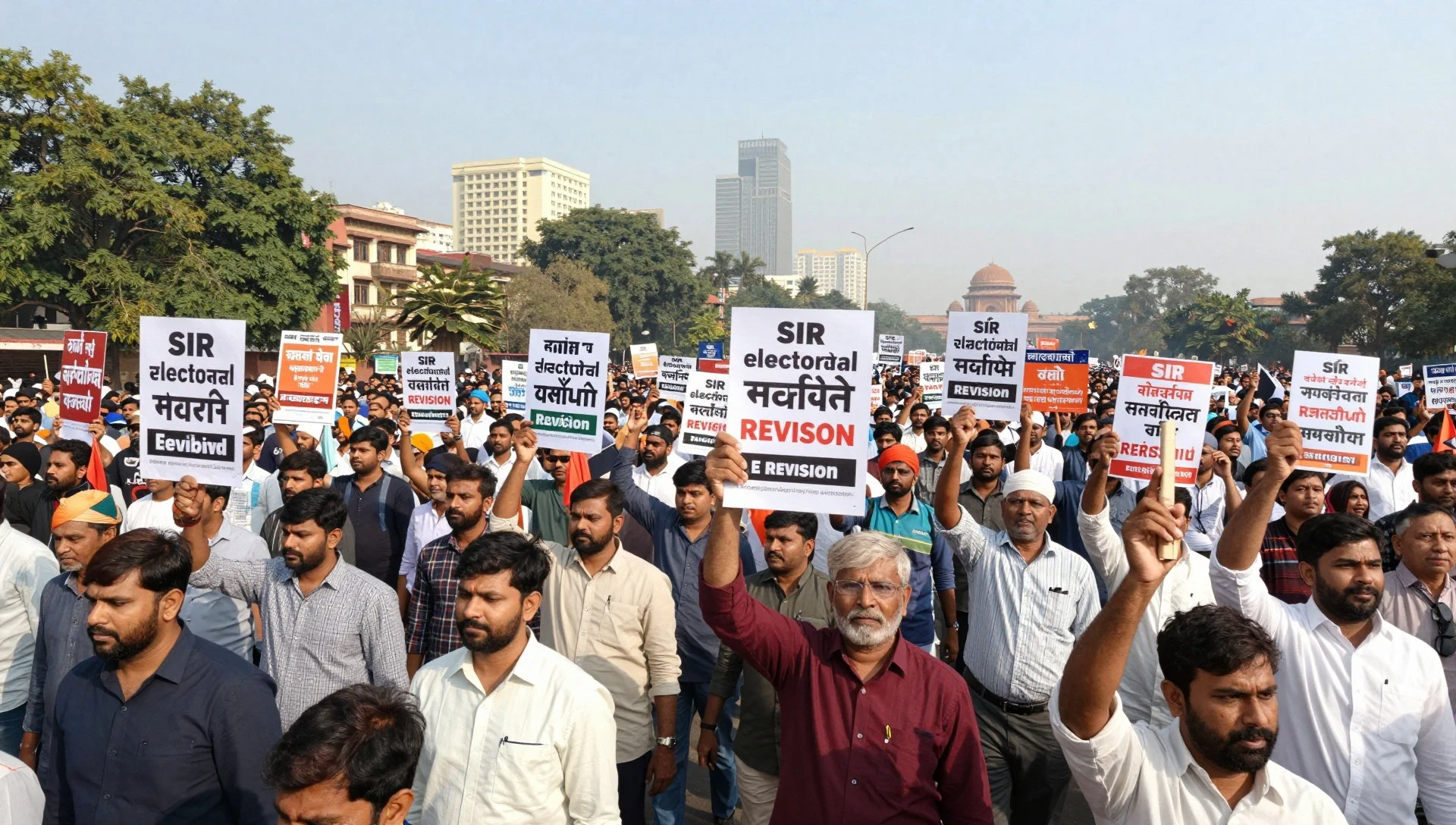
On Sunday, 1 November 2026, thousands converged on central Delhi ahead of an INDIA bloc rally at Ramlila Maidan, turning the capital's streets into a stage for a single grievance: the Special Intensive Revision (SIR) of electoral rolls. The crowd was not a monolith.
It drew political parties, youth organisations, women's groups and farmers' bodies, alongside ordinary citizens with no party affiliation whatsoever. Before opposition leaders arrived, including Leader of the Opposition Rahul Gandhi, demonstrators near Minto Road raised slogans alleging vote theft and demanded the resignation of Chief Election Commissioner Gyanesh Kumar.
The composition of the gathering is the story. Members of the Indian Youth Congress, Samajwadi Party, Rashtriya Rata Janata Dal, National Students' Union of India, Krantikari Yuva Sangathan and All India Students' Federation marched beside unaffiliated residents who said the convergence of parties and public had strengthened the protests after weeks of smaller demonstrations.
On This Page
One participant, Tejender, an IT employee who travelled from Gurugram with his wife, likened the crowd to a bundle of sticks that cannot easily be broken. He framed his presence around children's education, healthcare and the possible misuse of votes.
Beneath the slogans lies a documentation problem with measurable human cost. Tejender conceded he could furnish every required document precisely because he is educated, while many others cannot. That asymmetry — between citizens who can navigate paperwork and those who cannot — is the analytical core of the SIR controversy.
This analysis examines the rally's demands, the mechanics of electoral roll revision, and what the Delhi mobilisation signals about institutional trust and opposition strategy ahead of future contests.
TL;DR Thousands gathered in central Delhi on 1 November 2026 for an INDIA bloc rally against the Special Intensive Revision of electoral rolls, demanding the resignation of Chief Election Commissioner Gyanesh Kumar and withdrawal of the exercise. The crowd mixed party workers with unaffiliated citizens, and participants described earlier youth-led protests as having reduced fear of police action. The core grievance is documentary: voters lacking education or resources struggle to satisfy SIR requirements, raising questions about disenfranchisement, institutional credibility and the opposition's capacity to convert street mobilisation into electoral strategy.
The Anatomy of the Delhi Mobilisation
The 1 November gathering was notable less for its size than for its sociology. Political parties supplied organisational muscle, but the presence of unaffiliated citizens gave the protest a legitimacy that partisan rallies often lack.
Participants explicitly credited weeks of prior demonstrations with lowering the psychological barrier to attendance, suggesting a cumulative mobilisation effect rather than a single-event spike.
Who Marched, and Why It Matters
The coalition roster spanned generational and ideological lines: youth wings such as the Indian Youth Congress and NSUI, student bodies including the All India Students' Federation and Krantikari Yuva Sangathan, plus Samajwadi Party and RJD contingents. Farmers' bodies and women's groups rounded out the formation.
This breadth matters because it signals that the SIR issue has crossed from a technical electoral dispute into a broader civic grievance.
Tejender's presence illustrates the shift. An IT professional from Gurugram who brought his wife, he articulated motives rooted in family welfare rather than party loyalty: education, healthcare and the integrity of his vote. His analogy of the bundle of sticks — individually breakable, collectively resistant — captured the rally's organising logic. When salaried professionals join students and farmers, the protest's social base widens considerably.
The demand structure was equally specific. Protesters sought Gyanesh Kumar's resignation and the withdrawal of the SIR exercise, framing the process as vote theft rather than administrative correction. Specificity of demand is strategically double-edged: it sharpens messaging but also gives authorities a clear target to refuse.
The rally therefore functioned as much as a pressure test of institutional response as a display of opposition strength.
Equally significant was the reported decline in fear. One participant said earlier youth-led protests had removed fear of the police among ordinary people. That claim, if accurate, represents a meaningful shift in the perceived cost of dissent.
Lower perceived costs typically raise participation in subsequent events, which explains why organisers could assemble such a heterogeneous crowd on relatively short notice.
The Demand for the CEC's Resignation
Calling for Chief Election Commissioner Gyanesh Kumar's resignation elevates a procedural dispute into a question of institutional accountability. The demand implies that the SIR exercise is not merely flawed in execution but compromised in intent.
Such framing places the Election Commission on the defensive, forcing it to justify methodology rather than merely announce timelines.
Historically, resignation demands against constitutional authorities rarely succeed directly. Their function is cumulative: each demand erodes perceived neutrality and builds a record that opposition parties can cite in Parliament and courts. The Delhi rally therefore operates on two tracks simultaneously — immediate pressure and long-horizon delegitimisation. Both require sustained repetition to remain credible.
The vote-theft allegation sharpens this further. By characterising SIR as theft rather than error, protesters shift the burden of proof onto the Commission. Officials must now demonstrate that deletions are accurate and reversible, not simply that the process followed rules.
That evidentiary burden is heavier and slower to discharge, which extends the political shelf life of the controversy.
Yet the demand carries risk. Overreach can alienate voters who view the Commission as a credible institution. The opposition must calibrate between holding authority accountable and appearing to attack the referee.
The rally's mixed crowd suggests the calibration is currently working, but durability depends on whether documented irregularities emerge to substantiate the rhetoric.
From Street to Strategy: What the Rally Signals
Street mobilisation matters only insofar as it converts into organisational capacity. The Delhi rally demonstrated that the INDIA bloc can convene a broad coalition around a procedural issue, but conversion requires voter registration drives, legal challenges and sustained local presence. Without these, momentum dissipates between news cycles and the next election.
The presence of unaffiliated citizens offers the clearest strategic asset. These participants are persuadable voters, not committed cadre, and their attendance signals that SIR touches lived experience. Parties that translate this grievance into concrete assistance — helping citizens restore deleted entries — can convert sympathy into loyalty far more effectively than slogans alone.
Conversely, the rally exposes a coordination challenge. A coalition spanning the Samajwadi Party, RJD, Congress youth wings and left-leaning student bodies must manage divergent priorities. The SIR issue provides temporary unity, but electoral arithmetic will test it. The bundle-of-sticks metaphor works precisely because the sticks remain separate — and separateness cuts both ways.
Timing compounds the stakes. With the exercise unfolding in late 2026, the opposition has a narrow window to build documentation of harm before institutional responses harden. The rally's value lies less in its crowd size than in the evidence-gathering networks it activates. Protests that generate testimony, affidavits and media records become litigation assets.
The Mechanics and Contestation of Electoral Roll Revision
Understanding the controversy requires separating the administrative rationale for SIR from its implementation effects. Electoral roll revision is a routine, legally mandated function; intensive revision is a heavier variant that re-verifies entries rather than merely updating them. The dispute concerns scale, error rates and the reversibility of deletions, not the principle of accurate rolls.
What the Special Intensive Revision Entails
Intensive revision typically involves house-to-house verification, re-collection of documentary proof and removal of entries deemed duplicate, dead or shifted. Proponents argue this purges ghost voters and strengthens integrity. Critics counter that intensive methods generate false positives at scale, particularly where documentary standards assume literacy and administrative access.
The error mathematics are unforgiving. If a verification process wrongly removes even a small fraction of legitimate voters, the absolute number can run into lakhs given India's electorate size. A false-positive rate of just ##0.5\%## across a base of ##900## million voters yields ##4.5## million deletions. That arithmetic explains why procedural design, not intent, dominates the debate.
###\text{Expected wrongful deletions} = N \times p_{fp}###
Where ##N## is the number of entries reviewed and ##p_{fp}## the false-positive rate. The formula is simple, but its implications are political: small technical parameters produce large human consequences. This is why participants like Tejender emphasised documentation capacity rather than ideology — the mechanism of harm is administrative, not conspiratorial.
Reversibility is the crucial variable. If deleted voters can restore entries through accessible appeals, harm is bounded. If restoration requires repeated visits, affidavits and literacy, the burden falls disproportionately on marginalised groups. The rally's demand for withdrawal reflects a judgment that current restoration pathways are inadequate, not merely that errors exist.
The Documentation Burden and Vulnerable Voters
Tejender's admission is analytically decisive: he could produce every document because he is educated, while many others cannot. This is a textbook case of administrative burden operating as a regressive filter. The cost of compliance — time, travel, literacy, familiarity with forms — is borne unevenly across income and education gradients.
Consider the practical sequence a voter must navigate: receiving notice, assembling proof, visiting offices during working hours, responding to objections and appealing adverse decisions. Each step imposes a fixed cost that is trivial for a salaried professional and prohibitive for a daily-wage worker. Aggregated across millions, these costs function as a de facto literacy test.
Farmers' bodies and women's groups at the rally articulated precisely this concern. Rural households often hold documents collectively, and women's entries are frequently tied to household records that shift upon marriage. Intensive verification that ignores these social realities produces deletions that are technically correct but substantively unjust. The grievance is therefore structural, not anecdotal.
This is where the protest's moral authority concentrates. Unlike abstract claims of vote theft, documentation burden is demonstrable through individual testimony. Each case of a legitimate voter unable to restore an entry becomes evidence.
The rally's organisers appear to understand this, which is why citizen participation was emphasised over party representation in the reported accounts.
Institutional Trust and the Fear Factor
The claim that earlier protests reduced fear of police action deserves analytical weight. Perceived risk is a primary determinant of protest participation. When citizens believe the cost of attendance has fallen, turnout rises even among those without strong partisan commitments. The Delhi crowd's heterogeneity is consistent with this mechanism.
Trust in electoral institutions follows a similar logic. Citizens tolerate administrative inconvenience when they believe the process is neutral; they resist when they suspect targeting. The rally's slogans about vote theft reflect a prior erosion of that belief. Once trust declines, even routine procedures are reinterpreted as threats, and compliance becomes conditional.
This creates a feedback loop. Visible protest signals that others share the grievance, which lowers participation costs further and validates suspicion. The bundle-of-sticks metaphor captures the dynamic precisely: individual vulnerability diminishes as collective visibility rises. Authorities face a corresponding challenge, because reassurance requires credible, verifiable action rather than statements.
Restoring trust therefore demands transparency metrics — published deletion counts, error rates, restoration timelines and independent audit. Absent such data, both sides argue from assertion. The rally's demand for withdrawal is a maximalist position, but the underlying request for verifiable fairness is one that a confident institution could readily address.
We Also Published
Comparative Context and Forward Implications
Placing the Delhi rally in comparative context clarifies what is at stake. Electoral roll purges have generated controversy in multiple democracies, from the United States to European states, typically along partisan lines. The recurring pattern is that intensive verification produces disparate impact, and disparate impact produces litigation. India's version follows this template with distinctive scale.
How Other Democracies Handle Roll Purging
Comparative evidence suggests three design levers determine controversy intensity: notice requirements, restoration ease and independent oversight. Jurisdictions that mandate individualised notice before deletion and provide low-cost appeals experience fewer disputes. Those relying on bulk matching against databases generate higher false-positive rates and correspondingly greater political friction.
The lesson is procedural rather than ideological. Accuracy and inclusion are not inherently opposed; they diverge when verification methods assume capacities that voters do not uniformly possess. Designing for the least-resourced voter — the daily-wage worker, the recently married woman, the rural household — improves accuracy for everyone by reducing error cascades.
India's scale magnifies these effects. With an electorate approaching a billion, even well-designed processes encounter implementation variance across states and districts. That variance, not central policy, often determines outcomes. Local administrative capacity becomes the binding constraint, and it is precisely where the rally's participants reported the greatest difficulty.
International observers typically focus on whether deletions are reversible and whether oversight is independent. Both criteria are measurable. Publishing restoration statistics and permitting civil society audit would address them directly. The opposition's challenge is to demand these specifics rather than only withdrawal, which is easier to refuse and harder to verify.
What Comes Next for the INDIA Bloc
The bloc's immediate task is conversion: turning rally attendance into documented cases, legal filings and voter assistance. Each restored entry is both a public service and a political argument. Parties that build such infrastructure demonstrate competence, which matters more than rhetoric when voters assess fitness to govern.
Coordination remains the binding constraint. A coalition of parties with distinct regional bases must agree on escalation strategy without ceding ownership of the issue. The SIR controversy offers a unifying frame, but frames require maintenance. Sustained parliamentary questioning, coordinated state-level protests and unified legal challenges would signal durability.
Risk also lies in overreach. If the Commission publishes credible data showing low error rates and accessible restoration, maximalist claims of vote theft become liabilities. The opposition must therefore anchor demands in verifiable metrics — deletion counts, appeal outcomes, processing times — rather than intent. Evidence-based demands are harder to dismiss and easier to sustain.
Finally, the rally's citizen component is its most transferable asset. Unaffiliated participants like Tejender lend credibility that partisan crowds cannot manufacture. Preserving that character requires restraint in messaging and tangible assistance on the ground. If the bloc manages this balance, the Delhi gathering becomes a template rather than an episode.
- 01
- 02
- 03
- 04
Reading the Signals: A Scorecard
Assessing the rally requires separating symbolic from substantive outcomes. Symbolically, the mobilisation succeeded: it demonstrated breadth, generated national coverage and forced the Commission onto the defensive. Substantively, the scorecard is incomplete, because withdrawal has not occurred and resignation demands remain unmet.
The intermediate indicators are more informative. Did attendance exceed prior protests? Participants say yes. Did fear of participation decline? Reported testimony suggests so. Did unaffiliated citizens join? Clearly. These indicators predict future mobilisation capacity better than immediate concessions, which are rarely granted under pressure.
Institutional response will determine the next phase. A transparent, data-rich rebuttal would deflate the protest's momentum; silence or defensiveness would extend it. The Commission's choice between engagement and insulation is therefore the pivotal variable in the coming weeks, more consequential than any single speech at Ramlila Maidan.
For observers, the analytical takeaway is that electoral administration has become a frontline political battleground. Procedural design choices — notice, appeals, audit — now carry direct partisan consequences. The Delhi rally made that connection visible to a broad public, and visibility, once established, is difficult to reverse.
Frequently Asked Questions
Readers seeking clarity on the Delhi mobilisation and the SIR controversy will find the following consolidated answers useful. Each addresses a distinct dimension: the event itself, the procedural dispute and the political implications. Together they summarise the analytical framework developed above without repeating the full evidentiary detail.
What Was the Delhi Rally About?
Thousands gathered in central Delhi on 1 November 2026 ahead of an INDIA bloc rally at Ramlila Maidan against the Special Intensive Revision of electoral rolls. Participants demanded Chief Election Commissioner Gyanesh Kumar's resignation and withdrawal of the exercise, alleging vote theft through improper deletions.
Who Participated in the Protest?
The crowd included political parties, youth organisations, women's groups and farmers' bodies, alongside unaffiliated citizens. Specific groups named included the Indian Youth Congress, Samajwadi Party, RJD, NSUI, Krantikari Yuva Sangathan and All India Students' Federation. Leader of the Opposition Rahul Gandhi was among the arriving leaders.
Why Does Documentation Matter in the SIR Debate?
Intensive verification requires documentary proof that many voters cannot easily supply. Participant Tejender noted he could provide all documents because he is educated, while others cannot. This asymmetry means administrative burden falls hardest on poorer, less literate and recently migrated voters.
What Did Participants Say About Fear of Protesting?
Participants reported that earlier youth-led demonstrations had reduced fear of police action among ordinary people. Lower perceived costs of participation help explain the heterogeneous turnout on 1 November, including citizens with no party affiliation who cited children's education and healthcare as motivations.
From our network :
- The Hidden Cost of AI Convenience: Why Over-Permissioned Agents Are a Security Time BombDiscover why AI agents with excessive permissions create dangerous single points of failure, and learn how implementing least privilege principles can protect your organization from exploitation.
- How AI Agents Will Change the Way We Manage Personal FinancesExplore how AI agents are transforming personal finance through automated budgeting, bill payment, and investment management, while examining the critical security protocols and governance frameworks required for safe deployment.
- Committed Mediterranean Precipitation Decline: Why Emissions Cuts Alone Cannot Restore Winter RainsNew NOAA research reveals that Mediterranean winter rains may decline irreversibly even with emissions cuts. Explore the science of committed climate change and regional impacts.
- Live Online English Classes for Kids: Do They Actually Reduce Anxiety?A ten-week study reveals that synchronous online English classes can significantly reduce child language anxiety while improving listening and reading skills. Discover what makes these programs effective and how parents can select the right one.
- University Language Proficiency Exams: Why Institutional Tests Demand Different Preparation Than IELTS and TOEFLDiscover why university-specific language proficiency examinations differ fundamentally from IELTS and TOEFL, and learn strategic preparation approaches for institutional assessment success.
- The Final Descent: How ESA Retired the Legendary Cluster Constellation After 24 Years of Space Weather ScienceAfter 24 years mapping Earth’s magnetosphere, ESA’s Cluster mission concluded with a precisely controlled reentry over the South Pacific. This analysis explores the scientific legacy, engineering decisions, and debris mitigation principles behind one of space exploration’s most responsible retirements.
- CISA’s Ten-Advisory Wave: Why Generic Patching Fails in OT and How to Build Product-Specific PlaybooksCISA released ten ICS advisories in one week, exposing critical infrastructure risks. Generic patching fails in OT. Learn to build product-specific remediation playbooks.
- Forbidden Matrix Patterns and Visible Lattice Points: A Geometric DictionaryExplore how multidimensional 0–1 matrices encode geometric truths, linking forbidden patterns to visible lattice points and hypergraph theory, with applications in combinatorics and computational geometry.
- Mobile Learning and VR in English: What Global Evidence Reveals About Effective Language TechnologyA systematic review across 14 countries reveals which language-learning technologies genuinely work. Mobile learning, AI, and VR show measurable benefits when pedagogically integrated. This evidence-based guide helps educators and learners select technology that delivers real return on investment.
RESOURCES
- India's opposition holds mega rally seeking election chief's resignationbbc.com23 hours ago ... Organised by the opposition INDIA bloc and led by Rahul Gandhi's Congress party, the protest drew many of the alliance's…
- Opposition parties have announced plans for more protests ...facebook.comOct 3, 2026 ... Delhi student farmer protest, Special Intensive Revision electoral rolls ... [Delhi protest, Bangla Sahib, People Against SIR, Election ...
- Why are India's 'cockroaches' protesting again? - DW.comdw.comOct 9, 2026 ... India opposition holds major rally against voter roll revisions ... march in Delhi over revision of electoral rolls. Politics 11/01/2026 ...
- LoP Shri Rahul Gandhi joined INDIA bloc MPs in Delhi to protest ...facebook.comJul 22, 2025 ... LoP Shri Rahul Gandhi , along with INDIA bloc MPs, protested against the ongoing Special Intensive Revision (SIR) of electoral…
- Declared dead: Indian voters fight to get back on electoral rollsreuters.comOct 22, 2026 ... Kamta Prasad has been shuttling between government offices in Delhi trying to prove he is not dead.
- 'How do you explain the deletion of 130 million names?': why Indian ...theguardian.comOct 14, 2026 ... ... India's electoral roll through a process known as SIR, or special intensive revision. ... protests against SIR. Opposition and…
- New Delhi | 09 October 2026 Today, at the INDIA coalition's march ...instagram.comOct 9, 2026 ... INDIA bloc's big announcement against the Election Commission and the Special Intensive Revision (SIR) of electoral rolls. After a meeting ...
- India's opposition holds mega rally seeking election chief's resignationbbc.co.uk1 day ago ... Thousands gathered in the heart of delhi, calling for the chief election commissioner to step down.
- Why India's tens of millions of voter deletions have led to ... - Reutersreuters.comOct 9, 2026 ... NEW DELHI, October 9 - India's verification exercise of its nearly one billion voters has sparked protests across the country, ...
- What to know about nationwide protests in India over voter list ...nprillinois.orgOct 6, 2026 ... ... Revision (SIR) of electoral rolls, in Mumbai, India, Sunday, Oct. 4, 2026. NEW DELHI — Protests have spread across…
- The selective solidarity at the heart of India's voter protests - Al Jazeeraaljazeera.com2 days ago ... ... against a sweeping revision of electoral rolls that has removed some 130 million names. ... The Special Intensive Revision…
- BJP's Nationwide March Ahead Of INDIA Bloc Rally - Brutbrut.media6 days ago ... ... SIR process and its allegations of irregularities in voter lists. The INDIA bloc has been questioning the electoral roll…
- India's opposition parties protest against a controversial electoral roll ...apnews.comAug 11, 2025 ... NEW DELHI (AP) — India 's opposition parties held a protest Monday calling for the rollback of a controversial revision…
- Delhi SIR Protest: Opposition Turns Up Heat On ECI - Frontlinefrontline.thehindu.comOct 7, 2026 ... Opposition parties unite at Jantar Mantar against SIR and CEC Gyanesh Kumar as voter-roll concerns deepen, putting electoral fairness and ...
- India's Congress launches nationwide campaign over alleged ...asianews.networkOct 6, 2026 ... ... electoral malpractices in the Special Intensive Revision (SIR) of electoral rolls, in New Delhi on September 28, 2026. PHOTO:…
- 01
- 02
- 03
- 04
- 05
- 06
- 07
- 08
0 Comments