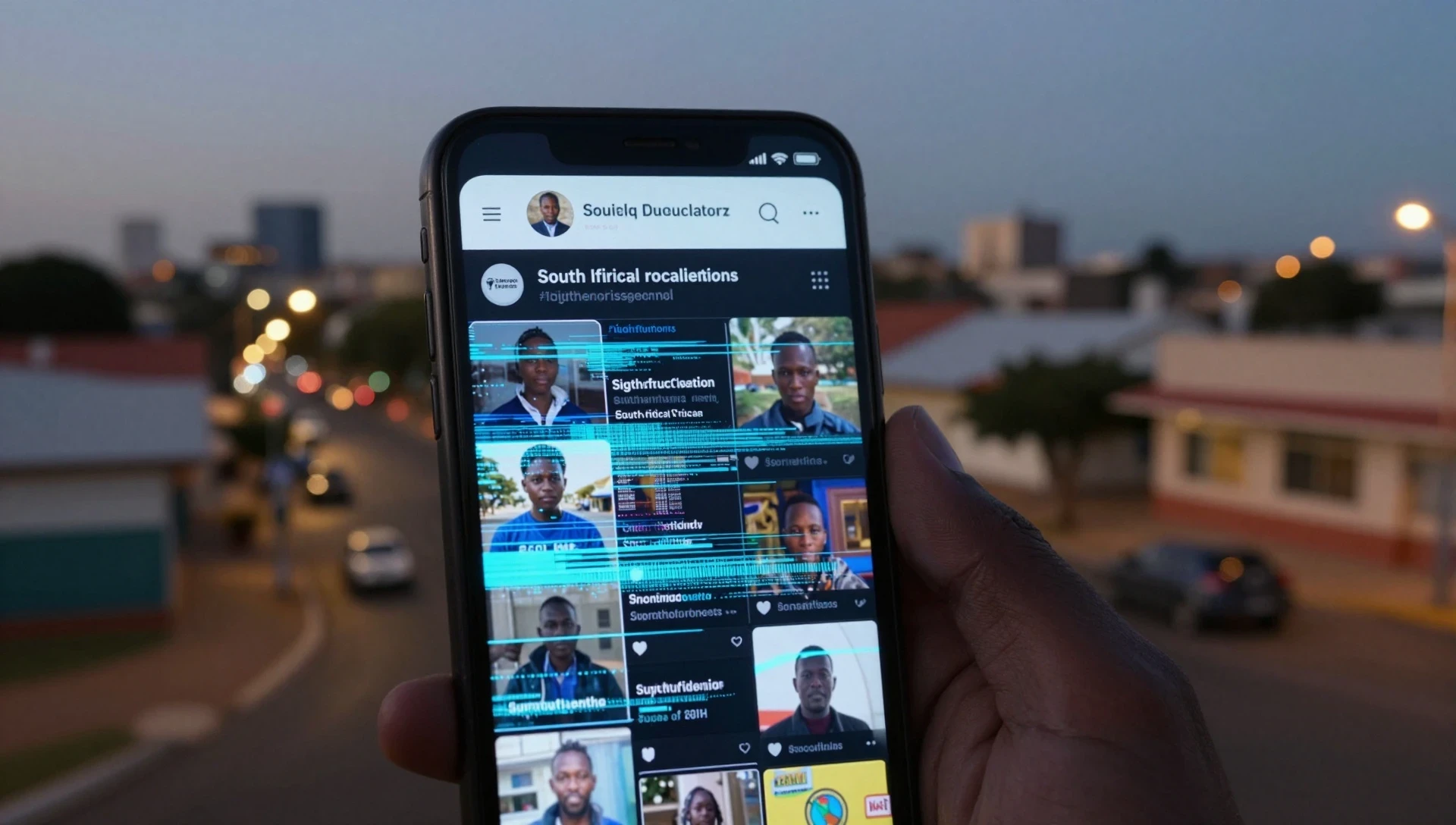
South Africa's municipal elections, scheduled for 4 November 2026, have become a live stress test for the country's electoral integrity apparatus. The Electoral Commission of South Africa (IEC) has logged hundreds of complaints concerning fabricated content circulating across social platforms in the weeks before voting day, according to reporting by DW.com.
The volume and variety of these complaints distinguish this cycle from earlier contests, where misinformation tended to be sporadic and poorly coordinated.
The most corrosive falsehood to gain traction asserts that asylum seekers and undocumented foreign nationals are entitled to cast ballots. That claim has spread widely on social media, inflaming anti-foreigner sentiment during a campaign already punctuated by anti-immigration protests.
On This Page
The fabrication matters because it fuses two volatile issues — immigration and electoral legitimacy — into a single narrative that is difficult to correct once embedded in public discourse.
Other deceptive material includes AI-generated videos, counterfeit job advertisements and invented election predictions. In one documented case, a candidate for a Johannesburg council seat was targeted with online abuse and false assertions about their nationality.
Together these episodes illustrate how digital manipulation now shapes political debate before a single vote is counted, and why election watchdogs are treating information integrity as core infrastructure rather than an afterthought.
TL;DR South Africa's 2026 local elections have drawn hundreds of misinformation complaints to the country's election watchdog, centred on false claims that asylum seekers may vote. AI-generated videos, fake job adverts and fabricated predictions are amplifying anti-foreigner sentiment and targeting individual candidates. The case demonstrates that electoral integrity now depends as much on information security as on ballot security, and that under-resourced watchdogs face a structural disadvantage against fast, cheap synthetic content.
What the Misinformation Wave Reveals About Electoral Integrity
The South African case is best read as evidence of a shifting threat model. Electoral commissions have historically invested in physical safeguards — ballot custody, result transmission, observer access — while treating disinformation as a communications nuisance. The complaint data from the IEC suggests that assumption no longer holds.
Falsehoods about voter eligibility attack the legitimacy of the register itself, which is the foundation every other safeguard rests upon.
The Asylum Seeker Claim and Its Mechanics
The assertion that asylum seekers can vote is legally false under South African electoral law, which restricts registration to citizens with valid identity documentation. Its power lies not in plausibility but in resonance: it arrives amid genuine anxiety about migration, service delivery and unemployment.
Researchers who study rumour dynamics note that corrections rarely travel as far as the original claim, a pattern sometimes described as the continued influence effect.
Quantifying that asymmetry is instructive. A false post can be produced in minutes and shared at zero marginal cost, while a correction requires verification, legal review and institutional sign-off. The resulting velocity gap is the central operational problem for any watchdog.
It is not a failure of diligence but a structural mismatch between the cost of fabrication and the cost of rebuttal.
The anti-foreigner dimension compounds the harm. When a false eligibility claim circulates during a campaign marked by anti-immigration protests, it can convert online suspicion into physical risk for migrant communities.
Election misinformation therefore carries a public safety externality that extends well beyond the ballot box, and watchdogs are increasingly obliged to coordinate with police and civil society.
South Africa's experience also mirrors patterns documented elsewhere. In Kenya, Brazil and the Philippines, fabricated eligibility and fraud claims have preceded contested results and litigation. The recurrence suggests a transferable playbook rather than a local anomaly, and it argues for regional information-sharing among electoral bodies rather than isolated national responses.
Synthetic Media and the Cost Collapse
AI-generated video represents a qualitative shift rather than a quantitative one. Earlier disinformation required either manual effort or a credulous audience; generative tools now produce plausible audiovisual artefacts in minutes at negligible cost.
Detection remains possible but demands technical capacity that many electoral bodies lack, and public literacy lags well behind the production capability.
The economics are stark. A convincing synthetic clip may cost a few dollars to generate, while forensic verification and counter-messaging can consume thousands. This inversion of cost structures is the defining feature of the current information environment, and it explains why watchdogs describe themselves as outmatched rather than merely busy.
Fake job advertisements add a distinct vector. By exploiting high unemployment, they lure users into sharing personal data or paying application fees, while simultaneously eroding trust in official communication channels. The technique blurs the line between electoral manipulation and ordinary fraud, complicating jurisdiction and response.
Invented election predictions complete the toolkit. Fabricated polling figures can depress turnout among supporters of a candidate depicted as losing, or inflate expectations that later translate into fraud allegations. The mechanism is subtle but well documented in comparative research on strategic misinformation during competitive contests.
Targeted Abuse and Candidate Safety
The Johannesburg case, in which a council candidate faced online abuse and false claims about nationality, illustrates the personal dimension. Such attacks deter participation, particularly among first-time candidates and minority aspirants. When nationality becomes a weapon, the cost is borne disproportionately by those whose citizenship is already questioned in everyday life.
Electoral commissions are not traditionally mandated to protect candidates from harassment. Yet the boundary between campaign rhetoric and coordinated abuse has blurred, and watchdogs increasingly find themselves documenting threats rather than merely counting votes. This expansion of mandate without matching resources is a recurring theme in comparative election administration.
Platform response remains uneven. Takedown timelines vary by language, region and perceived commercial risk, and South African content in local languages often receives slower review than English-language material. That asymmetry creates a predictable gap that bad actors exploit, and it argues for region-specific moderation capacity rather than global templates.
Legal remedies exist but move slowly. Defamation suits and electoral code complaints can vindicate a candidate months after the vote, by which time the reputational damage is irreversible. Speed, not severity, is the binding constraint in every jurisdiction that has attempted to regulate campaign falsehoods.
Institutional Response and Its Structural Limits
South Africa's watchdog has responded by logging complaints, issuing public corrections and coordinating with platforms. These measures are necessary but insufficient. Complaint-driven systems are inherently reactive: they process harm after it has spread, and they depend on citizens recognising falsehood well enough to report it. The architecture rewards the fastest liar and penalises the most diligent regulator.
What the Complaint Volume Actually Measures
Hundreds of complaints is a meaningful signal but an imprecise metric. It captures only content that reached someone motivated to report it, and it likely undercounts material circulating in closed messaging groups. The true exposure is probably larger, and the reported figure should be read as a floor rather than a ceiling.
Complaint data also reveals distribution. If reports cluster around a single false claim, that suggests coordinated amplification rather than organic confusion. Analysts can use clustering patterns to distinguish spontaneous rumour from deliberate campaigns, which matters enormously for choosing between education and enforcement as a response.
There is a measurement problem beneath the measurement problem. Platforms rarely disclose removal volumes by country and language, so watchdogs cannot verify whether their complaints produced action. Without transparency from intermediaries, electoral bodies are reduced to estimating their own effectiveness, a position no serious regulator should accept.
Comparative benchmarks help. The European Union's Digital Services Act imposes transparency and risk-assessment duties on very large platforms, and similar frameworks are emerging elsewhere. South Africa lacks an equivalent statutory lever, which limits its ability to compel disclosure during an active campaign.
Legal and Regulatory Gaps
South African law addresses electoral falsehoods unevenly. The Electoral Act prohibits certain false statements about candidates, but enforcement is slow and penalties modest. There is no comprehensive framework for synthetic media, and platform liability remains governed by general communications law rather than election-specific rules.
This gap is not unique. Most democracies have discovered that their electoral statutes were drafted for a broadcast era in which a handful of licensed outlets could be held accountable. The current environment has millions of publishers, no licensing requirement and cross-border hosting, which defeats territorial enforcement almost by design.
Proposed remedies range from mandatory labelling of synthetic content to rapid-response courts for campaign disputes. Each carries trade-offs: labelling can be evaded, and fast-track tribunals risk political capture. The absence of an obvious solution is itself an important finding, and it cautions against legislative overconfidence.
Civil society has partially filled the vacuum. Fact-checking organisations, academic monitoring projects and journalist networks now provide much of the verification capacity that regulators lack. Their work is valuable but fragile, dependent on donor funding and vulnerable to the same harassment that targets candidates.
Lessons for Other Democracies
South Africa's predicament offers transferable lessons. First, misinformation about eligibility is more damaging than misinformation about policy, because it attacks the legitimacy of the electorate itself. Second, synthetic media has shifted the cost curve decisively in favour of bad actors, and regulators must plan accordingly rather than hoping for platform self-restraint.
Third, language coverage matters. Content in less commercially significant languages receives slower moderation, creating exploitable gaps. Any credible strategy must fund local-language verification capacity, which is labour-intensive and difficult to automate, and therefore chronically underprovided by market incentives.
Fourth, candidate protection deserves explicit attention. Harassment and nationality-based abuse deter participation and narrow the field of contenders, which is a democratic harm independent of any single false claim. Electoral bodies should treat candidate safety as part of integrity, not as a separate welfare concern.
Finally, transparency from platforms is a precondition for accountability. Without country-level removal data, watchdogs cannot assess their own performance or identify systematic gaps. Legislatures that fail to mandate disclosure leave regulators working blind during the periods when sight matters most.
- 01
- 02
- 03
- 04
We Also Published
Reading the 4 November Vote in Context
The 4 November municipal polls will test more than party fortunes. They will measure whether a middle-income democracy can defend the informational basis of its elections against cheap, fast and largely extraterritorial manipulation.
The complaint volume already suggests the answer will be partial, and that the post-election period will feature disputes rooted in narratives seeded weeks earlier.
What to Watch on Election Day
Observers should track three indicators. First, whether the asylum seeker claim resurfaces as a justification for challenging results at specific polling stations. Second, whether synthetic media targeting individual candidates escalates in the final 72 hours, when correction is least feasible. Third, whether platform response times improve or deteriorate under peak load.
Turnout is the fourth variable. If fabricated predictions depress participation in contested wards, the effect will be measurable only through comparison with registration and historical baselines. Analysts should prepare those baselines now rather than reconstructing them after the fact, when data access becomes contested.
The watchdog's own performance deserves scrutiny too. Complaint handling speed, public correction reach and coordination with platforms are all assessable. Publishing those metrics after the vote would strengthen institutional credibility and provide a template for future cycles, which is precisely why transparency here is a strategic asset.
Finally, the international dimension matters. South Africa's experience will inform how other African electoral bodies prepare for 2027 and beyond. Documenting what worked, what failed and what remained unmeasurable is a public good that extends well past national borders.
Conclusion: Integrity as Information Security
The South African case compresses a global problem into a single campaign. False eligibility claims, synthetic video, fraudulent job adverts and invented predictions are not discrete nuisances but components of a coherent threat to electoral legitimacy. Treating them as communications issues rather than security issues guarantees continued underinvestment.
The corrective is structural. Electoral bodies need standing verification capacity, statutory access to platform data, local-language moderation funding and faster dispute resolution. None of these is glamorous, and all are expensive. But the alternative — a vote whose result is contested because the information environment was abandoned — is costlier still.
What the watchdog's hundreds of complaints ultimately document is not a failure of South African democracy but a mismatch between inherited institutions and a transformed information economy. Closing that mismatch is the central electoral governance challenge of the decade, and the 4 November polls will provide an early, instructive data point.
From our network :
- CISA’s Ten-Advisory Wave: Why Generic Patching Fails in OT and How to Build Product-Specific PlaybooksCISA released ten ICS advisories in one week, exposing critical infrastructure risks. Generic patching fails in OT. Learn to build product-specific remediation playbooks.
- Live Online English Classes for Kids: Do They Actually Reduce Anxiety?A ten-week study reveals that synchronous online English classes can significantly reduce child language anxiety while improving listening and reading skills. Discover what makes these programs effective and how parents can select the right one.
- Mobile Learning and VR in English: What Global Evidence Reveals About Effective Language TechnologyA systematic review across 14 countries reveals which language-learning technologies genuinely work. Mobile learning, AI, and VR show measurable benefits when pedagogically integrated. This evidence-based guide helps educators and learners select technology that delivers real return on investment.
- Committed Mediterranean Precipitation Decline: Why Emissions Cuts Alone Cannot Restore Winter RainsNew NOAA research reveals that Mediterranean winter rains may decline irreversibly even with emissions cuts. Explore the science of committed climate change and regional impacts.
- The Hidden Cost of AI Convenience: Why Over-Permissioned Agents Are a Security Time BombDiscover why AI agents with excessive permissions create dangerous single points of failure, and learn how implementing least privilege principles can protect your organization from exploitation.
- How AI Agents Will Change the Way We Manage Personal FinancesExplore how AI agents are transforming personal finance through automated budgeting, bill payment, and investment management, while examining the critical security protocols and governance frameworks required for safe deployment.
- The Final Descent: How ESA Retired the Legendary Cluster Constellation After 24 Years of Space Weather ScienceAfter 24 years mapping Earth’s magnetosphere, ESA’s Cluster mission concluded with a precisely controlled reentry over the South Pacific. This analysis explores the scientific legacy, engineering decisions, and debris mitigation principles behind one of space exploration’s most responsible retirements.
- Forbidden Matrix Patterns and Visible Lattice Points: A Geometric DictionaryExplore how multidimensional 0–1 matrices encode geometric truths, linking forbidden patterns to visible lattice points and hypergraph theory, with applications in combinatorics and computational geometry.
- University Language Proficiency Exams: Why Institutional Tests Demand Different Preparation Than IELTS and TOEFLDiscover why university-specific language proficiency examinations differ fundamentally from IELTS and TOEFL, and learn strategic preparation approaches for institutional assessment success.
RESOURCES
- SA local elections will test voters' ability to spot fake news | ISS Africaissafrica.orgSep 24, 2026 ... South Africa's new code of conduct against election disinformation is a vital step ahead of what could be the country's…
- Report Election Disinformation - Electoral Commission of South Africaelections.org.zaDisinformation is information that's false or misleading, shared by someone who knows it isn't true – or has no reasonable basis for believing it…
- Electoral Commission introduces new Disinformation Code ahead of ...gov.zaSep 8, 2026 ... ... Local Government elections (the Disinformation Code) on Friday, 4 September 2026 ... About South Africa · About government. Contacts.…
- Multi-stakeholder partnership to combat disinformation in the 2021 ...elections.org.zaOct 19, 2021 ... Multi-stakeholder partnership to combat disinformation in the 2021 Municipal Elections ... © Electoral Commission of South Africa (IEC) ...
- The Electoral Commission of South Africa (IEC) has gazetted a code ...facebook.comSep 8, 2026 ... Protecting yourself from election disinformation in South Africa's local government elections. NetSavvy with Carina. 11w · Public · A fake…
- Understanding the fake news about South Africa's electionsgoodauthority.orgMay 27, 2024 ... In this interview we talk about disinformation and misinformation in South African politics and how it could affect the election.…
- 2026 Local Government Elections: Misinformation and ... - Facebookfacebook.com5 days ago ... Article 103 is relevant because South Africa signed United Nations Refugee Convention, this is an international agreement. The United Nations ...
- AI And The 2024 South African Elections | EISAeisa.orgMay 9, 2024 ... Coupling fake news with the ability of AI models to psychologically profile and target voters, is enabled by technology and…
- Disinformation Dialogue 2026 - Public Sector Managerpublicsectormanager.gov.zaAs South Africa prepares for the 2026 Local Government Elections, the rise of generative artificial intelligence (AI) and its use in hyper-local ...
- Domestic Disinformation on the Rise in Africaafricacenter.orgOct 6, 2021 ... ... elections), Guinea, Kenya, and South Africa. What questions do you still have about these campaigns and disinformation in Africa…
- DON'T LET FAKE NEWS MISLEAD YOU! As South Africa prepares ...instagram.com3 days ago ... ... FAKE NEWS MISLEAD YOU! As South Africa prepares for the Local Government Elections #LGE2026, play your part in protecting…
- Mapping a Surge of Disinformation in Africaafricacenter.orgMar 13, 2024 ... Highlights · African elections provide prime opportunities for disinformation. · Domestic actors have also increasingly integrated disinformation ...
- Think before you share! With #LGE2026 around the corner, help ...instagram.com7 days ago ... AI fake news could sway your vote. Here's how to spot it. South Africa votes in the local government elections…
- Disinformation, governance and the South African electionfutures.issafrica.orgMar 19, 2024 ... How can we safeguard South Africa's hard-won free and fair elections in the age of disinformation online? Phumzile Van Damme…
- 01
- 02
- 03
- 04
- 05
- 06
- 07
- 08
0 Comments