
When Vietnam and Italy convened their seventh deputy-ministerial political consultation in Rome on November 2, 2026, the meeting signalled something more consequential than routine diplomatic housekeeping. Two economies separated by vast geography and distinct historical trajectories were quietly recalibrating a partnership around trade records, technological ambition, and shared maritime principles.
The talks, led by Vietnamese Deputy Foreign Minister Le Thi Thu Hang and Italian Undersecretary of State Maria Tripodi, reviewed recent cooperation and mapped an expansion into defence, security, science, technology, and innovation.
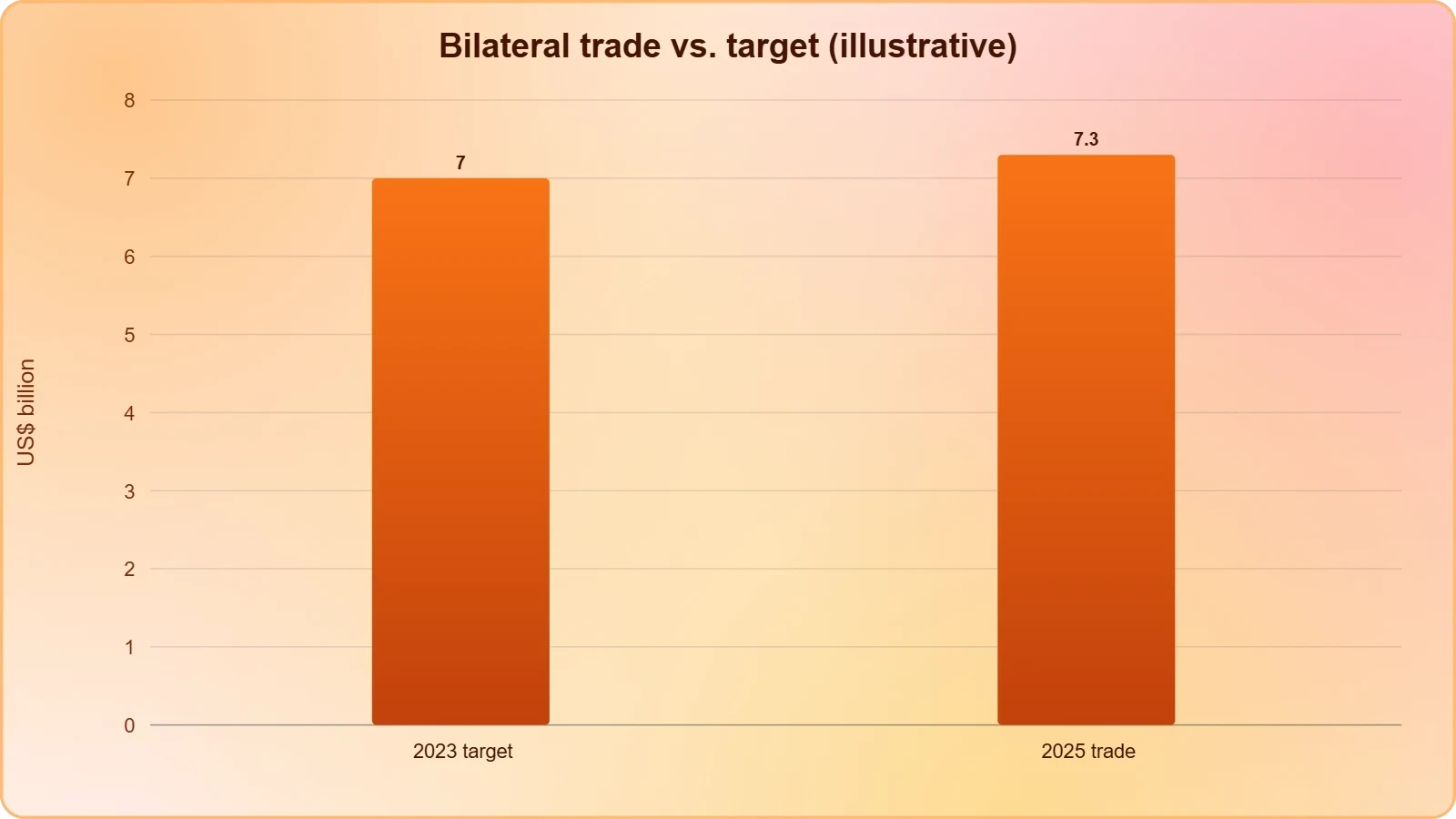
Bilateral trade reaching a record 7.3 billion US dollars in 2025, surpassing the 7 billion dollar target set in 2023, provides the clearest evidence that this relationship has moved beyond ceremonial exchanges.
On This Page
- The Diplomatic Architecture Behind the Rome Consultation
- Record Trade and the EU-Vietnam Free Trade Agreement
- Investment Protection and the Ratification Bottleneck
- Green Energy Transition and the JETP Framework
- Culture, Education, and Multilateral Coordination
- What the Consultation Reveals About Middle-Power Strategy
Vietnam's request that Italy push the European Commission to lift its warning on Vietnamese seafood over illegal, unreported and unregulated fishing reveals how trade diplomacy now intersects with regulatory compliance and reputation management.
Italy's reciprocal interest in artificial intelligence, semiconductors, biotechnology, and high-tech agriculture shows Rome viewing Hanoi as a gateway rather than a peripheral market.
The consultation also touched on cultural exchange, heritage preservation, scholarships, a September 2026 Italian naval vessel visit, and coordination at the United Nations and within ASEAN frameworks. On the South China Sea, both sides affirmed the importance of peace, stability, and freedom of navigation under the 1982 UN Convention on the Law of the Sea.
This analysis examines what the meeting reveals about middle-power diplomacy, the mechanics of EU-Vietnam trade architecture, and the sectors where Italian capital and Vietnamese ambition are converging.
TL;DR Vietnam and Italy used their seventh deputy-ministerial political consultation in Rome to consolidate a partnership now anchored in record bilateral trade of 7.3 billion US dollars and expanding into defence, semiconductors, artificial intelligence, biotechnology, and green energy. Hanoi pressed Rome to advocate lifting the EU's seafood warning and to secure ratification of the EU-Vietnam Investment Protection Agreement by five remaining member states. Italy expressed business interest in Vietnamese high-tech and renewable sectors. Both sides aligned on multilateral coordination, cultural exchange, and peaceful maritime dispute resolution under UNCLOS.
The Diplomatic Architecture Behind the Rome Consultation
Deputy-ministerial consultations rarely generate headlines, yet they perform the essential groundwork that higher-profile summits merely formalise. The seventh iteration of this Vietnam-Italy mechanism demonstrates institutional persistence, a recurring diplomatic channel that has survived changes in government, global economic shocks, and shifting European priorities.
Such regularity matters because it converts goodwill into procedural habit, embedding bilateral cooperation within bureaucratic routines rather than leaving it dependent on personal chemistry between leaders.
Institutional Continuity and Delegation Exchange
The two sides noted increased exchanges of delegations at various levels, including a visit to Italy by Vietnam's National Assembly President Tran Thanh Man in April 2026. Parliamentary engagement adds a legislative dimension that pure executive diplomacy often lacks, creating channels for ratifying agreements and aligning regulatory frameworks.
These visits build familiarity among lawmakers who ultimately approve the treaties and budget allocations that give diplomatic language practical effect.
Regular consultation also functions as an early-warning system, allowing officials to surface irritants before they escalate into public disputes. By reviewing cooperation annually, both governments can adjust priorities, redirect resources, and measure whether earlier commitments produced tangible outcomes. This rhythm of accountability distinguishes functioning partnerships from aspirational communiqués that gather dust after the photographers depart.
The 2025-2026 Action Plan and Its 2027 Vision
Agreement to carry out the Vietnam-Italy action plan for 2025-2026, with a vision extending to 2027, provides the operational spine for everything else discussed. Action plans translate vague intentions into sequenced tasks with responsible agencies and timelines.
The explicit 2027 horizon suggests both capitals anticipate continuity, planning beyond immediate political cycles and signalling confidence that the relationship will deepen rather than plateau.
Expanding cooperation into defence, security, science and technology, and innovation marks a qualitative shift from traditional trade-and-aid frameworks. Defence and security cooperation between a Southeast Asian state and a NATO member carries strategic weight, particularly in a region where maritime tensions persist. Science and innovation collaboration, meanwhile, positions the partnership within the knowledge economy rather than the commodity economy.
Record Trade and the EU-Vietnam Free Trade Agreement
Bilateral trade hitting 7.3 billion US dollars in 2025, above the 7 billion dollar target set in 2023, gives the partnership a measurable foundation. Deputy Minister Hang explicitly credited continued growth to the EU-Vietnam Free Trade Agreement, the instrument that has progressively dismantled tariff barriers since its entry into force.
For Italian exporters, Vietnam represents a fast-growing ASEAN market; for Vietnamese producers, Italy offers access to European consumers and industrial supply chains.
How the EVFTA Reshapes Bilateral Commerce
The EVFTA operates as a phased liberalisation architecture, removing duties across thousands of tariff lines while imposing rules of origin that encourage genuine production rather than simple transshipment. Vietnam's export profile to Italy includes textiles, footwear, seafood, coffee, and electronics, sectors where tariff elimination translates directly into competitive advantage.
Italian machinery, pharmaceuticals, and luxury goods flow the other way, balancing a relationship that might otherwise skew heavily toward Vietnamese manufacturing.
Trade agreements alone, however, cannot resolve regulatory friction. The seafood warning illustrates this precisely: tariff advantages become meaningless if shipments face administrative barriers at European ports. Vietnam's request that Italy advocate within the European Commission reflects a sophisticated understanding that trade diplomacy now extends into sanitary standards, sustainability certification, and enforcement credibility.
The IUU Fishing Warning and Reputation Economics
The European Commission's yellow card on illegal, unreported and unregulated fishing functions as a reputational instrument with commercial consequences. Vietnam has invested substantially in monitoring, control, and surveillance systems, vessel registration, and traceability protocols to address the underlying deficiencies.
Securing Italian advocacy for lifting the warning would validate those reforms and unlock smoother market access for a seafood sector employing millions.
This dimension reveals how modern trade relationships are governed by compliance narratives as much as price competitiveness. A country's regulatory reputation becomes an economic asset, and diplomatic partners can accelerate rehabilitation by lending credibility.
Italy's willingness to engage on this issue, even indirectly, signals that Rome views the relationship as worth investing political capital in.
Investment Protection and the Ratification Bottleneck
The EU-Vietnam Investment Protection Agreement occupies a different legal category from the free trade agreement, requiring ratification by all EU member states rather than proceeding through exclusive EU competence. Vietnam's request that Italy urge the remaining five member states to complete ratification exposes a structural bottleneck in European treaty-making.
Until those parliaments act, the investment protections, dispute resolution mechanisms, and legal certainty that investors expect remain suspended.
Why the IPA Matters for Italian Investors
Investment protection agreements provide guarantees against expropriation, ensure fair and equitable treatment, and establish arbitration pathways when disputes arise. For Italian firms contemplating capital-intensive projects in semiconductors, biotechnology, or renewable energy, these protections reduce political risk and lower the cost of capital.
Without ratification, investors rely on domestic Vietnamese law and bilateral arrangements that offer less predictability than a multilateral European framework.
The five outstanding member states represent a familiar European pattern, where national parliamentary calendars and domestic political coalitions determine the pace of continental commitments. Italy's advocacy role, therefore, is not merely symbolic.
Rome can leverage its standing within EU institutions to nudge laggard capitals, framing ratification as essential to Europe's strategic presence in Southeast Asia.
Semiconductors, AI, and Biotechnology Interest
Undersecretary Tripodi identified artificial intelligence, semiconductors, biotechnology, and high-tech agriculture as sectors where Italian businesses see opportunity. This list reflects Italy's own industrial strengths, particularly in precision manufacturing, agricultural technology, and applied research.
Vietnam's growing semiconductor ecosystem, supported by major global investment, offers Italian suppliers of equipment, materials, and design services a foothold in an expanding regional cluster.
Biotechnology collaboration could extend into pharmaceuticals, diagnostics, and food science, areas where Italian expertise meets Vietnamese agricultural diversity. High-tech agriculture addresses a shared concern: climate resilience and food security. These are not speculative categories but concrete commercial domains where complementary capabilities can generate joint ventures, licensing arrangements, and research partnerships.
- 01
- 02
- 03
- 04
Green Energy Transition and the JETP Framework
Italy's interest in Vietnam's green energy transition, thermal power modernisation, the Just Energy Transition Partnership, and offshore wind power reflects a broader European push into Southeast Asian decarbonisation markets. The JETP, a financing mechanism combining public and private capital, offers Italian firms opportunities in grid infrastructure, turbine manufacturing, and energy efficiency. Vietnam's rapidly growing electricity demand makes this a commercially viable arena rather than a purely environmental gesture.
Offshore Wind and Thermal Transition
Vietnam's long coastline and strong monsoon winds give it substantial offshore wind potential, though regulatory frameworks and grid capacity remain works in progress. Italian engineering and marine construction expertise could support project development, while thermal power modernisation addresses the practical reality that coal remains part of the current energy mix. A credible transition strategy must manage both expansion and retirement simultaneously.
The JETP framework, backed by international partners, conditions financing on policy reforms including renewable energy targets and coal phase-down commitments. Italian participation would position Rome within a multilateral structure that shares risk and amplifies impact.
For Vietnam, diversified European engagement reduces over-reliance on any single partner and strengthens negotiating leverage across the energy portfolio.
Defence, Security, and Naval Engagement
The agreement to expand defence and security cooperation, coupled with the welcome extended to an Italian naval vessel visiting Vietnam in September 2026, signals a maritime dimension to the partnership. Naval visits are diplomatic instruments that demonstrate presence, build interoperability, and open channels for defence industrial dialogue. For Italy, Southeast Asian port calls support a broader Indo-Pacific posture within European strategic autonomy debates.
Defence cooperation between Vietnam and a NATO member requires careful calibration given Vietnam's longstanding principle of non-alignment and its complex relationships with major powers. The emphasis on capacity building, training, and technology rather than formal alliance structures allows both sides to deepen ties without triggering strategic complications. This pragmatic approach characterises Vietnam's broader diplomatic method.
Culture, Education, and Multilateral Coordination
Cultural and educational provisions often appear decorative in diplomatic readouts, yet they build the long-term constituency that sustains bilateral relationships across political transitions. Agreements to promote exchanges, hold cultural events in both countries, share heritage preservation experience, and offer scholarships create people-to-people networks that outlast individual governments. Heritage cooperation carries particular resonance given both nations' rich and complex historical legacies.
Scholarships and Academic Exchange
Scholarship programmes produce alumni who later occupy positions of influence in business, government, and academia, creating informal channels that formal diplomacy cannot replicate. Vietnamese students studying in Italy acquire language skills, professional networks, and cultural fluency that make them natural bridges for future commercial and institutional collaboration. Italy's university system, particularly in engineering, design, and conservation sciences, offers specialised expertise attractive to Vietnamese students.
Heritage preservation cooperation extends beyond sentiment into technical domains including archaeological methodology, restoration chemistry, and museum management. Italy's institutional experience managing UNESCO sites and Vietnam's own heritage challenges create a natural knowledge exchange. These projects generate visibility and public goodwill that complement the harder-edged commercial and security agenda.
UN, ASEAN, and UNCLOS Principles
Coordination at multilateral forums, especially the United Nations and within ASEAN-Italy and ASEAN-EU frameworks, reflects shared interest in rules-based order. Both sides affirmed that disputes should be settled peacefully under international law and the UN Charter.
On the South China Sea, they stressed peace, stability, security, safety, and freedom of navigation and overflight in line with international law, particularly the 1982 UN Convention on the Law of the Sea.
This maritime language matters because it aligns Italy with ASEAN's preferred framing of South China Sea disputes, emphasising international law rather than bilateral power dynamics. For Vietnam, European partners who endorse UNCLOS principles strengthen its diplomatic position. For Italy, such statements signal commitment to a rules-based Indo-Pacific without requiring direct involvement in territorial disputes.
What the Consultation Reveals About Middle-Power Strategy
Vietnam's diplomatic method, visible throughout this consultation, involves cultivating multiple overlapping partnerships without formal alignment. Engaging Italy complements relationships with the United States, China, Japan, South Korea, and ASEAN neighbours, creating a diversified portfolio that reduces dependence on any single power.
This hedging strategy requires disciplined messaging, consistent principles, and the institutional capacity to manage numerous bilateral tracks simultaneously.
Vietnam's Diversification Playbook
By requesting Italian advocacy on seafood and investment ratification, Vietnam demonstrates sophisticated use of secondary partners to influence European-level decisions. Rather than negotiating solely with Brussels, Hanoi cultivates sympathetic member states who can shape internal EU deliberations. This approach recognises that European foreign policy emerges from member-state preferences, not exclusively from Commission directives.
The emphasis on science, technology, and innovation reflects Vietnam's ambition to move up global value chains, transitioning from labour-intensive manufacturing toward higher-productivity sectors. Italian expertise in precision engineering, automation, and applied research complements this trajectory.
The partnership thus serves Vietnam's industrial policy objectives while offering Italy access to a dynamic Southeast Asian market.
Italy's Indo-Pacific Calculus
Italy's engagement with Vietnam fits within a broader European recalibration toward the Indo-Pacific, driven by supply chain diversification, maritime security concerns, and commercial opportunity. Rome's participation in ASEAN frameworks and its naval presence signal a desire for strategic relevance beyond the Mediterranean. Vietnam offers a stable, reform-oriented partner with a young workforce and growing consumer market.
The green energy dimension aligns with Italy's industrial strengths and European climate commitments, while defence cooperation positions Rome within discussions about European strategic autonomy. By investing in this relationship now, Italy builds influence in a region where Chinese, American, Japanese, and Korean capital already compete intensely. The consultation's breadth suggests Rome intends to compete seriously.
The seventh Vietnam-Italy political consultation ultimately demonstrates how middle powers construct influence through patient institutional engagement rather than dramatic gestures. Record trade, sectoral ambition, regulatory advocacy, and principled maritime language combine into a partnership that serves both nations' strategic interests.
Whether the 2027 vision materialises depends on ratification calendars, investment decisions, and the durability of political attention across two distant capitals.
From our network :
- Forbidden Matrix Patterns and Visible Lattice Points: A Geometric DictionaryExplore how multidimensional 0–1 matrices encode geometric truths, linking forbidden patterns to visible lattice points and hypergraph theory, with applications in combinatorics and computational geometry.
- CISA’s Ten-Advisory Wave: Why Generic Patching Fails in OT and How to Build Product-Specific PlaybooksCISA released ten ICS advisories in one week, exposing critical infrastructure risks. Generic patching fails in OT. Learn to build product-specific remediation playbooks.
- The Final Descent: How ESA Retired the Legendary Cluster Constellation After 24 Years of Space Weather ScienceAfter 24 years mapping Earth’s magnetosphere, ESA’s Cluster mission concluded with a precisely controlled reentry over the South Pacific. This analysis explores the scientific legacy, engineering decisions, and debris mitigation principles behind one of space exploration’s most responsible retirements.
- Live Online English Classes for Kids: Do They Actually Reduce Anxiety?A ten-week study reveals that synchronous online English classes can significantly reduce child language anxiety while improving listening and reading skills. Discover what makes these programs effective and how parents can select the right one.
- The Hidden Cost of AI Convenience: Why Over-Permissioned Agents Are a Security Time BombDiscover why AI agents with excessive permissions create dangerous single points of failure, and learn how implementing least privilege principles can protect your organization from exploitation.
- University Language Proficiency Exams: Why Institutional Tests Demand Different Preparation Than IELTS and TOEFLDiscover why university-specific language proficiency examinations differ fundamentally from IELTS and TOEFL, and learn strategic preparation approaches for institutional assessment success.
- Committed Mediterranean Precipitation Decline: Why Emissions Cuts Alone Cannot Restore Winter RainsNew NOAA research reveals that Mediterranean winter rains may decline irreversibly even with emissions cuts. Explore the science of committed climate change and regional impacts.
- Mobile Learning and VR in English: What Global Evidence Reveals About Effective Language TechnologyA systematic review across 14 countries reveals which language-learning technologies genuinely work. Mobile learning, AI, and VR show measurable benefits when pedagogically integrated. This evidence-based guide helps educators and learners select technology that delivers real return on investment.
- How AI Agents Will Change the Way We Manage Personal FinancesExplore how AI agents are transforming personal finance through automated budgeting, bill payment, and investment management, while examining the critical security protocols and governance frameworks required for safe deployment.
RESOURCES
- Resources will be updated soon.
- 01
- 02
- 03
- 04
- 05
- 06
- 07
- 08
0 Comments