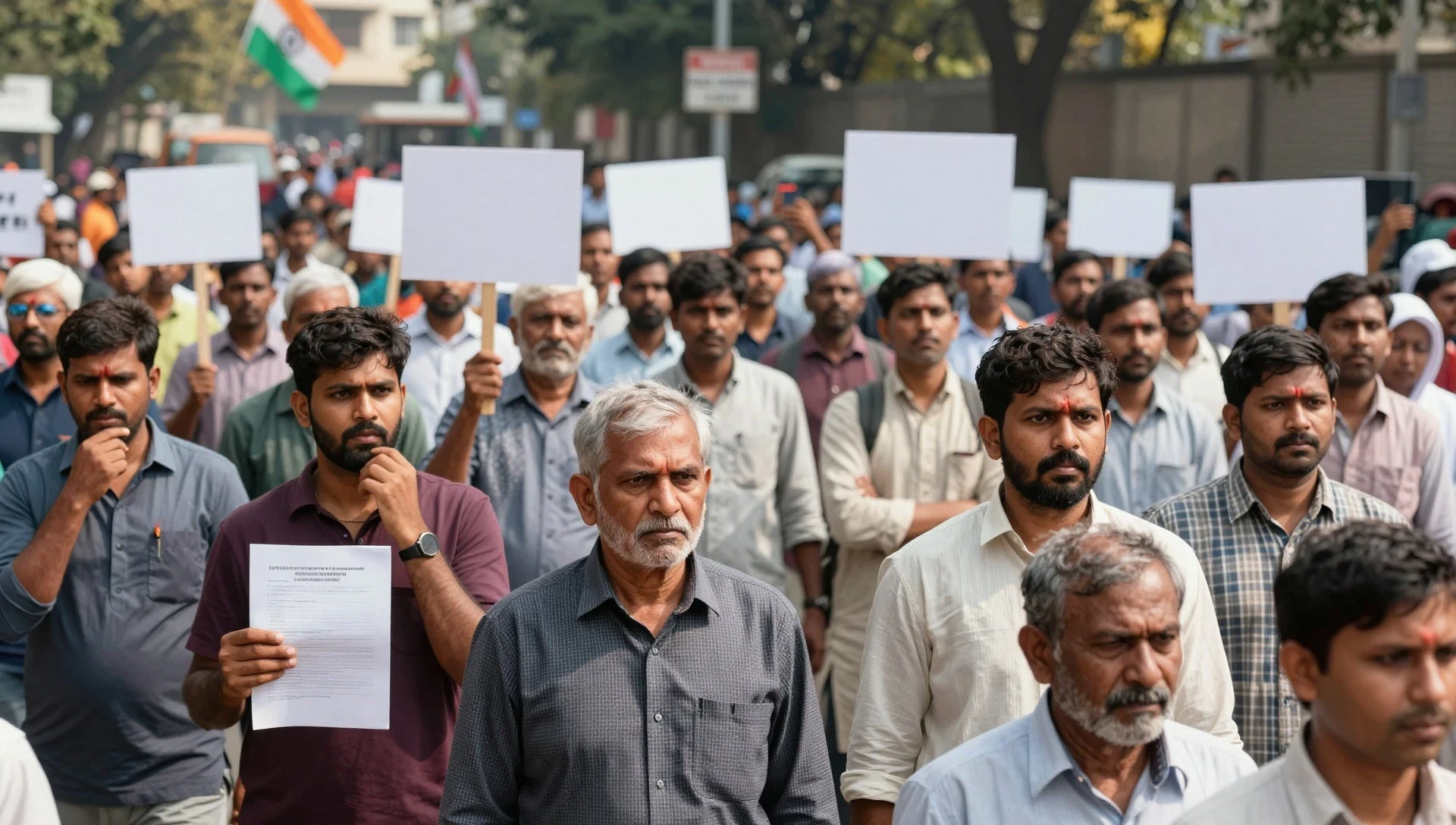
Electoral administration has become one of the most contested frontiers in contemporary Indian politics, and the protest reported by Dawn on 1 November 2026 crystallises that tension with unusual clarity.
Thousands of demonstrators gathered in the national capital to oppose a revision of the voter roll, an administrative process that determines who may lawfully cast a ballot. The source is deliberately sparse: it confirms the scale of the crowd, the location, and the object of the grievance, yet supplies no date, no organisers, and no official response.
That silence is itself analytically significant, because it places the event within a broader pattern of disputes over the integrity of electoral registers rather than a single isolated flashpoint.
On This Page
The mechanics matter more than the headline. Voter roll revision encompasses house-to-house verification, deletion of deceased or duplicate entries, addition of newly eligible citizens, and correction of demographic data.
Each step is technical, but each also carries distributional consequences, since deletions cluster unevenly across constituencies and can alter the arithmetic of close contests. When thousands take to the streets over what appears to be a bureaucratic housekeeping exercise, the underlying question is almost always about who gains and who loses representation.
The protest therefore reads as a dispute over the legitimacy of the register itself, not merely its accuracy.
This analysis situates the demonstration within India's electoral machinery, examines the institutional and legal architecture governing roll revisions, and weighs the evidence available against the claims circulating around such exercises.
It draws on comparative data from the Election Commission of India's published roll statistics, historical precedent from earlier revision cycles, and the structural incentives that shape political mobilisation around registration.
The aim is measured assessment rather than advocacy: to separate what the source establishes from what it leaves unresolved, and to identify the indicators that would clarify the dispute as further reporting emerges.
TL;DR Thousands protested in India's capital against a voter roll revision, according to a Dawn report that confirms the scale and target of the demonstration but omits dates, organisers, and official responses. The episode reflects a recurring structural conflict over electoral registers, where routine verification and deletion processes carry measurable political consequences because they reshape constituency electorates. India's roll now exceeds 960 million electors, meaning even small percentage shifts in deletion or addition translate into millions of affected voters. The dispute is best understood as a contest over administrative legitimacy rather than a simple accuracy question, and its resolution will depend on transparency in deletion data, independent audit, and published redress mechanisms.
The Institutional Architecture of Voter Roll Revision
India's electoral register is maintained under Article 324 of the Constitution, which vests superintendence of elections in the Election Commission of India. Roll revision proceeds through statutory rules framed under the Representation of the People Act, 1950, and is conducted on a cyclical basis with continuous updating between cycles.
The Commission publishes draft rolls, invites claims and objections, and issues reasoned orders on disputed entries. This procedural scaffolding is designed to make revision auditable, yet its practical operation depends heavily on the quality of field verification and the willingness of citizens to engage with the objection window.
Statutory Basis and Revision Cycles
The legal foundation rests on Section 21 of the Representation of the People Act, 1950, which empowers the Commission to revise the roll for any constituency. Special intensive revision exercises typically precede major state elections, while summary revisions occur annually.
Each cycle generates a draft publication, a statutory objection period, and a final roll. The sequence is fixed, but the discretion embedded in field-level enumeration means outcomes vary considerably across districts. Analysts tracking roll quality therefore focus less on the formal calendar and more on the deletion-to-addition ratio in each cycle.
Comparative figures illustrate the scale at which these processes operate. India's electoral roll surpassed 960 million registered voters by 2024, making it the largest such register globally. A deletion rate of even one percent equates to roughly 9.6 million entries removed, a figure larger than the entire electorate of many sovereign states.
This arithmetic explains why administrative decisions that appear marginal in percentage terms become politically explosive when translated into absolute numbers of disenfranchised or newly enfranchised citizens.
The objection window is the principal safeguard available to affected voters, but its effectiveness depends on awareness and access. Citizens whose names are marked for deletion must file Form 7 or respond to notices within the stipulated period, often thirty days.
Rural and migrant populations face structural disadvantages in meeting such deadlines, since notices may be served at addresses they no longer occupy. The resulting asymmetry between urban and rural participation in redress is a persistent feature of roll revision disputes.
Judicial oversight has expanded over successive cycles. Courts have repeatedly held that deletion without notice violates natural justice, and have ordered restoration of names where procedure was not followed. These rulings establish that the register is not merely an administrative artefact but a rights-bearing document.
The Commission's compliance with procedural norms therefore becomes the central test of legitimacy whenever revision is contested, and it is precisely this test that protest movements invoke when they allege exclusion.
Scale of the Register and Deletion Arithmetic
Absolute numbers clarify why revision disputes escalate quickly. With roughly 960 million electors on the roll, a 0.5 percent deletion rate removes about 4.8 million names, comparable to the voting population of a mid-sized European nation. Conversely, a 0.5 percent addition rate enrols a similar bloc of first-time or previously omitted voters.
Both directions of change alter the composition of the electorate, and both are therefore monitored closely by parties whose margins in competitive seats may hinge on tens of thousands of ballots.
The ratio between deletions and additions is the most informative single indicator available to outside analysts. A cycle in which deletions substantially exceed additions suggests either genuine roll purification after a period of inflation, or exclusion driven by verification failures.
A cycle in which additions dominate suggests successful outreach to unenrolled citizens, or alternatively lax verification. Without published disaggregated data, neither interpretation can be confirmed, which is why demands for transparency typically accompany protests of this kind.
Historical precedent offers useful calibration. During the 2019 special intensive revision in Assam, roughly 1.9 million people were excluded from the draft National Register of Citizens, a process adjacent to but distinct from electoral roll revision. The political fallout from that exercise demonstrated how register-related exclusion can dominate national debate for years.
The current protest, though smaller in reported scale, draws on the same underlying anxiety about documentary proof of citizenship and residence as conditions of political membership.
Demographic composition of deletions adds another layer. If removals concentrate among migrant labourers, tenants without formal leases, or residents of informal settlements, the effect is a systematic underrepresentation of those groups. Independent studies of roll data have repeatedly flagged such clustering, though official responses dispute the magnitude.
The protest in the capital should therefore be read as an assertion that the distributional pattern of revision, not merely its existence, is the substantive grievance.
Transparency, Audit, and Redress Mechanisms
Transparency is the operative variable in defusing disputes. The Commission publishes final rolls and summary statistics, but constituency-level deletion data with reasons is not consistently released in machine-readable form. Researchers and opposition parties have repeatedly requested such disclosure, arguing that aggregate figures conceal the geographic and demographic distribution of removals.
Where disclosure has occurred, it has generally reduced the temperature of controversy by allowing claims to be tested against evidence rather than asserted.
Independent audit offers a second safeguard. Civil society organisations have conducted sample-based verification of roll entries, comparing field reality against register data. These audits consistently find both false inclusions and false exclusions, typically in the low single digits as a percentage of sampled entries.
The coexistence of both error types complicates the narrative of deliberate exclusion, but it also confirms that register quality is imperfect in both directions and warrants systematic correction.
Redress mechanisms determine whether errors are remediable. The statutory objection process, supplemented by appellate authority before the Chief Electoral Officer and ultimately the courts, provides multiple layers of review. The practical constraint is time and information: affected voters must learn of their deletion, obtain documentation, and file within a compressed window.
Civil liberties groups have documented cases where notices were served at outdated addresses, effectively denying the opportunity to object.
Digital infrastructure has changed the redress landscape. Online portals now permit claims and objections to be filed electronically, and SMS alerts notify applicants of status changes. These tools lower transaction costs for literate, connected citizens but may widen the gap for those without digital access.
The net effect on equity is therefore ambiguous, and the design of assisted enrolment and helpline support becomes a meaningful policy variable in its own right.
We Also Published
Reading the Protest: Evidence, Grievance, and Political Context
The Dawn report establishes four verifiable facts: a protest occurred, it took place in India's capital, thousands participated, and the stated grievance concerned voter roll revision. Everything beyond that remains unconfirmed by the source.
Responsible analysis must therefore distinguish between the confirmed core and the interpretive superstructure that commentators will inevitably build around it. The absence of a date, organiser identity, and official response is not a trivial omission, because each of those elements would materially change how the event should be weighted.
What the Source Establishes and What It Omits
Confirmed elements are limited but meaningful. A crowd of thousands in the capital constitutes a significant mobilisation by any standard, since assembling such numbers requires coordination, communication, and a perceived stake in the outcome. The choice of the capital as venue signals an intent to address national rather than purely local authority.
The explicit focus on roll revision indicates that the grievance is institutional, directed at the machinery of electoral administration rather than at a particular candidate or party.
Omissions constrain inference. Without a date, the event cannot be situated relative to a specific revision cycle, draft publication, or election announcement. Without organiser identity, the protest cannot be classified as partisan, civil society, or spontaneous. Without an official response, the dispute cannot be assessed for escalation or accommodation.
Each gap corresponds to a question that further reporting would resolve, and analysts should treat the current picture as provisional rather than settled.
Attribution matters for interpretation. The report originates from Dawn, a Pakistani English-language daily, which frames the event for a regional readership with its own editorial priorities. That does not invalidate the factual core, but it does mean the selection and emphasis of details reflect an external vantage point. Cross-referencing with Indian domestic reporting would be necessary before drawing conclusions about scale, tone, or official reaction.
Verification protocols for protest reporting are well established. Independent confirmation typically requires at least two sources, ideally with differing institutional interests, plus photographic or video evidence and, where possible, police estimates of crowd size. None of these are available in the present source.
The appropriate analytical posture is therefore to accept the occurrence while withholding judgment on magnitude, motivation, and consequence until corroboration arrives.
Why Register Disputes Mobilise Crowds
Electoral registers are the gateway to political power, and control over their composition is control over the franchise. A revision that removes names alters the denominator of every future contest in affected constituencies.
Citizens understand this intuitively, which is why administrative notices about roll verification can generate mobilisation that abstract policy debates rarely achieve. The register is not a neutral list; it is the formal boundary of the political community, and disputes over boundaries are inherently high-stakes.
Mobilisation also draws on accumulated grievance. Where communities have experienced prior exclusion, or believe they have, a new revision activates collective memory of earlier disputes. The Assam experience, the periodic controversies over migrant voter registration in metropolitan constituencies, and allegations of bulk deletion in specific districts all feed a reservoir of distrust. A single protest in the capital can therefore aggregate grievances that originated in disparate states and cycles.
Political incentives reinforce the dynamic. Opposition parties have a structural interest in contesting revisions that may disadvantage their electorates, while incumbent administrations have an interest in defending the integrity of the process.
This alignment does not determine who is correct on the facts, but it does explain why register disputes reliably become partisan. The protest should be read within that incentive structure rather than as an isolated expression of civic concern.
Comparative perspective is instructive. Roll maintenance controversies have surfaced in the United States over purging practices, in the United Kingdom over individual electoral registration transition, and in several European states over registration of mobile EU citizens.
In each case, the dispute turned on the same axis: whether administrative accuracy measures were applied even-handedly or produced systematic exclusion. India's scale magnifies the consequences but not the underlying logic.
Escalation Pathways and Institutional Response
Protests over electoral administration typically follow one of three trajectories. They may dissipate if the Commission publishes clarifying data and restores contested entries. They may institutionalise into litigation, with affected voters challenging deletions in high courts.
Or they may escalate into sustained political mobilisation if opposition parties adopt the grievance as a campaign theme. The trajectory depends largely on how quickly and credibly the administering authority responds to specific, verifiable complaints.
Institutional response options are well defined. The Commission can publish constituency-level deletion data with reasons, extend objection windows in affected areas, deploy additional verification staff, and issue public clarifications on procedure. Each measure addresses a distinct dimension of the grievance: transparency, access, capacity, and communication.
Historically, combinations of these measures have succeeded in lowering tension, while silence or blanket denial has tended to prolong controversy.
Judicial intervention remains a live pathway. Public interest litigation challenging revision procedures has precedent, and courts have shown willingness to order restoration of names where notice was deficient. The prospect of litigation itself shapes administrative behaviour, since officials anticipate scrutiny of procedural records. A credible legal challenge can therefore function as an accountability mechanism even before any judgment is delivered.
Media and information dynamics condition escalation. Rapid, unverified circulation of claims about deletion numbers can inflate grievance beyond what evidence supports, while official silence creates space for speculation. The most stabilising condition is timely release of disaggregated data accompanied by accessible explanation.
Where that condition is met, disputes tend to narrow to specific, adjudicable cases rather than broad allegations of systemic exclusion.
- 01
- 02
- 03
- 04
Assessing Legitimacy and the Path to Resolution
Legitimacy in electoral administration rests on three pillars: procedural regularity, transparency of data, and effective redress. A revision that satisfies all three can withstand political challenge even if it removes millions of names, because affected individuals have demonstrable recourse.
A revision that satisfies only the first invites the kind of protest reported here, since formal compliance without disclosure or accessible remedy appears to affected citizens as exclusion dressed in procedure. The current dispute should be evaluated against all three pillars rather than any single one.
Benchmarks for a Credible Revision Process
Credible revision requires published, disaggregated deletion data with stated reasons for each removal category. Aggregate totals are insufficient because they conceal distribution. Independent sample audits, conducted by bodies with access to field records, provide a second layer of assurance. Statutory objection windows must be long enough and notices served at verified addresses.
Finally, appellate decisions should be published so that patterns of error and correction become visible to public scrutiny.
Each benchmark is measurable, which makes assessment possible rather than rhetorical. Deletion data can be checked for geographic clustering. Audit results can be compared across cycles. Notice service rates can be tracked. Appellate outcomes can be coded by reason.
A revision process that publishes these metrics invites evidence-based debate; one that withholds them invites the politics of suspicion. The choice between those outcomes is administrative, not inevitable.
International practice offers reference points without providing a template. The United Kingdom's Electoral Commission publishes detailed registration statistics and audit findings, while several European jurisdictions require judicial confirmation before large-scale removals. India's scale makes direct transplantation impractical, but the underlying principle of published, auditable data is scale-independent.
Adopting it would not resolve substantive disputes, but it would relocate them from the street to the record.
The protest in the capital is therefore best read as a demand for that relocation. Thousands assembling over a technical process signals that the public does not accept administrative discretion as self-justifying.
Whether the demand is met depends on the Commission's willingness to disclose and the political system's willingness to treat register integrity as a shared interest rather than a partisan weapon. The evidence available does not yet permit a verdict, but it clearly identifies the questions that matter.
Indicators to Monitor as Reporting Develops
Several indicators will clarify the dispute as further reporting emerges. The first is the specific revision cycle to which the protest responded, which determines whether the grievance concerned a draft publication, a final roll, or a mid-cycle correction.
The second is the identity of organisers, which distinguishes partisan mobilisation from civil society advocacy. The third is the official response, whether clarification, concession, or dismissal. Together these three would substantially resolve the interpretive ambiguity that currently surrounds the event.
Quantitative indicators matter equally. Published deletion figures for the affected region, compared against prior cycles, would establish whether the revision was anomalous or routine. The number of objections filed and the proportion upheld would indicate the responsiveness of the redress mechanism. Any judicial filings and their outcomes would signal the legal trajectory.
Each data point converts a generalised grievance into a specific, testable claim, which is the precondition for reasoned public debate.
Comparative monitoring across states provides context. If deletions cluster in particular regions or demographic categories, the pattern suggests systematic rather than random error. If they distribute evenly, the case for routine administrative imperfection strengthens.
Analysts should therefore track constituency-level data as it becomes available, rather than relying on national aggregates that obscure precisely the variation that matters for assessing fairness.
The broader lesson concerns institutional trust. Electoral administration derives authority from demonstrated impartiality, and that demonstration requires disclosure. A protest of thousands in the capital is a signal that the demonstration has not been sufficiently made.
Whether the signal is heeded will determine not only the outcome of this dispute but the durability of confidence in the register itself, which is the foundation on which every subsequent election rests.
From our network :
- The Hidden Cost of AI Convenience: Why Over-Permissioned Agents Are a Security Time BombDiscover why AI agents with excessive permissions create dangerous single points of failure, and learn how implementing least privilege principles can protect your organization from exploitation.
- CISA’s Ten-Advisory Wave: Why Generic Patching Fails in OT and How to Build Product-Specific PlaybooksCISA released ten ICS advisories in one week, exposing critical infrastructure risks. Generic patching fails in OT. Learn to build product-specific remediation playbooks.
- How AI Agents Will Change the Way We Manage Personal FinancesExplore how AI agents are transforming personal finance through automated budgeting, bill payment, and investment management, while examining the critical security protocols and governance frameworks required for safe deployment.
- Live Online English Classes for Kids: Do They Actually Reduce Anxiety?A ten-week study reveals that synchronous online English classes can significantly reduce child language anxiety while improving listening and reading skills. Discover what makes these programs effective and how parents can select the right one.
- Committed Mediterranean Precipitation Decline: Why Emissions Cuts Alone Cannot Restore Winter RainsNew NOAA research reveals that Mediterranean winter rains may decline irreversibly even with emissions cuts. Explore the science of committed climate change and regional impacts.
- Mobile Learning and VR in English: What Global Evidence Reveals About Effective Language TechnologyA systematic review across 14 countries reveals which language-learning technologies genuinely work. Mobile learning, AI, and VR show measurable benefits when pedagogically integrated. This evidence-based guide helps educators and learners select technology that delivers real return on investment.
- The Final Descent: How ESA Retired the Legendary Cluster Constellation After 24 Years of Space Weather ScienceAfter 24 years mapping Earth’s magnetosphere, ESA’s Cluster mission concluded with a precisely controlled reentry over the South Pacific. This analysis explores the scientific legacy, engineering decisions, and debris mitigation principles behind one of space exploration’s most responsible retirements.
- University Language Proficiency Exams: Why Institutional Tests Demand Different Preparation Than IELTS and TOEFLDiscover why university-specific language proficiency examinations differ fundamentally from IELTS and TOEFL, and learn strategic preparation approaches for institutional assessment success.
- Forbidden Matrix Patterns and Visible Lattice Points: A Geometric DictionaryExplore how multidimensional 0–1 matrices encode geometric truths, linking forbidden patterns to visible lattice points and hypergraph theory, with applications in combinatorics and computational geometry.
RESOURCES
- Protests against voter roll revisions rock capital of world's largest ...npr.orgOct 10, 2026 ... Demonstrations flared across New Delhi today to protest a controversial revision of the country's electoral rolls. Authorities there have ...
- "India Cut 130 Million From Voter Roll, Fueling Protests Against ...electionlawblog.orgOct 6, 2026 ... “India Cut 130 Million From Voter Roll, Fueling Protests Against Modi” ... NYT: Nearly a billion people in the world's…
- India: Authorities trampling on human rights in crackdown on ...amnesty.orgOct 2, 2026 ... ... Revision (SIR) of electoral rolls. More than 130 million people have been deleted from electoral rolls since 2025. The…
- Tens of thousands protest in India's capital against voter roll revisionlemonde.fr1 day ago ... The nationwide revision of electoral rolls has sparked political disputes and street protests in the world's largest democracy over the…
- Why India's tens of millions of voter deletions have led to ... - Reutersreuters.comOct 9, 2026 ... NEW DELHI, October 9 - India's verification exercise of its nearly one billion voters has sparked protests across the country, ...
- What to know about nationwide protests in India over voter list ...nbcnews.comOct 6, 2026 ... Protesters demand the resignation of Chief Election Commissioner Gyanesh Kumar and an end to the poll body's ongoing revision of…
- Declared dead: Indian voters fight to get back on electoral rollsreuters.comOct 22, 2026 ... ... voters in Prasad's neighborhood were struck off after the revision. The voter roll revision has triggered protests across India.…
- India's opposition parties protest against a controversial electoral roll ...apnews.comAug 11, 2025 ... NEW DELHI (AP) — India 's opposition parties held a protest Monday calling for the rollback of a controversial revision…
- Mass protests demanding poll chief resignation shake India for third ...aljazeera.comOct 4, 2026 ... Protesters say the election commission's voter-roll revision has removed millions of eligible voters to benefit PM Modi.
- India Cut 130 Million From Voter Roll, Fueling Protests Against Modinytimes.comOct 6, 2026 ... To be sure, inaccuracies in the voter roll, which included about 970 million names before the recent revisions, have long…
- India court seeks explanations from election body in voter list rowcourthousenews.comOct 5, 2026 ... (AFP) — India's Supreme Court ordered the government and the national election body Monday to explain decisions linked to a…
- India's supreme court demands answers over changes to voter rolltheguardian.comOct 5, 2026 ... Modi government, election body and its head issued notices after removal of millions from lists prompts mass protests.
- Thousands Protest In India's Capital Against Voter Roll Revisionbarrons.com22 hours ago ... The nationwide revision of electoral rolls has sparked political disputes and street protests in the world's largest democracy over the…
- Leaders from India's 'Cockroach' movement released from detention ...pbs.orgOct 11, 2026 ... The protests were triggered after authorities removed more than 130 million voters from the list since last year. Critics say…
- India Faces Fresh Protests, This Time Over Voter Rollsnytimes.comOct 2, 2026 ... The rallies were part of a call for nationwide agitation against an ongoing, contentious revision of India's voter rolls that…
- 01
- 02
- 03
- 04
- 05
- 06
- 07
- 08
0 Comments