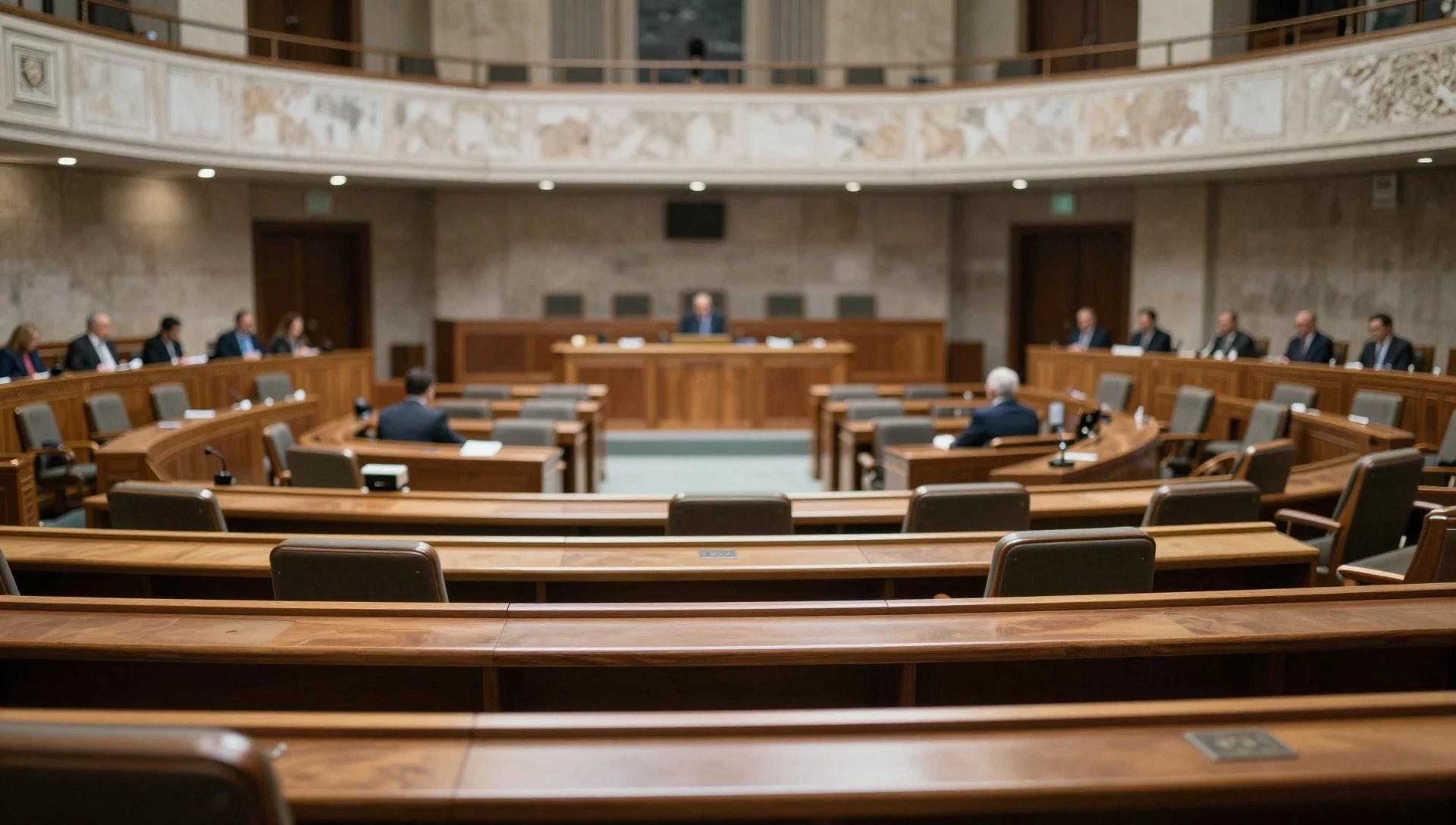
Israel's parliamentary election has produced a fragmented Knesset in which no bloc commands the 61 seats required to govern, and the arithmetic now matters more than the campaign rhetoric.
Final tallies place Prime Minister Benjamin Netanyahu's aligned group at 53 seats, a result that strips the incumbent coalition of its majority without delivering a decisive defeat. The principal opposition bloc led by Gadi Eisenkot secured 48 seats, while Arab-led parties captured 19 seats, their highest tally in the country's electoral history.
With 120 seats in play, the gap between victory and paralysis is measured in single digits, and every faction is now a potential kingmaker or spoiler.
On This Page
The deadlock is not merely a numbers problem but an institutional one. President Isaac Herzog will receive the official results next Wednesday and must then invite a candidate to attempt government formation, a process that historically consumes weeks of confidential negotiation.
Centrist leader Yair Lapid has acknowledged that difficult work lies ahead and confirmed that talks are proceeding behind the scenes. Should successive formation attempts fail, Israel could return to the polls next year, extending a cycle of electoral instability that has already reshaped its political calendar more than once in recent memory.
Beneath the coalition mathematics sits a more consequential shift: the Arab-led parties have moved from the periphery of Israeli politics to its balance of power. Eisenkot's bloc could cooperate with those parties to elect a new Speaker, a maneuver that would hand them control of the parliamentary agenda and the ability to legislate.
The two sides have coordinated in this fashion only once before, in 2021. Public rallies in support of such cooperation, including testimony from demonstrators who describe Arab parties as a legitimate part of the population, suggest that the political culture around this question is changing faster than the formal rules.
TL;DR Israel's election has ended in deadlock, with Netanyahu's bloc at 53 seats, Eisenkot's opposition at 48, and Arab-led parties at a record 19 — none reaching the 61-seat threshold in the 120-seat Knesset. Coalition negotiations now determine whether Israel avoids a further election. The pivotal variable is whether Eisenkot's bloc formalizes cooperation with Arab-led parties to elect a Speaker and control the parliamentary agenda, a step taken only once before, in 2021.
The Seat Arithmetic That Produces Deadlock
The Israeli electoral system converts votes into seats through a single national district with a proportional threshold, which means fragmentation is structural rather than accidental. A bloc can win the most seats and still lack a governing majority, as Netanyahu's 53-seat result demonstrates.
The opposition's 48 seats and the Arab-led parties' 19 seats together exceed the threshold, but only if cooperation holds across ideological lines that have historically been difficult to bridge. The table below sets out the distribution and its implications.
Why 53 Seats Is a Loss, Not a Win
A plurality without a majority is a recurring feature of Israeli politics, and the 53-seat figure illustrates the distinction precisely. Netanyahu's group leads the field but cannot assemble a coalition from its natural partners alone.
The shortfall of eight seats forces the incumbent bloc into the same bargaining position as its rivals, competing for the same small parties whose demands escalate with each round of talks. Incumbency confers visibility, not leverage, when the arithmetic refuses to cooperate.
Historical comparison sharpens the point. Israeli elections have repeatedly produced blocs in the high fifties or low sixties, and the difference between 59 and 61 has decided governments. The current result places the leading bloc closer to the opposition than to the threshold, which means the initiative may pass to Eisenkot even though his bloc finished second.
In parliamentary systems, the ability to construct a majority matters more than the size of the largest single faction.
The 19 seats held by Arab-led parties represent the most significant single change in the seat map. That tally is sufficient to swing a Speaker election and to sustain or deny a governing coalition.
It also raises the cost of exclusion: a bloc that refuses to engage with those parties must find its majority elsewhere, and the arithmetic offers few alternatives. The record result therefore functions as both an opportunity and a constraint on every other faction.
Negotiations now proceed under a fixed institutional clock. The results go to President Herzog next Wednesday, the new Knesset is sworn in on November 10, and formation attempts follow in sequence.
Each stage narrows the options available to the parties, because the Speaker election and the formation mandate are separate contests with different coalitions. Analysts tracking the process should watch the Speaker vote as the first reliable signal of whether cross-bloc cooperation is real or rhetorical.
The Coalition Mathematics in Practice
Coalition formation in Israel resembles a constrained optimization problem in which the objective is 61 seats and the constraints are ideological compatibility, personal rivalries, and the price each partner sets. The leading bloc's 53 seats require at least eight additional mandates from parties outside its alignment.
The opposition's 48 seats require thirteen, but the Arab-led parties' 19 seats can supply them in a single transaction. The feasible set is therefore asymmetric, and the asymmetry favors Eisenkot.
That asymmetry explains why the Speaker contest has become the focal point. Control of the parliamentary agenda allows a bloc to schedule legislation, set committee composition, and shape the order in which contentious bills reach the floor.
A Speaker elected with Arab-led party support would give the opposition bloc procedural dominance even before a government exists. The mechanism is legal, precedented, and precisely the kind of institutional leverage that determines outcomes in hung parliaments.
The precedent dates to 2021, when the two sides cooperated in this manner for the first and only time. That single instance established both the feasibility and the fragility of the arrangement.
It demonstrated that a working majority could be assembled across the divide, and it demonstrated how quickly such arrangements collapse under pressure. Negotiators on both sides are aware that the precedent cuts both ways, offering a template while reminding participants of its short lifespan.
Public opinion appears to be moving ahead of the political class on this question. Rallies have urged Eisenkot to join forces with the Arab-led parties, and demonstrators such as Miri Sklair of Jaffa have argued publicly that those parties represent a legitimate segment of the population and should be engaged.
Whether street-level sentiment translates into coalition agreements depends on the willingness of party leaders to absorb the political cost of cooperation.
We Also Published
The Institutional Path From Deadlock to Decision
Israel's formation process is sequential and time-bound, which means the deadlock will resolve through procedure rather than through a fresh vote in the short term. The President's consultation, the formal mandate, the Speaker election, and the swearing-in of the new Knesset each create decision points.
Understanding the sequence is essential to interpreting daily developments, because a setback at one stage does not necessarily doom the next. The table below maps the timeline and its contingencies.
What the President's Mandate Actually Decides
The President's role is consultative rather than directive, but the choice of whom to task first carries substantial weight. Herzog will hear recommendations from party leaders and then invite the candidate with the most plausible path to 61 seats.
That judgment is political, not mathematical, and it can favor a smaller bloc if the larger one faces insurmountable objections. The mandate is therefore the first real test of whether the opposition's arithmetic translates into institutional authority.
Formation attempts are not unlimited, and each failure consumes time that the political system does not have in abundance. If several attempts collapse, the country returns to the polls next year, a prospect that concentrates minds across the spectrum.
The cost of a repeat election falls disproportionately on smaller parties, whose survival depends on turnout and threshold performance. That asymmetry gives the larger blocs leverage in negotiations, but it also raises the risk of miscalculation.
The swearing-in date of November 10 creates a hard boundary before which the new Knesset cannot act. Once seated, however, the chamber can elect a Speaker and begin legislating regardless of whether a government exists.
This gap between parliamentary control and executive formation is the space in which the opposition bloc can operate. Procedural control does not require a coalition agreement, only a majority on a single vote.
Observers should treat the Speaker election as the leading indicator of the entire formation cycle. A Speaker chosen with Arab-led party support would signal that the cross-bloc arrangement is operational and that a government built on the same foundation is plausible.
A Speaker chosen without it would suggest that the 2021 precedent remains an exception rather than a template, and that a repeat election is the more likely destination.
The Arab-Led Parties as Balance of Power
The 19-seat result is the highest ever recorded by Arab-led parties and changes their strategic position materially. Previously, their numbers could influence outcomes at the margins; now they can determine them outright.
The shift is quantitative in origin but qualitative in effect, because a bloc that can swing a Speaker election can also set the terms of its own participation. That leverage is new, and it is being exercised in public as well as in private negotiations.
Domestic reaction has been instructive. Rallies urging Eisenkot to work with the Arab-led parties indicate that a segment of the Jewish public views such cooperation as legitimate rather than taboo.
The argument advanced by demonstrators, that these parties represent a genuine part of the population, reframes the question from one of concession to one of representation. Whether that framing survives the pressure of coalition bargaining remains to be seen, but it has entered the mainstream discourse.
The 2021 precedent provides the operational template. In that instance, cooperation between the two sides produced a working arrangement that elected a Speaker and enabled legislation. It also demonstrated the fragility of such arrangements, which dissolved under political pressure.
Negotiators today must decide whether to replicate the model with stronger safeguards or to pursue a different configuration that avoids its known weaknesses.
For the wider region, the outcome matters beyond Israel's borders. A government dependent on Arab-led party support would pursue different priorities than one built on the incumbent bloc, particularly on domestic allocation and civil rights. A repeat election would extend uncertainty and delay decisions on security and economic policy. Either path carries consequences for partners who calibrate their engagement to the stability of Israeli governance.
Scenarios, Probabilities, and What to Watch
The deadlock admits a finite set of resolutions, and each can be assessed against the seat arithmetic and the institutional calendar. A cross-bloc government, a narrow incumbent-led coalition, and a repeat election are the principal scenarios, with variations in between.
Assigning rough probabilities is useful not because the future is predictable but because it forces attention to the constraints that make some outcomes more likely than others. The table below summarizes the scenarios and their observable markers.
Reading the Signals Correctly
Public statements during coalition negotiations are instruments rather than disclosures, and treating them as reliable information is a common analytical error. Lapid's remark that difficult work lies ahead and that talks are proceeding behind the scenes conveys position rather than progress.
The substantive signals are procedural: who is invited to consultations, who abstains in the Speaker vote, and which committees are constituted first. These reveal the actual configuration of power more accurately than press conferences.
The timing of the Speaker election relative to the formation mandate is the critical variable. If the opposition bloc elects a Speaker with Arab-led support before a formation attempt concludes, it establishes facts on the ground that constrain the President's options.
If the formation mandate is assigned first and succeeds, the Speaker contest becomes secondary. The order of operations therefore determines which bloc sets the agenda, and both sides understand this sequencing advantage.
Repeat elections are costly and unpredictable, which is why they are threatened more often than they are triggered. The 2021 precedent shows that cross-bloc arrangements can be assembled when the alternative is sufficiently unattractive.
The current arithmetic makes the alternative unattractive for both major blocs, since neither can govern alone and both face losses in a fresh vote. That mutual vulnerability is the strongest argument for a negotiated outcome.
For analysts and observers, the disciplined approach is to track the formal steps and discount the rhetoric. The results go to Herzog next Wednesday, the Knesset is sworn in on November 10, and the Speaker election follows. Each of these events produces a verifiable outcome that updates the probability distribution.
Everything else, including claims of imminent breakthroughs or collapses, should be treated as noise until the votes are counted.
Comparative Context and Structural Lessons
Israel's experience is not unique, and comparing it with other fragmented parliamentary systems clarifies what is structural and what is contingent. Belgium has gone more than a year without a government; Spain has repeated elections within a single cycle; Italy has built governments from unlikely coalitions for decades.
The common thread is that proportional representation with a low threshold produces fragmentation, and fragmentation produces negotiation. Israel's deadlock is a familiar institutional pattern, not an anomaly.
The distinctive feature is the role of a bloc that has historically been excluded from governing. When a party or alliance moves from the margins to the balance of power, the political system must decide whether to incorporate it or to construct majorities around it.
Incorporation expands the feasible set and reduces the frequency of elections; exclusion narrows the set and raises the cost of governance. The 19-seat result forces that decision into the open.
The 2021 precedent suggests that incorporation is possible but unstable. A single instance of cooperation does not establish a norm, and the collapse of that arrangement left both sides wary. Building a durable cross-bloc coalition would require institutional guarantees that go beyond a single Speaker vote, including committee allocations and legislative commitments. Whether the parties can design such guarantees is the substantive question beneath the headline deadlock.
The broader lesson concerns the relationship between electoral systems and governability. Systems that prioritize proportionality tend to produce parliaments that mirror the electorate closely and governments that require broad coalitions. The trade-off is representation against decisiveness, and Israel's current impasse is the price of the former.
Reforms that raise the threshold or introduce bonus seats for the largest party would reduce fragmentation, but they would also reduce the representation that produced the record Arab-led party tally.
What the Deadlock Means Beyond Israel
The outcome carries implications for regional diplomacy and for the credibility of Israel's governing institutions. A prolonged formation process limits the government's capacity to make commitments on security, trade, and normalization, because partners prefer counterparts who can deliver legislative outcomes. A repeat election would extend that limitation by months.
The cost of deadlock is therefore measured not only in domestic politics but in the country's external relationships.
For investors and businesses, the relevant variable is policy continuity rather than coalition composition. Budget passage, regulatory appointments, and infrastructure approvals all depend on a functioning government, and a hung parliament delays each.
Historical evidence from comparable systems suggests that markets price uncertainty gradually rather than abruptly, with the sharpest reactions occurring when formation attempts fail. The Speaker election and the first formation mandate are the events most likely to move sentiment.
The record tally for Arab-led parties also has symbolic weight that extends beyond coalition arithmetic. Representation at that level changes the terms of public debate, even if the parties remain outside government.
It normalizes participation in the institutions that shape policy, and it raises the political cost of exclusion for any bloc that chooses that route. Over time, such normalization can reshape the boundaries of what coalitions are considered acceptable.
The most probable near-term outcome is a prolonged negotiation followed by either a fragile cross-bloc government or a repeat election, with the Speaker contest as the decisive early indicator. The least probable is a rapid, stable coalition, because the arithmetic does not support one and the ideological distances remain wide.
Analysts should therefore expect volatility in the headlines and continuity in the underlying constraints until the formal votes are cast.
From our network :
- Mobile Learning and VR in English: What Global Evidence Reveals About Effective Language TechnologyA systematic review across 14 countries reveals which language-learning technologies genuinely work. Mobile learning, AI, and VR show measurable benefits when pedagogically integrated. This evidence-based guide helps educators and learners select technology that delivers real return on investment.
- CISA’s Ten-Advisory Wave: Why Generic Patching Fails in OT and How to Build Product-Specific PlaybooksCISA released ten ICS advisories in one week, exposing critical infrastructure risks. Generic patching fails in OT. Learn to build product-specific remediation playbooks.
- The Hidden Cost of AI Convenience: Why Over-Permissioned Agents Are a Security Time BombDiscover why AI agents with excessive permissions create dangerous single points of failure, and learn how implementing least privilege principles can protect your organization from exploitation.
- Live Online English Classes for Kids: Do They Actually Reduce Anxiety?A ten-week study reveals that synchronous online English classes can significantly reduce child language anxiety while improving listening and reading skills. Discover what makes these programs effective and how parents can select the right one.
- Forbidden Matrix Patterns and Visible Lattice Points: A Geometric DictionaryExplore how multidimensional 0–1 matrices encode geometric truths, linking forbidden patterns to visible lattice points and hypergraph theory, with applications in combinatorics and computational geometry.
- Committed Mediterranean Precipitation Decline: Why Emissions Cuts Alone Cannot Restore Winter RainsNew NOAA research reveals that Mediterranean winter rains may decline irreversibly even with emissions cuts. Explore the science of committed climate change and regional impacts.
- The Final Descent: How ESA Retired the Legendary Cluster Constellation After 24 Years of Space Weather ScienceAfter 24 years mapping Earth’s magnetosphere, ESA’s Cluster mission concluded with a precisely controlled reentry over the South Pacific. This analysis explores the scientific legacy, engineering decisions, and debris mitigation principles behind one of space exploration’s most responsible retirements.
- University Language Proficiency Exams: Why Institutional Tests Demand Different Preparation Than IELTS and TOEFLDiscover why university-specific language proficiency examinations differ fundamentally from IELTS and TOEFL, and learn strategic preparation approaches for institutional assessment success.
- How AI Agents Will Change the Way We Manage Personal FinancesExplore how AI agents are transforming personal finance through automated budgeting, bill payment, and investment management, while examining the critical security protocols and governance frameworks required for safe deployment.
RESOURCES
- Beyond the Deadlock: Five Scenarios for Israel After the Electionjstreet.org... forming a coalition dependent on them. ... As has happened in the past, after the election individual Members of Knesset may break ranks…
- How can Israel break its election deadlock? - Al Jazeeraaljazeera.com3 days ago ... No political party has achieved the 61-seat majority required in the Knesset to form a government in Israel ... election,…
- Netanyahu's bloc leading Israel election but short of majority ... - BBCbbc.com4 days ago ... Both the prime minister and his main rival have insisted that they should be tasked with forming a governing coalition.…
- How Is an Israeli Government Formed? - Israel Policy Forumisraelpolicyforum.org7 days ago ... How is an Israeli government formed after an election? This explainer breaks down Israel's coalition formation process, from Knesset seat ...
- Netanyahu and Eisenkot deadlocked according to exit polls - Reutersreuters.com5 days ago ... No single party in Israel has ever won an outright majority, so governments are formed by a coalition of parties.…
- Deadlock ahead for Israel as election fails to deliver an alternative to ...theconversation.com4 days ago ... Stalemate in the Israeli Knesset means Netanyahu is likely to continue as caretaker prime minister.
- Netanyahu's Electoral Strategy: Deadlockarabcenterdc.orgTurning Arab Votes into an Electoral Liability. Israel's parliament, the Knesset, has 120 seats. To form a government, a party or coalition of parties…
- Israel may face new election in Knesset deadlock - ARAB NEWSarabnews.jp2 days ago ... The results will be submitted next Wednesday to President Isaac Herzog, who will task someone with forming a government. ...…
- Minority Governments: A Possible Way Out of Political Deadlock?en.idi.org.il5 days ago ... Does political deadlock mean a new election? Not necessarily. Israeli law actually allows the formation of a minority government.
- Timeline: A tumultuous year in Israeli politics - Brookings Institutionbrookings.eduDec 19, 2019 ... The task of forming a new coalition may be just as difficult after the third election as it was after…
- Israel's election deadlock: 3 scenarios for what comes nextjta.org5 days ago ... Israel faces a difficult coalition-building process — and possibly another election. ... Formation of a unity government. A quick look…
- How the Israeli election deadlock could end - Atlantic Councilatlanticcouncil.org5 days ago ... ... Knesset. The vote ... An unclear outcome for Netanyahu or opponents could lead to prolonged coalition negotiations or even…
- Herzog's coalition challenge amid election deadlock, and what a ...timesofisrael.com5 days ago ... Knesset elections. If you'd like to comment, join. The Times of Israel Community. JOIN THE TOI COMMUNITY Already a member?…
- How Israel Forms a Government: Coalition Scenarios and the ...mepc.org6 days ago ... Israelis vote today, Oct. 27, but the election is only the first step in forming a government. To govern, a…
- Two Years, Four Elections: The Twists and Turns of Israel's Political ...crisisgroup.orgMar 22, 2021 ... Two Years, Four Elections: The Twists and Turns of Israel's Political Deadlock ... forming a coalition if given the chance.…
- 01
- 02
- 03
- 04
- 05
- 06
- 07
- 08
0 Comments