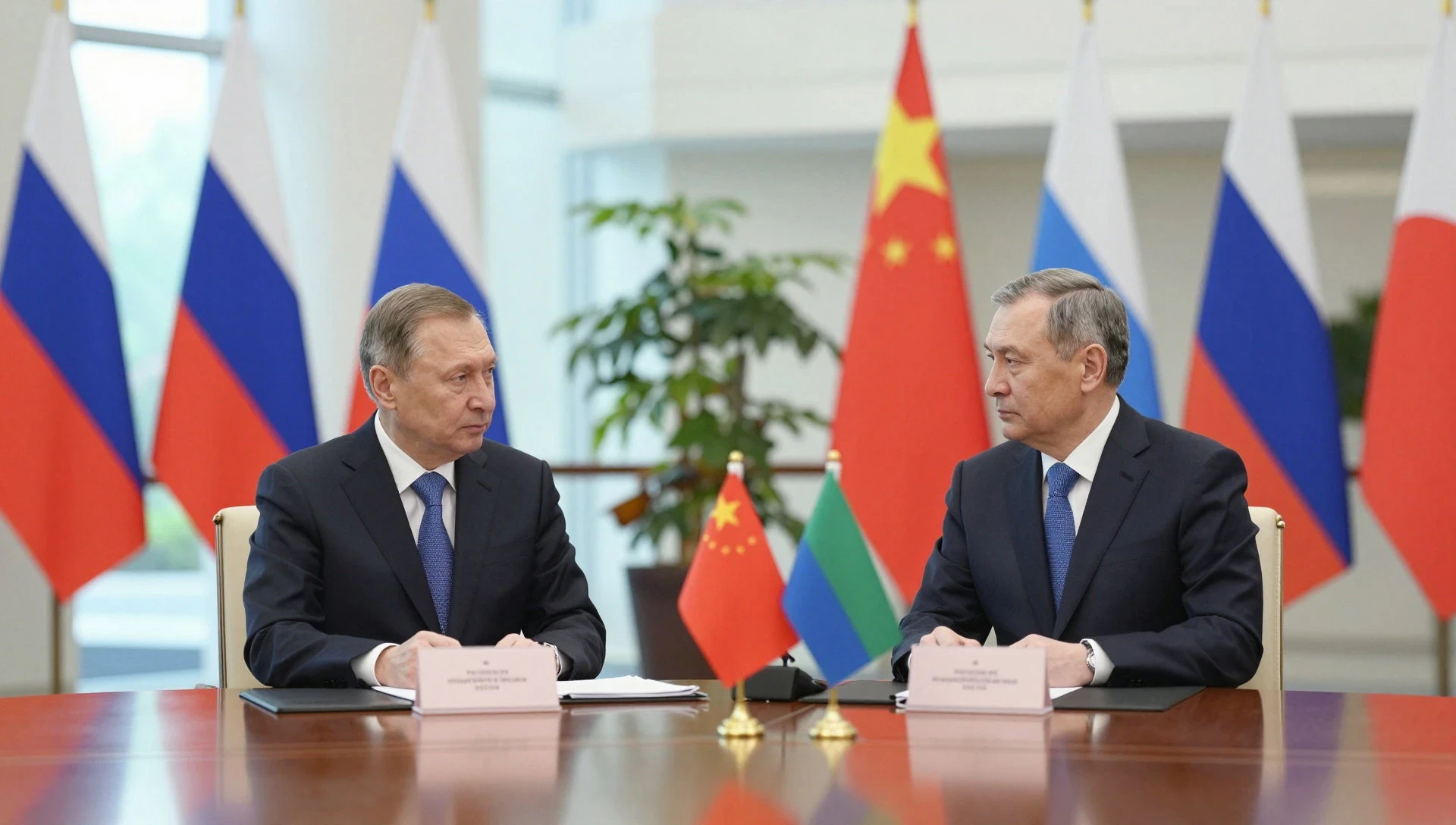
When Sergey Lavrov and Toshimitsu Motegi sat down on the sidelines of the G20 Foreign Ministers' Meeting in Atlanta, the encounter carried more diplomatic weight than its brief billing suggested.
It marked the first full-scale, in-person talks between the Russian and Japanese foreign ministers in five years, a gap that spans a period of acute geopolitical rupture. The previous substantive face-to-face negotiations occurred at the UN General Assembly in New York in September 2021, before the war in Ukraine reshaped almost every bilateral relationship Moscow maintains.
The meeting matters because it reopens a channel that had effectively frozen. Tokyo joined Western sanctions against Russia after February 2022, and Moscow retaliated by suspending the long-running negotiations over the disputed Kuril Islands and by designating Japan as an unfriendly state.
On This Page
Against that backdrop, a structured ministerial conversation in a multilateral setting signals a modest but measurable recalibration rather than a breakthrough. Diplomacy, in this reading, is being kept alive at low intensity while the strategic fundamentals remain unresolved.
The choice of Atlanta as the venue adds a further layer of significance. A G20 gathering on American soil provides a neutral, multilateral frame that allows adversaries to meet without the political cost of a bilateral visit.
This analysis examines what the Lavrov–Motegi encounter reveals about the state of Russia–Japan relations, the mechanics of sideline diplomacy, and the wider signals such meetings send to markets, allies, and regional security planners across Northeast Asia.
TL;DR Russian Foreign Minister Sergey Lavrov and Japanese Foreign Minister Toshimitsu Motegi met on the sidelines of the G20 Foreign Ministers' Meeting in Atlanta, their first full-scale in-person talks in five years. The prior substantive meeting took place at the UN General Assembly in New York in September 2021. The encounter signals a cautious reopening of a frozen diplomatic channel rather than a resolution of core disputes, chiefly the Kuril Islands question and Japan's sanctions alignment with the West.
The Diplomatic Context Behind the Atlanta Meeting
The Atlanta meeting did not emerge from a vacuum. It followed years in which Russia–Japan relations deteriorated sharply, driven by sanctions, the suspension of peace treaty talks, and reciprocal diplomatic expulsions.
Understanding why two foreign ministers would choose a G20 sideline for their first substantive contact in five years requires attention to the structural pressures shaping both capitals.
Why Five Years of Silence Mattered
The five-year gap is the single most revealing data point in the source report. Between September 2021 and the Atlanta encounter, the bilateral relationship passed through its most severe deterioration since the Cold War, with formal peace treaty negotiations suspended indefinitely by Moscow in March 2022.
A five-year interval between ministerial talks places Russia–Japan diplomacy in a category usually reserved for adversarial or suspended relationships.
That silence had concrete costs. Consular access, fisheries arrangements around the disputed islands, and energy cooperation on Sakhalin projects all became harder to manage without a functioning political channel.
When ministers stop talking, technical and commercial disputes lose their political safety valve, and small frictions accumulate into structural hostility that outlasts the original trigger.
The resumption therefore carries procedural value independent of outcomes. Simply restoring a ministerial line creates a mechanism for managing incidents, clarifying intentions, and preventing miscalculation. In security terms, the reopening of a communication channel between two states with overlapping maritime claims and adjacent air defense zones is a stabilizing measure, even when substantive agreement remains distant.
The G20 as a Neutral Diplomatic Frame
Multilateral summits function as diplomatic infrastructure. They concentrate heads of delegation in one location, provide protocol cover for unscheduled bilateral contacts, and allow meetings to be framed as routine rather than as concessions.
The G20 Foreign Ministers' Meeting in Atlanta offered precisely this cover for a Lavrov–Motegi conversation that neither side could easily host bilaterally.
For Moscow, the venue matters because it demonstrates continued access to major multilateral forums despite Western isolation efforts. For Tokyo, the setting allows engagement without the domestic political cost of a formal bilateral visit to Russia.
Both governments can present the meeting as a byproduct of multilateral participation rather than a deliberate bilateral overture, preserving flexibility on either side.
The Atlanta location adds an American dimension. Holding a G20 ministerial on US soil while Russian and Japanese diplomats meet on the margins illustrates how multilateral architecture continues to function even amid sharp bilateral ruptures.
The frame is neutral; the participants are not, and every sideline conversation is read by allies as a signal about alignment and intent.
Reading the Signals From Both Capitals
Tokyo's calculus centers on regional security. Japan has deepened defense cooperation with the United States and partners in Europe, and any direct engagement with Moscow must be calibrated against that alliance framework. A ministerial meeting allows Tokyo to test Russian intentions on the Northern Territories without appearing to soften its sanctions posture.
Moscow's calculus is broader. Sustaining dialogue with a G7 member demonstrates that isolation is incomplete and that Russia retains diplomatic reach across multiple regions. The Kremlin has consistently used multilateral forums to project normalcy, and a meeting with Japan's foreign minister serves that narrative at minimal cost while keeping a channel open for future leverage.
Both readings can be true simultaneously. Diplomatic meetings often serve multiple audiences, and the Atlanta encounter likely did. The absence of a joint statement or announced deliverables suggests the conversation was exploratory, focused on establishing contact and testing whether further engagement is feasible under current conditions.
Core Disputes and the Limits of a Single Meeting
A single ministerial meeting cannot resolve the structural disputes that define Russia–Japan relations. The Kuril Islands sovereignty question, the absence of a formal peace treaty ending World War II hostilities, and Japan's alignment with Western sanctions all remain intact.
What the Atlanta meeting can do is establish whether those disputes are manageable through dialogue or remain frozen.
The Kuril Islands and the Peace Treaty Impasse
The territorial dispute over the islands known in Japan as the Northern Territories has blocked a peace treaty since 1945. Moscow suspended negotiations in 2022, and any resumption would require a political decision at the presidential level, far beyond the scope of a foreign ministers' sideline meeting.
Yet the issue cannot be ignored indefinitely. Fisheries agreements, humanitarian visits to the islands, and maritime boundary management all depend on some level of political contact. A ministerial channel provides the minimum mechanism for handling these practical matters without requiring either side to concede on sovereignty, which remains the central obstacle.
The historical pattern offers limited optimism. Repeated rounds of talks over decades produced no treaty, and the 2022 suspension reversed whatever incremental progress had been made. The realistic function of renewed contact is crisis management and incremental confidence building, not settlement of a dispute that has resisted resolution for eighty years.
Sanctions, Alignment, and Alliance Pressure
Japan's sanctions alignment with the G7 constrains what Tokyo can offer Moscow. Any easing would require coordination with Washington and European partners, and domestic politics in Japan strongly favor maintaining pressure on Russia. This limits the meeting's practical yield to procedural and humanitarian matters rather than economic normalization.
For Moscow, the sanctions regime is a structural condition rather than a negotiating variable. Russian officials have consistently framed sanctions as illegal and unilateral, and they are unlikely to offer concessions to secure their removal.
The meeting therefore proceeds within fixed parameters, with both sides aware that the economic relationship remains severely constrained.
Alliance dynamics add complexity. Japan's security posture has shifted markedly since 2022, with higher defense spending and closer trilateral coordination with the United States and South Korea. Moscow watches these developments closely, and any dialogue with Tokyo is partly an intelligence-gathering exercise about Japan's evolving strategic trajectory.
What a Sideline Meeting Can and Cannot Deliver
Sideline meetings are best understood as procedural instruments. They establish contact, clarify positions, and create the possibility of follow-up without committing either side to outcomes. Their value lies in reducing the risk of miscalculation and in signaling intent to domestic and international audiences, not in producing signed agreements.
What they cannot do is substitute for sustained negotiation. The Kuril dispute and the peace treaty require leadership-level decisions and a favorable strategic environment, neither of which exists today. Expectations should therefore be calibrated to the modest but real achievement of restoring a channel that had been closed for five years.
The follow-up question is whether the Atlanta contact produces further meetings. A pattern of regular ministerial engagement would indicate genuine stabilization; a single encounter followed by renewed silence would suggest the meeting was tactical rather than strategic. Observers should watch for subsequent contacts at lower levels as the more reliable indicator.
We Also Published
Strategic Implications for Northeast Asia and Global Diplomacy
The Lavrov–Motegi meeting sits within a wider pattern of diplomatic activity across Northeast Asia. Russia, Japan, China, and the Korean peninsula states are all adjusting to a security environment shaped by the Ukraine war, alliance expansion, and intensifying technological competition. A reopened Russia–Japan channel alters the regional diplomatic geometry, even if only marginally.
Regional Security and Alliance Signaling
Japan's engagement with Moscow will be scrutinized in Washington, Seoul, and Beijing. Allies will want assurance that dialogue does not imply softening on sanctions or territorial principles, while adversaries will look for signs of division within the G7. Tokyo's handling of the follow-up will therefore be as important as the meeting itself.
For Russia, the meeting demonstrates that its diplomatic isolation is not absolute. Sustaining contacts with G7 members supports the Kremlin's broader narrative that multilateral engagement continues despite sanctions. This is primarily a signaling exercise, but signaling matters in international politics because it shapes how other states calculate alignment and risk.
Regional security planners will read the encounter through the lens of communication channels. Maintaining ministerial contact between states with overlapping maritime claims and adjacent air defense zones reduces the probability of inadvertent escalation. In that narrow but important sense, the Atlanta meeting contributes to stability in Northeast Asia.
Economic and Energy Dimensions
Energy cooperation remains a latent issue. Japanese companies hold stakes in Russian liquefied natural gas projects, and the sanctions framework has complicated but not eliminated these commercial ties. Any thaw, however modest, would be watched closely by energy markets and by Japan's industrial consumers who depend on stable LNG supply.
Broader trade and investment flows remain severely constrained. The economic relationship cannot normalize while sanctions remain in place, and sanctions will remain while the Ukraine conflict persists. The meeting therefore has limited immediate economic significance, though it preserves the possibility of future commercial engagement should political conditions change.
Financial markets typically price geopolitical signals with a lag. A single ministerial meeting is unlikely to move energy or currency markets, but a sustained pattern of Russia–Japan engagement would be read as a modest de-escalation signal in Asian markets. Traders should treat the Atlanta encounter as a data point rather than a trend.
- 01
- 02
- 03
- 04
Precedents and Comparative Cases
History offers instructive parallels. During the Cold War, ministerial contacts between adversarial states often continued through multilateral forums even when bilateral relations were frozen. These channels served as early-warning mechanisms and, in some cases, as precursors to later detente. The Atlanta meeting fits this established pattern of maintaining minimal contact.
Comparisons with other frozen relationships sharpen the analysis. Russia–NATO contacts through the NATO–Russia Council continued intermittently before 2022, and US–Russia diplomatic channels have persisted through the Ukraine war at reduced intensity. In each case, the existence of a channel has been valued primarily for crisis management rather than for conflict resolution.
The lesson is that diplomatic channels are infrastructure, not outcomes. They require maintenance, they produce value only when used, and they can be closed abruptly by political decisions. The Lavrov–Motegi meeting restored a piece of infrastructure; whether it is used depends on decisions in Moscow, Tokyo, and their respective capitals of alliance.
What to Watch Next
Several indicators will reveal whether the Atlanta meeting represents genuine stabilization or a tactical encounter. The most important is follow-up: whether lower-level consultations resume, whether consular and fisheries issues are addressed, and whether further ministerial contacts occur within a defined timeframe. Silence after Atlanta would suggest the meeting was symbolic.
A second indicator is the tone of official statements. Carefully neutral language emphasizing dialogue would signal openness to continued engagement, while hardened rhetoric would suggest the meeting was a one-off. Third-party reactions, particularly from Washington and Beijing, will also shape the space available for further Russia–Japan contacts.
The broader lesson concerns the resilience of multilateral diplomacy. Even amid severe bilateral ruptures, forums like the G20 continue to provide venues where adversaries can meet, talk, and maintain minimal channels.
That resilience is a feature of the international system worth preserving, because it reduces the risk that frozen relationships become permanently hostile ones.
From our network :
- CISA’s Ten-Advisory Wave: Why Generic Patching Fails in OT and How to Build Product-Specific PlaybooksCISA released ten ICS advisories in one week, exposing critical infrastructure risks. Generic patching fails in OT. Learn to build product-specific remediation playbooks.
- Forbidden Matrix Patterns and Visible Lattice Points: A Geometric DictionaryExplore how multidimensional 0–1 matrices encode geometric truths, linking forbidden patterns to visible lattice points and hypergraph theory, with applications in combinatorics and computational geometry.
- University Language Proficiency Exams: Why Institutional Tests Demand Different Preparation Than IELTS and TOEFLDiscover why university-specific language proficiency examinations differ fundamentally from IELTS and TOEFL, and learn strategic preparation approaches for institutional assessment success.
- Mobile Learning and VR in English: What Global Evidence Reveals About Effective Language TechnologyA systematic review across 14 countries reveals which language-learning technologies genuinely work. Mobile learning, AI, and VR show measurable benefits when pedagogically integrated. This evidence-based guide helps educators and learners select technology that delivers real return on investment.
- The Hidden Cost of AI Convenience: Why Over-Permissioned Agents Are a Security Time BombDiscover why AI agents with excessive permissions create dangerous single points of failure, and learn how implementing least privilege principles can protect your organization from exploitation.
- How AI Agents Will Change the Way We Manage Personal FinancesExplore how AI agents are transforming personal finance through automated budgeting, bill payment, and investment management, while examining the critical security protocols and governance frameworks required for safe deployment.
- Committed Mediterranean Precipitation Decline: Why Emissions Cuts Alone Cannot Restore Winter RainsNew NOAA research reveals that Mediterranean winter rains may decline irreversibly even with emissions cuts. Explore the science of committed climate change and regional impacts.
- Live Online English Classes for Kids: Do They Actually Reduce Anxiety?A ten-week study reveals that synchronous online English classes can significantly reduce child language anxiety while improving listening and reading skills. Discover what makes these programs effective and how parents can select the right one.
- The Final Descent: How ESA Retired the Legendary Cluster Constellation After 24 Years of Space Weather ScienceAfter 24 years mapping Earth’s magnetosphere, ESA’s Cluster mission concluded with a precisely controlled reentry over the South Pacific. This analysis explores the scientific legacy, engineering decisions, and debris mitigation principles behind one of space exploration’s most responsible retirements.
RESOURCES
- G20 foreign ministers end Atlanta meeting without consensus on key ...pbs.org2 days ago ... European diplomats objected to the inclusion of Russian Foreign Minister Sergey Lavrov and threatened to boycott or walk out of…
- Japan demands release of national in meeting with Russia's Lavrovreuters.com2 days ago ... Japanese Foreign Minister Toshimitsu Motegi met Russian Foreign Minister Sergei Lavrov on the sidelines of a G20 meeting in Atlanta…
- G20 foreign ministers in Atlanta meeting head to an ending ... - PBSpbs.org2 days ago ... Japan's Foreign Minister Toshimitsu Motegi, India's External ... Russia's war with Ukraine, overshadowed the start of the Atlanta meeting.
- Consensus looks elusive as G20 diplomats meet in Atlanta | AP Newsapnews.com2 days ago ... ... G20 Foreign Ministers Meeting in Atlanta, Friday, Oct. 30, 2026 ... Russia's Foreign Minister Sergei Lavrov, Saudi Arabia's Foreign…
- News - The Ministry of Foreign Affairs of the Russian Federationmid.ruPress release on the outcomes of the G20 Foreign Ministers' Meeting in Atlanta, October 30-31, 2026. 31 October 2026 00:41 photo. Foreign Minister Sergey ...
- On October 30, in Atlanta (Georgia, USA), Russia's Foreign Minister ...facebook.com3 days ago ... ✓On November 22-23, Foreign Minister Sergey #Lavrov took part in the regular #G20 Foreign Ministers' Meeting in Nagoya, #Japan. ✓The…
- Secretary Rubio's Travel to Atlanta to Host the G20 Foreign Ministers ...state.govSecretary Marco Rubio departs Joint Base Andrews in Camp Springs, Maryland for the G20 Foreign Ministers' meeting in Atlanta, Georgia, October 29, 2026.
- G20 foreign ministers end Atlanta meeting without consensus on key ...amp.scmp.com2 days ago ... Among these meetings was one between Japanese Foreign Minister Toshimitsu Motegi and Russia's Lavrov. “Concerning the international ...
- United States-Japan-Republic of Korea (ROK) Trilateral Foreign ...state.gov2 days ago ... United States-Japan-Republic of Korea (ROK) Trilateral Foreign Ministers' Meeting ... G20 in Atlanta to review progress across the ...
- G20 Foreign Ministers - G20 Research Group - University of Torontog20.utoronto.caOctober 30-31, 2026: G20 foreign ministers' meeting, Atlanta, Georgia ... 2019: November 22-23, Nagoya, Aichi Prefecture, Japan: Foreign ministers; 2018: May ...
- Home | G20 Miami 2026g20.orgFlag of Japan. Mexico. Flag of Mexico. Poland. Flag of Poland. Russia. Flag of ... Media Logistics for the G20 Foreign Ministers' Meeting in…
- Foreign Minister Sergey Lavrov's remarks and answers to media ...mid.ru... The Ministry of Foreign Affairs of the Russian Federation MFA Russia ... G20 Foreign Ministers' Meeting, Atlanta, October 30, 2026. 1774-31-10-2026.
- Embassy of the Russian Federationwashington.mid.ruMID Russia. All news. 31.10.2026. Press release on the outcomes of the G20 Foreign Ministers' Meeting in Atlanta, October 30-31, 2026. 31.10.2026. Foreign ...
- Exchange of Views between Japanese Foreign Minister and U.S. ...mofa.go.jp2 days ago ... MOTEGI Toshimitsu, Minister for Foreign Affairs of Japan, who is visiting Atlanta, the United States, to attend the G20 Foreign…
- G20 'family photo' cancelled after protests over presence of Russian ...bbc.com2 days ago ... ... Foreign Ministers' Meeting ... Reuters. UK Foreign Secretary Ed Miliband confronted Russia's Foreign Minister Sergei Lavrov at the G20…
- 01
- 02
- 03
- 04
- 05
- 06
- 07
- 08
0 Comments