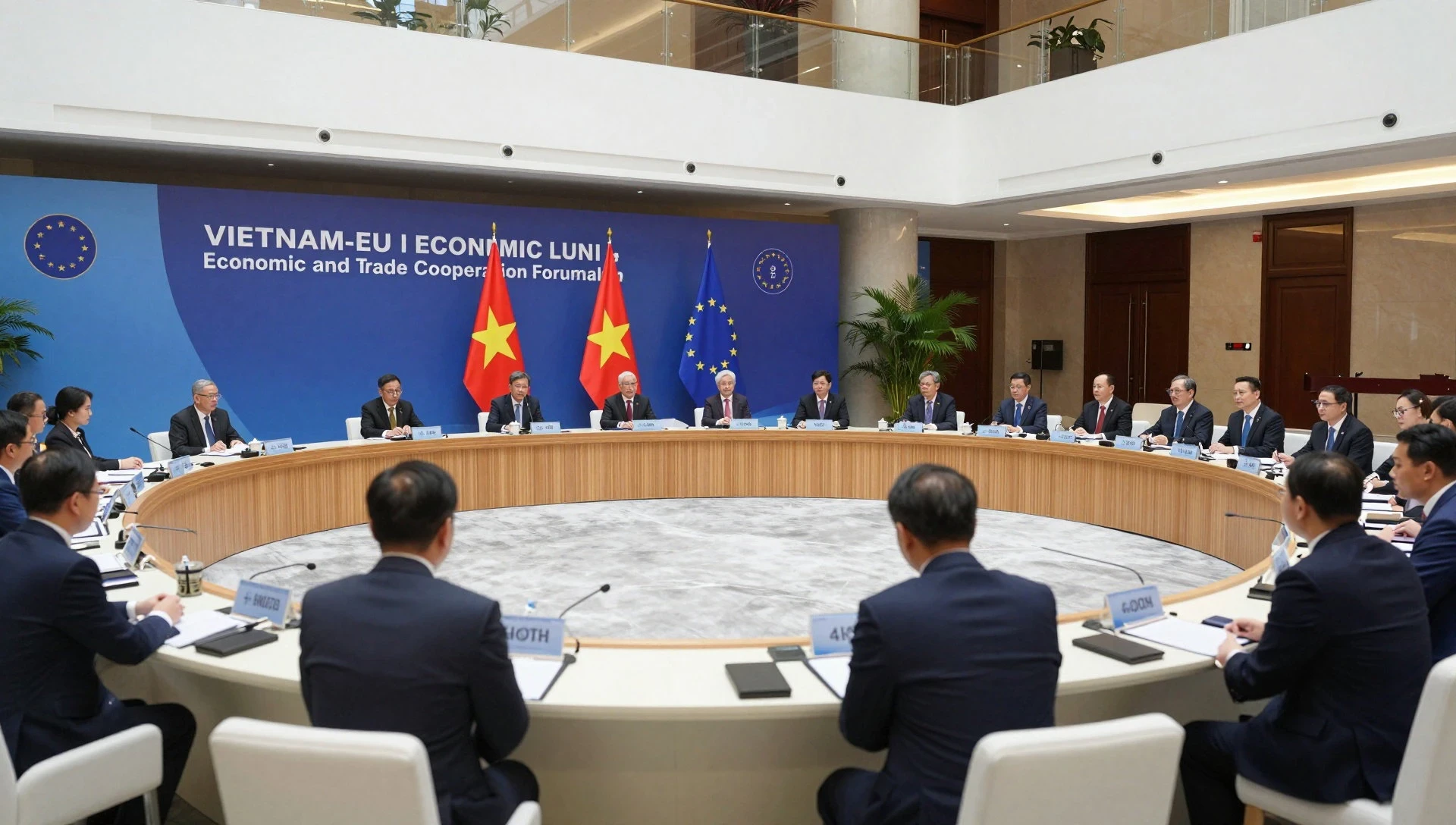
Vietnam and the European Union are preparing to convene a high-level economic and trade forum in Hanoi on the afternoon of November 4, 2026, an event formally titled "Shaping the Future Green Economy and New Value Chains."
The gathering arrives at a genuinely pivotal moment, because 2026 marks the opening of a new chapter in bilateral relations after both sides elevated their ties to a Comprehensive Strategic Partnership. That upgraded status is not merely ceremonial; it supplies the political foundation for widening cooperation across trade, investment, and industrial policy.
The forum is being organized by Vietnam's Ministry of Industry and Trade alongside the EU Delegation to Vietnam, the EU–ASEAN Business Council, and the European Chamber of Commerce in Vietnam.
On This Page
- The Strategic Context Behind the Hanoi Forum
- Decoding the Forum's Core Themes and Participants
- The EVFTA as a Living Instrument
- Supply Chain Restructuring and the New Value Chains
- Challenges, Risks, and the Compliance Imperative
- What the Forum Means for Businesses and Investors
- Conclusion: From Dialogue to Durable Partnership
More than six years after the EU–Vietnam Free Trade Agreement entered into force, commercial flows between the two partners have continued to expand steadily. Yet the ministry is candid that businesses now face mounting pressure to sharpen competitiveness and adapt quickly as international markets shift beneath them.
This analysis examines what the Hanoi forum signals about the direction of Vietnam–EU economic relations, why green growth and supply chain restructuring dominate the agenda, and how the EVFTA is being leveraged to convert diplomatic goodwill into tangible commercial outcomes.
It also weighs the practical opportunities and structural challenges facing Vietnamese suppliers as they seek deeper integration into European value chains.
TL;DR Vietnam and the EU will hold the 2026 Vietnam–EU Economic and Trade Cooperation Forum in Hanoi on November 4, organized by the Ministry of Industry and Trade with the EU Delegation, EU-ABC, and EuroCham. The event follows the upgrade of bilateral ties to a Comprehensive Strategic Partnership and builds on more than six years of EVFTA-driven trade growth. Discussions will center on green industry, energy transition, logistics, green finance, trade facilitation, and new value chains, with a high-level European business delegation visiting Vietnam to forge concrete partnerships and help local firms enter regional and global supply chains.
The Strategic Context Behind the Hanoi Forum
The Hanoi forum does not emerge from a vacuum; it reflects a deliberate recalibration of Vietnam's external economic strategy. By upgrading relations with the EU to a Comprehensive Strategic Partnership, Hanoi has signaled that Europe ranks among its most consequential partners for capital, technology, and market access. The forum therefore functions as the first major commercial showcase of that elevated relationship.
From EVFTA to Comprehensive Strategic Partnership
When the EVFTA took effect in August 2020, it was widely celebrated as one of the most ambitious trade agreements the EU had concluded with a developing economy. Tariff elimination schedules, services liberalization, and commitments on sustainable development gave Vietnamese exporters unprecedented access to European consumers. More than six years on, the agreement's incremental benefits are compounding rather than plateauing.
The Comprehensive Strategic Partnership adds a political superstructure atop that commercial foundation. It enables structured dialogue on industrial policy, regulatory alignment, and investment protection that a trade agreement alone could not deliver.
For European firms, this signals predictability; for Vietnamese agencies, it creates a formal channel to lobby for market access and technical support.
Why Green Growth Dominates the Agenda
Europe's regulatory environment has become the single most powerful force shaping global supply chains, and Vietnam recognizes that access to the EU market now depends on environmental performance. The Carbon Border Adjustment Mechanism, corporate sustainability due diligence rules, and tightening product standards all impose new compliance burdens on exporters. The forum's green economy framing is a direct response to this reality.
Vietnam's own commitments under its net-zero 2050 pledge and Power Development Plan VIII create domestic momentum for renewable energy, grid modernization, and industrial decarbonization. European capital and expertise in offshore wind, green hydrogen, and energy efficiency are precisely what Vietnam requires to meet those targets. The forum positions green industry as the connective tissue between European technology and Vietnamese manufacturing ambition.
Decoding the Forum's Core Themes and Participants
The forum's stated purpose is to strengthen policy dialogue and promote economic, trade, and investment cooperation between Vietnam and Europe. Its convening power is considerable: ministry leaders, government agency representatives, diplomatic missions, international organizations, local authorities, and business communities from both sides will attend.
A high-level European business delegation organized by EU-ABC and EuroCham will visit Vietnam in connection with the event.
Green Industry, Energy Transition, and Logistics
Participants will discuss sectors identified as having strong cooperation potential, with green industry and energy transition at the forefront. Vietnam's renewable energy ambitions require European turbines, grid technology, and project finance, while European firms seek reliable manufacturing partners with credible decarbonization pathways.
Logistics features prominently because port efficiency, cold chain capacity, and digital customs systems determine whether Vietnamese goods reach European shelves competitively.
Green finance rounds out the industrial agenda, reflecting the reality that sustainability transitions are capital-intensive. European development banks and private investors can supply long-tenor financing that domestic institutions struggle to match.
Trade facilitation measures, including paperless documentation and mutual recognition of standards, are equally vital to reducing the friction costs that erode EVFTA benefits.
Supplier Capacity and Technology Transfer
A recurring theme in Vietnam–EU commercial dialogue is the gap between foreign-invested enterprises and domestic suppliers. The forum explicitly addresses improving the capacity of domestic suppliers so that Vietnamese firms can capture more value within global production networks. Technology transfer, quality certification support, and mentorship from European buyers are the practical instruments under discussion.
Attracting high-quality investment is the complementary objective. Vietnam wants capital that brings skills, R&D capability, and environmental responsibility rather than low-value assembly operations. European companies, for their part, want assurance that Vietnamese partners meet labor, environmental, and governance standards that European consumers and regulators increasingly demand.
The EVFTA as a Living Instrument
Six years of EVFTA implementation have produced a body of evidence that both sides now seek to exploit more effectively. The agreement eliminated tariffs on the overwhelming majority of goods, opened services markets, and established dispute settlement and sustainability chapters.
Yet utilization rates among Vietnamese small and medium enterprises remain uneven, and the forum aims to close that gap.
Trade Performance and Untapped Potential
Bilateral trade has grown consistently since 2020, with Vietnam maintaining a substantial surplus driven by electronics, footwear, textiles, and agricultural products. European exports to Vietnam, by contrast, have grown more slowly, a asymmetry that Brussels would like to correct.
The forum provides a venue to discuss regulatory barriers, certification costs, and distribution bottlenecks that constrain European sales.
Rules of origin compliance is a persistent technical challenge. Vietnamese exporters must document sourcing carefully to claim preferential tariffs, and cumulation provisions allow European inputs to count toward origin. Simplifying this architecture, and digitizing the documentation, would raise utilization rates and deepen the commercial relationship.
Turning Dialogue into Deals
The ministry's stated ambition is to convert cooperation potential into concrete trade and investment opportunities. That requires more than communiqués; it demands matchmaking, follow-up mechanisms, and accountability. The presence of a high-level European business delegation suggests that companies are prepared to move beyond symbolism toward specific projects and supply agreements.
Local authorities will present their potential, strengths, and investment incentives, giving provinces a rare platform to attract European attention. By linking policy dialogue with the practical needs of businesses, the forum aspires to make the EVFTA a living instrument rather than a static legal text.
- 01
- 02
- 03
- 04
Supply Chain Restructuring and the New Value Chains
The phrase "new value chains" in the forum's title is more than rhetorical flourish; it captures a structural transformation underway in global manufacturing. European companies are actively diversifying production away from single-country dependence, and Vietnam has emerged as a principal beneficiary of that de-risking. The forum seeks to formalize and deepen this repositioning.
Vietnam's Position in Regional Production Networks
Vietnam's network of free trade agreements, competitive labor costs, and proximity to East Asian component suppliers make it an attractive assembly and export platform. Electronics, textiles, and footwear have led the way, but higher-value segments such as semiconductor packaging and precision engineering are emerging. European firms want reliable partners capable of meeting quality and sustainability benchmarks.
The China-plus-one strategy has accelerated foreign investment into northern industrial clusters, yet infrastructure and skills constraints limit how quickly capacity can scale. The forum's emphasis on supplier capacity building acknowledges that Vietnam must upgrade its domestic industrial base to capture more of the value it helps create.
Local Authorities and Investment Incentives
Provincial governments will use the forum to showcase industrial parks, tax incentives, and land availability to European investors. Competition among provinces for foreign direct investment is intense, and the event gives local leaders direct access to decision-makers they rarely encounter. Coherent incentive packages and streamlined approvals will determine which regions succeed.
For European companies, the appeal lies in predictability and infrastructure quality rather than incentives alone. Power reliability, port connectivity, and skilled labor availability weigh heavily in site selection. The forum allows both sides to discuss these practical determinants of investment location candidly.
Challenges, Risks, and the Compliance Imperative
Optimism about the forum's commercial potential must be tempered by an honest assessment of the obstacles. Vietnamese businesses face rising compliance costs as European sustainability regulations tighten, and many lack the technical capacity to meet new reporting and certification requirements. The ministry's acknowledgment of competitive pressure is a candid recognition of this reality.
Regulatory Burden and SME Readiness
European due diligence rules, deforestation regulations, and carbon border measures impose documentation and verification obligations that disproportionately burden smaller firms. Vietnamese SMEs often lack dedicated compliance staff and access to accredited testing facilities. Bridging this gap requires technical assistance, shared certification infrastructure, and clearer guidance from European authorities.
The forum's emphasis on trade facilitation and supplier capacity building responds to these concerns, but implementation will determine outcomes. Without sustained follow-through, the event risks producing declarations rather than durable capability improvements. Both governments must commit resources to training, digital tools, and institutional support.
Geopolitical and Macroeconomic Headwinds
Global economic uncertainty, fluctuating demand in Europe, and geopolitical tensions all shape the environment in which this partnership unfolds. European consumers facing cost-of-living pressures may reduce discretionary spending on Vietnamese goods, while currency volatility complicates pricing and investment planning. The forum cannot insulate either side from these forces.
Vietnam's balancing act among major powers adds complexity. Deepening European ties complements its broader diversification strategy, but it must manage relationships with other trading partners carefully. The Comprehensive Strategic Partnership with the EU is one pillar of a multi-directional foreign economic policy, not a substitute for it.
What the Forum Means for Businesses and Investors
For European companies, the Hanoi forum offers structured access to Vietnamese policymakers, provincial authorities, and potential local partners within a compressed timeframe. Firms in renewable energy, logistics, agribusiness, and industrial equipment stand to benefit most directly. The high-level delegation format signals seriousness and facilitates senior-level conversations that would otherwise take months to arrange.
Opportunities for Vietnamese Enterprises
Vietnamese firms gain a rare platform to present capabilities to European buyers and investors seeking alternatives to established suppliers. Participation in regional and global supply chains becomes more attainable when European partners can verify quality, sustainability, and delivery reliability firsthand. The forum's matchmaking dimension is therefore its most tangible commercial value.
Access to green finance and technology transfer could accelerate modernization for firms willing to invest in compliance and capability. The EVFTA's cumulation rules allow Vietnamese producers to incorporate European components and still qualify for preferential treatment, creating incentives for deeper bilateral industrial integration.
Practical Steps for Stakeholders
Businesses preparing for the forum should map their compliance readiness against European standards, identify certification gaps, and prepare credible sustainability narratives. Provincial authorities should assemble coherent investment packages with clear timelines and infrastructure commitments. European firms should identify specific partnership objectives rather than attending for general networking.
The forum's success will be measured in follow-up agreements, pilot projects, and measurable increases in trade and investment flows over the following years. Policy dialogue is necessary but insufficient; execution determines whether the Comprehensive Strategic Partnership delivers prosperity for both partners.
Conclusion: From Dialogue to Durable Partnership
The 2026 Vietnam–EU Economic and Trade Cooperation Forum represents a deliberate effort to translate diplomatic elevation into commercial substance. By convening government leaders, provincial authorities, and a high-level European business delegation around green economy and value chain themes, the event addresses the issues that will define the next decade of bilateral trade. Its success, however, depends on execution beyond the conference hall.
Vietnam's trajectory from low-cost assembler to higher-value manufacturing partner hinges on supplier upgrading, infrastructure investment, and regulatory compliance. Europe's interest in resilient, sustainable supply chains aligns with those ambitions, creating a genuine convergence of incentives.
The forum provides the platform; sustained institutional commitment will determine whether the partnership delivers on its considerable promise.
From our network :
- The Final Descent: How ESA Retired the Legendary Cluster Constellation After 24 Years of Space Weather ScienceAfter 24 years mapping Earth’s magnetosphere, ESA’s Cluster mission concluded with a precisely controlled reentry over the South Pacific. This analysis explores the scientific legacy, engineering decisions, and debris mitigation principles behind one of space exploration’s most responsible retirements.
- The Hidden Cost of AI Convenience: Why Over-Permissioned Agents Are a Security Time BombDiscover why AI agents with excessive permissions create dangerous single points of failure, and learn how implementing least privilege principles can protect your organization from exploitation.
- Forbidden Matrix Patterns and Visible Lattice Points: A Geometric DictionaryExplore how multidimensional 0–1 matrices encode geometric truths, linking forbidden patterns to visible lattice points and hypergraph theory, with applications in combinatorics and computational geometry.
- How AI Agents Will Change the Way We Manage Personal FinancesExplore how AI agents are transforming personal finance through automated budgeting, bill payment, and investment management, while examining the critical security protocols and governance frameworks required for safe deployment.
- University Language Proficiency Exams: Why Institutional Tests Demand Different Preparation Than IELTS and TOEFLDiscover why university-specific language proficiency examinations differ fundamentally from IELTS and TOEFL, and learn strategic preparation approaches for institutional assessment success.
- CISA’s Ten-Advisory Wave: Why Generic Patching Fails in OT and How to Build Product-Specific PlaybooksCISA released ten ICS advisories in one week, exposing critical infrastructure risks. Generic patching fails in OT. Learn to build product-specific remediation playbooks.
- Committed Mediterranean Precipitation Decline: Why Emissions Cuts Alone Cannot Restore Winter RainsNew NOAA research reveals that Mediterranean winter rains may decline irreversibly even with emissions cuts. Explore the science of committed climate change and regional impacts.
- Mobile Learning and VR in English: What Global Evidence Reveals About Effective Language TechnologyA systematic review across 14 countries reveals which language-learning technologies genuinely work. Mobile learning, AI, and VR show measurable benefits when pedagogically integrated. This evidence-based guide helps educators and learners select technology that delivers real return on investment.
- Live Online English Classes for Kids: Do They Actually Reduce Anxiety?A ten-week study reveals that synchronous online English classes can significantly reduce child language anxiety while improving listening and reading skills. Discover what makes these programs effective and how parents can select the right one.
RESOURCES
- Resources will be updated soon.
- 01
- 02
- 03
- 04
- 05
- 06
- 07
- 08
0 Comments