The Federal Bureau of Investigation's inquiry into a suspected intrusion of the National Crime Information Center lands at an uncomfortable intersection of criminal justice and digital resilience. The NCIC is not an ordinary government database; it is the connective tissue that lets patrol officers in one jurisdiction instantly learn whether a vehicle is stolen, a warrant is outstanding, or a person is flagged as dangerous. When the integrity of such a system is questioned, the anxiety travels far beyond a single server room, reaching every traffic stop, every bail hearing, and every investigation that depends on trustworthy records.
The timing sharpens the concern. The reported investigation follows a cluster of disruptions across aviation, banking, and communications, each of which exposed how much routine life leans on fragile technical scaffolding. Officials have stressed that no evidence yet links these events, and several outages have been attributed to ordinary technical failures rather than hostile action. That distinction matters enormously, because the difference between a misconfigured router and a determined adversary is the difference between inconvenience and a national security incident. Still, the coincidence has invited scrutiny of whether America's digital infrastructure is prepared for sustained pressure.
Security expert Cynthia Kaiser has framed the NCIC question around consequences rather than speculation, pointing to the theft or alteration of sensitive police records and the downstream effects on criminal investigations and public safety. Her emphasis is instructive. A breach of a crime database is not measured only in stolen rows; it is measured in cases that collapse, in officers who act on poisoned information, and in the erosion of the mutual trust that lets thousands of agencies share data. This analysis examines what the episode reveals about database security, institutional preparedness, and the accountability structures that govern law enforcement information.
On This Page
TL;DR The FBI is investigating a suspected breach of the National Crime Information Center, the shared database that underpins law enforcement queries nationwide. The inquiry arrives amid unrelated disruptions in aviation, banking, and communications, and no link between the incidents has been established. Expert commentary from Cynthia Kaiser centers on the theft or alteration of police records and the resulting risks to investigations and public safety. The episode raises durable questions about database integrity, interagency trust, and whether US digital infrastructure is prepared for coordinated or opportunistic attacks.
The Architecture of a National Crime Database
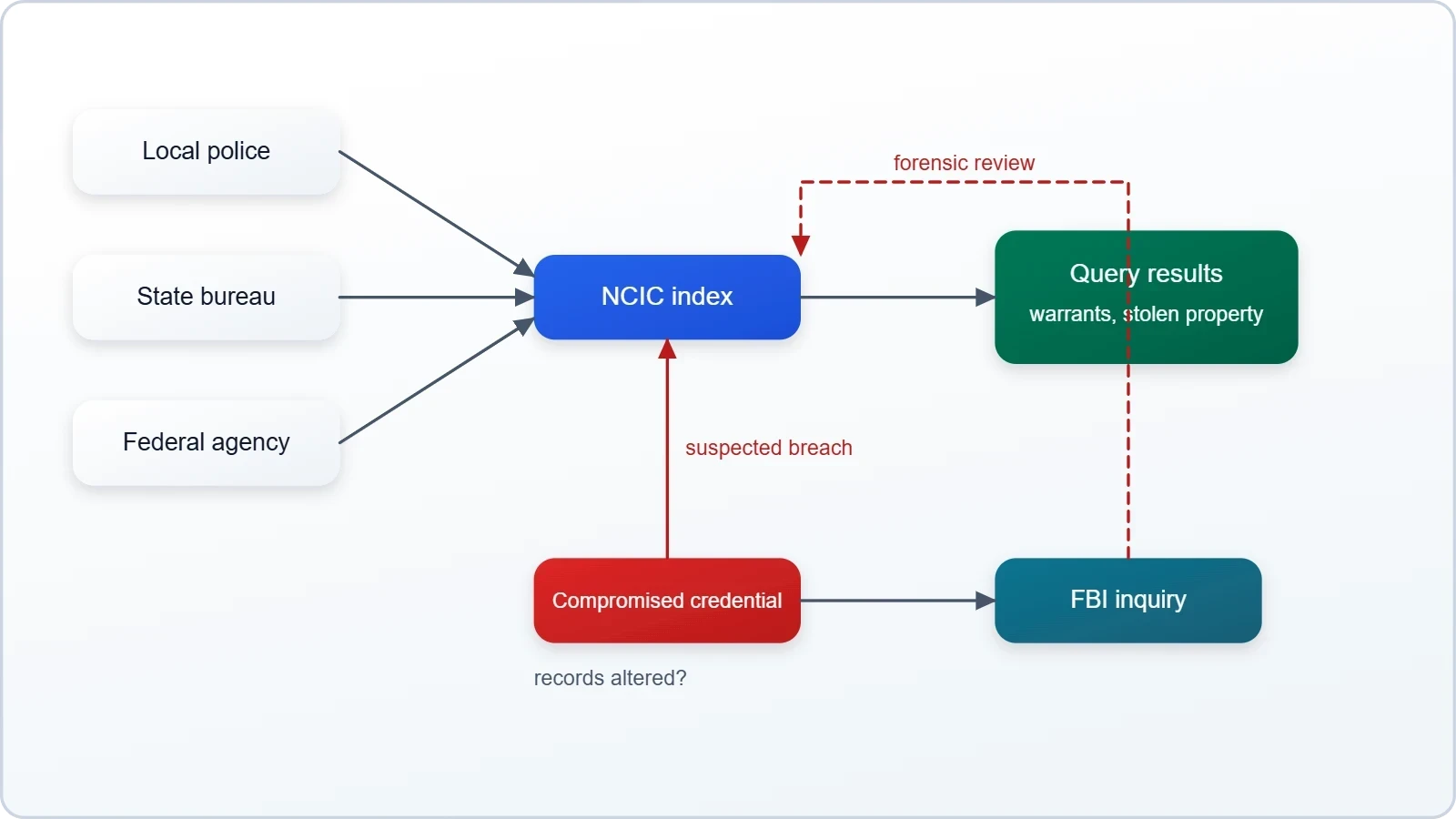
The National Crime Information Center functions as a federated nervous system rather than a single monolithic store. It connects local police departments, sheriff's offices, state bureaus, federal agencies, and tribal authorities into one queryable index of warrants, stolen property, missing persons, and protective alerts. A patrol officer typing a license plate into a cruiser terminal is, in effect, reaching into a shared national ledger maintained under strict access rules. That design delivers extraordinary operational speed, but it also concentrates risk: compromise at any trusted node can propagate suspicion through the entire network.
Understanding the stakes requires appreciating how many decisions rest on a single query. A traffic stop can escalate or de-escalate based on a warrant flag. A pawn shop transaction can be cleared or flagged as trafficking based on a stolen-property record. A missing child alert can mobilize resources across state lines within minutes. When analysts speak about database integrity, they are describing the reliability of thousands of small, high-consequence judgments made daily by people who have neither the time nor the training to second-guess the record in front of them.
How Records Enter and Move Through the System
Records enter the NCIC ecosystem through contributing agencies, each of which retains responsibility for the accuracy and currency of what it submits. This distributed authorship is both a strength and a vulnerability. It allows local knowledge to flow upward quickly, but it also means that a compromised credential at one agency can inject false entries that appear authoritative everywhere else. Auditors have long warned that entry validation, periodic purging of stale warrants, and identity proofing for terminal operators are the practical bulwarks against exactly this scenario.
The movement of records also creates forensic complexity. When an entry is altered, investigators must reconstruct not only who changed it but when, from which terminal, and under whose credentials. Logging practices vary across agencies, and retention windows differ, so a breach discovered weeks after the fact may leave only partial evidence. Security professionals describe this as an attribution gap, and it is one reason why suspected intrusions into shared law enforcement systems are treated with such gravity even before confirmation of unauthorized access.
Why Federated Trust Is the Real Asset
The deepest asset in the NCIC model is not the hardware but the reciprocal trust among participating agencies. Departments share sensitive entries precisely because they believe the network is guarded and the records are authentic. A confirmed breach would not merely expose data; it would introduce doubt into every future query, encouraging officers to verify independently, delay action, or discount alerts altogether. That behavioral erosion is difficult to quantify and harder to repair, and it explains why officials treat even suspected intrusions as matters of institutional credibility rather than routine IT incidents.
Trust also shapes how agencies respond to incidents. A department that suspects its credentials were misused must decide whether to notify partners immediately, potentially exposing its own lapses, or to investigate quietly first. Transparency norms in this space remain uneven, and critics argue that delayed disclosure undermines the collective security the network depends on. The strongest federated systems pair technical controls with clear breach-notification obligations, so that trust is reinforced by predictable process rather than left to discretion.
Reading the Cluster of Infrastructure Disruptions
The suspected NCIC intrusion did not surface in isolation. It emerged against a backdrop of disruptions in aviation, banking, and communications that collectively unsettled public confidence. Each sector carries its own failure modes and its own regulators, yet the public experiences them as a single question: is the digital foundation holding? Officials have been careful to note that no evidence connects the incidents and that some outages trace to technical faults. That caution is appropriate, but it does not dissolve the underlying concern about systemic fragility.
Aviation disruptions ripple through crew scheduling and passenger trust; banking outages freeze payments and erode confidence in settlement systems; communications failures sever the channels emergency services rely upon. When these occur within a compressed window, the psychological effect compounds even absent coordination. Security analysts distinguish between correlation and causation precisely because adversaries sometimes exploit coincidental failures, and defenders sometimes mistake noise for signal. The disciplined response is to investigate each event on its merits while asking whether shared dependencies create common-mode risk.
Separating Technical Failure from Hostile Action
Attribution is among the most demanding tasks in cybersecurity, and premature conclusions carry real costs. A misconfigured update can mimic the signature of an intrusion, while a sophisticated adversary can disguise deliberate action as routine malfunction. Investigators therefore examine timing, tooling, persistence mechanisms, and the specificity of targets before assigning cause. In the current cluster, the public record supports only limited claims: disruptions occurred, some were technical, and a separate inquiry into the NCIC is underway. Anything beyond that is inference, and responsible analysis labels it as such.
The distinction matters for policy as well as for public understanding. If failures are predominantly technical, the remedy lies in engineering discipline, redundancy, and maintenance investment. If hostile action is involved, the remedy shifts toward deterrence, intelligence sharing, and hardened access controls. Most realistic scenarios blend both, which is why preparedness frameworks emphasize resilience rather than perfect prevention. The goal is to absorb shocks, isolate damage, and restore service quickly enough that adversaries gain little from disruption.
The Preparedness Question Behind the Headlines
The framing of the DW report, asking whether America is prepared amid tech failures, captures a legitimate policy debate. Preparedness is not a binary state but a spectrum spanning detection, response, recovery, and learning. Agencies may detect intrusions quickly yet struggle to coordinate disclosure; they may recover services rapidly yet fail to institutionalize lessons. Independent reviews of major incidents repeatedly find that organizational factors, unclear authority, and uneven training matter as much as technical controls. The NCIC inquiry will likely be judged on whether it produces durable improvements rather than a single reassuring statement.
Budget realities complicate the picture. Law enforcement technology competes with staffing, equipment, and community programs for limited funds, and cybersecurity investments rarely produce visible wins. Legislators and the public tend to reward response over prevention, which biases spending toward incident handling. Experts argue that sustained funding for identity management, logging infrastructure, and routine penetration testing yields disproportionate returns. The question is whether the current anxiety translates into appropriations or fades once headlines move on.
We Also Published
Consequences for Investigations and Public Safety
Cynthia Kaiser's emphasis on stolen or altered police records directs attention to the operational core of the problem. Stolen records expose informants, undercover identities, victims, and witnesses to retaliation, and they can compromise cases built over months. Altered records are arguably worse, because they weaponize the system's own authority. A fabricated warrant can send armed officers to the wrong door; a deleted protective order can leave a domestic violence survivor without the shield the law promised. These are not abstract data harms but direct threats to physical safety.
The investigative consequences compound over time. Defense attorneys who learn of record tampering can challenge the integrity of entire case files, and prosecutors may be forced to dismiss charges rather than rely on tainted evidence. Cold cases that depend on historical entries become unreliable. Public defenders and civil liberties advocates have long warned that error and manipulation in criminal databases produce wrongful arrests, and a confirmed breach would amplify those warnings into a systemic credibility problem that courts would have to address.
Operational Effects on Frontline Policing
For officers on the street, a compromised database introduces hesitation at precisely the wrong moment. Split-second decisions about whether to approach a vehicle or draw a weapon rest on the assumption that a warrant flag is accurate. If that assumption weakens, officers may adopt more cautious or more aggressive postures, each carrying its own risks. Supervisors must then weigh the cost of delayed action against the danger of acting on false information, a trade-off that consumes time and attention during already stressful encounters.
Departments also face practical burdens after a suspected breach. Credentials must be rotated, terminals audited, and entries re-verified, often with limited staff. Smaller agencies with thin IT support may struggle to complete these tasks promptly, leaving gaps that persist for weeks. Mutual aid arrangements and regional fusion centers can absorb some of the load, but coordination costs rise. The cumulative effect is a temporary degradation of the information advantage that modern policing treats as routine.
Civil Liberties and the Accountability Question
Civil liberties organizations have consistently argued that criminal databases concentrate power without commensurate transparency. Individuals often cannot easily inspect or correct their own records, and error-correction processes vary widely across jurisdictions. A breach intensifies these concerns, because affected persons may never learn that their data was exposed or altered. Advocates call for notification requirements, independent audits, and clearer avenues for redress, arguing that accountability is not an obstacle to security but a condition of legitimate security.
Accountability also concerns the agencies themselves. When a breach is suspected, the public deserves a clear account of what happened, what data was affected, and what remedies are available. Vague reassurances erode confidence, while excessive disclosure can compromise investigations. The balance is delicate, and it is best struck through pre-established protocols rather than improvised statements. Legislatures in several jurisdictions have moved toward mandatory breach reporting for public agencies, recognizing that secrecy in the absence of necessity breeds suspicion.
- 01
- 02
- 03
- 04
Technical Defenses and Institutional Gaps
Defending a system like the NCIC requires layered controls rather than a single perimeter. Identity and access management ensures that only authorized personnel can query or modify records, with role-based permissions limiting what each user can see. Audit logging records every transaction, enabling investigators to reconstruct activity after an anomaly. Encryption protects data in transit and at rest, while network segmentation limits how far an intruder can move after initial access. Each control is well understood; the challenge lies in consistent implementation across thousands of participating agencies.
Institutional gaps often undermine technical safeguards. Small departments may lack dedicated security staff, relying on part-time administrators who juggle multiple responsibilities. Training is frequently annual and generic, failing to address the specific risks of law enforcement data. Vendor relationships introduce another layer of complexity, since third-party systems that interface with the NCIC must meet security standards that are not always uniformly enforced. These gaps are not unique to criminal justice, but the sensitivity of the data raises the cost of every lapse.
Identity, Access, and the Insider Dimension
Insider misuse deserves particular attention because authorized users pose risks that perimeter defenses cannot address. Officers have been known to query databases for personal reasons, and compromised credentials can turn a trusted account into an attacker's foothold. Multi-factor authentication, least-privilege provisioning, and behavioral analytics that flag unusual query patterns are practical countermeasures. So too is a culture that treats data stewardship as a professional obligation rather than a bureaucratic hurdle, reinforced by meaningful consequences for misuse.
Detection of insider activity depends on robust monitoring, which in turn depends on adequate logging and the capacity to review it. Many agencies collect logs but lack the analytical tools or staff to interpret them, leaving a trove of evidence unexamined until an incident forces attention. Automated anomaly detection can help, flagging queries that deviate from a user's normal pattern, but such systems require tuning to avoid alert fatigue. The balance between surveillance of employees and protection of the public is delicate and warrants transparent policy.
What a Mature Response Looks Like
A mature response to a suspected breach follows a recognizable sequence: contain the intrusion, preserve evidence, assess scope, notify affected parties, remediate vulnerabilities, and institutionalize lessons. Each step has established frameworks, and agencies that rehearse them respond more effectively under pressure. The FBI's involvement brings forensic capability and national coordination, but the ultimate measure of success is whether participating agencies emerge with stronger controls and clearer protocols than they had before the inquiry began.
Lessons from prior public-sector incidents suggest that the weakest link is often communication. Technical teams, legal counsel, public affairs, and partner agencies must share a coherent picture while respecting legal constraints. Pre-drafted notification templates, designated spokespeople, and regular tabletop exercises reduce confusion. The goal is not to appear flawless but to demonstrate competence and candor, qualities that sustain public trust even when the underlying news is unwelcome.
Governance, Disclosure, and the Road Ahead
Governance determines whether a security incident becomes a passing news cycle or a catalyst for reform. Clear lines of authority, defined reporting obligations, and independent oversight transform scattered responses into coherent policy. In the United States, law enforcement data governance is fragmented across federal, state, and local jurisdictions, each with its own rules and oversight bodies. That fragmentation makes uniform standards difficult to achieve, yet it also creates laboratories where effective practices can emerge and spread.
Disclosure policy sits at the center of public confidence. Agencies must balance investigative confidentiality against the public's right to know whether their data has been compromised. Best practice favors timely, accurate statements that acknowledge uncertainty rather than premature certainty. When officials say only that an investigation is ongoing, they leave space for speculation to fill the vacuum. A disciplined communication strategy, prepared in advance and coordinated across partners, reduces that risk and demonstrates institutional seriousness.
Regulatory and Legislative Momentum
Legislative interest in public-sector cybersecurity has grown steadily, driven by high-profile incidents and persistent warnings from auditors. Proposals typically address mandatory incident reporting, minimum security standards for agencies receiving federal data, and funding for modernization. The political challenge lies in translating concern into durable appropriations, since cybersecurity lacks the visible constituency that other public safety investments enjoy. Advocates argue that framing security as a component of public safety, rather than as an IT expense, improves the odds of sustained support.
Regulation also raises questions about liability and accountability. Should agencies face penalties for failing to meet security standards, or does that risk punishing under-resourced departments? Should vendors bear greater responsibility for the systems they supply? These debates are unresolved, and they will shape how quickly the NCIC ecosystem modernizes. The most constructive approaches pair standards with funding and technical assistance, recognizing that mandates without resources produce compliance theater rather than genuine resilience.
Practical Steps for Agencies and the Public
Agencies can take concrete steps regardless of legislative action. Inventorying data flows, enforcing least-privilege access, retiring obsolete systems, and rehearsing incident response all deliver measurable improvements. Partnering with regional fusion centers and sharing threat intelligence extends limited resources. Publishing annual security summaries, even in aggregate form, builds credibility. None of these measures is glamorous, but together they constitute the unglamorous work that prevents small vulnerabilities from becoming national incidents.
The public also has a role. Citizens can request information about how their data is stored and corrected, support funding for modernization, and engage with oversight bodies when errors occur. Civil society organizations that monitor surveillance and data practices provide valuable scrutiny. A well-informed public is itself a defense, because it demands the transparency and accountability that make security sustainable. The NCIC inquiry is a reminder that the systems holding society's most sensitive records deserve the same care as the institutions they serve.
Reading the Signal Without Overreading It
The most responsible conclusion is also the least dramatic: a suspected breach is under investigation, several unrelated disruptions have occurred, and no evidence yet connects them. That restraint is not complacency. It reflects the discipline required to investigate complex incidents without inflaming speculation or prematurely assigning blame. The FBI's inquiry will proceed through forensic examination, interviews, and log analysis, and its findings should shape both public understanding and institutional reform. Until then, careful language is a form of accuracy.
At the same time, the episode offers a genuine opportunity. Public attention to infrastructure resilience is rare and fleeting, and it tends to peak precisely when incidents cluster. Agencies, legislators, and citizens can use this window to demand better funding, clearer standards, and more transparent reporting. Whether the NCIC inquiry becomes a footnote or a turning point depends less on the breach itself than on what institutions do with the attention it generates. Preparedness, ultimately, is a choice renewed with every incident.
From our network :
- Forbidden Matrix Patterns and Visible Lattice Points: A Geometric DictionaryExplore how multidimensional 0–1 matrices encode geometric truths, linking forbidden patterns to visible lattice points and hypergraph theory, with applications in combinatorics and computational geometry.
- The Hidden Cost of AI Convenience: Why Over-Permissioned Agents Are a Security Time BombDiscover why AI agents with excessive permissions create dangerous single points of failure, and learn how implementing least privilege principles can protect your organization from exploitation.
- Committed Mediterranean Precipitation Decline: Why Emissions Cuts Alone Cannot Restore Winter RainsNew NOAA research reveals that Mediterranean winter rains may decline irreversibly even with emissions cuts. Explore the science of committed climate change and regional impacts.
- Live Online English Classes for Kids: Do They Actually Reduce Anxiety?A ten-week study reveals that synchronous online English classes can significantly reduce child language anxiety while improving listening and reading skills. Discover what makes these programs effective and how parents can select the right one.
- Mobile Learning and VR in English: What Global Evidence Reveals About Effective Language TechnologyA systematic review across 14 countries reveals which language-learning technologies genuinely work. Mobile learning, AI, and VR show measurable benefits when pedagogically integrated. This evidence-based guide helps educators and learners select technology that delivers real return on investment.
- The Final Descent: How ESA Retired the Legendary Cluster Constellation After 24 Years of Space Weather ScienceAfter 24 years mapping Earth’s magnetosphere, ESA’s Cluster mission concluded with a precisely controlled reentry over the South Pacific. This analysis explores the scientific legacy, engineering decisions, and debris mitigation principles behind one of space exploration’s most responsible retirements.
- How AI Agents Will Change the Way We Manage Personal FinancesExplore how AI agents are transforming personal finance through automated budgeting, bill payment, and investment management, while examining the critical security protocols and governance frameworks required for safe deployment.
- CISA’s Ten-Advisory Wave: Why Generic Patching Fails in OT and How to Build Product-Specific PlaybooksCISA released ten ICS advisories in one week, exposing critical infrastructure risks. Generic patching fails in OT. Learn to build product-specific remediation playbooks.
- University Language Proficiency Exams: Why Institutional Tests Demand Different Preparation Than IELTS and TOEFLDiscover why university-specific language proficiency examinations differ fundamentally from IELTS and TOEFL, and learn strategic preparation approaches for institutional assessment success.
RESOURCES
- FBI Releases Annual Internet Crime Reportfbi.govApr 23, 2025 ... The top three cyber crimes, by number of complaints reported by victims in 2024, were phishing/spoofing, extortion, and personal data…
- FBI reportedly investigating apparent hack of its criminal databasebbc.com16 hours ago ... In September, the FBI said it was investigating an apparent breach by a cyber-crime group ShinyHunters, which claimed it had…
- Trump downplays breach into FBI's crime database while reviving ...cnn.com2 days ago ... The NCIC database is one of the most critical information-sharing systems in law enforcement, a former FBI official who led…
- FBI investigating suspected hack of national crime database, AP ...wesh.com1 hour ago ... The potential breach of the National Crime Information Center (NCIC) was first reported by CNN and confirmed by the Associated…
- FBI national crime database suffers suspected breach: Reportsaljazeera.com22 hours ago ... ... Crime Information Center (NCIC), which is used by law enforcement ... In September, the FBI said it was investigating…
- National Incident-Based Reporting System Volume 1ucr.fbi.gov... in the Uniform Crime Reporting Handbook and the NCIC Uniform ... The computation of valid statistics requires the FBI to differentiate between no…
- 5 days ago - Instagraminstagram.com6 days ago ... drhilllaw41A suspected intrusion into the FBI's NCIC database is now under investigation ... into its National Crime Information Center (NCIC) ...
- FBI Investigates Fresh Hack Of US National Crime Databasefacebook.com1 day ago ... FBI Investigates Fresh Hack Of US National Crime Database The Federal Bureau of Investigation (FBI) is investigating a suspected cyberattack ...
- N-DEx System Helps Investigators Outwit Offenders — LE - FBI.govle.fbi.govSep 3, 2019 ... ... in-house investigation, but the other suspect remained unidentified. ... Recently, a man in Florida called the local police to…
- FBI probes suspected hack of US crime database - Facebookfacebook.com23 hours ago ... FBI probes suspected hack of US crime database The Federal Bureau of Investigation is “investigating ...
- FBI investigating suspected hack of national crime database, AP ...ksbw.com1 hour ago ... The potential breach of the National Crime Information Center (NCIC) was first reported by CNN and confirmed by the Associated…
- FBI investigates suspected breach of nationwide crime databaseuk.finance.yahoo.com1 day ago ... Investing.com -- The FBI is investigating a suspected cyberattack targeting its National Crime Information Center (NCIC), a database used by ...
- FBI investigating apparent hack of a key criminal justice information ...abcnews.com21 hours ago ... The National Crime Information Center, known as the NCIC, is a computerized database of criminal justice information that is available…
- Reports: FBI criminal information database, NCIC, breached in ...wusa9.com2 days ago ... ... investigating an apparent hack on its national law enforcement database ... And in March, the FBI disclosed that it…
- Trump downplays breach into FBI's crime database while ... - CNNedition.cnn.com2 days ago ... ... to revisit his longstanding and unrelated grievances with the FBI over its investigation into Russian interference in the 2016…
- 01
- 02
- 03
- 04
- 05
- 06
- 07
- 08
0 Comments