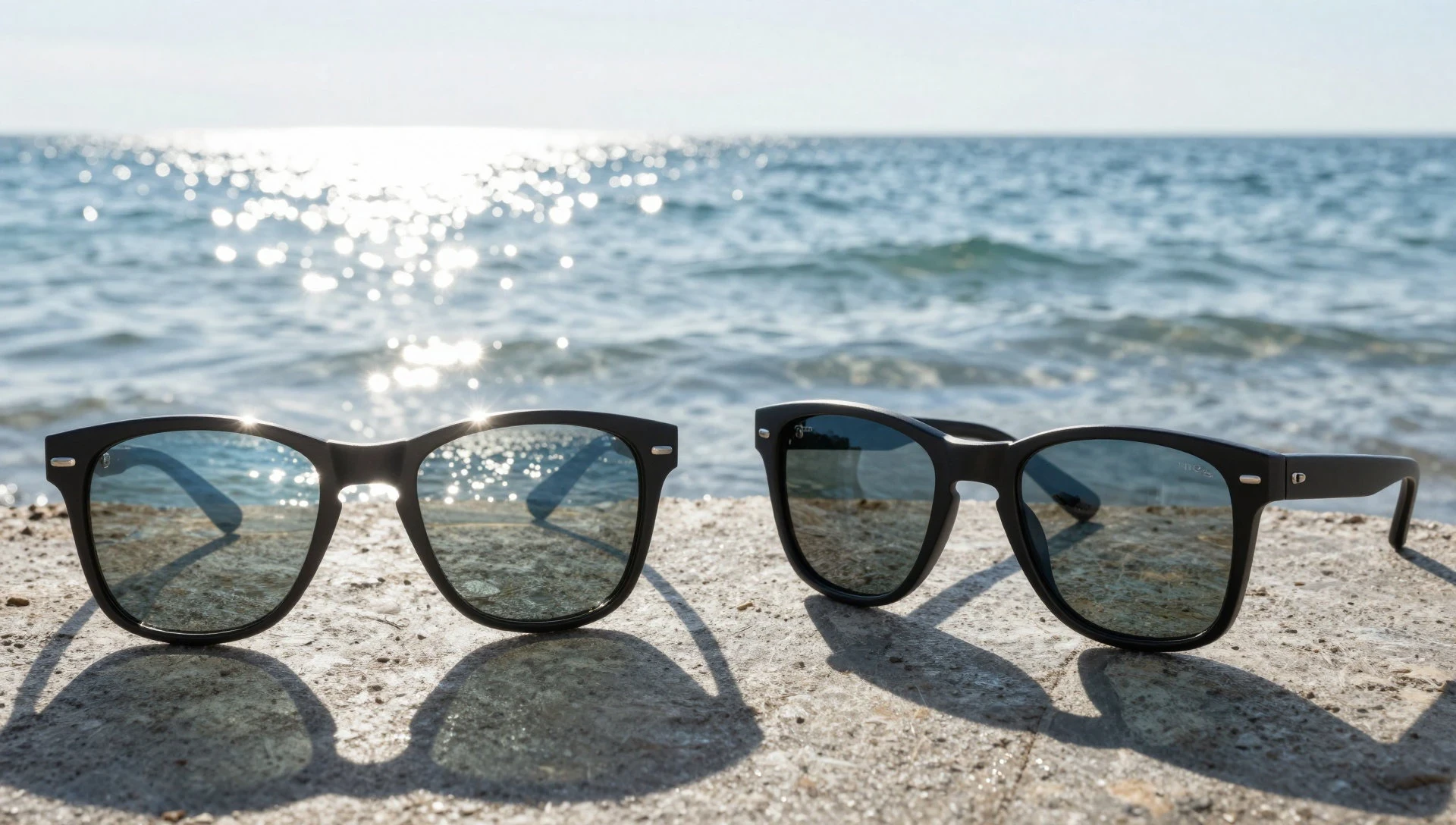
Few purchasing decisions appear as straightforward as choosing a pair of sunglasses, yet the distinction between polarized and non-polarized lenses quietly reshapes how the wearer experiences light itself. Polarized lenses carry a laminated filter that absorbs horizontal light waves—the very reflections bouncing off asphalt, water, snow, and glass—while standard tinted lenses merely reduce overall brightness without discriminating between wave orientations. That single engineering difference cascades into driving safety, water sports visibility, screen readability, and price, making the choice far more consequential than most shoppers assume when they lift a frame from a display rack.
Understanding this comparison begins with the physics of glare. Sunlight oscillating in every direction strikes a flat, reflective surface and reorganizes itself into a horizontal band of concentrated intensity; polarized filters, aligned vertically, block precisely that band. The result is a scene with richer color saturation, deeper contrast, and dramatically reduced eye strain. Non-polarized lenses, by contrast, dim everything uniformly, which suits casual wear but leaves the harshest reflections intact. Neither design is universally superior—each answers a different set of daily habits, and the wisest purchase follows the wearer's actual routine rather than marketing language.
This analysis examines both lens types across the situations that matter most: highway driving, open-water activities, winter sports, digital screen use, and budget considerations. It weighs optical performance against practical trade-offs, including the well-known friction between polarized filters and certain LCD displays, and it offers a decision framework grounded in how people genuinely spend their daylight hours. By the end, readers should hold a clear, defensible answer to a question that retailers rarely explain with sufficient honesty.
On This Page
TL;DR Polarized lenses contain a chemical filter that blocks horizontally oriented light waves, eliminating glare from roads, water, and snow while improving contrast and color depth. They excel for driving, fishing, boating, and skiing, but can interfere with LCD screens, dashboard displays, and aircraft instrumentation. Non-polarized lenses simply darken the visual field, cost less, and remain compatible with every display, making them suitable for casual city wear and screen-heavy environments. The correct choice depends on lifestyle: frequent drivers and water enthusiasts should pay the premium for polarization, while occasional wearers and pilots may prefer standard tints.
The Optical Science Behind Glare and Lens Filters
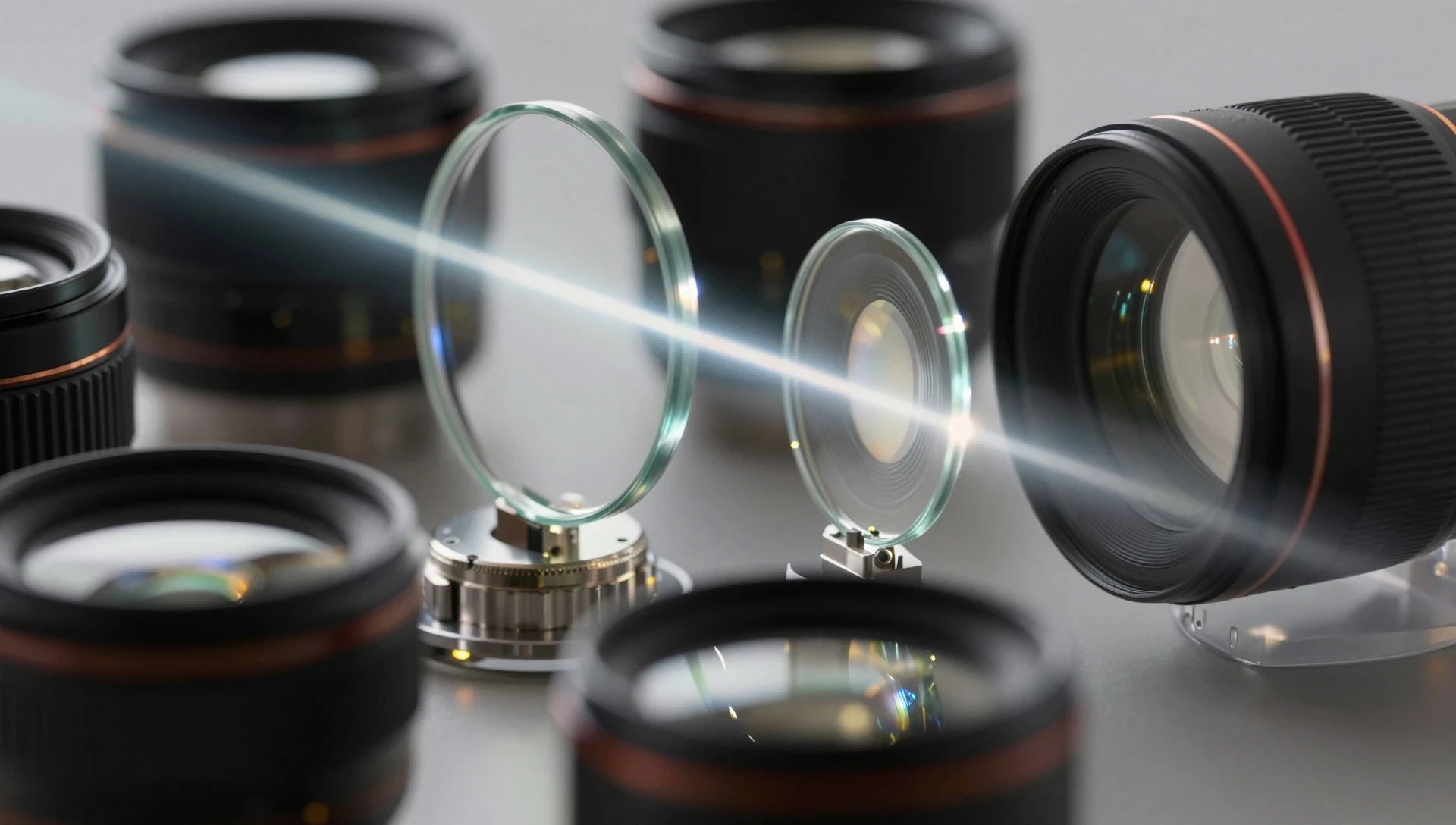
Light behaves as a transverse wave, oscillating perpendicular to its direction of travel. In open sunlight the oscillations point in every direction, but when rays strike a non-metallic surface at a shallow angle—wet asphalt, a lake, a snowfield—the reflected wave becomes strongly aligned along the horizontal plane. This alignment is what the human eye registers as glare: a blinding, washed-out sheen that obscures detail and forces squinting. Polarized lenses exploit this predictability by embedding a filter whose molecular chains are stretched vertically, absorbing horizontal oscillations while transmitting vertical ones. The physics is elegant and deterministic, governed by the relationship between reflection angle and refractive index.
Non-polarized lenses take a blunter approach. They rely on tint alone—grey, brown, green, or gradient dyes—to attenuate the total luminous flux reaching the retina. Every wave orientation is reduced proportionally, so the scene darkens but the glare pattern persists at lower intensity. This distinction explains why two lenses of identical darkness can feel radically different on a bright highway: one removes the offending signal, the other merely turns down the volume on everything. Understanding this difference is the foundation for every practical recommendation that follows.
How Polarizing Filters Are Manufactured
Modern polarizing film begins as a sheet of polyvinyl alcohol that is heated and stretched in one direction, aligning its polymer chains into parallel rows. The sheet is then doped with iodine or a dichroic dye, whose molecules attach to the aligned chains and absorb light vibrating along that axis. This film is laminated between layers of cellulose triacetate or polycarbonate and bonded into the lens, often with additional coatings for scratch resistance and UV blocking. The vertical orientation of the absorbing chains is deliberate: it targets the horizontal glare produced by flat surfaces while preserving useful vertical light.
Quality control matters enormously here. Cheap polarizing film can delaminate, lose efficiency at the edges, or introduce optical distortion, which is why budget sunglasses sometimes deliver uneven glare reduction across the lens. Premium manufacturers test polarization efficiency, typically expressed as a percentage of blocked horizontal light, and reputable lenses exceed ninety-nine percent. The manufacturing complexity explains much of the price gap between polarized and standard lenses, though brand markup also plays a role that consumers should recognize.
The Role of UV Protection
Polarization and ultraviolet protection are entirely separate properties, a point frequently muddled in retail marketing. A lens can be polarized without blocking UV rays, and a non-polarized lens can offer complete UV400 protection. Ultraviolet radiation damages the cornea and contributes to cataracts and macular degeneration over decades, so UV blocking should be treated as non-negotiable regardless of polarization status. In many markets, labeling standards require sunglasses to state their UV category, and buyers should verify this explicitly rather than assuming that a dark or polarized lens guarantees safety.
There is a subtle risk worth noting: dark lenses without UV protection can be worse than no sunglasses at all, because the pupil dilates behind the tint and admits more harmful radiation. This makes the UV specification the first checkbox on any purchase, ahead of polarization. Reputable opticians test lenses with a photometer on request, and online buyers should insist on documented UV400 ratings rather than trusting vague claims of "full protection" printed on flimsy packaging.
Driving, Water, and Winter: Where Polarization Earns Its Price

Behind the wheel, glare is not merely uncomfortable—it is a measurable hazard. Sunlight reflecting off a wet road or a preceding vehicle's hood can momentarily erase lane markings and brake lights from view, and the effect intensifies at low sun angles during morning and evening commutes. Polarized lenses cut that horizontal wash almost entirely, restoring the contrast between painted lines and asphalt and reducing the fatigue that accumulates over long drives. Fleet safety programs and driving instructors frequently recommend them for precisely this reason, though the recommendation carries an important caveat about dashboard displays that deserves separate attention.
On water, the case for polarization becomes even stronger. Anglers rely on polarized lenses to see beneath the surface, distinguishing submerged structure, weed beds, and fish from the mirror-like sheen of the water itself. Sailors and kayakers use them to read chop, currents, and hazards that flat light conceals. Winter sports present a parallel scenario: snow reflects an extraordinary volume of light, and polarized goggles or sunglasses reveal the texture of the slope—ice patches, drifts, and shadows—that uniform tinting would flatten into an undifferentiated white field.
The Driving Case in Detail
Automotive windshields are themselves partially polarizing, particularly when tinted or coated, which means the interaction between windshield and lens can produce unexpected effects. Some drivers report a faint mottled pattern or "rainbow" artifact when viewing certain laminated glass through polarized lenses, a phenomenon caused by stress birefringence in the glass. It is rarely severe enough to impair vision, but sensitive drivers should test a pair in their own vehicle before committing. The benefit—clearer lane markings, reduced hood glare, and calmer eyes at dusk—generally outweighs the artifact for most motorists.
Dashboard and infotainment screens pose the more practical concern. Many LCD panels emit polarized light, and when the lens filter is oriented perpendicular to the screen's polarization axis, the display can appear black or heavily dimmed, particularly when the driver tilts their head. Head-up displays, which project information onto the windshield, are especially vulnerable. Drivers who depend heavily on navigation screens or digital instrument clusters should verify compatibility, or choose a lens with a rotated polarization axis where manufacturers offer it.
Water Sports and Snow Visibility
Fishermen describe the moment they first wear polarized lenses as a revelation: the water's surface stops behaving like a mirror and begins behaving like a window. This is not exaggeration but applied physics, since the filter removes the horizontally polarized reflection that otherwise dominates the view. Flat-water anglers, fly fishers working shaded streams, and offshore boaters all benefit, and the same principle helps sailors spot floating debris and read wind patterns on the water's surface. Brown or copper-tinted polarized lenses are popular in these settings because they sharpen contrast against green and blue backgrounds.
Skiers and snowboarders face a related challenge in a far more hostile environment. Snow's albedo can exceed eighty percent, and the resulting glare is intense enough to cause photokeratitis—snow blindness—after prolonged exposure. Polarized lenses reduce that reflected load and, crucially, reveal terrain texture that flat light hides. Categorical lens systems used in mountaineering, rated from zero to four, pair with polarization to manage conditions from overcast whiteout to brilliant alpine noon, and serious winter athletes treat the combination as standard equipment rather than luxury.
Screens, Instruments, and the Compatibility Problem

The most persistent objection to polarized lenses concerns electronic displays, and it is grounded in real physics rather than anecdote. Liquid crystal displays work by twisting polarized light through a liquid crystal layer sandwiched between two polarizing filters; the image you see is itself polarized. When a polarized sunglass lens is rotated to align with the display's blocking axis, the screen darkens dramatically or vanishes entirely. This effect varies with head tilt, screen orientation, and viewing angle, which is why some drivers see a perfectly readable dashboard while others see a black rectangle.
The problem extends beyond cars. Smartphone screens, ATM displays, camera viewfinders, and cockpit instruments all emit polarized light, and the interaction can range from a mild dimming to complete blackout. Pilots are advised against polarized lenses for this reason, and many aviation authorities formally discourage them. Cyclists using handlebar-mounted computers, photographers reviewing images on rear LCD panels, and medical professionals reading monitors have all reported similar frustrations, making screen compatibility a genuine decision criterion rather than a theoretical footnote.
Why LCD Panels Interact With Polarized Lenses
An LCD produces images by modulating polarized light, and its front polarizer is typically oriented at a specific angle—often forty-five or ninety degrees depending on the panel design. A polarized sunglass lens transmits light vibrating along one axis; when that axis is perpendicular to the display's, the transmitted intensity approaches zero. The mathematics is captured by Malus's law, which describes how transmitted intensity varies with the angle between polarizer axes:
Here ##I_0## is the incident intensity and ##\theta## the angle between the two polarization axes. At ##\theta = 90°##, the transmitted intensity falls to zero, which is precisely the blackout effect users experience. Rotating the head changes ##\theta## and restores visibility, which explains why tilting the head often brings a "dead" screen back to life. Understanding this relationship helps buyers anticipate the problem rather than discovering it mid-journey.
Practical Workarounds for Screen Users
Several strategies mitigate the conflict without abandoning polarization. Some manufacturers offer lenses with a rotated polarization axis, aligning the filter to suit dashboard displays rather than the horizontal glare of roads. Others recommend keeping a non-polarized pair for cockpit or screen-intensive work and reserving polarized lenses for outdoor driving and recreation. Aftermarket screen protectors with circular polarizers can also reduce the effect on phones and tablets, though they are not universally available.
For most consumers, the simplest resolution is honest self-assessment. A driver who glances at a navigation screen occasionally will tolerate minor dimming; a pilot or a professional who reads instruments continuously should not. Testing a candidate pair against one's own devices—phone, car dashboard, laptop—takes minutes and prevents years of irritation. Retailers increasingly permit this, and online buyers can rely on generous return policies to verify compatibility before committing.
We Also Published
- 01
- 02
- 03
- 04
Cost, Quality, and the Value Equation
Polarization commands a price premium that typically ranges from twenty to sixty percent over comparable non-polarized lenses, and the gap widens with brand prestige. Part of that premium reflects genuine manufacturing cost—the polarizing film, lamination, and quality control add real expense—but a substantial portion is marketing. Consumers should understand that a modestly priced polarized lens from a reputable optical house can outperform a luxury-branded non-polarized lens on glare reduction, and that the brand name on the temple does not determine optical quality.
Value assessment should weigh frequency of use against benefit. A daily commuter who drives an hour each way in bright conditions will extract enormous utility from polarization, amortizing the premium across hundreds of glare-free journeys. An occasional weekend wearer who mostly walks city streets may find standard tinted lenses entirely adequate. The calculation is personal, but it should be explicit rather than left to the persuasive powers of a sales assistant.
What Drives the Price Difference
The polarizing film itself is the primary cost driver, followed by the lamination process and the precision required to maintain optical clarity across the lens. Premium manufacturers invest in testing equipment that verifies polarization efficiency and detects distortion, costs that budget producers avoid. Frame material, lens coatings, and brand positioning layer additional expense on top. A useful heuristic is to compare lenses of similar tint and UV rating from different price tiers and ask whether the polarization premium is proportionate to the glare reduction actually delivered.
Counterfeit and mislabeled products complicate the market. Some inexpensive sunglasses claim polarization but deliver only partial filtering, and the difference is invisible until tested. A simple at-home check involves rotating the lens ninety degrees in front of an LCD screen: a genuine polarized lens will darken dramatically at one orientation and clear at the other, while a non-polarized or fake lens will show little change. Buyers should treat this test as routine due diligence.
Durability and Long-Term Ownership
Polarized lenses are not inherently more fragile than standard ones, but their laminated construction introduces a failure mode: delamination, in which the film layers separate after prolonged heat, salt, or chemical exposure. Leaving sunglasses on a car dashboard in summer accelerates this, and saltwater without rinsing can degrade the bonding over seasons. Careful owners extend lens life considerably by rinsing after ocean use, storing in a case, and avoiding prolonged heat exposure, practices that apply equally to both lens types.
Scratch resistance depends on coatings rather than polarization, and premium lenses typically carry harder anti-scratch layers. Replacement cost matters too: prescription polarized lenses cost more to replace than standard ones, which argues for protective cases and careful handling. Over a multi-year ownership horizon, the total cost difference between the two lens types is often smaller than the sticker price suggests, particularly when durability and replacement cycles are factored in.
Matching the Lens to the Wearer's Daily Life
The decisive question is not which lens is objectively better but which lens fits the life being lived. A delivery driver logging six hours on sunlit roads, a fly fisherman wading a spring creek, and a ski instructor working alpine slopes all share a compelling case for polarization. A commercial pilot, a laboratory technician reading LCD instruments, or a casual wearer who mostly walks shaded city blocks may find standard lenses perfectly serviceable and considerably cheaper. The framework is situational, and honest self-assessment beats generic advice.
Seasonality and geography also matter. Dwellers in high-altitude or snow-prone regions face reflected light loads that make polarization nearly essential, while those in overcast maritime climates may prioritize tint and UV protection over glare control. Travelers who split time between beach and boardroom might consider owning both types, treating them as tools for different tasks rather than a single lifetime purchase. This pragmatic approach is increasingly common among outdoor professionals.
Decision Framework by Lifestyle
A structured decision path helps cut through the noise. Begin with UV400 protection as a mandatory baseline, then assess glare exposure: if the wearer regularly faces roads, water, or snow, polarization earns its premium. Next, evaluate screen dependence—pilots, drivers with head-up displays, and anyone reading instruments continuously should lean toward non-polarized or rotated-axis lenses. Finally, weigh budget and frequency of use, recognizing that a daily-worn pair justifies more investment than an occasional accessory. This sequence resolves most purchasing dilemmas in minutes.
Prescription wearers face an additional layer of complexity, since polarized prescription lenses cost more and may limit frame choices. Many opticians now offer both options with clear pricing, and some provide trial lenses so patients can experience the difference before ordering. For those who need vision correction, the decision should be made with an optometrist who can discuss lens thickness, coating compatibility, and the practical implications of polarization for their specific prescription.
Common Misconceptions Worth Discarding
Several myths persist in retail conversation. The first holds that darker lenses offer more protection; in reality, tint darkness and UV blocking are independent, and very dark lenses without UV protection can be harmful. The second claims polarized lenses are unsuitable for all driving, which overstates a narrow screen-compatibility issue. The third suggests polarization eliminates the need for UV coating, which is simply false. The fourth assumes higher price guarantees better polarization, when testing often reveals otherwise.
A fifth misconception concerns color perception: some wearers believe polarized lenses distort colors, when in fact they typically enhance saturation by removing the washed-out glare that desaturates scenes. Finally, many assume polarized lenses are only for fishermen, missing their value for drivers, skiers, and anyone facing reflective surfaces. Dispelling these myths allows buyers to evaluate lenses on evidence rather than folklore, and to spend their money where it actually improves their visual experience.
Making the Final Purchase Decision
Armed with the physics, the use-case evidence, and the cost analysis, the final decision reduces to a handful of concrete steps. First, confirm UV400 protection regardless of lens type, since this is the non-negotiable health baseline. Second, list the environments where the sunglasses will actually be worn—highway, water, snow, city, cockpit—and weight them by frequency. Third, test any candidate pair against the screens the wearer relies on, using the LCD rotation method or an in-store trial. Fourth, set a budget that reflects expected wear frequency rather than brand aspiration.
For most people, the outcome is a polarized pair for outdoor and driving use, supplemented by a cheaper non-polarized pair for screen-heavy environments or as a backup. This dual-lens strategy resolves the apparent conflict between glare control and display compatibility without forcing a compromise. It also acknowledges that sunglasses are tools with specific jobs, not a single universal accessory, and that owning the right tool for each task is the mark of a considered buyer.
A Practical Buying Checklist
Before completing any purchase, verify the UV rating explicitly, ideally with documentation rather than a sticker. Confirm polarization using the LCD test if the claim matters to you. Check lens tint against intended use—grey for neutral color, brown or copper for contrast, green for general purpose. Inspect the frame for fit and coverage, since peripheral light leakage undermines even excellent lenses. Finally, confirm the return policy, because real-world testing over a few days reveals compatibility issues that a showroom cannot.
Prescription buyers should add a consultation with their optometrist, discussing lens material, coating options, and the practical implications of polarization for their specific needs. Those who fly, operate heavy machinery with digital displays, or work in screen-intensive roles should consider a rotated-axis lens or a non-polarized alternative. Everyone else can proceed with confidence that polarized lenses will deliver a measurable improvement in visual comfort across the reflective environments that dominate daily life.
Final Verdict and Parting Guidance
Polarized lenses represent a genuine optical advance, not a marketing gimmick, and for drivers, anglers, and winter athletes they are the better choice by a clear margin. Non-polarized lenses retain a legitimate role for screen-dependent professionals, budget-conscious casual wearers, and anyone who values universal display compatibility. The honest answer to the original question is therefore conditional: buy polarized if your days are spent facing reflective surfaces, and buy non-polarized if your days are spent facing displays. Many people, sensibly, will buy both.
What matters most is that the decision be made on evidence rather than sales pressure. Verify UV protection, test polarization, match the lens to the environment, and treat price as a signal rather than a guarantee. Sunglasses protect one of the body's most valuable and least replaceable sensory systems, and a considered purchase—whether polarized or not—pays dividends in comfort, safety, and long-term eye health for years of bright days ahead.
From our network :
- Live Online English Classes for Kids: Do They Actually Reduce Anxiety?A ten-week study reveals that synchronous online English classes can significantly reduce child language anxiety while improving listening and reading skills. Discover what makes these programs effective and how parents can select the right one.
- Committed Mediterranean Precipitation Decline: Why Emissions Cuts Alone Cannot Restore Winter RainsNew NOAA research reveals that Mediterranean winter rains may decline irreversibly even with emissions cuts. Explore the science of committed climate change and regional impacts.
- Forbidden Matrix Patterns and Visible Lattice Points: A Geometric DictionaryExplore how multidimensional 0–1 matrices encode geometric truths, linking forbidden patterns to visible lattice points and hypergraph theory, with applications in combinatorics and computational geometry.
- CISA’s Ten-Advisory Wave: Why Generic Patching Fails in OT and How to Build Product-Specific PlaybooksCISA released ten ICS advisories in one week, exposing critical infrastructure risks. Generic patching fails in OT. Learn to build product-specific remediation playbooks.
- The Final Descent: How ESA Retired the Legendary Cluster Constellation After 24 Years of Space Weather ScienceAfter 24 years mapping Earth’s magnetosphere, ESA’s Cluster mission concluded with a precisely controlled reentry over the South Pacific. This analysis explores the scientific legacy, engineering decisions, and debris mitigation principles behind one of space exploration’s most responsible retirements.
- Mobile Learning and VR in English: What Global Evidence Reveals About Effective Language TechnologyA systematic review across 14 countries reveals which language-learning technologies genuinely work. Mobile learning, AI, and VR show measurable benefits when pedagogically integrated. This evidence-based guide helps educators and learners select technology that delivers real return on investment.
- University Language Proficiency Exams: Why Institutional Tests Demand Different Preparation Than IELTS and TOEFLDiscover why university-specific language proficiency examinations differ fundamentally from IELTS and TOEFL, and learn strategic preparation approaches for institutional assessment success.
- How AI Agents Will Change the Way We Manage Personal FinancesExplore how AI agents are transforming personal finance through automated budgeting, bill payment, and investment management, while examining the critical security protocols and governance frameworks required for safe deployment.
- The Hidden Cost of AI Convenience: Why Over-Permissioned Agents Are a Security Time BombDiscover why AI agents with excessive permissions create dangerous single points of failure, and learn how implementing least privilege principles can protect your organization from exploitation.
RESOURCES
- Noob here - Polarized vs Non-polarized : r/sunglasses - Redditreddit.comJun 7, 2024 ... It's a matter of preference. Polarized lenses block glare and make the sky look darker in a nice way, but…
- Polarized Sunglasses vs. Non-polarized Sunglasses - All About Visionallaboutvision.comFeb 29, 2020 ... Polarized and non-polarized sunglasses both darken a bright day, but that's where their similarities end. Polarized lenses can reduce glare, ...
- ELI5: Polarized vs Non-Polarized sunglasses : r/explainlikeimfivereddit.comSep 10, 2024 ... Polarized sunglasses have a filter which stops that light which is reflected from different angles, so you don't see the…
- Polarized vs. Non-polarized Sunglasses: What Is the Difference?ouhealth.comJul 9, 2026 ... Polarized vs. Non-polarized Sunglasses. In general, the ability to filter light is the main difference between polarized and non-polarized ...
- Shady Debate: Polarized vs. Non-Polarized Sunglasseshealth.clevelandclinic.orgFeb 6, 2024 ... When it comes to polarized vs. non-polarized sunglasses, polarized lenses may be best for you, as they reduce glare on…
- Polarized vs Non-Polarized Sunglasses | Revant Opticsrevantoptics.comMar 17, 2026 ... The difference between polarized and non-polarized sunglasses comes down to how the lenses handle reflected light. Polarized lenses are designed ...
- Polarized vs. Non-Polarized Sunglasses | Warby Parkerwarbyparker.comAug 13, 2026 ... Non-polarized sunglasses lack the glare-filtering coating of polarized sunglasses. Our non-polarized lenses protect against harmful UV rays at ...
- Polarized vs Non Polarized: The Definitive Guide - Sunglass Sciencesunglassscience.comJul 1, 2024 ... Discover the pros and cons of polarized lenses, when to use non-polarized sunglasses, and how to choose the best eyewear…
- Tennis Sunglasses: Polarized or Not? - SportRxsportrx.comSep 3, 2019 ... Polarized lenses filter out this horizontal wavelength which in turn, cuts the glare. They offer great advantages when it comes…
- Polarized vs Non-Polarized Sunglasses - Learn the True Differenceknockaround.comNon-polarized lenses treat all sunlight equally and reduce the overall intensity. This offers protection for the eyes but will not tackle shimmer and sparkle…
- Effect of polarized sunglasses on visual functions - PMC - NIHpmc.ncbi.nlm.nih.govDec 18, 2025 ... Polarized and non-polarized sunglasses do not significantly affect visual acuity, stereopsis, or phoria under controlled glare conditions.
- Polarized vs. Non-Polarized Sunglasses: The Differences - Sunskisunski.comThe primary benefit of polarized lenses is that they reduce glare, allowing your eyes to see richer colors, starker contrast in shadows and more…
- Cypress Polarized Sunglasses - Johnnie-Ojohnnie-o.com... lenses. Polarized vs. Non-Polarized. Though the common belief is that polarized is better, each is good for different settings. For times when glare…
- What Are the Benefits of Polarized Sunglasses? – Randolph USArandolphusa.comNov 11, 2025 ... Polarized lenses provide all the benefits of traditional tinted lenses, but with the added advantage of glare reduction. While regular ...
- Are Polarized Sunglass Lenses Always Essential? - Julbo USAjulbo.usDec 22, 2022 ... ... not all of the lenses in Julbo's performance eyewear are polarized. If you spend the majority of your time…
- 01
- 02
- 03
- 04
- 05
- 06
- 07
- 08
0 Comments