American midterm elections have long functioned as a national stress test, a quadrennial moment when voters render a verdict not merely on individual candidates but on the sitting president's stewardship of the country. The 2026 contest carries that tradition into unusually turbulent territory, with media projections pointing toward a Democratic takeover of the House of Representatives while vote counting continues across the states. What makes this cycle analytically rich is not simply the projected seat swing but the constellation of forces behind it: eroding presidential approval, persistent cost-of-living anxiety, and an ongoing military confrontation with Iran that has unsettled broad segments of the electorate. Each of these pressures interacts with the others, shaping a political environment in which the White House's legislative ambitions now hang by a thread.
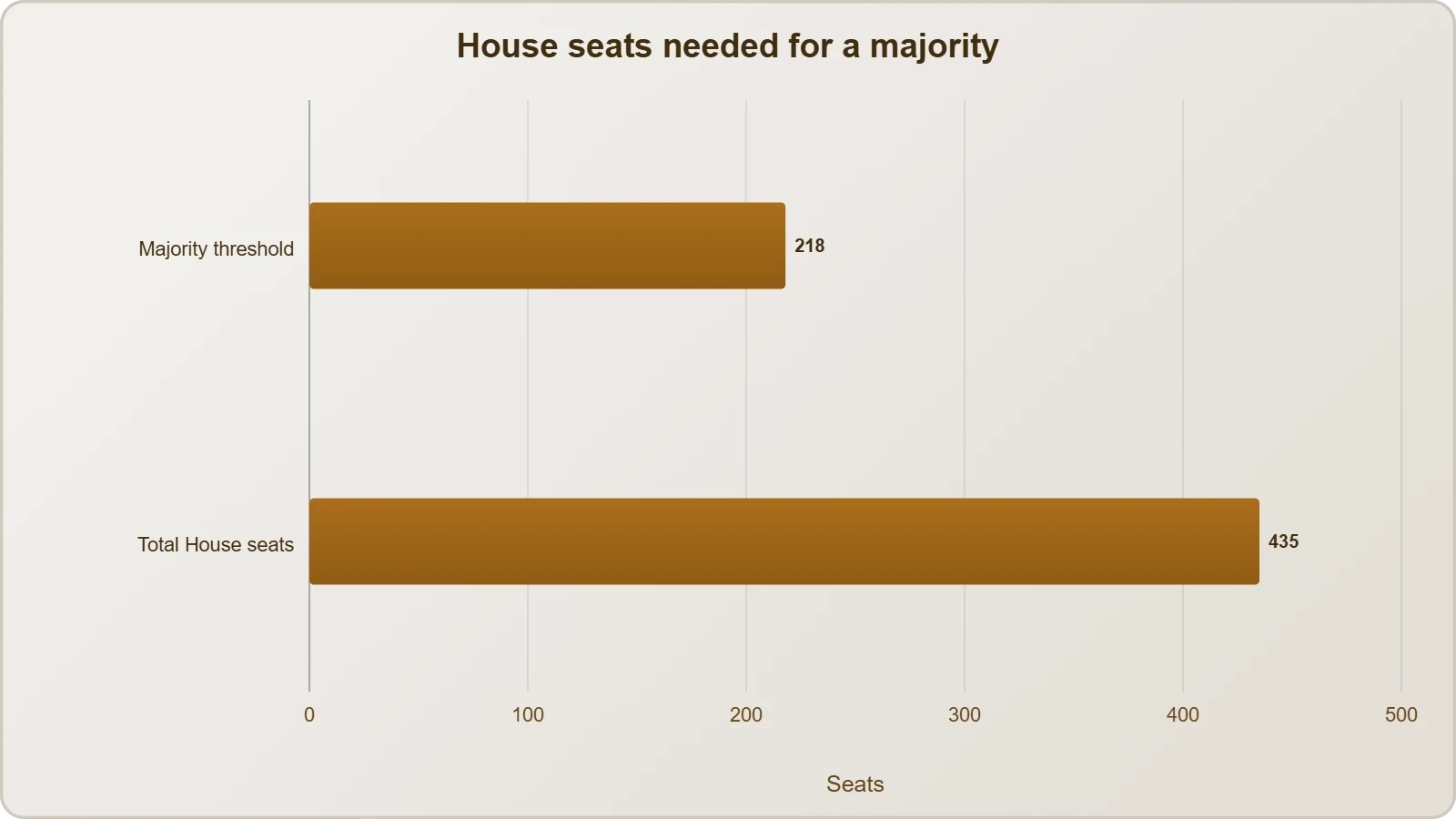
Understanding the significance of these projections requires attention to the machinery of American governance rather than the horse-race drama alone. The House contests all 435 seats every two years, and 218 constitutes the threshold for control; the Senate's staggered design means only a fraction of its 100 seats face voters in any given cycle. When one chamber flips while the presidency remains in the opposing party's hands, the result is divided government in its most confrontational form. Committees gain subpoena power, appropriations become leverage, and the veto emerges as the executive's primary defensive instrument. The source reporting captures precisely this dynamic, quoting President Trump's pre-election embrace of what he called "the ultimate power — it's called 'veto,'" a remark that previews the governing strategy likely to follow any Democratic victory.
Beyond the institutional chess match, the 2026 midterms illuminate how economic sentiment and foreign policy entanglement converge to reshape electoral coalitions. Midterm elections historically punish the party holding the White House, yet the scale of the projected Democratic advantage in early House returns suggests something more than the customary backlash. Elevated prices at the grocery store and the gasoline pump translate into visceral, household-level grievance that no macroeconomic talking point easily neutralizes. Simultaneously, the conflict with Iran injects a dimension of national security uncertainty that complicates the administration's messaging on competence and stability. Together, these factors frame a referendum not just on policy but on the perceived direction of the country itself.
On This Page
- The Architecture of American Midterm Elections
- Reading the Early Projections and Seat Arithmetic
- Economic Anxiety as the Engine of Electoral Discontent
- The Veto as Governing Strategy in Divided Government
- Implications for Governance, Markets, and Global Standing
- What the 2026 Verdict Means for the Road Ahead
TL;DR US media projections indicate the Democratic Party is poised to win a House majority in the 2026 midterm elections, with vote counting still underway across key states. The contest is widely interpreted as a referendum on President Donald Trump, whose approval ratings have declined amid high prices and the ongoing conflict with Iran. Republicans are projected to retain a meaningful Senate presence, but a Democratic House would sharply constrain the president's legislative agenda and elevate the veto as his central governing tool. The outcome signals a return to divided government and a more aggressive congressional posture toward the administration.
The Architecture of American Midterm Elections
Midterm elections occupy a distinctive place in the American constitutional order, occurring every four years at the midpoint of a presidential term and thereby serving as a structured opportunity for the electorate to register satisfaction or discontent with the incumbent administration. Unlike presidential years, when turnout surges around a single national figure, midterms traditionally draw lower participation and reward organized, motivated constituencies. This structural feature means that intensity of sentiment—particularly negative sentiment—often matters more than broad but lukewarm approval. The 2026 cycle appears to conform to this pattern, with projections suggesting that voters animated by economic frustration and foreign policy anxiety have turned out in sufficient numbers to threaten Republican control of the lower chamber.
The framers designed these staggered rhythms deliberately, embedding within the Constitution a mechanism for periodic correction that prevents any single electoral victory from cementing permanent control. House members face voters every two years, keeping them closely tethered to local sentiment, while senators serve six-year terms that insulate one-third of the chamber from immediate backlash. This asymmetry produces the recurring phenomenon of split outcomes, where one chamber changes hands while the other holds. The source reporting reflects exactly this possibility: projections show Democrats gaining ground in the House while Republicans retain a substantial Senate foothold, a configuration that would produce negotiation, gridlock, and institutional friction rather than clean one-party rule.
House and Senate: Divergent Electoral Mechanics
The House of Representatives operates on a scale that magnifies national mood swings. All 435 seats are contested every cycle, and the majority threshold of 218 seats means that relatively modest uniform swings in the popular vote can translate into dramatic shifts in control. Projections cited in the reporting—Associated Press figures suggesting Republicans winning 55 seats and Democrats 101 in early returns—illustrate how quickly the arithmetic can move once counting begins in earnest. Because House districts are drawn to be competitive in a limited number, control frequently hinges on a few dozen races concentrated in suburban and swing regions where independent voters and college-educated moderates exercise outsized influence over the national result.
The Senate's design produces a fundamentally different calculus. Only 35 of the 100 seats were up for election in this cycle, and the staggered class system means that national waves crash against a seawall of seats not yet subject to voter review. The reporting notes Republicans projected to hold at least 36 Senate seats and Democrats at least 45, with the remainder distributed across contests still being resolved. This structure explains why a party can suffer a decisive House defeat while retaining Senate leverage—and why the Senate frequently becomes the arena where a president's judicial nominations and treaty priorities survive even amid broader electoral repudiation.
The Referendum Framing and Presidential Accountability
Treating midterms as a referendum on the president is less a partisan talking point than a durable analytical convention supported by decades of electoral history. Voters who disapprove of the chief executive's performance tend to express that disapproval by voting against his party's congressional candidates, particularly when the president himself is not on the ballot to mobilize supporters. The reporting explicitly frames the 2026 contest in these terms, noting that the elections are seen as a referendum on President Donald Trump and that his approval ratings have fallen significantly during his second term. When a president's standing erodes, down-ballot candidates in competitive districts often find themselves unable to separate their fortunes from his.
This accountability mechanism carries consequences that extend well beyond seat counts. A president whose party loses a chamber confronts a transformed legislative environment: committee chairs from the opposition party gain authority to investigate, request documents, and summon officials, while the appropriations process becomes a venue for extracting concessions. The reporting captures the president's anticipatory response, quoting his telephone interview with CBS News in which he declared he possesses "the ultimate power — it's called 'veto'" and reportedly welcomed the moniker "Mr. Veto." That framing acknowledges the practical reality that a veto pen becomes the principal instrument of executive influence once legislative majorities slip away.
We Also Published
Reading the Early Projections and Seat Arithmetic
Election-night projections are provisional instruments, and responsible analysis treats them as directional signals rather than final verdicts. The reporting is careful to note that vote counting remains underway and that projections originate from media organizations employing statistical models, exit polling, and partial returns. ABC News projected Republicans holding at least 36 Senate seats against Democratic control of at least 45, while Associated Press projections on the House side showed Republicans at 55 seats and Democrats at 101 in the early tally. These figures, while incomplete, establish the trajectory of the contest and give analysts a framework for interpreting subsequent counting in Kentucky, Indiana, and other states where balloting had concluded.
The gap between early projections and final outcomes can be substantial, particularly in states with extended mail-ballot processing or close races subject to recount provisions. What matters analytically is the consistency of the signal across multiple independent projection sources: when several major outlets converge on the same directional conclusion, the probability that the underlying reality differs materially diminishes. The reporting reflects this convergence, with multiple US media outlets projecting a Democratic House majority. That consensus, combined with the structural factors of presidential unpopularity and economic discontent, gives the projection considerable weight even before certification.
Why the Senate Remains a Republican Firewall
The Senate's staggered class structure functions as a structural firewall against national waves, and the 2026 cycle demonstrates the mechanism clearly. With only 35 seats in play, the map is inherently limited, and many of those seats sit in states whose partisan leanings are stable enough to resist a national swing. The reporting's projection that Republicans hold at least 36 seats while Democrats control at least 45 reflects this uneven terrain, leaving a handful of contests to determine the final balance. Even a strong Democratic year cannot easily dislodge a chamber whose exposure is deliberately partial, which is why divided government so often takes the form of a flipped House paired with a retained Senate.
This firewall matters enormously for the president's remaining agenda. Judicial confirmations, cabinet appointments, and treaty considerations flow through the Senate, and a Republican-held chamber preserves the administration's ability to reshape the federal judiciary and staff the executive branch. Conversely, a Democratic Senate would have blocked those priorities outright. The practical consequence of the projected configuration is therefore asymmetric: the president loses legislative initiative in domestic policy while retaining the ability to confirm personnel and defend his administration's institutional legacy through the upper chamber's advice-and-consent function.
Vote Counting, Certification, and the Credibility Question
Election integrity has become an increasingly contested dimension of American electoral administration, and the 2026 cycle unfolds against a backdrop of heightened scrutiny regarding counting procedures, mail-ballot processing, and certification timelines. The reporting notes that counting has begun in states including Kentucky and Indiana, and that projections rest on partial returns. In an environment where public confidence in electoral administration has been uneven, the transparency of counting processes and the consistency of projections across multiple independent outlets serve as important credibility anchors. When ABC News, the Associated Press, and other major organizations converge on similar conclusions, the informational basis for those conclusions becomes more robust.
Certification itself involves a sequence of statutory steps—canvassing, reconciliation of provisional and mail ballots, potential recounts in close races, and formal certification by state authorities—that can extend weeks beyond election night. Analysts therefore distinguish between projected outcomes, which guide immediate interpretation, and certified results, which carry legal finality. The reporting's careful language about ongoing counting reflects this professional discipline. For markets, policymakers, and foreign capitals watching the American political scene, the practical question is not whether projections might shift marginally but whether the directional verdict on House control is durable enough to warrant planning around divided government.
Economic Anxiety as the Engine of Electoral Discontent
Few forces shape American voting behavior as reliably as pocketbook perception, and the 2026 cycle appears to be no exception. The reporting identifies high prices as a factor that has upset some voters, a formulation that understates the political potency of sustained cost-of-living pressure. Inflation experienced at the grocery store, the pharmacy, and the fuel pump registers differently from aggregate economic statistics; households compare current prices against remembered prices and form judgments that no favorable unemployment report easily dislodges. When those judgments persist across multiple years, they accumulate into a generalized sense that the economy is working against ordinary families, and incumbent parties absorb the blame regardless of the underlying causes.
The political mechanics of price dissatisfaction are well documented in electoral research. Voters who feel financially squeezed become more receptive to opposition messaging, more likely to turn out in protest, and less willing to credit policy achievements that do not translate into visible relief. The reporting's observation that high prices have upset voters therefore carries substantial explanatory weight for the projected Democratic gains. It also explains why the administration's defensive posture centers on institutional tools like the veto rather than on a persuasive economic narrative—once price perception hardens, rhetorical remedies rarely reverse it within a single cycle.
Inflation Perception Versus Macroeconomic Data
A persistent puzzle in electoral analysis is the divergence between official economic indicators and public sentiment. Aggregate measures of growth, employment, and even inflation rates can improve while household perceptions remain stubbornly negative, because individuals weight the prices they encounter daily far more heavily than statistical averages. The reporting's reference to high prices upsetting voters captures this divergence precisely. When the cost of staples rises faster than wages in the lived experience of a family, the political consequence is a durable sense of grievance that persists even after headline inflation moderates, since price levels remain elevated relative to the baseline voters remember.
This perception gap has direct strategic implications for both parties. Incumbents struggle to convert favorable data into political credit, while challengers can invoke household budgets without needing to construct elaborate policy arguments. The result is an electoral environment in which economic messaging from the governing party often fails to penetrate, and in which opposition candidates benefit from a simple, visceral narrative of affordability. For the 2026 cycle, this dynamic helps explain why projections favor Democrats despite whatever macroeconomic strengths the administration might cite, and why the president's defensive posture emphasizes institutional blocking power over economic persuasion.
The Iran Conflict and Foreign Policy Salience
Foreign policy rarely dominates midterm elections unless it intrudes directly into public consciousness through casualties, energy prices, or visible strategic setbacks. The reporting identifies the ongoing conflict with Iran as a factor that has upset some voters, suggesting that the confrontation has achieved sufficient salience to influence perceptions of administration competence. Military entanglement raises questions about judgment, resource allocation, and the president's capacity to manage simultaneous domestic and international pressures. When voters already feel economically strained, the addition of geopolitical uncertainty compounds a general sense that events are spiraling beyond control, a sentiment that incumbent parties historically struggle to counter.
The strategic dimension extends beyond domestic politics. A conflict with Iran affects global energy markets, regional alliance structures, and the credibility of American commitments, all of which feed back into economic conditions at home. Voters may not follow the tactical details of military operations, but they register gasoline prices, news of escalation, and the general atmosphere of instability. The reporting's inclusion of the Iran conflict among voter concerns therefore reflects a sophisticated understanding of how foreign policy transmits into electoral behavior—not through detailed debate but through ambient anxiety that colors assessments of leadership and competence.
The Veto as Governing Strategy in Divided Government
President Trump's pre-election remark to CBS News that he holds "the ultimate power — it's called 'veto'" and his reported welcome of the nickname "Mr. Veto" constitute a candid acknowledgment of what divided government actually looks like from the executive branch. The veto power, established in Article I of the Constitution, allows a president to reject legislation passed by Congress, subject to override by a two-thirds vote in both chambers. In practice, the threat of a veto reshapes legislative bargaining before bills ever reach the president's desk, because congressional majorities must anticipate executive resistance and calibrate their proposals accordingly. The remark signals a governing posture built around defense rather than initiative.
This strategic framing carries both strengths and limitations. On the strength side, the veto is a reliable instrument: sustaining a veto requires only one-third-plus-one of either chamber, making overrides rare in practice. A president can therefore block opposition legislation with considerable confidence. On the limitation side, a veto-centric strategy concedes the legislative agenda entirely, ceding initiative to the opposing party while the administration focuses on protecting prior achievements and exercising administrative discretion. The reporting's emphasis on this remark reveals a White House that has already internalized the likely loss of the House and is preparing for a defensive phase of the presidency.
- 01
- 02
- 03
- 04
Congressional Oversight and the Investigative Turn
When the opposition captures a chamber, committee gavels become instruments of accountability, and the investigative machinery of Congress shifts into higher gear. House committees can compel testimony, issue subpoenas, demand documents, and hold public hearings that shape media narratives and public opinion. For an administration already facing declining approval, sustained oversight creates a compounding political burden: each hearing generates coverage, each document request signals scrutiny, and each witness appearance becomes a platform for criticism. The reporting's observation that Congress is expected to be more aggressive if either chamber flips captures this dynamic in compressed form, and it explains why the administration's planning would prioritize defensive positioning.
Oversight also interacts with the appropriations process, where the power of the purse provides concrete leverage. A chamber controlled by the opposition can attach conditions to spending bills, demand policy concessions in exchange for government funding, and use the threat of shutdowns as bargaining leverage. These mechanisms transform divided government from an abstract constitutional concept into a daily operational reality for executive agencies. The president's veto can block legislation, but it cannot compel Congress to fund priorities it opposes, and the resulting standoffs often produce negotiated outcomes that neither branch would have chosen independently.
Historical Patterns of Midterm Reversals
History offers a consistent template for interpreting the 2026 projections. The president's party has lost House seats in the vast majority of midterm elections since the Second World War, with only rare exceptions occurring during periods of extraordinary national unity or presidential popularity. This pattern reflects the referendum logic embedded in the electoral calendar: midterms arrive when the administration's honeymoon has faded but before a new presidential campaign can reset the political narrative. The 2026 cycle appears to follow this template, with the reporting's emphasis on declining approval ratings and economic discontent aligning with the historical conditions that produce governing-party losses.
What distinguishes individual midterm waves is magnitude and durability. Some reversals produce narrow majorities that constrain but do not paralyze the executive; others generate commanding margins that reshape the legislative landscape for years. The early projections cited in the reporting—Democrats at 101 House seats to Republicans' 55 in partial returns—suggest a substantial swing, though final margins will depend on counting in competitive districts. The historical lesson is that midterm verdicts, once rendered, tend to persist through the following cycle unless the president's standing recovers decisively, making the 2026 outcome consequential well beyond the immediate legislative session.
Implications for Governance, Markets, and Global Standing
Divided government introduces a distinctive form of policy uncertainty that markets and international partners must price into their planning. When legislative initiative shifts to the opposition while the executive retains veto and administrative authority, the range of plausible policy outcomes widens: tax provisions may expire or be extended depending on negotiations, regulatory priorities may shift through agency action, and fiscal deadlines become recurring flashpoints. The reporting's framing of the midterms as a major challenge for President Trump captures the political dimension, but the economic dimension is equally significant. Investors, businesses, and foreign governments all recalibrate when American governance enters a period of institutional friction.
For global allies and adversaries alike, the 2026 outcome signals the practical limits of American executive power. A president who cannot legislate must rely on executive agreements, sanctions waivers, and administrative discretion to conduct foreign policy, while Congress may assert its own prerogatives through resolutions, funding conditions, and oversight of diplomatic and military initiatives. The reporting's emphasis on the conflict with Iran makes this dimension especially salient: a divided government may constrain escalation or complicate negotiation, depending on which chamber flips and which party's priorities prevail. International observers will read the results as a measure of American political stability and the durability of current strategic commitments.
Market Reactions and Policy Uncertainty
Financial markets process political information through the lens of policy predictability, and divided government cuts both ways. On one hand, legislative gridlock reduces the risk of sweeping regulatory or tax changes, which some investors welcome as stability. On the other hand, uncertainty about fiscal deadlines, debt ceiling negotiations, and spending fights introduces volatility that complicates corporate planning. The 2026 projections therefore generate a mixed market signal: sectors sensitive to regulation may price in diminished legislative risk, while sectors dependent on government spending or tax certainty may price in heightened negotiation risk. The net effect depends on which specific policies become contested.
Currency and bond markets add another layer of interpretation. A divided government that struggles to address fiscal imbalances may face pressure from creditors concerned about long-term sustainability, while a government that pursues aggressive fiscal expansion could face inflation expectations. The reporting does not address market specifics, but the analytical framework is clear: political outcomes transmit into economic conditions through expectations about taxation, spending, regulation, and institutional stability. For professional investors, the practical task is scenario planning—assigning probabilities to legislative outcomes and adjusting portfolio positioning as counting concludes and the shape of the new Congress becomes clear.
Alliances, Adversaries, and the Message Abroad
Foreign capitals interpret American midterm results as evidence about the durability of current policy commitments, and the 2026 projections will be read closely in allied and adversarial capitals alike. A president weakened at home may find his credibility abroad diminished, as partners question whether agreements can survive congressional scrutiny or whether commitments will be honored through administrative action alone. Conversely, adversaries may perceive opportunity in a Washington consumed by domestic political conflict, testing resolve in regions where American attention appears divided. The reporting's emphasis on the Iran conflict makes these calculations especially immediate, since military and diplomatic posture toward Tehran depends on both executive will and congressional support.
The longer-term message concerns the resilience of American democratic institutions. Midterm elections that produce peaceful transfers of chamber control, orderly counting, and acceptance of results reinforce the credibility of the constitutional system. The reporting's careful attention to ongoing counting and multiple independent projections reflects the professional norms that sustain that credibility. For international audiences, the 2026 cycle is therefore a test not only of partisan fortunes but of institutional durability—a demonstration that American governance can absorb sharp political reversals without crisis, and that the machinery of divided government continues to function even under intense partisan pressure.
What the 2026 Verdict Means for the Road Ahead
The projected Democratic House majority represents more than a partisan setback for the administration; it marks a structural reconfiguration of American governance that will shape legislative possibilities, oversight intensity, and foreign policy execution for the remainder of the presidential term. The reporting's core findings—declining approval, economic discontent, the Iran conflict, and the president's anticipatory embrace of the veto—together describe a White House transitioning from agenda-setting to defensive preservation. That transition carries consequences for every policy domain, from budgeting to judicial confirmations, and it establishes the political terrain on which the next presidential campaign will be fought.
For citizens and analysts alike, the appropriate posture is disciplined attention to the counting process and its certification, followed by careful assessment of how the new Congress organizes itself. Committee assignments, leadership elections, and early legislative priorities will reveal whether the projected majority pursues confrontation or negotiation, and whether the administration's veto strategy produces stalemate or bargaining. The reporting provides the essential factual foundation for that assessment: the seat arithmetic, the referendum framing, the economic and foreign policy pressures, and the executive's stated governing philosophy. What remains is the unfolding of events, and the professional obligation to interpret them with precision rather than partisan enthusiasm.
From our network :
- Mobile Learning and VR in English: What Global Evidence Reveals About Effective Language TechnologyA systematic review across 14 countries reveals which language-learning technologies genuinely work. Mobile learning, AI, and VR show measurable benefits when pedagogically integrated. This evidence-based guide helps educators and learners select technology that delivers real return on investment.
- Committed Mediterranean Precipitation Decline: Why Emissions Cuts Alone Cannot Restore Winter RainsNew NOAA research reveals that Mediterranean winter rains may decline irreversibly even with emissions cuts. Explore the science of committed climate change and regional impacts.
- Live Online English Classes for Kids: Do They Actually Reduce Anxiety?A ten-week study reveals that synchronous online English classes can significantly reduce child language anxiety while improving listening and reading skills. Discover what makes these programs effective and how parents can select the right one.
- CISA’s Ten-Advisory Wave: Why Generic Patching Fails in OT and How to Build Product-Specific PlaybooksCISA released ten ICS advisories in one week, exposing critical infrastructure risks. Generic patching fails in OT. Learn to build product-specific remediation playbooks.
- The Final Descent: How ESA Retired the Legendary Cluster Constellation After 24 Years of Space Weather ScienceAfter 24 years mapping Earth’s magnetosphere, ESA’s Cluster mission concluded with a precisely controlled reentry over the South Pacific. This analysis explores the scientific legacy, engineering decisions, and debris mitigation principles behind one of space exploration’s most responsible retirements.
- University Language Proficiency Exams: Why Institutional Tests Demand Different Preparation Than IELTS and TOEFLDiscover why university-specific language proficiency examinations differ fundamentally from IELTS and TOEFL, and learn strategic preparation approaches for institutional assessment success.
- Forbidden Matrix Patterns and Visible Lattice Points: A Geometric DictionaryExplore how multidimensional 0–1 matrices encode geometric truths, linking forbidden patterns to visible lattice points and hypergraph theory, with applications in combinatorics and computational geometry.
- The Hidden Cost of AI Convenience: Why Over-Permissioned Agents Are a Security Time BombDiscover why AI agents with excessive permissions create dangerous single points of failure, and learn how implementing least privilege principles can protect your organization from exploitation.
- How AI Agents Will Change the Way We Manage Personal FinancesExplore how AI agents are transforming personal finance through automated budgeting, bill payment, and investment management, while examining the critical security protocols and governance frameworks required for safe deployment.
RESOURCES
- ElectIt - Gary Kinggking.harvard.edu1 day ago ... MidtermPresidential year. This page presents our forecasts for all US House and Senate seats in the 11/3/2026 election. Our methodology ...
- Live updates: 2026 US midterm elections and results - BBC Newsbbc.com2 hours ago ... Summary. The Democrats are projected to win a majority in US House of Representatives, taking control from the Republicans.
- Midterm forecast strongly favors Democrats to win House majoritynews.cornell.eduSep 3, 2026 ... The team's analysis is detailed in “A District-Level Forecast of the 2026 U.S. House of Representatives Midterm Elections,” presented during…
- What the US midterms could mean for Trump's powerchathamhouse.orgSep 9, 2026 ... The Democrats are projected to make big gains in November's midterm elections ... With a majority in either or both…
- 2026 House Election Interactive Map - 270toWin.com270towin.com... majority (when there are no vacancies). This 3-part map lets you view the current composition of the U.S. House and make a forecast…
- Cook Political Report | Non-Partisan Political Analysis for US ...cookpolitical.comThe Cook Political Report with Amy Walter is an independent, non-partisan newsletter that analyzes state, federal and presidential elections, and American ...
- Midterm Elections 2026: Congress Polls, Charts and Morenbcnews.com2 hours ago ... To get to a majority, Democrats ... See how candidates are polling in competitive races for the U.S. Senate, seats…
- A Simple Model for Forecasting the Impact of Mid-Cycle Redistricting ...centerforpolitics.orgMay 19, 2026 ... ... 2026 midterm election to take control of the U.S. House of Representatives. The president's party almost always loses seats…
- What history tells us about the 2026 midterm elections | Brookingsbrookings.eduAug 28, 2025 ... The result: a 41-seat gain for House Democrats, enabling them to regain control of the House with a 36-seat majority.…
- Sabato's Crystal Ball - UVA Center for Politicscenterforpolitics.orgTHE FINAL 2026 RATINGS: Democrats Favored to Capture House, Senate, and Gubernatorial Majorities ... Citizen Forecasts on the Eve of the Midterm Elections ...
- Democrats' advantage is clear with less than a month to go in the ...npr.orgOct 6, 2026 ... The president's party tends to lose House seats in midterm elections ... GOP expands House majority and flips Senate control.…
- 2026 State Elections Could Reshape Trifecta Control (States to Watch)multistate.usFeb 5, 2026 ... ... Democratic majority House and a Republican majority Senate since 2023. The early forecast gives a slight "lean" rating for…
- The midterm election outcomes that could shape Trump's final two ...reuters.com2 days ago ... Democrats need a net gain of four seats in the US House of Representatives ... 2026 US midterm elections. 1…
- 2026 Governor Elections - MultiStatemultistate.usAll 36 gubernatorial races in the 2026 cycle. Forecasts, open seats, and candidate filings.
- Democrats projected to win majority control of US House, US media ...reuters.com2 hours ago ... [1/3]People react to election returns, suggesting Democrats could ... 2026 US midterm elections. 1 hour ago United Statescategory · Chris ...
- 01
- 02
- 03
- 04
- 05
- 06
- 07
- 08
0 Comments