When CNN projected on the night of November 3, 2026, that Democratic Senator Jon Ossoff of Georgia had won reelection, the announcement carried weight far beyond a single statewide contest. Georgia had been singled out by Republicans as one of their foremost pickup opportunities in the Senate map, a seat they believed could be flipped with the right combination of national momentum, candidate quality, and suburban realignment. The projection, delivered as returns consolidated across the state, confirmed that Democrats would retain a seat they already held rather than surrender it to a determined challenger. In the arithmetic of Senate control, where every seat can decide committee gavels and judicial confirmations, holding a vulnerable incumbent is functionally equivalent to a pickup.
The source material is deliberately spare: a single projection, a date, a state, and a party outcome. Yet that brevity invites a broader reading of what such a result signifies in contemporary American politics. Georgia has spent the past several cycles oscillating between deep-red tradition and competitive purple reality, and Ossoff himself first entered the Senate through a runoff that drew global attention. His successful defense of the seat suggests that the coalition which delivered Georgia to Democrats in the early 2020s retains enough structural durability to withstand a concerted Republican assault. Understanding why requires examining the state's demographic evolution, the mechanics of Senate campaigns, and the way national narratives collide with local conditions.
This analysis unpacks the projection from multiple angles: the strategic significance of the seat, the demographic and electoral forces shaping Georgia, the role of media projections in modern election coverage, and the downstream consequences for Senate control and governance. It treats the Ossoff result not as an isolated headline but as a data point embedded in a longer story about partisan competition in the Sun Belt. Readers seeking a clear-eyed assessment of what the projection means, and what it does not, will find the sections below organized to move from immediate electoral facts toward broader institutional implications.
On This Page
- The Strategic Weight of a Single Senate Seat
- Georgia's Electoral Geography and Demographic Change
- How Media Projections Shape Election Coverage
- Coalition Dynamics Behind the Result
- Consequences for Senate Control and Governance
- Reading the Source Critically: What Remains Unresolved
- What the Georgia Result Signals for 2026 and Beyond
TL;DR CNN projected that Democratic Senator Jon Ossoff won reelection in Georgia on election night, November 3, 2026, denying Republicans a seat they had targeted as a leading pickup opportunity. The outcome preserves Democratic control of a competitive Senate seat and underscores Georgia's status as a genuine battleground rather than a reliably red state. This analysis examines the strategic stakes of the race, the demographic and coalition dynamics behind the result, the function of media projections in election coverage, and the consequences for Senate arithmetic and governance. It also considers what the sparse source material leaves unresolved and how observers should interpret a single projection within the broader midterm landscape.
The Strategic Weight of a Single Senate Seat
Senate seats are not interchangeable units of political capital; their value fluctuates with the national map, the incumbent's profile, and the margin of control. In 2026, with the chamber divided along razor-thin lines, a single Georgia seat carried outsized leverage over legislative scheduling, committee assignments, and the confirmation of executive and judicial nominees. Republicans had identified Georgia as a leading offensive opportunity precisely because a flip there would compound gains elsewhere and potentially shift the majority. Ossoff's projected victory therefore functions as a defensive anchor, preserving the Democratic caucus's ability to set the agenda and resist hostile amendments.
Why Georgia Became a Republican Target
Georgia's transformation from a Republican stronghold into a competitive state is a relatively recent phenomenon, driven by rapid population growth in metropolitan Atlanta, diversification of the electorate, and sustained investment in organizing infrastructure. Republicans reasoned that a midterm environment, typically unfavorable to the party holding the White House, would depress Democratic turnout and allow a well-funded challenger to consolidate the state's rural and exurban vote. The party's calculus rested on the assumption that Ossoff's 2021 runoff margin was a product of exceptional circumstances rather than a durable coalition, an assumption the 2026 projection directly challenges.
The strategic logic also reflected resource allocation. Senate campaigns are expensive, and parties must decide where marginal dollars yield the highest probability of a seat change. Georgia's size, media-market cost, and history of narrow margins made it an attractive target for national Republican committees and allied super PACs. Treating the seat as a leading pickup opportunity meant channeling advertising, field operations, and surrogate visits into the state, resources that could not be spent elsewhere. A loss there represents not only a missed seat but also an opportunity cost measured in foregone investment in other battlegrounds.
The Incumbent Advantage and Its Limits
Incumbency confers tangible advantages: name recognition, fundraising networks, constituent service records, and the ability to shape the terms of debate. Ossoff entered the 2026 cycle with a full term of Senate experience, committee assignments, and a public profile built through high-visibility hearings and legislative work. These assets help incumbents define their challengers before those challengers can define themselves. Yet incumbency is not decisive in a state as closely divided as Georgia, where margins frequently fall within a few percentage points and where national tides can overwhelm individual candidate quality.
The projection suggests that Ossoff successfully converted these advantages into a durable coalition. That conversion required more than incumbency alone; it demanded disciplined messaging on economic conditions, sustained engagement with suburban and urban voters, and enough crossover appeal to limit defections in exurban counties. The result also implies that Republican efforts to nationalize the race around unpopular figures or policies failed to move enough persuadable voters. In competitive Senate contests, the incumbent's task is often to make the election a choice between two known quantities rather than a referendum on the party in power, and the Georgia outcome appears consistent with that strategy succeeding.
Georgia's Electoral Geography and Demographic Change
Georgia's political identity has been reshaped by two decades of demographic transformation. Metropolitan Atlanta, home to a majority of the state's population, has absorbed domestic and international migration that diversified the electorate and strengthened Democratic performance in suburban counties once considered reliably Republican. Simultaneously, the state's rural counties have grown more uniformly Republican, creating a stark geographic polarization. The result is a state where statewide outcomes hinge on turnout differentials between a dense, diverse metro core and a sprawling, conservative hinterland. Ossoff's projected win reflects a coalition that managed those differentials effectively.
The Atlanta Metropolitan Engine
Atlanta's economic vitality has attracted educated professionals, immigrant communities, and young workers, all of whom tend to lean Democratic. Counties such as Cobb, Gwinnett, and Fulton have shifted markedly, and their growing share of the statewide vote has altered the arithmetic of Georgia elections. Democratic campaigns have invested heavily in registering and mobilizing these voters, while Republicans have sought to counterbalance them by maximizing turnout in exurban and rural areas. The 2026 projection suggests the metro engine delivered sufficiently to offset those counterweights, a pattern consistent with the state's recent competitive history.
The metro's influence extends beyond raw vote totals. Atlanta anchors the state's media market, shapes its cultural identity, and hosts a concentration of corporate and civic institutions that engage in public affairs. Campaigns must therefore compete for attention in a crowded information environment, and the cost of reaching persuadable voters is high. Ossoff's ability to communicate across this landscape, combining urban outreach with targeted appeals to suburban moderates, likely contributed to his projected margin. The result reinforces that Georgia's statewide contests are now decided in the suburbs, where college-educated voters have drifted toward Democrats.
Rural Consolidation and Turnout Math
Republican strength in Georgia's rural counties has intensified, producing enormous margins in small-population areas. These margins are essential to any statewide Republican coalition, but they face a structural ceiling: rural counties simply do not contain enough voters to overcome a unified metro bloc unless suburban defections are substantial. The 2026 race tested whether Republicans could generate enough rural turnout and suburban swing to close the gap. The projection indicates they fell short, suggesting that the party's path to a Georgia majority requires either reclaiming suburban voters or achieving unprecedented rural participation.
Turnout math also interacts with election administration. Georgia's voting laws, including identification requirements and rules governing absentee and early voting, shape who participates and how quickly results are reported. Election-night projections must account for the sequencing of in-person, early, and mail ballots, which can produce shifts as counts proceed. CNN's projection, issued on election night, reflects the network's modeling of these dynamics and its assessment of the remaining vote. Observers should treat such projections as informed estimates rather than final tallies, while recognizing their practical role in informing the public.
How Media Projections Shape Election Coverage
Election-night projections occupy a peculiar position in American democracy: they are neither official results nor mere speculation, but structured inferences built from partial returns, historical patterns, and statistical models. CNN's decision to project a winner reflects a judgment that the remaining uncounted votes cannot plausibly alter the outcome. This practice allows the public to understand results as they emerge, but it also invites scrutiny about methodology, timing, and the potential influence of early calls on late-voting or undecided citizens. The Ossoff projection, issued on election night, exemplifies these tensions.
The Modeling Behind a Projection
Modern projections rely on a combination of reported vote totals, exit polling, pre-election surveys, and demographic modeling of outstanding precincts. Analysts compare the composition of counted votes with expectations derived from registration data and past performance, then estimate the range of plausible final outcomes. When that range excludes the trailing candidate, a projection is issued. The process is probabilistic rather than certain, and networks maintain the option to retract a call if new information contradicts the model. Understanding this machinery helps citizens interpret projections with appropriate confidence and skepticism.
The credibility of any projection depends on the quality of its inputs and the transparency of its assumptions. Networks employ statisticians and analysts who monitor for anomalies, such as discrepancies between reported and expected turnout or unusual patterns in specific jurisdictions. In close races, the threshold for issuing a call is higher, and networks may wait for additional returns. The Georgia projection, delivered on election night, implies that the modeled margin was sufficiently robust to meet that threshold, though the source material does not disclose the specific data underlying the call.
Public Trust and the Speed of Calling Races
Speed carries consequences. Early projections can shape perceptions of legitimacy, particularly when margins are narrow or when different networks call races at different times. A premature call that later requires correction can erode confidence, while excessive caution can leave the public without clear information for days. Networks navigate this trade-off by calibrating their models and communicating uncertainty. The Ossoff projection, as reported, represents a confident call, and its accuracy will ultimately be judged against certified results and any subsequent recounts or legal challenges.
Public trust also depends on consistency across outlets. When multiple networks converge on the same projection, the collective signal is stronger; when they diverge, confusion can follow. The source material attributes the Georgia call to CNN specifically, leaving open whether other networks had made the same determination at the time of reporting. This detail matters for assessing the robustness of the projection, since convergence among independent analysts provides a form of external validation that a single call cannot supply on its own.
We Also Published
Coalition Dynamics Behind the Result
A Senate victory in a competitive state is the product of many overlapping coalitions rather than a single unified electorate. Ossoff's projected win implies that several groups moved or held in sufficient numbers: suburban moderates, Black voters in metro and rural areas, young voters, and college-educated professionals. Each bloc has distinct priorities and turnout patterns, and campaigns must craft messages that mobilize them without alienating others. The projection suggests the Democratic coalition in Georgia retained enough cohesion to withstand a well-funded challenge, though the source material does not provide the demographic breakdown needed to quantify each group's contribution.
Suburban Moderates and Persuasion
Suburban voters, particularly those with college degrees, have become a pivotal swing constituency in Georgia. Their movement toward Democrats in recent cycles reflects discomfort with certain Republican positions on social issues, education, and governance style, alongside economic concerns that cut both ways. Winning them requires candidates to project competence and moderation while avoiding positions that energize the opposing base. Ossoff's profile as a mainstream Democrat likely appealed to these voters, and his projected victory suggests that Republican efforts to brand him as ideologically extreme did not resonate sufficiently in the suburbs.
Persuasion in the suburbs is expensive and incremental. Campaigns invest in targeted advertising, direct mail, and local outreach designed to move small percentages of voters. Because these voters are heterogeneous, messaging must be segmented by neighborhood, profession, and life stage. The 2026 result implies that Democratic segmentation and turnout operations outperformed Republican counterparts in these areas, or that national conditions favored the incumbent's party despite the usual midterm headwinds. Either interpretation underscores the importance of granular, data-driven campaigning in modern Senate races.
Base Turnout and Community Organizing
Democratic victories in Georgia have depended on robust turnout among Black voters, who constitute a substantial share of the statewide electorate and an even larger share of the Democratic coalition. Community organizations, churches, and civic groups have played central roles in mobilization, often operating outside formal party structures. Sustaining that turnout requires year-round engagement rather than election-season appeals. The projection suggests these networks delivered, though the absence of detailed data in the source material means the precise magnitude of their contribution remains a matter for post-election analysis.
Young voters and first-time participants also matter disproportionately in close races. Their turnout is volatile and sensitive to enthusiasm, issue salience, and peer influence. Campaigns use digital organizing, campus outreach, and cultural messengers to reach them. If Ossoff's projected margin depended on above-expected youth participation, that would carry implications for future cycles, suggesting that investments in youth engagement can yield durable returns. Conversely, if base turnout merely held at prior levels, the result may reflect persuasion gains among moderates rather than mobilization gains among core supporters.
- 01
- 02
- 03
- 04
Consequences for Senate Control and Governance
Retaining Georgia preserves the Democratic caucus's numerical position and, with it, the practical levers of power: the ability to schedule floor votes, control committee agendas, and influence nominations. In a chamber where a single seat can determine the majority, defensive victories are as consequential as offensive ones. The projection therefore shapes not only the 2026 midterm narrative but also the governing environment that follows, including the prospects for legislation on spending, immigration, and judicial confirmations. It also affects the psychological dynamics within both parties, signaling which strategies are rewarded and which are not.
Legislative Arithmetic and Committee Power
Senate control determines committee chairmanships, subpoena power, and the flow of legislation to the floor. A retained Georgia seat helps Democrats preserve these instruments, though the precise balance depends on outcomes elsewhere. Even in a narrowly divided chamber, committee control allows a party to set investigative priorities and shape the content of bills before they reach a final vote. The Ossoff projection thus contributes to a broader arithmetic that will determine whether the next Congress can advance major legislation or settles into gridlock and oversight battles.
Governance also depends on the Senate's role in confirming executive branch officials and federal judges. A majority that can confirm nominees shapes the judiciary and administrative agencies for years beyond a single term. Retaining Georgia therefore has downstream effects on the composition of courts and the direction of regulatory policy. These consequences are often invisible on election night but accumulate over time, which is why parties treat Senate seats as long-term institutional investments rather than short-term electoral prizes.
Signals for Future Campaigns
Every competitive race produces lessons that inform future strategy. A Democratic hold in Georgia suggests that the party's Sun Belt investments are yielding returns and that claims of a durable Republican realignment in the state are premature. For Republicans, the result raises questions about coalition breadth, message discipline, and resource allocation. These lessons will shape candidate recruitment, advertising strategies, and national party priorities in subsequent cycles, making the Georgia outcome a reference point for strategists on both sides.
The result also carries implications for how parties interpret midterm environments. Midterms often favor the party out of power, and Republicans had reason to expect gains. A Democratic hold in a targeted state complicates that narrative and may prompt reassessment of national polling, turnout models, and the salience of specific issues. Whether the Georgia outcome proves an outlier or a leading indicator will depend on results in other battlegrounds, but its symbolic weight is already substantial.
Reading the Source Critically: What Remains Unresolved
The source material is a single projection report, and responsible analysis must acknowledge its limits. It does not provide vote totals, margins, turnout figures, or demographic breakdowns. It does not specify whether other networks concurred, whether the trailing candidate conceded, or whether any legal challenges were anticipated. These omissions are not flaws in the source so much as boundaries that define what can be responsibly inferred. Treating the projection as a confirmed final result would overstate the evidence, while dismissing it as mere speculation would understate the rigor behind professional election modeling.
Information Gaps and Their Implications
Without margin data, it is impossible to assess how close the race actually was or whether recount thresholds might be triggered. Without turnout figures, analysts cannot determine whether the outcome reflected persuasion or mobilization. Without demographic breakdowns, claims about coalition composition remain hypotheses rather than findings. These gaps matter because political narratives often harden before complete data arrives, and early interpretations can shape fundraising, recruitment, and strategy in ways that outlast their evidentiary basis. Careful readers should hold conclusions loosely until fuller data becomes available.
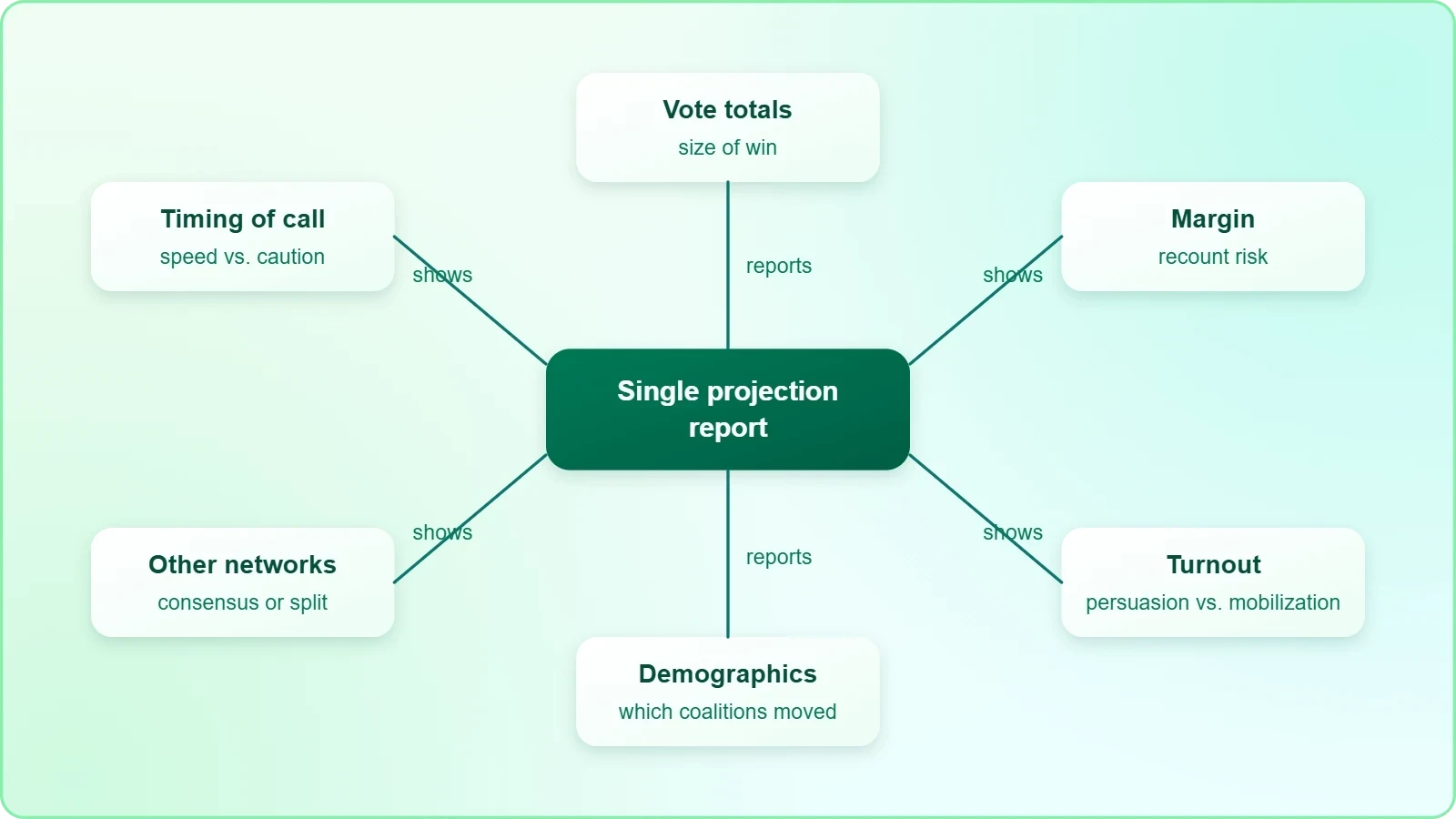
The absence of detail also affects how the result should be weighted in national analysis. A narrow hold and a comfortable hold carry different implications for future competitiveness, yet the source does not distinguish between them. Similarly, the timing of the projection relative to other races could influence its perceived significance. Until certified results and comprehensive analyses emerge, the Georgia outcome is best understood as a significant but incompletely specified data point within a larger midterm picture.
Distinguishing Projection From Outcome
Finally, the distinction between a projection and a certified outcome deserves emphasis. Projections are provisional by design, subject to revision if counts shift or anomalies emerge. The history of American elections includes instances where early calls were revisited, and the possibility, however remote, cannot be excluded. The responsible posture is to treat CNN's projection as a strong indication while awaiting official certification. That posture respects both the professionalism of the analysts involved and the integrity of the counting process that ultimately determines who takes the seat.
For citizens, this means consuming election news with attention to sourcing and uncertainty. For analysts, it means building models that incorporate the possibility of late-count shifts and communicating confidence levels clearly. For the candidates and parties, it means preparing for both outcomes while respecting institutional processes. The Georgia projection is a meaningful signal, but signals are not the same as final results, and the difference matters for public trust in elections.
What the Georgia Result Signals for 2026 and Beyond
Beyond the immediate arithmetic, the Georgia projection offers a reading of the national mood. A Democratic hold in a state Republicans targeted suggests that the anticipated midterm swing was not uniform and that local conditions retained significant influence over outcomes. It also indicates that the Democratic coalition's Sun Belt wing remains viable, complicating narratives of a wholesale Republican realignment. For strategists, the result reinforces the value of sustained investment in competitive states and the limits of nationalizing every race around a single message.
Implications for the National Parties
Democrats can point to Georgia as evidence that their defensive map is holding and that investments in organizing and persuasion are paying dividends. Republicans, meanwhile, must confront the gap between targeting a seat and winning it, a gap that often reflects candidate quality, message discipline, and resource allocation. Both parties will commission post-mortems examining turnout, advertising effectiveness, and coalition composition. The conclusions they draw will shape recruitment and spending in the next cycle, making Georgia a template as much as a result.
The result also affects the psychology of donors and activists. Victories, even defensive ones, sustain morale and fundraising, while losses prompt recriminations. A retained Georgia seat gives Democrats a narrative of resilience heading into subsequent battles, while Republicans face pressure to demonstrate that their targeting was sound. These psychological effects are difficult to quantify but materially influence how parties prepare for future contests, including candidate recruitment and early advertising reservations.
Longer-Term Questions for Georgia Politics
Georgia's long-term trajectory remains contested. Demographic change favors Democrats in the aggregate, but turnout patterns, migration shifts, and Republican gains among certain working-class and Hispanic voters could alter the calculus. The 2026 result does not settle these questions; it provides one data point in an ongoing series. Future cycles will test whether the Democratic coalition can institutionalize its advantage or whether Republicans can adapt their message to reclaim suburban voters and expand their base.
For observers, the prudent approach is to track structural indicators, such as registration trends, migration patterns, and partisan identification, alongside election results. These indicators provide early signals about the durability of coalitions and the competitiveness of future races. The Ossoff projection is best understood as a confirmation that Georgia remains a genuine battleground, one whose outcome will depend on the same factors that shaped 2026: turnout, persuasion, resources, and the national environment.
From our network :
- Live Online English Classes for Kids: Do They Actually Reduce Anxiety?A ten-week study reveals that synchronous online English classes can significantly reduce child language anxiety while improving listening and reading skills. Discover what makes these programs effective and how parents can select the right one.
- How AI Agents Will Change the Way We Manage Personal FinancesExplore how AI agents are transforming personal finance through automated budgeting, bill payment, and investment management, while examining the critical security protocols and governance frameworks required for safe deployment.
- The Final Descent: How ESA Retired the Legendary Cluster Constellation After 24 Years of Space Weather ScienceAfter 24 years mapping Earth’s magnetosphere, ESA’s Cluster mission concluded with a precisely controlled reentry over the South Pacific. This analysis explores the scientific legacy, engineering decisions, and debris mitigation principles behind one of space exploration’s most responsible retirements.
- Mobile Learning and VR in English: What Global Evidence Reveals About Effective Language TechnologyA systematic review across 14 countries reveals which language-learning technologies genuinely work. Mobile learning, AI, and VR show measurable benefits when pedagogically integrated. This evidence-based guide helps educators and learners select technology that delivers real return on investment.
- University Language Proficiency Exams: Why Institutional Tests Demand Different Preparation Than IELTS and TOEFLDiscover why university-specific language proficiency examinations differ fundamentally from IELTS and TOEFL, and learn strategic preparation approaches for institutional assessment success.
- The Hidden Cost of AI Convenience: Why Over-Permissioned Agents Are a Security Time BombDiscover why AI agents with excessive permissions create dangerous single points of failure, and learn how implementing least privilege principles can protect your organization from exploitation.
- Forbidden Matrix Patterns and Visible Lattice Points: A Geometric DictionaryExplore how multidimensional 0–1 matrices encode geometric truths, linking forbidden patterns to visible lattice points and hypergraph theory, with applications in combinatorics and computational geometry.
- CISA’s Ten-Advisory Wave: Why Generic Patching Fails in OT and How to Build Product-Specific PlaybooksCISA released ten ICS advisories in one week, exposing critical infrastructure risks. Generic patching fails in OT. Learn to build product-specific remediation playbooks.
- Committed Mediterranean Precipitation Decline: Why Emissions Cuts Alone Cannot Restore Winter RainsNew NOAA research reveals that Mediterranean winter rains may decline irreversibly even with emissions cuts. Explore the science of committed climate change and regional impacts.
RESOURCES
- Resources will be updated soon.
- 01
- 02
- 03
- 04
- 05
- 06
- 07
- 08
0 Comments