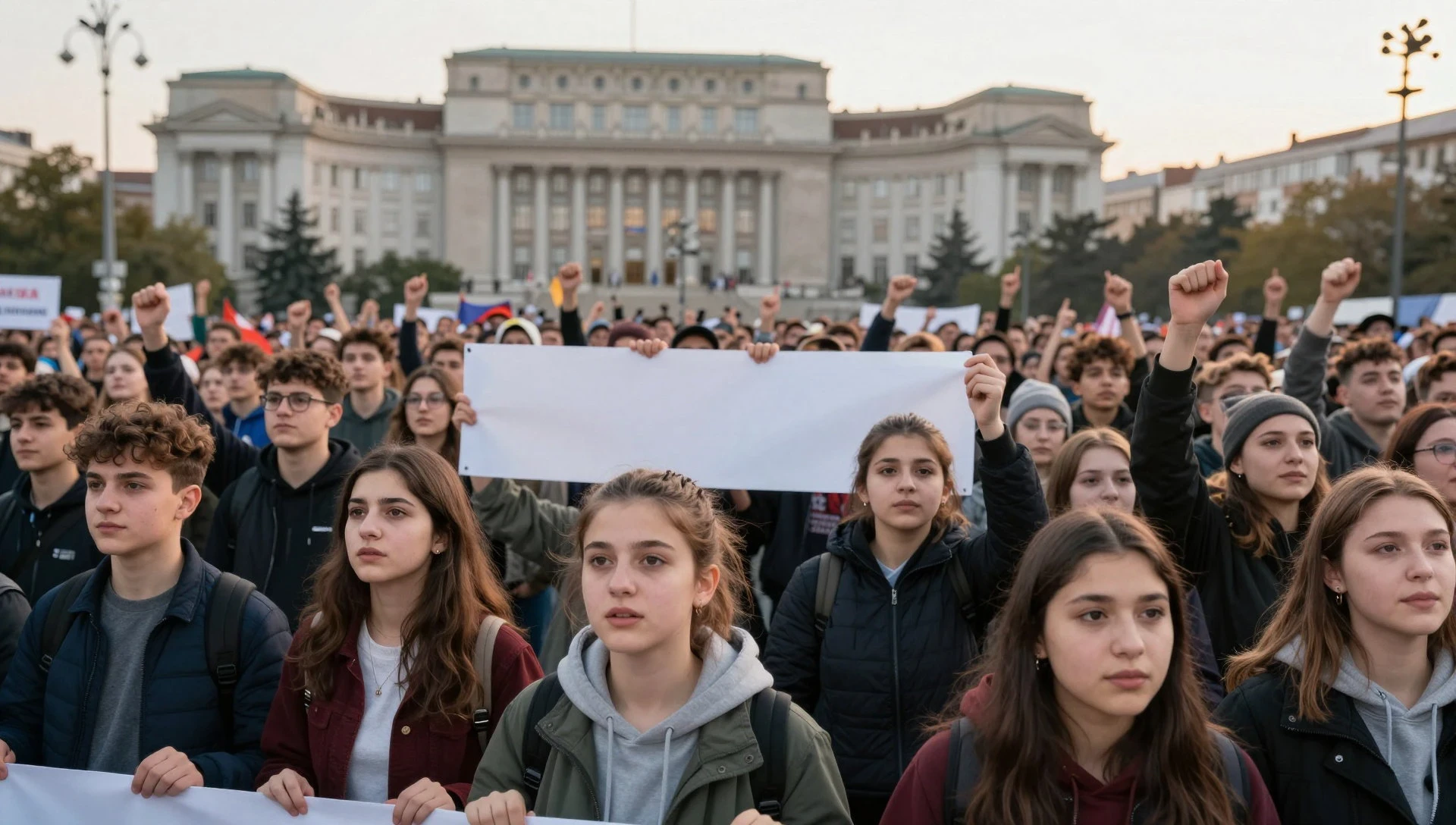
Serbia's October 2026 snap parliamentary election produced a decisive rupture in the country's post-2012 political order. A student-led coalition, the Students' List, captured 53 percent of the vote against 39 percent for the Serbian Progressive Party of President Aleksandar Vucic, according to the independent watchdog CeSID, with 96 percent of ballots counted.
Translated into the 250-seat Skupstina, that margin yields roughly 140 seats for the movement and 103 for the SNS, a reversal large enough to end fourteen years of right-wing populist governance without coalition arithmetic.
The proximate cause of this outcome was not ideology but accountability. The November 2024 collapse of a concrete canopy at Novi Sad railway station killed 16 people, and public anger fixed on the renovation contracts and permitting irregularities that preceded it.
On This Page
Nearly two years of sustained protest followed, culminating in turnout near 70 percent, the highest in a Serbian parliamentary election in more than three decades. Vucic conceded within two hours of polls closing, while attributing the result to foreign backing rather than domestic grievance.
What follows examines the mechanics of the victory, the institutional inheritance awaiting the incoming government, and the wider European significance of a grassroots student campaign defeating an entrenched party machine.
The analysis weighs electoral data against structural constraints, because a 53 percent mandate does not by itself resolve the corruption, media capture, and external alignment questions that produced the protest cycle in the first place.
TL;DR Serbia's student-led movement won a snap parliamentary election with 53 percent of the vote and approximately 140 of 250 seats, ending fourteen years of SNS dominance under Aleksandar Vucic. The vote followed nearly two years of protests triggered by the 2024 Novi Sad canopy collapse that killed 16 people. Turnout near 70 percent was the highest in over three decades. The result now tests whether grassroots democratic organizing can convert moral authority into governing capacity amid corruption investigations, media reform, and EU accession pressure.
The Electoral Arithmetic and the Anatomy of an Upset
The headline numbers describe a rout, but the underlying mechanics deserve closer reading. A movement with no prior parliamentary presence, minimal institutional funding, and an improvised national structure converted street mobilization into 53 percent of the popular vote.
That conversion rate is historically unusual, and it depended on three variables: the credibility of the triggering grievance, the neutrality of the count, and the willingness of the incumbent to concede rather than contest.
From Novi Sad to the Ballot Box
The canopy collapse at Novi Sad railway station functioned as a focusing event in the precise sense political scientists use the term. Sixteen deaths in a recently renovated public facility made abstract complaints about procurement fraud concrete and personal.
The disaster supplied the movement with a moral vocabulary that cut across urban and rural, young and old, and it made subsequent government defensiveness politically costly.
Protest logistics then built organizational capacity that later served electoral purposes. Student plenums, neighborhood assemblies, and faculty networks created distributed decision-making structures capable of sustaining momentum across two years.
When the snap election was called, those same networks could be repurposed for canvassing, poll-watching, and candidate recruitment within weeks rather than months, an advantage that conventional parties could not match.
The sequencing matters analytically. Movements that contest elections immediately after a triggering event often peak too early; movements that wait too long lose salience. Serbia's students sustained pressure for roughly twenty-four months, long enough to exhaust the government's counter-narrative but short enough to preserve urgency.
The snap election call, intended by the incumbent to catch opponents unprepared, instead arrived after the movement had already built durable infrastructure.
Turnout as the Decisive Variable
Turnout near 70 percent is the statistic that explains the seat distribution more than any other. In a polity where parliamentary participation had typically hovered well below that figure, a ten-point surge disproportionately benefits challengers, because irregular voters skew young and urban. The Students' List did not merely convert existing opposition voters; it expanded the electorate itself.
CeSID's count, based on 96 percent of ballots, placed no third party above the threshold, which compressed the seat arithmetic into a clean two-way split. That compression amplified the winner's mandate: 53 percent of votes became 56 percent of seats.
Proportional systems with high thresholds routinely produce this bonus, and it means the incoming government will not depend on fringe partners to legislate.
Concession, Contestation, and the Foreign-Hands Claim
Vucic's rapid concession, delivered less than two hours after polls closed, removed the most dangerous variable from the equation. Incumbents facing defeat frequently allege fraud to delegitimize results; a swift acknowledgment, even one framed as victimhood, forecloses that path. The concession also protected the count's credibility, which the incoming government will need when it pursues prosecutions.
His attribution of the result to European governments and the American "deep state" follows a recognizable populist template: defeat is externalized, domestic agency is denied, and supporters are told their opponents are proxies.
The claim is analytically weak, given the turnout surge and the movement's documented grassroots structure, but it retains utility as a narrative for the SNS's remaining base and for future mobilization.
Analyst Dusan Vucicevic's observation that the movement's grassroots democracy secured over half the vote, while cautioning that the model may not travel, is the more useful commentary. It identifies the mechanism, distributed decision-making with high legitimacy, and simultaneously flags its fragility.
Models built on participation are difficult to scale and harder to maintain once the founding grievance is addressed.
We Also Published
Governing Inheritance: Corruption, Media, and External Alignment
Winning an election is the simpler task. The Students' List inherits a state apparatus shaped by fourteen years of centralized party control, including judiciary appointments, regulatory boards, and public broadcaster leadership. Each of these institutions was implicated, directly or by omission, in the conditions that produced the Novi Sad disaster.
Reform therefore requires the incoming government to act against structures staffed by people it has spent two years denouncing.
The Corruption File and Institutional Trust
The Novi Sad collapse is not a closed matter. Investigations into the renovation contracts, permitting chain, and inspection failures remain the incoming government's most sensitive obligation. Prosecuting them credibly requires judicial independence that the previous administration had systematically eroded, which means reform of the judiciary is not a separate agenda item but a precondition for delivering on the mandate's central promise.
Public expectations are correspondingly high and correspondingly impatient. Movements born from single-issue grievances often discover that their base measures success against the original demand, not against legislative output. If prosecutions stall, or if they appear selective, the same mobilization capacity that produced 140 seats can be turned against the new government with equal speed.
There is also a fiscal dimension. Anti-corruption enforcement typically begins with procurement audits, and Serbia's infrastructure pipeline depends on public tenders with significant external financing. Reopening contracts may trigger disputes with contractors and lenders, imposing short-term costs that a government with a fresh mandate and thin administrative bench may struggle to absorb.
Media Capture and the Information Environment
Serbia's media landscape under the SNS featured concentrated ownership, state advertising used as leverage, and public broadcasting aligned with incumbents. Reversing this requires legislation, regulatory appointments, and sustained political will against outlets that will characterize reform as censorship. The incoming government must simultaneously avoid the mirror-image error of using state media for its own advantage.
Independent watchdogs and press freedom indices have documented these patterns for years, and European institutions have flagged them in accession assessments. The Students' List can leverage that external documentation to justify reform, converting international benchmarks into domestic political cover. Doing so, however, invites the SNS's foreign-hands narrative to harden into a durable opposition talking point.
Foreign Policy Between Brussels, Moscow, and Washington
Serbia's external alignment has long balanced EU accession ambitions with energy dependence on Russia and cordial ties to Washington. The SNS managed this triangulation through ambiguity; a movement that owes its victory partly to European and American rhetorical support will face pressure to choose more explicitly. That pressure will arrive before the government has consolidated its administrative capacity.
Recognition of Kosovo remains the binding constraint on EU membership and the issue most likely to fracture the Students' List's broad coalition. The movement campaigned on domestic accountability, not territorial questions, and has no settled position that satisfies both its nationalist-inclined voters and Brussels. Deferral is possible but costly, since accession timelines reward early clarity.
Energy contracts with Russian suppliers present a parallel test. Reorientation toward alternative supply requires capital and time, and any abrupt move risks price shocks that would erode the government's domestic standing. The incoming administration will likely pursue incremental diversification while avoiding public confrontation, a strategy that satisfies neither hawks nor dependents.
A European Precedent and the Limits of a Student Model
The Serbian result arrives during a visible wave of youth-led demonstrations across Europe, from climate movements to housing protests to anti-corruption campaigns. What distinguishes Serbia is conversion: mobilization became parliamentary representation at governing scale.
That conversion, rather than the protest itself, is the transferable lesson, and it depends on conditions that vary sharply across the continent.
What Travels and What Does Not
Three conditions enabled the Serbian outcome. First, a discrete, morally unambiguous triggering event with documented institutional failure behind it. Second, an electoral system with a single national threshold that rewarded consolidation. Third, an incumbent willing to concede. Remove any one, and the trajectory changes materially, which is why Vucicevic's caution is warranted.
Movements in countries with fragmented party systems face a different arithmetic: even strong protest energy may fragment across multiple lists, diluting seat returns. Movements in systems with runoffs or district-based elections must build geographically targeted organizations rather than national ones. And movements facing incumbents willing to contest results must prepare for legal and street-level confrontation simultaneously.
The organizational model itself, distributed plenums with rotating facilitation, has genuine advantages in legitimacy and resilience. It also has known weaknesses: slow decision-making, difficulty negotiating with external actors, and vulnerability to factional capture once the unifying grievance fades. The Students' List will now test whether participatory structures can execute policy at state scale.
Regional Reverberations in the Western Balkans
Neighboring states with similar governance profiles will read the Serbian result as both warning and template. Incumbents in the region have already begun framing youth mobilization as externally orchestrated, borrowing Vucic's vocabulary.
Opposition movements, conversely, will study the plenum model and the two-year timeline as a playbook for sustained pressure without premature electoral entry.
Brussels faces a delicate calculation. Celebrating the result too enthusiastically validates the SNS's foreign-hands narrative; responding too coolly wastes an opportunity to re-energize enlargement policy. The most defensible posture is procedural: offer accession support conditional on documented reforms, and let the incoming government own its domestic agenda without external branding.
Russia's reaction will be closely watched given Serbia's energy ties and the SNS's cordial relations with Moscow. A government explicitly oriented toward Brussels would alter the regional balance, though the Students' List has given no indication of abrupt rupture. Continuity in energy contracts is the likeliest short-term outcome regardless of rhetorical shifts.
Measuring Success After the Honeymoon
The incoming government's first hundred days will be judged against three measurable benchmarks: whether Novi Sad prosecutions advance, whether public broadcaster leadership changes, and whether procurement transparency improves in verifiable terms.
Each is observable, each was central to the protest agenda, and each can be tracked by the same civil society organizations that monitored the election.
Beyond that window, the harder test is institutional durability. Movements that govern through informal networks rather than formal procedures tend to concentrate authority over time, reproducing the pathologies they opposed.
Codifying the plenum model into statutory consultation mechanisms would be the clearest signal that participatory democracy is a governing method rather than a campaign technique.
Finally, the movement must manage its own success narrative. A 53 percent mandate is a mandate to govern, not a permanent license, and the electorate that turned out at 70 percent can withdraw that mandate with equal decisiveness.
The most reliable protection is delivery on the specific promises that produced the victory, measured publicly and without embellishment.
Frequently Asked Questions
Readers seeking clarity on the Serbian election's mechanics and implications will find the following consolidated answers useful. Each response draws on the reported figures and the structural analysis above, distinguishing between confirmed electoral data and the more speculative questions of governing capacity and regional precedent.
What exactly happened in Serbia's snap election?
A student-led movement, the Students' List, won 53 percent of the vote against 39 percent for the Serbian Progressive Party, according to CeSID projections at 96 percent of the count. That translates to roughly 140 of 250 seats, ending fourteen years of SNS-led government under President Aleksandar Vucic.
Why did the election happen when it did?
The vote followed nearly two years of anti-government protests triggered by the November 2024 collapse of a canopy at Novi Sad railway station, which killed 16 people. The disaster was widely attributed to corruption in renovation and inspection processes, and it sustained mobilization at unusual scale.
How significant was turnout?
Turnout near 70 percent was the highest in a Serbian parliamentary election in more than three decades. High turnout disproportionately benefits challengers because irregular voters skew younger and more urban, which helps explain why a new movement outperformed established opposition parties.
What did Vucic say about the result?
He conceded defeat less than two hours after polls closed, which protected the count's credibility. He simultaneously blamed foreign powers, describing the outcome as a revolution supported by various European countries and the US deep state, a framing consistent with populist defeat narratives.
Can the student model be replicated elsewhere?
Analyst Dusan Vucicevic noted that the movement's grassroots democracy secured over half the vote but cautioned that a similar model may not work elsewhere. Transferability depends on a discrete triggering event, a consolidating electoral system, and an incumbent willing to concede.
What are the incoming government's biggest challenges?
Judicial reform and credible prosecution of the Novi Sad procurement chain are the most urgent obligations. Media reform, procurement transparency, and the Kosovo question will test the coalition's cohesion, while energy dependence on Russia constrains any rapid foreign policy reorientation.
Conclusion: Mandate, Method, and the Test of Delivery
The Serbian election demonstrates that sustained, disciplined mobilization can defeat an entrenched party machine, but it also demonstrates how narrow the enabling conditions are. A fatal institutional failure, a consolidating electoral system, and a conceding incumbent aligned within a single two-year window. The Students' List now holds 140 seats and a mandate that no coalition arithmetic can dilute.
Governing will require the movement to convert participatory legitimacy into administrative competence, and to do so while prosecuting the very networks it opposed. The measurable benchmarks are clear: Novi Sad indictments, broadcaster reform, procurement transparency, and codified consultation.
Failure on any of these would validate the SNS's narrative that protest energy cannot govern, and would hand the opposition its most effective argument.
For Europe, the result is a data point rather than a template. Youth-led movements elsewhere will study the Serbian timeline and the plenum structure, but they will also confront different electoral systems and less accommodating incumbents.
The transferable insight is narrower and more durable: movements win when they build organizational capacity before the election is called, not after.
From our network :
- The Final Descent: How ESA Retired the Legendary Cluster Constellation After 24 Years of Space Weather ScienceAfter 24 years mapping Earth’s magnetosphere, ESA’s Cluster mission concluded with a precisely controlled reentry over the South Pacific. This analysis explores the scientific legacy, engineering decisions, and debris mitigation principles behind one of space exploration’s most responsible retirements.
- CISA’s Ten-Advisory Wave: Why Generic Patching Fails in OT and How to Build Product-Specific PlaybooksCISA released ten ICS advisories in one week, exposing critical infrastructure risks. Generic patching fails in OT. Learn to build product-specific remediation playbooks.
- Mobile Learning and VR in English: What Global Evidence Reveals About Effective Language TechnologyA systematic review across 14 countries reveals which language-learning technologies genuinely work. Mobile learning, AI, and VR show measurable benefits when pedagogically integrated. This evidence-based guide helps educators and learners select technology that delivers real return on investment.
- Live Online English Classes for Kids: Do They Actually Reduce Anxiety?A ten-week study reveals that synchronous online English classes can significantly reduce child language anxiety while improving listening and reading skills. Discover what makes these programs effective and how parents can select the right one.
- How AI Agents Will Change the Way We Manage Personal FinancesExplore how AI agents are transforming personal finance through automated budgeting, bill payment, and investment management, while examining the critical security protocols and governance frameworks required for safe deployment.
- Forbidden Matrix Patterns and Visible Lattice Points: A Geometric DictionaryExplore how multidimensional 0–1 matrices encode geometric truths, linking forbidden patterns to visible lattice points and hypergraph theory, with applications in combinatorics and computational geometry.
- University Language Proficiency Exams: Why Institutional Tests Demand Different Preparation Than IELTS and TOEFLDiscover why university-specific language proficiency examinations differ fundamentally from IELTS and TOEFL, and learn strategic preparation approaches for institutional assessment success.
- The Hidden Cost of AI Convenience: Why Over-Permissioned Agents Are a Security Time BombDiscover why AI agents with excessive permissions create dangerous single points of failure, and learn how implementing least privilege principles can protect your organization from exploitation.
- Committed Mediterranean Precipitation Decline: Why Emissions Cuts Alone Cannot Restore Winter RainsNew NOAA research reveals that Mediterranean winter rains may decline irreversibly even with emissions cuts. Explore the science of committed climate change and regional impacts.
RESOURCES
- Serbia's Vucic concedes defeat in historic election win for ... - Reutersreuters.comOct 25, 2026 ... Serbia's Aleksandar Vucic conceded defeat to a student-led protest movement in a historic election on Sunday that ends his long…
- Serbia's veteran ruler Vučić concedes election to student-led protest ...bbc.com7 days ago ... Serbia's long-standing leader Aleksandar Vučić has admitted defeat to a student-led protest movement in snap parliamentary elections.
- Serbia Election Marks the End of an Eracfr.org5 days ago ... The country's student-led opposition movement secured a historic victory in parliamentary elections. But the new government will have its ...
- Serbia's Vucic concedes election defeat to student-led movementaljazeera.comOct 25, 2026 ... ... 2026, after the student movement declared victory at snap parliamentary elections [AFP]. Belgrade resident Dragana Kovecevic told the ...
- Serbian leader Aleksandar Vučić ousted by student movement in ...theguardian.comOct 25, 2026 ... ... election provoked by student-led protests. ... The victory for the student-led movement in Serbia is also likely to ...
- How the Serbian Student Movement Is a Victory for Organizing Powerthenation.com3 days ago ... ... snap election outright. Standing on the corner of Broadway and 72nd Street in New York City and reading the…
- Serbia's strongman leader Vučić concedes defeat to student-led ...nbcnews.comOct 25, 2026 ... BELGRADE, Serbia — The long-serving strongman leader of Serbia, Aleksandar Vučić, conceded defeat Sunday in an election that pitted him…
- Experts react: Serbia's Vučić is out and the student-led movement is ...atlanticcouncil.org6 days ago ... Vučić, who has dominated Serbian politics since 2014 as prime minister and then as president, had called the snap election…
- Serbia's Aleksandar Vucic concedes defeat to the student-led ...abc7news.com6 days ago ... Final "Student List - Students Win" rally ahead of a parliamentary election in Belgrade, Serbia, Thursday, Oct. 22, 2026. AP…
- Serbia's student movement defeats Russia-backed leader - NPRnpr.org7 days ago ... ... elections that saw Serbia's student-led movement claim victory. ... election operations facility on May 27, 2026 in. Politics ·…
- Serbia's student movement ousts nationalist leader Aleksandar ...lemonde.fr7 days ago ... ... Serbia, October 26, 2026. UROS ARSIC / REUTERS. Serbia's student-led movement declared victory in parliamentary elections Sunday, October 25 ...
- Serbia's leader concedes defeat to student-led movement in ... - CNNcnn.comOct 25, 2026 ... The long-serving strongman leader of Serbia, Aleksandar Vucic, conceded defeat on Sunday in an election that pitted him and his…
- Serbian president concedes defeat to student-led movement in ...abc.net.auOct 25, 2026 ... President Aleksandar Vučić has conceded defeat to a student-led protest movement in Serbia's parliamentary elections. Mr Vučić called a snap ...
- What Serbian and Hungarian Opposition Parties Have in Commonicds.eeOct 2, 2026 ... Serbia's snap election on 25 October has raised high ... The student-led protest movement has since entered the race as…
- Serbia's Aleksandar Vucic concedes defeat to student-led oppositiondw.comOct 25, 2026 ... Vucic: 'It is clear that we lost these elections' · What is Serbia's student protest movement · The scandals that…
- 01
- 02
- 03
- 04
- 05
- 06
- 07
- 08
0 Comments