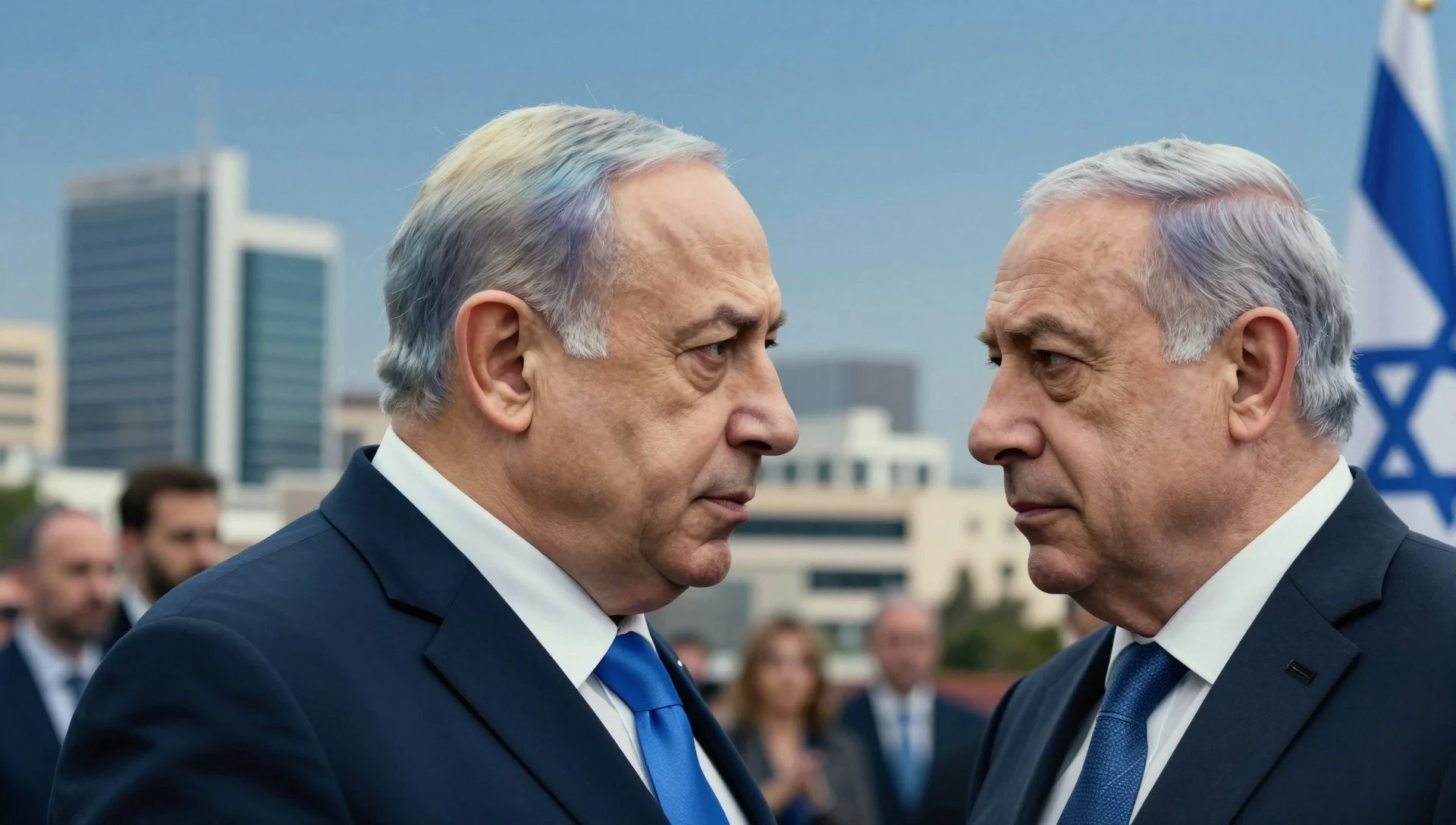
The Israeli general election of October 2026 constitutes a political contest in which the incumbent prime minister, Benjamin Netanyahu, functions simultaneously as candidate, governing framework and primary axis of partisan identification.
His tenure, spanning 19 of the past 30 years since first assuming office three decades ago, has restructured the Israeli party system around a single referential figure rather than a conventional left-right continuum.
Analysts therefore characterise the campaign as a referendum on personal rule, institutional concentration and the durability of a political brand that has outlasted successive coalitions, intifadas and diplomatic realignments.
On This Page
The principal opposition challenger, Gadi Eisenkot, a former military chief of staff who entered electoral politics four years ago at the helm of the Yashar party, embodies a distinct model of authority rooted in professional military credibility rather than partisan apprenticeship.
His campaign rhetoric, including the call for "a country without lies" and the advocacy of statutory term limits on prime ministers, signals an argument that executive longevity itself corrodes accountability. Supporters reportedly regard his limited political charisma as an asset, interpreting directness as evidence of reliability rather than deficiency.
Beyond the two leading figures, the electoral landscape is populated by actors whose positions are legible chiefly through their historical relationship with Netanyahu. Naftali Bennett and Avigdor Lieberman, both situated on the nationalist right, once governed in close alignment with him before subsequent rupture.
On the far-right periphery, figures such as Yishai Fleisher of Otzma Yehudit deploy derisive imagery, comparing the prime minister to a shopping trolley before orthodox audiences in Bet Shemesh. These dynamics unfold against documented societal fissures, rendering the election an index of polarisation as much as a mechanism of representation.
TL;DR Israel's October 2026 election is structured less by ideological polarity than by proximity to Benjamin Netanyahu, whose three-decade career has made him the gravitational centre of the party system. Gadi Eisenkot of Yashar presents a military-credibility alternative emphasising integrity and term limits, while right-wing figures such as Bennett and Lieberman define themselves through prior alliance and subsequent rupture with the incumbent. The contest therefore measures both the durability of personalist politics and the depth of societal division within Israel.
The Structural Logic of Personalist Electoral Competition
The campaign demonstrates how a dominant incumbent can reorganise the fundamental grammar of electoral competition, substituting affiliation with a single figure for programmatic disagreement between blocs. When the principal cleavage is described as support for or opposition to one individual, parties lose autonomous ideological identity and become satellites orbiting a shared centre.
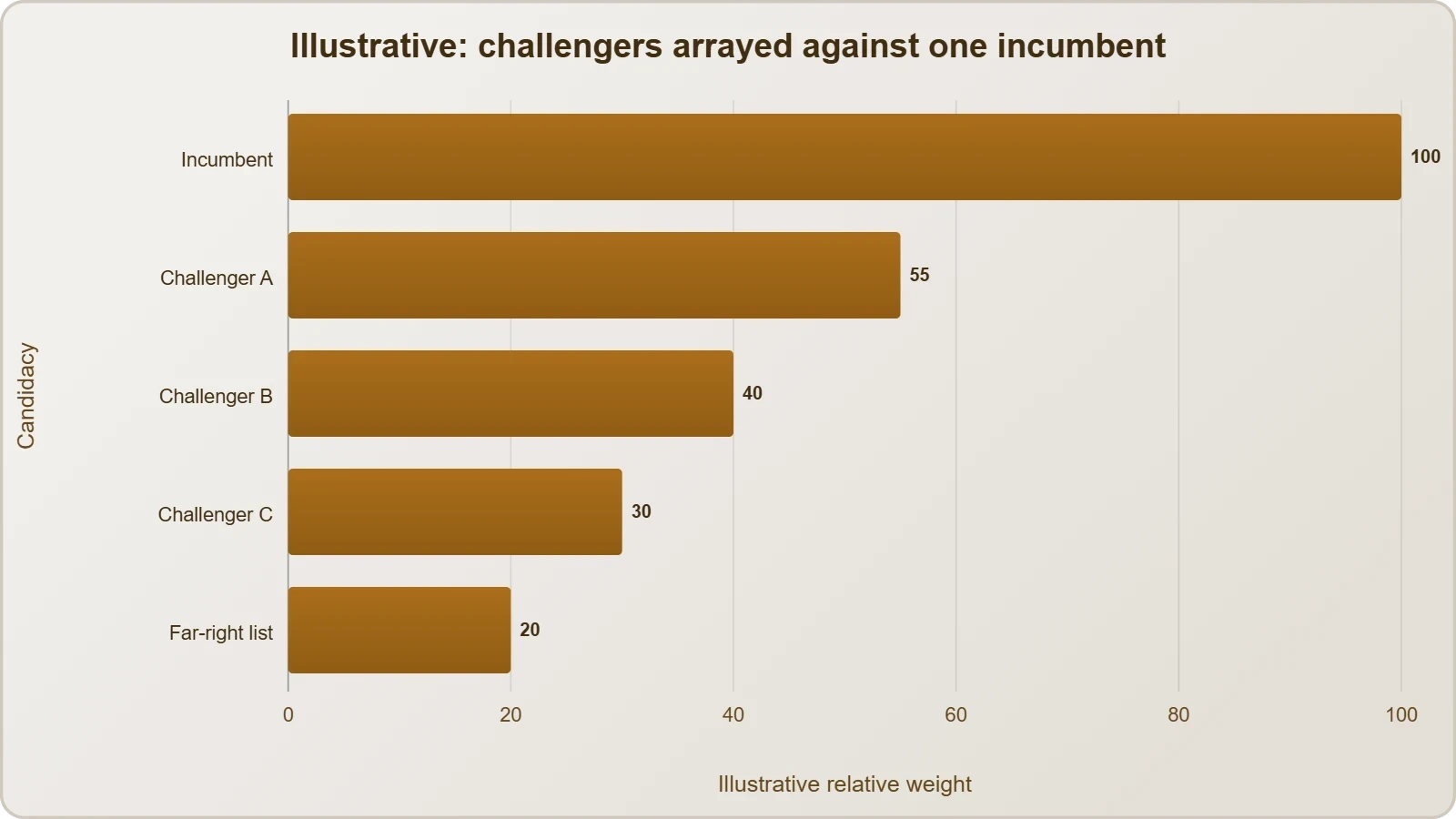
This configuration is analytically distinct from conventional spatial models of voting, in which parties occupy stable positions along redistributive or security axes and voters select the nearest alternative.
From Left-Right Cleavage to Incumbent Referendum
Comparative scholarship on personalist parties suggests that prolonged incumbency converts a leader's biography into an informal constitution, against which all rivals must position themselves. Netanyahu's 19 years in office across three decades provide an unusually extended case, allowing observers to trace how institutional memory, patronage networks and media familiarity compound into structural advantage.
The resulting asymmetry means opposition candidates contest not merely policies but the legitimacy of an entire governing epoch.
Under such conditions, the left-right vocabulary retains rhetorical currency while losing descriptive precision, because voters may support redistributive policies and simultaneously endorse the incumbent's security posture. Survey evidence from comparable systems indicates that affective polarisation, defined as hostility toward opposing partisans rather than disagreement on issues, intensifies when leadership becomes the primary cue. Israel's current contest appears consistent with this pattern, though causal attribution remains contested among scholars.
The practical consequence is that coalition arithmetic becomes secondary to the symbolic question of whether the incumbent's tenure should continue. Parties that might otherwise compete for median voters instead compete for the role of principal alternative, producing fragmentation among opposition forces.
This dynamic can paradoxically strengthen the incumbent, since dispersed challengers cannot easily aggregate a majority against a unified governing bloc.
Analysts should therefore interpret campaign rhetoric with attention to its relational function rather than its substantive content. A slogan criticising corruption or promising integrity may communicate less about policy than about distance from the incumbent.
The election thus functions as a measurement instrument for the incumbent's residual authority, calibrated through the intensity of opposition rhetoric and the willingness of former allies to defect.
The Eisenkot Candidacy and Military Credibility as Political Capital
Eisenkot's profile illustrates a recurring pathway in Israeli politics whereby senior military office confers transferable legitimacy in civilian contests. His four years in electoral politics represent a comparatively brief apprenticeship, yet his tenure as chief of staff supplies name recognition and an implicit claim to competence in security affairs.
The Yashar campaign appears designed to convert this professional capital into an argument for institutional restraint and executive humility.
The pledge to eliminate Hamas situates Eisenkot firmly within mainstream security consensus, pre-empting accusations that his emphasis on integrity implies strategic softness. This positioning is significant because it narrows the space for the incumbent to portray opposition as a security risk.
Campaign appearances in Modi'in, where speakers emphasised background and integrity, suggest a deliberate strategy of projecting steadiness rather than charisma.
The proposal for prime ministerial term limits constitutes the most institutionally consequential element of his platform, framing concentrated power as inherently corrupting. Such a reform would alter Israel's constitutional practice rather than merely its personnel, and its advocacy signals that the campaign targets the structure of incumbency, not solely its current occupant. Whether voters prioritise structural reform over immediate security concerns remains an open empirical question.
Supporters' characterisation of limited charisma as an advantage reflects a broader anti-populist mood observable in several democracies, where stylistic restraint is reinterpreted as authenticity. This framing allows Eisenkot to compete without replicating the incumbent's communicative style, though it also risks ceding emotional intensity to rivals. The strategic bet is that fatigue with perpetual campaigning outweighs appetite for performative leadership.
Right-Wing Fragmentation and the Politics of Former Allegiance
The nationalist right presents a particularly instructive case, since Bennett and Lieberman combine ideological proximity to the incumbent with personal histories of rupture. Their trajectories demonstrate that coalition partnerships in personalist systems generate durable resentments when terminated, and that former allies often become the most credible critics.
Each must therefore manage a dual audience of voters who admire the incumbent and voters who feel betrayed by him.
Bennett's prior service as prime minister within a broad coalition, and Lieberman's recurrent role as kingmaker, supply both figures with governing credentials that newer parties lack. Yet these credentials are inseparable from their association with Netanyahu, creating a rhetorical trap in which criticism invites accusations of ingratitude or opportunism. Their campaigns consequently emphasise competence and reliability rather than direct confrontation.
This fragmentation on the right complicates any simple narrative of a unified nationalist bloc confronting a unified opposition. Instead, multiple parties compete for overlapping constituencies, and the incumbent benefits from the dispersion of anti-incumbent sentiment across several lists. Electoral systems with proportional representation amplify this effect, since small parties can survive without aggregating majorities.
The far-right periphery, represented by Otzma Yehudit and figures such as Fleisher, adopts a different register, employing vivid and occasionally derisive imagery to signal independence from the incumbent's establishment. The shopping-trolley comparison, delivered to orthodox voters in Bet Shemesh, illustrates how humour and insult function as markers of authenticity. Such rhetoric may attract protest voters while limiting the party's capacity for coalition respectability.
Societal Division as Electoral Substrate
The election occurs amid divisions that extend beyond partisan preference into questions of religious authority, judicial independence and military service obligations. These cleavages predate the current campaign and structure its reception, meaning that campaign events are interpreted through pre-existing loyalties rather than creating them.
Analysts therefore treat the contest as an expression of underlying social stratification as much as a cause of polarisation.
When a single figure dominates political culture for three decades, that figure becomes a repository for accumulated grievances and aspirations alike, personalising structural conflicts. Voters may experience disagreements over judicial reform or conscription as disagreements about the incumbent himself, which raises the stakes of electoral choice. This personalisation can mobilise participation but also erode trust in institutions that mediate conflict.
Comparative research on divided societies indicates that elections in such contexts function as censuses of affiliation, revealing the relative strength of competing identities. Israel's current contest appears consistent with this interpretation, given the prominence of identity-based appeals and the limited salience of distributive economics.
The resulting mandate, whichever coalition emerges, will confront the challenge of governing a polity whose divisions the campaign has amplified.
It remains uncertain whether the election will produce a governing coalition capable of addressing these divisions, or merely a temporary equilibrium. The structural factors identified here, including personalist dominance, fragmented opposition and entrenched cleavages, suggest that any resolution will be provisional. Observers should therefore attend to post-election coalition negotiations as closely as to the vote itself.
Incumbency, Longevity and the Architecture of Executive Power
The duration of Netanyahu's tenure invites systematic examination of how extended incumbency reshapes executive institutions, party organisations and public expectations. Three decades of presence, encompassing 19 years in office, generate cumulative advantages that are difficult to quantify but empirically consequential.
These include familiarity among voters, established relationships with foreign governments, and control over appointment processes that shape bureaucratic and judicial composition.
Temporal Dimensions of Political Dominance
Political science literature distinguishes between electoral success, which is episodic, and regime consolidation, which is structural. Netanyahu's career spans both categories, with repeated electoral victories accompanied by institutional changes that outlast individual campaigns.
The relevant analytical question concerns the threshold at which prolonged leadership ceases to be a variable within a system and becomes a constitutive feature of it.
Quantitatively, 19 years in office across a 30-year span implies an occupancy rate of approximately 63 per cent, a figure that exceeds most comparable parliamentary democracies. Such continuity affects the civil service, the judiciary and the military through appointment cycles, producing what scholars term institutional imprinting. The precise magnitude of this effect in Israel remains debated, but its direction is widely acknowledged.
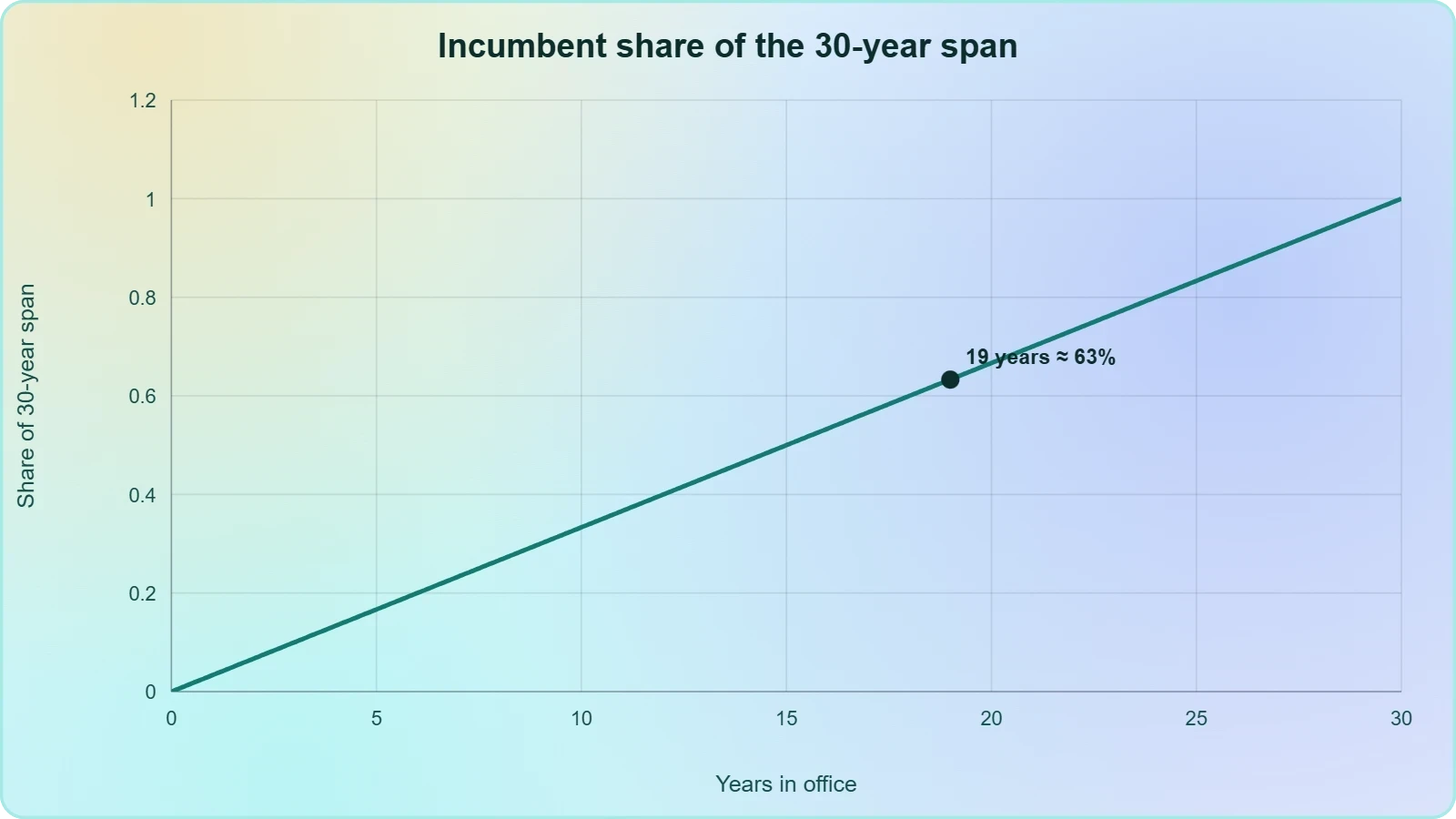
###\text{Occupancy Rate} = \frac{19}{30} \approx 0.633###
The equation above offers a crude but instructive metric, indicating that the incumbent has governed for roughly two-thirds of the period under consideration. Comparative cases suggest that occupancy rates above 50 per cent correlate with diminished turnover in senior administrative positions. Whether this constitutes entrenchment or merely stability depends on normative priors, but the empirical pattern warrants attention.
Term Limits as Institutional Corrective
Eisenkot's advocacy of prime ministerial term limits represents a direct institutional response to the longevity problem, proposing a constitutional constraint rather than relying on electoral volatility. Term limits exist in numerous presidential systems, including the United States, Brazil and Mexico, though parliamentary systems have adopted them less frequently. The proposal therefore imports a presidential mechanism into a parliamentary context, raising questions of compatibility.
Proponents argue that term limits reduce the personalisation of politics, encourage leadership renewal and diminish the value of incumbency advantages. Critics counter that they remove experienced leaders prematurely, weaken accountability during final terms and may shift power to unelected advisers.
The empirical record is mixed, with studies finding modest effects on corruption and ambiguous effects on governance quality.
Within Israel's specific institutional setting, term limits would require basic-law legislation and would likely face constitutional challenge. The proposal's significance may therefore lie less in its immediate feasibility than in its diagnostic function, identifying concentrated executive power as a systemic risk. Campaigns that raise structural questions can influence public discourse even when their specific proposals fail.
Security Credentials and Civilian Authority
The translation of military rank into political authority is a well-documented phenomenon in states with conscript armies and existential security threats. Former chiefs of staff possess public recognition, demonstrated competence under pressure and networks extending across institutional boundaries. Eisenkot's candidacy exemplifies this pathway, though his comparatively recent entry into politics limits his partisan infrastructure.
Critics of military-to-political transitions argue that command experience does not automatically confer aptitude for coalition management, budgetary negotiation or legislative strategy. Supporters counter that the armed forces cultivate exactly the decision-making discipline that civilian leadership requires. The debate reflects deeper questions about what qualities democratic electorates should prioritise when selecting executives.
The pledge to eliminate Hamas illustrates how security credentials constrain as well as enable candidates, since maximalist commitments invite scrutiny of feasibility. Eisenkot must therefore balance the credibility conferred by his background against the expectations it generates. This tension is characteristic of security-oriented candidacies in contested regions.
Charisma, Authenticity and Anti-Populist Strategy
The deliberate cultivation of an uncharismatic persona constitutes a notable strategic innovation, inverting conventional assumptions about electoral communication. By framing plainness as honesty, the campaign positions itself against performative politics and appeals to voters fatigued by perpetual campaigning. This strategy presupposes a electorate that values substance over spectacle, an assumption requiring empirical verification.
Research on political communication suggests that authenticity perceptions depend on consistency between message and demeanour rather than on warmth or energy. A candidate who consistently projects restraint may therefore be judged authentic even if judged uninspiring. The strategic question is whether authenticity alone can mobilise sufficient turnout in a polarised environment.
Comparative examples include technocratic candidates in European elections who emphasised competence over charisma and achieved variable results. Success appears contingent on the salience of crisis conditions, which elevate competence above inspiration. Israel's security environment may provide favourable conditions for such an appeal, though the incumbent's communicative dominance complicates the contest.
We Also Published
Coalition Dynamics and the Fragmentation of Opposition
Proportional representation systems reward party fragmentation, and Israel's low electoral threshold has historically produced multi-party legislatures requiring complex coalition bargaining. In the current contest, fragmentation is concentrated among opposition forces, where multiple lists compete for overlapping anti-incumbent constituencies. This dispersion creates a structural advantage for the governing bloc, which can negotiate from a consolidated position.
Arithmetic of Aggregation Under Proportional Rules
The translation of votes into seats under proportional representation follows a predictable mathematical relationship, though threshold effects and district allocation introduce nonlinearities. Parties that fail to cross the threshold forfeit their votes, effectively transferring seats to larger lists. Strategic voting therefore becomes consequential, as voters weigh preference against viability.
Opposition fragmentation interacts with this arithmetic in ways that may systematically disadvantage anti-incumbent majorities. If several parties each secure representation but none commands sufficient seats to lead, coalition formation requires concessions that dilute reform agendas.
The incumbent, by contrast, can leverage a stable base and negotiate with smaller partners from a position of relative strength.
Historical Israeli elections demonstrate recurrent patterns of post-election bargaining lasting weeks, with coalition agreements specifying budgetary allocations and policy commitments. The current contest is likely to follow this pattern, though the personalisation of the campaign may complicate negotiations.
Parties defined primarily by opposition to an individual may find cooperation difficult once that individual is removed from the immediate contest.
Former Allies as Credible Critics
The credibility of political criticism often depends on the critic's prior proximity to the target, since defectors can claim inside knowledge unavailable to lifelong opponents. Bennett and Lieberman occupy this position, having governed alongside Netanyahu before withdrawing support. Their critiques therefore carry evidentiary weight that external criticism lacks, though they also invite accusations of self-interest.
This dynamic creates a distinctive rhetorical burden: former allies must explain their earlier cooperation while justifying subsequent rupture. Explanations typically invoke changed circumstances or revealed character, both of which are difficult to verify. Voters must therefore assess credibility through indirect cues such as consistency, tone and the specificity of allegations.
The strategic value of defector criticism is highest when it addresses matters of competence or integrity rather than ideology, since ideological disagreement is expected among rivals. Allegations concerning decision-making processes or ethical conduct are more damaging because they cannot be dismissed as partisan positioning. The current campaign appears to feature such allegations, though their electoral impact remains uncertain.
Far-Right Rhetoric and Coalition Respectability
Parties on the far-right periphery face a persistent tension between attracting protest voters through transgressive rhetoric and maintaining the respectability required for coalition inclusion. The shopping-trolley comparison attributed to Fleisher exemplifies transgressive framing, using mundane imagery to diminish the incumbent's stature. Such rhetoric may energise base supporters while alienating potential partners.
Comparative research on radical-right parties identifies a normalisation trajectory in which initially marginal actors moderate their rhetoric to enter government. Whether Otzma Yehudit follows this trajectory depends on electoral results and coalition arithmetic, as well as on the willingness of mainstream parties to collaborate. The party's current positioning suggests it prioritises ideological clarity over immediate governing prospects.
The use of humour as a political instrument deserves analytical attention, since jokes can convey criticisms that would be libellous if stated directly. Derisive comparisons function as plausible deniability, allowing speakers to signal contempt while retaining formal deniability. Audiences attuned to shared codes interpret such remarks as substantive claims rather than mere entertainment.
Orthodox Constituencies and Religious-Political Alignment
The Bet Shemesh setting of the reported remarks is significant, since orthodox communities constitute a growing demographic with distinctive political priorities centred on religious education, Sabbath observance and military exemption. Parties compete intensely for these voters, whose turnout rates are comparatively high. Rhetoric addressed to orthodox audiences therefore reflects calculations about a pivotal constituency.
Religious-political alignment in Israel has historically favoured parties that combine doctrinal commitment with pragmatic coalition participation. The incumbent's long tenure has involved sustained engagement with orthodox parties, producing both policy concessions and mutual dependence.
Challenges to this alignment emerge when newer parties offer more stringent religious commitments or when secular voters mobilise against orthodox influence.
The interaction between religious constituencies and personalist politics is complex, since loyalty to the incumbent may coexist with loyalty to rabbinic authority. Voters may therefore evaluate candidates through multiple filters, including religious endorsement and communal interest. Analysts should avoid reducing orthodox voting to a single determinant.
Comparative Perspectives on Personalist Leadership
Israel's experience invites comparison with other democracies where prolonged incumbency has restructured party competition around a single figure. Cases ranging from Turkey and Hungary to India and Brazil exhibit analogous dynamics, though institutional contexts differ substantially. Comparative analysis can therefore illuminate general mechanisms while respecting contextual specificity.
- 01
- 02
- 03
- 04
Global Patterns of Extended Incumbency
Cross-national data indicate that extended incumbency correlates with institutional adaptation, as leaders modify rules governing term length, judicial appointment and media regulation. These adaptations are not necessarily anti-democratic, but they alter the competitive landscape in ways that advantage incumbents. The analytical challenge lies in distinguishing legitimate institutional reform from self-serving manipulation.
Comparative scholarship identifies several mechanisms through which incumbency advantages accumulate, including patronage, media access and agenda control. These mechanisms operate continuously rather than discretely, producing cumulative effects that are difficult to reverse. The Israeli case exhibits several such mechanisms, though their relative weight remains contested among observers.
Quantitative indices of democracy, such as those produced by V-Dem and Freedom House, capture some but not all of these dynamics. Their methodologies rely on expert coding, which introduces subjectivity and lag. Analysts should therefore triangulate quantitative indices with qualitative case knowledge when assessing institutional change.
Term Limits in Comparative Constitutional Design
Term limits represent one of the few institutional mechanisms explicitly designed to constrain incumbency advantages, and their global diffusion has accelerated since the 1990s. Presidential systems in Latin America, Africa and Asia have adopted limits with varying degrees of enforcement. Parliamentary systems have been more resistant, reflecting the centrality of legislative confidence to executive tenure.
Empirical research on term limits yields mixed findings, with some studies reporting reduced corruption and others finding no significant effect. The heterogeneity likely reflects differences in enforcement, institutional context and the presence of complementary accountability mechanisms. Term limits alone appear insufficient to guarantee democratic quality.
Within parliamentary systems, term limits on prime ministers are rare, and their introduction would require significant constitutional amendment. The proposal's significance may therefore be primarily discursive, raising questions about executive concentration without immediate implementation. Such discursive interventions can nonetheless shape long-term institutional trajectories.
Security Establishments and Democratic Civilian Control
The integration of former military commanders into electoral politics raises questions about civilian control of the armed forces and the boundaries between security expertise and political authority. Democracies vary in their tolerance for such transitions, with some imposing cooling-off periods and others permitting immediate candidacy. Israel's practice has historically permitted rapid transitions.
Comparative research suggests that military-to-political transitions can strengthen civilian oversight when former commanders bring institutional knowledge to legislative roles. Conversely, they may blur boundaries and create expectations of military involvement in policy. The net effect depends on institutional safeguards and political culture.
Eisenkot's candidacy exemplifies the benign interpretation, presenting military experience as preparation for responsible governance rather than as a claim to authority. His emphasis on integrity and restraint reinforces this framing, distinguishing his candidacy from more assertive security-oriented appeals. Whether voters accept this framing remains an empirical question.
Polarisation, Affective Politics and Democratic Stability
Affective polarisation, defined as emotional distance between partisan groups, has increased across established democracies and is associated with diminished trust and reduced willingness to compromise. Israel's current contest exhibits high affective polarisation, with the incumbent serving as a focal point for both attachment and aversion. This configuration poses challenges for post-election governance.
Research indicates that affective polarisation can be mitigated by cross-cutting identities, deliberative institutions and leadership rhetoric that emphasises shared values. None of these mitigants appears prominent in the current campaign, which emphasises distinction and opposition. The resulting environment may complicate coalition-building and policy implementation.
Long-term democratic stability depends on the capacity of institutions to channel conflict without rupturing social bonds. Elections that amplify polarisation may therefore impose costs that outlast the campaign itself. Analysts should attend to post-election reconciliation efforts as indicators of systemic resilience.
Electoral Consequences and the Future of Israeli Governance
The October 2026 election will produce outcomes whose significance extends beyond the composition of the next coalition, shaping the trajectory of Israeli democracy for years to come. Whether the incumbent secures another term or the opposition achieves rotation, the campaign has already demonstrated the depth of societal division and the centrality of personal leadership to political competition. These structural features will persist regardless of the result.
Scenarios for Post-Election Governance
Three broad scenarios merit consideration, distinguished by the degree of opposition consolidation and the willingness of former allies to cooperate. In the first, fragmented opposition enables the incumbent to form a coalition with familiar partners, continuing existing policy trajectories.
In the second, consolidated opposition achieves a narrow majority, producing rotation and institutional reform. In the third, no stable coalition emerges, triggering prolonged negotiations or repeat elections.
Each scenario carries distinct implications for the issues identified throughout this analysis, including term limits, judicial independence and security policy. The first scenario preserves the status quo, the second enables structural change, and the third generates uncertainty that may itself influence institutional behaviour. Historical precedent suggests that repeat elections are not uncommon in Israel's proportional system.
The probability of each scenario depends on factors that cannot be reliably forecast, including turnout patterns, threshold effects and last-minute shifts. Analysts should therefore present scenarios as analytical tools rather than predictions, acknowledging the inherent uncertainty of electoral forecasting. The value of scenario analysis lies in preparing for multiple outcomes rather than selecting one.
Institutional Legacies of the Campaign
Beyond the immediate result, the campaign will leave institutional legacies that shape future contests, including precedents for campaign rhetoric, coalition formation and opposition strategy. The prominence of term limits as a campaign issue, for instance, may persist even if the proposal fails, influencing future debates about executive power. Similarly, the strategic use of military credentials may establish templates for subsequent candidates.
The campaign has also illuminated the structural advantages of incumbency, which may prompt reform proposals from civil society and academic actors. Whether such proposals gain political traction depends on post-election dynamics and the composition of the next coalition. Institutional reform typically requires sustained advocacy beyond a single electoral cycle.
Finally, the campaign's emphasis on personal leadership may accelerate or reverse depending on the outcome, with rotation potentially reducing personalisation and continuity reinforcing it. The long-term trajectory of Israeli political culture therefore remains contingent on choices made in the coming months. Observers should monitor both formal institutional changes and informal norms.
Implications for Regional and International Actors
Israel's electoral outcome carries implications for regional security, diplomatic alignments and economic relationships, though the precise magnitude depends on policy continuity. International actors typically prepare for multiple scenarios, calibrating engagement based on perceived stability and policy direction. The personalisation of Israeli politics complicates such preparation, since outcomes depend heavily on individual leadership.
Regional dynamics, including relations with Gulf states and the Palestinian question, may shift depending on the coalition's composition and priorities. The campaign's emphasis on eliminating Hamas suggests continuity in security policy regardless of outcome, though tactical approaches may differ. Diplomatic observers should therefore distinguish between strategic continuity and tactical variation.
Economic relationships, including trade agreements and investment flows, are less directly affected by electoral outcomes but may respond to perceived political risk. Markets typically price uncertainty rather than specific outcomes, meaning that prolonged coalition negotiations could generate volatility.
The eventual formation of a government, whatever its composition, may therefore be welcomed by economic actors seeking clarity.
Methodological Reflections on Electoral Analysis
The analysis presented here relies on reported campaign events, biographical data and comparative scholarship, each with limitations that warrant acknowledgment. Campaign reporting may emphasise dramatic moments over substantive positions, and biographical data may oversimplify complex careers. Comparative scholarship, meanwhile, risks imposing frameworks that obscure contextual specificity.
Readers should therefore treat the interpretations offered as provisional and subject to revision as additional evidence emerges. The analytical value of the framework lies in its capacity to organise observations and generate testable expectations, not in its claim to definitive truth. Electoral analysis is inherently probabilistic and context-dependent.
Future research might examine the relationship between personalist politics and institutional trust using survey data, or compare Israeli dynamics with other cases using matched designs. Such research would strengthen the evidentiary basis for claims about incumbency advantages and polarisation. The current analysis identifies questions rather than resolving them.
From our network :
- University Language Proficiency Exams: Why Institutional Tests Demand Different Preparation Than IELTS and TOEFLDiscover why university-specific language proficiency examinations differ fundamentally from IELTS and TOEFL, and learn strategic preparation approaches for institutional assessment success.
- CISA’s Ten-Advisory Wave: Why Generic Patching Fails in OT and How to Build Product-Specific PlaybooksCISA released ten ICS advisories in one week, exposing critical infrastructure risks. Generic patching fails in OT. Learn to build product-specific remediation playbooks.
- The Final Descent: How ESA Retired the Legendary Cluster Constellation After 24 Years of Space Weather ScienceAfter 24 years mapping Earth’s magnetosphere, ESA’s Cluster mission concluded with a precisely controlled reentry over the South Pacific. This analysis explores the scientific legacy, engineering decisions, and debris mitigation principles behind one of space exploration’s most responsible retirements.
- The Hidden Cost of AI Convenience: Why Over-Permissioned Agents Are a Security Time BombDiscover why AI agents with excessive permissions create dangerous single points of failure, and learn how implementing least privilege principles can protect your organization from exploitation.
- Mobile Learning and VR in English: What Global Evidence Reveals About Effective Language TechnologyA systematic review across 14 countries reveals which language-learning technologies genuinely work. Mobile learning, AI, and VR show measurable benefits when pedagogically integrated. This evidence-based guide helps educators and learners select technology that delivers real return on investment.
- Forbidden Matrix Patterns and Visible Lattice Points: A Geometric DictionaryExplore how multidimensional 0–1 matrices encode geometric truths, linking forbidden patterns to visible lattice points and hypergraph theory, with applications in combinatorics and computational geometry.
- How AI Agents Will Change the Way We Manage Personal FinancesExplore how AI agents are transforming personal finance through automated budgeting, bill payment, and investment management, while examining the critical security protocols and governance frameworks required for safe deployment.
- Committed Mediterranean Precipitation Decline: Why Emissions Cuts Alone Cannot Restore Winter RainsNew NOAA research reveals that Mediterranean winter rains may decline irreversibly even with emissions cuts. Explore the science of committed climate change and regional impacts.
- Live Online English Classes for Kids: Do They Actually Reduce Anxiety?A ten-week study reveals that synchronous online English classes can significantly reduce child language anxiety while improving listening and reading skills. Discover what makes these programs effective and how parents can select the right one.
RESOURCES
- Who is Gadi Eisenkot, Netanyahu's main challenger in Israel's ...cnn.com4 days ago ... One of Gadi Eisenkot's strongest electoral assets is a simple, undeniable fact: He is not Benjamin Netanyahu. And for many…
- Israelis have changed. Will they change their leadership? - NPRnpr.org2 days ago ... Will they vote out Prime Minister Benjamin Netanyahu — and his coalition of far-right, ultranationalist and religious political parties — ...
- Israel's Election and Eisenkot's Arab Coalition Dilemmaarabcenterdc.orgIn a political environment defined by the chaos of the Netanyahu era, Eisenkot offers competence and credibility. To many Israelis, Eisenkot represents not just ...
- Trends and Key Developments Ahead of the 2026 Israeli Electionjstreet.orgGadi Eisenkot's personal journey – from a modest Mizrahi family to becoming ... This political reality has become one of Netanyahu's most effective campaign ...
- Arab voter turnout could make or break Netanyahu in Israeli electionreuters.comOct 19, 2026 ... ... Israel's national election, in Yokneam Illit, Israel, October 18, 2026. ... He said the Joint List would join an…
- A Hot Summer in Israeli Politics - Israel Policy Forumisraelpolicyforum.orgJun 3, 2026 ... ... election, the mixed fortunes so far of the Bennett-Lapid merger, the rising Gadi Eisenkot, the role the Arab-Israeli political…
- Israelis shatter turnout records to pass wartime judgment ... - Reutersreuters.com18 hours ago ... EISENKOT SEES 'NEW SPIRIT' ... For many of Netanyahu's opponents, the election turns on accountability for the security failures of…
- Israel Election Live Updates: Record Voter Turnout as Netanyahu ...nytimes.com2 hours ago ... Live Updates: Record Turnout in Israeli Election as Netanyahu Fights for Political Survival ... The party of Gadi Eisenkot, Netanyahu's ...
- Israel Heads to the Polls as Netanyahu Battles to Stay in Power - TIMEtime.com5 hours ago ... Israelis headed to polling stations Tuesday to decide the political fate of Benjamin Netanyahu ... Eisenkot, Netanyahu's main rival, has ...
- Gadi Eisenkot Challenges Netanyahu To Televised Debate Ahead ...i24news.tvOct 4, 2026 ... Yashar chairman Gadi Eisenkot formally invited Prime Minister Benjamin Netanyahu to take part in a televised debate ahead of Israel's…
- Israel's 2026 Elections: The Political Landscape and Strategic Outlooksteptoe.comMay 29, 2026 ... Eisenkot's military credentials and reputation for personal ... For many Israelis, the election is effectively a judgment on Netanyahu's ...
- The Battle Over Israel's Future in the 2026 Electionsgiga-hamburg.deDomestic politics presents a further challenge for Netanyahu. Despite strong ... political debate in Israel (The Knesset 2026e). The government has ...
- A post-October 7 security doctrine is forming in Israel – GIS ...gisreportsonline.comOct 2, 2026 ... ... elections on October 27, 2026 ... Internationally, another Netanyahu government will face continued global criticism over Israel's conduct.
- Israel election polls: Gadi Eisenkot leads most surveys, Likud gains ...jpost.comSep 13, 2026 ... Netanyahu's Likud, Eisenkot's Yashar trade leads as 2026 election picture stays unclear - poll · Five polls released after Israel's…
- 01
- 02
- 03
- 04
- 05
- 06
- 07
- 08
0 Comments