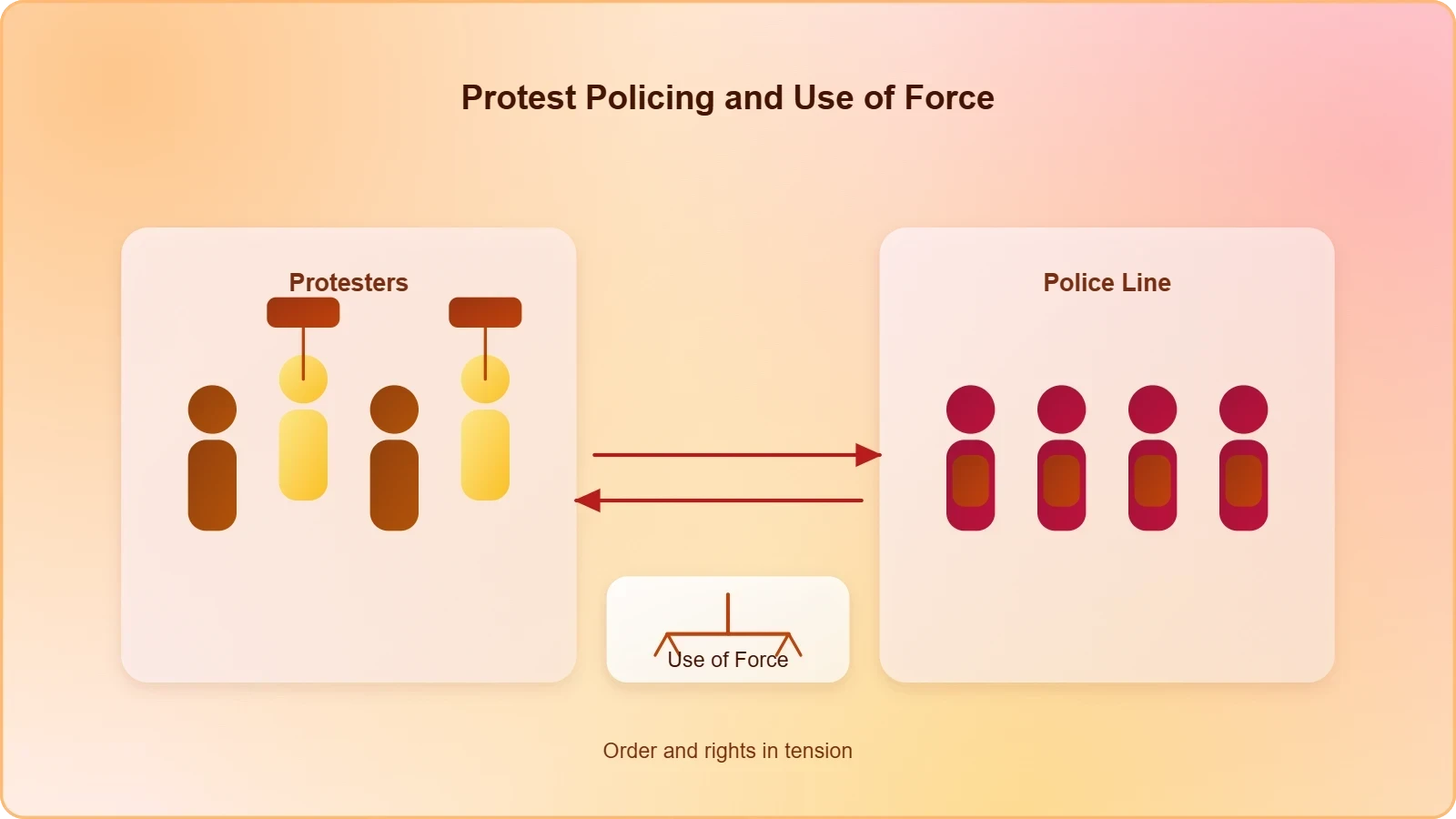
France's policing of protests has become one of the most scrutinised flashpoints in contemporary Western European democracy, drawing sustained criticism from Amnesty International, the Council of Europe, and a broad coalition of civil liberties observers.
Images of tear gas drifting across Parisian squares, baton charges against demonstrators, and gruesome injuries inflicted by stun grenades have renewed uncomfortable questions about how the French state manages dissent.
What distinguishes France from neighbours such as Germany or the Netherlands is not simply the frequency of protest but the intensity of the state's response, which analysts trace to deep historical, political, and institutional roots rather than to any single administration's temperament.
On This Page
The French model of public order rests on a conception of the police as an instrument of the state itself, charged with protecting the republic and enforcing its laws, rather than as a body deriving authority from public consent.
This Napoleonic inheritance produces a security culture in which blockades and mass disorder are treated as direct challenges to republican authority, not merely as civil disruptions to be contained.
The priority, repeatedly, is to clear the streets rather than to negotiate them, a logic that explains encircling tactics, less-lethal weaponry, and the deployment of munitions that are banned or restricted elsewhere in Europe.
Yet France also possesses one of the world's most entrenched cultures of street protest, a legacy of insurrection stretching back to 1789. Because French unions are not formal negotiating partners with government and the presidential Fifth Republic limits institutional consultation, the street becomes one of the few remaining avenues through which citizens can force concessions.
This collision between a centralised state and an insurgent civic tradition produces a self-reinforcing cycle of escalation, in which military-style tactics antagonise peaceful demonstrators, validate radical factions, and entrench confrontation as the default grammar of French political life.
TL;DR France's aggressive policing of protests is not an aberration but a structural feature of its Napoleonic, centralised state, which treats mass disorder as a challenge to republican authority rather than a civic negotiation. Human rights bodies including Amnesty International and the Council of Europe have condemned the use of defence ball launchers, pyrotechnic stun grenades, and encircling tactics that have caused lost eyes, fractured jaws, and deaths. Simultaneously, France maintains one of Europe's strongest cultures of street protest, rooted in 1789 and reinforced by weak institutional consultation channels. Conflict-monitoring data from Acled shows France does not always lead Western Europe in protest volume, but consistently records the highest rates of escalated, high-intensity unrest, including barricades, arson, looting, and direct clashes between citizens and police.
The Napoleonic Architecture of French Public Order
French policing cannot be understood without confronting its Napoleonic DNA, a centralised apparatus in which the police function as an instrument of the state rather than as servants of the public.
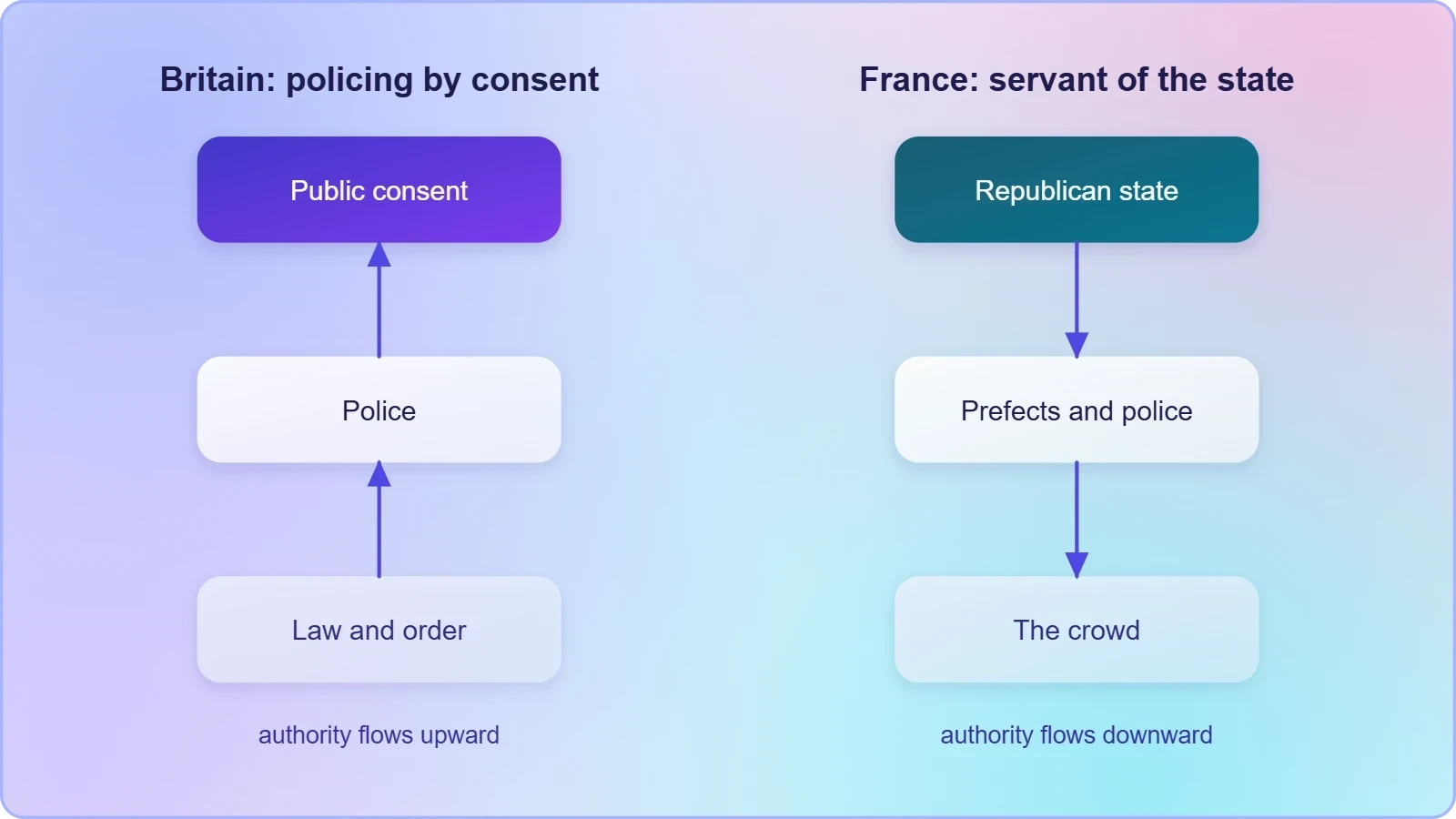
This foundational distinction separates France sharply from the British model, where authority flows upward from public consent and policing by agreement is the guiding doctrine. In France, the state precedes the citizen, and the police exist to protect the state's continuity, enforce its laws, and maintain public order as a matter of sovereign prerogative rather than negotiated service delivery.
Centralisation as a Security Doctrine
Napoleon's administrative legacy concentrated authority in Paris and its prefects, creating a security apparatus designed to detect, deter, and disperse threats to the regime before they could coalesce into insurrection. That architecture survived every subsequent republic, monarchy, and empire, embedding itself in training doctrines, command structures, and operational reflexes that persist today.
When French officers face a crowd, they inherit a two-century-old institutional memory in which the crowd is a potential insurrectionary body rather than a gathering of citizens exercising a right.
The consequence is a doctrine of dispersal rather than containment, in which clearing streets takes precedence over de-escalation and dialogue. Neighbouring Western European forces generally emphasise containing crowds and reducing tension, treating negotiation as a first resort and force as a last.
France inverts this hierarchy, deploying significant physical force against social movements as a matter of routine operational preference, a divergence that human rights monitors have documented repeatedly and condemned consistently.
Servants of the State Versus Servants of the Public
The contrast with the United Kingdom is instructive because both nations claim democratic policing traditions yet operationalise them in opposite directions. British policing derives legitimacy from public consent, meaning that when consent erodes, tactics must change; French policing derives legitimacy from state authority, meaning that when authority is challenged, tactics must intensify.
This philosophical divergence explains why identical protest scenarios produce radically different police responses on either side of the Channel.
Analysts emphasise that French protests, blockades, and mass disorder are treated not merely as civil disruptions but as direct challenges to the authority of the republic itself. That framing elevates every demonstration into a constitutional test, transforming crowd control into a defence of the state rather than a management of public safety.
Once a protest is coded as a challenge to the republic, negotiation appears as capitulation, and force appears as duty.
We Also Published
Weapons, Injuries, and the Human Cost of Dispersal
The operational toolkit of French crowd control has attracted the sharpest criticism from human rights organisations, precisely because several instruments in routine use are banned or restricted elsewhere in Europe. Defence ball launchers fire rubber projectiles at high velocity, capable of inflicting severe trauma at close range.
Explosive grenades deployed in the late 2010s were phased out after a protester was killed in 2014, but were promptly replaced by pyrotechnic stun grenades designed to disperse crowds through impact and acoustic shock.
The Lethal Arithmetic of Less-Lethal Weapons
Pyrotechnic stun grenades have caused injuries in recent years that read like a casualty list from a conflict zone: lost eyes, lost teeth, fractured jaws, and deaths. They also frequently trigger mass panic in confined urban spaces, transforming orderly demonstrations into chaotic stampedes that endanger protesters and bystanders alike.
The phrase "less-lethal" thus functions as a euphemism rather than a guarantee, describing a category of weaponry that reduces but never eliminates the probability of grave harm.
Human rights groups including Amnesty International and the Council of Europe have documented these injuries and questioned whether the French threshold for deploying such munitions meets European human rights standards.
The criticism is not merely about individual incidents but about a pattern: weapons restricted elsewhere are normalised in France, and the burden of injury falls disproportionately on demonstrators exercising what French law itself recognises as a legitimate civic function.
Encircling Tactics and the Erosion of Peaceful Assembly
Beyond munitions, French forces employ encircling tactics that trap crowds within police cordons, a technique designed to detain and identify participants but which also prevents peaceful demonstrators from dispersing safely.
When combined with baton charges, these tactics antagonise even peaceful participants and can validate more radical groups by confirming their narrative that the state responds to dissent with violence. Instead of isolating violent elements, police often respond indiscriminately, and the aggression becomes entrenched.
The result is a predictable transformation: protests turn into clashes between citizens and police, and the original grievance that prompted the demonstration recedes behind the spectacle of confrontation. Each cycle of escalation supplies fresh imagery for both sides, hardening public opinion and deepening the institutional distrust that makes future negotiation even less likely. The weaponry is therefore not merely a tactical choice but a political variable with compounding consequences.
The Insurrectionary Tradition and the Street as Parliament
France's protest culture is as formidable as its policing apparatus, and the two are locked in a dialectic that neither can escape. A legacy of insurrection dating back to the 1789 revolution means French protesters genuinely believe the street can force governments to back down, because history repeatedly confirms that belief.
Unlike in Germany or the Netherlands, French unions are not formal negotiating partners with the government, leaving them with few institutional levers and a powerful incentive to mobilise.
Why the Street Substitutes for the Negotiating Table
The presidential structure of the Fifth Republic concentrates executive power and limits institutional consultation, meaning that a centralised state may pass laws with little popular consent. When legislative channels offer scant leverage, street protest becomes one of the few ways citizens can win concessions, and it is widely regarded as a civic duty and a legitimate democratic tool.
This is not romantic nostalgia but a rational response to institutional design: where consultation is thin, mobilisation is thick.
The absence of formal union partnership distinguishes France from corporatist neighbours where labour organisations sit at the negotiating table and therefore have less need to fill the streets. In France, the street functions as a supplementary parliament, a venue where veto power is exercised through disruption rather than through committee.
That function is widely legitimised in public opinion, which complicates any government attempt to delegitimise protest as mere disorder.
The Escalation Cycle and Its Entrenchment
Authorities see large crowds as a threat and send in police, whose military-style tactics antagonise even peaceful demonstrators and can validate more radical groups. Instead of isolating violent elements, police often respond with baton charges and munitions, and the aggression becomes entrenched on both sides.
Protests then turn into clashes between citizens and police, a pattern that repeats with sufficient regularity to constitute a structural feature rather than an episodic failure.
This cycle is self-reinforcing because each confrontation supplies justification for the next round of hardening on both sides. Protesters conclude that only escalation commands attention; authorities conclude that only force preserves order.
The middle ground of negotiation erodes, and the street becomes the site where the republic's unresolved tensions are periodically and violently renegotiated.
Reading the Data: Volume Versus Intensity
Conflict-monitoring organisations such as Acled provide the empirical corrective to lazy assumptions about French exceptionalism in protest volume. The data shows that France does not always have the highest number of demonstrations in Western Europe; Germany and Italy also compete for that title, and the raw count of protests fluctuates with political calendars and economic cycles. Volume alone, therefore, cannot explain the international scrutiny that French policing attracts.
What Acled Reveals About Escalation
Where France does stand apart is in the intensity of its unrest, consistently recording the highest rates of escalated, high-intensity events in Western Europe. Barricades, vandalism, looting, arson, and direct confrontations between protesters and police appear with a frequency that distinguishes the French repertoire from its neighbours.
The metric that matters is not how often people protest but how often protest becomes confrontation, and on that measure France leads.
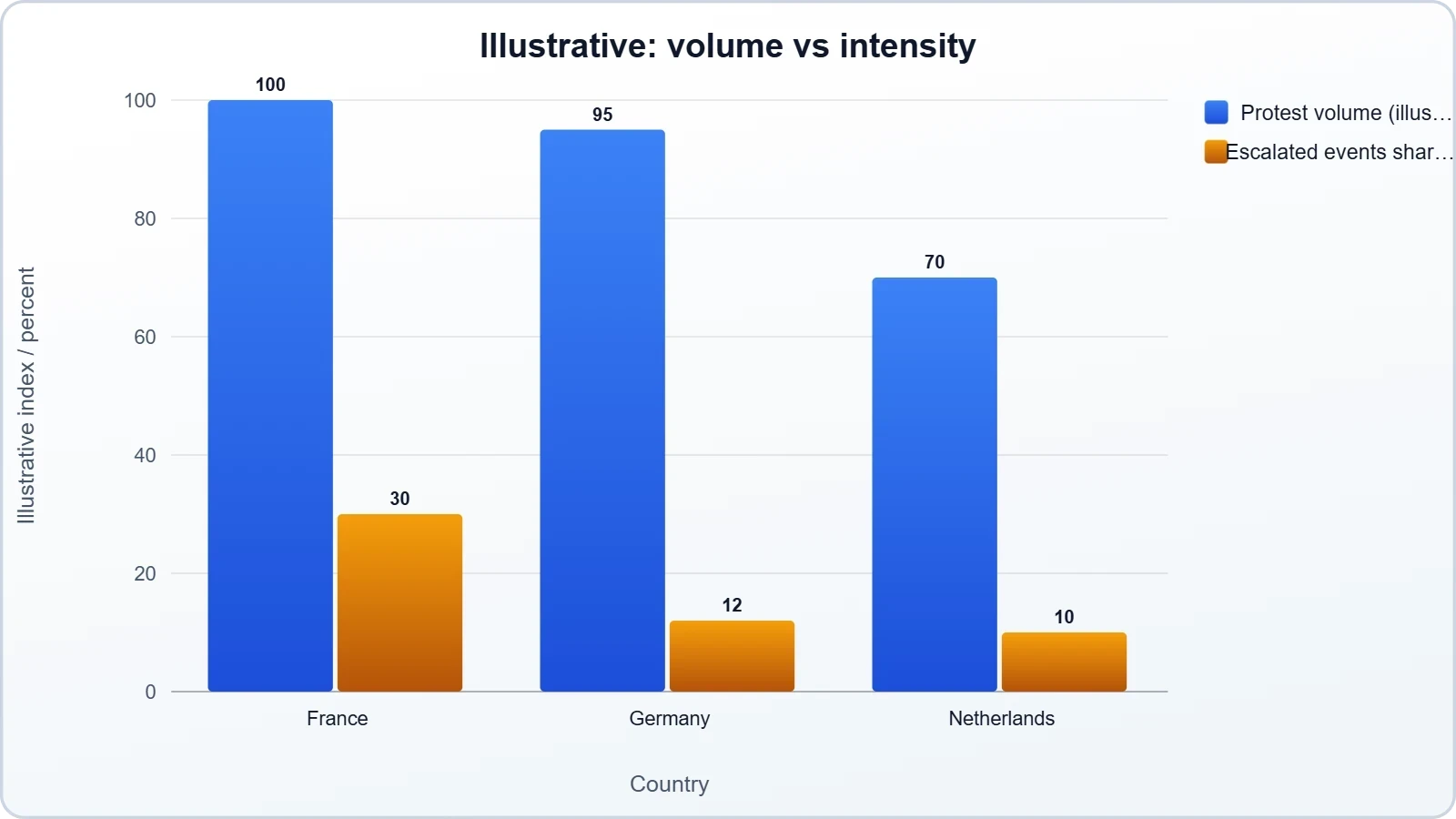
This distinction reframes the entire debate: the question is not why French people demonstrate so much but why French demonstrations so reliably escalate. The answer lies in the interaction between policing doctrine and protest culture, each amplifying the other's worst expectations.
Data of this kind converts a political argument into an empirical one, and the empirical pattern supports the structural explanation over the cultural caricature.
Interpreting Intensity Without Determinism
Intensity data must be read carefully, because escalation is a product of interaction rather than of any single actor's disposition. A high-intensity event requires both a mobilised crowd and a forceful police response, and attributing causation to one side alone distorts the picture.
The honest reading is that French institutions and French protest traditions co-produce the outcome, each responding rationally to the other's anticipated moves.
Nor does the data support fatalism: intensity rates are not immutable, and comparative evidence from neighbours demonstrates that different doctrines produce different outcomes under similar pressures. The French pattern is a choice embedded in institutions, not a law of national character.
Recognising that opens space for reform, however politically difficult such reform may prove in a system built to resist it.
Accountability, Reform, and the European Standard
The criticism levelled by Amnesty International and the Council of Europe raises a question of accountability that France has struggled to answer convincingly. When injuries from stun grenades include lost eyes and fractured jaws, the adequacy of internal police oversight becomes a matter of European human rights compliance rather than domestic administrative preference.
The comparison with neighbours that restrict or ban certain munitions sharpens the pressure, framing French practice as an outlier requiring justification.
The Oversight Deficit
Accountability mechanisms in France have historically been criticised for investigating police conduct with insufficient independence, a structural weakness that human rights bodies identify as a root cause of impunity. Without credible external scrutiny, tactical choices face little deterrent, and the institutional incentives that favour force over negotiation remain undisturbed. Reform proposals therefore tend to focus less on individual conduct than on the architecture of oversight itself.
The European dimension matters because membership of the Council of Europe entails commitments to assembly rights and proportionate use of force. When those commitments are tested against documented injuries, the resulting scrutiny is not external interference but the ordinary operation of a system France helped construct.
Framing criticism as anti-French sentiment misses the point: the standards being applied are ones the republic itself endorsed.
What Genuine Reform Would Require
Meaningful reform would require altering the doctrinal hierarchy that privileges street clearing over negotiation, a change that touches the Napoleonic foundations of the security apparatus. It would also require strengthening institutional consultation channels so that unions and civic groups have alternatives to mobilisation, reducing the pressure that drives protesters into the street. Neither change is technically difficult; both are politically formidable because they redistribute authority within a centralised state.
The comparative evidence suggests reform is feasible, since neighbours achieve lower escalation rates with different doctrines under comparable democratic conditions. What France lacks is not capacity but incentive, and incentive emerges only when accountability mechanisms make the costs of the status quo visible and unavoidable.
Until then, the cycle of confrontation will continue to define the relationship between the French state and its citizens.
The Broader Meaning for Democratic Order
France's policing dilemma carries significance far beyond its borders, because it exposes a tension latent in every democratic state between order and liberty. The French case demonstrates that institutions designed to protect a republic can, under certain conditions, treat the republic's own citizens as the primary threat to be managed.
That inversion is not unique to France, but France renders it unusually visible through the intensity of its confrontations and the clarity of its doctrinal inheritance.
Order as a Contested Democratic Value
Public order is a genuine democratic value, not a pretext, and no serious analysis can pretend that barricades, arson, and looting are costless expressions of civic virtue. The difficulty is that order and liberty are not opposites but interdependent goods, and policing doctrines that privilege one over the other eventually corrode both.
France's high-intensity unrest is the visible symptom of a system that has not yet found a stable equilibrium between the two.
The criticism from human rights bodies should therefore be read as an invitation to recalibrate rather than an attack on French democracy itself. A republic confident in its legitimacy can afford to negotiate with its citizens; one that treats every crowd as an insurrection reveals a fragility it claims to oppose.
The measure of institutional strength is not the capacity to disperse crowds but the capacity to avoid needing to.
Lessons for Comparative Democratic Practice
Other democracies watching France can extract a clear lesson: policing doctrine is a political choice with measurable consequences, not a technical matter settled by operational manuals. Nations that invest in consultation, negotiation, and consent-based legitimacy record lower escalation rates even when protest volume is comparable.
The French experience thus functions as a natural experiment whose results are publicly available to any government willing to read them.
For France itself, the path forward requires acknowledging that the street is not an aberration to be suppressed but a symptom of institutional gaps to be filled. Until consultation channels widen and oversight gains independence, the cycle will persist, and the images of tear gas in Parisian squares will continue to define how the world sees the French republic. That is a cost no serious democracy should accept indefinitely.
From our network :
- Forbidden Matrix Patterns and Visible Lattice Points: A Geometric DictionaryExplore how multidimensional 0–1 matrices encode geometric truths, linking forbidden patterns to visible lattice points and hypergraph theory, with applications in combinatorics and computational geometry.
- Committed Mediterranean Precipitation Decline: Why Emissions Cuts Alone Cannot Restore Winter RainsNew NOAA research reveals that Mediterranean winter rains may decline irreversibly even with emissions cuts. Explore the science of committed climate change and regional impacts.
- Live Online English Classes for Kids: Do They Actually Reduce Anxiety?A ten-week study reveals that synchronous online English classes can significantly reduce child language anxiety while improving listening and reading skills. Discover what makes these programs effective and how parents can select the right one.
- The Hidden Cost of AI Convenience: Why Over-Permissioned Agents Are a Security Time BombDiscover why AI agents with excessive permissions create dangerous single points of failure, and learn how implementing least privilege principles can protect your organization from exploitation.
- The Final Descent: How ESA Retired the Legendary Cluster Constellation After 24 Years of Space Weather ScienceAfter 24 years mapping Earth’s magnetosphere, ESA’s Cluster mission concluded with a precisely controlled reentry over the South Pacific. This analysis explores the scientific legacy, engineering decisions, and debris mitigation principles behind one of space exploration’s most responsible retirements.
- University Language Proficiency Exams: Why Institutional Tests Demand Different Preparation Than IELTS and TOEFLDiscover why university-specific language proficiency examinations differ fundamentally from IELTS and TOEFL, and learn strategic preparation approaches for institutional assessment success.
- Mobile Learning and VR in English: What Global Evidence Reveals About Effective Language TechnologyA systematic review across 14 countries reveals which language-learning technologies genuinely work. Mobile learning, AI, and VR show measurable benefits when pedagogically integrated. This evidence-based guide helps educators and learners select technology that delivers real return on investment.
- CISA’s Ten-Advisory Wave: Why Generic Patching Fails in OT and How to Build Product-Specific PlaybooksCISA released ten ICS advisories in one week, exposing critical infrastructure risks. Generic patching fails in OT. Learn to build product-specific remediation playbooks.
- How AI Agents Will Change the Way We Manage Personal FinancesExplore how AI agents are transforming personal finance through automated budgeting, bill payment, and investment management, while examining the critical security protocols and governance frameworks required for safe deployment.
RESOURCES
- France: Permanently ban the use of all stun grenades in policing of ...amnesty.orgOct 7, 2026 ... France: Permanently ban the use of all stun grenades in policing of protests ... force against all protesters, to ensure…
- France must respect and promote right to peaceful protest: UN expertsohchr.orgJun 15, 2023 ... GENEVA (15 June 2023) – UN experts* today expressed concern at the reported excessive use of force during protests in…
- France: Nahel shooting highlights need for overhaul of police ...amnesty.orgJul 13, 2023 ... Following the banning of a number of demonstrations protesting police ... Since 2017, the use of lethal force by police…
- France sees protests by activists, medics and police | PBS Newspbs.orgJun 17, 2020 ... The CGT union said one of her ribs was broken. Activists said that what happened to her was part of…
- Thousands protest in France against bill expanding protections for ...france24.comSep 21, 2026 ... In July, deputies in the National Assembly approved the bill, which says that any law-enforcement official who uses force is…
- France Protests Test Government's Commitment to Rightshrw.orgMar 24, 2023 ... Law enforcement officers must facilitate them and avoid excessive use of force.” Excessive use of force by police during protests…
- French policing under scrutiny as student protest injuries mountreuters.comOct 10, 2026 ... ... police force, of which 15 are among those under investigation by the IGPN. They involve the use of rubber…
- Police use of force during street protests: A pressing public mental ...pmc.ncbi.nlm.nih.govIn a recent study conducted among 523 Yellow Vests protesters in France, we assessed self-reported exposure to police violence-related traumas (yes/no items ...
- Fraisse et al. v. France: Against the Normalization of Systemic ...strasbourgobservers.comMay 6, 2025 ... Can the lethal use of an explosive grenade by law enforcement during a protest ... Another example of lethal force…
- French police's tendency to violence questioned after latest killingtheguardian.comJun 30, 2023 ... The OHCHR spokesperson, Ravina Shamdasani, said authorities should ensure that the use of police force “always respects the principles of ...
- UN rights office calls on France to address 'deep issues' of racism in ...news.un.orgJun 30, 2023 ... Following a third night of riots and protests across France over the police ... We call on the authorities to…
- French police suspend use of stun grenades at school protests as ...theguardian.comOct 7, 2026 ... France's interior minister has suspended the use ... Rights groups and trades unions have repeatedly accused the police of using…
- High schoolers across France have taken to the streets to protest the ...facebook.comOct 14, 2026 ... ... protest the government's continued under- investment in their education. Police use of force in response to the protests has…
- Demonstrations in France: freedoms of expression and assembly ...coe.intMar 24, 2023 ... ... use of force by state agents. Such acts are not sufficient to deprive peaceful demonstrators of the enjoyment of…
- What actions are French police allowed to take at blockades and ...lemonde.frOct 13, 2026 ... What actions are French police allowed to take at blockades and protests? ... use force. Leave the area immediately," and,…
- 01
- 02
- 03
- 04
- 05
- 06
- 07
- 08
0 Comments