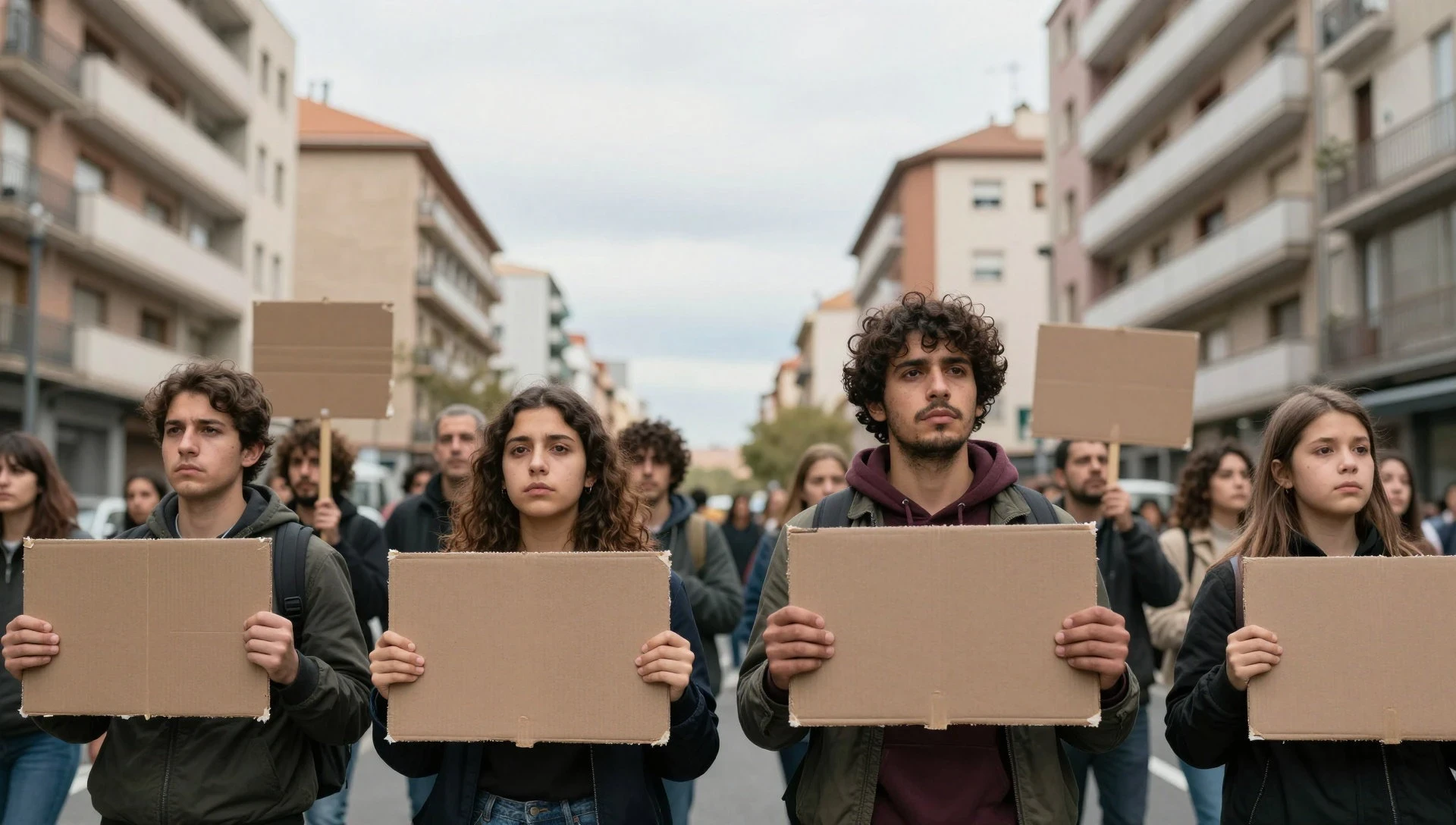
Spain's first nationwide general strike in fourteen years, reported by Reuters on 11 November 2026, represents far more than a routine labour action. It is the visible eruption of a housing crisis that has been quietly compounding across the country for well over a decade, transforming shelter from a basic social guarantee into one of the most punishing cost centres in the average household budget. When a nation that endured the brutal austerity of the post-2008 years returns to the barricades, the signal is unmistakable: the political settlement around housing has lost its legitimacy in the eyes of a substantial share of the working population.
The strike's framing matters enormously. This was not a wage dispute confined to a single industry, nor a protest against pension reform or public-sector cuts. It was called explicitly in response to public anger over housing costs, which positions the action as a broad social coalition rather than a narrow union campaign. That distinction carries weight, because general strikes historically succeed in mobilising beyond organised labour only when the grievance touches something universal — and few grievances are more universal than the fear of being priced out of one's own city, neighbourhood, or future.
What makes the Reuters dispatch particularly telling is what it leaves unsaid. The report does not name the organising unions, quantify participation, identify affected sectors, or detail the strikers' specific demands and the government's reply. Those omissions are not incidental; they reflect the early, fast-moving nature of breaking labour news, and they invite a deeper structural reading. The absence of granular detail forces analysts to examine the underlying conditions that made such a strike conceivable in the first place, and those conditions are well documented in housing economics, rental market data, and the political history of Southern Europe.
On This Page
TL;DR Spain staged its first general strike since 2010 on 11 November 2026, driven by public fury over housing costs rather than a conventional wage dispute. The action signals that housing affordability has become a first-order political question capable of uniting labour unions, tenant movements, and younger voters. While Reuters did not specify organisers, participation figures, or government responses, the strike's timing and framing point to deep structural pressures: constrained supply, speculative rental markets, tourism-driven demand, and stagnant real wages. This analysis unpacks the economics, the political consequences, and the wider European precedent.
The Anatomy of a Housing-Driven General Strike
A general strike is a blunt instrument, and its deployment over housing rather than pay reveals how the hierarchy of working-class concerns has shifted. In Spain, as across much of Southern Europe, the cost of shelter has outpaced earnings so persistently that it now functions as a de facto wage cut, quietly redistributing purchasing power from tenants to property owners. When that pressure reaches a tipping point, the grievance escapes the confines of collective bargaining and becomes a question of social legitimacy — precisely the terrain on which a general strike becomes thinkable.
Why Housing Became the Flashpoint
Spain's housing market carries the scars of the 2008 collapse and the austerity that followed. A construction boom turned bust left a legacy of household debt, while subsequent recovery concentrated new investment in property as a safe asset, particularly in Madrid, Barcelona, and coastal tourist hubs. The result is a market where rental yields attract institutional capital, short-term letting competes directly with long-term tenancy, and young adults face deposit requirements that bear little relation to entry-level salaries. Housing stopped behaving like infrastructure and started behaving like a speculative commodity.
The affordability arithmetic is unforgiving. When rent consumes a majority of disposable income for median earners in major cities, every other household expense is squeezed. Savings collapse, family formation is delayed, and geographic mobility becomes a privilege rather than a choice. Economists describe this as a misallocation of labour, but the lived experience is simpler and angrier: people working full-time cannot secure stable shelter. That gap between effort and outcome is precisely the kind of injustice that converts diffuse frustration into organised collective action.
The Coalition Behind the Action
Although Reuters did not identify the organising unions, the framing of the strike as a response to housing anger suggests a coalition broader than traditional labour confederations. Tenant unions, youth organisations, and neighbourhood assemblies have spent years building capacity around eviction defence and rent regulation, and a general strike offers a natural convergence point. The political logic is compelling: housing grievances cut across employment status, generation, and region, giving organisers a mobilising narrative that a sector-specific dispute could never provide.
This coalition structure also explains the strike's symbolic weight. A general strike called by a single union over pay is an industrial event; one called over housing is a civic event. It signals that the grievance has escaped the workplace and entered the public square, where legitimacy is contested through visibility rather than negotiation. For the government, that shift is far more dangerous, because it reframes housing policy from a technical portfolio into a test of whether the state can deliver basic security to working people.
The Economics Beneath the Anger
Housing affordability is often discussed as a social issue, but its mechanics are strictly economic, and understanding them is essential to interpreting why a strike rather than a petition emerged. Shelter is a non-substitutable good: households cannot opt out of needing somewhere to live, which gives landlords and property owners structural pricing power that ordinary consumer markets do not permit. When supply is inelastic and demand is captive, prices rise faster than incomes almost by design, and the burden falls hardest on those with the least bargaining power.
Supply, Demand, and the Affordability Gap
Spain's construction sector never fully regained its pre-crisis rhythm, and the reasons are layered: tighter lending standards, labour shortages, land-use regulation, and developer caution after the crash. Meanwhile demand has been sustained by urbanisation, immigration, tourism, and the financialisation of residential property. The mismatch is structural, not cyclical, which means interest-rate adjustments alone cannot resolve it. When supply cannot respond to price signals within a reasonable horizon, the market clears through exclusion rather than construction, and exclusion is precisely what generates political anger.
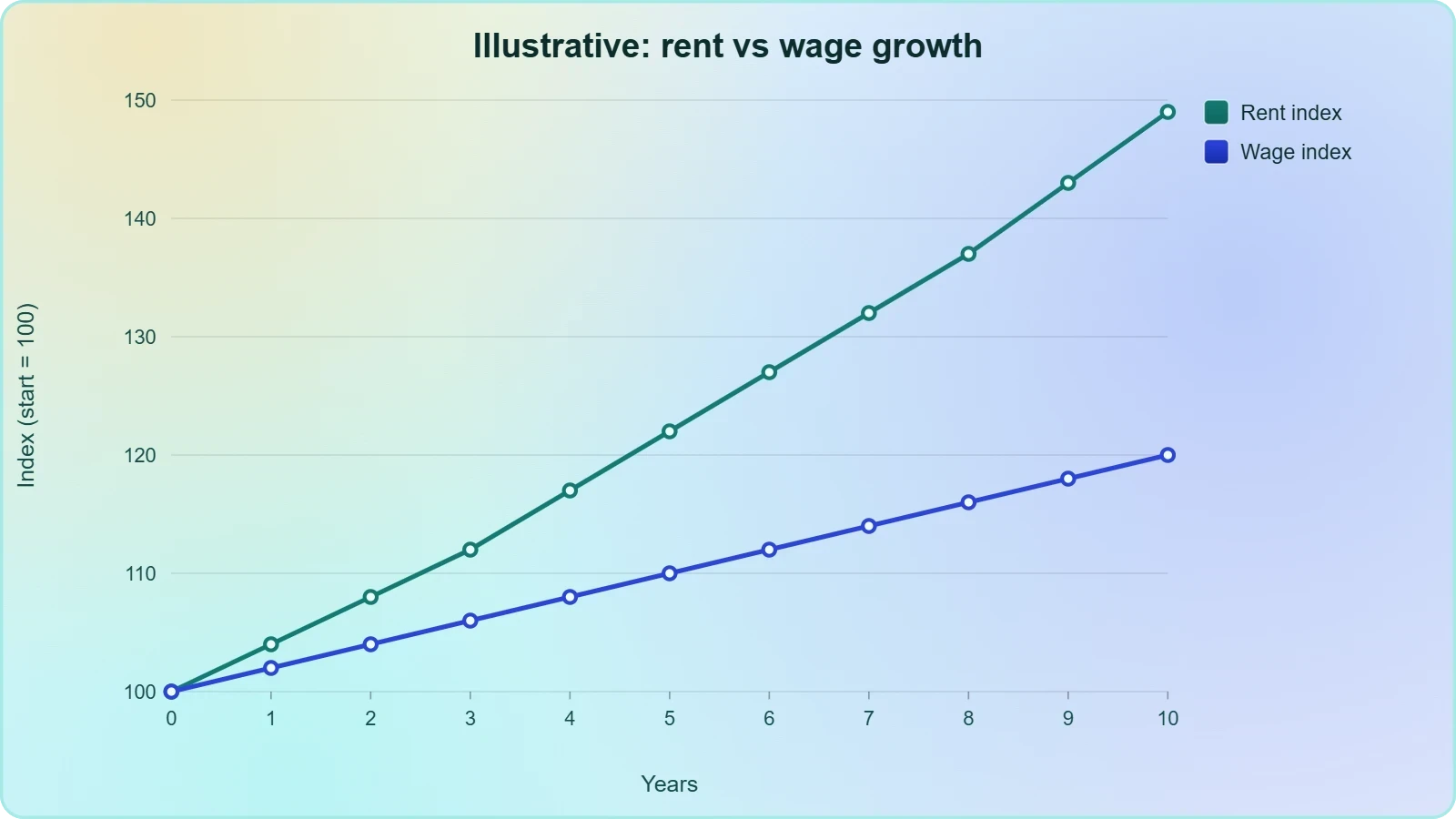
The affordability gap can be expressed simply as the divergence between shelter costs and disposable income. If rents grow at ##r## percent annually while median wages grow at ##w## percent, the affordability ratio deteriorates whenever ##r > w##, and the cumulative effect over a decade is severe. A household spending a third of income on rent in 2015 may find that share approaching half by 2026 without any change in behaviour. That silent erosion is the arithmetic behind the anger, and it explains why the grievance feels systemic rather than personal.
Rent Regulation and Its Discontents
Governments across Europe have reached for rent controls as a visible response, and Spain is no exception, with regional regimes and national frameworks competing for coherence. The economics are contested: caps can protect sitting tenants in the short run while discouraging new rental supply and pushing investment into alternative uses. Critics argue that controls treat symptoms; defenders counter that without them, displacement accelerates faster than construction can respond. The strike suggests that public patience with the gradualist approach has worn thin, regardless of which side of the academic debate one favours.
What the strike exposes is a legitimacy problem rather than a purely technical one. Even well-designed regulation struggles when enforcement is weak, when the short-term letting market offers an escape route, and when tenants lack the legal resources to contest abuses. Housing policy therefore fails not only on supply but on governance, and that failure is visible in everyday life. A general strike is, in effect, a demand that the state demonstrate competence in a domain where market mechanisms have visibly failed to deliver security.
Political Consequences and the European Precedent
The political significance of a general strike extends well beyond the day itself. It resets the terms of debate, forcing housing onto the front pages and into party manifestos, and it signals to incumbents that the cost-of-living agenda cannot be managed through incremental tweaks. In Spain, where the memory of austerity protest remains vivid, a strike over housing connects the present grievance to a longer narrative about who bears the cost of economic adjustment. That narrative is potent because it frames housing not as a market outcome but as a political choice.
Reading the Government's Silence
Reuters did not report the government's response, and that silence is itself informative. Early in a labour dispute, governments often withhold detailed comment while assessing participation and public mood, and a housing-driven strike is especially delicate because it pits fiscal caution against visible social distress. A heavy-handed response risks amplifying the grievance; a conciliatory one invites accusations of capitulation. The strategic calculation is further complicated by coalition politics, regional autonomy over housing policy, and the need to retain credibility with investors in the property market.
For opposition parties, the strike is an opportunity to channel discontent into electoral support, and housing has already become a signature issue for populist movements across the continent. The risk for mainstream parties is that they appear to be managing a crisis rather than solving it, which erodes trust incrementally. The strike therefore functions as a stress test of political responsiveness, and the outcome will depend less on the size of the crowd than on whether the government can credibly promise that affordability will improve within a visible timeframe.
Spain in the Wider European Pattern
Spain is not alone. Housing has become a flashpoint from Lisbon to Berlin, with tenant movements, rent strikes, and protest encampments emerging wherever shelter costs outpace wages. The common thread is the financialisation of residential property and the retreat of the state from direct provision, a combination that has produced similar outcomes across very different economies. What distinguishes the Spanish case is the willingness to escalate to a general strike, which suggests a higher tolerance for confrontation and a deeper reservoir of organisational capacity built during the austerity years.
For the rest of Europe, the lesson is that housing is no longer a second-order policy domain. It sits at the intersection of labour markets, migration, tourism, and generational equity, and it is capable of uniting constituencies that rarely share a platform. Governments that treat affordability as a technical matter to be delegated to regulators may find themselves facing the same escalation. The Spanish strike is therefore best read as a warning shot, one that other capitals would be wise to interpret before their own housing pressures reach a similar threshold.
We Also Published
- 01
- 02
- 03
- 04
Labour Movements and the New Social Contract
The strike also raises a question about the future of labour organising itself. Traditional unions built their power around the workplace, where membership, bargaining units, and strike funds are well defined. Housing, by contrast, is a community issue that affects workers, students, pensioners, and the self-employed alike, and mobilising around it requires different structures and different coalitions. The Spanish action suggests that unions are experimenting with a broader mandate, one that treats social reproduction — shelter, care, and basic security — as core labour terrain rather than a peripheral concern.
From Workplace to Community Bargaining
This shift is not entirely new; labour history is full of movements that linked wages to rents, and housing has long been a union concern in cities with strong tenant traditions. What is new is the scale and the framing. By calling a general strike over housing, organisers are asserting that the employment relationship cannot be understood in isolation from the cost of living, and that bargaining over pay is meaningless if shelter absorbs every gain. That argument resonates because it is empirically true: a wage increase that is immediately captured by rent is not a real improvement in living standards.
The strategic implication is that unions may increasingly find common cause with tenant organisations, urban movements, and youth groups, forming coalitions that are more diffuse but also more representative of the population. Such coalitions are harder to coordinate and easier to fracture, but they carry greater legitimacy when they succeed. The Spanish strike is a test case for whether this model can deliver sustained pressure, and its outcome will inform organising strategies well beyond the Iberian peninsula.
What a Successful Strike Would Look Like
Success in a housing-driven strike is difficult to measure. Participation numbers matter, but so does the durability of the coalition and the extent to which the grievance remains on the political agenda after the streets clear. A strike that produces a one-off concession but no structural change may be judged a failure by organisers, while a strike that shifts public opinion and forces housing onto the legislative calendar may be judged a success even without immediate policy wins. The metrics are political rather than contractual.
Ultimately, the strike's significance lies in what it reveals about the limits of the current settlement. When housing becomes unaffordable for a broad swath of the working population, the social contract that trades labour for security breaks down, and the resulting anger finds expression wherever it can. A general strike is one such expression, and its emergence in Spain after fourteen years of relative labour peace is a signal that the underlying pressures have reached a level that institutions can no longer absorb quietly.
Data Gaps and the Discipline of Careful Reading
The Reuters dispatch is deliberately spare, and that sparseness is worth examining as a lesson in how breaking news should be read. The report confirms the existence of a general strike, its timing, its framing around housing costs, and the fact that it is the first such action in fourteen years. It does not confirm participation figures, organising bodies, affected sectors, demands, or government responses. Those gaps are not failures of journalism; they are the normal condition of early reporting, and they should shape how confidently analysts draw conclusions.
What the Report Confirms and What It Leaves Open
Confirmed facts are few but significant: a nationwide general strike occurred, it was the first in fourteen years, and it was called in response to public anger over housing costs. Everything else is open. The absence of participation data means claims about scale should be treated cautiously, and the absence of named unions means the coalition's composition remains uncertain. Analysts who fill these gaps with assumption rather than evidence risk misreading both the strike's significance and its likely trajectory.
This discipline matters because housing strikes are politically charged, and interested parties on all sides have incentives to inflate or minimise participation. A rigorous reading separates the event from its interpretation, acknowledging that the framing around housing is itself the most important confirmed fact. The framing tells us what organisers believed would mobilise people, and that belief is a data point about the state of public opinion, regardless of how many workers ultimately stayed home.
Methodological Lessons for Analysts
For researchers and journalists covering labour action, the Spanish case offers a useful template: anchor analysis in confirmed facts, flag uncertainty explicitly, and use structural context to interpret gaps without pretending to fill them. Housing economics, labour history, and political science all provide relevant context, but none can substitute for the missing participation data. The honest approach is to present the strike as a significant signal while being transparent about what remains unknown, and to revisit the analysis as fuller reporting emerges.
The broader lesson is that early reports of social unrest are best treated as openings rather than conclusions. The Spanish strike will be studied for years, and its meaning will be refined as participation figures, union statements, and policy responses become available. What can be said now is that the action marks a threshold: housing has become a grievance capable of producing the most disruptive form of labour protest, and that fact alone reshapes the political landscape in ways that will outlast the strike itself.
Conclusion: A Threshold Moment for Housing Politics
Spain's first general strike in fourteen years will be remembered less for its immediate disruption than for what it signifies. Housing has crossed the line from a policy portfolio into a mobilising grievance, and the fact that it could summon the most disruptive form of labour protest is a measure of how far affordability has deteriorated. The strike does not resolve the crisis, but it changes the political weather, forcing governments, parties, and markets to reckon with a demand that cannot be dismissed as sectional or temporary.
The deeper message is that shelter is infrastructure, and when infrastructure fails, the consequences are not confined to the housing sector. They spill into labour relations, electoral politics, generational trust, and social stability. Spain has provided an early and vivid demonstration of that spillover, and the rest of Europe would do well to study it closely. The question is no longer whether housing will shape politics, but how quickly institutions can respond before the next strike, in the next country, makes the same point with even greater force.
From our network :
- How AI Agents Will Change the Way We Manage Personal FinancesExplore how AI agents are transforming personal finance through automated budgeting, bill payment, and investment management, while examining the critical security protocols and governance frameworks required for safe deployment.
- Live Online English Classes for Kids: Do They Actually Reduce Anxiety?A ten-week study reveals that synchronous online English classes can significantly reduce child language anxiety while improving listening and reading skills. Discover what makes these programs effective and how parents can select the right one.
- University Language Proficiency Exams: Why Institutional Tests Demand Different Preparation Than IELTS and TOEFLDiscover why university-specific language proficiency examinations differ fundamentally from IELTS and TOEFL, and learn strategic preparation approaches for institutional assessment success.
- Mobile Learning and VR in English: What Global Evidence Reveals About Effective Language TechnologyA systematic review across 14 countries reveals which language-learning technologies genuinely work. Mobile learning, AI, and VR show measurable benefits when pedagogically integrated. This evidence-based guide helps educators and learners select technology that delivers real return on investment.
- CISA’s Ten-Advisory Wave: Why Generic Patching Fails in OT and How to Build Product-Specific PlaybooksCISA released ten ICS advisories in one week, exposing critical infrastructure risks. Generic patching fails in OT. Learn to build product-specific remediation playbooks.
- Forbidden Matrix Patterns and Visible Lattice Points: A Geometric DictionaryExplore how multidimensional 0–1 matrices encode geometric truths, linking forbidden patterns to visible lattice points and hypergraph theory, with applications in combinatorics and computational geometry.
- The Final Descent: How ESA Retired the Legendary Cluster Constellation After 24 Years of Space Weather ScienceAfter 24 years mapping Earth’s magnetosphere, ESA’s Cluster mission concluded with a precisely controlled reentry over the South Pacific. This analysis explores the scientific legacy, engineering decisions, and debris mitigation principles behind one of space exploration’s most responsible retirements.
- The Hidden Cost of AI Convenience: Why Over-Permissioned Agents Are a Security Time BombDiscover why AI agents with excessive permissions create dangerous single points of failure, and learn how implementing least privilege principles can protect your organization from exploitation.
- Committed Mediterranean Precipitation Decline: Why Emissions Cuts Alone Cannot Restore Winter RainsNew NOAA research reveals that Mediterranean winter rains may decline irreversibly even with emissions cuts. Explore the science of committed climate change and regional impacts.
RESOURCES
- Millions join Spain's first general strike in 14 years in protest at rising ...theguardian.com3 hours ago ... Millions join Spain's first general strike in 14 years in protest at rising housing costs ... 2026. The housing crisis…
- Spain's general strike puts housing crisis at centre of upcoming ...france24.com8 hours ago ... ... general strike in Spain on November 11, 2026. © Bruna Casas, Reuters ... Europe's Gen Z protesters unite over…
- Spain braces for nationwide strike as anger over housing, costs ...aljazeera.com22 hours ago ... ... Spain, November 7, 2026 [Alejandro Martinez Velez/Reuters] ... And he knows that if you have a general strike before…
- Spain's general strike demands solutions to housing crisis - NPRnpr.org7 hours ago ... Protesters block a road during a nationwide general strike over the country's housing crisis in Barcelona, Spain, Wednesday, Nov. 11,…
- Italy, Spain, Belgium, Portugal: Social unrest spreads across Europe ...lemonde.frOct 20, 2026 ... ... prices and a housing crisis. France is not the only country ... general strike" on November 11, in coordination…
- Spanish unions call general strike for November 11, weeks before ...reuters.comOct 8, 2026 ... "We cannot ignore the fact that housing is where most of our wages go. What is the point of raising…
- Spain's workers hold a general strike over housing costs ahead of a ...wsls.com12 hours ago ... Police spray pepper spray at protesters during a nationwide general strike over the country's housing crisis in Madrid, Spain, Wednesday, ...
- General strikes to paralyze Spain as demonstrators clash with policecnbc.com4 hours ago ... Soaring rents and living costs are driving the unrest, as unions demand stronger government action on housing and wages. The…
- Spain's workers hold a general strike over housing costs before a ...local10.com9 hours ago ... ... strike over the country's housing crisis in Madrid, Spain, Wednesday, Nov. 11, 2026. (AP Photo/Francisco Seco) (Copyright 2026 The ...
- Workers across Spain stage first general strike in 14 years as anger ...reuters.com2 hours ago ... ... general strike demanding wages that allow access to what demonstrators say is decent housing, in Barcelona, Spain, November 11,…
- Photos of Spain's general strike over housing costs – WTOP Newswtop.com49 minutes ago ... White House confronts Democrats over planned probes, claiming possible 'criminality'. By The Associated Press November 11, 2026 | 10:28 AM.…
- Spanish trade unions general strike on 11 November 2026 - Facebookfacebook.com10 hours ago ... Spanish trade unions will stage a general strike for wages, housing, and prices on 11 November 2026, ahead of the…
- Spain's workers hold a general strike over housing costs ahead of a ...abcnews.comNovember 10, 2026, 8:17 PM. Share. Follow ABC News on Google. BARCELONA, Spain -- Millions of Spanish workers shut down businesses and snarled transport…
- Spain General Strike Disrupts Cities Over Cost of Living Crisis - WSJwsj.com5 hours ago ... Spain Hit by General Strike as Cost of Living Takes Center Stage Ahead of Elections · Protesters demand the government…
- Housing protests lead to general strike in Spain - MR Onlinemronline.orgOct 12, 2026 ... ... housing costs, Barcelona, 5 October 2026 (Photo: Angel Garcia / Bloomberg). Housing protests lead to general strike in Spain.…
- 01
- 02
- 03
- 04
- 05
- 06
- 07
- 08
0 Comments