
The diplomatic posture of the United States toward Cuba has entered a phase of pronounced rhetorical escalation, exemplified by Secretary of State Marco Rubio's public exhortation to Cuban citizens to pursue political transformation through partnership with American intelligence structures.
The episode, reported in late October 2026, combines electoral campaigning, coercive signalling, and an explicit reference to the Central Intelligence Agency within a single communicative frame. Such convergence warrants careful analytical scrutiny, since it blurs the conventional boundary between diplomatic persuasion and intelligence recruitment conducted in the open.
President Donald Trump's remarks at a South Florida rally introduced a naval dimension to the discourse, suggesting that warships returning from a conflict with Iran could pause approximately fifty yards from the Cuban coastline.
On This Page
The statement was delivered days before midterm elections in which voters had expressed anxiety regarding inflationary pressures linked to that conflict. Rubio's subsequent appeal to Cubans seeking change therefore operated within a domestic political economy of grievance, wherein foreign policy gestures function simultaneously as electoral instruments and as strategic declarations.
The Cuban response, articulated by Deputy Foreign Minister Carlos Fernández de Cossío, framed the American posture as evidence of desperation rather than strength. This exchange illustrates a broader pattern in hemispheric relations: public rhetoric designed for domestic audiences frequently produces unintended interpretive consequences abroad.
The analysis that follows examines the semantic, strategic, institutional, and geopolitical dimensions of this episode, situating it within longer trajectories of United States–Cuba antagonism and intelligence practice.
TL;DR Secretary of State Marco Rubio publicly urged Cubans to pursue political change through partnership with the CIA, while President Trump suggested returning warships could stop near Cuba following a conflict with Iran. The remarks, delivered during midterm campaigning, prompted a mocking rebuttal from Havana. The episode reveals the fusion of electoral messaging, coercive diplomacy, and intelligence signalling, raising substantive questions about the legal, ethical, and strategic implications of conducting recruitment rhetoric in the public domain.
The Rhetorical Architecture of Coercive Diplomacy
Public diplomacy ordinarily relies upon calibrated ambiguity, allowing states to signal intent without committing to specific operational consequences. The statements examined here depart from that convention by naming an intelligence agency explicitly and by attaching a naval image to a call for internal political change.
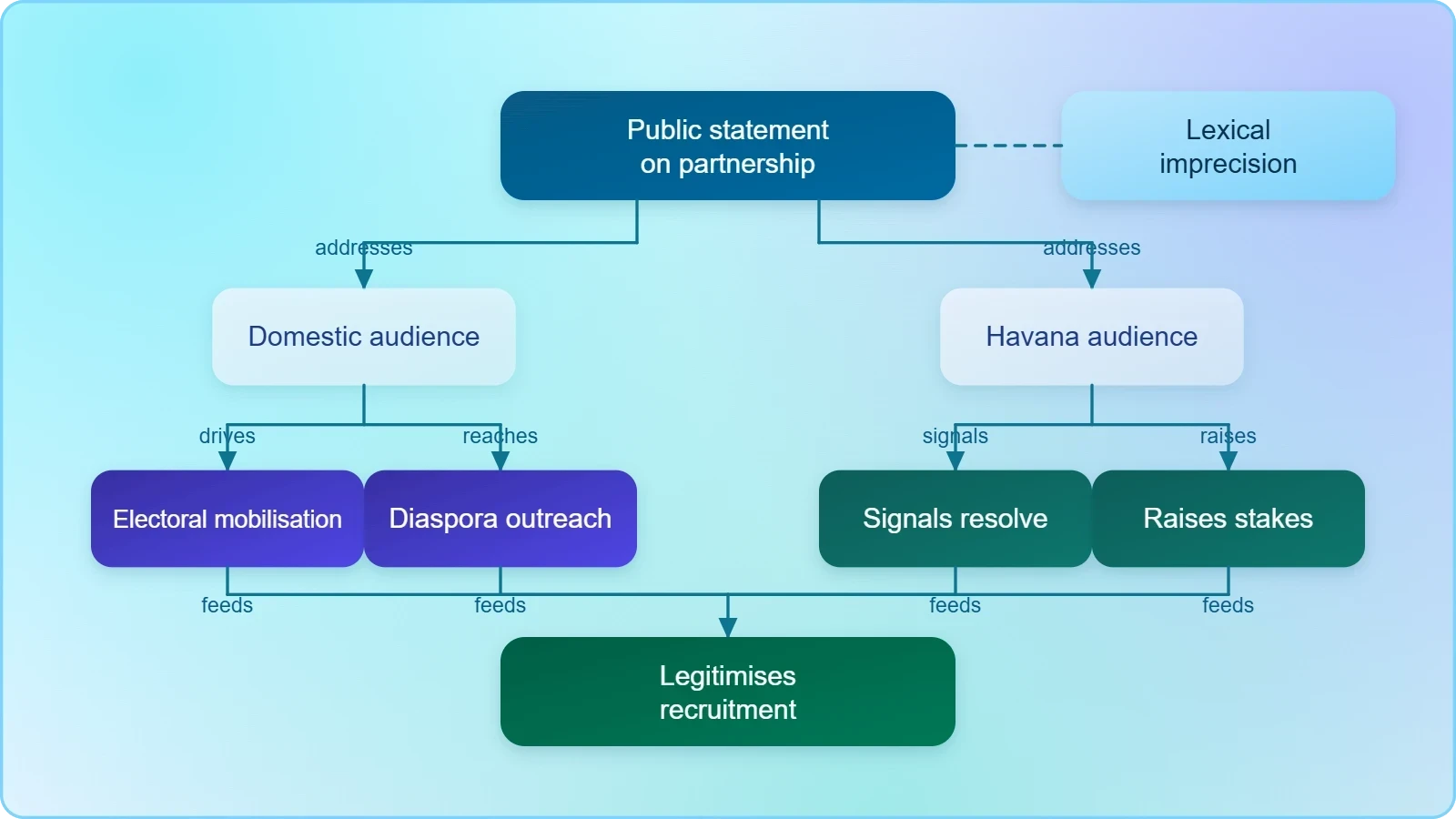
Such specificity transforms diplomatic communication into a form of strategic theatre, wherein the audience comprises domestic voters, foreign publics, and allied governments simultaneously.
The Semantics of "Partnership" and Intelligence Recruitment
The term "partnership" carries institutional weight when attached to an intelligence service, implying structured collaboration rather than symbolic solidarity. Rubio's phrasing invited Cubans to pursue change through association with the CIA, a formulation that conflates civic dissent with clandestine cooperation.
Analysts may reasonably interpret this as an attempt to legitimise intelligence contact by embedding it within a narrative of democratic aspiration.
Historical precedent suggests that public recruitment rhetoric is unusual and potentially counterproductive. Covert services typically cultivate assets through private channels, preserving deniability and protecting sources. Open appeals risk exposing prospective collaborators to surveillance and reprisal, thereby undermining the very networks such rhetoric purports to encourage. The strategic logic of publicising recruitment therefore requires explanation beyond simple enthusiasm.
One plausible interpretation holds that the statement was intended primarily for domestic consumption, signalling resolve to constituencies sympathetic to hardline Cuba policy. Under this reading, the operational consequences for Cuban citizens are incidental to the communicative objective.
Such an interpretation aligns with scholarship on "audience costs," wherein leaders accept reputational exposure to demonstrate credibility to specific domestic groups.
An alternative reading emphasises signalling to Havana itself, communicating that Washington possesses both intent and capability to intensify pressure. The explicit mention of the CIA functions as a coercive cue, reminding Cuban authorities of historical intelligence operations. Both interpretations remain compatible, since political communication frequently serves multiple audiences through a single utterance.
The lexical imprecision noted in reporting, wherein "discrete" appeared where "discreet" was likely intended, introduces an ironic dimension. A statement concerning clandestine partnership contained a term denoting separateness rather than secrecy, an ambiguity that commentators might exploit. Such details, while minor, illustrate the risks of extemporaneous high-stakes diplomacy.
Naval Imagery and the Geography of Coercion
Trump's reference to warships stopping approximately fifty yards from the Cuban coast constitutes a vivid spatial claim with limited operational plausibility. Naval vessels of significant displacement cannot safely approach within such proximity to shore without navigational hazard. The image therefore functions rhetorically rather than literally, condensing threat into a memorable geographic figure.
The linkage to a conflict with Iran supplies narrative continuity, positioning Cuba as a subsequent theatre in a sequence of confrontations. This framing constructs a temporal logic of unfinished business, wherein military assets returning from one engagement become available for another. Such sequencing resonates with longstanding predictions that Cuba would "be next" following other interventions.
Geopolitical analysts note that the Caribbean basin retains strategic significance for maritime transit, energy logistics, and hemispheric security architecture. A naval presence near Cuba therefore carries implications beyond bilateral relations, affecting calculations in Mexico, Venezuela, and the broader Caribbean Community. The rhetorical gesture thus acquires regional resonance irrespective of its literal feasibility.
The timing of these remarks, occurring days before midterm elections, invites interpretation through the lens of electoral incentives. Voters concerned about fuel and food prices linked to foreign conflict may respond favourably to displays of decisive leadership. Foreign policy rhetoric thereby becomes an instrument for managing domestic economic anxiety.
Comparative evidence from other administrations suggests that naval deployments near adversarial coastlines are frequently accompanied by declaratory statements calibrated for media effect. The Cuban case conforms to this pattern, wherein operational reality and rhetorical amplification diverge considerably. Distinguishing between the two remains essential for accurate assessment.
Havana's Rebuttal and the Politics of Mockery
Deputy Foreign Minister Fernández de Cossío's response employed ridicule rather than indignation, characterising Washington as desperate and publicly recruiting for intelligence services. Mockery constitutes a deliberate rhetorical choice, positioning the Cuban government as composed and superior rather than threatened. Such framing seeks to reassure domestic audiences while signalling resilience to international observers.
The suggestion that the CIA must be desperate to promote its services inverts the intended coercive message, transforming recruitment rhetoric into evidence of institutional weakness. This rhetorical manoeuvre reflects a broader Cuban strategy of contesting American narratives through irony. It also exploits the unusual publicness of the original appeal.
Diplomatic historians observe that revolutionary governments frequently deploy satire to defuse external pressure, drawing upon traditions of popular humour and political caricature. The Cuban response thus aligns with established practice, converting a security threat into a subject of derision. Whether such tactics influence American decision-making remains uncertain.
Simultaneously, the rebuttal acknowledges the seriousness of the underlying signal by engaging with it directly. Ridicule does not erase the material dimensions of naval deployment, sanctions, or intelligence activity. It operates at the level of narrative framing, seeking to shape how third parties interpret the exchange.
Regional reactions to the exchange have been muted, with most hemispheric governments avoiding explicit endorsement of either position. This reticence reflects the diplomatic costs of alignment in a polarised environment. It also indicates that the rhetorical escalation has not yet translated into substantive regional realignment.
Electoral Temporality and Foreign Policy Signalling
The proximity of the statements to midterm elections invites scrutiny of the relationship between electoral calendars and diplomatic communication. Campaign rallies provide platforms for unfiltered foreign policy pronouncements, often bypassing customary interagency vetting. The resulting statements may therefore reflect political intuition rather than strategic deliberation.
Scholarship on rally-round-the-flag effects suggests that external confrontation can temporarily boost executive approval, particularly when framed as decisive leadership. However, the durability of such effects depends on perceived success and material outcomes. Rhetoric unaccompanied by tangible results may generate scepticism over time.
The specific mention of voter concern regarding fuel and food prices indicates that economic anxiety framed the rhetorical context. Foreign policy gestures may therefore function as diversionary instruments, redirecting attention from domestic inflation toward external adversaries. Whether such diversion succeeds is empirically contested.
Electoral incentives also shape the selection of audiences, with South Florida's Cuban-American population constituting a historically significant constituency. Appeals to Cuban liberation resonate within this community, carrying electoral weight disproportionate to its size. The rally setting thus amplified the domestic political utility of the message.
Comparative analysis of campaign foreign policy rhetoric indicates that statements made in electoral contexts are frequently softened or abandoned after voting concludes. This pattern suggests that the Cuban pronouncements may not translate directly into operational policy. Prudence therefore counsels against overinterpreting campaign-season declarations.
Institutional Dimensions of Intelligence Disclosure
The explicit invocation of the Central Intelligence Agency within a public diplomatic appeal raises institutional questions that extend beyond the immediate exchange. Intelligence services traditionally operate under statutory frameworks requiring congressional oversight and presidential authorisation for covert activities.
Public statements implying recruitment initiatives may therefore create legal ambiguity regarding the boundaries between advocacy and covert action.
Statutory Frameworks and Oversight Obligations
United States law distinguishes between covert action, which requires presidential findings and congressional notification, and public diplomacy, which does not. A secretary of state publicly encouraging foreign nationals to partner with an intelligence agency occupies an indeterminate category. Whether such rhetoric constitutes covert action in substance, despite its public form, remains legally unsettled.
Oversight committees may reasonably inquire whether the statements reflected authorised policy or extemporaneous commentary. The absence of clear authorisation would raise concerns regarding accountability and interagency coordination. Conversely, explicit authorisation would imply a deliberate departure from customary secrecy norms.
Comparative practice among allied intelligence services suggests that public recruitment appeals are rare and typically confined to defector programmes with established legal protocols. The Cuban case lacks such institutional scaffolding, rendering the appeal anomalous. This anomaly invites scrutiny from scholars of intelligence governance.
International law imposes additional constraints, particularly regarding non-intervention principles codified in the United Nations Charter. Public encouragement of foreign nationals to collaborate with intelligence services may be characterised as interference in internal affairs. The legal status of such rhetoric depends on interpretation of sovereignty and permissible persuasion.
Historical precedents, including Cold War-era recruitment campaigns, indicate that public appeals have occasionally been deployed as psychological operations. Their effectiveness remains difficult to measure, and their diplomatic costs are frequently substantial. Contemporary practice has largely abandoned such methods in favour of deniable engagement.
The Political Economy of Sanctions and Pressure
Cuba's economic condition, characterised by Rubio as non-functional, reflects decades of sanctions, structural inefficiencies, and external shocks. The rhetorical emphasis on economic collapse serves to justify external pressure by framing it as response rather than cause. This causal framing warrants careful examination.
Empirical studies of sanctions regimes indicate that comprehensive embargoes frequently produce humanitarian costs without achieving political objectives. The Cuban case has attracted extensive scholarly attention, with findings suggesting limited causal efficacy. Rhetorical claims of imminent collapse may therefore reflect political narrative rather than empirical assessment.
Remittance flows, tourism, and informal markets sustain significant portions of the Cuban economy despite formal restrictions. These adaptive mechanisms complicate narratives of total dysfunction. Analysts emphasising collapse may underestimate the resilience of informal economic structures.
The linkage between economic pressure and political change remains theoretically contested, with evidence from comparative cases yielding mixed conclusions. Some regimes liberalise under pressure, while others consolidate control through external threat narratives. Cuba's trajectory appears to align with the latter pattern.
Energy security constitutes a particularly sensitive dimension, given Cuba's dependence on imported fuel and periodic grid failures. Statements linking foreign conflict to domestic fuel prices in the United States illustrate the interconnectedness of energy markets. Similar dynamics affect Cuban households, amplifying vulnerability.
Diplomatic Engagement and Its Limits
Reports indicate that Rubio and senior administration officials have met with Cuban counterparts to explore improved relations. This diplomatic track coexists uneasily with public rhetoric emphasising regime change. The coexistence suggests tactical flexibility rather than coherent strategy.
Negotiation scholarship emphasises the importance of consistent signalling, wherein public and private communications reinforce rather than contradict one another. Divergence between the two can undermine credibility and complicate bargaining. The Cuban case exhibits precisely such divergence.
Rubio's stated doubt regarding the possibility of diplomatic resolution with the current government narrows the space for negotiation. Pre-emptive scepticism may become self-fulfilling, reducing incentives for compromise on either side. This dynamic has characterised bilateral relations for decades.
Regional mediators, including Mexico and the Vatican, have historically played constructive roles in United States–Cuba relations. Their current involvement appears limited, reflecting broader hemispheric fragmentation. Reviving mediation capacity would require sustained diplomatic investment.
The contrast between engagement and confrontation within a single policy posture is not unique to Cuba, but its intensity in this case is notable. Coherence may emerge over time, or the contradiction may persist as competing factions shape policy. Either outcome carries implications for regional stability.
Historical Memory and Revolutionary Legitimacy
Cuban political legitimacy rests substantially on revolutionary narrative and resistance to external pressure. American rhetoric invoking intelligence partnership directly engages this narrative, potentially reinforcing rather than eroding regime cohesion. Nationalist sentiment frequently intensifies under perceived external threat.
Generational change within Cuba complicates this dynamic, as younger cohorts exhibit diverse attitudes toward the revolutionary legacy. Appeals framed in Cold War idioms may resonate less with populations focused on economic opportunity. The effectiveness of American messaging therefore varies across demographic segments.
Historical episodes of American intervention in Latin America and the Caribbean inform regional receptivity to such appeals. Memories of past operations generate scepticism regarding contemporary intentions. This historical baggage constrains the persuasive power of liberation rhetoric.
Cuban diaspora communities, particularly in Florida, occupy a complex position, combining strong opposition to the current government with varied views on American tactics. Their electoral significance amplifies their influence on policy rhetoric. Diaspora preferences thus shape the communicative strategies examined here.
Scholarship on memory politics suggests that external actors frequently misread the symbolic resonance of their interventions. Statements intended to encourage dissent may instead consolidate solidarity around existing authorities. The Cuban response suggests precisely such consolidation.
Geopolitical Repercussions Across the Hemisphere
The Caribbean basin functions as a zone of intersecting maritime, energy, and security interests involving numerous state and non-state actors. American rhetorical escalation toward Cuba therefore reverberates beyond bilateral relations, affecting calculations in Mexico, Venezuela, and the wider Caribbean Community. Regional governments must navigate between alignment with Washington and solidarity with Havana.
Regional Alignment and Strategic Autonomy
Latin American governments have increasingly asserted strategic autonomy, resisting pressure to align exclusively with either the United States or alternative partners. Public American appeals to Cuban citizens may therefore be interpreted as disregard for regional norms of non-interference. Such interpretation could strengthen arguments for diversified partnerships.
Institutions such as the Community of Latin American and Caribbean States provide forums for articulating collective positions on sovereignty. Their responses to the Cuban episode have been restrained, reflecting internal divisions. Nevertheless, the rhetorical escalation supplies material for advocates of regional independence.
Mexico's longstanding policy of non-intervention, rooted in historical experience of foreign intervention, renders it particularly sensitive to American statements regarding Cuba. Mexican diplomacy may therefore emphasise dialogue and mediation. Such positioning enhances Mexico's credibility as a regional broker.
Venezuela's alignment with Cuba complicates regional dynamics, as Caracas may interpret American rhetoric as preparation for broader pressure against allied governments. This perception could intensify security cooperation among aligned states. The episode thus contributes to patterns of regional polarisation.
Small island states in the Caribbean, dependent on tourism and remittances, prefer stability over confrontation. Their interests favour diplomatic resolution rather than rhetorical escalation. American statements may therefore generate quiet diplomatic pressure for restraint.
Energy Markets and Conflict Spillovers
The reference to a war with Iran situates the Cuban episode within a broader energy security landscape. Conflict in the Persian Gulf affects global oil prices, with consequences for Caribbean economies dependent on imported fuel. Rhetorical linkage between the two theatres therefore carries material implications.
Fuel price volatility disproportionately affects small, import-dependent economies, where energy constitutes a substantial share of consumer expenditure. Cuban households, already vulnerable to supply disruptions, face compounded risks. American rhetoric linking conflict to fuel prices acknowledges these transmission mechanisms.
Analysts modelling energy shock transmission note that geopolitical risk premiums can persist long after physical disruptions subside. The rhetorical amplification of conflict scenarios may therefore contribute to price instability independent of supply conditions. Communication thus possesses economic consequences.
Alternative energy development in the Caribbean has accelerated, driven by cost considerations and climate imperatives. Cuba's solar potential remains underutilised, constrained by financing and infrastructure limitations. External pressure may paradoxically accelerate diversification by highlighting vulnerability.
The intersection of energy security and geopolitical rivalry creates complex incentive structures for regional governments. Decisions regarding suppliers and infrastructure partners acquire strategic significance. American rhetoric may influence such decisions, though not necessarily in intended directions.
Intelligence Cooperation and Sovereignty Norms
Public references to intelligence partnership challenge established norms governing foreign intelligence activities, which typically emphasise confidentiality and respect for sovereignty. Such references may complicate cooperation with regional services wary of exposure. The reputational costs of public disclosure therefore extend beyond the immediate target.
Comparative intelligence literature indicates that partner services assess reliability partly through discretion. Public statements implying recruitment may raise concerns regarding operational security among prospective partners. This dynamic could undermine broader intelligence relationships.
Sovereignty norms in the Western Hemisphere have evolved toward explicit rejection of intervention, codified in regional declarations and treaties. Public appeals to foreign nationals may be characterised as inconsistent with these norms. Such characterisation carries diplomatic costs.
Legal scholars debate whether public encouragement of intelligence collaboration constitutes intervention under international law. The absence of definitive jurisprudence leaves interpretive space. Nevertheless, the political resonance of intervention narratives remains potent.
Historical memory of covert operations in Latin America amplifies sensitivity to contemporary intelligence references. Governments recalling past interventions may adopt precautionary postures. The rhetorical gesture thus activates historical anxieties with unpredictable consequences.
Diaspora Politics and Transnational Influence
Cuban-American communities exercise disproportionate influence on United States policy toward the island, reflecting electoral concentration and organisational capacity. Their preferences shape the rhetorical strategies adopted by officials. The South Florida rally setting exemplifies this influence.
Diaspora attitudes have diversified over generations, with younger cohorts emphasising engagement and family reunification over isolation. This evolution creates tension within diaspora politics, complicating assumptions of monolithic hardline sentiment. Rhetorical strategies calibrated to older constituencies may alienate newer ones.
Remittance flows constitute a material link between diaspora and island, sustaining households and informal markets. Policies affecting remittances therefore carry immediate humanitarian consequences. Rhetorical escalation may indirectly threaten these flows by heightening regulatory uncertainty.
Transnational advocacy networks connect diaspora organisations with international human rights mechanisms, amplifying their influence beyond electoral channels. Such networks may contest or endorse American rhetoric depending on their orientations. The communicative environment is therefore plural and contested.
Comparative diaspora studies indicate that homeland conflicts frequently persist within diaspora communities, shaping identity and political mobilisation. Cuban-American politics exemplifies this pattern, with historical grievances informing contemporary positions. Rhetorical appeals to liberation resonate within this context.
- 01
- 02
- 03
- 04
We Also Published
Communication Ethics and the Boundaries of Persuasion
The episode invites normative reflection on the ethics of public communication that encourages foreign nationals to undertake risky political action. Persuasion in international affairs carries moral weight when audiences face potential reprisal. Distinguishing legitimate advocacy from reckless incitement requires careful conceptual work.
Persuasion, Incitement, and Moral Responsibility
Philosophical accounts of persuasion emphasise respect for autonomous agency, wherein speakers provide reasons rather than manipulate fears. Appeals invoking intelligence partnership may blur this distinction by combining opportunity with implicit threat. The moral status of such appeals therefore warrants scrutiny.
Incitement involves encouraging action with insufficient regard for consequences to the audience. Public calls for political change in a repressive environment may expose listeners to detention or worse. Speakers bear responsibility for foreseeable harms arising from their exhortations.
Defences of such rhetoric typically invoke the value of solidarity with oppressed populations and the legitimacy of supporting self-determination. These defences possess genuine force, particularly where domestic avenues for change are constrained. Nevertheless, they do not eliminate responsibility for foreseeable consequences.
Comparative ethical frameworks, including just war traditions and humanitarian principles, emphasise proportionality and discrimination in the use of pressure. Applying such frameworks to rhetorical pressure suggests the need for calibrated messaging that minimises risk to vulnerable audiences. Whether the Cuban statements meet this standard is doubtful.
Scholarship on political communication ethics highlights the vulnerability of audiences in authoritarian contexts, where information asymmetry and surveillance risks are acute. Speakers addressing such audiences bear heightened responsibilities. The public naming of intelligence partnership intensifies these responsibilities.
Truth Claims and Factual Verification
Claims regarding Cuba's economic collapse, governmental corruption, and strategic alignment with adversaries require empirical substantiation. Some assertions, such as the non-functionality of the economy, are contestable given persistent informal activity and remittance flows. Rhetorical overstatement may undermine credibility.
The assertion that Cuba constitutes a national security threat through ties to adversaries reflects longstanding American assessments, though the magnitude of such threat remains debated. Intelligence community evaluations have varied across administrations. Public rhetoric frequently amplifies threat perceptions beyond evidentiary support.
Verification of claims regarding naval deployments and their proximity to Cuban shores would require operational transparency unavailable to independent analysts. The rhetorical figure of fifty yards functions symbolically rather than descriptively. Audiences should therefore interpret such statements as gestures rather than reports.
Fact-checking organisations have noted the difficulty of assessing statements made in campaign contexts, where rhetorical licence is customary. Nevertheless, the policy significance of such statements warrants scrutiny. Distinguishing campaign rhetoric from policy commitment remains an ongoing challenge.
Epistemic responsibility in international communication requires clarity regarding the status of claims, whether descriptive, predictive, or normative. Conflating these categories generates confusion and may mislead audiences. The Cuban episode exhibits such conflation across multiple statements.
Media Framing and Public Reception
Journalistic framing of the episode emphasises its dramatic elements, including the naval imagery and the intelligence reference. Such framing shapes public understanding, potentially amplifying perceptions of imminent confrontation. Media responsibility in reporting escalatory rhetoric therefore merits attention.
Comparative analysis of foreign policy coverage indicates that dramatic statements receive disproportionate attention relative to substantive policy developments. This asymmetry may distort public perceptions of threat levels. The Cuban episode exemplifies this pattern.
Social media amplification further accelerates the circulation of dramatic claims, often stripped of context. Cuban officials' rebuttals circulated through the same channels, creating a contested information environment. Audiences must therefore navigate competing narratives with limited verification capacity.
Research on framing effects suggests that episodic coverage emphasising confrontation can increase public support for hardline policies. Sustained thematic coverage examining underlying causes may produce different attitudes. The structure of reporting thus carries policy consequences.
International media coverage of the episode has been uneven, with regional outlets providing more contextual analysis than global ones. This variation reflects differing audience interests and editorial priorities. Comparative media analysis illuminates how the same event acquires divergent meanings.
Accountability and Institutional Learning
Institutional learning requires systematic evaluation of the consequences of public rhetoric, including unintended effects on target populations and regional partners. Mechanisms for such evaluation remain underdeveloped in foreign policy bureaucracies. The Cuban episode offers an opportunity for reflection.
Congressional oversight provides one avenue for accountability, particularly regarding intelligence-related statements. Hearings examining the authorisation and coordination of such rhetoric could clarify institutional responsibilities. Whether such oversight will occur remains uncertain.
Diplomatic feedback mechanisms, including allied consultations and regional forums, offer additional channels for assessing consequences. Their effectiveness depends on willingness to receive critical input. The muted regional response may limit learning opportunities.
Scholarly evaluation contributes to institutional memory by documenting episodes and analysing outcomes over time. Comparative case studies of similar rhetorical interventions could inform future practice. The Cuban episode merits inclusion in such comparative work.
Ultimately, accountability in foreign policy communication depends on political will to examine consequences rather than intentions. The gap between the two is frequently substantial. Closing it requires sustained institutional commitment.
Forecasting Trajectories and Analytical Implications
Forecasting the trajectory of United States–Cuba relations requires attention to multiple variables, including electoral outcomes, regional alignments, and institutional dynamics. The rhetorical escalation examined here constitutes one input among many. Analytical humility is warranted given the complexity of interacting factors.
Scenarios for Bilateral Relations
A scenario of continued rhetorical escalation without operational follow-through appears plausible, given the electoral incentives driving the statements. Under this scenario, public declarations intensify while material policy remains constrained. Such divergence may erode credibility over time.
An alternative scenario envisions operational escalation, including naval deployments and intelligence activities, translating rhetoric into action. This scenario carries substantial risks of confrontation and regional destabilisation. Its likelihood depends on political calculations beyond electoral cycles.
A third scenario emphasises diplomatic re-engagement, wherein public rhetoric subsides and negotiations resume. Historical patterns suggest such cycles of escalation and engagement are recurrent. The current episode may represent a phase within a longer cycle.
Scenario analysis benefits from explicit probability assessments, though such assessments remain inherently uncertain. Analysts should communicate uncertainty transparently rather than projecting false confidence. The Cuban case exemplifies the need for calibrated forecasting.
Comparative case studies of similar rhetorical episodes could inform scenario development by identifying recurring patterns. Such studies remain limited, suggesting opportunities for further research. The Cuban episode offers a valuable case for comparative analysis.
Implications for Intelligence Practice
Public references to intelligence partnership may prompt internal reviews regarding communication protocols and operational security. Such reviews could strengthen boundaries between public diplomacy and covert activity. Alternatively, they may normalise public discussion of intelligence matters.
Partner services may reassess cooperation with American agencies, weighing benefits against exposure risks. The reputational consequences of public disclosure could affect multilateral intelligence relationships. These effects may persist beyond the immediate episode.
Recruitment practices may adapt to heightened public scrutiny, emphasising digital channels and deniable contact methods. Technological change already transforms intelligence tradecraft, and public rhetoric may accelerate such transformation. The long-term implications remain uncertain.
Legal frameworks governing intelligence activities may require clarification regarding public statements by senior officials. Legislative updates could address ambiguities exposed by the episode. Whether such updates occur depends on political priorities.
Scholarly research on intelligence communication could benefit from systematic analysis of public statements and their consequences. Such research would require access to declassified materials and practitioner perspectives. The Cuban episode provides a useful starting point.
Methodological Reflections for Analysts
Analysing rhetorical episodes requires attention to multiple levels, including semantics, institutional context, and geopolitical positioning. Single-level analysis risks missing important dynamics. The Cuban case illustrates the value of multi-level approaches.
Distinguishing between statements intended for domestic audiences and those intended for foreign governments is methodologically challenging. Triangulation across sources and contexts can improve interpretation. Analysts should acknowledge interpretive uncertainty explicitly.
Quantitative methods, including sentiment analysis and network analysis, can complement qualitative interpretation of rhetorical episodes. Such methods require careful validation and contextual grounding. Their application to diplomatic communication remains an emerging field.
Comparative historical analysis provides essential context for interpreting contemporary episodes. Patterns of escalation and de-escalation recur across administrations and regions. Situating the Cuban case within these patterns enhances analytical depth.
Ethical considerations apply to analysis itself, particularly regarding the potential consequences of scholarly framing. Analysts should avoid amplifying threat narratives without evidentiary support. Responsibility extends to the interpretive community as well as to policymakers.
Enduring Questions and Research Agendas
Questions regarding the effectiveness of public diplomacy in authoritarian contexts remain unresolved, with evidence suggesting limited persuasive power. Future research could examine conditions under which such appeals influence attitudes. The Cuban case offers relevant data.
The relationship between rhetorical escalation and material outcomes requires further investigation, particularly regarding unintended consequences. Longitudinal studies could trace effects across multiple episodes. Such research would enhance forecasting capacity.
Institutional dynamics within foreign policy bureaucracies, including competition between agencies, shape rhetorical outputs. Ethnographic and archival research could illuminate these dynamics. The Cuban episode suggests avenues for such inquiry.
Regional responses to American rhetoric constitute an understudied dimension, with implications for hemispheric order. Comparative research across Latin American and Caribbean states could identify patterns. The current episode provides a useful case.
Normative questions regarding the ethics of persuasion in international affairs merit sustained philosophical attention. Engaging with traditions of just war, humanitarianism, and democratic theory could enrich analysis. The Cuban case illustrates the stakes of such inquiry.
From our network :
- How AI Agents Will Change the Way We Manage Personal FinancesExplore how AI agents are transforming personal finance through automated budgeting, bill payment, and investment management, while examining the critical security protocols and governance frameworks required for safe deployment.
- The Hidden Cost of AI Convenience: Why Over-Permissioned Agents Are a Security Time BombDiscover why AI agents with excessive permissions create dangerous single points of failure, and learn how implementing least privilege principles can protect your organization from exploitation.
- University Language Proficiency Exams: Why Institutional Tests Demand Different Preparation Than IELTS and TOEFLDiscover why university-specific language proficiency examinations differ fundamentally from IELTS and TOEFL, and learn strategic preparation approaches for institutional assessment success.
- Forbidden Matrix Patterns and Visible Lattice Points: A Geometric DictionaryExplore how multidimensional 0–1 matrices encode geometric truths, linking forbidden patterns to visible lattice points and hypergraph theory, with applications in combinatorics and computational geometry.
- The Final Descent: How ESA Retired the Legendary Cluster Constellation After 24 Years of Space Weather ScienceAfter 24 years mapping Earth’s magnetosphere, ESA’s Cluster mission concluded with a precisely controlled reentry over the South Pacific. This analysis explores the scientific legacy, engineering decisions, and debris mitigation principles behind one of space exploration’s most responsible retirements.
- Committed Mediterranean Precipitation Decline: Why Emissions Cuts Alone Cannot Restore Winter RainsNew NOAA research reveals that Mediterranean winter rains may decline irreversibly even with emissions cuts. Explore the science of committed climate change and regional impacts.
- Live Online English Classes for Kids: Do They Actually Reduce Anxiety?A ten-week study reveals that synchronous online English classes can significantly reduce child language anxiety while improving listening and reading skills. Discover what makes these programs effective and how parents can select the right one.
- CISA’s Ten-Advisory Wave: Why Generic Patching Fails in OT and How to Build Product-Specific PlaybooksCISA released ten ICS advisories in one week, exposing critical infrastructure risks. Generic patching fails in OT. Learn to build product-specific remediation playbooks.
- Mobile Learning and VR in English: What Global Evidence Reveals About Effective Language TechnologyA systematic review across 14 countries reveals which language-learning technologies genuinely work. Mobile learning, AI, and VR show measurable benefits when pedagogically integrated. This evidence-based guide helps educators and learners select technology that delivers real return on investment.
RESOURCES
- U.S.-Cuba Relations Explainedcfr.orgFeb 13, 2026 ... The second Trump administration has ushered in a period of renewed strain in bilateral relations, marked by tougher rhetoric and…
- The Next Caribbean Crisis? Assessing U.S. Military Options Toward ...csis.orgJun 3, 2026 ... The United States has stepped up economic, political, and military pressure on Cuba. This commentary examines five possible scenarios ...
- The U.S., Denmark, and Greenland Reached a Security Deal. Here's ...cfr.orgAfter nearly two years of escalating rhetoric from Washington, the United States ... The new agreement expands that partnership, allowing the United States ...
- US to 'run' Venezuela after Maduro captured, says Trumpchathamhouse.orgJan 3, 2026 ... Here is early analysis from Chatham House experts, who will monitor developments in the coming days and weeks, with further…
- U.S.-China Relations for the 2030s: Toward a Realistic Scenario for ...carnegieendowment.orgOct 17, 2024 ... It can be analyzed at three levels: the global military balance, the military balance in East Asia, and the nuclear-strategic…
- The Crisis in Cuba, Explained - TIMEtime.comMar 17, 2026 ... The U.S., particularly the CIA, famously devised a plan to ... The diplomatic tiff between the U.S. and Cuba almost…
- After the strike: The danger of war in Iran - Brookings Institutionbrookings.eduMar 2, 2026 ... On February 28, 2026, the United States and Israel launched a joint military operation against Iran, resulting in the killing…
- The Cold War | JFK Libraryjfklibrary.orgJun 18, 2026 ... ... alliance in American history. The establishment of NATO also ... American pledge not to reinvade Cuba. But the end…
- Syria: Transition and U.S. Policy - Congress.govcongress.govFeb 26, 2026 ... Transitional leaders' rhetoric and some government actions have prioritized de-escalation ... U.S. diplomatic residence in Damascus for the ...
- Radio Free Cuba: From Détente to Re-escalation in Havana and ...scienceopen.comWhile the United States long represented a safe haven for Cuban political exiles, the Cuban Revolution and its Cold War context accelerated the tendency…
- Dwight D. Eisenhower: Foreign Affairs | Miller Centermillercenter.orgNuclear weapons played a controversial role in some of Eisenhower's diplomatic initiatives, including the President's effort to end the Korean War. As promised, ...
- 2025 Annual Report to Congress: Military and Security ... - War.govmedia.defense.govDec 23, 2025 ... ... escalation, more broadly. We will ... Since late-2023, Beijing's influence efforts to undermine U.S. partnerships have included diplomatic.
- A Framework for Evaluating the Escalatory Risks of Policy Actionsrand.orgThis report documents research and analysis conducted as part of a project entitled Managing. Escalation for Strategic Advantage, sponsored by U.S. Army-Pacific ...
- ATA-2024-Unclassified- Report. pdf - DNI.govarchive.dni.govFeb 5, 2024 ... This annual report of worldwide threats to the national security of the United States responds to. Section 617 of the…
- Managing Escalation - RANDrand.orgIn this report, we analyze three historical cases of militarized crises and conflicts between nuclear-armed major powers: • the 1962 Cuban Missile Crisis ...
- 01
- 02
- 03
- 04
- 05
- 06
- 07
- 08
0 Comments