
The reported linkage of Abdul El-Sayed to the Muslim Brotherhood constitutes a recognisable instrument of negative framing within Michigan Democratic primary politics, whereby Republican-aligned critics seek to impose reputational costs on a progressive candidate.
The available record is deliberately sparse: the originating report identifies the attack, the alleged association, and the strategic intent of deepening intra-party divisions, but supplies no documentary substantiation of any organisational tie.
Analytical caution is therefore warranted, since the claim itself functions as the political artefact under examination rather than as an established fact.
On This Page
- The Strategic Architecture of Guilt-by-Association Framing
- Coalition Management and the Mechanics of Intra-Party Division
- Evidentiary Thresholds and the Normative Evaluation of Political Claims
- Comparative and Theoretical Perspectives on Religious Framing
- Consequences for Democratic Competition and Institutional Trust
- Synthesis and Analytical Conclusions
Guilt-by-association rhetoric of this type operates through a well-documented mechanism in competitive electoral systems. By attaching a stigmatised label to a candidate, opponents compel the target to expend resources on disavowal while simultaneously seeding doubt among persuadable voters in the opposing coalition.
The Michigan case exhibits the classic signature: an external actor intervenes in an internal partisan contest, framing the intervention as informational rather than strategic, and calibrates the allegation to maximise salience among the target's own base.
The following analysis situates the episode within comparative scholarship on negative campaigning, coalition management, and the political economy of religious labelling in American elections. It examines the strategic logic, the evidentiary standards that such claims ought to satisfy, and the downstream consequences for Democratic cohesion in a pivotal midwestern state.
TL;DR Republican critics in Michigan have publicly linked Democratic figure Abdul El-Sayed to the Muslim Brotherhood, an Islamist organisation, in what the originating report characterises as a strategy to deepen divisions within the Democratic coalition. No supporting documentation accompanied the allegation. The episode illustrates a recurring pattern in American politics in which guilt-by-association framing is deployed across party lines to shape primary outcomes and erode trust in a target's authenticity. This analysis examines the strategic mechanics, evidentiary thresholds, and coalitional consequences of such rhetoric, concluding that the principal effect is often intra-party friction rather than durable persuasion.
The Strategic Architecture of Guilt-by-Association Framing
Negative campaigning rests on a simple asymmetry: allegations travel faster than rebuttals, and the burden of proof falls on the accused rather than the accuser. When the allegation concerns organisational affiliation with a stigmatised entity, the reputational cost is amplified because denial cannot fully erase the association from public memory. The Michigan episode conforms to this pattern with notable precision.
Defining the Allegation and Its Political Function
The Muslim Brotherhood is a transnational Islamist movement founded in Egypt in 1928, with a complex history spanning social service provision, electoral participation, and periodic repression across the Middle East.
In American political discourse, the label carries substantial stigma, and its deployment against domestic figures typically signals an attempt to question loyalty or ideological authenticity rather than to describe a verifiable membership relationship.
Abdul El-Sayed, a former Detroit health department director and 2018 gubernatorial candidate, has been a prominent progressive voice in Michigan Democratic politics. His public record includes advocacy on healthcare access, water affordability, and municipal governance reform.
Nothing in the available reporting establishes any organisational connection to the Brotherhood, and the allegation appears to rest on inference rather than documentation.
The strategic function of the attack is therefore best understood as coalition disruption rather than persuasion of the general electorate. By raising the allegation within Democratic primary discourse, critics aim to activate latent anxieties among moderate and older Democratic voters, thereby fragmenting the progressive base that El-Sayed's candidacy mobilises.
This technique has deep roots in American electoral history. From anti-Catholic nativism in the nineteenth century to Cold War red-baiting and contemporary accusations of socialism, the mechanism remains constant: attach an out-group label to an in-group candidate and let the resulting ambiguity do the persuasive work.
Scholarship on negative campaigning suggests that such attacks are most effective when the target is relatively unknown and when the allegation resonates with pre-existing stereotypes. El-Sayed's rising profile and his religious identity render him unusually exposed to this specific framing, which explains its selection by his critics.
The Michigan Political Context and Democratic Coalition Dynamics
Michigan occupies a distinctive position in American electoral geography as a perennial battleground state with a strong industrial labour tradition and a significant Arab American population concentrated in the Detroit metropolitan area. Democratic primaries in the state frequently feature contests between organised labour, progressive activists, and moderate suburban constituencies.
The state's Democratic coalition is heterogeneous, encompassing union households, Black voters in Detroit, suburban professionals, and a growing Arab American and Muslim electorate. Managing these constituencies requires careful coalition maintenance, and allegations that touch on religious identity can destabilise the equilibrium that party leaders seek to preserve.
Republican intervention in Democratic primaries is a documented phenomenon, sometimes conducted through paid advertising and sometimes through elite rhetoric amplified by sympathetic media. The strategic logic is straightforward: a weakened or divided Democratic nominee improves Republican prospects in the general election, particularly in a state decided by narrow margins.
The timing of the reported attacks, occurring during a competitive primary cycle, is consistent with an intent to influence nomination outcomes rather than to inform public deliberation. This distinction matters for evaluating the ethics of the intervention and for assessing its likely effectiveness.
Comparative evidence from other states suggests that cross-party primary interventions can succeed in elevating weaker opponents, though the effects are contingent on the salience of the issue and the credibility of the messenger. In this instance, the messenger's partisan identity may limit persuasiveness among Democratic primary voters.
Evidentiary Standards and the Ethics of Political Allegation
Responsible political discourse requires that allegations of organisational affiliation be supported by documentary evidence, testimony from credible sources, or admissions by the parties involved. The originating report provides none of these, describing the attack and its strategic intent without adjudicating the underlying claim.
This evidentiary gap is itself analytically significant. When an allegation circulates without substantiation, the appropriate response is not to treat it as established but to examine why it was made, who benefits from its circulation, and what institutional incentives sustain it.
Journalistic norms ordinarily require attribution and verification before publication of consequential claims about named individuals. The report's framing, which describes the attack rather than the alleged tie, reflects a defensible editorial choice to report on political rhetoric without endorsing its content.
Ethical frameworks for political communication, including those developed in deliberative democracy theory, emphasise reciprocity: claims should be advanced in terms that could be accepted by reasonable interlocutors. Allegations that cannot be substantiated fail this test and degrade the informational environment on which democratic accountability depends.
The asymmetry of harm deserves emphasis. Even a demonstrably false association can persist in public perception, and the target bears the cost of rebuttal while the accuser bears little. This imbalance creates incentives for strategic allegation that responsible institutions should counteract.
Comparative Perspectives on Religious Labelling in Electoral Politics
Religious labelling has been a recurrent feature of American electoral competition, from nineteenth-century anti-Catholicism through twentieth-century anti-Semitism to contemporary suspicion of Muslim candidates. Each iteration follows a similar structure: a religious identity is linked to an alleged external loyalty, and the candidate is thereby positioned as insufficiently American.
Comparative scholarship on European elections documents analogous dynamics, including the framing of Muslim candidates as security risks and the use of religious affiliation as a proxy for ideological extremism. The persistence of these patterns across democracies suggests structural rather than idiosyncratic causes.
Counter-strategies exist and have been studied. Candidates who confront allegations directly, mobilise counter-constituencies, and reframe the debate around shared values tend to fare better than those who ignore the attack or respond defensively. The effectiveness of these strategies depends on the candidate's existing trust reserves.
Institutional responses, including party leadership statements and media fact-checking, can mitigate the damage of unfounded allegations. Their efficacy depends on the credibility of the institutions and the speed of response relative to the circulation of the original claim.
The Michigan episode thus belongs to a broader class of cases that illuminate how religious identity functions as a resource for political entrepreneurs seeking to reshape coalition boundaries. Understanding this class of cases requires attention to both the strategic logic and the normative stakes.
Coalition Management and the Mechanics of Intra-Party Division
Democratic coalitions in swing states are assembled from constituencies with divergent material interests and cultural orientations. Maintaining cohesion requires continuous negotiation, and external actors who can activate latent tensions within the coalition enjoy disproportionate influence relative to their numerical strength. The Michigan allegation targets precisely such a fault line.
Fault Lines Within the Michigan Democratic Coalition
The Michigan Democratic Party encompasses organised labour, African American voters concentrated in Detroit, suburban professionals in Oakland and Washtenaw counties, and a substantial Arab American community in Dearborn and surrounding municipalities. These groups differ on foreign policy, policing, and economic regulation.
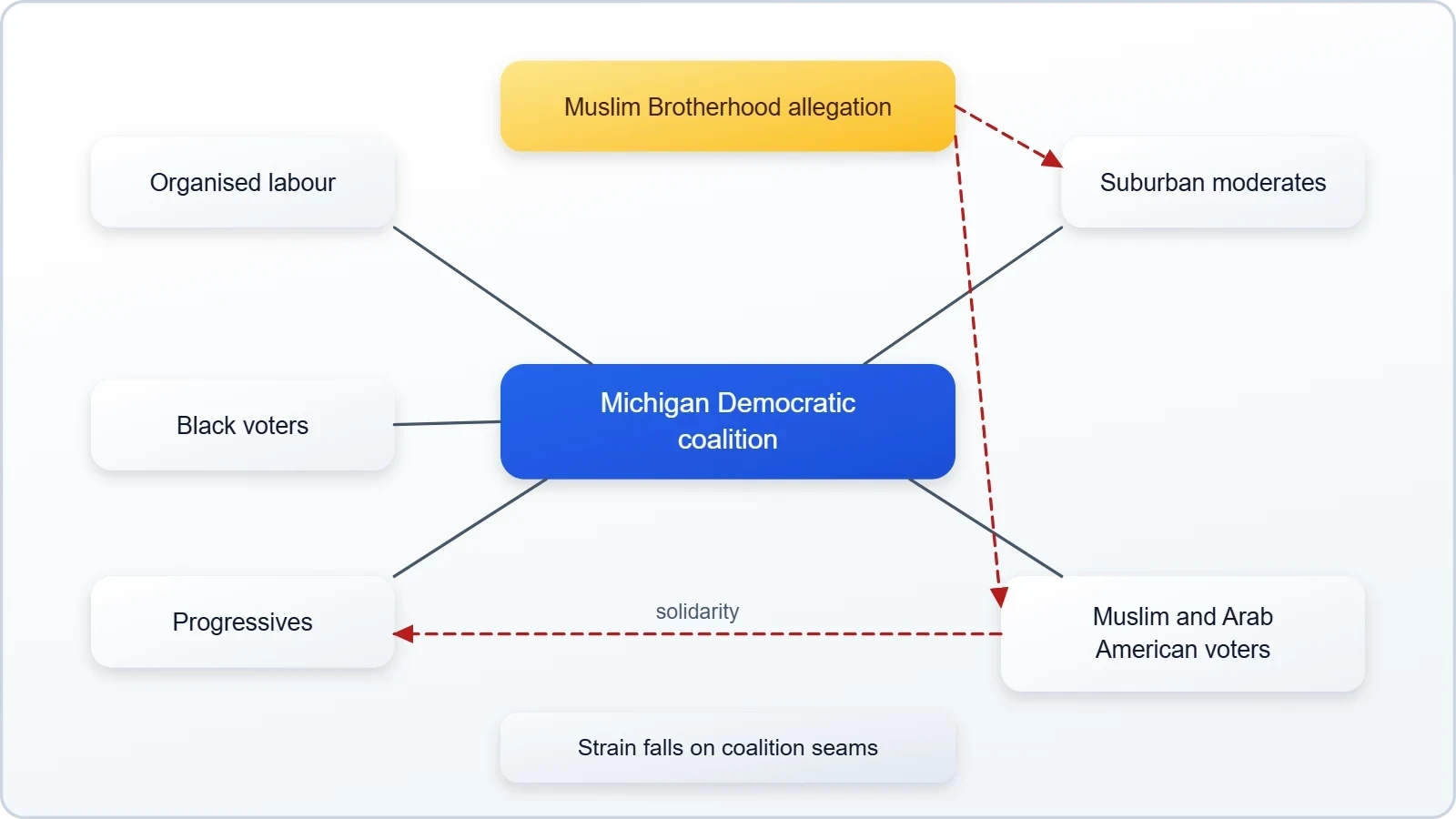
Allegations touching on Islamist organisations intersect with foreign policy divisions that have become increasingly salient in Michigan Democratic politics. Debates over Middle East policy have generated measurable intra-party friction, and entrepreneurs seeking advantage can exploit these tensions by associating candidates with controversial transnational movements.
The progressive wing of the party, which El-Sayed's candidacy energises, tends to prioritise economic redistribution and civil liberties. Moderate Democrats emphasise electability and fiscal prudence. The allegation attempts to translate a foreign policy controversy into a character question that transcends these programmatic differences.
Whether such translation succeeds depends on the credibility of the accuser and the receptivity of the audience. Republican critics addressing Democratic primary voters face an inherent credibility deficit, which may limit the allegation's persuasive reach even as it generates media coverage.
Coalition management theory suggests that party leaders will seek to contain the controversy by emphasising unity and refocusing attention on Republican opponents. The effectiveness of this containment strategy depends on the speed and coordination of elite responses.
Cross-Party Intervention in Nomination Contests
Intervention by one party in another's nomination process is a recurring feature of American elections, documented in congressional, senatorial, and gubernatorial contests. The tactic exploits the openness of primary systems and the asymmetry between partisan and general-electorate audiences.
Empirical research on such interventions finds mixed results. Advertising that elevates a perceived extremist opponent can succeed in shifting nomination outcomes, but the strategy carries risks if the elevated candidate proves more competitive than anticipated in the general election.
Elite rhetoric differs from paid advertising in its mechanism. Whereas advertising operates through repetition and emotional association, elite statements rely on media amplification and the credibility of the speaker. The Michigan case appears to belong to the latter category.
The strategic logic assumes that Democratic primary voters will respond to cues about a candidate's associations even when those cues originate from Republican critics. This assumption is questionable, given strong partisan filtering of political information among engaged primary voters.
Nevertheless, the allegation may achieve its objective indirectly by generating media coverage that frames the candidate in terms of controversy rather than policy. Coverage effects can persist even when the underlying claim is rejected by the audience.
Media Amplification and Framing Effects
Media coverage of political allegations follows a predictable pattern: the initial claim receives disproportionate attention, rebuttals receive less, and the controversy becomes a standing frame through which the candidate is subsequently interpreted. This asymmetry is well documented in communication research.
The originating report's framing, which describes the attack and its strategic intent without endorsing the underlying claim, represents a relatively responsible approach. It reports the political fact of the allegation while withholding judgment on its truth, leaving readers to assess the evidentiary basis.
However, even responsible reporting can amplify allegations by increasing their salience. The mere mention of a stigmatised organisation in proximity to a candidate's name can activate associative networks that influence subsequent evaluations, a phenomenon studied extensively in social psychology.
Digital media environments intensify these effects through algorithmic amplification and the fragmentation of audiences into ideologically homogeneous networks. Allegations that circulate within partisan echo chambers may be accepted uncritically by audiences predisposed to believe them.
Counter-framing by the target and allies can mitigate amplification effects, particularly when it provides an alternative interpretive frame that audiences find more compelling than the original allegation. The success of counter-framing depends on message discipline and timing.
Historical Precedents and Their Lessons
American political history offers numerous precedents for guilt-by-association attacks, including the anti-Masonic movement of the 1820s, nativist campaigns against Catholic candidates, and Cold War accusations of communist sympathy that ended several political careers. Each case exhibits the same structural features.
The Cold War era is particularly instructive because it demonstrates how allegations of foreign ideological affiliation can become self-sustaining, generating investigations and counter-allegations that persist long after the original claim has been discredited. Institutional mechanisms, including congressional hearings, amplified rather than resolved the controversies.
More recent cases involving Muslim American candidates illustrate the persistence of religious labelling in electoral politics. Studies of such campaigns find that Muslim candidates face distinctive barriers, including heightened scrutiny of their associations and demands for disavowal that are not imposed on candidates of other faiths.
These precedents suggest that the Michigan allegation is unlikely to be an isolated episode. Rather, it belongs to a continuing pattern that reflects deeper tensions in American political culture concerning religious pluralism and national identity.
The lessons for candidates and parties are clear: preparation for association-based attacks, rapid and coordinated response, and sustained engagement with affected constituencies can reduce the damage. Institutional actors, including media and civil society organisations, bear responsibility for maintaining evidentiary standards.
Evidentiary Thresholds and the Normative Evaluation of Political Claims
Evaluating the Michigan allegation requires distinguishing between three questions: whether the claim is true, whether it was made in good faith, and whether its circulation serves democratic deliberation. These questions are analytically independent, and conflating them produces confusion in public discourse about political ethics.
Standards of Proof in Political Allegation
Political allegations are not legal proceedings, and the standards of proof applicable in court do not translate directly to electoral discourse. Nevertheless, the concept of evidentiary sufficiency provides a useful benchmark for assessing whether a claim merits public credence.
At minimum, a claim of organisational affiliation should be supported by documented membership, public statements of support, financial contributions, or credible testimony. Absent such evidence, the claim remains speculative and should be characterised as such in responsible reporting.
The originating report's decision to describe the attack without adjudicating its truth reflects this standard. It treats the allegation as a political act whose significance lies in its strategic function rather than in its factual accuracy.
This approach has limitations. By reporting the allegation without evaluating its evidentiary basis, the report may inadvertently confer legitimacy on the claim. The inclusion of contextual information about the Muslim Brotherhood partially mitigates this risk.
Readers bear responsibility for applying appropriate evidentiary standards when encountering political allegations. Media literacy education, which emphasises source evaluation and claim verification, provides relevant competencies for this task.
The Ethics of Strategic Allegation
Normative political theory offers several frameworks for evaluating strategic allegation. Consequentialist approaches assess the practice by its effects on democratic outcomes, while deontological approaches emphasise duties of truthfulness and respect for persons. Both converge on scepticism toward unfounded claims.
Deliberative democracy theory, particularly as developed by Habermas and his successors, holds that political claims should be advanced in terms that could be accepted by reasonable interlocutors under conditions of free and equal deliberation. Allegations that cannot survive scrutiny fail this test.
Republican political theory emphasises the importance of non-domination and the protection of citizens from arbitrary power. Strategic allegation, when deployed to marginalise religious minorities, raises concerns about the reproduction of social hierarchies through political means.
Virtue ethics approaches focus on the character of the accuser and the dispositions that strategic allegation cultivates. Habituation to unfounded accusation may erode the civic virtues on which democratic governance depends, including honesty, fair-mindedness, and respect for evidence.
These frameworks do not yield a single verdict on the Michigan episode, but they converge in recommending caution. The absence of disclosed evidence, combined with the strategic intent described in the report, warrants scepticism about the claim's factual basis.
Institutional Responses and Accountability Mechanisms
Institutions capable of responding to unfounded allegations include political parties, media organisations, civil society groups, and fact-checking bodies. Their effectiveness depends on credibility, speed, and coordination, as well as on the receptivity of the audience.
Party leaders face a delicate task in responding to allegations against co-partisans. Premature defence may appear to endorse the alleged association, while silence may be interpreted as tacit acceptance. The optimal strategy typically involves affirming the candidate's standing while declining to amplify the allegation.
Media fact-checking can provide authoritative assessments of specific claims, but its reach is limited by audience fragmentation and by the tendency of partisans to reject inconvenient findings. Fact-checking is most effective when it reaches audiences not already committed to a position.
Civil society organisations, including religious and civil liberties groups, can play a constructive role by articulating principles that transcend particular controversies. Their interventions may carry moral weight that partisan actors lack.
Accountability mechanisms for accusers are comparatively weak in American politics. Unlike legal proceedings, political discourse lacks formal sanctions for unfounded claims, and reputational costs for accusers are often minimal. This asymmetry is a structural feature of the system.
Implications for Democratic Representation
The Michigan episode raises broader questions about the conditions under which religious and ethnic minorities can participate fully in democratic representation. If association-based attacks impose systematic costs on minority candidates, the principle of equal political opportunity is compromised.
Empirical research on minority candidates finds that they face distinctive barriers, including heightened scrutiny of their loyalties and demands for disavowal that are not imposed on majority candidates. These barriers can deter candidacy and distort representation.
The composition of the Michigan Democratic coalition, which includes a significant Arab American electorate, renders the state a bellwether for these dynamics. How the party manages the controversy may signal its approach to religious pluralism more broadly.
Representation theory suggests that descriptive representation, in which representatives share characteristics with their constituents, can enhance substantive representation by bringing distinctive perspectives to deliberation. Attacks that deter minority candidacy therefore have costs beyond the individuals targeted.
The long-term consequences of association-based attacks depend on institutional responses and on the resilience of norms against religious labelling. If such attacks become normalised, the costs to democratic representation may compound over successive electoral cycles.
Comparative and Theoretical Perspectives on Religious Framing
Placing the Michigan episode in comparative perspective illuminates both its distinctive features and its participation in broader patterns. Democracies with religiously diverse electorates confront recurring tensions between secular governance and religious identity, and these tensions are frequently exploited for electoral advantage.
European Parallels and Divergences
European democracies have experienced analogous controversies involving Muslim candidates and allegations of extremist affiliation. France's debates over laïcité, Germany's treatment of Turkish-origin politicians, and the United Kingdom's controversies over Islamophobia within parties all illustrate the pattern.
Differences in party systems and electoral rules shape the form these controversies take. Proportional representation systems, which encourage multi-party competition, may generate different dynamics than the American two-party system, in which intra-party coalitions are the primary arena of contestation.
The American case is distinctive in the intensity of its association-based rhetoric and in the role of religious identity in constructions of national belonging. The concept of a Judeo-Christian heritage, invoked in political discourse, positions Muslim Americans as outsiders in ways that European secularism does not.
Comparative analysis also reveals variation in institutional responses. European countries with strong anti-discrimination frameworks may provide more robust protections than the American system, which relies primarily on constitutional norms and civil society vigilance.
These comparisons suggest that the Michigan episode is neither uniquely American nor universally replicated. Its specific form reflects the interaction of American political culture, Michigan's demographic composition, and the strategic choices of political entrepreneurs.
The Political Economy of Religious Labelling
Religious labelling can be analysed through the lens of political economy, which examines how actors allocate scarce resources, including attention and credibility, to achieve political objectives. Labels function as low-cost signals that convey information about a candidate's perceived group affiliations.
The supply of labels is constrained by cultural repertoires and historical associations. The Muslim Brotherhood label is available in the American context because of decades of media coverage and policy discourse linking the organisation to extremism, a linkage that is contested among scholars but widely available in public culture.
The demand for labels comes from voters seeking cognitive shortcuts in low-information environments. Partisan cues and group identities provide efficient heuristics, and labels that activate these heuristics can influence evaluations with minimal informational content.
Entrepreneurs who supply labels profit from media attention and from the gratitude of constituencies that share their antagonism toward the labelled group. These profits are distributed asymmetrically, accruing to accusers while costs fall on targets and on the broader polity.
Regulatory interventions, including campaign finance disclosure and media ownership rules, can affect the supply of labels by altering the costs of producing and disseminating political messages. The efficacy of such interventions in the digital environment remains contested.
Identity, Authenticity, and Electoral Persuasion
Voters evaluate candidates on multiple dimensions, including competence, integrity, and authenticity. Allegations of foreign affiliation target the authenticity dimension, suggesting that the candidate's true loyalties lie elsewhere and that their professed commitments are instrumental.
This framing is particularly potent for candidates from minority groups, whose belonging is often questioned on the basis of ancestry, religion, or name. The allegation of Muslim Brotherhood ties activates a cluster of associations that position the candidate outside the imagined national community.
Research on candidate evaluation finds that authenticity perceptions are shaped by both candidate behaviour and media framing. Candidates who demonstrate consistent commitment to constituency interests can build trust reserves that insulate them from association-based attacks.
El-Sayed's political profile, which emphasises progressive policy commitments and public health expertise, provides resources for counter-framing. Whether these resources are sufficient to neutralise the allegation depends on the dynamics of the specific contest and the responses of allies.
The broader implication is that identity-based attacks are not merely episodic irritants but structural features of American electoral competition. Addressing them requires attention to both the strategic incentives that generate them and the institutional resources available for response.
Toward a Normative Framework for Evaluating Political Rhetoric
A normative framework for evaluating political rhetoric should incorporate standards of truthfulness, reciprocity, and respect for persons. These standards are not arbitrary but derive from the conditions under which democratic deliberation can function legitimately.
Truthfulness requires that claims be advanced with appropriate regard for evidence and that uncertainty be acknowledged. Allegations presented as established fact, when the underlying evidence is absent or contested, violate this standard.
Reciprocity requires that claims be framed in terms that could be accepted by reasonable interlocutors, including those who disagree. Allegations that rely on stigmatised labels to bypass argument fail this test.
Respect for persons requires that individuals be treated as agents capable of self-determination rather than as members of suspect categories. Association-based attacks that reduce candidates to their alleged affiliations violate this principle.
Applying this framework to the Michigan episode yields a critical assessment. The allegation, as reported, lacks evidentiary support, relies on stigmatised labelling, and treats the target as a member of a suspect category rather than as an individual with a public record.
We Also Published
Consequences for Democratic Competition and Institutional Trust
The circulation of unfounded association-based allegations has consequences that extend beyond the immediate contest. Each episode contributes to a cumulative erosion of trust in political institutions and in the possibility of good-faith disagreement across partisan and religious lines.
Effects on Voter Trust and Participation
Research on political trust finds that exposure to negative campaigning can depress turnout and reduce confidence in government, though the effects are contingent on the intensity and credibility of the messages. Association-based attacks may be particularly corrosive because they implicate identity rather than policy.
Voters who perceive politics as a domain of smear and innuendo may disengage, particularly those with weaker partisan attachments. This disengagement can advantage actors who benefit from low-turnout environments, creating incentives for further negative campaigning.
The effects on the targeted candidate's supporters may be different. Allegations perceived as unfair can mobilise supporters, increasing their commitment and participation. This backlash effect is well documented in studies of negative campaigning.
The net effect on participation therefore depends on the balance between demobilisation among the broader electorate and mobilisation among the target's base. In primary contests, where the electorate is smaller and more engaged, mobilisation effects may predominate.
Long-term effects on trust are more difficult to measure but potentially more consequential. Repeated exposure to unfounded allegations may normalise the practice and reduce the reputational costs for future accusers, creating a ratchet effect.
The Role of Political Parties as Gatekeepers
Political parties function as gatekeepers in democratic systems, shaping the candidate pool and the terms of competition. Their response to association-based attacks signals the boundaries of acceptable conduct and influences the incentives facing future actors.
Party leaders who defend targeted candidates against unfounded allegations reinforce norms of fair play and discourage future attacks. Conversely, leaders who remain silent or who amplify the allegations contribute to their normalisation.
The Michigan Democratic Party's response to the reported attacks is not detailed in the available reporting, limiting assessment of its gatekeeping function. The absence of information is itself notable, suggesting that the party may have chosen a low-profile approach.
Republican actors who initiated the attacks face different incentives. Their primary audience may reward the attacks regardless of their factual basis, and the costs of being perceived as unfair accusers may be minimal within their coalition.
The asymmetry in incentives between the two parties shapes the strategic environment. If one party can attack the other's candidates without incurring significant costs, the practice is likely to continue and intensify.
Implications for Minority Political Representation
The Michigan episode has implications for the representation of religious minorities in American politics. If association-based attacks impose systematic costs on Muslim and Arab American candidates, the diversity of the candidate pool and the quality of representation may suffer.
Descriptive representation research finds that minority officeholders bring distinctive perspectives and priorities to legislative and executive bodies. Reductions in minority candidacy therefore have consequences for the substantive representation of minority interests.
The chilling effect of association-based attacks may extend beyond the targeted individual. Potential candidates who observe the costs imposed on others may decide against running, reducing the diversity of the candidate pool in future cycles.
Countervailing factors include the growing political mobilisation of Arab American and Muslim communities, which may increase their influence within the Democratic coalition and their capacity to defend targeted candidates. Demographic change in Michigan and other states may shift the balance over time.
The long-term trajectory of minority representation depends on the interaction of these forces. Institutional reforms, including changes to primary systems and campaign finance rules, may alter the strategic environment in ways that reduce the returns to association-based attacks.
Prospects for Normative Repair
Normative repair refers to the processes by which damaged norms of political conduct are restored. In the context of association-based attacks, repair would require changes in elite behaviour, media practices, and public expectations.
Elite behaviour can change through leadership, through electoral incentives, and through institutional rules. Leaders who articulate and enforce norms against unfounded allegation can shift expectations and reduce the frequency of such attacks.
Media practices can change through editorial standards, fact-checking investments, and audience demand for verification. Outlets that consistently apply evidentiary standards can differentiate themselves and influence the broader information environment.
Public expectations can change through civic education and through the experience of political competition. Citizens who value fair play and evidence may reward candidates and parties that uphold these standards, creating electoral incentives for restraint.
The prospects for repair are uncertain and depend on the balance of forces in American politics. The Michigan episode illustrates both the persistence of association-based attacks and the resources available for resistance, including a free press and an engaged civil society.
Synthesis and Analytical Conclusions
The Michigan episode, as reported, presents a compact case study in the strategic deployment of association-based allegation within American electoral politics. Its significance lies less in the specific claim than in the pattern it exemplifies and the questions it raises about evidentiary standards and democratic norms.
Recapitulation of Principal Findings
The originating report describes Republican critics linking Abdul El-Sayed to the Muslim Brotherhood as part of a strategy to deepen Democratic divisions. No supporting evidence accompanied the allegation, and the report does not adjudicate its truth.
Analysis of the strategic logic suggests that the attack targets coalition fault lines, seeking to activate latent anxieties among moderate Democratic voters and to fragment the progressive base. The choice of the Muslim Brotherhood label reflects its availability in American political culture as a stigmatised association.
Evidentiary standards for affiliation claims require documentation, testimony, or admissions. The allegation, as reported, meets none of these thresholds, placing it in the lowest evidentiary category and warranting scepticism about its factual basis.
Comparative and historical analysis situates the episode within a long tradition of association-based attacks, from anti-Masonic and anti-Catholic campaigns to Cold War red-baiting and contemporary religious labelling. The structural features of these episodes are remarkably consistent.
Normative evaluation, drawing on deliberative democracy theory and republican political thought, finds the allegation deficient on criteria of truthfulness, reciprocity, and respect for persons. These deficiencies have consequences for democratic legitimacy and for minority representation.
Uncertainties and Directions for Further Inquiry
Several aspects of the episode remain uncertain, including the identity of the specific critics, the venues in which the allegations were made, and the responses of the targeted candidate and his allies. These uncertainties limit the precision of the analysis.
Further inquiry could examine the media coverage of the allegations in Michigan outlets, the reactions of Democratic primary voters, and the strategic calculations of Republican actors. Such research would require access to local reporting and polling data not available in the originating source.
Comparative research on association-based attacks against Muslim candidates in other states could illuminate the conditions under which such attacks succeed or fail. Variation in electoral rules, demographic composition, and party dynamics provides natural experiments for analysis.
Research on counter-strategies could identify effective responses to association-based attacks, informing the practice of candidates and parties. Experimental methods, including survey experiments, could test the efficacy of different counter-framing approaches.
Theoretical work could refine the normative framework for evaluating political rhetoric, integrating insights from deliberative democracy, republican theory, and virtue ethics. Such work would provide guidance for institutional design and civic education.
Concluding Assessment
The Michigan episode illustrates the persistent tension in democratic politics between strategic competition and normative restraint. Actors who prioritise short-term advantage may deploy association-based attacks regardless of their evidentiary basis, while the costs of such attacks are borne by targets and by the polity as a whole.
Institutional responses, including party gatekeeping, media fact-checking, and civil society vigilance, can mitigate these costs but cannot eliminate them. The effectiveness of such responses depends on the credibility of the institutions and the receptivity of the audience.
The long-term trajectory of American political discourse depends on the balance of forces that sustain and that resist association-based attacks. The Michigan episode provides a data point suggesting that the practice remains available and that its costs remain unevenly distributed.
For analysts, the appropriate response is neither to dismiss such episodes as ephemeral nor to treat their claims as established. Rather, the task is to examine the strategic logic, apply evidentiary standards, and assess the normative stakes with the care that democratic deliberation requires.
The reported linkage of Abdul El-Sayed to the Muslim Brotherhood thus functions as a case study in the politics of allegation, illuminating the mechanisms by which reputational costs are imposed, the standards by which claims should be evaluated, and the institutional resources available for response.
From our network :
- Live Online English Classes for Kids: Do They Actually Reduce Anxiety?A ten-week study reveals that synchronous online English classes can significantly reduce child language anxiety while improving listening and reading skills. Discover what makes these programs effective and how parents can select the right one.
- CISA’s Ten-Advisory Wave: Why Generic Patching Fails in OT and How to Build Product-Specific PlaybooksCISA released ten ICS advisories in one week, exposing critical infrastructure risks. Generic patching fails in OT. Learn to build product-specific remediation playbooks.
- The Hidden Cost of AI Convenience: Why Over-Permissioned Agents Are a Security Time BombDiscover why AI agents with excessive permissions create dangerous single points of failure, and learn how implementing least privilege principles can protect your organization from exploitation.
- The Final Descent: How ESA Retired the Legendary Cluster Constellation After 24 Years of Space Weather ScienceAfter 24 years mapping Earth’s magnetosphere, ESA’s Cluster mission concluded with a precisely controlled reentry over the South Pacific. This analysis explores the scientific legacy, engineering decisions, and debris mitigation principles behind one of space exploration’s most responsible retirements.
- Mobile Learning and VR in English: What Global Evidence Reveals About Effective Language TechnologyA systematic review across 14 countries reveals which language-learning technologies genuinely work. Mobile learning, AI, and VR show measurable benefits when pedagogically integrated. This evidence-based guide helps educators and learners select technology that delivers real return on investment.
- University Language Proficiency Exams: Why Institutional Tests Demand Different Preparation Than IELTS and TOEFLDiscover why university-specific language proficiency examinations differ fundamentally from IELTS and TOEFL, and learn strategic preparation approaches for institutional assessment success.
- Forbidden Matrix Patterns and Visible Lattice Points: A Geometric DictionaryExplore how multidimensional 0–1 matrices encode geometric truths, linking forbidden patterns to visible lattice points and hypergraph theory, with applications in combinatorics and computational geometry.
- How AI Agents Will Change the Way We Manage Personal FinancesExplore how AI agents are transforming personal finance through automated budgeting, bill payment, and investment management, while examining the critical security protocols and governance frameworks required for safe deployment.
- Committed Mediterranean Precipitation Decline: Why Emissions Cuts Alone Cannot Restore Winter RainsNew NOAA research reveals that Mediterranean winter rains may decline irreversibly even with emissions cuts. Explore the science of committed climate change and regional impacts.
RESOURCES
- Trump escalates rhetoric against El-Sayed as he tries to undermine ...pbs.org2 days ago ... PORT HURON, Mich. (AP) — President Donald Trump intensified his anti-Muslim rhetoric against Michigan Senate candidate Abdul El-Sayed on ...
- Examining the Muslim Brotherhood claims in Michigan's Senate racewashingtonpost.com4 days ago ... Republican Mike Rogers claims without evidence that Democrat Abdul El-Sayed has “pledged his support” to the movement.
- A bitter Michigan Senate race rattles Jewish and Muslim voters ...pbs.orgOct 19, 2026 ... Trump went further Wednesday, claiming El-Sayed was a member of the Muslim Brotherhood. ... Democratic nominee for U.S. Senate Abdul…
- Republicans made El-Sayed a top midterm target. The Democrat ...ap.orgRepublicans are aggressively targeting Abdul El-Sayed, the Democratic Senate nominee from Michigan, as the face of the opposition ... Muslim Brotherhood” but ...
- Anti-Muslim Hate Targeting Abdul El-Sayed Surged 20-Fold After ...csohate.orgAug 12, 2026 ... Abdul El-Sayed's victory in Michigan's Democratic Senate primary on ... Terrorism and Muslim Brotherhood allegations: Posts allege that ...
- With Michigan's US Senate race tightening, Democratic candidate ...facebook.comOct 13, 2026 ... ... Abdul El-Sayed's denial of family connections to the Muslim Brotherhood. The video compiles various allegations, including a social media ...
- 'What are you implying?': El-Sayed confronts critics head-on as ...theguardian.com6 days ago ... Against a backdrop of rising Islamophobia, Michigan Senate hopeful has challenged premise of repeated questions on Muslim Brotherhood, ...
- Fact check: Abdul El-Sayed, Mike Rogers debate ... - Bridge Michiganbridgemi.com5 days ago ... ... Sayed in the Democratic primary, but it wasn't ... Claims that El-Sayed is affiliated with the Muslim Brotherhood, a…
- Republican 'Muslim Brotherhood' attacks on El-Sayed in Michigan ...reuters.com4 days ago ... "If Democratic voters aren't casting ballots for El-Sayed in what is the biggest population area here, then that is a…
- How the US far-right weaponised 'inshallah' against Abdul El-Sayedaljazeera.comAug 10, 2026 ... An Al Jazeera investigation has tracked the rapid spread of an anti-Muslim ... Abdul el-Sayed has won Michigan's Democratic senate…
- Trump Says El-Sayed Is '100%' Muslim Brotherhood—As ... - Forbesforbes.comOct 15, 2026 ... Topline. President Donald Trump insisted on Thursday that Michigan Democratic Senate candidate Abdul El-Sayed is a member of the Muslim ...
- El-Sayed's alleged ties to Muslim Brotherhood shake up Michigan ...thehill.com5 days ago ... Republicans are targeting Democratic candidate Abdul El-Sayed in Michigan, alleging ties to the Muslim Brotherhood in hopes it will help ...
- Abdul El-Sayed Won a Combative Democratic Nomination for U.S. ...legalnews.comAug 13, 2026 ... ... Michigan's Democratic primary ... Ted Cruz focused on El-Sayed's alleged family connections to organizations associated with the Muslim ...
- Muslim Brotherhood Publication Celebrates Abdul El-Sayed Primary ...algemeiner.comAug 10, 2026 ... A Muslim Brotherhood-linked publication celebrated Abdul El-Sayed's victory in Michigan's Democratic ... Alleged potential ties between El-Sayed ...
- 'He hates our country': Trump calls El-Sayed 'a Muslim Brotherhood ...abcnews4.comOct 16, 2026 ... President Donald Trump said Michigan Democratic Senate candidate Abdul El-Sayed is "100%" affiliated with the Muslim Brotherhood.
- 01
- 02
- 03
- 04
- 05
- 06
- 07
- 08
0 Comments