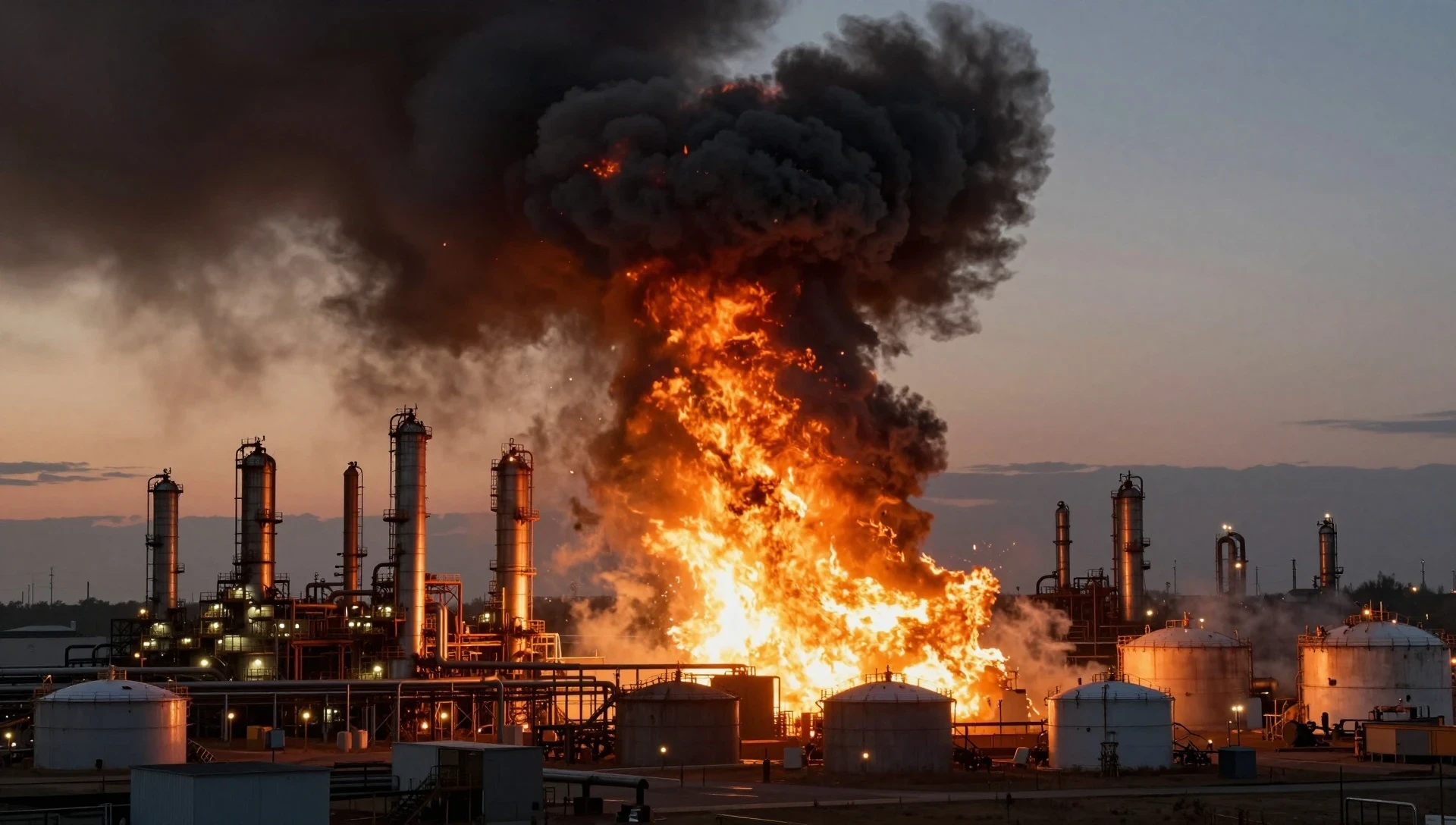
Russia's Investigative Committee has opened a criminal terrorism case following a Ukrainian drone strike on an industrial facility in the Nizhny Novgorod region, a legal escalation that reframes a tactical battlefield exchange as a prosecutable act of terror.
The region's governor described the assault as massive and reported significant damage to the unnamed site, while Ukrainian media identified the target as the Kstovo oil refinery, one of Russia's largest fuel and lubricant producers.
No casualties were reported, yet regional authorities immediately moved to stabilise petrol station supplies, signalling that the strike's economic shock outweighed its human toll.
On This Page
The same day produced a mirror-image account from Kyiv. President Volodymyr Zelenskyy reported that hundreds of thousands of Ukrainian households lost power after Russian strikes on energy infrastructure across four regions overnight, and he accused Moscow of exploiting Ukraine's shortage of ballistic missile interceptors.
Ukraine's air force claimed it downed 371 of 433 long-range drones launched since Saturday evening, while Russia's Defence Ministry said its forces intercepted 235 Ukrainian drones over Russian territory. These competing interception figures illustrate how both sides now publish attrition statistics as instruments of narrative control rather than neutral disclosure.
Beneath the immediate exchange lies a contested strategic bargain. Washington had pressed Kyiv for weeks to halt refinery strikes, blaming them for elevated diesel prices, and Moscow confirmed on Friday that Ukraine had resumed attacks after a pause of several days.
Senior Russian official Alexander Novak said Ukraine hit three oil refineries and one gas-chemical complex. The Kremlin simultaneously signalled openness to resumed peace talks, with an aide stating that Vladimir Putin would accept a call from Zelenskyy and that initial negotiations should include only Russia, Ukraine and the United States, excluding European powers.
TL;DR Russia has criminalised a Ukrainian drone strike on the Kstovo refinery as terrorism while Ukraine reports mass power losses from Russian energy strikes, and both sides publish inflated interception counts. The exchange reveals a deliberate mutual targeting of energy infrastructure, complicated by US pressure on Kyiv over diesel prices and a Kremlin proposal to confine peace talks to Russia, Ukraine and the US.
The Legal Framing of Drone Warfare
Classifying a drone strike as terrorism is a juridical act with political consequences that extend well beyond the damaged facility. Russia's Investigative Committee controls the charge, and the terrorism designation allows Moscow to cast Ukrainian military targeting as criminal rather than lawful combat, a distinction that matters in extradition requests and international forums.
Why the Terrorism Charge Matters
The terrorism label carries specific legal weight under Russian statute, permitting broader investigative powers, longer pre-trial detention and a rhetorical frame that positions Kyiv outside the laws of armed conflict. It also creates a documentary record Moscow can cite in future negotiations or tribunals, converting a single strike into durable diplomatic capital.
Comparable designations have appeared throughout the conflict, with Russia repeatedly opening criminal cases over cross-border incidents. Each filing serves a dual function: domestic reassurance that the state is responding, and international messaging that Ukrainian operations constitute unlawful aggression rather than legitimate defence against an invasion launched in February 2022.
Ukraine has not formally responded to the specific charge, and its media framing emphasises the refinery's military-economic role. That divergence in legal characterisation is itself the story, because both governments are constructing parallel evidentiary narratives around the same physical event in Nizhny Novgorod.
The practical effect on the ground is limited, since criminal cases do not alter battlefield conduct. Their value is cumulative and reputational, shaping how third-party states, insurers and investors assess risk when engaging with either economy.
The Kstovo Refinery and Fuel Economics
Kstovo ranks among Russia's largest refineries, producing fuels and lubricants that feed both domestic consumption and export revenue. Striking such a node disrupts refining throughput, and regional authorities acknowledged they were taking steps to keep petrol stations supplied, an implicit admission of downstream strain.
Refinery attacks impose asymmetric costs. A drone costing tens of thousands of dollars can force repairs measured in millions and downtime measured in weeks, degrading Russia's ability to convert crude into high-margin refined products. That ratio explains why Kyiv has repeatedly targeted oil and gas sites since February 2022.
The economic transmission runs through diesel markets. Reduced Russian refining capacity tightens global distillate supply, and Washington's objection to the strikes was explicitly tied to higher diesel prices, a domestic political concern that shaped American pressure on Kyiv.
Moscow's decision to publicise the terrorism case alongside fuel-supply assurances suggests it is managing two audiences simultaneously: a domestic population sensitive to pump prices and an international one being told that Ukrainian operations are criminal.
Interception Claims as Information Warfare
Russia's Defence Ministry reported downing 235 Ukrainian drones overnight, while Ukraine's air force claimed 371 of 433 Russian long-range drones destroyed since Saturday evening. Both figures are self-reported, unverifiable in real time, and calibrated to project defensive competence.
The arithmetic matters. Ukraine's claim implies an interception rate of roughly 85.7 percent, calculated as ##371 \div 433 \approx 0.857##, a figure designed to reassure citizens that mass drone salvos remain survivable despite the interceptor shortage Zelenskyy himself acknowledged.
Russia's 235 figure lacks a stated launch denominator, making rate calculation impossible and comparison asymmetric. That omission is itself informative, since a bare count projects volume of defence without exposing the proportion of drones that penetrated.
Analysts typically treat such claims as directional rather than precise, useful for tracking escalation tempo but unreliable for damage assessment. The gap between claimed and actual interception rates is where infrastructure damage accumulates.
The Energy War and Its Economic Consequences
Both belligerents have converged on energy infrastructure as the decisive pressure point, and the weekend's exchanges confirm that neither intends to abandon the strategy. Ukraine struck refining capacity; Russia struck generation and distribution, leaving hundreds of thousands without power across four regions.
Mutual Targeting of Energy Infrastructure
Kyiv's rationale is explicit: strikes on Russian oil and gas sites respond to Russian attacks on Ukrainian energy infrastructure dating from the February 2022 offensive. This tit-for-tat logic has produced a durable reciprocal targeting regime that neither side has shown willingness to suspend unilaterally.
Moscow's strikes on Ukrainian generation exploit a specific vulnerability, namely the shortage of ballistic missile interceptors that Zelenskyy publicly identified. By saturating air defences with drones and missiles, Russia converts Ukraine's interceptor scarcity into civilian hardship during colder months.
The pattern resembles a coercive bargaining strategy in which each side degrades the other's economic base to strengthen its negotiating position. Energy infrastructure is attractive precisely because damage is visible, measurable and politically painful.
Novak's confirmation that Ukraine hit three refineries and one gas-chemical complex indicates the scale of the campaign, while Moscow's statement that strikes resumed after a pause suggests temporary restraint was tactical rather than principled.
The US Factor and Diesel Prices
Washington's intervention introduced a third-party constraint on Ukrainian targeting. President Donald Trump pressed Kyiv for weeks to stop refinery attacks, attributing elevated diesel prices to them, which placed Ukrainian military strategy in tension with American consumer economics.
That pressure illustrates how energy markets transmit war into domestic politics. Diesel underpins freight, agriculture and construction, so marginal refining losses in Russia register as price increases at American pumps and in American supply chains.
The pause Moscow observed and Kyiv apparently ended therefore reflects a triangular negotiation: Ukraine weighing military effect against allied patience, Russia monitoring whether Western restraint holds, and Washington managing inflation expectations.
Whether the resumed strikes signal Ukrainian defiance or a renegotiated understanding remains unclear, but the episode demonstrates that refinery targeting has become a bargaining chip in alliance management, not merely a battlefield tactic.
Interceptors, Power Outages and Civilian Cost
Zelenskyy's reference to a ballistic missile interceptor shortage identifies the binding constraint on Ukrainian air defence. Interceptors are scarce, expensive and Western-supplied, so Russia's saturation tactics impose disproportionate costs on defenders forced to choose which threats to engage.
The consequence is measurable in households disconnected from power. Hundreds of thousands losing electricity across four regions translates into disrupted heating, water pumping and communications, effects that compound as temperatures fall and repair crews work under threat.
Russia frames its grid strikes as retaliation for Ukrainian refinery attacks, mirroring Kyiv's own justification. This reciprocal framing has become the standard rhetorical architecture of the energy war, with each side presenting escalation as response.
For civilians, the distinction between offensive and retaliatory strikes is academic. What registers is the duration of outage, the availability of fuel and the reliability of the grid through winter.
We Also Published
- 01
- 02
- 03
- 04
Diplomacy, Escalation and the Narrowing Negotiating Table
The weekend's military exchange coincided with diplomatic signals that deserve equal attention. A Kremlin aide said Putin would take a call from Zelenskyy if he called, asserting that Putin has never refused talks, while specifying that initial negotiations should include only Russia, Ukraine and the United States.
The Kremlin's Three-Party Proposal
Excluding European countries from initial negotiations is a substantive demand, not a procedural detail. It would sideline the states most exposed to the conflict's consequences and reduce the forum to the three capitals Moscow considers decisive.
The proposal aligns with a broader Russian preference for bilateral great-power management over multilateral frameworks. By narrowing the table, Moscow reduces the number of parties able to insist on terms it finds unpalatable, including security guarantees and territorial questions.
Ukraine has consistently sought broader European involvement, recognising that its security depends on neighbours with direct stakes. The gap between Kyiv's preferred format and Moscow's proposal is itself a negotiating obstacle.
Whether the offer reflects genuine intent or tactical positioning cannot be determined from a single statement, but its timing alongside continued strikes suggests leverage-building rather than de-escalation.
Escalation Dynamics and Bargaining Leverage
Simultaneous escalation and diplomatic outreach is a recognisable bargaining pattern. Each side improves its position before talks by demonstrating capacity to inflict costs, then offers negotiations from relative strength.
Ukraine's refinery strikes and Russia's grid attacks both serve this function, generating pain that can be traded away. The terrorism case adds legal leverage, creating a bargaining chip that could theoretically be withdrawn as part of a settlement.
The risk is that escalation outpaces diplomacy. Reciprocal infrastructure attacks create constituencies for continued retaliation and make restraint politically costly for leaders who have promised resolve.
Trump's pressure on Kyiv introduced a variable that neither Moscow nor Kyiv fully controls, and the resumption of refinery strikes indicates that allied restraint has limits when core military objectives are at stake.
What the Weekend Exchange Reveals
The Nizhny Novgorod strike and the terrorism case together demonstrate that legal, economic and military instruments are now deployed in concert. Russia prosecutes what it cannot prevent, and Ukraine targets what Russia cannot easily replace.
Interception claims on both sides function as domestic reassurance and international signalling, but they obscure the material reality of damaged refineries and darkened cities. The verifiable facts are narrower than the rhetoric surrounding them.
Diplomatically, the Kremlin's three-party proposal and its willingness to accept a Zelenskyy call suggest a channel exists, however narrow. The exclusion of Europe remains the principal structural obstacle to any durable settlement.
What emerges is a conflict locked into reciprocal infrastructure warfare, mediated by American electoral economics and Russian procedural manoeuvring, with civilians bearing the measurable costs of both.
From our network :
- University Language Proficiency Exams: Why Institutional Tests Demand Different Preparation Than IELTS and TOEFLDiscover why university-specific language proficiency examinations differ fundamentally from IELTS and TOEFL, and learn strategic preparation approaches for institutional assessment success.
- Mobile Learning and VR in English: What Global Evidence Reveals About Effective Language TechnologyA systematic review across 14 countries reveals which language-learning technologies genuinely work. Mobile learning, AI, and VR show measurable benefits when pedagogically integrated. This evidence-based guide helps educators and learners select technology that delivers real return on investment.
- CISA’s Ten-Advisory Wave: Why Generic Patching Fails in OT and How to Build Product-Specific PlaybooksCISA released ten ICS advisories in one week, exposing critical infrastructure risks. Generic patching fails in OT. Learn to build product-specific remediation playbooks.
- Live Online English Classes for Kids: Do They Actually Reduce Anxiety?A ten-week study reveals that synchronous online English classes can significantly reduce child language anxiety while improving listening and reading skills. Discover what makes these programs effective and how parents can select the right one.
- How AI Agents Will Change the Way We Manage Personal FinancesExplore how AI agents are transforming personal finance through automated budgeting, bill payment, and investment management, while examining the critical security protocols and governance frameworks required for safe deployment.
- The Final Descent: How ESA Retired the Legendary Cluster Constellation After 24 Years of Space Weather ScienceAfter 24 years mapping Earth’s magnetosphere, ESA’s Cluster mission concluded with a precisely controlled reentry over the South Pacific. This analysis explores the scientific legacy, engineering decisions, and debris mitigation principles behind one of space exploration’s most responsible retirements.
- The Hidden Cost of AI Convenience: Why Over-Permissioned Agents Are a Security Time BombDiscover why AI agents with excessive permissions create dangerous single points of failure, and learn how implementing least privilege principles can protect your organization from exploitation.
- Committed Mediterranean Precipitation Decline: Why Emissions Cuts Alone Cannot Restore Winter RainsNew NOAA research reveals that Mediterranean winter rains may decline irreversibly even with emissions cuts. Explore the science of committed climate change and regional impacts.
- Forbidden Matrix Patterns and Visible Lattice Points: A Geometric DictionaryExplore how multidimensional 0–1 matrices encode geometric truths, linking forbidden patterns to visible lattice points and hypergraph theory, with applications in combinatorics and computational geometry.
RESOURCES
- Russia opens terrorism case over Ukraine attack on industrial facilityabc.net.au7 hours ago ... ... drone attack. Ukrainian media reported the attack had hit the Kstovo oil refinery, calling it "one of Russia's largest…
- A major oil refinery in Kstovo, Russia's Nizhny Novgorod region, was ...facebook.com4 hours ago ... ... Russian military. Ukrainian drone strikes hit Russian oil refinery and power facilities. Price of Peace ▻ Everything happening in…
- “Give Us Interceptor Missiles”: Zelenskyy Backs Energy Ceasefire ...united24media.comOct 20, 2026 ... ... Russia's Kstovo oil refinery following a drone strike on November 1. Author. Photo of Ivan Khomenko. Ivan Khomenko. Category:…
- Kyiv launches 'massive' overnight drone strikes on Russian facilitiesindependent.co.uk2 hours ago ... On Friday, Russia said Ukraine had resumed strikes on its oil refineries ... Russia opens terrorism case over attack on…
- Russian oil refinery in Kstovo ablaze after reported overnight drone ...kyivindependent.com1 hour ago ... Russian attack hits Kyiv energy facility, leaving parts of the city without power and water; Ukraine hits plant producing fuel…
- Russian official says oil refinery hit in 'massive' drone attackindependent.co.uk8 hours ago ... Russian investigators opened a criminal case on terrorism charges over a suspected Ukrainian attack ... strikes Russian oil refinery in…
- Russian Offensive Campaign Assessment, October 16, 2025 | ISWunderstandingwar.orgOct 16, 2025 ... Russian forces are reportedly adapting their long-range drone and missile strike tactics targeting Ukrainian energy infrastructure in an attempt ...
- How severe is Russia's energy shortage because of Ukrainian strikes?aljazeera.comJun 30, 2026 ... Analysts say Russia's fuel crisis may affect its domestic economy, but the war in Ukraine will remain the priority.
- The Kyiv Independent — News from Ukraine, Eastern Europekyivindependent.comRussia continued its campaign against Ukraine's energy ... Ukraine war latest: Russian oil refinery in Kstovo ablaze after reported overnight drone strike.
- Moscow Opens Terrorism Case After Drone Strike on Russian Oil ...au.headtopics.com7 hours ago ... ... attack had hit the Kstovo oil refinery ... Ukraine-Russia War Oil Refinery Attack Terrorism Charges Energy Infrastructure Cyber And…
- Ukraine News Premier Independent English-language Source ...english.nv.uaDrones attack Kstovo refinery in Russia, large fire erupts. November 1, 2026, 12:37 AM. Emergency power outages introduced in Kyiv because of Russian attacks.
- 'Massive' Russian air attack hits Western Ukraine, Kyiv; Poland says ...france24.comMar 24, 2024 ... Smoke rises in the sky over the city after a Russian missile strike, amid Russia's Cover ...
- Focus Ukraine: Attacking Russia's Economic Potential and ...agendapublica.esThe attack on March 12 on the refinery in Kstovo, Nizhny Novgorod Oblast, 1,150 km from the estimated location of the drone launch in…
- Welcome to Ukraine - Ласкаво просимо в Україну! - Redditreddit.comr/ukraine - Ukrainian Drones Strike LUKOIL Oil Refinery in Kstovo, Fire Breaks Out ... drone attack targeted the Novokuybyshevsk refinery near Samara, Russia.
- Russia in Review, Jan. 24-31, 2025russiamatters.org... war-torn country repair vital energy infrastructure damaged by Russian attacks. ... Ukraine launched one of its largest drone attacks across nine Russian regions.
- 01
- 02
- 03
- 04
- 05
- 06
- 07
- 08
0 Comments