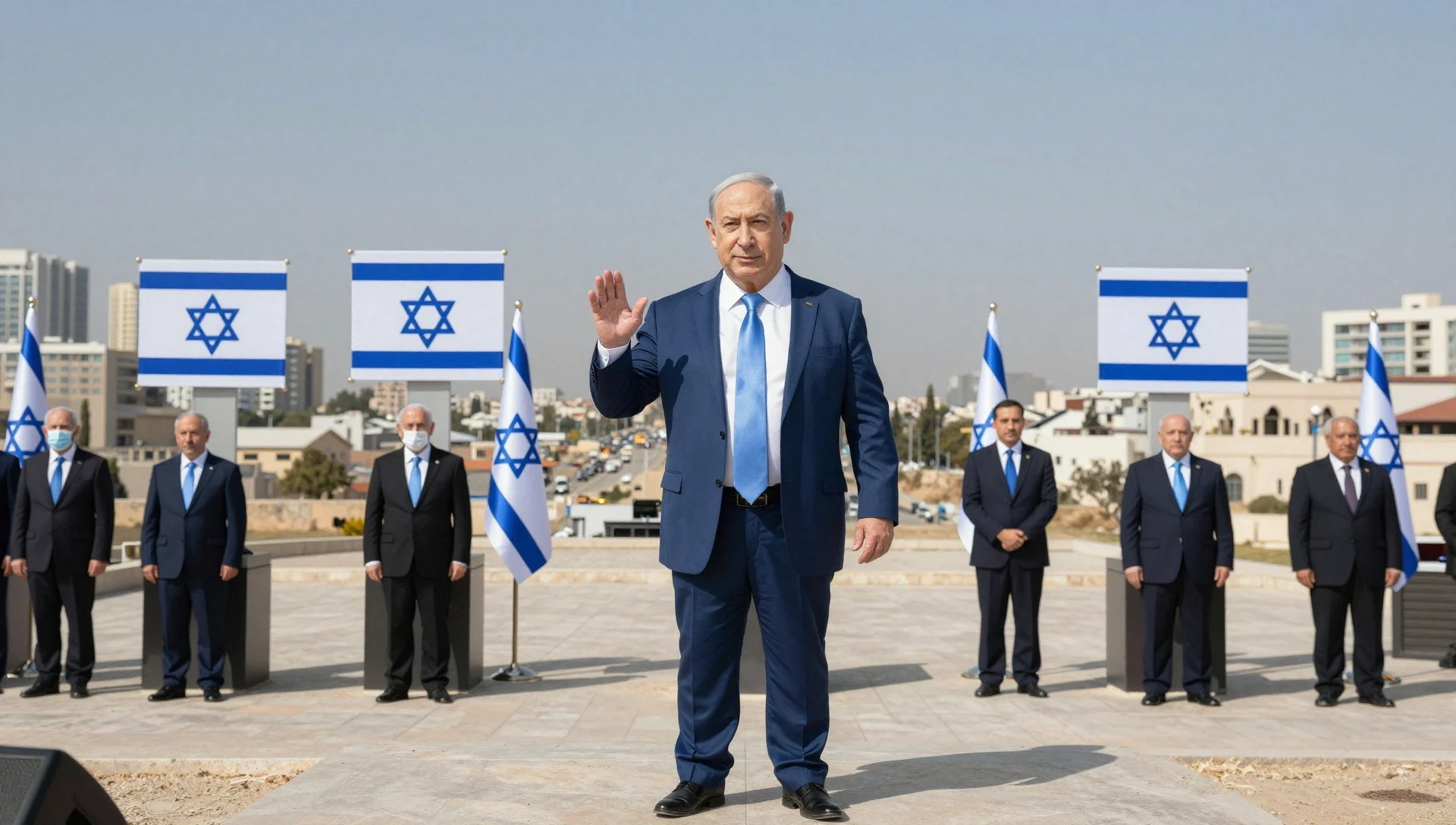
Israel's electoral landscape has long functioned as one of the most volatile and consequential political laboratories in the democratic world, and the repeated contests that defined the Netanyahu era distilled that volatility into a single, recurring national question.
Voters were asked, again and again, whether the longest-serving prime minister in the country's history should remain at the helm or whether the accumulated weight of legal jeopardy, coalition fragility, and public fatigue had finally tipped the balance. Each ballot became less a routine civic exercise and more a referendum on one man's political durability.
Understanding those outcomes requires moving beyond the horse-race framing of seat counts and bloc arithmetic. The deeper story concerns structural forces: a fragmented party system, proportional representation without a meaningful threshold, the rising weight of religious and nationalist constituencies, and a judiciary increasingly drawn into the center of political life.
On This Page
- The Structural Roots of Israel's Electoral Stalemate
- The Legal Shadow Over Netanyahu's Political Career
- Coalition Mathematics and the 2021 Turning Point
- The Return to Power and the Meaning of the 2022 Verdict
- Netanyahu's Future: Scenarios and Strategic Variables
- What the Israeli Experience Reveals About Democratic Resilience
- Conclusion: Reading the Netanyahu Era in Full
Netanyahu's survival and eventual displacement were shaped by how these forces interacted, not merely by campaign tactics or personality. The result was a political system that repeatedly produced stalemate rather than resolution.
This analysis examines the meaning embedded in those elections, the coalition mathematics that governed outcomes, the legal pressures that shadowed the prime minister, and the strategic calculations that determined his future.
It also considers what the Netanyahu saga reveals about democratic resilience, institutional stress, and the price of prolonged political uncertainty in a region where stability is never assumed.
TL;DR Israel's repeated elections between 2019 and 2022 became a sustained referendum on Benjamin Netanyahu's leadership, producing four inconclusive contests before a coalition finally unseated him and later returned him to power. The core meaning lies in structural fragmentation, the entanglement of legal accountability with coalition politics, and the erosion of governing stability. Netanyahu's future remains contingent on coalition arithmetic, judicial outcomes, and the shifting balance between his loyal base and a weary electorate seeking normalcy.
The Structural Roots of Israel's Electoral Stalemate
Israel's electoral system is built for representation rather than governability, and that design choice explains much of the paralysis that defined the Netanyahu years. A single nationwide constituency with a low electoral threshold allows small parties to enter parliament, which in turn grants them disproportionate leverage in coalition negotiations.
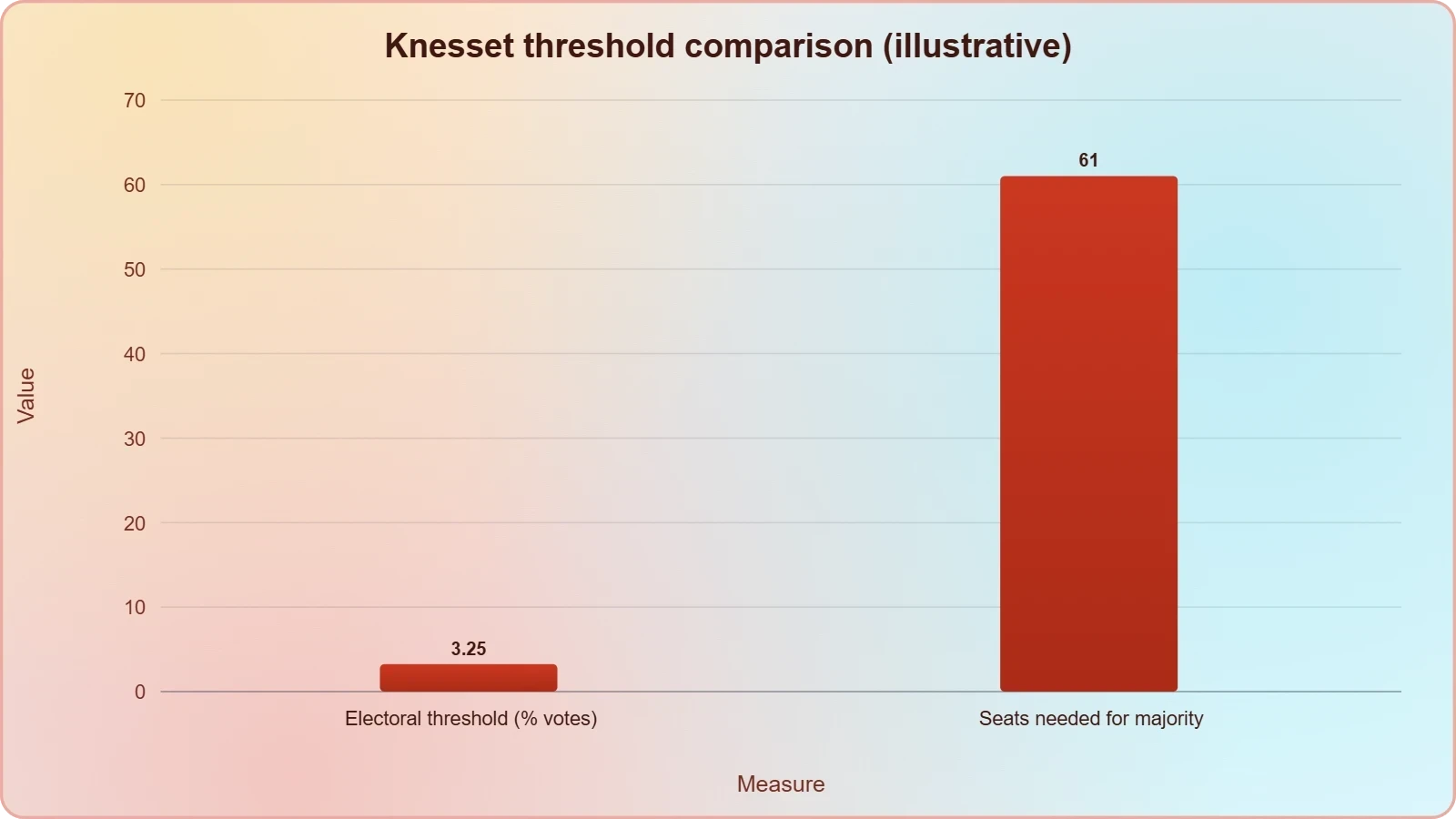
The result is a legislature where no bloc commands a stable majority, and where every election risks reproducing the same arithmetic.
Proportional Representation and Coalition Arithmetic
The Knesset's 120 seats are allocated proportionally, meaning that governing requires assembling at least 61 members into a coalition. Because the threshold sits at 3.25 percent, parties representing narrow sectoral interests routinely survive and then extract concessions far beyond their electoral weight. This structural feature transforms coalition-building into an exercise in endurance rather than governance.
Netanyahu mastered this arithmetic more skillfully than any predecessor, cultivating relationships with ultra-Orthodox and nationalist factions that reliably delivered bloc support. Yet the same skill that sustained him also trapped the system, because his partners' demands hardened over time and narrowed the space for compromise. The machinery that kept him in power also made the country increasingly difficult to govern.
The Fragmentation of the Anti-Netanyahu Camp
Opposition to Netanyahu was broad but never unified, and that fragmentation proved decisive across successive elections. Parties spanning the left, center, and even the right shared a desire to remove him but disagreed profoundly on policy, identity, and the acceptable terms of coalition partnership. These internal divisions repeatedly handed the initiative back to the incumbent.
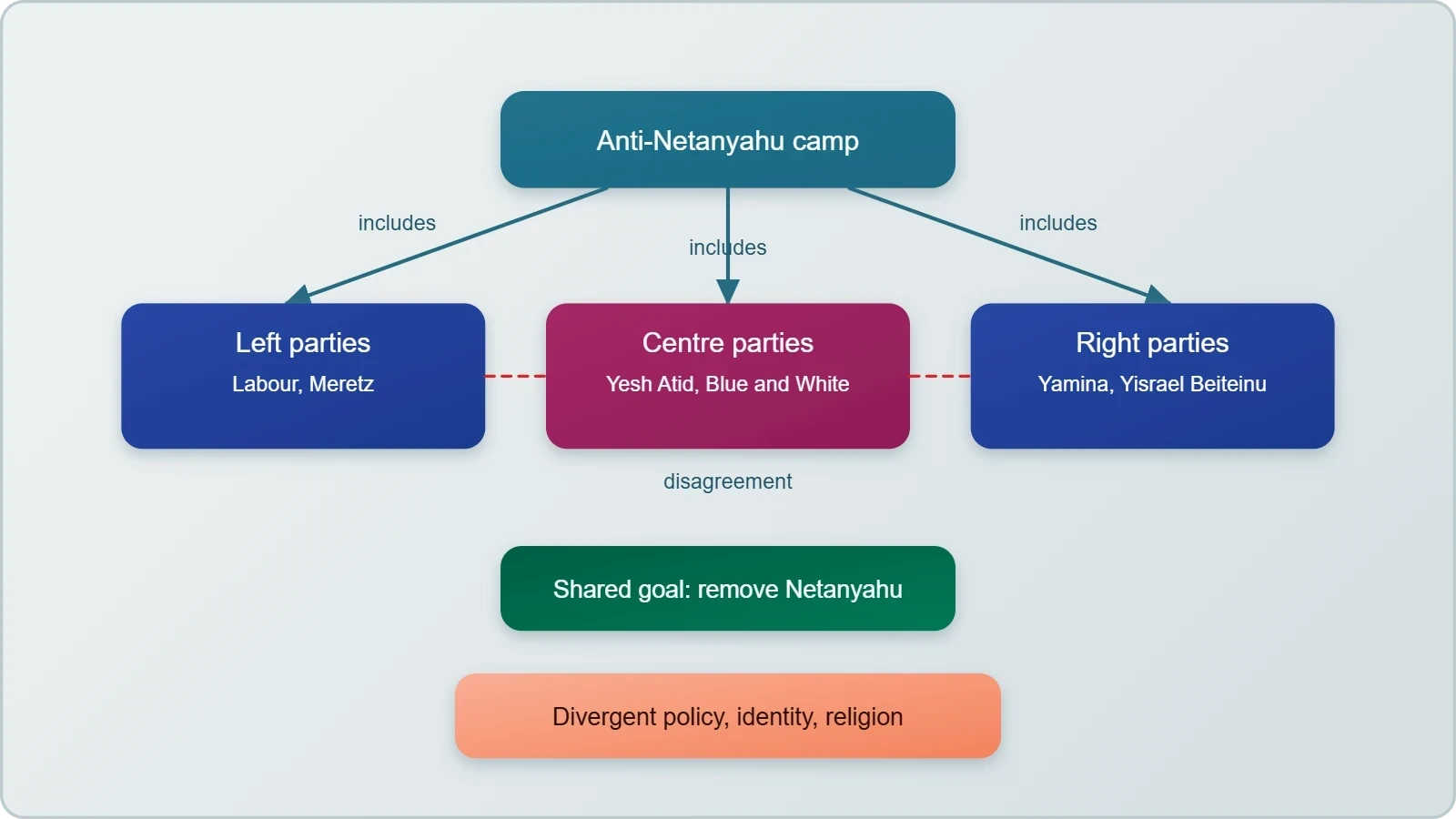
The anti-Netanyahu bloc's inability to convert a parliamentary majority into a governing coalition exposed a deeper truth about Israeli politics. Opposition built on negation rather than affirmative vision struggles to hold together once the shared enemy is removed from the equation. That lesson shaped both the 2021 unity government and its eventual collapse.
The Legal Shadow Over Netanyahu's Political Career
No analysis of Netanyahu's electoral trajectory is complete without confronting the criminal proceedings that accompanied it. Indictments on charges of bribery, fraud, and breach of trust in three separate cases transformed his political calculations, because remaining in office offered both a platform for delegitimizing the prosecution and a shield against the practical consequences of conviction. The legal and political tracks became inseparable.
Indictments, Trial, and Political Narrative
Netanyahu consistently framed the investigations as a coordinated effort by unelected officials, media, and political rivals to overturn the electorate's will. This narrative proved remarkably effective with his base, converting legal jeopardy into a rallying cry rather than a liability. Supporters came to view his legal troubles as evidence of persecution rather than misconduct.
The trial itself proceeded slowly, with procedural delays, witness testimony, and evidentiary disputes stretching across years. That pace suited the defense, since time in office allowed Netanyahu to argue that voters had already rendered their verdict. The courtroom and the ballot box became parallel arenas in a single contest over legitimacy.
Judicial Reform and Institutional Confrontation
The 2023 judicial overhaul initiative represented the culmination of this confrontation, proposing changes to the judiciary's composition and powers that critics saw as an attempt to neutralize legal exposure. Mass protests, reservist refusals, and international alarm followed, exposing how deeply the rule of law had become entangled with one leader's fate.
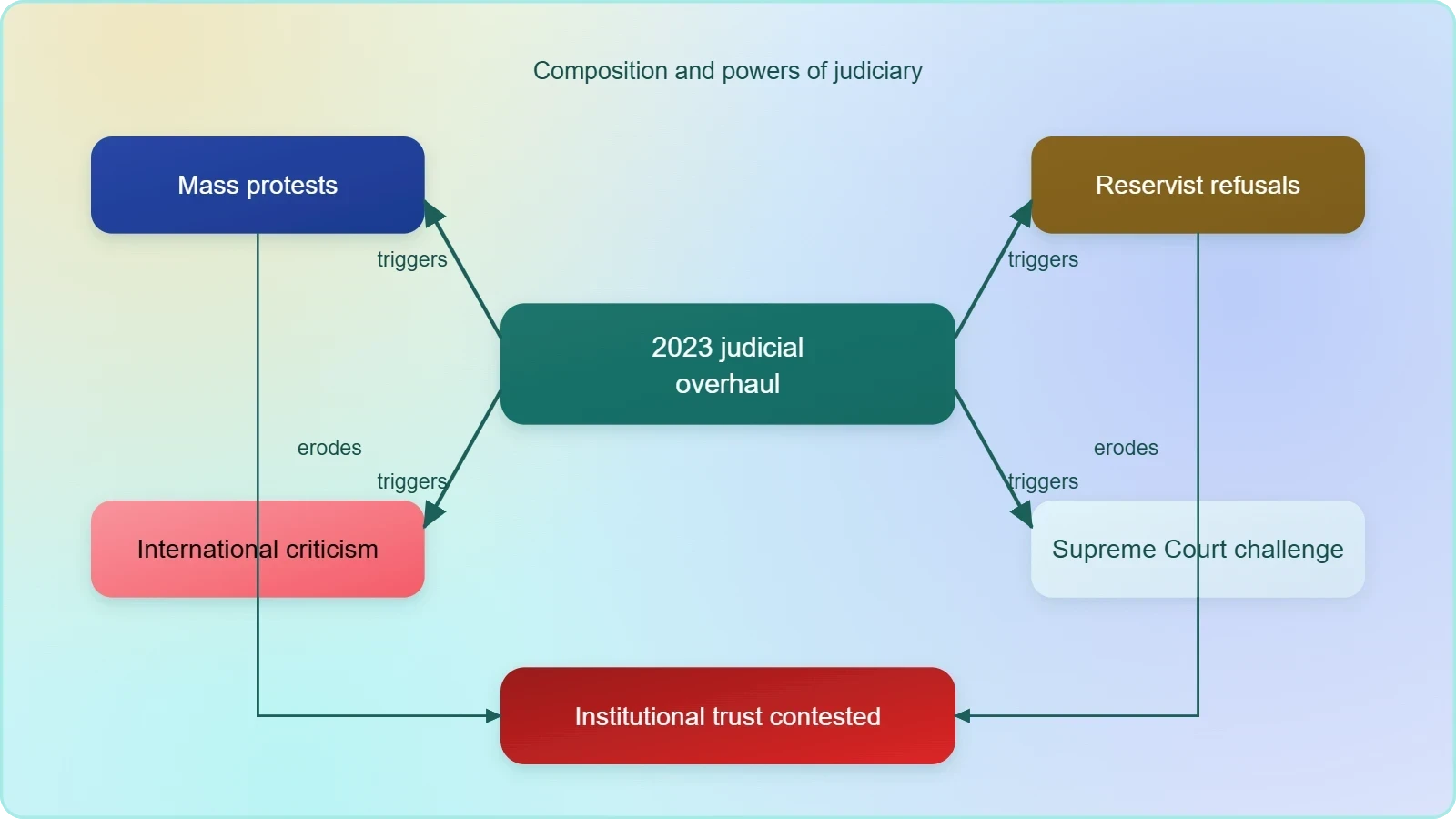
Whether framed as reform or as regime change, the episode demonstrated that institutional trust in Israel had become a partisan variable. The judiciary's independence, once treated as a shared inheritance, was now contested terrain. This shift carried consequences far beyond any single prosecution or politician.
Coalition Mathematics and the 2021 Turning Point
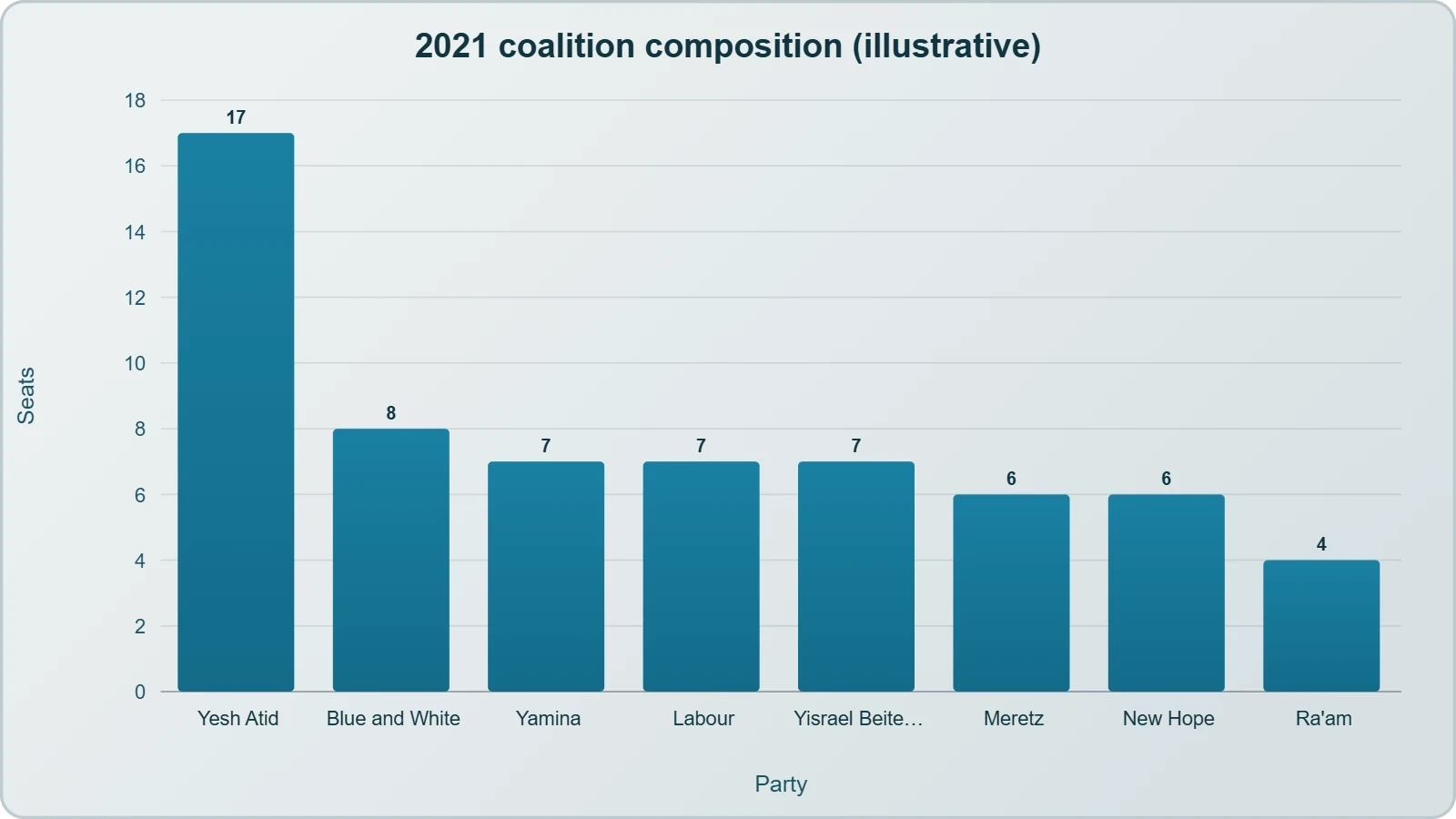
The 2021 election produced the first genuine rupture in the cycle, when eight parties spanning ideological boundaries assembled a coalition united primarily by their desire to end Netanyahu's tenure. The arrangement was historically unusual, pairing right-wing, centrist, left-wing, and Arab parties in a government that required extraordinary discipline to survive. Its formation demonstrated that the anti-Netanyahu majority was arithmetically possible.
The Bennett-Lapid Rotation and Its Limits
The rotation agreement between Naftali Bennett and Yair Lapid was a creative institutional device designed to distribute leadership across a fragile coalition. It worked well enough to demonstrate that governance without Netanyahu was feasible, but it could not overcome the ideological contradictions embedded in the partnership. The arrangement was always a bridge rather than a destination.
Coalition discipline eroded under pressure from security incidents, legislative disputes, and the defection of individual members. The government's narrow majority meant that a single resignation could collapse the entire structure, and eventually that vulnerability proved decisive. The experiment ended not because of electoral defeat but because of internal fragility.
Why the Unity Government Collapsed
The coalition's collapse illustrated a fundamental tension in Israeli politics: opposition unity is easier to achieve than governing unity. Once the shared objective of removing Netanyahu was accomplished, the parties' divergent constituencies reasserted themselves. Arab party participation, judicial appointments, and settlement policy all became flashpoints that the coalition could not contain.
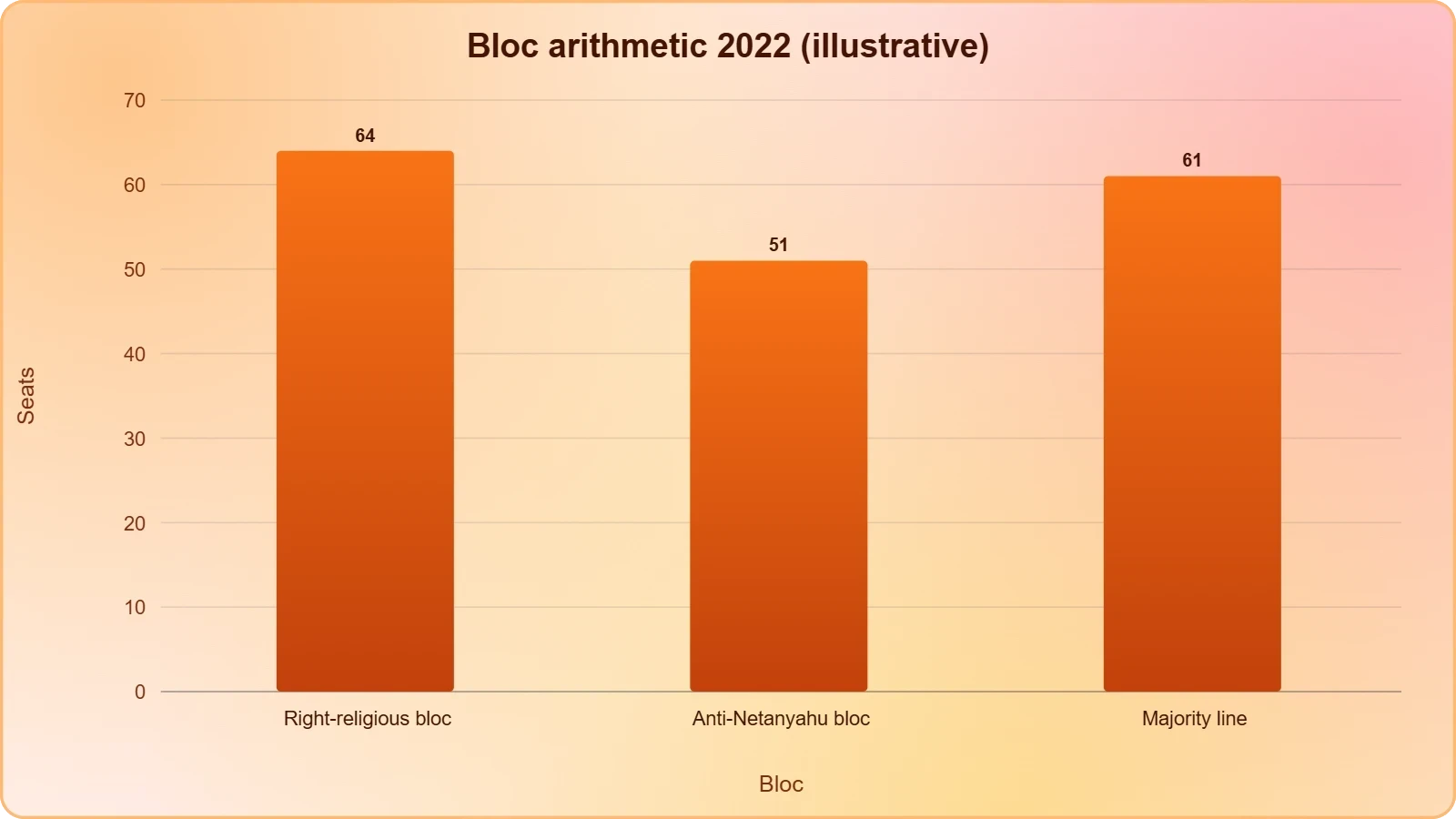
The episode also revealed that voters rewarded neither the coalition's achievements nor its restraint. Instead, the 2022 election returned a clear majority to the right-religious bloc, demonstrating that the anti-Netanyahu coalition had exhausted its political capital without consolidating a durable alternative. The pendulum swung back with considerable force.
We Also Published
- 01
- 02
- 03
- 04
The Return to Power and the Meaning of the 2022 Verdict
The 2022 election delivered Netanyahu a clear path back to the premiership, anchored by a cohesive right-religious bloc that required no ideological gymnastics to assemble. This outcome carried a distinct meaning: a substantial portion of the electorate had weighed the legal allegations, the institutional confrontations, and the repeated deadlocks, and concluded that his leadership remained preferable to the alternatives. The verdict was neither a full exoneration nor a simple endorsement.
Voter Priorities and the Security Calculus
Security concerns, economic anxiety, and dissatisfaction with the previous coalition's composition drove voters toward the right-religious bloc. For many, governance competence and ideological alignment outweighed concerns about the prime minister's legal position. The election thus reflected a pragmatic calculus rather than an abstract judgment about accountability.
Turnout patterns and bloc consolidation also mattered, as smaller parties merged or dropped below the threshold in ways that reshaped the final arithmetic. The result was a governing majority that appeared more stable than its predecessors, though its cohesion depended heavily on shared ideological commitments and reciprocal political investment.
The Fragility Beneath the Majority
Even a cohesive bloc faces internal pressures, and the 2022 coalition's agenda exposed tensions between ultra-Orthodox demands, settler priorities, and broader economic governance. Managing these competing claims required constant negotiation, and the government's durability remained contingent on discipline that could erode under crisis. Majority status does not guarantee longevity.
The deeper meaning is that Israel's political system continues to oscillate between unstable broad coalitions and cohesive narrow ones, with neither configuration resolving the underlying structural problems. Until electoral reform or party consolidation occurs, the cycle of volatility is likely to persist regardless of who occupies the premiership.
Netanyahu's Future: Scenarios and Strategic Variables
Projecting Netanyahu's future requires weighing several interdependent variables rather than forecasting a single trajectory. The legal proceedings, coalition stability, the composition of his base, and the emergence of credible successors all interact in ways that make any prediction provisional. What can be analyzed are the scenarios and the conditions under which each becomes plausible.
Legal Outcomes and Political Survival
A conviction or a plea arrangement would fundamentally alter the calculus, potentially triggering coalition defections or forcing a leadership transition within his party. Conversely, an acquittal or prolonged proceedings would preserve his political viability and reinforce his narrative of persecution. The legal track therefore remains the single most consequential variable.
Israeli law does not automatically require a convicted prime minister to resign, which means the political system could face a constitutional confrontation if a verdict arrives while he holds office.
That ambiguity adds another layer of uncertainty to an already unpredictable landscape, and it places unusual pressure on institutions designed for calmer circumstances.
Succession, Party Dynamics, and the Post-Netanyahu Era
Within his own party, potential successors have largely calculated that challenging the leader prematurely is politically costly, given his enduring support among the base. That deference has delayed any genuine succession contest, leaving the party's future closely tied to one individual's fortunes. Institutional dependence on a single figure is itself a vulnerability.
Beyond the party, the broader right-religious bloc would need to reconstitute itself around a new leader if Netanyahu exits the scene, and that process could produce fragmentation or realignment. The post-Netanyahu era, whenever it arrives, will likely be defined by competition among heirs rather than by ideological transformation.
What the Israeli Experience Reveals About Democratic Resilience
The Israeli case offers a broader lesson about how democracies absorb sustained pressure without collapsing, even as their institutions strain visibly. Repeated elections, mass protests, judicial confrontations, and coalition collapses tested the system's capacity to channel conflict through lawful procedures. That the system continued to function, however imperfectly, is itself a meaningful data point about institutional durability.
Institutional Stress Without Breakdown
Democratic resilience is often measured by whether institutions can withstand leaders who test their boundaries. Israel's courts, military reservists, civil society organizations, and media all played roles in checking overreach, sometimes in tension with electoral majorities. The resulting friction was uncomfortable but arguably constitutive of accountability rather than evidence of failure.
At the same time, the experience exposed how quickly shared norms can become partisan possessions. When the rules of the game are themselves contested, every election becomes a higher-stakes confrontation, and the space for compromise narrows. Resilience, in this reading, is not a fixed asset but a practice that must be continually renewed.
Lessons for Comparative Politics
Comparatively, Israel illustrates how electoral design choices shape political outcomes over decades, long after the designers have departed. Proportional representation without robust thresholds can produce representational richness alongside chronic governability deficits, a trade-off that other fragmented democracies recognize. Institutional engineering is never neutral in its effects.
The Netanyahu era also demonstrates the outsized influence of individual leaders in systems with weak party institutionalization. Where parties are vehicles for personalities rather than durable organizations, succession becomes a systemic risk rather than a routine transition. That insight travels well beyond the Middle East and applies to democracies everywhere.
Conclusion: Reading the Netanyahu Era in Full
The elections that defined the Netanyahu era were never merely about seats and coalitions, though those mechanics determined every outcome. They were about the terms on which a democracy holds its leaders accountable, the durability of institutions under sustained pressure, and the willingness of voters to tolerate uncertainty in exchange for ideological alignment. The meaning of those contests lies in that larger contestation.
Netanyahu's future remains genuinely open, contingent on legal outcomes, coalition discipline, and the evolution of his party and bloc. What is already clear is that his career has permanently reshaped Israeli politics, normalizing prolonged instability and demonstrating both the power and the limits of personal political durability. The system that produced him will continue to be tested by his legacy.
From our network :
- Committed Mediterranean Precipitation Decline: Why Emissions Cuts Alone Cannot Restore Winter RainsNew NOAA research reveals that Mediterranean winter rains may decline irreversibly even with emissions cuts. Explore the science of committed climate change and regional impacts.
- University Language Proficiency Exams: Why Institutional Tests Demand Different Preparation Than IELTS and TOEFLDiscover why university-specific language proficiency examinations differ fundamentally from IELTS and TOEFL, and learn strategic preparation approaches for institutional assessment success.
- Live Online English Classes for Kids: Do They Actually Reduce Anxiety?A ten-week study reveals that synchronous online English classes can significantly reduce child language anxiety while improving listening and reading skills. Discover what makes these programs effective and how parents can select the right one.
- The Final Descent: How ESA Retired the Legendary Cluster Constellation After 24 Years of Space Weather ScienceAfter 24 years mapping Earth’s magnetosphere, ESA’s Cluster mission concluded with a precisely controlled reentry over the South Pacific. This analysis explores the scientific legacy, engineering decisions, and debris mitigation principles behind one of space exploration’s most responsible retirements.
- CISA’s Ten-Advisory Wave: Why Generic Patching Fails in OT and How to Build Product-Specific PlaybooksCISA released ten ICS advisories in one week, exposing critical infrastructure risks. Generic patching fails in OT. Learn to build product-specific remediation playbooks.
- Forbidden Matrix Patterns and Visible Lattice Points: A Geometric DictionaryExplore how multidimensional 0–1 matrices encode geometric truths, linking forbidden patterns to visible lattice points and hypergraph theory, with applications in combinatorics and computational geometry.
- The Hidden Cost of AI Convenience: Why Over-Permissioned Agents Are a Security Time BombDiscover why AI agents with excessive permissions create dangerous single points of failure, and learn how implementing least privilege principles can protect your organization from exploitation.
- How AI Agents Will Change the Way We Manage Personal FinancesExplore how AI agents are transforming personal finance through automated budgeting, bill payment, and investment management, while examining the critical security protocols and governance frameworks required for safe deployment.
- Mobile Learning and VR in English: What Global Evidence Reveals About Effective Language TechnologyA systematic review across 14 countries reveals which language-learning technologies genuinely work. Mobile learning, AI, and VR show measurable benefits when pedagogically integrated. This evidence-based guide helps educators and learners select technology that delivers real return on investment.
RESOURCES
- Netanyahu's future still uncertain after Israeli election | PBS Newspbs.orgMar 3, 2020 ... JERUSALEM (AP) — Prime Minister Benjamin Netanyahu's political future remained up in the air Tuesday as preliminary results and exit…
- As elections loom, can Netanyahu balance Trump, Mohammed bin ...atlanticcouncil.orgNov 17, 2025 ... ... political future? By Daniel B ... Israeli Prime Minister Benjamin Netanyahu, Finance Minister Bezalel Smotrich, Defense Minister Israel ...
- Israel prepares for a high-stakes election : State of the World from NPRnpr.orgOct 19, 2026 ... And this election will decide the future of Prime Minister Benjamin Netanyahu. It is the first vote since Hamas-led attacks…
- Netanyahu's future on the line as polls open in Israeli elections - ABC7abc7.com24 hours ago ... ... Benjamin Netanyahu and former military chief of staff Gadi Eisenkot. ... Netanyahu's decades-long political career. The vast human toll…
- The IDF ordered new restrictions on the West Bank ahead of Israeli ...facebook.com3 days ago ... It comes just days before nationwide elections could determine Prime Minister Benjamin Netanyahu's political future. NBC News' Matt Bradley ...
- Netanyahu's last war? The struggle for Israel's political futurenewarab.comOct 16, 2025 ... ... political endorsement ahead of Israel's next elections, due ... Even if Netanyahu loses the next election and far-right figures…
- When Israelis go the polls on October 27, they will face a familiar ...facebook.com3 days ago ... Benjamin Netanyahu's political future is about to be tested at the ballot box. ... For Prime Minister Benjamin Netanyahu, the…
- Election leaves Israel's political future uncertain, but Netanyahu still ...timesofisrael.com13 hours ago ... Like Shimon Peres 30 years ago, Gadi Eisenkot thought the exit polls meant he'd defeated the Likud leader. Not so…
- Opposition Holds Slim Lead Over Netanyahu's Coalition in Exit Pollsnytimes.com1 day ago ... Days before Tuesday's pivotal Israeli election, Prime Minister Benjamin Netanyahu shocked his country by offering a bleak economic forecast that ...
- Israel's Election: What Comes Next?carnegieendowment.org... Benjamin Netanyahu and his coalition will retain power, but ... What will the Israeli election reveal about the country's changing political landscape?
- Israel's Netanyahu takes the U.N. stage facing global isolation and a ...nbcnews.comSep 24, 2026 ... stage facing global isolation and a fight for his political future. Benjamin Netanyahu isn't scheduled to meet with President Donald…
- Netanyahu's political future looks shakier in midst of Israel-Hamas wartheguardian.comOct 31, 2023 ... ... Israel: the Dead Sea and Benjamin Netanyahu's demeanour. One is a ... election is still three years away, it…
- Israeli voters go to the polls Oct. 27 with Netanyahu's future and ...cbs12.com2 days ago ... Israeli voters are preparing to head to the polls in a high-stakes parliamentary election that could determine Prime Minister Benjamin ...
- Israelis divided as vote that could oust Netanyahu only weeks awaytheguardian.comOct 1, 2026 ... ... Israeli national elections – and rightwing Jewish Israelis have deepened since 7 October. ... Netanyahu's main political rivals. On…
- Netanyahu's political future hangs in balance as Israel votesthearabweekly.com1 day ago ... A child looks at a banner depicting Israeli Prime Minister and Likud party leader Binyamin Netanyahu, during the country's national…
- 01
- 02
- 03
- 04
- 05
- 06
- 07
- 08
0 Comments