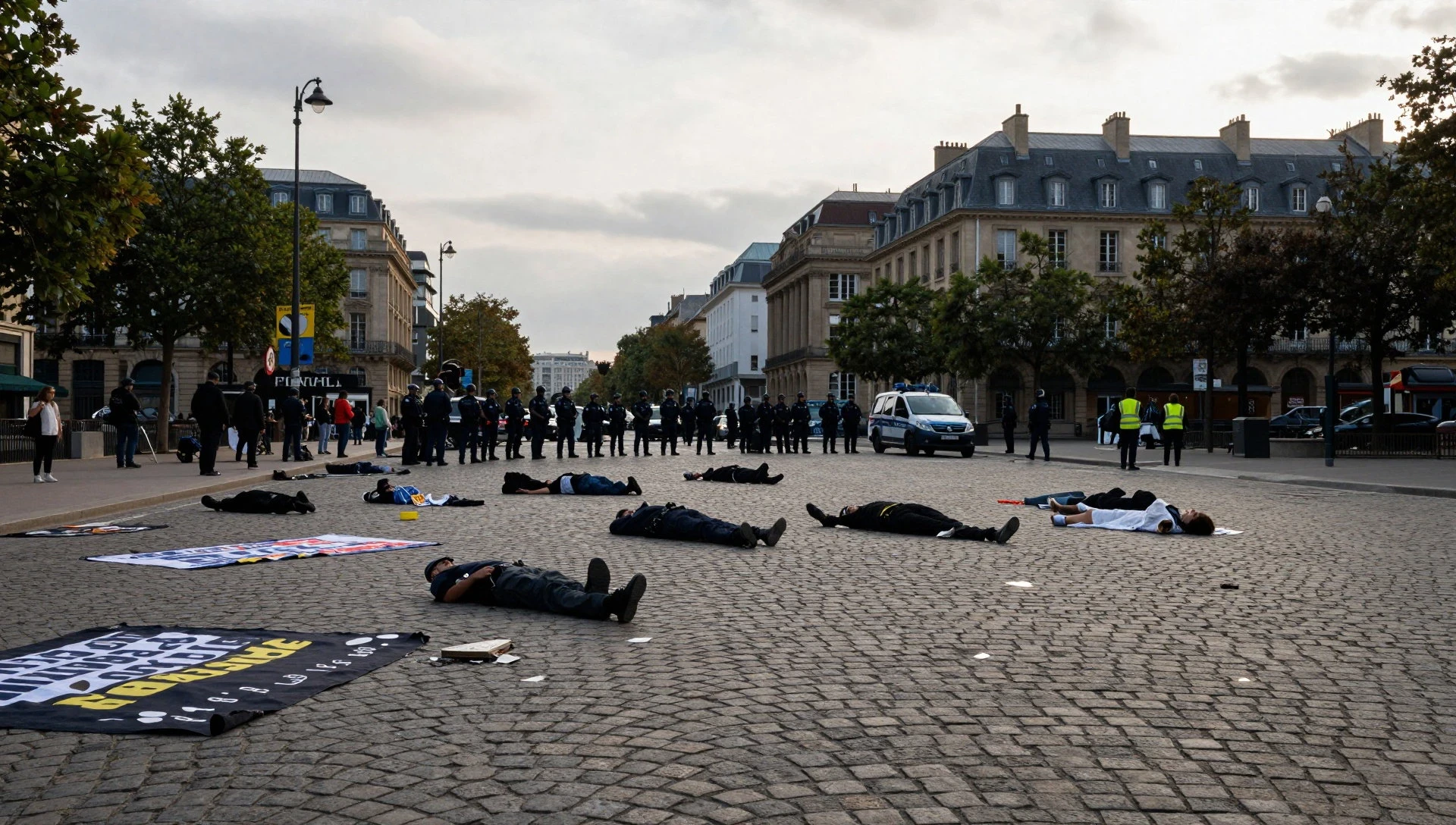
France's interior ministry confirmed more than 500 arrests across the country during a third consecutive weekend of unrest, a sequence that began with largely peaceful demonstrations over declining living standards before escalating into confrontations with police.
Participants threw paving stones and petrol bombs at officers after the organised marches concluded, shifting the character of the events from civic grievance to public order crisis. The pattern matters because it separates the political message from the policing response, and each side now frames the other as the aggressor.
The same weekend produced a wider European and global tableau. Albania saw anti-government protests resume, with police deploying water cannon against demonstrators. In Ukraine, families separated for more than four years by Russian occupation were reunited as evacuees from Oleshky arrived.
On This Page
- France's Third Weekend: Reading the Arrest Data and the Escalation Pattern
- Albania, Ukraine and Britain: Three Different Tests of Institutional Response
- Wikipedia at 25, Medieval Knights on E-Bikes, and the Attention Economy
- Wikipedia's Twenty-Five Year Record
- The Jousting Knights and the Mechanics of Virality
- Attention Allocation Across Weekend Stories
- Why the Light Stories Belong in the Analysis
- Reading a Weekend Digest Critically
- Digest Reliability Checklist
- What to Watch in the Coming Weeks
- Forward Indicators to Monitor
- Conclusion: The Weekend as a Single Dataset
In Britain, Andy Burnham went further than any previous prime minister by declaring himself "open" to a formal apology for the country's role in the transatlantic slave trade, while ruling out financial reparations. Wikipedia co-founder Jimmy Wales marked the encyclopedia's 25th anniversary in a BBC interview.
Read together, these dispatches describe a single underlying condition: institutions under pressure from publics that no longer accept delay. The French case supplies the sharpest data point, because arrest counts are measurable and comparable across weekends.
The Albanian water cannon response, the Ukrainian reunion, the British reparations debate and even the London jousting knights on electric bikes all illustrate how grievance, memory and spectacle now share the same news cycle. This analysis examines the numbers, the mechanisms and the media logic behind that convergence.
TL;DR More than 500 arrests in France over a third weekend of unrest signal a protest cycle that begins peacefully over living standards and ends in petrol bombs and paving stones. The same period brought renewed anti-government demonstrations in Albania met with water cannon, emotional reunions for Ukrainians evacuated from Russian-occupied Oleshky, and a British political first as Andy Burnham opened the door to a formal apology for the slave trade while excluding reparations. The common thread is eroding patience with institutional timelines, amplified by a media environment in which a medieval joust on electric bikes can rival a riot for attention.
France's Third Weekend: Reading the Arrest Data and the Escalation Pattern
The French interior ministry's figure of more than 500 arrests is the most concrete metric in the entire weekend's reporting, and it deserves scrutiny rather than summary. Arrest counts measure police capacity and political will as much as they measure disorder, because a government that instructs officers to detain aggressively will produce higher numbers than one that tolerates static demonstrations.
The third-weekend repetition is the analytically significant detail, since single weekends of unrest are common in European democracies while sustained cycles indicate a grievance that organisers can reactivate at will.
From Living Standards to Street Violence
The demonstrations were, by the ministry's own framing, mostly peaceful and focused on declining living standards. That origin matters: cost-of-living pressure is a material grievance with measurable inputs such as food and energy prices, not an abstract ideological complaint.
When material grievances go unaddressed across multiple budget cycles, the composition of a protest crowd shifts toward younger and more marginalised participants who have less to lose from confrontation and more incentive to escalate visibility.
The escalation sequence described by officials follows a recognisable pattern. Organised marches conclude, a residual group remains, and that group converts available materials into projectiles. Paving stones and petrol bombs are not improvised in the abstract; they require access to a street environment and a decision to use it.
The transition from march to riot therefore marks a breakdown in the tacit negotiation between organisers and police that normally allows a demonstration to disperse without injury.
Comparative European data supports a cautious reading. France has a long tradition of disruptive protest that coexists with high institutional trust in specific services, so arrest totals alone do not predict political collapse.
What they do predict is a hardening of the interior ministry's posture, tighter prefectural restrictions on assembly, and a widening gap between the demonstrators' economic argument and the public's memory of burning barricades.
Why the Third Weekend Is the Analytically Important One
First weekends of unrest are dominated by shock and by the largest crowds, because curiosity and outrage mobilise broadly. Second weekends typically shrink as casual participants weigh risk against outcome.
A third weekend that still generates more than 500 arrests therefore suggests a hardened core with organisational capacity, communication channels and a supply of willing participants that has not yet been exhausted by fatigue or legal consequence.
That persistence carries a cost the ministry can quantify. Each weekend of deployment consumes police overtime budgets, diverts officers from ordinary crime duties and generates injury claims. Over successive cycles, the fiscal burden becomes a political argument in itself, allowing the government to reframe the dispute from living standards to public order and thereby change the subject without conceding the original economic demand.
The Risk of Narrative Displacement
Narrative displacement is the central risk in this sequence. Once petrol bombs appear, coverage pivots from wages and rents to flames and arrests, and the demonstrators' material case loses its audience.
The French interior ministry's emphasis on the peaceful origin of the marches reads as an attempt to preserve that distinction, but the arithmetic of 500 arrests tends to overwhelm the qualifier in headline form.
For analysts, the practical lesson is to track two series separately: the economic indicators that triggered the protests, and the public order indicators that now dominate reporting. Conflating them produces bad forecasts.
A falling inflation print does not end a protest cycle that has acquired its own momentum, and a quiet weekend does not prove that the underlying grievance has been resolved.
We Also Published
Albania, Ukraine and Britain: Three Different Tests of Institutional Response
The weekend's other dispatches test institutional response under three distinct conditions. Albania faces a familiar democratic stress pattern in which anti-government demonstrations recur and police answer with water cannon, a tactic chosen for visibility and non-lethality.
Ukraine presents the human cost of occupation through the reunion of evacuees from Oleshky with relatives after more than four years apart. Britain presents a historical reckoning conducted through language rather than money, as Andy Burnham moved the reparations debate onto the terrain of apology.
Albania: Water Cannon as a Signal
Water cannon is a signalling instrument as much as a physical one. It disperses crowds without the casualty risk of baton charges or chemical irritants, and it photographs as restraint rather than repression.
When a government authorises its use, it is communicating that it intends to hold public space while avoiding the international condemnation that follows serious injury, a calculation that reveals how closely domestic policing now tracks global media exposure.
The recurrence of anti-government protests in Albania also indicates that opposition mobilisation has found a durable rhythm. Recurring demonstrations are cheaper to sustain than single mass events because organisers build lists, routines and legal defence funds over time.
Each repetition lowers the marginal cost of the next, which is why a protest movement that survives three cycles rarely disappears without a political concession or a change of government.
Ukraine: Reunion After Four Years of Occupation
The evacuation of residents from Russian-occupied Oleshky and their reunion with friends and family after more than four years produced the weekend's most emotionally legible images. For analysis, the relevant point is administrative: reunions of this kind require registration lists, transport corridors, identity verification and receiving infrastructure, all of which depend on institutional coordination that continues despite active conflict.
Four years is a long separation in human terms and a short one in legal terms. Property claims, custody arrangements, pension entitlements and documentation status all become contested after such intervals, and the reunion photograph marks the beginning of a bureaucratic process rather than its conclusion. Reconstruction planning for occupied territories must therefore budget for family reunification casework, not merely for physical rebuilding.
Britain: Apology Without Reparations
Andy Burnham's statement that he is "open" to calls for a formal apology for Britain's role in the transatlantic slave trade, coupled with an explicit ruling out of financial reparations, defines the outer limit of current British political consensus.
The formulation separates symbolic recognition from fiscal liability, allowing a senior figure to acknowledge historical wrong while foreclosing the transfer of public funds that Caribbean nations have sought.
That separation is politically efficient and analytically revealing. Apologies cost nothing in budgetary terms but carry legal weight, since formal acknowledgment can be cited in litigation and in treaty negotiations.
By pairing the apology with a reparations exclusion in the same breath, Burnham secures the moral gesture while capping the exposure, a manoeuvre that will satisfy neither campaigners nor fiscal conservatives entirely.
What the Three Cases Share
All three cases involve institutions asked to deliver something concrete within a timeframe the public considers reasonable. Albania's government must show that protest changes policy. Ukraine's state must show that it can retrieve its citizens. Britain's political class must show that historical acknowledgment has consequences.
In each instance, the response so far has been procedural rather than substantive, which is precisely the condition that sustains further mobilisation.
The measurable difference lies in cost. Water cannon deployment, evacuation logistics and a parliamentary apology carry vastly different price tags, yet all three purchase time rather than resolution. Time is the resource governments are actually spending in these situations, and publics increasingly recognise the transaction, which explains why procedural gestures now generate less deference than they did a decade ago.
Wikipedia at 25, Medieval Knights on E-Bikes, and the Attention Economy
Two lighter dispatches complete the weekend's picture and, read carefully, explain the environment in which the heavier stories circulate. Wikipedia co-founder Jimmy Wales spoke to the BBC on the encyclopedia's 25th anniversary, an occasion that invites assessment of a genuinely unusual institution.
Separately, medieval knights jousting on electric bikes in a London park drew millions of views after footage of their first contest spread online, a story whose commercial logic is as instructive as its absurdity.
Wikipedia's Twenty-Five Year Record
Wikipedia's quarter-century is a rare case of a large digital institution surviving without advertising revenue, subscription walls or venture capital exit pressure. Its operating model depends on donations and volunteer editing, which insulates it from the engagement incentives that degrade most platforms.
The anniversary therefore functions as a natural experiment in whether a non-commercial knowledge commons can persist at global scale, and the evidence so far is favourable.
The unresolved questions concern editor retention and source diversity. Volunteer pools age, and the demographic composition of editors shapes which topics receive depth. Meanwhile, the encyclopedia's reliance on cited sources means its coverage tracks the publishing industry, so regions with thinner journalism receive thinner articles.
These are structural limitations rather than failures, but they determine where the project's next decade of effort must go.
The Jousting Knights and the Mechanics of Virality
The London jousting contest on electric bikes illustrates a repeatable formula: familiar historical imagery, incongruous modern technology, and a physical spectacle that reads instantly in a vertical video. Millions of views followed the first contest, and the second was staged in a park with the cameras already positioned.
The event was designed for distribution rather than attendance, which is now the default logic of public entertainment.
This matters analytically because attention is a finite resource allocated across the same feeds that carry news of arrests and evacuations. A jousting video and a riot report compete for the same seconds of user attention, and the video usually wins on completion rate.
News organisations know this, which is why protest coverage increasingly favours the most visual moment, typically the confrontation, over the policy argument that preceded it.
Why the Light Stories Belong in the Analysis
Including the jousting knights and the Wikipedia anniversary is not a concession to levity but a methodological requirement. A weekend news digest is a sample of what editors judged publishable and what audiences judged watchable, and the ratio between confrontation, compassion, reflection and novelty reveals the operating preferences of the whole system. Ignoring the light items would misrepresent the information environment that shapes public understanding of the serious ones.
The practical consequence for readers is a discipline of proportional attention. A riot generates more footage per unit of policy significance than a budget decision, so visual abundance is a poor guide to importance.
The remedy is deliberate: read the arrest figure, then read the grievance behind it, then check whether any policy changed. That sequence restores the causal order the feed tends to invert.
- 01
- 02
- 03
- 04
Reading a Weekend Digest Critically
A digest compiled from a single broadcaster's audio bulletin carries specific selection effects. Items are chosen for geographic spread, emotional range and audio suitability, so the resulting list is a curated sample rather than a census of global events.
Treating it as representative would overstate the prominence of stories that happen to produce good sound and understate slow developments that produce none.
Within that limitation, the digest remains useful because it captures simultaneity. Knowing that French arrests, Albanian water cannon, Ukrainian reunions and a British reparations debate all occurred in the same seventy-two hours establishes a baseline against which later weeks can be compared. Repetition across digests is the signal; a single appearance is an anecdote.
What to Watch in the Coming Weeks
Three indicators will determine whether this weekend marks a peak or a plateau. The first is whether France records a fourth consecutive weekend of unrest, since four cycles would indicate organisational depth rather than residual anger.
The second is whether Albania's government offers any policy concession, because concessions typically end protest cycles faster than policing does. The third is whether the British reparations debate advances from apology to negotiation.
On the lighter side, the Wikipedia anniversary will prompt discussion of funding models and editor demographics, while the jousting format will almost certainly be replicated. Both outcomes are predictable and both are informative.
The replication of a viral spectacle and the scrutiny of a knowledge institution are the same phenomenon observed from different angles: attention seeking durability, and durability seeking attention.
Conclusion: The Weekend as a Single Dataset
The weekend's dispatches are best read as one dataset rather than five separate stories. Arrest counts, water cannon deployments, reunification logistics, apology politics and viral spectacle all measure the same variable: how quickly institutions respond to publics that have learned to escalate.
France's 500-plus arrests are the clearest number, but the pattern they represent is general, and the next three weekends will show whether it holds.
What remains constant across every item is the compression of patience. Grievances that once waited for a budget cycle now produce street action within weeks, and symbolic gestures that once bought years now buy headlines. Institutions that recognise this and deliver material outcomes will find their protest cycles shortening. Those that substitute procedure for substance should expect the fourth weekend, and the fifth.
From our network :
- The Hidden Cost of AI Convenience: Why Over-Permissioned Agents Are a Security Time BombDiscover why AI agents with excessive permissions create dangerous single points of failure, and learn how implementing least privilege principles can protect your organization from exploitation.
- University Language Proficiency Exams: Why Institutional Tests Demand Different Preparation Than IELTS and TOEFLDiscover why university-specific language proficiency examinations differ fundamentally from IELTS and TOEFL, and learn strategic preparation approaches for institutional assessment success.
- Mobile Learning and VR in English: What Global Evidence Reveals About Effective Language TechnologyA systematic review across 14 countries reveals which language-learning technologies genuinely work. Mobile learning, AI, and VR show measurable benefits when pedagogically integrated. This evidence-based guide helps educators and learners select technology that delivers real return on investment.
- CISA’s Ten-Advisory Wave: Why Generic Patching Fails in OT and How to Build Product-Specific PlaybooksCISA released ten ICS advisories in one week, exposing critical infrastructure risks. Generic patching fails in OT. Learn to build product-specific remediation playbooks.
- Committed Mediterranean Precipitation Decline: Why Emissions Cuts Alone Cannot Restore Winter RainsNew NOAA research reveals that Mediterranean winter rains may decline irreversibly even with emissions cuts. Explore the science of committed climate change and regional impacts.
- The Final Descent: How ESA Retired the Legendary Cluster Constellation After 24 Years of Space Weather ScienceAfter 24 years mapping Earth’s magnetosphere, ESA’s Cluster mission concluded with a precisely controlled reentry over the South Pacific. This analysis explores the scientific legacy, engineering decisions, and debris mitigation principles behind one of space exploration’s most responsible retirements.
- Live Online English Classes for Kids: Do They Actually Reduce Anxiety?A ten-week study reveals that synchronous online English classes can significantly reduce child language anxiety while improving listening and reading skills. Discover what makes these programs effective and how parents can select the right one.
- How AI Agents Will Change the Way We Manage Personal FinancesExplore how AI agents are transforming personal finance through automated budgeting, bill payment, and investment management, while examining the critical security protocols and governance frameworks required for safe deployment.
- Forbidden Matrix Patterns and Visible Lattice Points: A Geometric DictionaryExplore how multidimensional 0–1 matrices encode geometric truths, linking forbidden patterns to visible lattice points and hypergraph theory, with applications in combinatorics and computational geometry.
RESOURCES
- From France to Albania, how social unrest is fueling protests ... - PBSpbs.orgOct 19, 2026 ... Despite hundreds of thousands of people marching peacefully, the weekend's unrest led to 2,400 arrests and serious disturbances in parts…
- Teenager's hand blown off as French school protests enter third weekreuters.comOct 5, 2026 ... Summary. Some 400 to 500 of France's 3,700 high schools set to be shut ...
- A third weekend of protests in France as youth-led rallies sweep ...pbs.org1 day ago ... Police had arrested thousands of people following riots and looting that marred marches the previous two Saturdays. Protesters have diverse ...
- France Third Weekend Of Student Protests Ends In Clashes, 296 ...newscord.org1 day ago ... France Third Weekend Of Student Protests Ends In Clashes, 296 Arrests Nationwide ... Our editorials offer in-depth analysis curated by…
- Third weekend of French protests brings hundreds of thousands to ...lemonde.fr2 days ago ... Interior Minister Laurent Nuñez said the marches, which were held under heavy security, had been largely peaceful. Police arrested more…
- Global Protest Tracker - Carnegie Endowment for International Peacecarnegieendowment.orgJan 26, 2026 ... ... summary of recent pro-Israel and pro-Palestine protests ... Trigger:Recent widespread arrests of activists involved in the 2019 Iraqi protests.
- Clashes break out as hundreds of thousands protest in Franceafp.com2 days ago ... ... third weekend of protests at soaring living costs. More than 500 people were arrested as police fired water cannon…
- Global News Podcast — Подкаст — Подкасты Applepodcasts.apple.com... analysis and insight. Get the news that matters, delivered twice a day on ... Violent protests in France for the third weekend in…
- More than 5,000 detained so far in French student protests - France 24france24.comOct 5, 2026 ... As the protests entered a third week, there are reports that behind the scenes, there are divisions within French President…
- Violent protests in France for the third weekend in a rowpodcasts.apple.com1 day ago ... The French interior ministry says that more than 500 people were arrested during riots across the country. Paving stones and…
- Youth-led protests sweep across France, Europe for a 3rd weekendcbc.ca1 day ago ... Analysis. France shaken by fiery street protests ... Authorities in France reported more than 560 arrests nationwide by Saturday night.
- Just Facts: As Many Americans Have Criminal Records as College ...brennancenter.orgNov 17, 2015 ... If all arrested Americans were a nation, they would be the world's 18th largest. Larger than Canada. Larger than France.…
- World | Latest News & Updates - BBCbbc.comThere were hundreds of arrests as protesters took to the streets in cities across France for the third weekend in a row. Just now.…
- Cost of living protests in France - DW.comdw.comOct 8, 2026 ... More than 290 arrested in France as some weekend protests turn violent ... 320,000 protest for a third weekend in…
- An Analysis of Recent Developments in Anti-Technology Violenceicct.nlMay 11, 2026 ... On 3 April 2026, a 26-year-old resident of Rome was arrested for allegedly preparing acts of terrorism inspired by Theodore…
- 01
- 02
- 03
- 04
- 05
- 06
- 07
- 08
0 Comments