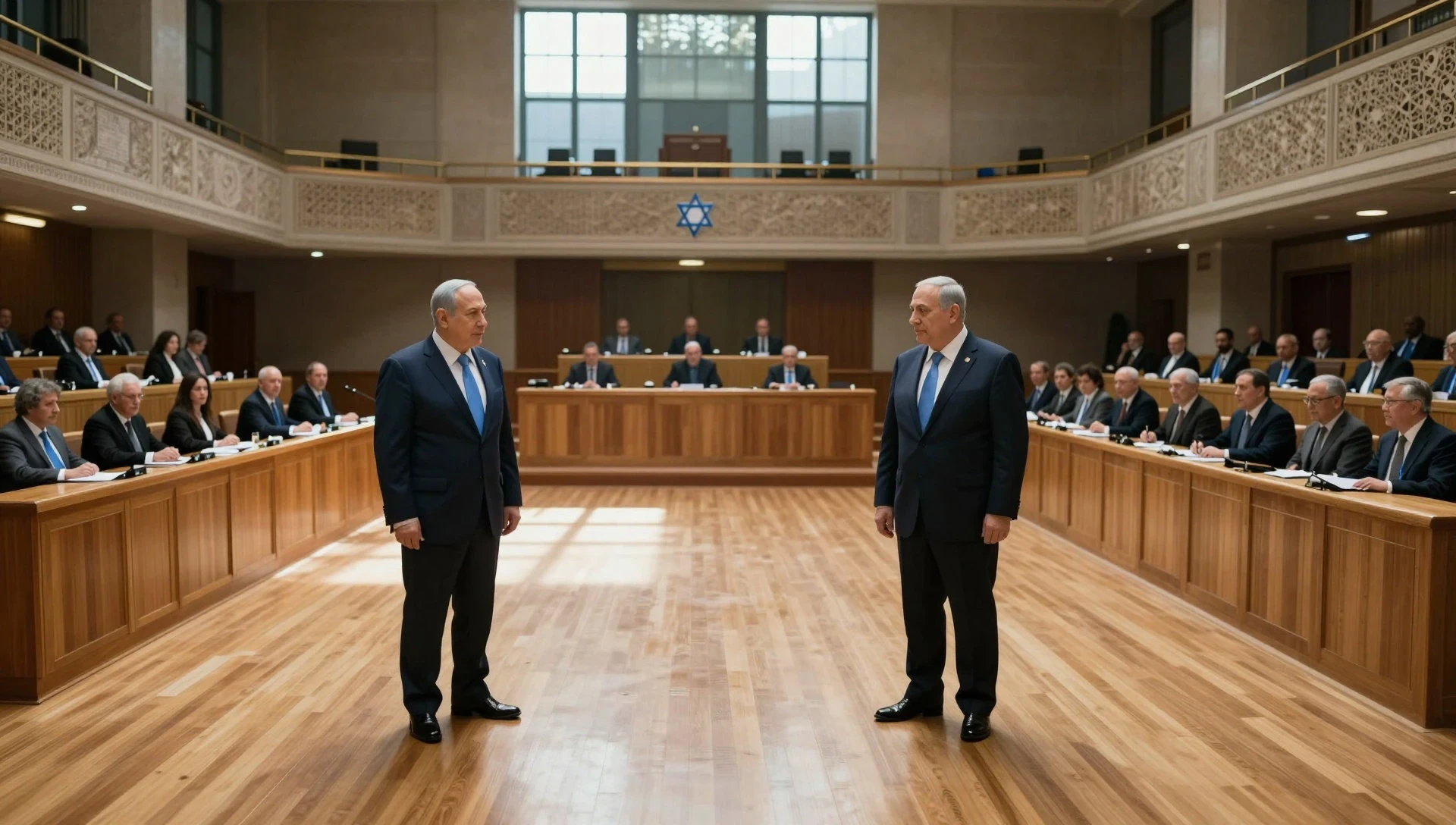
Israel's election has produced a parliamentary arithmetic that resists every obvious coalition formula. Neither Prime Minister Benjamin Netanyahu nor his principal rival, Gadi Eisenkot, commands a path to the 61 seats required in the 120-member Knesset, and the results announced Friday confirm a structural deadlock rather than a decisive verdict.
Netanyahu's Likud won the largest single tally with 27 seats, yet his supporting bloc of right-wing, far-right, and ultra-Orthodox parties fell to 53 — eight short of a majority. Eisenkot's grouping of parties secured 48 seats, leaving both camps dependent on partners they have publicly rejected.
The decisive variable is the Arab-led parties, which won a record 19 seats. Mathematically, that tally would hand Eisenkot a governing majority exceeding 67 seats if he chose to rely on it.
On This Page
Politically, he and his allies ruled out such a partnership throughout the campaign, citing the Arab parties' positions on Hamas and the war in Gaza. The result is a rare configuration in Israeli politics: a numerical majority exists on paper, but the political consent required to activate it has been explicitly withheld by the very candidate it would benefit.
Attention now shifts to the president's consultation process, which is governed by recommendation counts rather than raw seat totals. Party leaders will recommend a candidate, and the president is not obliged to select the leader of the largest party — only the person judged most capable of assembling a majority.
That candidate receives 28 days, extendable by 14, to secure at least 61 lawmakers. Failure allows the president to invite another candidate, meaning the process could run for weeks or months, or terminate without a government at all.
TL;DR Israel's election has ended in deadlock. Netanyahu's right-wing, far-right, and ultra-Orthodox bloc holds 53 seats; Eisenkot's grouping holds 48; Arab-led parties hold a record 19. Neither bloc reaches the 61-seat Knesset majority without partners it has rejected. The president's consultation process now determines who gets the first 28-day mandate, with a possible 14-day extension. Two outcomes dominate analysis: a Netanyahu–Eisenkot unity government, reportedly favored by President Trump, or an Eisenkot-led government backed by Arab parties that Eisenkot has publicly refused. A third path — no government at all — remains live.
The Arithmetic of a 120-Seat Knesset and the Collapse of the Netanyahu Bloc
The headline number — Likud's 27 seats — obscures the more consequential figure: 53. Netanyahu's bloc of right-wing, far-right, and ultra-Orthodox parties has governed from a position of comfortable majority in recent cycles, but this result strips it of the eight seats needed to cross the threshold.
The shortfall is not marginal noise; it is a structural deficit that cannot be closed by arithmetic alone, because every remaining seat belongs to parties outside the bloc's ideological perimeter.
Eisenkot's 48 seats tell a parallel story of insufficiency. His grouping is large enough to deny Netanyahu a majority but too small to construct one independently. The gap between 48 and 61 is thirteen seats, and the only reservoir of that size is the Arab-led bloc at 19.
This creates a dependency that Eisenkot anticipated during the campaign and chose to foreclose rhetorically, leaving his post-election position constrained by his own pre-election commitments.
The combined opposition tally exceeds Netanyahu's bloc, a fact that matters for the president's recommendation count but not for coalition formation. Israeli coalition politics rewards the ability to assemble 61 votes, not the ability to win a plurality of seats.
The distinction explains why the largest party can lose the mandate and why a candidate with fewer seats can receive the first opportunity to govern.
Seat Distribution and Bloc Totals
The distribution below reflects the reported results and the bloc aggregations that determine coalition viability. The critical column is the distance from 61, which quantifies how far each camp sits from governing capacity.
Netanyahu's bloc is eight seats short; Eisenkot's is thirteen short; the Arab-led parties alone cannot form a government but can confer a majority on a willing partner.
The Record Arab-Led Tally and Its Political Weight
Nineteen seats is the highest tally Arab-led parties have recorded, and the figure carries weight beyond symbolism. It converts a community historically positioned outside governing coalitions into the single largest available reservoir of votes for any candidate seeking a majority.
That leverage is real but conditional: it can only be exercised if a Jewish-majority partner accepts it, and the leading candidate has refused.
The refusal is not incidental. Eisenkot and his allies framed the exclusion during the campaign around the Arab parties' positions on Hamas and the war in Gaza, making the rejection a matter of stated principle rather than tactical convenience.
Reversing that position after the vote would carry a political cost that the campaign rhetoric was designed to make prohibitive.
This is the central paradox of the result. The election produced a numerical majority that the political system has pre-emptively declined to use. In coalition terms, 67 seats exist; in political terms, they do not.
The gap between the two is where the deadlock lives, and no procedural mechanism in the president's toolkit can close it.
Why the Largest Party Does Not Automatically Govern
Israel's Basic Law does not award the mandate to the leader of the largest party. The president consults party leaders, receives their recommendations, and selects the candidate judged most likely to assemble 61 votes.
This design deliberately separates electoral size from governing capacity, and it explains why Likud's 27 seats do not guarantee Netanyahu the first attempt.
Eisenkot appears more likely to attract the most recommendations, since the combined opposition exceeds Netanyahu's bloc. But recommendations are advisory signals, not commitments to serve in a coalition. A candidate can receive the most endorsements and still fail the 61-seat test, which is precisely the scenario Eisenkot's arithmetic implies.
The 28-day mandate, extendable by 14 days, is the operative clock. If the first candidate fails, the president may invite another. The process can therefore consume weeks or months, and it can conclude without a government — an outcome the source text explicitly identifies as possible rather than theoretical.
We Also Published
Two Viable Outcomes and the External Variable of Washington
Analysis has converged on two plausible governments, each blocked by a specific refusal. The first is a unity government pairing Netanyahu and Eisenkot, which would command a stable majority drawn from moderate parties and could align Israel with the Trump administration on Gaza reconstruction and a potential normalization deal with Saudi Arabia. Reports suggest President Trump may favor such an arrangement, though NPR has not confirmed the claim.
The obstacle is personal and explicit: Eisenkot has said he will not serve under Netanyahu. A unity government would therefore require resolution of two questions — who holds the premiership, and whether the role rotates between the two leaders.
Those are not technical details; they are the substance of the negotiation, and they determine whether the arrangement is possible at all.
The second outcome is an Eisenkot-led government backed by Arab parties, which would hold a majority exceeding 67 seats. This remains unlikely precisely because Eisenkot and his allies rejected it during the campaign. The arithmetic is available; the political consent is not. Between these two paths sits the third possibility the source identifies: no government at all.
The Unity Government Option and Its Conditions
A Netanyahu–Eisenkot unity government would draw its majority from the center of the spectrum rather than its edges, which changes both its domestic stability and its foreign policy posture.
The reported alignment with Trump administration priorities on Gaza reconstruction and Saudi normalization gives the arrangement a strategic rationale beyond seat arithmetic, and that rationale may be the strongest argument for it.
Yet the personal refusal is not a bargaining chip that can be traded away cheaply. Eisenkot's statement that he will not serve under Netanyahu sets a precondition that must be dissolved before any rotation formula can be discussed. The sequence matters: leadership resolution precedes policy coordination, not the reverse.
If the two leaders settle the premiership question, the remaining work is coalition assembly from moderate parties. That is a narrower and more tractable task than either bloc faces alone, which is why the unity option persists in analysis despite the stated refusal. Its viability depends on whether the refusal is absolute or conditional.
The Arab-Backed Option and the Cost of Reversal
An Eisenkot government supported by Arab parties would clear 67 seats and end the deadlock immediately. The barrier is not numerical but reputational: Eisenkot and his allies spent the campaign arguing that reliance on these parties was unacceptable given their positions on Hamas and the war in Gaza. Reversing that stance would require a public justification that the campaign made difficult to supply.
The Arab-led parties' record 19 seats intensify the dilemma rather than resolve it. Greater leverage for those parties makes partnership more consequential and therefore more costly for a candidate who has ruled it out. The larger the bloc, the harder the reversal, which is an unusual inversion of normal coalition logic.
This option therefore functions as a latent majority: structurally available, politically dormant. It could be activated by a different candidate or by a change in Eisenkot's position, but neither condition is presently indicated. The deadlock persists because the only sufficient majority requires a consent that has been withheld.
Washington's Reported Preference and Regional Implications
The reported preference of President Trump for a unity government introduces an external variable into an otherwise domestic arithmetic. A Netanyahu–Eisenkot arrangement would give Washington a single, stable counterpart for Gaza reconstruction and a potential normalization deal with Saudi Arabia, both of which require sustained Israeli political capacity rather than a caretaker administration.
The caveat matters: NPR has not confirmed the report, and the source treats it as unverified. Even if accurate, external preference cannot manufacture the domestic consent that Eisenkot has withheld. American influence can shape incentives and timing, but it cannot substitute for the 61 votes that only Israeli parties can supply.
The regional stakes explain why the deadlock attracts external attention. Gaza reconstruction and Saudi normalization are multi-year projects that reward governmental continuity. A prolonged Israeli impasse delays both, which is why the unity option carries strategic weight beyond its seat count.
- 01
- 02
- 03
- 04
What the Deadlock Reveals About Coalition Politics and the Path Ahead
The Israeli result is a case study in the difference between electoral arithmetic and governing consent. A 67-seat majority exists on paper, yet the political system has declined to activate it because the candidate who would benefit has ruled out the partner who would supply it. Deadlock here is not a failure of counting but a failure of consent.
The president's consultation process will produce a first candidate, most likely Eisenkot on recommendation counts, and that candidate will confront the same obstacle his bloc faces. The 28-day mandate, extendable by 14, provides a defined window in which the refusal could soften or harden. Neither outcome is assured, and the source explicitly allows for the process to end without a government.
Three variables will determine the result: whether Eisenkot's refusal to serve under Netanyahu is absolute or negotiable; whether his rejection of Arab-party support survives post-election pressure; and whether external actors can alter the incentives around either refusal.
Each is a political question, not a procedural one, and none can be resolved by the arithmetic alone.
Comparing the Two Blocs on Governing Capacity
Measured strictly by distance from 61, Netanyahu's bloc is the closer of the two at eight seats short, while Eisenkot's grouping sits thirteen short. That comparison favors Netanyahu on arithmetic but not on coalition availability, because the eight seats he needs do not exist outside his bloc in any combination he could accept.
Eisenkot's deficit is larger but more bridgeable in principle, since the Arab-led bloc supplies more than enough seats. The bridge is political rather than numerical, which is why the larger deficit may prove easier to close than the smaller one. Arithmetic proximity and political feasibility point in opposite directions here.
This inversion is the analytical core of the result. Conventional coalition logic rewards the bloc closest to 61; this election rewards the bloc with access to a partner, even one it has rejected. The deadlock persists because neither advantage is sufficient on its own.
Timeline Scenarios and the Risk of No Government
The procedural clock permits a first mandate of 28 days with a 14-day extension, after which the president may invite another candidate. A single mandate can therefore consume 42 days, and multiple candidates can extend the process across weeks or months.
The source explicitly allows for the process to end without a government, which makes duration a risk rather than a formality.
If Eisenkot receives the first mandate and fails, the president can turn to another candidate, potentially Netanyahu. That sequence would test whether the unity option becomes more attractive under the pressure of a second attempt. Rotation and premiership questions would then move from speculation to negotiation.
The no-government outcome is not a stable equilibrium but a failure state. It would leave Israel without a governing coalition during a period when Gaza reconstruction and Saudi normalization require sustained political direction. That cost is the strongest argument for resolving the deadlock, and the weakest guarantee that it will be.
Reading the Result: Consent, Not Counting, Is the Binding Constraint
The Israeli election resolves into a single analytical proposition: the binding constraint on government formation is political consent, not seat arithmetic. A 67-seat majority exists, and a 53-seat bloc sits eight seats short, yet neither can govern because each requires a partner it has refused. The deadlock is therefore a product of stated commitments rather than an absence of options.
The president's consultation process will test those commitments under a defined clock. Eisenkot appears most likely to receive the most recommendations, and his first mandate will reveal whether the refusal to rely on Arab parties is absolute.
If it holds, the unity option becomes the remaining path, and that path requires Eisenkot to reverse his refusal to serve under Netanyahu.
Both reversals are costly, which is why the no-government outcome remains live. The source treats it as a genuine possibility rather than a procedural footnote, and the strategic stakes — Gaza reconstruction, Saudi normalization, governmental continuity — make the cost of failure higher than the cost of either compromise. The arithmetic is settled; the consent is not.
From our network :
- Forbidden Matrix Patterns and Visible Lattice Points: A Geometric DictionaryExplore how multidimensional 0–1 matrices encode geometric truths, linking forbidden patterns to visible lattice points and hypergraph theory, with applications in combinatorics and computational geometry.
- University Language Proficiency Exams: Why Institutional Tests Demand Different Preparation Than IELTS and TOEFLDiscover why university-specific language proficiency examinations differ fundamentally from IELTS and TOEFL, and learn strategic preparation approaches for institutional assessment success.
- Committed Mediterranean Precipitation Decline: Why Emissions Cuts Alone Cannot Restore Winter RainsNew NOAA research reveals that Mediterranean winter rains may decline irreversibly even with emissions cuts. Explore the science of committed climate change and regional impacts.
- How AI Agents Will Change the Way We Manage Personal FinancesExplore how AI agents are transforming personal finance through automated budgeting, bill payment, and investment management, while examining the critical security protocols and governance frameworks required for safe deployment.
- The Final Descent: How ESA Retired the Legendary Cluster Constellation After 24 Years of Space Weather ScienceAfter 24 years mapping Earth’s magnetosphere, ESA’s Cluster mission concluded with a precisely controlled reentry over the South Pacific. This analysis explores the scientific legacy, engineering decisions, and debris mitigation principles behind one of space exploration’s most responsible retirements.
- CISA’s Ten-Advisory Wave: Why Generic Patching Fails in OT and How to Build Product-Specific PlaybooksCISA released ten ICS advisories in one week, exposing critical infrastructure risks. Generic patching fails in OT. Learn to build product-specific remediation playbooks.
- Mobile Learning and VR in English: What Global Evidence Reveals About Effective Language TechnologyA systematic review across 14 countries reveals which language-learning technologies genuinely work. Mobile learning, AI, and VR show measurable benefits when pedagogically integrated. This evidence-based guide helps educators and learners select technology that delivers real return on investment.
- The Hidden Cost of AI Convenience: Why Over-Permissioned Agents Are a Security Time BombDiscover why AI agents with excessive permissions create dangerous single points of failure, and learn how implementing least privilege principles can protect your organization from exploitation.
- Live Online English Classes for Kids: Do They Actually Reduce Anxiety?A ten-week study reveals that synchronous online English classes can significantly reduce child language anxiety while improving listening and reading skills. Discover what makes these programs effective and how parents can select the right one.
RESOURCES
- Deadlock ahead for Israel as election fails to deliver an alternative to ...theconversation.com4 days ago ... His leading opponent, Gadi Eisenkot, leads a “change” coalition centred on his Yashar! (Truthful) party, which has 21 seats. Yashar!…
- How could Israel break election deadlock? Here are four scenariosbbc.com4 days ago ... Could Netanyahu persuade Eisenkot to join him in a national unity government? ... Eisenkot-led coalition with Arab parties. This would…
- Netanyahu and Eisenkot deadlocked according to exit polls - Reutersreuters.com5 days ago ... While official election results are still to come, major exit polls indicate that Israel is headed for possibly lengthy coalition…
- Beyond the Deadlock: Five Scenarios for Israel After the Electionjstreet.orgAn Eisenkot-led coalition would face substantial ideological divisions, a Netanyahu-led government would depend heavily on its smallest partners, and a ...
- Israeli exit polls show deadlock, point to setback for Netanyahureuters.com5 days ago ... Israel's wartime election appeared deadlocked on Tuesday, exit polls showed, with Gadi Eisenkot's ... coalition negotiations that have run ...
- Netanyahu's Electoral Strategy: Deadlockarabcenterdc.org... Eisenkot. The Netanyahu coalition categorically rejects the inclusion of parties led by Palestinian citizens of Israel. Their representatives in the Central ...
- How the Israeli election deadlock could end - Atlantic Councilatlanticcouncil.org5 days ago ... ... Eisenkot is poised ... An unclear outcome for Netanyahu or opponents could lead to prolonged coalition negotiations or even…
- Israel is in a political deadlock. What comes next? - NPRnpr.org3 days ago ... Who is most likely to get the first opportunity to form a coalition? Based on the election results, Eisenkot appears…
- How can Israel break its election deadlock? - Al Jazeeraaljazeera.com3 days ago ... Neither Israeli Prime Minister Benjamin Netanyahu's bloc nor the opposition grouping led by Gadi Eisenkot has secured the majority necessary…
- Israeli officials say elections will stand after Netanyahu claimed ...pbs.org14 hours ago ... ... Eisenkot — who he believes has the best chance of forming a coalition government. ... What Israel's election deadlock…
- How could Israel break election deadlock? Here are four scenariosbbc.co.uk5 days ago ... Could Netanyahu persuade Eisenkot to join him in a national unity government? ... Eisenkot-led coalition with Arab parties. This would…
- Coalition talks loom in Israel as Netanyahu and Eisenkot blocs set to ...theguardian.com5 days ago ... He might expect to benefit if the deadlock leads to another round of elections. Tens of thousands of diaspora Israelis…
- Israel's election deadlock: 3 scenarios for what comes nextjta.org5 days ago ... Yashar, the party led by Netanyahu's main rival, former Israeli army chief Gadi Eisenkot, looks set to be the second-largest…
- Israel Votes in Closely Watched Election as Netanyahu, Opposition ...gvwire.com6 days ago ... Israelis vote as Netanyahu and Eisenkot battle for enough ... But their seats cannot automatically be added to Eisenkot's coalition…
- Netanyahu and Eisenkot battle to form government after deadlockfrance24.com5 days ago ... Israeli Prime Minister Benjamin Netanyahu and rival Gadi Eisenkot on Wednesday both pledged to form a government after an election…
- 01
- 02
- 03
- 04
- 05
- 06
- 07
- 08
0 Comments