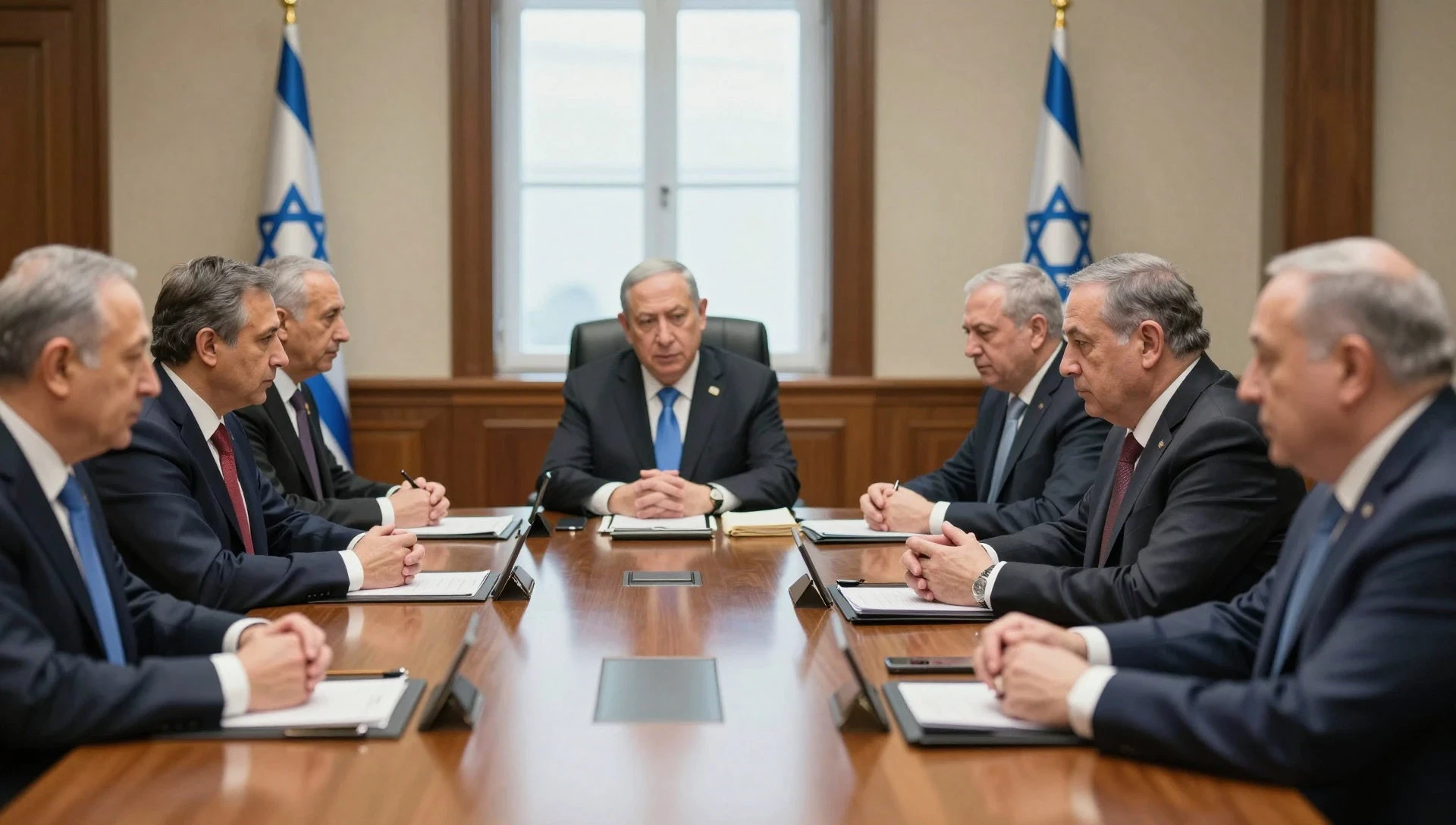
Israel's electoral arithmetic has once again produced a decisive plurality without a governing mandate. Benjamin Netanyahu's bloc finished first in the Knesset contest, yet it fell short of the 61 seats required for a majority in the 120-seat parliament.
That single number — 61 — now governs everything that follows, because it converts a clear electoral victory into an extended bargaining exercise rather than an immediate transfer of power.
The result is structurally familiar in Israeli politics, where proportional representation and a low electoral threshold fragment the legislature into many competing lists. A bloc can lead comfortably and still lack the votes to govern alone, which means coalition negotiations become the real election.
On This Page
The source material, reported by Dawn, confirms the bloc's first-place finish but provides no seat counts, turnout figures, or named coalition partners, leaving the composition of the next government genuinely open.
What follows is an analysis of why this outcome matters beyond the headline. It examines the mechanics of the 61-seat threshold, the coalition arithmetic that will decide the next prime minister, and the wider implications for Israeli governance, regional policy, and the durability of any eventual administration.
The central point is that leading an election and winning the right to govern are two distinct achievements in this system.
TL;DR Netanyahu's bloc won the most seats in Israel's election but did not reach the 61-seat majority needed in the 120-seat Knesset, according to Dawn. The outcome hands the initiative to coalition negotiations rather than to the voters' verdict alone. Because no seat counts, turnout data, or partner commitments were disclosed, the next government's composition and direction remain unresolved, and the coming weeks of bargaining will determine whether the bloc converts its plurality into executive power.
The Arithmetic of a Plurality Without a Majority
Israel's electoral system converts votes into seats through nationwide proportional representation, and the decisive figure is always 61. A bloc that finishes first but stops short of that line controls the largest faction without controlling the chamber.
The distinction matters because the Knesset does not award government to the largest party; it awards it to whoever can assemble a majority of members willing to support a coalition.
Why 61 Seats Is the Only Number That Matters
The 120-seat Knesset requires a simple majority of 61 members to invest a government. That threshold is not a formality but a hard constraint: a bloc holding 60 seats is, in practical terms, as powerless as one holding 40 when it comes to forming an administration. The source confirms the bloc fell short of this mark without specifying the margin.
This creates a negotiating asymmetry. Parties outside the leading bloc can extract concessions disproportionate to their size, because their handful of seats may be the difference between 61 and 59.
The smaller the gap, the higher the price of each partner's support, and the more policy ground the largest bloc must surrender to close it.
Historically, Israeli coalitions have ranged from razor-thin majorities of 61 or 62 to broader groupings exceeding 70 seats. Thin majorities are structurally fragile: a single defection can collapse a government, and the 2021–2022 coalition experience demonstrated how quickly a narrow base erodes under legislative pressure.
The absence of published seat counts in the source is analytically significant. Without the exact distribution, the feasible coalition combinations cannot be mapped, and the leverage of each mid-sized party remains speculative. What is certain is that the bloc's first-place finish does not translate automatically into the right to form a government.
The Fragmentation That Produces Hung Parliaments
Proportional representation with a low threshold rewards small parties and penalizes large ones. A party winning a quarter of the vote may receive only a quarter of the seats, while several niche lists collectively hold the balance of power.
This fragmentation is a design feature, not an accident, and it routinely produces parliaments without a natural majority.
The consequence is that elections in Israel function less as a direct choice of prime minister and more as a selection of bargaining positions. Voters choose lists; the lists then choose partners.
The gap between the popular verdict and the governing outcome is filled by negotiation, and that gap is precisely where the current result sits.
Comparative evidence supports this reading. Systems with single-member districts tend to manufacture majorities; systems with nationwide proportionality tend to manufacture coalitions. Israel sits firmly in the second category, and its recent electoral cycles have repeatedly delivered blocs clustered near, but not above, the 61-seat line.
For the leading bloc, fragmentation is a double-edged condition. It guarantees that no rival can easily assemble a majority either, preserving the bloc's centrality. But it also means that every potential partner knows its votes are indispensable, and indispensable partners price their support accordingly.
Reading the Result Without Published Seat Counts
The source reports the bloc's first-place finish but withholds the specific seat totals, turnout figures, and named partners. Analysts should therefore treat the headline as a directional signal rather than a complete picture. First place establishes momentum and the presumptive right to attempt coalition formation first.
What the result does establish is that the bloc remains the largest single force in the Knesset. That status carries procedural weight: the party best positioned to command a majority is typically invited to try first, and the largest bloc usually holds that position. The invitation, however, is not the government.
Turnout data, when published, will matter for interpretation. Higher turnout typically shifts the balance toward larger, more established lists; lower turnout can amplify smaller and more motivated constituencies. Without that figure, the durability of the bloc's lead cannot be assessed with confidence.
The prudent analytical stance is to separate what is known from what is inferred. Known: the bloc led and fell short of 61. Inferred: coalition negotiations will determine the outcome, and the bloc's plurality gives it the first and strongest claim to lead those talks.
Coalition Negotiation as the Real Contest
Once the votes are counted, the contest moves from the electorate to the negotiating table. Coalition formation in Israel is a structured process of demands, portfolios, and policy commitments, conducted under time pressure and public scrutiny.
The leading bloc enters these talks with the strongest hand, but not a decisive one, because it needs partners it cannot replace.
The Bargaining Leverage of Small Parties
A party with six or seven seats can be marginal in a large coalition and decisive in a narrow one. When the leading bloc needs only a handful of additional members, each small partner can demand cabinet posts, budget allocations, or policy concessions far exceeding its electoral weight. This is the structural premium on pivotal seats.
The premium rises as the gap to 61 narrows. A bloc needing two seats pays less per seat than a bloc needing eight, but the smaller partner in the first case knows it is irreplaceable.
Bargaining theory predicts that the last few seats command the highest price, and Israeli coalition history bears this out repeatedly.
For the leading bloc, the strategic question is whether to broaden the coalition with more moderate partners or deepen it with ideological allies. Broadening improves durability and international acceptability but dilutes policy control. Deepening satisfies the base but produces thin, fragile majorities vulnerable to a single defection.
Either path requires concessions that will shape the government's program before it takes office. The coalition agreement, not the election manifesto, becomes the operative document. Analysts should watch the published agreements closely, because they reveal the real policy priorities of the incoming administration.
Timelines, Mandates, and the Risk of Deadlock
Israeli law structures coalition formation through a presidential mandate to a candidate judged most likely to assemble a majority. That mandate is time-limited, and failure can trigger a transfer of the opportunity to another candidate or, in some circumstances, new elections. The clock is therefore a negotiating instrument.
The source notes that final results and government-building are expected to unfold over coming days and weeks. That phrasing captures the essential uncertainty: the process has a defined procedural path but an undefined outcome. Deadlock is a realistic scenario, not a remote one, in a parliament this fragmented.
Deadlock carries costs. Prolonged negotiations delay budget passage, freeze senior appointments, and leave policy in caretaker mode. Repeated failures can erode public confidence in the political system and increase pressure for another round of elections, which may reproduce the same arithmetic.
The rational expectation is a government eventually formed, because the alternative is costly for most parties. But the path, the partners, and the concessions are all open. The election produced a leader; it did not produce a government, and the difference will define Israeli politics for the months ahead.
We Also Published
Implications for Governance and Regional Policy
The composition of the next coalition will shape Israeli policy on security, judicial reform, economic management, and relations with regional partners. A narrow government dependent on ideological partners will pursue different priorities than a broad unity administration.
The election result therefore matters less for what it says about voters than for what it permits negotiators to build.
Domestic Policy and Institutional Stability
Coalition agreements typically lock in spending commitments and legislative priorities before the government is sworn in. A narrow majority will find its fiscal room constrained by the demands of indispensable partners, each seeking budget lines and regulatory concessions.
The result is often a government program that is more a sum of partner demands than a coherent strategy.
Institutional questions, including the balance between parliament and the judiciary, have dominated recent Israeli political cycles. The next coalition's composition will determine whether those debates resume with intensity or subside into negotiated compromise. A broad coalition tends to soften institutional confrontation; a narrow one tends to sharpen it.
Economic policy faces similar constraints. Budget passage requires majority support, and a fragile coalition may struggle to assemble it. Markets typically price political uncertainty through currency volatility and risk premia on sovereign debt, so the length and outcome of negotiations carry measurable financial consequences.
The practical test of any new government will be its first budget. If it passes on time and with a stable majority, the coalition has demonstrated durability. If it stalls, the government's fragility becomes visible early, and the countdown to the next crisis begins almost immediately.
Regional Alignment and Diplomatic Consequences
Israel's external relationships are sensitive to the ideological composition of its government. Coalition partners with strong positions on territorial and security questions can constrain the prime minister's diplomatic flexibility. Conversely, a broad coalition gives the prime minister more room to maneuver internationally.
Regional dynamics add pressure. Normalization agreements, security coordination, and relations with major powers all depend on a government capable of delivering on commitments. A caretaker administration or a fragile coalition has limited capacity to make credible long-term pledges, which partners recognize and discount accordingly.
The source does not address foreign policy, and this analysis should not overreach. What can be said is structural: coalition composition constrains diplomatic options, and the current uncertainty delays decisions that require a stable counterpart. The longer the negotiation, the longer that constraint persists.
For observers, the signal to watch is the identity of the coalition partners rather than the identity of the prime minister. The partners define the policy envelope. The prime minister operates within it, and in a narrow coalition that envelope is drawn by the smallest members.
What to Watch in the Coming Weeks
Three indicators will clarify the outcome. First, the final seat distribution, which determines the feasible combinations. Second, the identity of the parties invited into negotiations, which signals the likely ideological direction. Third, the content of any published coalition agreement, which reveals the real policy price of power.
Secondary indicators include turnout data, which contextualizes the result, and the tone of statements from mid-sized parties, which reveals their bargaining posture. Early declarations of support or refusal are often negotiating positions rather than final commitments, and should be read with that in mind.
The historical base rate favors eventual government formation, but the timeline is genuinely uncertain. Israeli coalitions have taken weeks to assemble and have also collapsed into repeat elections. The current arithmetic, with a leading bloc short of 61, places the outcome squarely in that familiar zone of uncertainty.
The core finding is simple and durable: a plurality is not a mandate. Netanyahu's bloc leads, but leadership in the Knesset is a starting position, not a destination. The next government will be built at the negotiating table, and its shape will be determined by the price that pivotal partners choose to charge.
From our network :
- Forbidden Matrix Patterns and Visible Lattice Points: A Geometric DictionaryExplore how multidimensional 0–1 matrices encode geometric truths, linking forbidden patterns to visible lattice points and hypergraph theory, with applications in combinatorics and computational geometry.
- The Hidden Cost of AI Convenience: Why Over-Permissioned Agents Are a Security Time BombDiscover why AI agents with excessive permissions create dangerous single points of failure, and learn how implementing least privilege principles can protect your organization from exploitation.
- University Language Proficiency Exams: Why Institutional Tests Demand Different Preparation Than IELTS and TOEFLDiscover why university-specific language proficiency examinations differ fundamentally from IELTS and TOEFL, and learn strategic preparation approaches for institutional assessment success.
- CISA’s Ten-Advisory Wave: Why Generic Patching Fails in OT and How to Build Product-Specific PlaybooksCISA released ten ICS advisories in one week, exposing critical infrastructure risks. Generic patching fails in OT. Learn to build product-specific remediation playbooks.
- Live Online English Classes for Kids: Do They Actually Reduce Anxiety?A ten-week study reveals that synchronous online English classes can significantly reduce child language anxiety while improving listening and reading skills. Discover what makes these programs effective and how parents can select the right one.
- The Final Descent: How ESA Retired the Legendary Cluster Constellation After 24 Years of Space Weather ScienceAfter 24 years mapping Earth’s magnetosphere, ESA’s Cluster mission concluded with a precisely controlled reentry over the South Pacific. This analysis explores the scientific legacy, engineering decisions, and debris mitigation principles behind one of space exploration’s most responsible retirements.
- How AI Agents Will Change the Way We Manage Personal FinancesExplore how AI agents are transforming personal finance through automated budgeting, bill payment, and investment management, while examining the critical security protocols and governance frameworks required for safe deployment.
- Committed Mediterranean Precipitation Decline: Why Emissions Cuts Alone Cannot Restore Winter RainsNew NOAA research reveals that Mediterranean winter rains may decline irreversibly even with emissions cuts. Explore the science of committed climate change and regional impacts.
- Mobile Learning and VR in English: What Global Evidence Reveals About Effective Language TechnologyA systematic review across 14 countries reveals which language-learning technologies genuinely work. Mobile learning, AI, and VR show measurable benefits when pedagogically integrated. This evidence-based guide helps educators and learners select technology that delivers real return on investment.
RESOURCES
- Difficult negotiations lie ahead in Israel after Netanyahu's bloc lost its ...pbs.org3 days ago ... Israel's final election results confirmed Prime Minister Benjamin Netanyahu and his allies lost their parliamentary majority and that weeks ...
- Israel Election 2026: Who Will Lead Israel and What Does It Mean ...ajc.org4 days ago ... Israel's 2026 election results, key parties, coalition negotiations ... Neither Prime Minister Benjamin Netanyahu's bloc of right-wing and ...
- Coalition talks loom in Israel as Netanyahu and Eisenkot blocs set to ...theguardian.com5 days ago ... The elections committee had sought to ban Arab Israeli parties before the poll, but the attempt to exclude them was…
- Netanyahu's bloc leading Israel election but short of majority ... - BBCbbc.com4 days ago ... Both the prime minister and his main rival have insisted that they should be tasked with forming a governing coalition.…
- Netanyahu set to remain caretaker after inconclusive Israeli electionreuters.com4 days ago ... Netanyahu bloc leads Eisenkot but falls short of majority ... Netanyahu would remain caretaker prime minister during any coalition negotiations ...
- Israel faces weeks of coalition haggling as neither bloc wins majoritycnbc.com3 days ago ... Israel's final election count left both Prime Minister Benjamin Netanyahu's right-wing bloc and the opposition led by former military chief…
- Israel's Election: Understanding Who's Who and What's at Stakecfr.orgOct 22, 2026 ... The anti-Netanyahu coalition is branding itself as the so-called change bloc. ... Israel is known for drawn-out coalition negotiations, and ...
- Israel election 2022 outcome and coalition negotiations - Facebookfacebook.comOct 25, 2026 ... What's at stake in Israel's first elections since the October 7 attacks? An unclear outcome for Netanyahu or opponents co...
- Netanyahu Bloc Loses Majority in Historic Vote - WWNYwwnytv.com3 days ago ... Final Israeli election results show Netanyahu's bloc lost its majority with 53 seats, setting up intense coalition talks as Arab-led…
- Israel Elections: Netanyahu's New Coalition Troubles | Brookingsbrookings.eduJan 22, 2013 ... ... coalition negotiations. While the opposition pays lip ... The key question to be answered in today's election – assuming…
- Israel election: Majority remains elusive after final count - DW.comdw.com6 days ago ... With all the votes counted, the pro-Netanyahu bloc finished ahead of Gadi Eisenkot's anti-Netanyahu bloc. But tough coalition talks loom…
- Netanyahu bloc finishes ahead in Israel vote, but well short of majorityjapantimes.co.jp3 days ago ... ... Israel's general election showed Friday, setting the stage for tough coalition talks or potentially another vote. Netanyahu's coalition of ...
- Israel faces prolonged coalition negotiations after an inconclusive ...facebook.com5 days ago ... Benjamin Netanyahu is coming Arise, check the current update; he is leading with the election almost complete. 3d · 7…
- No clear winner in Israeli election as negotiations to follow in order ...cbsnews.com4 days ago ... Neither Prime Minister Benjamin Netanyahu's coalition nor the opposition bloc, led by Gadi Eisenkot, secured a majority, according to the ...
- Can you form Israel's next coalition government? | Israel Election ...aljazeera.com4 days ago ... On the Central Elections Committee's count, Likud is ahead as the largest single party, with 26 seats. Netanyahu's bloc stood…
- 01
- 02
- 03
- 04
- 05
- 06
- 07
- 08
0 Comments