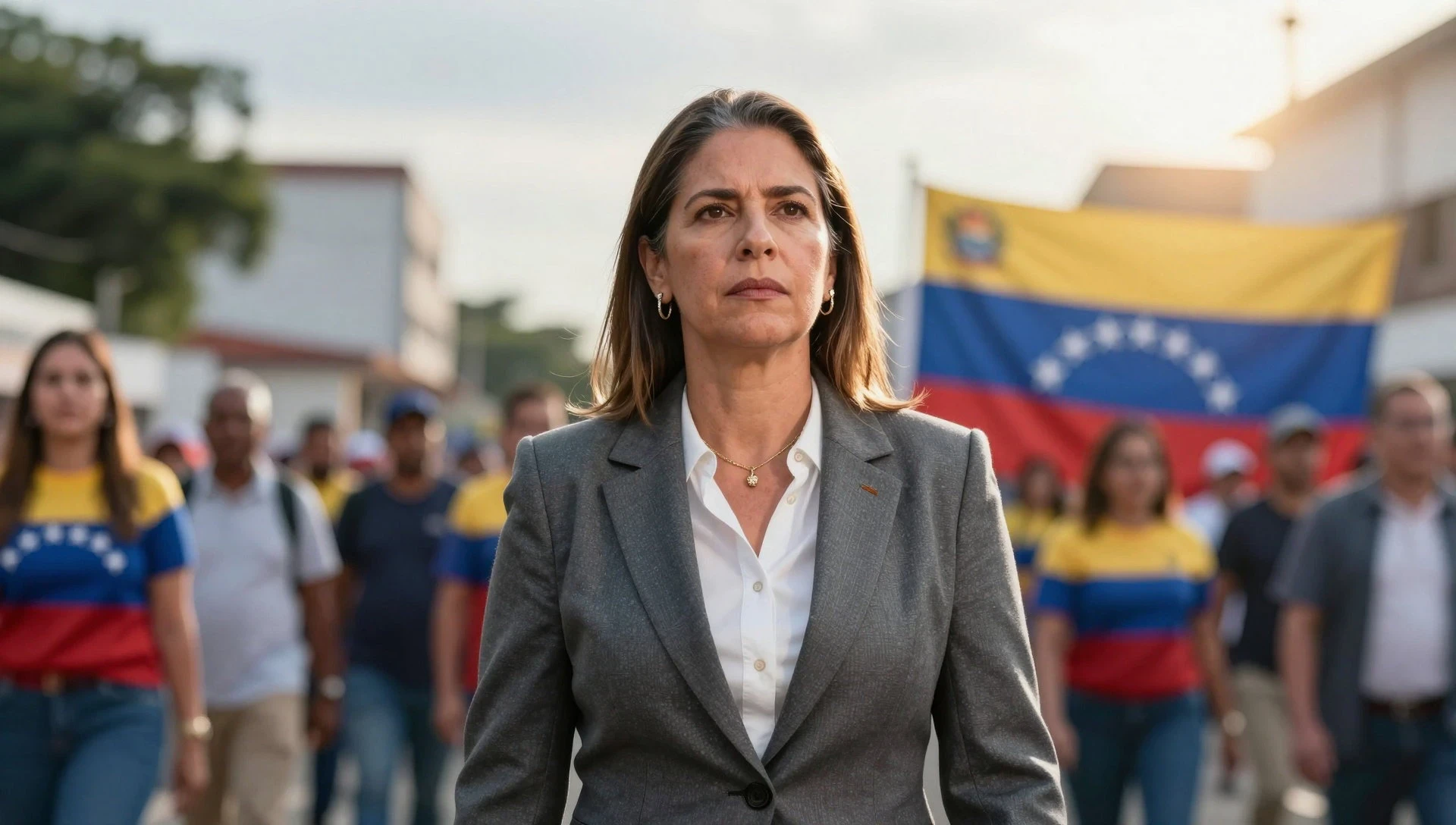
María Corina Machado's return to Caracas after ten months in exile marks a decisive inflection point in Venezuela's stalled democratic transition, and her first public remarks framed the country's next presidential contest as an externally brokered, near-inevitable event.
Speaking on Thursday, the opposition leader asserted that the United States has outlined a sequenced path toward a 2027 presidential election, attributing that framework to Secretary of State Marco Rubio.
Her language was deliberately absolute: the transition to democracy, she declared, is "irreversible," and the election date itself constitutes "the date of liberation."
On This Page
The political arithmetic behind that claim is unusually complex. Machado was barred from contesting the 2024 presidential election, ceding the opposition banner to Edmundo González, whose supporters insist he won by a wide margin while electoral authorities certified Nicolás Maduro.
Maduro's removal from power, following his capture by US authorities on drug trafficking and torture charges he denies, has reshaped the entire bargaining environment. Machado thanked President Donald Trump for actions on January 3 that she said opened "the floodgate to freedom," yet simultaneously criticized a major Washington–Caracas oil arrangement under which Venezuela would supply 20% of its reserves to the United States.
That contradiction — gratitude for liberation paired with objection to the commercial terms of re-engagement — defines the analytical core of this episode. Machado's priorities center on dismantling what she calls the country's repressive apparatus and securing the release of thousands of political prisoners, objectives that require institutional cooperation rather than rhetorical victory.
She denied any contact with interim President Delcy Rodríguez, who has confirmed elections "will" occur but has declined to set a date. The gap between an announced 2027 timeline and an undated official commitment is where Venezuelan sovereignty, US leverage, and opposition credibility now collide.
TL;DR María Corina Machado returned from ten months of exile claiming the United States, via Secretary of State Marco Rubio, has outlined a democratic transition culminating in a 2027 presidential election she calls "irreversible." She demands the dismantling of Venezuela's repressive system and the release of thousands of political prisoners, denies contact with interim President Delcy Rodríguez, and credits Donald Trump's January 3 actions — including Maduro's capture — for opening "the floodgate to freedom." Yet she criticizes a US–Venezuela oil deal granting Washington access to 20% of Venezuelan reserves as insufficiently transparent. The episode exposes the tension between externally brokered timelines and sovereign electoral authority.
The Architecture of an Externally Brokered Transition
Machado's account positions Washington as the principal architect of Venezuela's electoral calendar rather than a passive observer. By attributing the 2027 date to Rubio's sequenced steps, she converts an American diplomatic preference into an apparent binding framework.
This is a consequential rhetorical move: it lends the timeline international weight while exposing the opposition to charges of outsourcing sovereignty. The distinction matters because Venezuelan electoral authority has historically been contested terrain, and any date announced from abroad invites legitimacy challenges at home.
The Rubio Framework and Its Stated Sequence
According to Machado, the Secretary of State has set out a series of steps for democratic transition, with presidential elections in 2027 as the terminal milestone. The framework's credibility rests on whether intermediate benchmarks — prisoner releases, institutional reform, electoral council reconstitution — are specified and monitored.
Without verifiable sequencing, a 2027 date functions as aspiration rather than obligation. Machado's phrasing suggests she treats the sequence as actionable, though she disclosed no enforcement mechanism or verification schedule during her Caracas remarks.
The diplomatic logic is straightforward: Washington possesses leverage through sanctions relief and the oil arrangement, and it can condition further normalization on measurable democratic progress. Whether that leverage is applied consistently is another question.
The United States has simultaneously praised acting President Rodríguez, creating an ambiguity that Machado's return complicates rather than resolves. A broker that endorses both the opposition claimant and the interim incumbent preserves optionality but weakens the clarity a transition requires.
Maduro's Capture as the Transition's Trigger
Machado explicitly credited Trump's January 3 actions with opening "the floodgate to freedom," a reference to the US capture of former President Maduro on drug trafficking and torture charges he denies. The removal of the incumbent from the political scene altered every downstream calculation.
It eliminated the person around whom the 2024 electoral dispute crystallized, but it did not automatically transfer authority to the opposition. Instead, an interim presidency under Rodríguez emerged, producing a tripartite standoff between opposition claims, interim governance, and external brokerage.
Analytically, decapitation of an authoritarian executive rarely produces immediate democratic consolidation. It more commonly generates contested succession, fragmented security apparatuses, and external patrons competing to shape outcomes. Venezuela's case fits that pattern: the repressive system Machado wants dismantled remains intact, thousands of political prisoners remain detained, and the interim leadership has adopted the language of elections without committing to dates. The capture created opportunity; it did not create institutions.
Sovereignty, Leverage, and the Oil Question
Machado's criticism of the oil deal is the most analytically revealing element of her statement. Under the arrangement, Venezuela is expected to supply 20% of its oil reserves to the United States — a figure that dwarfs typical commercial terms and implies structural dependency.
She argued the agreement does not reflect the transparency Venezuelan society demands. This positions her against the very administration she thanked hours earlier, demonstrating that her coalition's consent is conditional on governance standards rather than geopolitical alignment alone.
Resource concessions of this magnitude carry long-term fiscal consequences. A state surrendering a fifth of its reserve base forfeits future revenue streams that fund public services, pensions, and reconstruction. If the deal lacks legislative oversight or public disclosure, it reproduces the opacity that undermined prior administrations.
Machado's objection therefore functions as a democratic test: a transition that swaps one opaque arrangement for another has changed personnel without changing method.
We Also Published
Machado's Political Position and the 2024 Precedent
The 2024 election remains the reference point against which all subsequent claims are measured. Barred from the ballot, Machado backed González, whose supporters said he won by a wide margin while electoral authorities declared Maduro the winner.
That unresolved dispute supplies the moral authority behind her current demands and the evidentiary basis for rejecting the incumbent administration's legitimacy. It also explains why she frames prisoner release and institutional dismantling as preconditions rather than negotiable concessions.
From Exile to Caracas: The Return's Strategic Effect
Returning after nearly a year abroad converts Machado from an exiled symbol into a domestic political actor with physical presence and immediate risk. Her presence in Caracas complicates matters for Washington, which has said she has every right to be in Venezuela while also praising Rodríguez.
That dual endorsement becomes harder to sustain when the two figures occupy the same political space and advance incompatible claims about who authorizes the transition.
Physical return also changes her bargaining position with the opposition base. Exile confers moral clarity but limits operational control; presence enables mobilization, negotiation, and direct engagement with detainees' families. The risk is detention or renewed exclusion, which would convert a strategic return into a diplomatic crisis.
Machado appears to have calculated that the cost of absence now exceeds the risk of presence, a judgment that signals confidence in the transition's momentum.
Questions Left Unanswered
Machado declined to directly address Trump's January comments that she lacked sufficient support to immediately lead Venezuela, or his suggestion this week that the country could become the 51st US state. Those omissions are significant.
The first implies an external assessment of her domestic mandate that contradicts her liberation narrative; the second raises annexation rhetoric incompatible with sovereign transition. Silence on both preserves coalition unity but leaves her exposed to later accusations of ambiguity.
Her denial of contact with Rodríguez is equally consequential. Refusing engagement with the interim presidency treats that office as illegitimate, which may be principled but narrows the pathways to negotiated prisoner releases. Dismantling a repressive system typically requires dealing with its current administrators, however distasteful.
Whether Machado's non-recognition posture is a temporary bargaining stance or a fixed doctrine will determine whether the 2027 timeline survives contact with institutional reality.
Geopolitical Consequences and the Wider Regional Order
Venezuela's transition carries weight far beyond its borders. The country holds the world's largest proven oil reserves, and any arrangement transferring 20% of that base to the United States reshapes hemispheric energy politics.
Regional governments that weathered Venezuelan migration flows have a direct stake in whether the transition produces stability or renewed fragmentation. Machado's insistence on transparency is therefore not merely domestic politics; it is a signal to neighbors about the kind of state Venezuela intends to become.
Washington's Dual Track and Its Contradictions
The United States is pursuing two objectives that pull in opposite directions: democratic restoration through Machado and energy security through the oil arrangement. Praising Rodríguez while backing Machado preserves both channels but generates incoherence. Authoritarian incumbents exploit such ambiguity by treating external endorsement as legitimization while conceding nothing on timelines.
If Washington does not condition the oil deal on measurable democratic benchmarks, the 2027 date loses its enforcement value.
Trump's suggestion that Venezuela could become the 51st US state compounds the problem. Even as rhetoric, annexation talk undermines the sovereignty framing that makes a 2027 election meaningful. Machado's refusal to address the remark suggests she recognizes the trap: engaging it would either endorse an untenable proposition or antagonize the administration whose support she credits. Her silence is tactically defensible and strategically costly.
What Would Make the 2027 Timeline Credible
Credibility requires observable milestones rather than announced intentions. A reconstituted electoral council with opposition representation, an independent prisoner-release process, and published terms of the oil arrangement would each provide verifiable evidence of movement. Absent such markers, the 2027 date remains a diplomatic aspiration vulnerable to indefinite postponement.
The historical record of authoritarian transitions suggests that timelines without enforcement mechanisms rarely survive the first institutional obstacle.
Machado's own framing — "the date of the election is the date of liberation" — collapses process into event. That is rhetorically powerful and analytically risky. Liberation implies a single decisive moment; democratic consolidation requires sustained institutional reconstruction across years.
If 2027 arrives without the preparatory steps, the opposition will face a choice between participating in a flawed contest and rejecting the timeline it helped establish. That dilemma is the transition's central unresolved risk.
Comparative Lens: Transitions Without Enforcement
Historical transitions that succeeded generally paired external pressure with internal institutional agreement. Where timelines were announced without verification, postponement followed. Venezuela's situation resembles cases in which an authoritarian executive was removed externally while subordinate structures persisted, producing elections that ratified existing power distributions.
The distinguishing variable here is Machado's domestic mobilization capacity, which could substitute for absent institutional guarantees if sustained.
Comparative evidence also cautions against overreading a single leader's return. Personal presence can catalyze momentum, but durable transitions depend on party structures, judicial independence, and security-sector reform. Machado's agenda names all three, yet her non-recognition of the interim presidency limits her ability to influence any of them.
The transition's outcome will hinge less on the 2027 date than on whether the intervening period produces institutional change.
Reading the Signal: What Machado's Statement Actually Establishes
Stripped of rhetoric, Machado's remarks establish four verifiable claims and one significant omission. She asserts a US-brokered sequence ending in a 2027 vote, an irreversible transition, a dismantling agenda, and a prisoner-release demand. She omits any enforcement mechanism, any acknowledgment of the interim presidency's institutional role, and any response to annexation rhetoric.
The gap between assertion and mechanism is the analytical space where the transition will either succeed or stall.
Assertion Versus Mechanism
Political transitions advance through mechanisms, not declarations. A date becomes binding when the actors who could obstruct it face costs for doing so. Machado's framework relies on US leverage to supply those costs, but Washington's simultaneous engagement with Rodríguez dilutes the pressure.
Until the oil arrangement is explicitly conditioned on electoral benchmarks, the 2027 timeline functions as a preference rather than a commitment enforceable against the incumbent administration.
The prisoner-release demand illustrates the same gap. Thousands remain detained, and their release requires cooperation from the security and judicial apparatus Machado wants dismantled. Demanding both simultaneously is coherent as an end state but difficult as a sequence.
A credible plan would specify which releases precede which institutional reforms, and who verifies compliance. No such sequencing was disclosed, leaving the agenda vulnerable to the charge of being aspirational.
The Sovereignty Question
Attributing the electoral calendar to a foreign secretary of state creates a durable vulnerability. Venezuelan political actors across the spectrum have historically mobilized around sovereignty claims, and an externally sourced date can be reframed as imposition.
Machado's counter is that the transition's content — prisoner release, institutional reform, free elections — is domestically demanded. That argument holds only if domestic institutions visibly own the process rather than ratifying an external design.
The oil deal sharpens this tension. A transfer of 20% of reserves to the United States, negotiated without the transparency Machado demands, reads to critics as the economic price of political transition. If that perception consolidates, the 2027 election could be delegitimized before it occurs.
Machado's criticism of the arrangement is therefore strategically essential: it separates her democratic agenda from the commercial terms of external support.
Implications for 2027 and Beyond
The 2027 timeline will be tested by three variables: whether Machado secures ballot access, whether the interim administration accepts verifiable benchmarks, and whether Washington conditions its energy interests on democratic progress. Each is currently unresolved.
The most probable near-term trajectory is prolonged negotiation punctuated by partial concessions, with the election date serving as a focal point rather than a fixed commitment. Optimism should be calibrated to institutional movement, not rhetorical confidence.
Machado's return has undeniably changed the political landscape. It restored a domestically present opposition leader, forced Washington to manage contradictory relationships openly, and placed the oil arrangement under scrutiny it would otherwise have escaped. Those are substantive achievements.
Whether they translate into a free election depends on mechanisms she has not yet described and institutions she does not yet control. The date of liberation, as she frames it, remains a claim awaiting verification.
From our network :
- The Hidden Cost of AI Convenience: Why Over-Permissioned Agents Are a Security Time BombDiscover why AI agents with excessive permissions create dangerous single points of failure, and learn how implementing least privilege principles can protect your organization from exploitation.
- University Language Proficiency Exams: Why Institutional Tests Demand Different Preparation Than IELTS and TOEFLDiscover why university-specific language proficiency examinations differ fundamentally from IELTS and TOEFL, and learn strategic preparation approaches for institutional assessment success.
- CISA’s Ten-Advisory Wave: Why Generic Patching Fails in OT and How to Build Product-Specific PlaybooksCISA released ten ICS advisories in one week, exposing critical infrastructure risks. Generic patching fails in OT. Learn to build product-specific remediation playbooks.
- Committed Mediterranean Precipitation Decline: Why Emissions Cuts Alone Cannot Restore Winter RainsNew NOAA research reveals that Mediterranean winter rains may decline irreversibly even with emissions cuts. Explore the science of committed climate change and regional impacts.
- How AI Agents Will Change the Way We Manage Personal FinancesExplore how AI agents are transforming personal finance through automated budgeting, bill payment, and investment management, while examining the critical security protocols and governance frameworks required for safe deployment.
- Mobile Learning and VR in English: What Global Evidence Reveals About Effective Language TechnologyA systematic review across 14 countries reveals which language-learning technologies genuinely work. Mobile learning, AI, and VR show measurable benefits when pedagogically integrated. This evidence-based guide helps educators and learners select technology that delivers real return on investment.
- Live Online English Classes for Kids: Do They Actually Reduce Anxiety?A ten-week study reveals that synchronous online English classes can significantly reduce child language anxiety while improving listening and reading skills. Discover what makes these programs effective and how parents can select the right one.
- The Final Descent: How ESA Retired the Legendary Cluster Constellation After 24 Years of Space Weather ScienceAfter 24 years mapping Earth’s magnetosphere, ESA’s Cluster mission concluded with a precisely controlled reentry over the South Pacific. This analysis explores the scientific legacy, engineering decisions, and debris mitigation principles behind one of space exploration’s most responsible retirements.
- Forbidden Matrix Patterns and Visible Lattice Points: A Geometric DictionaryExplore how multidimensional 0–1 matrices encode geometric truths, linking forbidden patterns to visible lattice points and hypergraph theory, with applications in combinatorics and computational geometry.
RESOURCES
- US proposes Venezuela elections for 2027, opposition ... - Reutersreuters.com4 days ago ... Venezuelan opposition leader Maria Corina Machado said on Thursday the United States has suggested the country hold presidential elections ...
- Venezuela: Opposition leader Machado says US backs 2027 electiondw.com3 days ago ... ... transition that includes presidential elections in 2027." "The date of the election is the date of liberation," Machado said…
- Venezuela's Maria Corina Machado hopeful for 2027 presidential ...wlrn.org3 days ago ... Opposition leader María Corina Machado has returned to Venezuela, asserting that the country is moving toward presidential elections in 2027 ...
- Venezuela's Post-Maduro Political Transition and U.S. Policycongress.govAug 13, 2026 ... winner of Venezuela's 2024 presidential election, or opposition leader María Corina Machado.3. President Trump reportedly warned that ...
- Venezuela's Maria Corina Machado hopeful for 2027 presidential ...washingtonpost.com3 days ago ... Opposition leader Maria Corina Machado has returned to Venezuela, asserting that the country is moving toward presidential elections in ...
- Maria Corina Machado calls for 2027 elections following return to ...latinamericareports.com3 days ago ... ... transition, saying that it made clear presidential elections would be held in 2027. U.S-backed talks between the Venezuelan government…
- US has proposed a roadmap for presidential elections in Venezuela ...facebook.com3 days ago ... ... presidential elections in Venezuela in 2027, according to opposition leader Maria Corina Machado ... transition toward democratic elections ...
- Venezuelans Take to the Streets to Demand Democracy - TIMEtime.comOct 23, 2026 ... ... presidential election in Caracas, Venezuela on Oct. 22, 2026.Jesus ... Rodríguez and U.S. President Donald Trump both have said…
- Venezuela's Machado lauds Trump for 'freedom', urges 2027 electionsaljazeera.com3 days ago ... Venezuelan opposition leader Maria Corina Machado has thanked US President Donald Trump's administration for opening the “floodgate to ...
- Machado's Return Changes Everything in Venezuela - Cato Institutecato.org5 days ago ... ... Venezuela could have presidential elections as early as mid-2027. ... president would almost certainly be the pro-American Machado. Machado ...
- In Venezuela, María Corina Machado's return tests a fragile transitioncsmonitor.com4 days ago ... ... U.S., has ... presidential elections, in Caracas, Venezuela, Oct. 22, 2026. For Ms. Machado, who has called for elections…
- US has proposed a roadmap for presidential elections in Venezuela ...instagram.com3 days ago ... (Maria Corina Machado, Venezuela elections 2027, US Venezuela roadmap, Marco Rubio Venezuela, Venezuela democratic transition, Nicolas Maduro ...
- Venezuela opposition leader María Machado calls for elections ...bbc.com4 days ago ... Soon after, in January, the US seized Maduro. The Trump administration then backed Rodríguez as leader. She was sworn in…
- US-backed Venezuela political transition talks begin without Nobel ...france24.comAug 7, 2026 ... "The Venezuelan people are eager and ready!" Machado said. Despite her gifting her Nobel Peace Prize to President Donald Trump,…
- What María Corina Machado's Return Means for Venezuela - WSJwsj.com7 days ago ... Machado says that U.S.-backed transition talks are moving too slowly. ... Machado's solution is a presidential election, contending that only ...
- 01
- 02
- 03
- 04
- 05
- 06
- 07
- 08
0 Comments