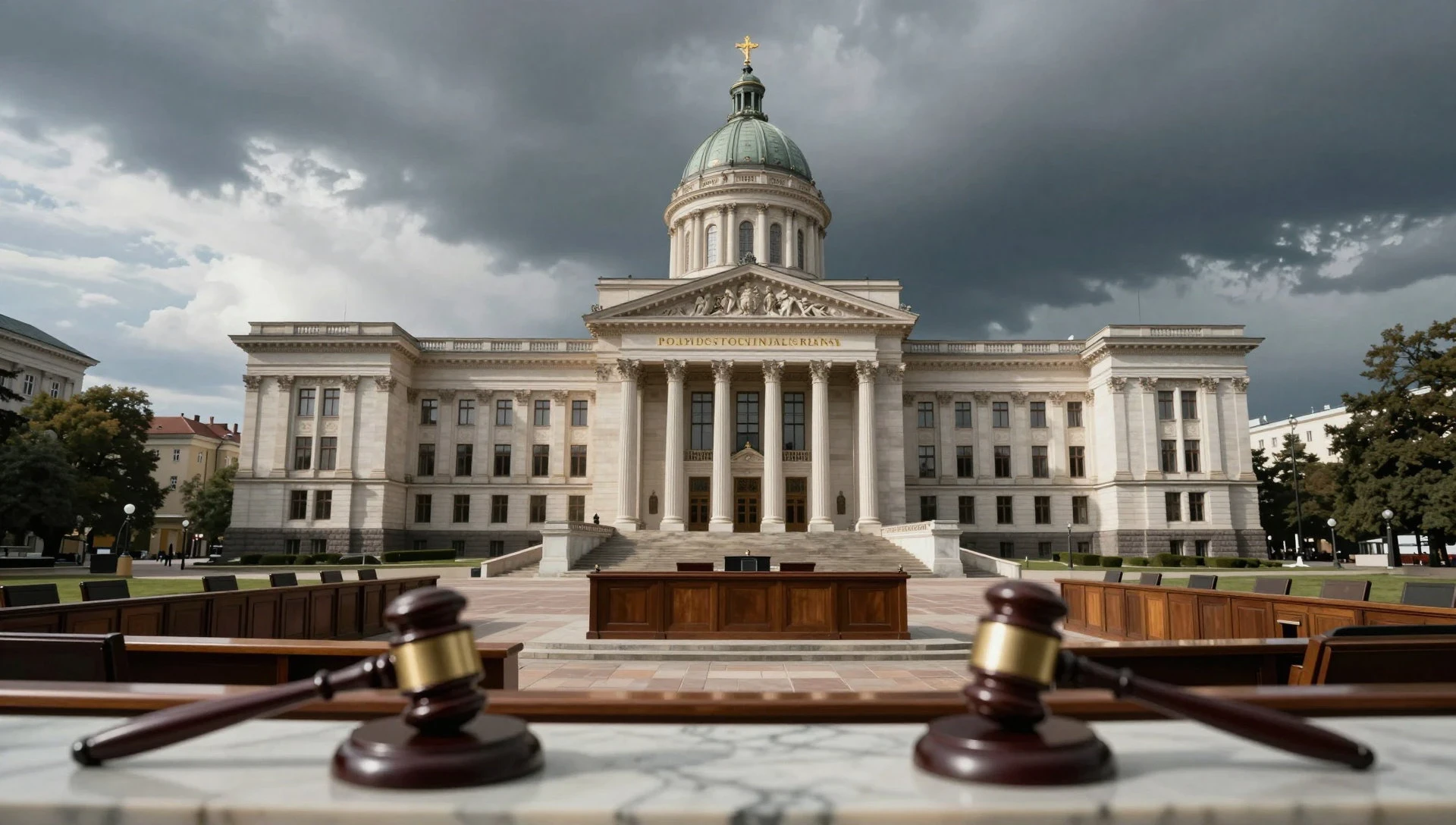
Poland's constitutional crisis entered a sharper phase on Saturday, 1 November 2026, when President Karol Nawrocki convened emergency talks at the presidential palace after the suspension of Constitutional Tribunal chief judge Bogdan Swieczkowski.
The meeting drew representatives of nationalist, far-right and some governing coalition parties, but Prime Minister Donald Tusk's centrist Civic Coalition stayed away. By Saturday afternoon, no breakthrough had been reached, and the standoff had moved from courtrooms into the highest offices of the state.
The dispute is not a procedural quarrel over one judge's tenure. It is the latest expression of a decade-long conflict over who controls Poland's judiciary, and it now pits a directly elected president against a governing coalition that claims a mandate to reverse the judicial changes made between 2015 and 2023.
On This Page
The Constitutional Tribunal, Poland's highest authority on constitutional matters, sits at the centre of that conflict. Its suspension of a chief judge, and the court's own description of the government's move as a coup, illustrate how far the institutional trust has eroded.
External actors have entered the frame with unusual directness. The European Commission urged Nawrocki to accept the appointment of new judges, while US ambassador Tom Rose called for calm on all sides and warned that confrontation could escalate.
Those interventions matter because Poland's judicial dispute has never been purely domestic: it has shaped Warsaw's standing in Brussels, its access to EU funds, and its credibility as a frontline NATO state.
The following analysis examines the legal mechanics, the political incentives and the wider consequences of a confrontation that neither side appears able to de-escalate.
TL;DR Poland's President Karol Nawrocki held emergency talks on 1 November 2026 after the suspension of Constitutional Tribunal chief judge Bogdan Swieczkowski, but Tusk's Civic Coalition boycotted the meeting and no breakthrough emerged. The standoff reflects a decade-long fight over judicial control, with the Tribunal itself calling the government's action a coup, the European Commission pressing for new judge appointments, and Washington urging restraint. The dispute carries direct consequences for EU relations, investor confidence and the durability of Poland's constitutional order.
The Legal Architecture of the Standoff
The immediate trigger was the suspension of Bogdan Swieczkowski, appointed to the Tribunal under the Law and Justice government that governed from 2015 to 2023. He was accused of using his position to block parliament from electing new judges, a charge that goes to the heart of the Tribunal's composition and legitimacy.
Tusk framed the removal as a painful but necessary step to restore judicial independence after what he described as years of erosion under PiS.
What the Suspension Actually Changes
The suspension does not resolve the underlying question of how Tribunal judges are lawfully appointed. It changes who exercises the chief judge's procedural powers, including control over case scheduling and the certification of rulings.
That procedural control is decisive in a court whose authority depends on the recognition of its judgments by other institutions and by the European Court of Justice.
Legal scholars have long noted that Poland's judicial conflict is less about statutory text than about mutual non-recognition. When one branch refuses to accept the validity of another's appointments, every subsequent ruling becomes contestable.
The suspension therefore functions as an assertion of authority rather than a settlement, and it invites reciprocal assertions from the presidency and from PiS-aligned judges.
The Tribunal's official account on X described the government's move as a coup, language that signals the court does not regard the suspension as lawful. Once a constitutional court characterises a government action in those terms, the dispute ceases to be administrative.
It becomes a contest over constitutional identity, in which each side claims to defend the rule of law against its subversion.
The President's Constitutional Role
Nawrocki justified the emergency consultations by citing a threat to Poland's internal security following the suspension. That framing is significant because it invokes the president's role as guarantor of state continuity rather than as a partisan arbiter.
It also positions him as the institutional counterweight to a government he did not appoint and does not control.
Poland's semi-presidential design gives the president limited but real levers: veto power, appointment authority and the capacity to shape public framing. Nawrocki's decision to convene nationalist and far-right parties, while excluding the governing coalition, converts a legal dispute into a visible political bloc. The exclusion of Civic Coalition was reciprocated, hardening the lines before any negotiation began.
The absence of the governing coalition from the palace talks is the most consequential procedural fact of the weekend. A settlement on judicial appointments requires parliamentary cooperation, and parliament's majority sits with Tusk.
Talks that exclude the majority can produce declarations but not legislation, which limits what the presidential initiative can realistically deliver.
Competing Legitimacy Claims
Each side in this dispute can point to a democratic mandate. Tusk's coalition won the 2023 parliamentary election on an explicit promise to restore judicial independence, and it treats that mandate as authorisation for decisive action. Nawrocki won the presidency in 2025, and PiS-aligned judges hold appointments made under two previous parliamentary terms.
The result is a layered legitimacy conflict in which elections at different times produce institutions with incompatible mandates. Comparative constitutional scholarship describes this pattern as a "constitutional capture" spiral, where each side's corrective action becomes the next side's grievance. Poland's case is distinctive mainly in how openly the participants now describe each other's actions as illegitimate.
Public opinion is correspondingly polarised. PiS supporters gathered outside the court on Saturday, continuing weeks of protests in support of judges aligned with the party. That mobilisation gives the court's defenders a street-level presence, while the government can claim the largest recent electoral mandate. Neither claim is easily reconciled with the other through ordinary parliamentary procedure.
Political Incentives and the Escalation Logic
Neither side has an obvious incentive to retreat. Tusk's coalition built its mandate on judicial restoration, and abandoning the suspension would demoralise its base and validate PiS's claim that the 2023 election did not authorise structural change.
Nawrocki, meanwhile, has positioned himself as the defender of institutional continuity against a government he portrays as acting outside constitutional limits.
Tusk's Calculation
Tusk's televised address accused conservative nationalist opposition leaders of seeking to destroy democracy and the rule of law. That framing is strategically useful because it casts the dispute as a defence of democratic order rather than a partisan manoeuvre.
It also raises the political cost of compromise, since any retreat would appear as concession to actors he has publicly described as destructive.
The government's leverage rests on parliamentary majority and control of the appointment process. If the Sejm can elect new judges, the Tribunal's composition shifts over time, and the suspended chief judge's blocking tactic loses force.
That is precisely why the European Commission's call to accept new appointments aligns with the government's position and why the presidency resists it.
Timing also favours the government in one respect: judicial appointments accumulate. Each successful election of a judge alters the court's balance, and the effects compound across a parliamentary term.
Tusk can therefore pursue a strategy of attrition, absorbing protest and litigation while the composition of the judiciary gradually changes in his coalition's favour.
Nawrocki's Calculation
Nawrocki's position depends on maintaining the perception that the government has overstepped. By convening talks that exclude the governing coalition, he signals that the dispute is not a routine policy disagreement but a constitutional emergency requiring a national response. That framing elevates his office and builds a coalition of grievance around the presidency.
The risk for Nawrocki is that exclusionary talks produce no binding outcome. Without Civic Coalition participation, the consultations cannot generate legislation, and repeated rounds of inconclusive meetings may erode the impression of presidential control.
His advantage lies in delay: the longer the dispute runs, the more the government's actions appear contested and provisional.
His alliance with nationalist and far-right parties carries its own costs. It consolidates a bloc but narrows his appeal to the median voter, and it hands the government a straightforward argument that the president is acting as a partisan rather than an arbiter. That argument resonates with the European Commission and with centrist opinion in western Europe.
The Street and the Courtroom
PiS supporters outside the court represent a durable mobilisation that gives the judicial opposition a visible constituency. Protests of this kind raise the political price of enforcement and can deter officials from implementing contested rulings.
They also create flashpoints where police action could generate sympathy for the protesters and further delegitimise the government.
Litigation runs in parallel. Challenges to the suspension will move through Polish courts and potentially to the European Court of Justice, which has already ruled on Polish judicial independence in earlier cases.
A ruling from Luxembourg would not resolve the domestic dispute, but it would supply one side with external validation and complicate the government's international position.
The interaction between street protest and courtroom challenge is what makes this dispute resistant to ordinary resolution. Each reinforces the other: legal challenges give protesters a claim of right, and protests give litigants political cover. The result is a stalemate that consumes institutional energy without producing a settlement.
We Also Published
External Pressure and Structural Consequences
The European Commission's intervention is consistent with its long record of linking Polish judicial arrangements to EU membership obligations. Its call for Nawrocki to accept new judge appointments places Brussels on the government's side of the argument, at least procedurally.
That alignment matters because EU funds and treaty obligations give the Commission leverage that domestic actors cannot ignore indefinitely.
Brussels and the Rule-of-Law Mechanism
Poland's earlier judicial conflicts triggered Article 7 proceedings and conditioned access to cohesion and recovery funds. A renewed confrontation would revive those mechanisms, and the Commission has shown willingness to withhold disbursements pending judicial benchmarks. For a government committed to restoring judicial independence, that pressure is broadly supportive rather than hostile.
The complication is that EU validation does not settle domestic legitimacy. PiS and its allies have long argued that Brussels overreaches into member-state competences, and they can present Commission pressure as external interference.
That narrative has proved durable in Polish politics, and it gives the presidency a rhetorical resource even when its legal position is weaker.
Financial markets watch these disputes through sovereign risk and currency channels. Sustained institutional conflict tends to widen spreads and weaken the zloty, though Poland's growth record has so far insulated it from severe repricing.
The longer the standoff persists, the more likely it is that investors begin to price political risk into Polish assets.
Washington's Restraint
Ambassador Tom Rose's call for calm on all sides, with a warning that confrontation could escalate, reflects a distinct American interest. Poland is a frontline NATO state whose military build-up and logistical role in supporting Ukraine depend on stable civil-military coordination. Washington prefers de-escalation without taking a position on the merits of the judicial dispute.
That neutrality is itself a signal. When the United States declines to endorse either side, it communicates that the dispute is viewed as a domestic matter with manageable risk.
But the explicit warning about escalation suggests Washington sees a plausible path from courtroom conflict to street confrontation, and it wants both sides to understand the cost.
The broader geopolitical context reinforces restraint. Poland's eastern border, its defence spending and its role in European security give it outsized importance relative to its population. A prolonged constitutional crisis would consume political attention that Warsaw can ill afford to divert from security policy, which is why external partners prefer a rapid settlement.
What a Settlement Would Require
A durable settlement would need three elements: a mutually accepted procedure for appointing Tribunal judges, a mechanism for reviewing past appointments, and a political truce that allows both sides to claim vindication.
None of these is currently on the table, and the exclusion of the governing coalition from Saturday's talks makes the first element harder to achieve.
Comparative experience suggests that judicial crises are resolved either through electoral realignment or through incremental institutional change. Poland's electoral calendar offers no immediate resolution, and the incremental path requires cooperation that the current leadership on both sides has publicly foreclosed. The most probable outcome is prolonged contestation with periodic flashpoints.
The practical consequence is that Polish constitutional law will remain contested for the foreseeable future, with rulings of uncertain enforceability and appointments of disputed validity. That uncertainty carries costs beyond politics: it affects commercial litigation, regulatory predictability and the willingness of foreign firms to commit long-term capital. The dispute is therefore an economic question as much as a constitutional one.
From our network :
- Committed Mediterranean Precipitation Decline: Why Emissions Cuts Alone Cannot Restore Winter RainsNew NOAA research reveals that Mediterranean winter rains may decline irreversibly even with emissions cuts. Explore the science of committed climate change and regional impacts.
- Live Online English Classes for Kids: Do They Actually Reduce Anxiety?A ten-week study reveals that synchronous online English classes can significantly reduce child language anxiety while improving listening and reading skills. Discover what makes these programs effective and how parents can select the right one.
- Mobile Learning and VR in English: What Global Evidence Reveals About Effective Language TechnologyA systematic review across 14 countries reveals which language-learning technologies genuinely work. Mobile learning, AI, and VR show measurable benefits when pedagogically integrated. This evidence-based guide helps educators and learners select technology that delivers real return on investment.
- How AI Agents Will Change the Way We Manage Personal FinancesExplore how AI agents are transforming personal finance through automated budgeting, bill payment, and investment management, while examining the critical security protocols and governance frameworks required for safe deployment.
- The Hidden Cost of AI Convenience: Why Over-Permissioned Agents Are a Security Time BombDiscover why AI agents with excessive permissions create dangerous single points of failure, and learn how implementing least privilege principles can protect your organization from exploitation.
- University Language Proficiency Exams: Why Institutional Tests Demand Different Preparation Than IELTS and TOEFLDiscover why university-specific language proficiency examinations differ fundamentally from IELTS and TOEFL, and learn strategic preparation approaches for institutional assessment success.
- The Final Descent: How ESA Retired the Legendary Cluster Constellation After 24 Years of Space Weather ScienceAfter 24 years mapping Earth’s magnetosphere, ESA’s Cluster mission concluded with a precisely controlled reentry over the South Pacific. This analysis explores the scientific legacy, engineering decisions, and debris mitigation principles behind one of space exploration’s most responsible retirements.
- CISA’s Ten-Advisory Wave: Why Generic Patching Fails in OT and How to Build Product-Specific PlaybooksCISA released ten ICS advisories in one week, exposing critical infrastructure risks. Generic patching fails in OT. Learn to build product-specific remediation playbooks.
- Forbidden Matrix Patterns and Visible Lattice Points: A Geometric DictionaryExplore how multidimensional 0–1 matrices encode geometric truths, linking forbidden patterns to visible lattice points and hypergraph theory, with applications in combinatorics and computational geometry.
RESOURCES
- Protests outside Poland's constitutional court: What's the crisis about?aljazeera.com2 days ago ... Poland's centrist government says it is restoring judicial independence after years of far-right political interference.
- Polish(ing) a Broken Tribunal. How to Restore Constitutional Justice ...tandfonline.comMar 31, 2026 ... Even a cursory glimpse of the scholarship on the Polish constitutional crisis reveals that populism is the main lens through…
- Polish PM Tusk vows support for tribunal amid court crisis - Reutersreuters.com1 day ago ... ... Poland, October 30, 2026. Michal Borowczyk/Agencja Wyborcza.pl/via REUTERS. [1/3]Poland's Constitutional Tribunal's President Bogdan ...
- Poland crisis explained: a dispute over legitimacy and the courtseuronews.com2 days ago ... It raises fundamental questions about the separation of powers, judicial independence and the authority of constitutional rulings. The ...
- Polish constitutional crisis - Wikipediaen.wikipedia.orgIn October 2026, the dispute continued with the suspension of Bogdan Święczkowski, the president of the Polish Constitutional Tribunal, who had been appointed ...
- Political crisis turns into open conflict in Poland - Le Mondelemonde.fr2 days ago ... Protesters gathered outside the ...
- Chaos at Poland's constitutional court as government-backed ...notesfrompoland.com2 days ago ... Poland's Constitutional Tribunal (TK) was plunged into chaos on Friday evening as one group of judges, backed by the government,…
- From Parallel Constitutions to Schrödinger's Tribunals: Poland's ...populismstudies.orgFrom Parallel Constitutions to Schrödinger's Tribunals: Poland's Unresolved Constitutional Crisis. August 27, 2026. The Constitutional Tribunal (Trybunał ...
- Long-running spat between Poland's pro-Europe PM and pro-Trump ...cnn.com18 hours ago ... Poland is in the throes of a constitutional crisis as a battle over the future of the country's highest court…
- Analysis of Ruling K 3/26 of the Polish Constitutional Tribunal - www ...iconnectblog.comJun 11, 2026 ... ... Polish constitutional crisis, stemmed from this situation of contested nominations of constitutional judges. ... Tribunal in 2026 appears ...
- Tusk defends overhaul of Poland's constitutional court despite proteststheguardian.com1 day ago ... The crisis flared again on Friday when a group of government-backed ... 2026. In Poland, compassion for Ukrainians has turned…
- Poland's fight over its constitutional court gets physicaleconomist.com20 hours ago ... Poland's Constitutional Tribunal has become the centre of a political crisis, pitting Donald Tusk's government against President Karol ...
- Riot police deployed to Poland's constitutional court after judge ...theguardian.com2 days ago ... ... Poland, compassion for Ukrainians has turned to contempt. The consequences could be dramatic. 25 Aug 2026. Russia accused of…
- Poland Coup Claims: Can the EU Intervene in Its Constitutional Crisis?diplomacyandlaw.com2 days ago ... Poland's constitutional crisis intensified on October 30, 2026, following disputed measures against the Constitutional Tribunal's leadership ...
- Poland's constitutional court rejects 4 new judges, deepening rule of ...aa.com.tr10 April 2026•Update: 10 April 2026. Archive. Content media. WARSAW ... Poland's Constitutional Tribunal descended further into crisis on Thursday after its ...
- 01
- 02
- 03
- 04
- 05
- 06
- 07
- 08
0 Comments