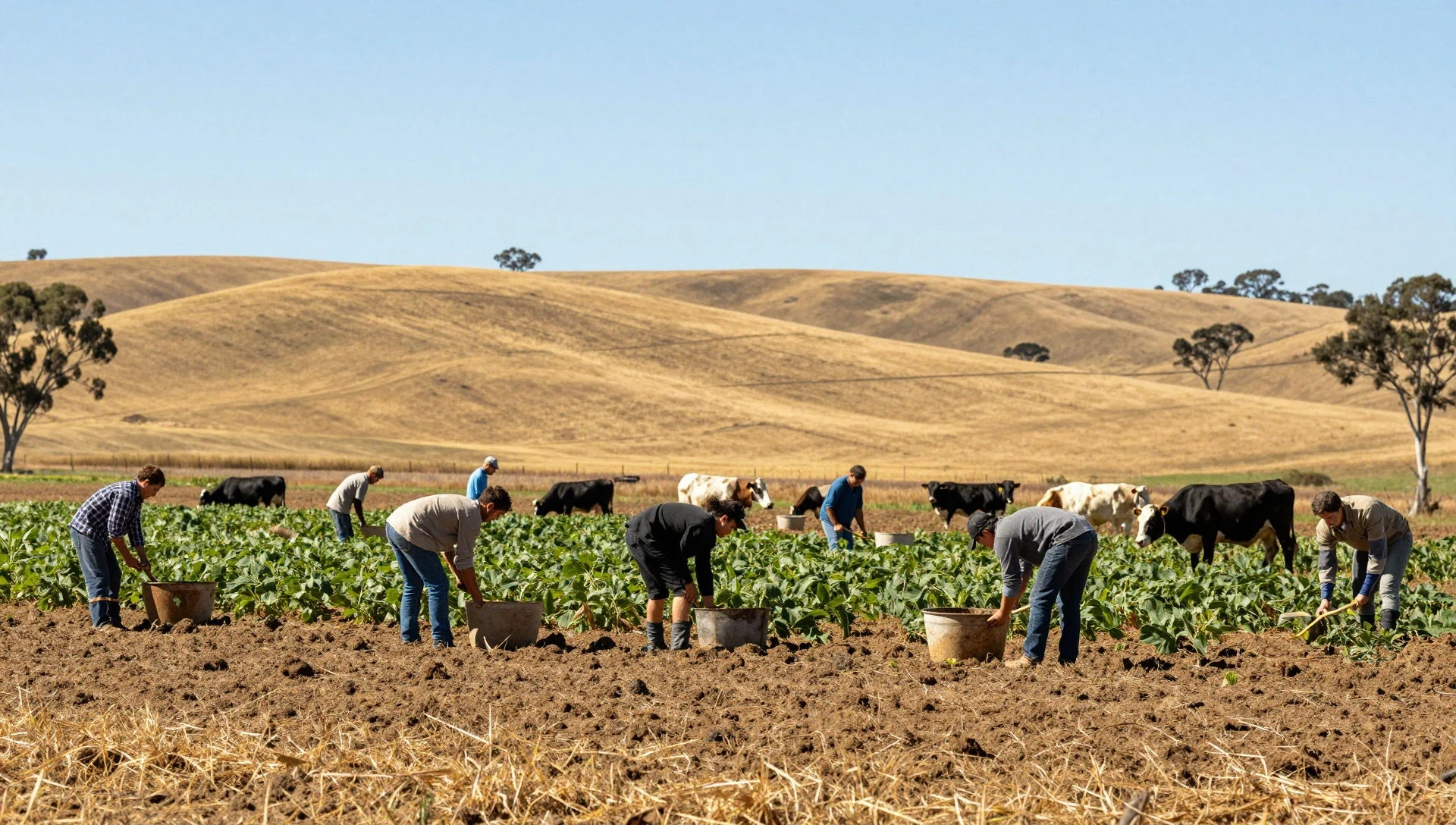
Manjimup, a timber and farming town roughly 290 kilometres south of Perth, has become an unlikely flashpoint in Australia's national migration debate. The federal government is pressing ahead with restrictions on the working holiday visa program, including a ballot system governing second and third-year extensions, and the town's hospitality and agricultural operators say the policy threatens their operating model outright.
The dispute is not abstract: it pits a labour-shortage reality in regional Western Australia against a federal department's stated goal of long-term program sustainability.
The numbers in Manjimup are stark. Publican Paul Fowler reports that more than 70 per cent of his staff are backpackers, predominantly from Italy, and that he employs between 50 and 80 of them annually across his venues.
On This Page
He had already purchased a second pub in nearby Pemberton on the assumption that this workforce would remain available. That expansion, he says, is now at risk, which illustrates how visa settings transmit directly into regional capital investment decisions.
The human dimension complicates the policy arithmetic. Italian travellers Roberto Spadotto and Giulia Colombo met during farm work, extended their stays, and now manage one of Fowler's pubs after roughly four years in the region. Valerie Casto, another Italian, moved from a seedling nursery into chef work once her visa was extended.
Truffle farmer Gavin Booth reports that workers are already departing. These cases suggest the extension mechanism functions as a retention tool, not merely an entry gate.
TL;DR Australia's working holiday visa changes, including a ballot for second and third-year extensions, are drawing opposition from Manjimup businesses and backpackers in southern Western Australia. A local publican says over 70 per cent of his staff are backpackers; a truffle farmer says workers are already leaving. Western Australia's Premier has asked the federal Immigration Minister to reconsider, while Home Affairs frames the reduction as necessary for program sustainability.
The Policy Mechanics and the Regional Labour Dependency
The working holiday visa program has long functioned as a structural subsidy for regional Australia, supplying temporary labour to sectors that struggle to recruit domestically. The federal government's changes narrow that channel, and the August slowdown in visa processing signalled the direction before formal rules took effect.
Farming and regional communities criticised that slowdown promptly, indicating that the labour dependency is broad rather than confined to a single town or industry.
What the Ballot System Changes
A ballot replaces first-come processing with a randomised selection mechanism for extension applicants. In principle, this reduces queue gaming and speculative applications. In practice, it introduces uncertainty into a worker's planning horizon, because an extension is no longer a predictable reward for completed farm work but a lottery outcome. For employers, that uncertainty translates into unreliable staffing forecasts across harvest and tourist seasons.
The design logic assumes labour supply is elastic and that reduced numbers will be absorbed elsewhere. Manjimup's evidence challenges that assumption. When more than seven in ten pub staff are visa holders, there is no domestic reserve to draw upon at short notice.
The ballot therefore does not redistribute labour; it removes it from precisely the locations where the program was intended to direct it.
Extension conditions have historically tied second and third-year visas to specified work, including agricultural and regional roles. That linkage created a reciprocal bargain: hard, remote work in exchange for prolonged stay. A ballot weakens the reciprocity by decoupling effort from outcome.
Workers who complete the required months may still be excluded, which reduces the incentive to accept difficult placements in the first place.
Department of Home Affairs officials describe the reduction as a sustainability measure and commit to working with affected industries on labour needs. That framing treats volume as the problem. Regional operators treat reliability as the problem.
The two positions are not irreconcilable, but they measure different variables, and current policy resolves the tension in favour of the national aggregate rather than the local one.
The Economics of a Second Pub
Fowler's purchase of the Pemberton venue is the clearest financial signal in the dispute. Capital allocation followed a labour assumption, and the policy change invalidated that assumption after the commitment was made.
Regional hospitality operates on thin margins, so a staffing shortfall of this magnitude is not a scheduling inconvenience but a solvency question for individual operators.
Pemberton sits in the same southern agricultural belt and shares Manjimup's reliance on seasonal labour. A single owner absorbing two venues with a combined requirement of dozens of temporary workers illustrates how concentrated the exposure is.
When the visa pipeline narrows, the shock is not distributed evenly across the economy; it lands on a small number of employers with no substitute workforce.
Tourism and agriculture reinforce each other in this corridor. Backpackers pick avocados, broccoli and seedlings, then move into pubs, kitchens and cellar doors. That internal labour mobility is what allows a small town to staff both harvest and hospitality simultaneously.
Restricting extensions interrupts the sequence at its midpoint, leaving harvest roles filled but service roles vacant, or vice versa.
The truffle sector adds a premium-product dimension. Truffles are time-critical and skill-sensitive, and Booth's report that workers are already leaving suggests the adjustment is occurring before the formal rules bite.
Anticipatory departure is a well-documented response to visa uncertainty, and it means the policy's practical effect may precede its legislative effect by months.
Political Pressure and Departmental Response
Western Australia's Premier, Roger Cook, has asked federal Immigration Minister Tony Burke to reconsider the restrictions, placing a state government directly against a federal migration decision. This is a familiar federal-state friction pattern: labour demand is regional and immediate, while visa settings are national and strategic.
The request signals that the state government views the labour shortage as an economic risk rather than a political talking point.
Home Affairs maintains that the reduction supports the program's long-term sustainability and pledges cooperation with affected industries. That commitment is procedural rather than substantive; it does not restore numbers.
The gap between "working with industries to meet labour needs" and the actual removal of a ballot-constrained extension pathway is where the dispute currently sits, unresolved.
Farming bodies and regional communities criticised the August processing slowdown well before the ballot details were confirmed. Their objection was consistent: the program is not discretionary labour but baseline infrastructure for regional production.
Once that framing is accepted, any reduction becomes a supply shock rather than a policy adjustment, and the political cost concentrates in marginal electorates dependent on agriculture and tourism.
The federal government's position implies that the program grew beyond sustainable levels and that dependency itself is the problem to be corrected. That is a defensible long-run argument. It is also an argument that requires a transition mechanism, and none has been described publicly. Without one, the adjustment is borne entirely by employers and workers in the interim.
The Worker Perspective and the Retention Argument
Backpackers in Manjimup argue that the changes ignore the value created after the first year, when workers move from raw harvest labour into supervisory and skilled roles. Spadotto and Colombo now manage a pub; Casto moved from a nursery to a kitchen.
Each transition represents training investment that the employer recovers only if the worker stays, which the ballot makes less likely.
From Farm Work to Management
The trajectory from visa-motivated farm work to paid management is common in regional hospitality, where labour scarcity accelerates promotion. A worker who arrives to pick avocados can be running a venue within four years. That progression benefits the employer, the town and the worker simultaneously. Restricting extensions truncates it at the point where returns begin to accrue.
Spadotto's account also demonstrates the social embedding that occurs. He met his partner during farm work and the couple now hope to settle permanently in Australia. Settlement intentions are precisely what regional communities say they need.
A policy that reduces extensions may therefore reduce the pool of future residents, not merely the pool of temporary workers, which is a longer-term demographic cost.
Casto's observation that extensions encourage backpackers to accept hard jobs is the retention argument in its simplest form. The extension is the payment for unpleasant, remote work. Remove or randomise the payment and the willingness to accept the work declines.
Her report that friends are now discouraged from coming to Australia is anecdotal but directionally consistent with standard incentive logic.
These accounts also reveal a mismatch in how the program is evaluated. Officials count visa grants; towns count people who stay, skill up and integrate. The two metrics diverge sharply after year one.
A policy optimised for the first metric can degrade the second without any visible change in headline numbers, which is why local opposition has been so immediate.
Why Extensions Function as Incentives
An extension is a conditional benefit, and conditional benefits shape behaviour. When the condition is months of specified regional work, the benefit reliably produces that work. When the condition becomes a ballot, the benefit produces applications rather than labour.
The behavioural shift is subtle but consequential for industries that depend on willingness to accept isolated, physically demanding placements.
Economically, the extension operates as a deferred wage. Workers accept lower immediate utility, in the form of hard farm work far from cities, in exchange for additional time in the country. Randomising the payout reduces the expected value of that bargain.
Some workers will still accept it; marginal workers will not, and marginal workers are precisely those who fill the least attractive roles.
The retention effect compounds over time. A worker in year three has local knowledge, employer trust and often a partner or community ties. Replacing that worker with a fresh arrival imposes recruitment, training and supervision costs that regional businesses already report as burdensome. The ballot reduces the stock of experienced workers while leaving the inflow of inexperienced ones largely intact.
There is also a signalling dimension. Policy changes communicate what a country values. Casto's report that friends are discouraged suggests the signal is being received as unwelcoming. Destination competition among working holiday schemes is real, and Australia's alternatives include Canada and New Zealand, both of which actively court the same demographic with clearer pathways.
Anticipatory Departure and Labour Market Adjustment
Booth's statement that backpacker workers are already leaving is the most operationally significant claim in the dispute. Labour markets adjust on expectations, not announcements. If workers anticipate that extensions will become uncertain, rational behaviour is to leave before committing further months to qualifying work. The policy's effect therefore arrives early.
For truffle production, timing is unforgiving. Harvest windows are short and the product is high-value, so a labour shortfall in a single season is not recoverable later. A sector that has built its reputation on consistent quality cannot absorb unpredictable staffing.
The same logic applies to avocado and broccoli harvests, where ripeness dictates the schedule rather than the employer.
Anticipatory departure also distorts the data that policymakers will later use to evaluate the change. If workers leave before the rules take effect, measured visa numbers fall for reasons unrelated to the ballot, and the apparent success of the restriction becomes partly an artefact of expectation. Attribution will be difficult, and the risk of misreading the evidence is high.
The adjustment burden falls asymmetrically. Large agricultural firms can recruit through licensed labour-hire contractors and absorb higher costs. Small town pubs and family farms cannot. Manjimup's publican and Pemberton's truffle farmer are representative of the segment least able to substitute capital for labour or to relocate operations.
- 01
- 02
- 03
- 04
We Also Published
Policy Sustainability Versus Regional Viability
The core tension is between two legitimate objectives measured on different timescales. Home Affairs is optimising the program's integrity and long-run credibility; Manjimup is optimising this season's harvest and this year's payroll.
Neither is wrong, but the current policy design resolves the conflict without compensation, transition support or a regional carve-out, which is why opposition has been so unified.
What a Transition Mechanism Would Require
A workable transition would need to phase the reduction, protect designated regional occupations, and give employers advance certainty for at least one full season. None of these elements has been publicly specified.
The August processing slowdown, implemented before the ballot rules were finalised, did the opposite by removing certainty first and explaining later.
Designated regional pathways already exist in comparable schemes, including Canada's provincial nominee arrangements, which tie temporary labour to specific areas. Australia's own extension conditions were a version of this logic.
Replacing a targeted mechanism with a national ballot removes the geographic steering that made the program useful to places like Manjimup in the first place.
Consultation with affected industries is promised but not structured. A formal regional impact assessment, published before implementation, would allow employers to adjust capital plans and hiring timelines. Without it, businesses discover the effect through unfilled shifts, which is the least efficient and most costly form of policy feedback.
Data transparency matters as well. If the department published regional visa grant and departure figures by postcode, the debate could proceed on evidence rather than anecdote. At present, the strongest numbers in circulation come from a publican's staffing records, which is an indictment of the available official granularity.
Reading the Manjimup Case More Broadly
Manjimup is a small sample, but small samples reveal mechanisms clearly. The town shows that working holiday visas are not a marginal supplement to regional labour markets; in some venues they are the labour market.
Any national policy that reduces the flow must account for that concentration or accept the resulting closures and consolidation.
The case also illustrates how migration policy interacts with capital investment. Fowler's second pub was financed on a labour assumption that the federal government has now altered. Multiply that decision across thousands of regional operators and the aggregate effect on regional business confidence becomes material, even if individual sums are modest.
Finally, the dispute exposes a measurement problem at the heart of the program. Sustainability is defined nationally, viability is experienced locally, and no shared metric reconciles them. Until one exists, each side will continue to cite accurate figures that support opposite conclusions, and towns like Manjimup will keep making their case one pub at a time.
From our network :
- Live Online English Classes for Kids: Do They Actually Reduce Anxiety?A ten-week study reveals that synchronous online English classes can significantly reduce child language anxiety while improving listening and reading skills. Discover what makes these programs effective and how parents can select the right one.
- Committed Mediterranean Precipitation Decline: Why Emissions Cuts Alone Cannot Restore Winter RainsNew NOAA research reveals that Mediterranean winter rains may decline irreversibly even with emissions cuts. Explore the science of committed climate change and regional impacts.
- Forbidden Matrix Patterns and Visible Lattice Points: A Geometric DictionaryExplore how multidimensional 0–1 matrices encode geometric truths, linking forbidden patterns to visible lattice points and hypergraph theory, with applications in combinatorics and computational geometry.
- The Hidden Cost of AI Convenience: Why Over-Permissioned Agents Are a Security Time BombDiscover why AI agents with excessive permissions create dangerous single points of failure, and learn how implementing least privilege principles can protect your organization from exploitation.
- University Language Proficiency Exams: Why Institutional Tests Demand Different Preparation Than IELTS and TOEFLDiscover why university-specific language proficiency examinations differ fundamentally from IELTS and TOEFL, and learn strategic preparation approaches for institutional assessment success.
- CISA’s Ten-Advisory Wave: Why Generic Patching Fails in OT and How to Build Product-Specific PlaybooksCISA released ten ICS advisories in one week, exposing critical infrastructure risks. Generic patching fails in OT. Learn to build product-specific remediation playbooks.
- Mobile Learning and VR in English: What Global Evidence Reveals About Effective Language TechnologyA systematic review across 14 countries reveals which language-learning technologies genuinely work. Mobile learning, AI, and VR show measurable benefits when pedagogically integrated. This evidence-based guide helps educators and learners select technology that delivers real return on investment.
- How AI Agents Will Change the Way We Manage Personal FinancesExplore how AI agents are transforming personal finance through automated budgeting, bill payment, and investment management, while examining the critical security protocols and governance frameworks required for safe deployment.
- The Final Descent: How ESA Retired the Legendary Cluster Constellation After 24 Years of Space Weather ScienceAfter 24 years mapping Earth’s magnetosphere, ESA’s Cluster mission concluded with a precisely controlled reentry over the South Pacific. This analysis explores the scientific legacy, engineering decisions, and debris mitigation principles behind one of space exploration’s most responsible retirements.
RESOURCES
- Skilled Employer Sponsored Regional (Provisional) visaimmi.homeaffairs.gov.auYou can live, work and study only in designated regional areas of Australia ... labour agreement with the Australian government in effect.
- Supporting strong and sustainable regions Discussion Paperhomeaffairs.gov.auJun 19, 2024 ... The expansion of the second Working Holiday visa initiative was in response to ongoing labour shortages that industries in regional…
- Nominating a position – Labour market testingimmi.homeaffairs.gov.auSep 21, 2026 ... Working in Australia · Employing or sponsoring ... Regional (Provisional) visa (subclass 494) Labour Agreement stream labour market testing.
- 'I want a visa, so I have to do farm work': how new visa rules will hit ...theconversation.comSep 21, 2026 ... Farmers and other industry groups have warned a new crackdown on backpacker visas will make it harder to fill jobs…
- working holiday visa politics and repurposing tourists as labourtandfonline.comMay 27, 2025 ... Intended as a cultural exchange scheme, the Australian program underwent several changes since the 2000s that gradually changed it into…
- Visa changes to support the reopening of Australia and our ...minister.homeaffairs.gov.auNov 25, 2021 ... ... workers in regional Australia,” Minister Hawke said. The Government will also extend visas for skilled regional (provisional visa) holders ...
- Full article: Precarious labour geographies of working holiday makerstandfonline.comFor 'Working Holiday' visa holders, 'specified work' needed to be completed in eligible areas of northern and regional Australia in plant and animal cultivation ...
- Supporting the agriculture workforce during COVID-19minister.homeaffairs.gov.auApr 4, 2020 ... The changes allow those within the Pacific Labour Scheme, Seasonal Worker Program and working holiday makers to continue to work…
- French backpacker Zoe has been waiting tables for months. By ...facebook.comSep 18, 2026 ... ✈️ AUSTRALIA SLOWS WORKING HOLIDAY VISA PROCESSING Australia ... regional employers often rely heavily on Working Holiday Maker labour.
- 3. Changes to the Working Holiday Maker Programaph.gov.auSupporting tourism and hospitality in rural and remote areas of Australia. 3.8. WHMs fill labour shortages in regional areas where the 'peaks and troughs…
- Western Australian jobs. We will always back Western ... - Facebookfacebook.com4 days ago ... Quite a number of WHV holders are coming for FIFO jobs rather than regional farms and hotels. This is not…
- Kimberley businesses fear working holiday visa changes will mean ...abc.net.auOct 1, 2026 ... Fewer incentives, fewer workers. Backpackers wanting to extend their visas for a second or third year must work in regional…
- Australia Introduces New Migration Reforms and Skilled Visa ...newlandchase.comOct 5, 2026 ... ... visitor and working holiday visas, together with compliance action against unlawful non-citizens. No eligibility changes were announced to ...
- Regional WA Faces Even More Workforce Concerns, Amid Working ...nationalswa.comAug 17, 2026 ... The Nationals WA has renewed concerns about the impact of Working Holiday Maker (WHM) visa changes on regional Western Australia…
- Tourism industry sounds alarm over 'crippling' working holiday visa ...travelweekly.com.auSep 22, 2026 ... Australia's tourism, accommodation and farming industries have warned that proposed changes to the Working Holiday Maker (WHM).
- 01
- 02
- 03
- 04
- 05
- 06
- 07
- 08
0 Comments