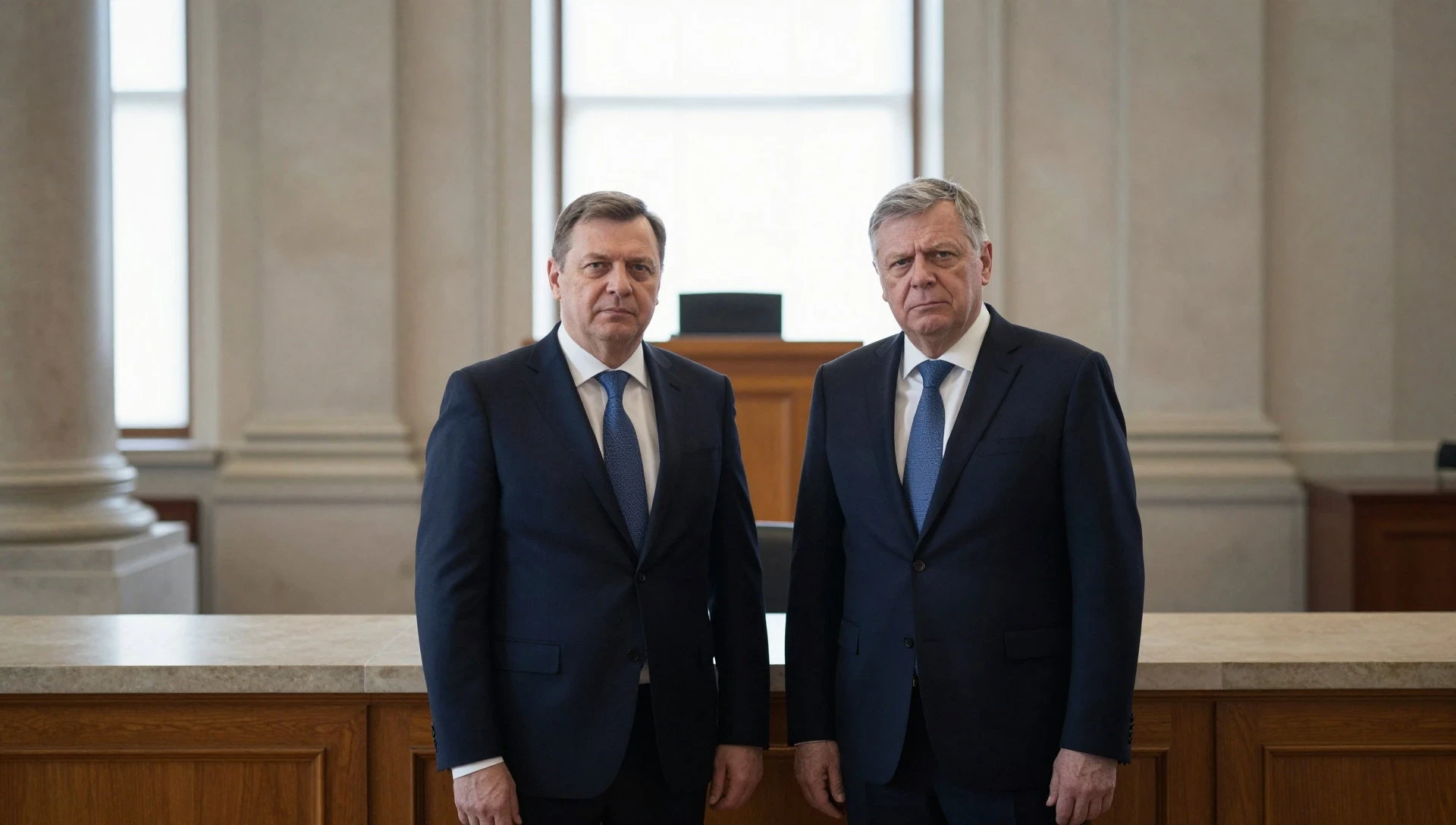
Poland's constitutional crisis has moved from procedural skirmish to open institutional confrontation, and the stakes now extend well beyond Warsaw. Prime Minister Donald Tusk's televised address on Saturday night confirmed that his centrist government will press ahead with a disputed reorganization of the Constitutional Tribunal, declaring that on certain questions "there can be no compromise."
Riot police were deployed to protect the court building as protests unfolded outside, a visible marker of how far the dispute has travelled from legal argument into physical standoff.
The underlying conflict is structural rather than personal. The Tribunal has been largely paralyzed for more than a decade, first by the collision between the right-wing Law and Justice (PiS) party and the European Union during its eight years in power, and now by the resistance of presidents aligned with the opposition who hold broad veto powers.
On This Page
President Karol Nawrocki's refusal earlier this year to swear in five judges approved by parliament converted a judicial dispute into a direct test of constitutional authority between elected institutions.
Friday's events sharpened that test. A group of judges backed by the government attempted to take procedural control of the court, suspending the PiS-appointed chief judge and deputy, which triggered street protests and prompted Tusk to criticize Nawrocki for joining them and forcing his way into the building.
The European Commission has urged the president to swear in the new judges, citing a May interim finding by the European Court of Human Rights, while Poland's Helsinki Foundation for Human Rights called the legal basis for the suspension "questionable."
TL;DR Poland's government under Donald Tusk is pressing ahead with a contested overhaul of the Constitutional Tribunal, arguing that a court shaped by Law and Justice lacks legitimacy after years of paralysis and adverse European rulings. The move has produced protests, riot police at the court building, and a direct clash with President Karol Nawrocki, who has refused to swear in judges approved by parliament. The European Commission wants the judges seated; domestic legal experts are divided on whether the government's procedural maneuver is lawful. The confrontation now frames next year's parliamentary election.
The Institutional Standoff: Power, Legitimacy, and the Polish Constitutional Tribunal
The Polish dispute is best understood as a collision between two competing theories of legitimacy. Tusk's government argues that a court captured through PiS-era appointments and subsequently rebuked by European courts cannot function as a neutral arbiter, and that restoring it requires decisive procedural action rather than negotiation.
The opposition and the presidency counter that only constitutionally prescribed appointments and sworn judges can confer authority, and that bypassing the president inverts the rule of law the government claims to defend.
The Mechanics of the Friday Procedural Move
The government-aligned judges who moved on Friday did not seize the courtroom by force; they used procedural instruments to suspend the PiS-appointed chief judge and deputy, effectively transferring control of the court's internal administration.
That distinction matters legally, because it determines whether the action is characterized as a lawful exercise of judicial self-governance or an irregular displacement of duly appointed leadership. The Helsinki Foundation's assessment that the legal basis was "questionable" signals that even sympathetic observers see risk in the method.
Timing amplified the effect. By acting on a Friday, the coalition forced the presidency and the opposition into a weekend of reactive politics, with protests forming before any court had ruled on the validity of the suspension.
Tusk's Saturday address then framed the sequence as defensive: a government restoring a weakened institution against actors who, in his metaphor, complain of being attacked after being caught. That framing is politically effective but legally inconclusive.
The suspension also created a practical vacuum. With the chief judge and deputy suspended and five parliamentary nominees still unsworn, the Tribunal's capacity to issue binding rulings is contested from multiple directions at once.
Any judgment it produces in this condition will be challenged by whichever side loses, extending the paralysis the overhaul was meant to end. Procedural victory, in other words, does not automatically produce institutional function.
Legal scholars remain split precisely because Polish constitutional text and practice do not resolve the question cleanly. The president's veto over judicial appointments is broad but not unlimited; parliamentary approval of judges is explicit but not self-executing.
When two constitutional organs claim authority over the same appointment, the resulting impasse has no obvious domestic arbiter, which is why European institutions have become participants rather than spectators.
Presidential Veto and the Limits of Parliamentary Appointment
Nawrocki's refusal to swear in the five judges is the pivot on which the entire crisis turns. Parliament approved the nominees; the president declined to formalize them; the government then sought to reconstitute the court's internal leadership without them.
Each step is defensible in isolation, but together they produce a court whose composition is disputed by at least one constitutional organ at every level, from the bench to the administration.
Tusk's criticism of the president was unusually direct for a head of government. He argued that in a democratic state no politician, not even the president, may enter a court to issue orders or intimidate judges, a statement that reframes Nawrocki's intervention as an assault on judicial independence rather than a defense of it. The president's supporters read the same act as constitutional guardianship against an unlawful takeover.
The structural problem is that Poland's constitutional design assumes cooperation between parliament and presidency on judicial appointments. When that assumption fails, no mechanism compels the president to act, and no mechanism prevents the government from reorganizing court administration in the meantime.
The result is a standoff that rewards procedural creativity over constitutional settlement, and that neither side can easily exit without appearing to concede legitimacy.
Comparative experience is instructive but not decisive. Hungary's government reshaped its constitutional court through appointment majorities rather than procedural suspension; Israel's judicial overhaul proposals triggered mass mobilization before legislation advanced.
Poland's path is distinct because the executive and legislature are aligned against a presidency and a court leadership installed under a previous governing coalition, producing a three-way contest rather than a two-way one.
European Law as an External Constraint
The European dimension converts a domestic impasse into a compliance question. The Commission's spokesperson confirmed that Brussels is following events closely and that Polish authorities must ensure the court operates in accordance with the Polish constitution and relevant EU court rulings.
That formulation is deliberately symmetrical: it demands constitutional fidelity without endorsing either side's interpretation of what the constitution requires.
The May interim finding by the European Court of Human Rights adds a concrete obligation. It required Polish authorities not to hinder judges still awaiting swearing-in from taking up their duties, which places the presidency's refusal under direct external scrutiny.
The Commission's public call for Nawrocki to approve the new judges effectively aligns Brussels with the government's position on the appointment question, even as it avoids endorsing the suspension maneuver.
Tusk's invocation of Russian criticism is a political rather than legal argument, but it carries weight in a security environment shaped by the war in Ukraine. He noted that Dmitry Medvedev, Russia's former president, had condemned the changes as a "constitutional coup" and accused Warsaw of "hounding the conservatives," and argued it was no coincidence that actors seeking to undermine democracy find support among pro-Russian forces globally. The claim is unverifiable as causation but potent as framing.
For investors and EU partners, the practical question is whether Poland's judicial machinery can issue reliable rulings during the dispute. Funds tied to rule-of-law conditionality and cross-border enforcement depend on courts whose authority is recognized.
A prolonged paralysis therefore carries economic as well as political costs, though neither side has an incentive to quantify them publicly while electoral positioning dominates.
Electoral Arithmetic and the Politics of Judicial Reform
The confrontation is inseparable from next year's parliamentary election, with polls indicating a close race between Tusk's broad coalition and the nationalist right. Judicial reform functions as a turnout instrument for both camps: the government mobilizes voters who see the court as a remnant of PiS-era capture, while the opposition mobilizes those who see the overhaul as executive overreach dressed in legal language. Neither coalition has an incentive to de-escalate before ballots are counted.
Polling, Coalitions, and the Close Race
A close race changes the calculus of every procedural decision. When margins are thin, a government gains more from demonstrating resolve to its base than from conceding ground to secure institutional calm, and an opposition gains more from casting the government as lawless than from accepting a compromise that legitimizes the overhaul. The court becomes a symbol whose electoral value exceeds its judicial function.
Tusk's coalition spans parties with different appetites for confrontation, which constrains how far he can push without fracturing his own majority. The nationalist right, meanwhile, benefits from framing the dispute as a defense of constitutional order against a government that treats legal procedure as an obstacle.
Both dynamics push toward escalation rather than settlement, even as public opinion on the underlying merits remains genuinely divided.
The presidency's role in the campaign adds a further variable. Nawrocki's intervention at the court building was widely read as a political statement as much as a constitutional one, and it positions him as the principal defender of the existing judicial order.
Whether that posture helps or hurts depends on whether voters prioritize institutional stability or institutional reform, a question polls have not resolved consistently.
Historical precedent suggests that judicial crises rarely decide elections on their own, but they shape the terms on which coalitions form afterward. A government that wins narrowly after an aggressive court overhaul inherits a judiciary whose legitimacy is contested by roughly half the electorate, which constrains its legislative agenda regardless of its formal majority.
Legal Uncertainty and the Risk of Prolonged Paralysis
The most consequential variable is not who wins the election but whether the court can function before it. If the suspension holds and the five judges remain unsworn, the Tribunal will operate with a composition that at least one constitutional organ rejects, and its rulings will face enforcement challenges in Polish and European forums alike. Paralysis, in that scenario, becomes self-reinforcing.
If the suspension is reversed or the judges are sworn in, the government's procedural maneuver will be retroactively validated or rendered moot, and the court may recover a measure of operational capacity.
Neither outcome resolves the deeper question of how Poland's constitution allocates authority when parliament and presidency disagree, which is why legal scholars expect the dispute to recur regardless of the immediate result.
The Helsinki Foundation's warning that the suspension would not help restore the court captures the central paradox. A maneuver designed to end paralysis may instead deepen it, because institutional legitimacy depends on acceptance by losers as well as winners.
Courts that issue rulings only their supporters recognize cease to function as courts of final resort, whatever their formal powers.
For observers outside Poland, the case illustrates a broader pattern: judicial reform pursued through procedural instruments generates legal uncertainty precisely where certainty is most needed. The Polish experience will be cited in debates from Brussels to Washington as evidence that court overhauls, however justified in substance, carry institutional costs that outlast the governments that initiate them.
We Also Published
- 01
- 02
- 03
- 04
Comparative Context and the Wider Rule-of-Law Debate
Poland's crisis sits within a wider European argument about how democracies repair judiciaries damaged by predecessor governments. The available tools include fresh appointments, legislative restructuring, and procedural reorganization of court administration, each with different legitimacy profiles.
Poland has now used all three in sequence, and the results illustrate why the choice of instrument matters as much as the stated goal.
How Other Democracies Have Handled Court Overhauls
Hungary's government reshaped its constitutional court primarily through sustained appointment majorities, a slower method that produced a court aligned with the governing coalition without dramatic procedural confrontations. Critics argued the result undermined judicial independence; defenders noted that the method was formally lawful and electorally ratified. Poland's faster, more confrontational approach has generated higher visibility and higher resistance.
Israel's recent experience offers a different contrast. Proposals to alter judicial selection and override powers triggered sustained mass mobilization and significant economic warnings before legislation advanced, demonstrating that court overhauls can mobilize civil society as effectively as they mobilize party bases. Poland's protests are smaller in scale but occur within a similarly charged environment.
The United States provides a third model, in which judicial composition changes through ordinary appointment cycles and confirmation fights rather than structural reorganization. That model depends on stable constitutional rules and norms of restraint that Poland's current impasse suggests are absent. Comparative analysis therefore offers cautionary lessons rather than templates.
What unites these cases is the observation that court legitimacy is a function of procedure as much as outcome. A court staffed by judges appointed through contested procedures will face resistance regardless of the quality of its rulings, and a government that bypasses established procedures will face resistance regardless of the merits of its case. Poland is testing both propositions simultaneously.
What the Polish Case Signals for EU Enlargement and Conditionality
Poland's dispute carries implications beyond its borders because the EU has made judicial independence a condition of membership and of access to certain funds. A member state that cannot resolve a court crisis internally tests whether conditionality can operate as a credible external constraint when domestic institutions are deadlocked. Brussels has so far chosen persuasion over escalation.
The Commission's call for Nawrocki to approve the new judges is calibrated to avoid taking sides on the suspension while pressing for the outcome that would restore functionality. That approach preserves Brussels' role as arbiter but risks appearing to endorse whichever interpretation prevails.
For candidate countries watching the process, the lesson may be that EU pressure works best when domestic actors already agree on the destination.
Tusk's reference to pro-Russian support for the opposition's position introduces a security frame that complicates the conditionality debate. If judicial disputes become entangled with geopolitical alignment, external actors gain leverage over outcomes they cannot control. That risk argues for resolving the impasse through domestic constitutional processes rather than through external pressure alone.
The broader signal is that rule-of-law conditionality is most effective before a crisis crystallizes, when governments still face costs for non-compliance. Once institutions are paralyzed and electorally mobilized, external pressure becomes one input among many, and domestic political incentives dominate. Poland's experience may therefore inform how the EU sequences future judicial benchmarks.
Scenarios Ahead: Settlement, Escalation, or Sustained Deadlock
Three scenarios are plausible. In the first, the president swears in the five judges under European pressure, the suspension is reversed or allowed to lapse, and the court regains partial functionality before the election.
This outcome requires Nawrocki to absorb a political cost that his base would likely punish, making it the least probable of the three.
In the second, the suspension holds, the judges remain unsworn, and the court operates with contested composition through the election. Rulings issued in this period would face enforcement challenges, and the dispute would become a central campaign issue. This scenario preserves each side's position but imposes the highest institutional cost on the court itself.
In the third, the deadlock persists beyond the election, and the new parliament revisits the appointment question with a fresh mandate. This outcome defers resolution but may produce a more durable settlement if the electoral result is decisive.
The risk is that a close result reproduces the current impasse with new actors and diminished institutional trust.
Each scenario carries distinct implications for EU relations, investor confidence, and the court's capacity to serve as a final arbiter. The common thread is that no scenario restores the pre-crisis status quo, because the procedural moves of the past week have altered the baseline against which future legitimacy claims will be measured.
The Polish Constitutional Tribunal dispute is ultimately a case study in how procedural choices shape institutional legitimacy. Tusk's government has chosen speed and confrontation over consensus and patience, betting that a restored court is worth the resistance it generates.
The presidency and opposition have chosen procedural defense, betting that a court reconstituted without presidential assent cannot command acceptance. Both bets may prove correct in part, which is precisely why the deadlock is likely to persist.
What remains clear is that the court's paralysis, now exceeding a decade, has outlasted the governments that caused it and may outlast the government attempting to end it. European institutions can press for compliance and courts can issue interim measures, but neither can substitute for a domestic settlement between parliament and presidency.
Until that settlement arrives, Poland's constitutional order will remain contested at the precise point where finality is most needed.
From our network :
- The Final Descent: How ESA Retired the Legendary Cluster Constellation After 24 Years of Space Weather ScienceAfter 24 years mapping Earth’s magnetosphere, ESA’s Cluster mission concluded with a precisely controlled reentry over the South Pacific. This analysis explores the scientific legacy, engineering decisions, and debris mitigation principles behind one of space exploration’s most responsible retirements.
- The Hidden Cost of AI Convenience: Why Over-Permissioned Agents Are a Security Time BombDiscover why AI agents with excessive permissions create dangerous single points of failure, and learn how implementing least privilege principles can protect your organization from exploitation.
- Forbidden Matrix Patterns and Visible Lattice Points: A Geometric DictionaryExplore how multidimensional 0–1 matrices encode geometric truths, linking forbidden patterns to visible lattice points and hypergraph theory, with applications in combinatorics and computational geometry.
- Mobile Learning and VR in English: What Global Evidence Reveals About Effective Language TechnologyA systematic review across 14 countries reveals which language-learning technologies genuinely work. Mobile learning, AI, and VR show measurable benefits when pedagogically integrated. This evidence-based guide helps educators and learners select technology that delivers real return on investment.
- Live Online English Classes for Kids: Do They Actually Reduce Anxiety?A ten-week study reveals that synchronous online English classes can significantly reduce child language anxiety while improving listening and reading skills. Discover what makes these programs effective and how parents can select the right one.
- University Language Proficiency Exams: Why Institutional Tests Demand Different Preparation Than IELTS and TOEFLDiscover why university-specific language proficiency examinations differ fundamentally from IELTS and TOEFL, and learn strategic preparation approaches for institutional assessment success.
- How AI Agents Will Change the Way We Manage Personal FinancesExplore how AI agents are transforming personal finance through automated budgeting, bill payment, and investment management, while examining the critical security protocols and governance frameworks required for safe deployment.
- Committed Mediterranean Precipitation Decline: Why Emissions Cuts Alone Cannot Restore Winter RainsNew NOAA research reveals that Mediterranean winter rains may decline irreversibly even with emissions cuts. Explore the science of committed climate change and regional impacts.
- CISA’s Ten-Advisory Wave: Why Generic Patching Fails in OT and How to Build Product-Specific PlaybooksCISA released ten ICS advisories in one week, exposing critical infrastructure risks. Generic patching fails in OT. Learn to build product-specific remediation playbooks.
RESOURCES
- Tusk defends overhaul of Poland's constitutional court despite proteststheguardian.com1 day ago ... Earlier this year, president Karol Nawrocki refused to swear in five judges approved by parliament. The crisis flared again on…
- Poland's Rule-of-Law Repair: Trapped in Institutional Paralysis?gmfus.orgDec 5, 2025 ... Duda referred the three acts to the Constitutional Tribunal, which remains an illiberal enclave aligned with PiS, and in the…
- Donald Tusk vows to press on with overhaul of Poland's judiciaryft.com1 day ago ... However, Nawrocki has refused since March to sign five new judges elected to the constitutional court by parliament into office,…
- Fertile Ground for Illiberalism: Poland's New President and the ...illiberalism.orgAug 5, 2025 ... The Tusk government prepared a bill on civil partnerships that Nawrocki will likely veto. His predecessor, Duda, previously blocked a…
- Tusk addressed the nation as tensions over Poland's Constitutional ...facebook.com2 days ago ... Good luck for Karol Nawrocki! One of the best presidents from our side of Europe. Wished Romania was that lucky!…
- Tusk-Nawrocki battle escalates as chief judge is ousted ... - POLITICOpolitico.eu2 days ago ... Poland's constitutional court descended into turmoil Friday evening as judges barred from hearing cases moved to oust the institution's ...
- Polish Prime Minister Donald Tusk on Saturday pledged to ensure ...facebook.com1 day ago ... Polish Prime Minister Donald Tusk on Saturday pledged to ensure the country's Constitutional Tribunal operated in accordance with the law, ...
- Long-running spat between Poland's pro-Europe PM and pro-Trump ...cnn.com18 hours ago ... The crisis came to a head on Friday when center-left Prime Minister Donald Tusk moved to remake Poland's Constitutional Tribunal,…
- Poland's Constitutional Tribunal crisis mirrors rising political ...thetruestory.news19 hours ago ... Polish prime minister Donald Tusk has stood firm over his dramatic overhaul of the country's constitutional court and denounced his ...
- Tusk vows constitutional court reform after Nawrocki forces entry to ...x.com18 hours ago ... Donald Tusk vowed on 31 October to rebuild Poland's Constitutional Tribunal, hours after President Karol Nawrocki forced his way past…
- What Hungary Can Learn From Poland | DGAPdgap.orgApr 14, 2026 ... The Tusk government has used other workarounds. Recently, parliament elected six new judges to the Constitutional Tribunal, but Nawrocki, in ...
- Tusk and Nawrocki fight over the umpire [ANALYSIS] - TVP Worldtvpworld.comOct 15, 2026 ... The role of the president to receive the oath appears in ordinary legislation, not in the Constitution. Poland's own Constitutional…
- Polish PM vows return to 'rule of law' following protests at courtcourthousenews.com... Constitutional Tribunal in Warsaw, media reported. Efforts to swear in new judges, amid attempts by Tusk's government to overhaul a judicial appointment ...
- Who do you think is right in the Constitutional Tribunal crisis - Redditreddit.com2 days ago ... Who do you think is right in the Constitutional Tribunal crisis: Tusk's government, President Nawrocki? An IBRiS poll shows that…
- Democracy After Illiberalism: A Warning from Polandjournalofdemocracy.orgTusk again became prime minister, and his government pledged to repair Poland's ... Alicja Ptak, “Polish Constitutional Court Has Lost Ability to ...
- 01
- 02
- 03
- 04
- 05
- 06
- 07
- 08
0 Comments