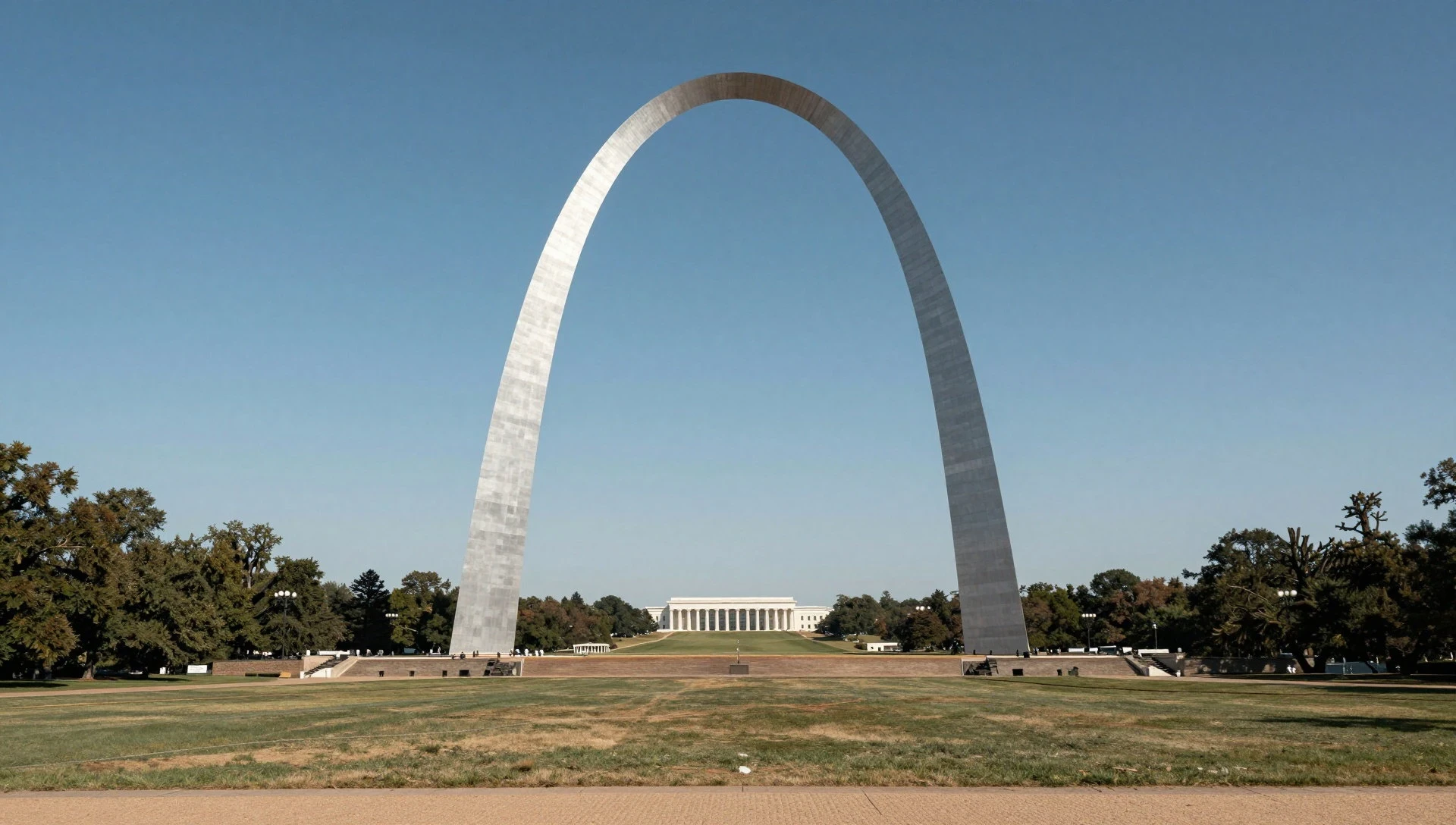
Virginia and the District of Columbia filed suit on Saturday, October 31, 2026, to halt construction of a 250-foot commemorative arch that President Trump intends to begin building as early as the following week. The complaint, lodged by Virginia Attorney General Jay Jones and Washington Attorney General Brian L.
Schwalb, characterizes the project as "flagrantly unlawful" and asks the court to intervene before ground is broken. The dispute is not merely aesthetic; it tests whether a president may erect a monument on federal land in the capital without the congressional authorization that federal law prescribes.
The legal architecture of the challenge rests on five distinct statutes, each imposing a separate procedural or substantive obligation on the executive branch. The Commemorative Works Act requires explicit congressional approval before any monument is placed on federal land in Washington.
On This Page
The Administrative Procedure Act supplies the vehicle for reviewing agency action, while the National Environmental Policy Act and the National Historic Preservation Act demand consultation and consideration of alternatives.
The Height of Buildings Act, which generally caps structures in the capital at 130 feet, supplies the sharpest numerical conflict: the proposed arch would stand roughly 120 feet above that ceiling.
The symbolic stakes compound the legal ones. The proposed site would obstruct the view of Arlington National Cemetery from the Lincoln Memorial, a sightline that carries considerable commemorative weight. President Trump has described the arch as being for himself, while senior administration officials separately assert a national security rationale.
That dual justification—personal tribute and security necessity—invites scrutiny of both the project's purpose and the process by which it advanced. The litigation is one of several challenges to the arch's legality, suggesting a coordinated legal front rather than an isolated objection.
TL;DR Virginia and the District of Columbia have sued the Trump administration to stop a planned 250-foot arch in Washington, arguing the project violates the Commemorative Works Act, the Height of Buildings Act, and three environmental and preservation statutes. The suit, filed by Attorneys General Jay Jones and Brian L. Schwalb, seeks judicial review before construction begins. The arch would exceed the capital's 130-foot height limit by roughly 120 feet and would block the view of Arlington National Cemetery from the Lincoln Memorial. The case tests executive authority over federal commemorative land and joins several parallel legal challenges.
The Legal Architecture of the Challenge
The complaint is best understood as a layered statutory attack rather than a single claim. Each statute supplies an independent basis for relief, which means the administration must prevail on every front to proceed.
That structure raises the probability that at least one claim survives preliminary review, and it explains why the plaintiffs emphasize urgency: once construction begins, judicial remedies become materially harder to fashion.
Congressional Authorization Under the Commemorative Works Act
The Commemorative Works Act establishes a gatekeeping function for Congress over monuments on federal land in the District. Its requirement of specific congressional approval is not a formality; it allocates decision-making authority away from the executive.
The plaintiffs contend the administration bypassed this gate entirely, treating congressional silence as permission rather than as a precondition unmet.
This claim carries doctrinal weight because the statute's text is mandatory rather than advisory. Courts generally enforce clear procedural mandates against agencies, particularly where the mandate protects a coordinate branch's prerogative.
If the arch lacks an authorizing statute, the project's legal foundation collapses regardless of how the other claims resolve, making this the central issue in the case.
The administration's likely defense is that existing authorities or prior approvals suffice. That argument must contend with the statute's specificity, which contemplates a discrete legislative act for each commemorative work.
General appropriations or executive site-management authority rarely satisfy such particularized requirements, and courts have been reluctant to infer congressional consent from ambiguous signals.
Timing magnifies the stakes. The plaintiffs allege the administration is racing to build before courts can review the project, a characterization that, if credited, supports preliminary injunctive relief. Federal courts weigh irreparable harm heavily at that stage, and demolition of a completed structure is far costlier than a pause before construction begins.
Procedural Statutes: APA, NEPA, and NHPA
The Administrative Procedure Act supplies the procedural chassis for the environmental and preservation claims. It permits courts to set aside agency action found arbitrary, capricious, or contrary to law.
The plaintiffs invoke it to challenge both the substance of the approvals and the process by which they were reached, framing the record as thin.
The National Environmental Policy Act requires agencies to prepare environmental analyses and to consider alternatives before committing to major federal actions. A 250-foot structure on prominent federal land plausibly triggers that obligation.
The complaint asserts only limited efforts were made, implying the administration either skipped required analysis or produced documentation too cursory to withstand review.
The National Historic Preservation Act adds a consultation dimension, requiring agencies to account for effects on historic properties and to involve relevant parties. The Lincoln Memorial and Arlington National Cemetery sit within a landscape of exceptional historic sensitivity.
Failure to consult, or consultation conducted after decisions were effectively made, is a recurring ground for judicial reversal.
These claims are procedural rather than absolute; an agency can often cure deficiencies by redoing its analysis. That remedial possibility cuts both ways. It weakens the case for permanent relief but strengthens the case for a temporary pause, since allowing construction to proceed would moot the very consultation the statutes require.
The Height of Buildings Act Conflict
The Height of Buildings Act supplies the most quantifiable defect in the project. Enacted in 1910, the statute generally limits structures in the capital to 130 feet, with narrow exceptions. A 250-foot arch exceeds that ceiling by 120 feet, a margin that leaves little room for interpretive accommodation absent a specific exemption.
The arithmetic is straightforward. The proposed structure stands at roughly 1.92 times the statutory maximum, a ratio that makes any claim of compliance difficult to sustain. The plaintiffs need not prove aesthetic harm to prevail on this claim; they need only establish that the arch is a structure subject to the Act and that no exception applies.
Exceptions exist, but they are limited and typically require explicit authorization. The administration would need to identify a statutory carve-out covering commemorative arches on federal land, a showing the complaint implies has not been made. Absent such a carve-out, the height claim is among the strongest in the filing.
Height regulation in Washington reflects a deliberate planning philosophy: horizontal monumentality over vertical density. The 130-foot cap preserves the primacy of the Capitol and the Washington Monument in the skyline.
A 250-foot arch would alter that hierarchy, and the statute's purpose supports a reading that treats the limit as substantive rather than advisory.
We Also Published
Symbolism, Siting, and the Public Interest
Beyond statutory compliance, the dispute engages questions of commemorative purpose and public landscape. The arch's proposed location would interrupt a sightline of national significance, and its stated rationales—personal tribute and national security—sit uneasily together.
Courts reviewing agency action must weigh these considerations against the procedural record, and the public interest analysis at the injunction stage will draw on them.
The Arlington-Lincoln Sightline
The view from the Lincoln Memorial toward Arlington National Cemetery across the Potomac functions as a commemorative composition in its own right. It links the president who preserved the Union to the cemetery where many of its soldiers rest.
A 250-foot structure placed within that corridor would physically interrupt the relationship the landscape was designed to express.
Preservation advocates treat such sightlines as cultural resources, and the National Historic Preservation Act provides a framework for assessing effects on them. The complaint's emphasis on the blocked view is therefore not merely rhetorical; it supplies the factual predicate for a preservation claim. Visual impact, in this context, is a legally cognizable harm.
The siting decision also raises questions about consultation with the jurisdictions most affected. Virginia borders the Potomac and hosts Arlington National Cemetery, giving it a direct interest in the viewshed. The District controls much of the adjacent federal land. Both plaintiffs argue their interests were subordinated to a predetermined outcome.
Comparisons to prior monument controversies are instructive. Disputes over the World War II Memorial and the Martin Luther King Jr. Memorial both turned on siting and design review, and both were resolved through the statutory processes the current complaint alleges were bypassed. The precedent favors procedural regularity over executive speed.
Competing Justifications: Tribute and Security
The administration's dual rationale complicates its legal position. A monument framed as a personal tribute fits awkwardly within the Commemorative Works Act's framework, which contemplates commemorative rather than personal purposes. A national security justification, meanwhile, invites demands for evidence that the record may not contain.
Security claims are difficult to litigate because courts defer to executive assessments of threat. But deference is not abdication, and a security rationale asserted without documentation may fail the arbitrary-and-capricious standard. The complaint's framing suggests the plaintiffs view the security argument as post hoc rationalization rather than genuine motivation.
The tension between the two justifications is itself legally relevant. When an agency offers shifting or inconsistent explanations, courts treat that inconsistency as a signal of pretext. The plaintiffs can argue that the administration adopted whichever rationale served the moment, undermining the credibility of both and strengthening the case for review.
Public opinion data on monument projects is sparse, but the pattern from comparable controversies suggests that personal commemorations on federal land attract bipartisan skepticism. That political context does not decide the legal question, yet it shapes the environment in which courts assess irreparable harm and the balance of equities.
Litigation Risk and Institutional Consequences
The case sits within a broader pattern of litigation challenging executive action on federal land and commemorative policy. Its outcome will shape how future administrations approach monument siting, and it may clarify the boundary between executive initiative and congressional authorization.
The preliminary injunction decision, likely the first substantive ruling, will signal how courts weigh procedural mandates against asserted urgency.
Prospects for Preliminary Relief
Preliminary injunctions require a showing of likelihood of success, irreparable harm, balance of equities, and public interest. The height claim offers the cleanest likelihood-of-success argument because the numerical violation is undisputed. The authorization claim is stronger still if the record confirms no congressional act exists.
Irreparable harm favors the plaintiffs if construction would destroy the very landscape the statutes protect. Courts have recognized that harm to historic resources can be irreparable because demolition and reconstruction are imperfect remedies. The administration's stated plan to begin within days sharpens the urgency and supports a temporary pause.
The balance of equities turns partly on cost. Halting a project before construction is cheaper than halting it midway, and far cheaper than removing a completed structure. That asymmetry gives the court a practical reason to act early, reinforcing the plaintiffs' procedural argument that review must precede ground-breaking.
Even if the plaintiffs prevail at the injunction stage, the ultimate outcome may be procedural rather than terminal. Congress could authorize the arch, agencies could cure their analyses, and the project could proceed lawfully. The litigation's immediate effect is delay, but its durable effect may be a reaffirmation of statutory process.
Precedent and the Separation of Powers
The case implicates separation-of-powers principles that extend beyond this single project. When Congress conditions monument construction on its own approval, it reserves a decision to itself. Executive construction without that approval would effectively transfer the decision, a result courts are institutionally reluctant to endorse.
Precedent supports congressional control over federal commemorative land. The Commemorative Works Act emerged from concerns about ad hoc monument proliferation, and its requirements have been applied consistently. Courts have generally required compliance rather than treating the statute as a flexible guideline subject to executive discretion.
The broader pattern of litigation matters here. Multiple challenges to the arch's legality suggest coordinated strategy, and a ruling in one case may inform others. Coordinated litigation can produce inconsistent outcomes across courts, which in turn increases the likelihood of appellate resolution and doctrinal clarification.
Institutional consequences may outlast the arch itself. A ruling that the executive may proceed without congressional authorization would weaken the Commemorative Works Act across future administrations. A ruling requiring compliance would reaffirm the statute and reinforce the principle that process constrains even high-profile projects.
What the Case Signals for Federal Land Policy
The arch dispute is a specific controversy with general implications. It tests whether procedural statutes governing federal land retain force when a project carries presidential priority. The answer will inform how agencies approach environmental review, historic preservation, and congressional consultation across a wide range of future undertakings, not only monuments.
Administrative Procedure in High-Profile Projects
High-profile projects often generate pressure to compress procedural timelines. The arch case illustrates the risk: compression can shade into circumvention, and circumvention invites litigation that produces greater delay than compliance would have. The irony is structural, not incidental, and it recurs across infrastructure and commemorative contexts.
Agencies retain discretion over how to conduct analyses, but discretion has boundaries. Courts defer to methodological choices while insisting that required steps actually occur. The complaint's allegation of "limited efforts" targets the occurrence of steps, not their quality, which places the dispute on terrain where judicial review is most robust.
The record will be decisive. If the administration documented consultation and alternatives analysis, its position improves materially. If the record is thin or post hoc, the plaintiffs' case strengthens. Much of the litigation will therefore turn on documentary evidence rather than legal theory, a familiar pattern in administrative law.
Remedial flexibility matters as well. Courts can remand for further analysis without permanently blocking a project, and agencies can cure defects. That flexibility reduces the stakes of any single ruling while preserving the incentive to comply, a balance courts generally prefer to categorical outcomes.
Accountability and the Commemorative Process
Commemorative policy allocates honor, and allocation requires legitimacy. The statutory process supplies that legitimacy by requiring congressional assent and public input. Bypassing the process may produce a structure, but it cannot produce the broad consent that commemorative works are meant to embody, a distinction the plaintiffs emphasize.
The dual rationale—personal tribute and national security—raises accountability questions. Personal commemoration on federal land invites scrutiny of motive, while security claims resist transparency. Together they create a justification gap that courts may find difficult to reconcile with reasoned decision-making requirements.
Public trust in federal land management depends on visible adherence to rules. When high-profile projects appear to skip steps, the perception of favoritism erodes confidence in the agencies that administer public lands. The litigation is therefore about more than one arch; it concerns the credibility of the administrative state.
The eventual outcome will depend on facts not yet public: the documentary record, the scope of any congressional authorization, and the court's assessment of urgency. What is already clear is that the dispute has converted a symbolic project into a test of procedural governance, and the ruling will be cited long after the arch's fate is settled.
From our network :
- Forbidden Matrix Patterns and Visible Lattice Points: A Geometric DictionaryExplore how multidimensional 0–1 matrices encode geometric truths, linking forbidden patterns to visible lattice points and hypergraph theory, with applications in combinatorics and computational geometry.
- The Final Descent: How ESA Retired the Legendary Cluster Constellation After 24 Years of Space Weather ScienceAfter 24 years mapping Earth’s magnetosphere, ESA’s Cluster mission concluded with a precisely controlled reentry over the South Pacific. This analysis explores the scientific legacy, engineering decisions, and debris mitigation principles behind one of space exploration’s most responsible retirements.
- Committed Mediterranean Precipitation Decline: Why Emissions Cuts Alone Cannot Restore Winter RainsNew NOAA research reveals that Mediterranean winter rains may decline irreversibly even with emissions cuts. Explore the science of committed climate change and regional impacts.
- CISA’s Ten-Advisory Wave: Why Generic Patching Fails in OT and How to Build Product-Specific PlaybooksCISA released ten ICS advisories in one week, exposing critical infrastructure risks. Generic patching fails in OT. Learn to build product-specific remediation playbooks.
- Mobile Learning and VR in English: What Global Evidence Reveals About Effective Language TechnologyA systematic review across 14 countries reveals which language-learning technologies genuinely work. Mobile learning, AI, and VR show measurable benefits when pedagogically integrated. This evidence-based guide helps educators and learners select technology that delivers real return on investment.
- The Hidden Cost of AI Convenience: Why Over-Permissioned Agents Are a Security Time BombDiscover why AI agents with excessive permissions create dangerous single points of failure, and learn how implementing least privilege principles can protect your organization from exploitation.
- University Language Proficiency Exams: Why Institutional Tests Demand Different Preparation Than IELTS and TOEFLDiscover why university-specific language proficiency examinations differ fundamentally from IELTS and TOEFL, and learn strategic preparation approaches for institutional assessment success.
- How AI Agents Will Change the Way We Manage Personal FinancesExplore how AI agents are transforming personal finance through automated budgeting, bill payment, and investment management, while examining the critical security protocols and governance frameworks required for safe deployment.
- Live Online English Classes for Kids: Do They Actually Reduce Anxiety?A ten-week study reveals that synchronous online English classes can significantly reduce child language anxiety while improving listening and reading skills. Discover what makes these programs effective and how parents can select the right one.
RESOURCES
- DC, Virginia file lawsuit to stop Trump's 250-foot Triumphal Archsanluisobispo.com2 days ago ... The District of Columbia and Virginia filed a federal lawsuit on Oct. 31 to stop President Donald Trump's planned building…
- Virginia and D.C. sue over Trump's arch, adding to legal challenges ...pbs.org2 days ago ... There are now three lawsuits calling for a halt to potential work on a monument that would rise 250 feet…
- D.C. and Virginia sue to block Trump's proposed triumphal archwashingtonpost.com1 day ago ... The lawsuit is the latest attempt to stop the 250-foot-tall arch, which Trump hopes to build near Arlington National Cemetery…
- Virginia and D.C. sue to block construction of Trump arch - NPRnpr.org1 day ago ... The lawsuit is the latest legal attempt to stop construction of the 250-foot tall arch whose plans were unveiled by…
- DC, Virginia sue Trump administration to block proposed 250-Foot ...wusa9.com1 day ago ... The lawsuit was filed in federal court on Saturday. Attorneys general for both jurisdictions argue the proposed 250-foot-tall arch would…
- Trump's Arch Faces New Legal Challenge From Virginia and D.C.nytimes.com2 days ago ... The District of Columbia and Virginia on Saturday sued the Trump administration to block construction of the president's planned 250-foot ...
- Arlington County Takes Legal Action to Stop Trump's 250-Foot-Tall ...democracyforward.orgOct 8, 2026 ... Memorial Circle Arch Unlawfully Bypassed Meaningful Environmental Review, Would Severely Impact Arlington County and its Residents.
- DC, Virginia sue to stop Trump's 250-foot Triumphal Arch - USA Todayusatoday.com2 days ago ... The District of Columbia and Virginia filed a federal lawsuit on Oct. 31 to stop President Donald Trump's planned building…
- D.C. and Virginia Join the Fight to Block Trump's Triumphal Arch ...time.com2 days ago ... ... Trump's proposed 250-foot triumphal arch. The Trump Administration ... lawsuit filed Virginia Attorney General Jay Jones and D.C. Attorney…
- D.C. and Virginia Sue Trump to Stop His 250-Foot Archlawcommentary.com1 day ago ... Washington, D.C., and Virginia sued President Donald Trump's administration Saturday, October 31, 2026, seeking an emergency court order to ...
- D.C., Virginia sue to block Trump's 250-foot arch - Facebookfacebook.com2 days ago ... ... sued to halt construction of President Trump's planned 250-foot ... Trump's memorial arch faces new lawsuit from Arlington County,…
- DC and Virginia sue to block Trump arch construction - POLITICOpolitico.com2 days ago ... Washington, D.C., and Virginia filed a lawsuit Saturday seeking to ... Construction on the 250-foot arch — which would tower…
- Trump's planned DC arch faces new lawsuit - Al Jazeeraaljazeera.comOct 9, 2026 ... Local authorities in Arlington, Virginia, have sued the United ... The 250-foot (76-metre) arch project could win approval as early…
- Trump Arch Lawsuit: DC, Virginia Sue to Block 250-Foot Monumentnewsweek.com2 days ago ... DC and Virginia sued to block Trump's proposed 250-foot triumphal arch near Arlington National Cemetery days before construction could ...
- D.C., Virginia sue to block Trump's 250-foot arch - Axiosaxios.com2 days ago ... The governments of Washington D.C. and Virginia asked a federal court to block construction of President Trump's planned "triumphal arch," ...
- 01
- 02
- 03
- 04
- 05
- 06
- 07
- 08
0 Comments