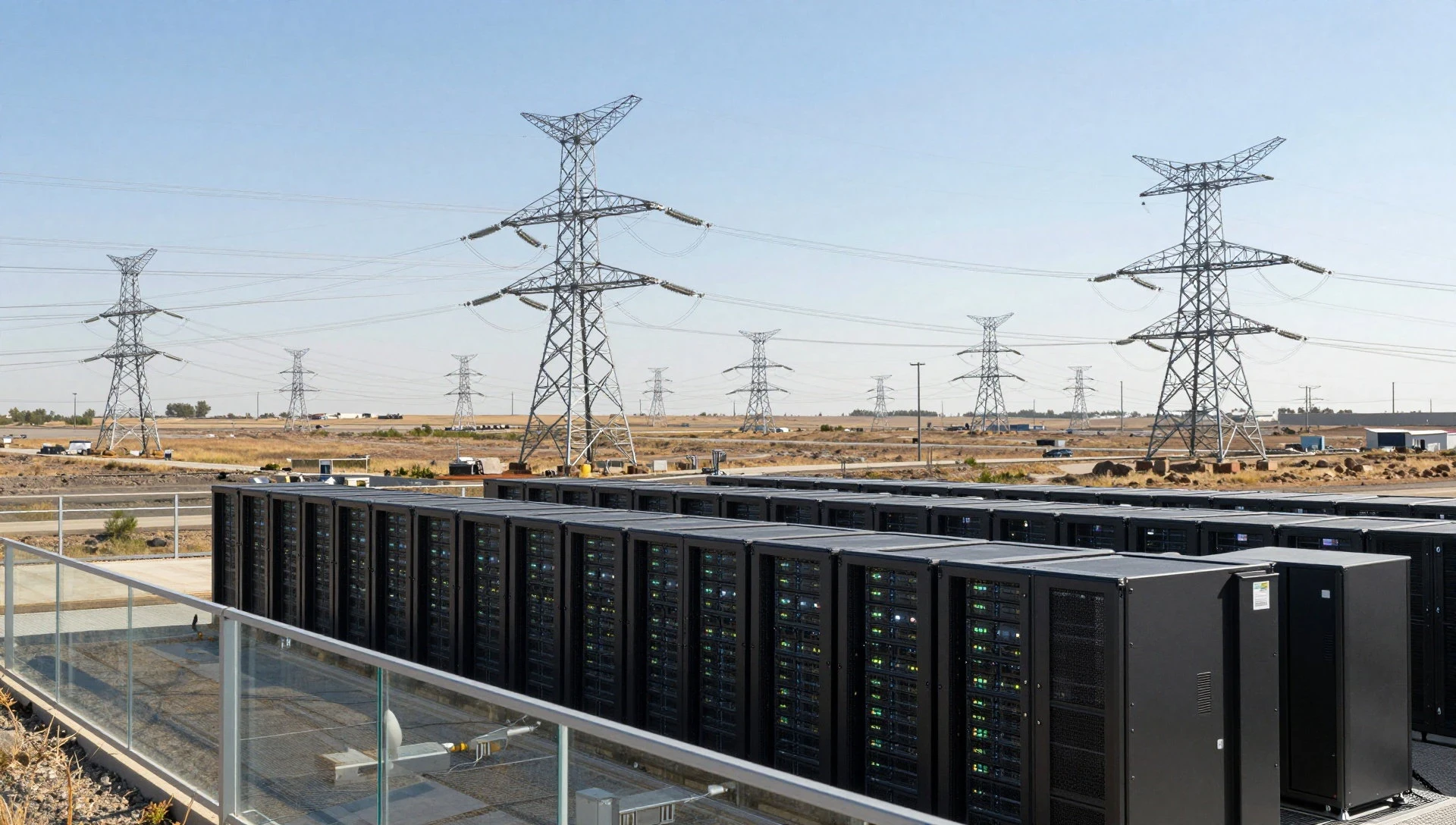
Electric utilities have entered the American midterm campaign as a first-order political subject, a status they have rarely held in modern federal elections. Two forces converge to produce that shift: household electricity bills that have climbed sharply since 2021, and the rapid build-out of hyperscale data centers serving artificial intelligence workloads.
Voters now connect the price printed on a monthly utility statement to decisions made by regulators, utilities, and the technology firms demanding ever more megawatts.
The political arithmetic is straightforward. Electricity is a non-discretionary purchase, so price increases transmit directly into household budgets and consumer sentiment, unlike abstract debates over grid reliability or wholesale market design.
On This Page
When residential rates rise faster than wages, incumbents absorb blame regardless of the underlying causes, which include fuel costs, transmission investment, and capacity auctions. Data centers amplify the grievance because residents can see the facilities and read about their power demand.
This analysis examines the mechanics behind the attention, the regulatory structures that determine who pays for grid expansion, and the electoral consequences for candidates in both parties. It separates documented cost drivers from campaign rhetoric, compares rate trends across states, and assesses whether utility policy can plausibly decide close races.
The central question is whether voter anger over power bills converts into durable policy change or dissipates after the ballots are counted.
TL;DR Rising residential electricity bills and the power demands of AI data centers have pushed utility regulation into US midterm politics. Voters blame incumbents for costs they cannot avoid, while utilities and technology firms argue that grid investment and new load are necessary for reliability and growth. The dispute turns on cost allocation: whether households subsidize industrial-scale computing or whether new load lowers average rates. Electoral attention is real but uneven, concentrated in states with steep rate increases and visible data center construction. Durable policy outcomes depend on state public utility commissions more than on federal campaigns.
Why Electricity Bills Became a Midterm Issue
Residential electricity prices rose at a pace not seen in decades, and the increase arrived alongside broader inflation in housing, food, and insurance. Because utility bills are recurring and unavoidable, they function as a highly visible inflation indicator that voters encounter every month.
Campaign strategists recognized that the bill is a concrete artifact voters can discuss at the kitchen table, unlike wholesale market rules or capacity accreditation formulas.
The Cost Drivers Behind Higher Bills
Several documented factors explain the increase. Natural gas prices spiked after 2021 and remain volatile, and gas-fired generation frequently sets the marginal clearing price in organized markets. Transmission and distribution investment has accelerated as utilities replace aging infrastructure and harden systems against extreme weather.
Wildfire mitigation spending in the West and storm recovery costs in the Southeast add substantial sums to rate bases that regulators allow utilities to recover.
Data center load enters this picture as a demand-side variable rather than a direct cost. A large facility can draw hundreds of megawatts continuously, comparable to a mid-sized city, and its arrival may require new substations, transmission upgrades, and generation capacity.
Whether those costs raise or lower average rates depends on the tariff structure and the timing of the load relative to existing capacity.
How Data Centers Change the Load Profile
Hyperscale computing differs from traditional industrial load in two respects: it is extraordinarily dense and it is remarkably flat. A facility may consume at near-constant levels around the clock, which improves utilization of baseload generation but strains local distribution equipment.
Utilities must size transformers and feeders for peak demand that arrives suddenly, often within eighteen to thirty-six months of a signed contract.
Grid operators have revised load forecasts upward in several regions, reversing a decade of flat or declining demand. That reversal changes planning assumptions fundamentally. Capacity auctions clear at higher prices when projected peak demand rises, and those prices flow into retail rates through default service provisions.
The result is that a data center built in one state can influence prices in a neighboring state within the same interconnection.
The Political Translation of a Utility Bill
Voters do not adjudicate capacity markets; they read a number on a statement and compare it with last year's figure. That simplification favors challengers, because incumbents are associated with the status quo regardless of party.
Utility regulation is largely a state function, yet federal candidates absorb blame because voters attribute rising costs to general governance rather than to public utility commissions.
Campaign messaging has adapted accordingly. Candidates in both parties promise rate relief, audit commissions, or renegotiate data center agreements, though the mechanisms available to a federal legislator are limited.
The gap between campaign promises and statutory authority is substantial, and it explains why utility anger may produce symbolic legislation rather than structural reform.
The Regulatory Architecture That Determines Who Pays
Cost allocation is the technical heart of the dispute, and it is decided in proceedings that attract little public attention. State public utility commissions approve rate cases, determine allowed returns on equity, and decide whether new investment enters the rate base. Federal regulators set transmission incentives and wholesale market rules. Municipal utilities and cooperatives operate under separate governance, often with elected boards.
Rate Design and the Subsidy Question
Whether households subsidize data centers depends on tariff structure. Under traditional volumetric rates, a large customer paying the same per-kilowatt-hour price as a residence contributes to fixed costs in proportion to consumption, which can be favorable to the utility.
Under special contracts, large loads often receive discounted rates justified by volume and by the argument that new load spreads fixed costs across more customers.
Critics argue that discounts shift fixed-cost recovery onto households, particularly when the utility must build capacity to serve a single customer. Defenders counter that without the load, utilities would build less and charge remaining customers more.
The dispute is empirical, and it turns on whether the new load arrives with adequate co-located generation or storage.
Commission Proceedings as the Real Battleground
Public utility commissions operate with limited media coverage and long procedural timelines, which insulates them from electoral pressure but also from accountability. A rate case may take nine to twelve months, and intervenors include industrial customers, consumer advocates, and environmental groups. Data center contracts are frequently filed as confidential attachments, reducing public scrutiny of the terms.
That opacity is itself a political liability. When residents cannot inspect the agreements that determine their bills, suspicion fills the vacuum. Several states have moved toward requiring disclosure of large-load contracts, and legislators have introduced bills mandating cost-benefit analysis before approval. These procedural reforms may prove more consequential than any campaign promise.
Federal Versus State Authority
Federal legislators cannot set retail rates, a limitation that constrains what midterm candidates can actually deliver. Congress influences the sector through tax credits, transmission permitting, and funding for grid resilience. The Federal Energy Regulatory Commission governs wholesale markets and transmission incentives, but its commissioners are appointed rather than elected.
This division creates a persistent mismatch between campaign rhetoric and governing capacity. A candidate promising lower bills has no direct instrument to achieve them. The realistic federal levers are permitting reform, which could accelerate transmission build-out, and tax policy, which affects the economics of generation investment. Neither produces immediate relief at the meter.
We Also Published
Electoral Consequences and the Limits of Utility Politics
Utility anger is a real but narrow electoral force. It concentrates in states with steep rate increases, visible data center construction, and competitive districts. Where rates have been stable, the issue barely registers.
The evidence from recent state races suggests that utility costs can swing close elections but rarely dominate a campaign agenda that includes inflation, immigration, and health care.
Where the Issue Bites Hardest
States with restructured markets and high capacity prices have experienced the sharpest residential increases, and those states often contain competitive congressional districts. Data center concentration in the Mid-Atlantic, the Southeast, and parts of the Midwest overlaps with battleground territory.
In those places, a candidate can point to a specific facility and a specific bill, which is potent political material.
Conversely, states with vertically integrated utilities and stable hydroelectric or nuclear generation have seen milder increases. There, utility policy remains a technical matter handled by commissions and rarely surfaces in federal campaigns. The geographic unevenness means national parties must calibrate messaging carefully to avoid alienating voters in low-cost regions.
What Voters Actually Reward
Survey evidence suggests voters reward visible action more than optimal policy. A commission that denies a rate increase generates political credit even if the denial is later reversed on appeal. A legislator who introduces a data center moratorium bill gains attention even if the bill cannot pass. The incentive structure favors symbolic gestures over the slow work of tariff reform.
That dynamic has a cost. Repeated interventions that suppress rates without addressing underlying cost drivers can weaken utility credit quality and defer necessary investment. Deferred maintenance eventually produces reliability failures, which are politically far more damaging than gradual rate increases. The prudent path is transparent cost allocation, not rate suppression.
- 01
- 02
- 03
- 04
Scenarios for the Post-Election Period
Three outcomes are plausible. In the first, attention fades after the election and commissions resume routine proceedings with modest reforms to large-load tariffs. In the second, sustained public pressure produces legislative mandates for contract disclosure and cost-benefit analysis, shifting the burden of proof onto utilities seeking special rates. In the third, federal permitting reform accelerates transmission, easing constraints but not retail bills.
The most likely outcome combines elements of all three. Disclosure requirements are politically cheap and broadly popular, so they are likely to spread. Transmission reform has bipartisan support tied to reliability and manufacturing.
Direct rate relief remains elusive because the underlying cost drivers are physical and financial, not merely political choices that a legislature can reverse.
Reading the Numbers Critically
Campaign claims about utility costs should be tested against commission filings rather than press releases. A useful check is the ratio of residential to industrial rates; a widening gap suggests cross-subsidy.
Another is the trajectory of the utility's authorized return on equity relative to its actual earned return, which reveals whether rates are adequate or suppressed.
Data center impact can be assessed through interconnection queue volumes and large-load tariff filings. Where a utility projects load growth exceeding five percent annually, infrastructure spending will follow, and rates will rise regardless of political rhetoric. Voters and analysts alike benefit from distinguishing between the cost of growth and the cost of mismanagement.
The broader lesson is that utility politics rewards transparency. When commissions publish large-load contracts and justify cost allocation explicitly, public anger has less room to grow. When proceedings remain opaque, suspicion substitutes for evidence, and campaigns fill the gap with claims that cannot be verified. The midterm attention is therefore a symptom of a governance gap as much as a cost problem.
For analysts, the useful takeaway is that electricity has become a measurable political variable. Rate increases, interconnection queues, and commission decisions can be tracked and compared across jurisdictions. That data offers a more reliable guide to electoral risk than any campaign advertisement, and it will remain relevant long after the ballots are counted.
From our network :
- Live Online English Classes for Kids: Do They Actually Reduce Anxiety?A ten-week study reveals that synchronous online English classes can significantly reduce child language anxiety while improving listening and reading skills. Discover what makes these programs effective and how parents can select the right one.
- Forbidden Matrix Patterns and Visible Lattice Points: A Geometric DictionaryExplore how multidimensional 0–1 matrices encode geometric truths, linking forbidden patterns to visible lattice points and hypergraph theory, with applications in combinatorics and computational geometry.
- The Hidden Cost of AI Convenience: Why Over-Permissioned Agents Are a Security Time BombDiscover why AI agents with excessive permissions create dangerous single points of failure, and learn how implementing least privilege principles can protect your organization from exploitation.
- CISA’s Ten-Advisory Wave: Why Generic Patching Fails in OT and How to Build Product-Specific PlaybooksCISA released ten ICS advisories in one week, exposing critical infrastructure risks. Generic patching fails in OT. Learn to build product-specific remediation playbooks.
- The Final Descent: How ESA Retired the Legendary Cluster Constellation After 24 Years of Space Weather ScienceAfter 24 years mapping Earth’s magnetosphere, ESA’s Cluster mission concluded with a precisely controlled reentry over the South Pacific. This analysis explores the scientific legacy, engineering decisions, and debris mitigation principles behind one of space exploration’s most responsible retirements.
- University Language Proficiency Exams: Why Institutional Tests Demand Different Preparation Than IELTS and TOEFLDiscover why university-specific language proficiency examinations differ fundamentally from IELTS and TOEFL, and learn strategic preparation approaches for institutional assessment success.
- Mobile Learning and VR in English: What Global Evidence Reveals About Effective Language TechnologyA systematic review across 14 countries reveals which language-learning technologies genuinely work. Mobile learning, AI, and VR show measurable benefits when pedagogically integrated. This evidence-based guide helps educators and learners select technology that delivers real return on investment.
- How AI Agents Will Change the Way We Manage Personal FinancesExplore how AI agents are transforming personal finance through automated budgeting, bill payment, and investment management, while examining the critical security protocols and governance frameworks required for safe deployment.
- Committed Mediterranean Precipitation Decline: Why Emissions Cuts Alone Cannot Restore Winter RainsNew NOAA research reveals that Mediterranean winter rains may decline irreversibly even with emissions cuts. Explore the science of committed climate change and regional impacts.
RESOURCES
- Resources will be updated soon.
- 01
- 02
- 03
- 04
- 05
- 06
- 07
- 08
0 Comments