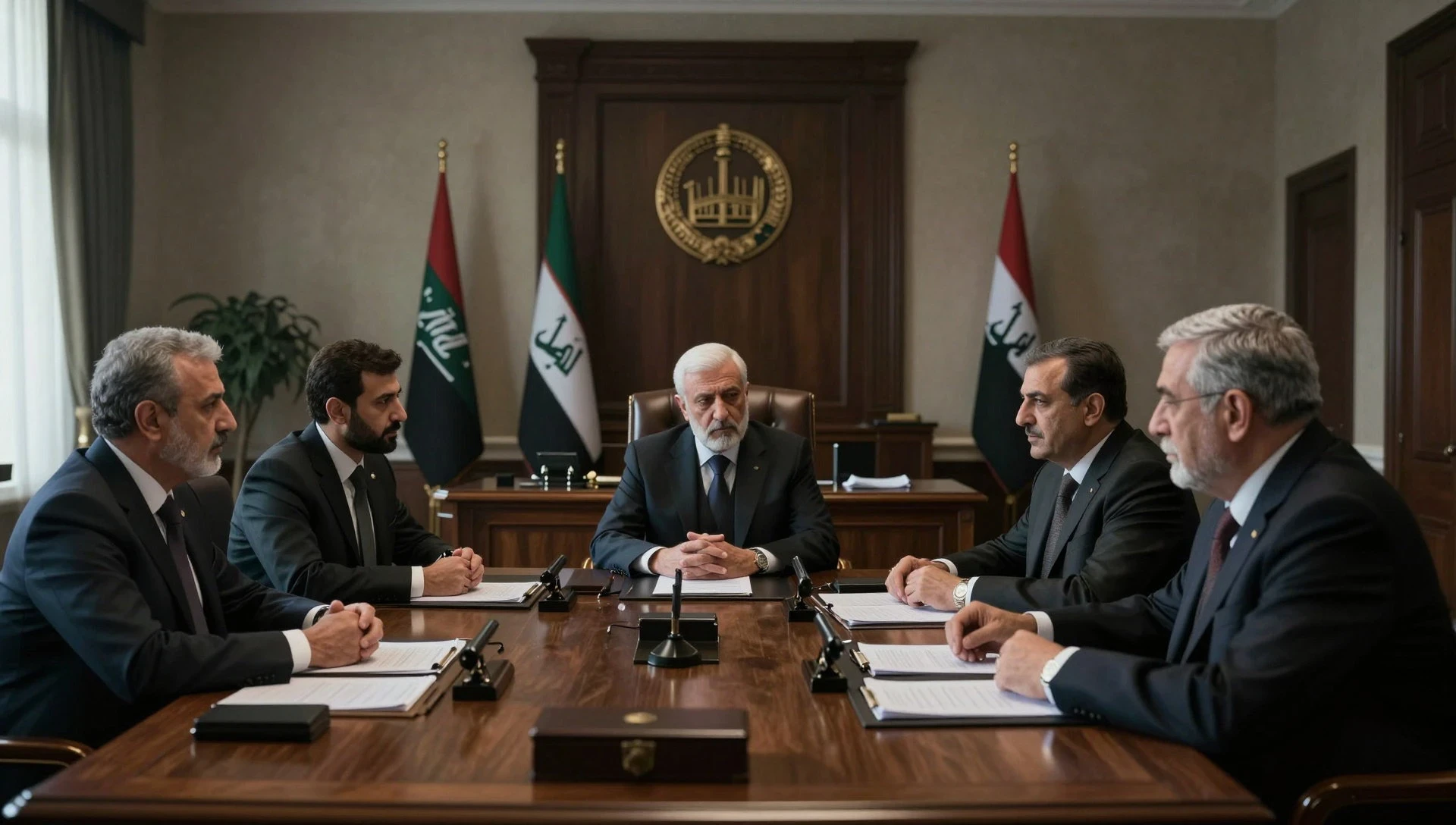
Iraq's intelligence apparatus has long functioned as a mirror of the country's confessional arithmetic, and the events of late October 2026 sharpened that reflection into something unusually stark. Prime Minister Ali Al-Zaidi dismissed agency chief Hamid Al-Shatri, appointed only in December 2024 by predecessor Mohammed Shia Al-Sudani, and then assumed direct command of the service himself three days later.
The government framed the dismissal as a step toward strengthening sovereignty and confronting unspecified regional challenges, but offered no timeline for the prime minister's tenure atop the agency and no detail on what those challenges entail.
The mechanics of the decision matter more than the rhetoric surrounding it. By holding the post personally rather than nominating a successor, Al-Zaidi removed the intelligence directorate from the power-sharing queue that unwritten factional agreements had reserved for a Sunni Arab appointee.
On This Page
Security sources cited by Asharq Al-Awsat indicated that no Sunni figure had yet been installed despite that designation, and that the prime minister's restructuring ambitions were colliding with efforts by rival blocs to capture the agency outright. The move thus reads less as a purge than as a temporary sequestration of a contested asset.
This analysis examines the institutional logic behind the takeover, the quota system that governs senior security appointments, and the regional pressures — including the March 2026 drone strike near the agency's Mansour headquarters — that make control of intelligence a live bargaining chip.
It weighs the prime minister's stated commitment to a service that "belongs to all Iraqis" against the durable reality of sectarian allotment, and it assesses what the episode reveals about how power is actually exercised in Baghdad two decades after 2003.
TL;DR Prime Minister Ali Al-Zaidi dismissed intelligence chief Hamid Al-Shatri and took direct control of the agency himself, suspending the factional quota expected to award the post to a Sunni Arab. The maneuver freezes a contested appointment rather than resolving it, shielding the next chief from political infighting while restructuring proceeds. It exposes the persistent gap between citizenship rhetoric and the arithmetic of sectarian power-sharing that has shaped Iraqi security institutions since 2003.
The Architecture of Sectarian Power-Sharing in Iraqi Security
Iraq's post-2003 order rests on an unwritten compact distributing the presidency, premiership, speakership, and senior security portfolios among Kurdish, Shi'ite, and Sunni Arab blocs. Intelligence has sat awkwardly within that framework: Shi'ite-affiliated officials have led the agency for most of the period since 2003, with the brief exception of former officer Mohammed Abdullah Al-Shahwani.
Sunni Arabs have instead held operational deputies, including the deputy director for operations — a post whose occupant faced sustained incitement campaigns from Iran-aligned factions.
The Quota System as Institutional Default
The designation of the intelligence directorate for Sunni Arabs under senior-post agreements is rarely written down, yet it functions with near-constitutional force in coalition negotiations. A Sunni politician speaking anonymously to Asharq Al-Awsat described the agency as belonging to the Sunni Arab share of senior posts, and argued that his community had repeatedly been shortchanged in sensitive security roles.
That gap, he said, exposes the distance between political rhetoric about citizenship and the actual exercise of power.
Quotas of this kind solve one problem and create another. They guarantee representation across confessional lines, which stabilizes coalition politics, but they also convert professional appointments into bargaining chips. Every vacancy becomes an occasion for renegotiation, and every nominee carries a factional sponsor.
The intelligence service, which requires continuity and discretion above all, is poorly suited to such treatment, yet it has absorbed the same logic as ministries and governorships.
Al-Shatri's tenure illustrates the pattern. Appointed in December 2024 by Al-Sudani, he served less than two years before dismissal, a duration consistent with the churn that afflicts quota-managed posts. The government's explanation — sovereignty and regional challenges — is generic enough to cover any number of factional calculations.
What it does not do is specify which challenges, which rivals, or which restructuring plans made his removal necessary at this particular moment.
Why the Vacancy Became a Flashpoint
Opening the directorship to nominations amid fierce factional competition risked producing deadlock, as the anonymous Sunni politician conceded. Multiple blocs could block one another indefinitely, leaving the agency leaderless during a period of elevated regional tension. Al-Zaidi's self-appointment sidesteps that paralysis by removing the post from the auction entirely, at least temporarily. The maneuver is procedural rather than ideological, and its logic is closer to escrow than to conquest.
Security sources told Asharq Al-Awsat that the prime minister's plans to restructure the security establishment were obstructing efforts by rival factions to seize the agency. That framing suggests the takeover is defensive: a holding action designed to preserve institutional coherence while broader reorganization proceeds.
Whether the prime minister can sustain that posture against blocs accustomed to extracting concessions is the open question, and the absence of any stated end date for his tenure keeps the uncertainty alive.
The Professional-Political Tension
Since 2003, Iraq's intelligence service has been caught in the same struggle between professional and political interests that has shaped the country's state institutions. Senior positions, including in security agencies, have frequently become bargaining chips in negotiations and rivalries among political factions.
The result is a service that must satisfy both operational requirements and confessional expectations, two sets of demands that rarely align and often directly conflict.
Al-Zaidi's stated ambition — an agency "belongs to all Iraqis," free from partisan, factional, and sectarian quotas — is a direct challenge to that equilibrium. It is also, on the evidence, easier to declare than to implement.
The quota system is embedded in coalition arithmetic, and any prime minister who bypasses it accumulates enemies among the blocs whose shares he has frozen. The takeover buys time; it does not settle the underlying distributional question.
We Also Published
Regional Pressure and the March 2026 Drone Strike
The timing of the dismissal cannot be separated from the security environment. In March 2026, a drone struck the area around the agency's headquarters in Baghdad's Mansour district, killing one officer and causing damage inside the compound.
Unofficial security reports blamed outlawed armed factions for the attack, linking it to regional tensions between Iran and the United States. An intelligence service under external fire is a service whose leadership becomes more, not less, politically sensitive.
Iran-Aligned Factions and the Deputy Director Post
The deputy director for operations post held by a Sunni official had already drawn incitement campaigns from Iran-aligned factions, according to the reporting. That pressure illustrates how operational roles become targets when they sit at the intersection of confessional identity and regional alignment.
A Sunni officer overseeing operations is exposed to accusations of disloyalty from factions aligned with Tehran, and the agency's internal cohesion suffers accordingly.
Al-Zaidi's decision may be aimed at protecting the agency's next chief from precisely this kind of infighting during heightened regional tensions, the security sources suggested. By occupying the director's chair himself, he absorbs the political exposure that would otherwise fall on a nominee.
The prime minister becomes a buffer, and the eventual appointee inherits a post whose partisan temperature has been temporarily lowered. Whether that insulation survives contact with factional pressure remains to be tested.
What the Drone Attack Signaled
The Mansour strike demonstrated that the agency's physical infrastructure is vulnerable to non-state actors operating within the capital. Blaming outlawed armed factions and linking the attack to Iran-United States tensions places the agency squarely inside a regional proxy contest it cannot fully control.
Under such conditions, leadership continuity acquires strategic value that outweighs the ordinary political cost of bypassing a quota.
That calculation helps explain why Al-Zaidi acted when he did. A prolonged succession fight in the wake of an attack on headquarters would signal institutional weakness to adversaries and allies alike. By taking command personally, the prime minister projects continuity and denies rivals a window of opportunity.
The cost is borne by the quota system, which absorbs a visible, if possibly temporary, suspension of its authority over the post.
Implications for Iraq's Political Equilibrium
The takeover carries consequences beyond the intelligence service itself. It tests whether a prime minister can override unwritten power-sharing conventions without triggering a coalition crisis, and it establishes a precedent that future premiers may invoke.
If Al-Zaidi sustains the arrangement without provoking retaliation, the episode weakens the quota system's claim to automatic application in security appointments. If he is forced to retreat, the system's resilience is confirmed once more.
The Sunni Share and the Credibility Gap
The anonymous Sunni politician's distinction between Al-Shatri's dismissal and Al-Zaidi's takeover is analytically important. He did not treat the prime minister's move as a sectarian affront, but as a mechanism for preventing the dispute over the post from becoming a factional contest.
Opening nominations amid fierce competition, he acknowledged, could have made agreement on a successor impossible. The takeover, on this reading, protects the Sunni share rather than expropriating it.
Yet the credibility gap he identified persists. Sunni Arabs have often been treated unfairly by the quota system, particularly in sensitive security positions, and their continued absence from such posts exposes the distance between rhetoric and reality.
A temporary prime ministerial occupation does not close that gap; it merely postpones the moment when the share must be honored or visibly denied. The eventual appointment will be the real test of intent.
Precedent and the Limits of Executive Override
Executive overrides of quota arrangements are not unprecedented in Iraqi politics, but they are usually brief and are typically followed by a negotiated restoration of the agreed allocation. Al-Zaidi's move fits that pattern: a temporary seizure that creates space for a settlement rather than a permanent reallocation of power.
The prime minister's rhetoric about an agency free of sectarian quotas points toward a more ambitious goal, but rhetoric and institutional change are different currencies.
The structural obstacles are considerable. Coalition partners who lose leverage over one post fear losing it over others, and they will price that risk into every subsequent negotiation. Restructuring the security establishment, which the sources describe as the prime minister's objective, requires cooperation from the very factions whose patronage networks such restructuring would disrupt.
The takeover may therefore be remembered less as a reform than as a tactical pause in an ongoing contest.
- 01
- 02
- 03
- 04
Reading the Episode Against Iraq's Longer Record
Two decades of post-2003 governance have produced a consistent pattern: institutions designed for professional function are repeatedly repurposed as instruments of confessional balance. The intelligence agency's trajectory — Shi'ite leadership for most of the period, Sunni operational deputies, a designated but unfilled Sunni directorship — is a compact expression of that pattern. Al-Zaidi's intervention interrupts the sequence without altering its underlying grammar.
The prime minister's language about an agency belonging to all Iraqis is therefore best read as an aspiration with political utility rather than a description of achieved reality. It justifies the takeover, appeals to reform-minded constituencies, and places the onus on factions to demonstrate that their commitments to citizenship exceed their appetite for shares.
Whether that appeal produces institutional change or merely rhetorical cover is the question on which the episode's significance ultimately rests.
Conclusion: A Holding Action, Not a Settlement
Ali Al-Zaidi's assumption of direct control over Iraq's intelligence agency is best understood as a holding action executed under regional duress. It removes a contested post from immediate factional auction, shields a future nominee from infighting, and buys time for a restructuring agenda whose contours remain undisclosed.
The government's sovereignty framing is broad enough to accommodate these purposes, and the absence of a stated end date preserves flexibility.
What the episode does not do is resolve the underlying distributional question. The Sunni share of senior security posts remains designated but unfilled, and the credibility gap between citizenship rhetoric and quota practice persists. The prime minister has demonstrated that executive override is available; he has not demonstrated that it is durable.
The eventual appointment of a permanent director, and the terms on which it is made, will determine whether October 2026 marks a genuine shift or another turn in a familiar cycle.
From our network :
- Mobile Learning and VR in English: What Global Evidence Reveals About Effective Language TechnologyA systematic review across 14 countries reveals which language-learning technologies genuinely work. Mobile learning, AI, and VR show measurable benefits when pedagogically integrated. This evidence-based guide helps educators and learners select technology that delivers real return on investment.
- The Final Descent: How ESA Retired the Legendary Cluster Constellation After 24 Years of Space Weather ScienceAfter 24 years mapping Earth’s magnetosphere, ESA’s Cluster mission concluded with a precisely controlled reentry over the South Pacific. This analysis explores the scientific legacy, engineering decisions, and debris mitigation principles behind one of space exploration’s most responsible retirements.
- Live Online English Classes for Kids: Do They Actually Reduce Anxiety?A ten-week study reveals that synchronous online English classes can significantly reduce child language anxiety while improving listening and reading skills. Discover what makes these programs effective and how parents can select the right one.
- Committed Mediterranean Precipitation Decline: Why Emissions Cuts Alone Cannot Restore Winter RainsNew NOAA research reveals that Mediterranean winter rains may decline irreversibly even with emissions cuts. Explore the science of committed climate change and regional impacts.
- CISA’s Ten-Advisory Wave: Why Generic Patching Fails in OT and How to Build Product-Specific PlaybooksCISA released ten ICS advisories in one week, exposing critical infrastructure risks. Generic patching fails in OT. Learn to build product-specific remediation playbooks.
- How AI Agents Will Change the Way We Manage Personal FinancesExplore how AI agents are transforming personal finance through automated budgeting, bill payment, and investment management, while examining the critical security protocols and governance frameworks required for safe deployment.
- The Hidden Cost of AI Convenience: Why Over-Permissioned Agents Are a Security Time BombDiscover why AI agents with excessive permissions create dangerous single points of failure, and learn how implementing least privilege principles can protect your organization from exploitation.
- Forbidden Matrix Patterns and Visible Lattice Points: A Geometric DictionaryExplore how multidimensional 0–1 matrices encode geometric truths, linking forbidden patterns to visible lattice points and hypergraph theory, with applications in combinatorics and computational geometry.
- University Language Proficiency Exams: Why Institutional Tests Demand Different Preparation Than IELTS and TOEFLDiscover why university-specific language proficiency examinations differ fundamentally from IELTS and TOEFL, and learn strategic preparation approaches for institutional assessment success.
RESOURCES
- Iraq's intelligence agency faces test of political rivalries - ARAB NEWSarabnews.jp2 days ago ... Iraqi Prime Minister Ali Al-Zaidi has taken direct control of the intelligence agency following the dismissal of its chief, raising…
- Iraq's intelligence agency faces test of political rivalries - Arab Newsarabnews.com2 days ago ... Iraqi Prime Minister Ali Al-Zaidi's decision to directly oversee the country's intelligence agency after dismissing its chief has raised ...
- Full article: The intelligence crisis in Iraq: political fragmentation and ...tandfonline.com... services after 2003 was obstructed by entrenched political rivalries and ethno-sectarian divisions. The Iraqi National Intelligence Service (INIS) ...
- Iraq's Intelligence Agency Faces Test of Political Rivalries - Facebookfacebook.com2 days ago ... "فضيحة ووترغيت" في العراق وتداعياتها على العلاقات مع الولايات المتحدة الامريكية - وكالة أخبار العرب: العالم بين يديك.
- Shiite rivalries could break Iraq's deceptive calm in 2023 | Brookingsbrookings.eduMar 1, 2023 ... ... Iraq's political and religious Shiite community. Sadr's limited ... Apart from intra-Shiite political rivalries, Iraq is also beset by ...
- Iraqi Prime Minister Ali Al-Zaidi's decision to directly oversee the ...facebook.com2 days ago ... Iraq's intelligence agency faces test of political rivalries. 46m. Recent posts. Kurdistan24 English. 18w · Public · Iraqi PM Realigns…
- The Intelligence crisis in Iraq: political fragmentation and the ...manara.qnl.qaOct 7, 2026 ... This article examines the transformation of Iraq's intelligence agencies ... political rivalries after 2003. Using a historical ...
- Iraq's political feuds spill over into anti-corruption, anti-terror effortsthearabweekly.comMar 3, 2022 ... Analysts believe that attempts to involve the judiciary and security services in political conflict pose a great danger to the…
- Iraq's Intelligence Agency Faces Test of Political Rivalries - Xx.com2 days ago ... Iraq's Intelligence Agency Faces Test of Political Rivalries https://t.co/itSQRCoaqx.
- The War at Home: The Need for Internal Security Sector Reform in ...mei.eduJul 6, 2021 ... ... political rivals and engage in tit-for-tat kidnappings.42 The threat of kidnapping and assassination43 is so pervasive that intelligence agents ...
- The Ides of November: Navigating the Shifting Sands of Iraq's 2025 ...warontherocks.comMay 2, 2025 ... To grasp the shifting dynamics, it is important to note that earlier in January, a photo of the three political…
- Iraq's popular mobilisation units: intra-sectarian rivalry and Arab Shi ...pmc.ncbi.nlm.nih.govJun 12, 2021 ... ... politics of post-2003 Iraq. Arab Sunni politicians had sought to create their own security unit in the hybrid political…
- 317. Research Study Prepared in the Central Intelligence Agencyhistory.state.govThis apparent absence of rivals to the Baath Party in Iraq and to Saddam ... Arming Iraq may serve Soviet political purposes, but Iraq…
- When political parties have their own intelligence agenciessashaingber.substack.comAug 29, 2024 ... That was the year when the oil rich city of Kirkuk fell to Iraqi security forces. ... It seems that…
- 01
- 02
- 03
- 04
- 05
- 06
- 07
- 08
0 Comments