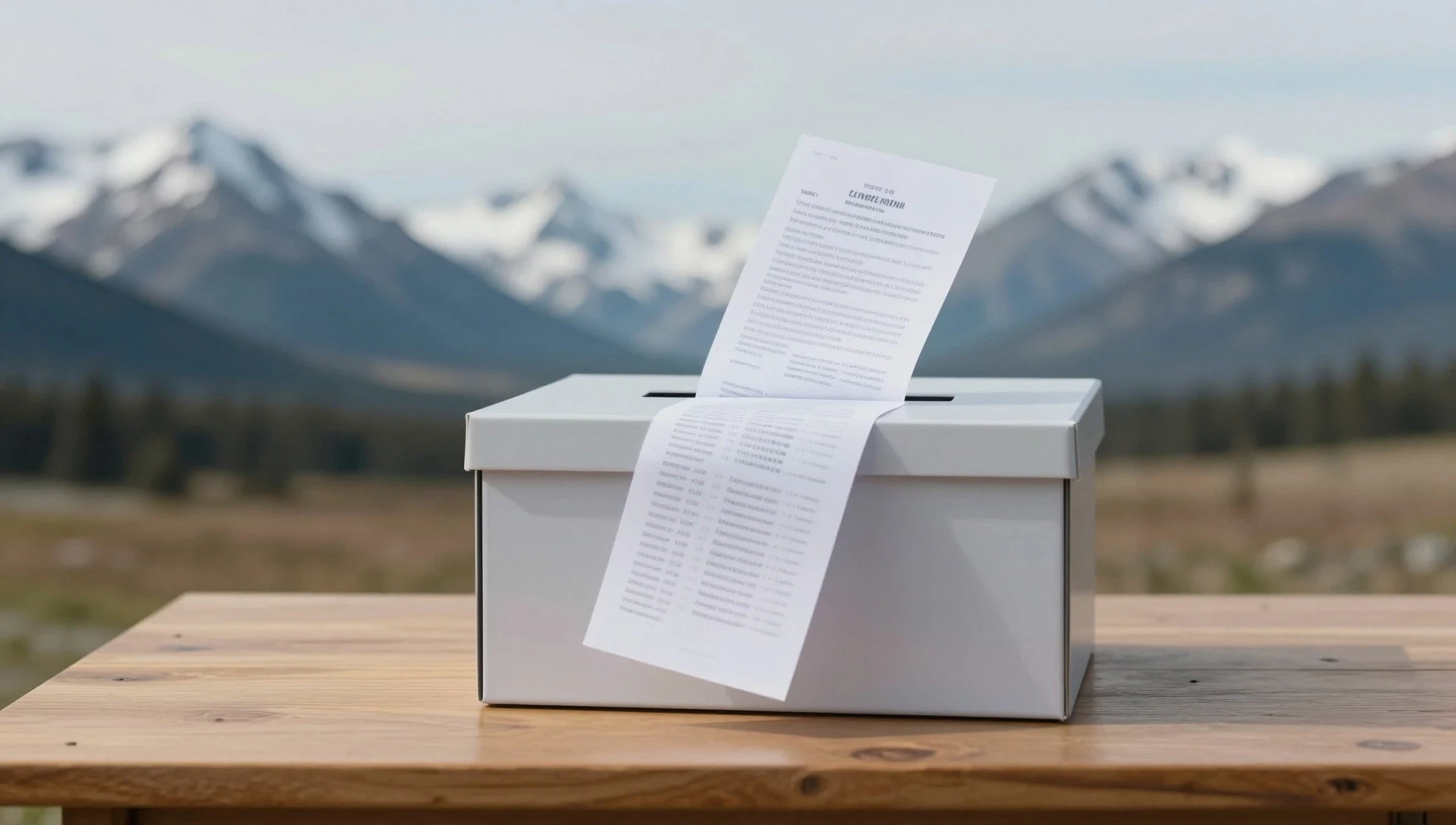
Alaska's 2026 U.S. Senate contest has become a live test of how voters interpret the word "spoiler" when a third candidate draws measurable support and neither major party holds a durable majority.
An NPR All Things Considered audio segment, dated October 30, 2026, reported that Alaskan voters were reacting to allegations that one candidate in the race could act as a spoiler. The report identified no candidates, no polling figures, and no specific source for the claims.
That absence of detail is itself analytically significant. A spoiler allegation is a claim about arithmetic: that a candidate's vote share exceeds the margin between the top two finishers, and that those votes would otherwise transfer to one of them.
On This Page
Without published numbers, the claim functions as narrative rather than evidence, and voters must weigh it on credibility and motive rather than on tabulated results.
Alaska's electoral architecture sharpens the question. The state uses a top-four primary and ranked-choice general election, a system designed to reduce spoiler effects by allowing voters to rank alternatives. Whether the allegation holds therefore depends less on raw vote share than on second-choice distribution, a distinction the reporting did not address.
TL;DR A late-October 2026 NPR report described Alaska voters reacting to allegations that a U.S. Senate candidate could act as a spoiler. The source supplied no names, no polling data, and no attribution for the claims, leaving the substance unverified. This analysis examines what a spoiler allegation actually asserts, how Alaska's ranked-choice system changes the arithmetic, and why unverified claims circulate in competitive races. The central finding is that spoiler claims are testable propositions about vote transfer, and that reporting them without the underlying numbers leaves voters assessing credibility rather than evidence.
The Anatomy of a Spoiler Allegation in a Three-Way Senate Race
A spoiler claim rests on a counterfactual: that removing a candidate from the ballot would change the winner. Establishing it requires two data points, the margin between the leading candidates and the second-choice preferences of the alleged spoiler's supporters. Neither appeared in the source material, which reported voter reaction without the underlying figures.
What the Source Material Actually Establishes
The NPR segment, timestamped 21:36 UTC on October 30, 2026, is an audio report on voter sentiment in Alaska. It confirms that allegations of a spoiler exist and that voters are discussing them.
It does not name the candidate accused, the accuser, or the two major-party contenders against whom the spoiler effect is alleged.
This is a thin evidentiary base, and it matters. A claim reported without attribution cannot be evaluated for motive, and a claim reported without numbers cannot be evaluated for accuracy. What remains is a description of public reaction, which is legitimate journalism but not proof that the spoiler dynamic is real.
Readers should treat the report as a signal that a contested narrative is circulating in Alaska, not as confirmation that any candidate is in fact splitting a rival's coalition. The distinction between a claim's existence and a claim's truth is the analytical core here.
Comparable reporting patterns appear in competitive Senate races where trailing campaigns seek to consolidate opposition. The allegation typically surfaces late, when absentee and early ballots are already cast, limiting the accused candidate's ability to respond before voting concludes.
Why "Spoiler" Is an Arithmetic Claim, Not a Moral One
Stripped of rhetoric, a spoiler effect is measurable. If candidate C receives ##V_C## votes and the winner's margin over the runner-up is ##M##, the spoiler claim is credible only when ##V_C > M## and when a majority of C's voters name the runner-up as their second preference.
In this formulation, ##S## is a spoiler index, ##p_{C \to B}## is the share of the third candidate's voters who would transfer to the runner-up, and ##M## is the observed margin. An index above 1.0 indicates the third candidate plausibly altered the outcome; below 1.0, the claim weakens considerably.
No such calculation was published in the source. The allegation therefore operates in the realm of assertion, and voters responding to it are responding to framing rather than to demonstrated vote transfer. That gap between claim and computation is where most spoiler controversies live.
How Alaska's Ranked-Choice System Alters the Calculus
Alaska adopted a top-four primary and ranked-choice general election, a structure explicitly intended to soften spoiler dynamics. Voters rank candidates, and if no one clears a majority, the last-place candidate is eliminated and their ballots reallocated to next preferences.
Under this system, a vote for a third candidate is not automatically wasted. The relevant question shifts from "did the spoiler split the vote" to "did the spoiler's elimination transfers favor one major candidate disproportionately," which is a narrower and more technical claim than the headline suggests.
Ranked-choice tabulation also produces public round-by-round data, meaning any genuine spoiler effect in Alaska should be verifiable after the count. That transparency makes unverified pre-election allegations harder to sustain and easier to test once ballots are tabulated.
The system does not eliminate spoiler claims entirely. It relocates them to the transfer stage, where a candidate eliminated in an early round can still determine the final margin through the destination of their second-choice ballots.
We Also Published
Voter Psychology and the Strategic Logic Behind Spoiler Narratives
Spoiler narratives are not neutral information; they are persuasion devices aimed at changing behavior before ballots are counted. A voter who believes a third candidate cannot win but can damage a preferred major candidate faces a coordination problem, and the allegation supplies a reason to abandon the third choice.
The Coordination Problem Facing Alaska Voters
In plurality elections, voting for a preferred but non-viable candidate risks electing the least-preferred option. Strategic voting theory predicts that voters abandon such candidates when credible polling shows them trailing, which is precisely the behavior a spoiler allegation is designed to trigger.
Alaska's ranked-choice format partially dissolves this dilemma, because voters can rank a sincere first choice without forfeiting influence over the final outcome. That structural feature should, in theory, reduce the persuasive force of spoiler messaging, though the source suggests the narrative persists regardless.
The persistence is instructive. It implies that spoiler claims serve purposes beyond vote coordination, including fundraising, media attention, and the delegitimization of a rival's candidacy before results are known.
Voters responding to the allegation are therefore navigating both a mechanical question about vote transfer and a social question about which campaigns and commentators they trust to define viability.
Why Unverified Claims Travel Faster Than Tabulated Data
An allegation requires no data to circulate; a rebuttal requires a tabulation. This asymmetry explains why spoiler claims surface in the final days of campaigns, when there is no time for verification and when the mere existence of the claim can shift marginal voters.
Audio reporting amplifies the effect. A voter's reaction, captured in a few seconds of broadcast, conveys sentiment efficiently but strips the context that would allow listeners to assess whether the underlying claim is sound.
The NPR segment fits this pattern: it documents that Alaskans are discussing a spoiler allegation, which is newsworthy, while leaving the allegation's factual foundation entirely outside the report's scope.
For analysts, the lesson is procedural. Treat reported reactions as evidence of narrative salience, not as evidence of electoral mechanics, and wait for round-by-round tabulation before drawing conclusions about spoiler effects.
Media Framing and the Limits of Audio Reporting
Broadcast segments prioritize immediacy and human voice, which suits voter-reaction stories but constrains evidentiary depth. A three-minute audio piece cannot simultaneously establish a claim, attribute it, and test it against polling, so it typically reports the claim's existence.
That editorial choice is defensible, yet it places a burden on audiences. Listeners who hear that a candidate "could act as a spoiler" may retain the assertion while missing the qualifier that no supporting data was presented.
Print and data journalism can close this gap by pairing reaction reporting with polling averages and transfer modeling. Where such pairing is absent, the responsible reading is that a narrative exists, not that a spoiler effect has been demonstrated.
The Alaska case illustrates the general rule: coverage of claims should be distinguished from coverage of findings, and the two are not interchangeable even when they appear in the same segment.
Reading the Alaska Race Without Overreading the Report
The disciplined conclusion is narrow. Alaska voters are discussing a spoiler allegation in a U.S. Senate race as of late October 2026, and a national broadcaster considered that reaction newsworthy.
Everything beyond that, including the identity of the candidate, the plausibility of the claim, and its likely effect, remains unestablished in the source.
What Can Be Concluded and What Cannot
What can be concluded is that the allegation exists, that it has entered public conversation, and that it arrived late enough in the cycle to resist easy verification. What cannot be concluded is that any candidate is in fact splitting a rival's coalition or altering the outcome.
The distinction matters for anyone tracking Senate control. A single seat can determine the chamber's balance, so unverified spoiler claims in competitive states carry outsized perceived importance relative to their evidentiary weight.
Analysts should therefore log the claim as a narrative event and reserve judgment on its mechanical effect until ranked-choice tabulation or credible polling supplies the transfer data required by the spoiler index.
This is not skepticism for its own sake. It is the standard evidentiary discipline that separates reporting on what people believe from reporting on what is demonstrably occurring.
Indicators to Watch as the Count Proceeds
Three indicators will settle the question. First, the first-choice vote share of the alleged spoiler relative to the margin between the leaders. Second, the elimination round in which that candidate exits. Third, the destination of transferred ballots by candidate.
If the spoiler's first-choice share falls below the leader margin and transfers split evenly, the allegation fails the arithmetic test. If transfers concentrate heavily toward one major candidate, the claim gains empirical support regardless of first-choice totals.
Alaska's published round-by-round tabulation makes these indicators observable, which is a genuine advantage over plurality states where transfer preferences remain invisible and spoiler claims stay permanently speculative.
Observers should also track turnout composition, since late allegations can depress or mobilize specific voter groups, producing effects that are behavioral rather than mechanical and therefore harder to isolate.
Why This Case Generalizes Beyond Alaska
Alaska is one of several states experimenting with ranked-choice voting, and its Senate races now serve as natural experiments in whether structural reform reduces spoiler politics. Early evidence from such systems suggests reduced but not eliminated strategic abandonment of third candidates.
The broader lesson concerns information quality. As long as spoiler allegations circulate without accompanying transfer data, voters in every state will face the same coordination problem, resolved by trust in messengers rather than by inspection of numbers.
Ranked-choice jurisdictions can mitigate this by publishing interim transfer estimates, though doing so raises its own questions about premature disclosure and its effect on late-arriving ballots.
For now, the Alaska report stands as a documented instance of a familiar pattern: a consequential claim, a thin evidentiary record, and a public left to weigh credibility until the count supplies clarity.
From our network :
- The Final Descent: How ESA Retired the Legendary Cluster Constellation After 24 Years of Space Weather ScienceAfter 24 years mapping Earth’s magnetosphere, ESA’s Cluster mission concluded with a precisely controlled reentry over the South Pacific. This analysis explores the scientific legacy, engineering decisions, and debris mitigation principles behind one of space exploration’s most responsible retirements.
- Mobile Learning and VR in English: What Global Evidence Reveals About Effective Language TechnologyA systematic review across 14 countries reveals which language-learning technologies genuinely work. Mobile learning, AI, and VR show measurable benefits when pedagogically integrated. This evidence-based guide helps educators and learners select technology that delivers real return on investment.
- Forbidden Matrix Patterns and Visible Lattice Points: A Geometric DictionaryExplore how multidimensional 0–1 matrices encode geometric truths, linking forbidden patterns to visible lattice points and hypergraph theory, with applications in combinatorics and computational geometry.
- University Language Proficiency Exams: Why Institutional Tests Demand Different Preparation Than IELTS and TOEFLDiscover why university-specific language proficiency examinations differ fundamentally from IELTS and TOEFL, and learn strategic preparation approaches for institutional assessment success.
- Committed Mediterranean Precipitation Decline: Why Emissions Cuts Alone Cannot Restore Winter RainsNew NOAA research reveals that Mediterranean winter rains may decline irreversibly even with emissions cuts. Explore the science of committed climate change and regional impacts.
- Live Online English Classes for Kids: Do They Actually Reduce Anxiety?A ten-week study reveals that synchronous online English classes can significantly reduce child language anxiety while improving listening and reading skills. Discover what makes these programs effective and how parents can select the right one.
- The Hidden Cost of AI Convenience: Why Over-Permissioned Agents Are a Security Time BombDiscover why AI agents with excessive permissions create dangerous single points of failure, and learn how implementing least privilege principles can protect your organization from exploitation.
- CISA’s Ten-Advisory Wave: Why Generic Patching Fails in OT and How to Build Product-Specific PlaybooksCISA released ten ICS advisories in one week, exposing critical infrastructure risks. Generic patching fails in OT. Learn to build product-specific remediation playbooks.
- How AI Agents Will Change the Way We Manage Personal FinancesExplore how AI agents are transforming personal finance through automated budgeting, bill payment, and investment management, while examining the critical security protocols and governance frameworks required for safe deployment.
RESOURCES
- Dan Sullivans: Alaska Senate race roiled by spoiler reporting - NPRnpr.org3 days ago ... Alaska's all-important Senate race is roiled by a report on alleged spoiler ... And because the state has a ranked-choice…
- Alaska governor orders probe into Democratic campaign's ... - BBCbbc.com4 days ago ... Dan S Sullivan, the incumbent Republican senator running for re-election, and allies have accused the Democrats of trying to confuse…
- Peltola campaign and national Dems recruited spoiler candidates ...alaskapublic.org5 days ago ... Alaska's election system makes it relatively easy ... But the ranked choice ballot also provides a means to eliminate the…
- Peltola denies knowing about Alaska spoiler candidate as Justice ...pbs.org3 days ago ... as part of an alleged effort to confuse voters. The race is considered key to control of the U.S. Senate.…
- Alaska's all-important Senate race is roiled by a report on alleged ...houstonpublicmedia.org3 days ago ... Alaska's all-important Senate race is roiled by a report on alleged spoiler candidate ... Also, because of rank choice voting,…
- Justice Department seeks to isolate Alaska ballots as criminal ... - PBSpbs.org2 days ago ... The dueling developments came days before Tuesday's ranked choice general election, in a race ... FBI holds press conference on…
- Explaining the Case of the Two Dan Sullivans on Alaska's Ballotfactcheck.org3 days ago ... In the Alaska Senate race ... The general elections are determined by ranked choice voting, which allows voters to rank…
- Explainer: Is it legal to recruit spoiler candidates in US elections?reuters.com3 days ago ... Candidates in the upcoming Alaska senate election in Anchorage ... Alaska's ranked-choice ballot will feature Sullivan, Peltola, a ...
- Republican governor of Alaska orders investigation into 'spoiler ...aljazeera.com4 days ago ... ... ranked-choice election. Voters rank candidates by preference, with votes transferred if a first choice is eliminated. The ballot identifies ...
- Alaska Governor Orders Criminal Investigation Into Peltola Campaignnytimes.com4 days ago ... ... Alaska Senate race not to be certified if Senator Sullivan lost. ... Kendall, the architect of Alaska's ranked-choice voting…
- Ranked Choice Voting - FairVotefairvote.orgRanked choice voting (RCV) makes our elections better by allowing voters to rank ... Trump administration sues to block Alaska Senate election result ·…
- Allegations that Mary Peltola's campaign was involved in recruiting ...facebook.com4 days ago ... ... votes through Alaska's ranked choice voting system. This kind of ... Alaska Senate race against incumbent Sen. Dan Sullivan.…
- Alaska Senate: Criminal investigation into Dan Sullivan candidacycnbc.com3 days ago ... The winner of the Alaska election could determine whether Republicans retain their majority in the U.S. Senate or if Democrats…
- Mary Peltola campaign controversy with Dan Sullivan may ... - The Hillthehill.com4 days ago ... ... Alaska politics than the Senate race, he ... alleged attempts to shape the race showed it misunderstands how ranked…
- Alaska's Senate race faces allegations of spoiler candidate | NSPRmynspr.org3 days ago ... ... spoiler candidate to go on the ballot. Democrat Mary Peltola is running to unseat Republican Senator Dan Sullivan in…
- 01
- 02
- 03
- 04
- 05
- 06
- 07
- 08
0 Comments