Bangladesh's political contest has entered a phase in which the government and the opposition accuse each other of the same destabilising conduct, and the argument advanced by Jamaat-e-Islami Secretary General Mia Golam Porwar on 21 October 2026 captures that symmetry precisely.
Speaking as chief guest at the 49th founding anniversary of the Bangladesh Labour Party in Segunbagicha, Dhaka, Porwar argued that the administration's own "wrong politics" is manufacturing the conditions under which the Awami League could return to electoral life.
His claim is structural rather than merely rhetorical: instability, street confrontation and administrative disarray, he contends, are the mechanisms by which a sidelined party re-enters the frame.
On This Page
The immediate context matters. Porwar's remarks came seven months into a BNP-led government that he described as already embroiled in disarray, and he attributed that drift to what he called the BNP's political immaturity and short-sighted leadership.
He further alleged that the government is attempting to transfer blame for its own misdeeds onto the opposition, and that partisan appointments have gone unchallenged. The opposition's duty, in his framing, is to expose those failures rather than absorb responsibility for them. That argument places the burden of democratic stability on transparency and accountability rather than on opposition restraint.
Two competing narratives therefore run in parallel. At a public event in Rajshahi the previous day, Prime Minister Tarique Rahman alleged that the ousted regime and a section of the opposition were conspiring to destabilise the country, citing intelligence reports that the Awami League was sending money from abroad to a domestic political party to create unrest.
Porwar's counter-narrative insists the opposition has held only peaceful programmes, enforced no hartal or blockade, and burned no vehicles. The dispute is less about facts than about which actor owns the instability.
TL;DR Jamaat-e-Islami Secretary General Mia Golam Porwar warned on 21 October 2026 that the government's "wrong politics" is creating the opening for the Awami League's return, arguing that instability and street confrontation would benefit the ousted party. He accused the BNP-led administration of shifting blame onto the opposition, following the Awami League's own playbook, and ignoring workers' wage and price concerns. Porwar demanded acceptance of a referendum verdict in which 70 percent voted "yes," implementation of constitutional reform proposals through dialogue, and support for a third-phase long march on 31 October. Prime Minister Tarique Rahman, meanwhile, alleged foreign-funded conspiracy to destabilise the country.
The Referendum Mandate and the Politics of Implementation
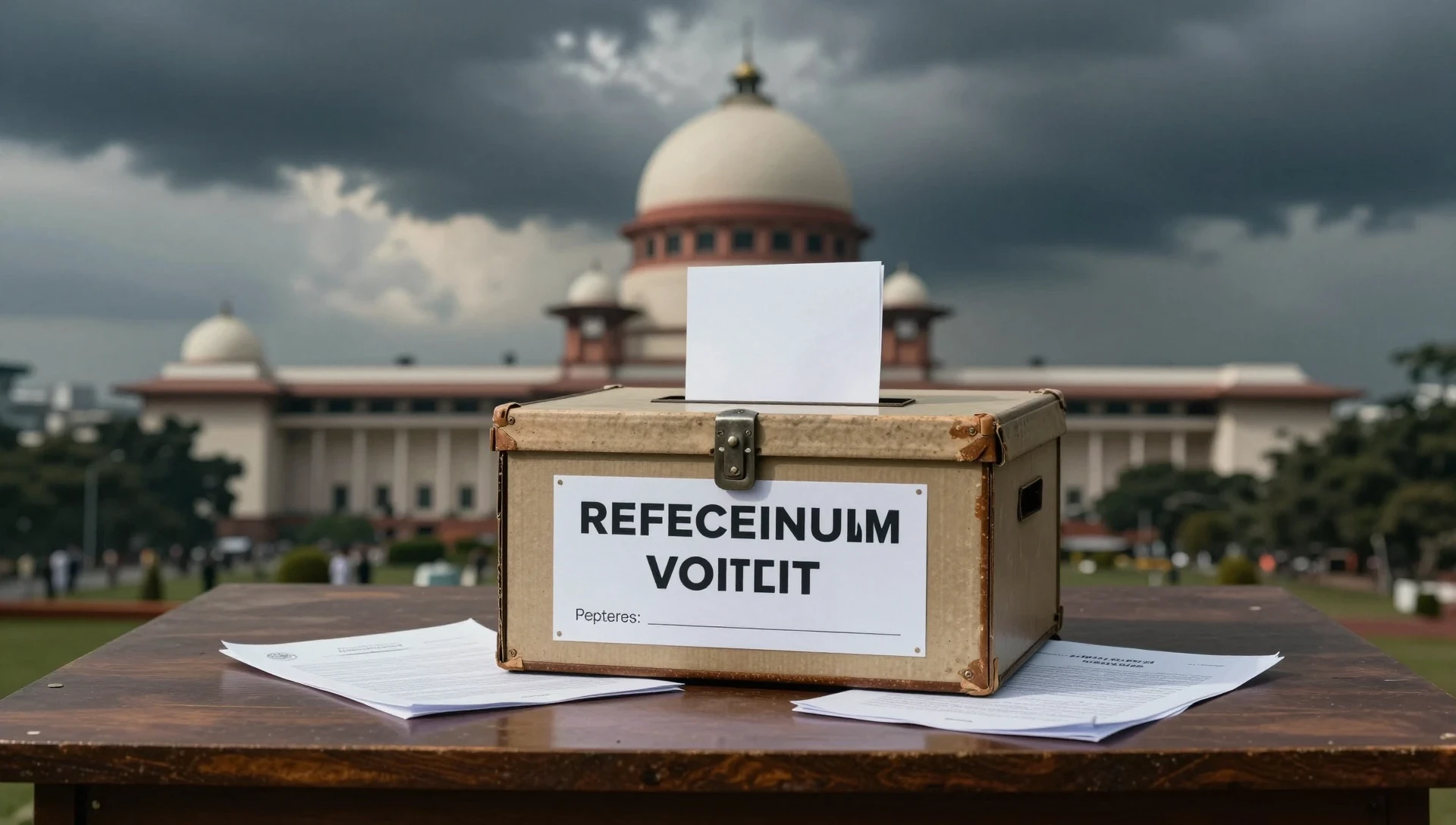
The most concrete element in Porwar's address is not the accusation but the mandate. He urged the government to accept a referendum verdict in which 70 percent of voters cast a "yes" ballot, and to implement the resulting constitutional reform proposals through discussion with the opposition.
That figure functions as the opposition's legitimising anchor: a supermajority is difficult to dismiss as factional noise, and it converts a demand into a test of the government's willingness to be bound by popular instruction.
The argument is procedural, and its force depends on whether the government treats a referendum as binding or advisory.
Reading the 70 Percent Threshold
A 70 percent affirmative vote is a substantial margin by any comparative standard, and it carries a specific political logic. In majoritarian systems, thresholds above two-thirds are conventionally treated as constitutional rather than ordinary, which is why the opposition frames implementation as a legal obligation rather than a policy preference.
The government's counter-position, implicit in Tarique Rahman's warnings about conspiracy, is that implementation must be sequenced against security considerations. The gap between those two readings is the substance of the current confrontation.
The arithmetic also shapes bargaining power. If 70 percent of participating voters endorsed the verdict, the opposition can claim that reform opponents represent a minority position, and it can present delay as defiance of the electorate rather than prudence.
That framing is why Porwar paired acceptance of the verdict with a demand for dialogue: dialogue concedes the mandate while preserving the government's room to negotiate sequencing, drafting and timelines. The proposal is therefore a face-saving mechanism as much as a substantive one.
Comparative experience suggests referendums on constitutional questions tend to produce prolonged implementation disputes rather than clean resolutions. Governments frequently accept the result in principle while contesting the scope of what was approved, and oppositions frequently treat any delay as bad faith.
Bangladesh's current impasse follows that pattern closely, with the added complication that the referendum's verdict is being invoked by a party that is itself outside the government and seeking to convert popular endorsement into institutional leverage.
Porwar's insistence on dialogue also serves an internal purpose. By demanding negotiation rather than unilateral implementation, he positions the opposition as a responsible stakeholder rather than a disruptive force, which directly rebuts the government's instability narrative.
That positioning is essential if the opposition is to sustain peaceful mobilisation without providing the government with grounds to characterise its programmes as confrontational. The rhetorical architecture of the speech is therefore as deliberate as its content.
Constitutional Reform as Bargaining Currency
Constitutional reform proposals are rarely implemented as written, and the demand for dialogue acknowledges that reality. By asking for discussion rather than decree, Porwar keeps the reform agenda alive while accepting that drafting, ratification and sequencing require negotiation.
The risk is that dialogue becomes delay, and that the referendum's momentum dissipates across committee stages. The opposition's long-march calendar appears designed to prevent exactly that outcome by maintaining public pressure between negotiating rounds.
There is also a legitimacy dimension. Reforms adopted through cross-party agreement are more durable than those imposed by a single administration, and they are harder for a future government to reverse. Porwar's emphasis on discussion can therefore be read as strategic prudence rather than concession.
A settlement endorsed by both sides would bind successors in a way that a partisan reform package could not, which strengthens the case for negotiation even where the opposition holds the stronger popular mandate.
The government's incentive structure is different. Conceding that the referendum is binding establishes a precedent that future referendums could be used against it, and it cedes agenda-setting power to the opposition.
That explains the emphasis on security and foreign interference in official rhetoric: reframing the dispute as a stability question avoids the constitutional question altogether. The two sides are therefore arguing about which framework governs, not merely about outcomes.
For workers and industrial constituencies, the constitutional debate is abstract unless it connects to wages and prices. Porwar linked the two explicitly, arguing that the government should address rising costs of essential commodities and minimum wage demands rather than blaming the opposition for labour unrest.
That linkage is politically significant because it grounds the reform agenda in material grievances, giving the opposition a constituency beyond its core supporters.
Stability, Blame and the Fascism Charge
Porwar's sharpest language concerned method rather than policy. He argued that whenever the opposition criticises the government it is accused of creating instability, and he described that reflex as following the path of fascism.
He further alleged that the BNP government is replicating the Awami League's practice of accusing opponents of conspiring against the state, and that it seeks to silence dissent. The charge is a serious one, and its political function is to invert the government's narrative: the accuser becomes the destabiliser.
The Mirror Argument
The mirror argument is the speech's central rhetorical device. By asserting that the BNP now behaves as the Awami League once did, Porwar collapses the distinction between the ousted regime and its successor, and he invites audiences to see continuity rather than change.
That framing is potent in transitional politics, where governments derive legitimacy from the claim that they are fundamentally different from what preceded them. If the opposition can establish behavioural equivalence, it erodes that legitimacy without needing to win an election.
The argument also has a defensive purpose. If criticism is routinely labelled destabilisation, then the opposition's peaceful programmes must be characterised as lawful dissent rather than confrontation. Porwar's insistence that no hartal, blockade, vehicle burning or vandalism has occurred serves that end directly.
It draws a line between protest and disorder, and it places the burden on the government to demonstrate otherwise. The claim is verifiable in principle, which makes it a stronger rhetorical position than a general denial.
Comparisons with the previous administration are unavoidable in this context. The Awami League's tenure was marked by accusations that opponents were conspiring against the state, and those accusations were widely criticised by the parties now in government. Porwar's charge is that the same instrument is being used by different hands.
Whether or not the comparison holds, its political resonance depends on public memory of how such accusations were previously received, and that memory is recent enough to matter.
The fascism label carries weight precisely because it is contested. Governments typically reject it as hyperbolic, while oppositions use it to signal that normal democratic contestation has been foreclosed. In Bangladesh's current setting, the term functions less as an analytical category than as a warning about trajectory.
Porwar's phrasing suggests a direction of travel rather than a completed condition, which leaves room for the government to change course and for dialogue to proceed.
Labour, Wages and Industrial Unrest
The labour dimension is where the argument becomes concrete. Porwar urged the government to address workers' concerns over rising prices of essential commodities and demands for minimum wages aligned with market prices, rather than blaming the opposition for unrest in industrial areas.
That framing shifts responsibility from agitators to policy, and it aligns the opposition with a constituency that is economically exposed and politically consequential. Wage-setting is a measurable policy question, which makes the demand harder to dismiss as rhetoric.
Minimum wage debates in Bangladesh have historically been resolved through tripartite mechanisms involving government, employers and worker representatives. Porwar's call for market-linked wages implicitly invokes that structure while criticising the government for neglecting it. If real wages have lagged food price inflation, the grievance is quantifiable, and quantification strengthens the opposition's case.
The political risk for the government is that industrial unrest can be attributed to policy neglect rather than external agitation.
The Bangladesh Labour Party's role as host is relevant here. The 49th founding anniversary programme at Segunbagicha brought together senior leaders of an 11-party alliance, and the venue signals that labour politics remains an organising channel for the broader opposition.
Porwar's remarks were delivered as chief guest, which places Jamaat within a coalition rather than at its head. That positioning matters for how the alliance's demands are received and for how responsibility for any escalation would be distributed.
Industrial unrest also interacts with the government's security narrative. If strikes and protests are framed as foreign-funded conspiracies, then labour grievances become a security matter rather than an economic one, and negotiation is displaced by policing. Porwar's counter-argument is that addressing wages and prices removes the grounds for unrest altogether.
The two approaches imply very different policy responses, and the choice between them will shape industrial relations over the coming year.
We Also Published
The Long March, Alliances and the Road Ahead
Porwar closed by calling on people to join the third phase of the long march on 31 October along the Dhaka–Khulna–Jashore–Jhenaidah–Kushtia route. The itinerary is not incidental: it traces a western corridor through districts where opposition sentiment and labour organisation are both established, and it converts a national argument into a sequence of local demonstrations.
A march is also a form of pressure that is difficult to characterise as violent, which is precisely why it fits the opposition's peaceful-programmes framing.
Reading the March Route
The route's geography carries political meaning. Khulna and Jashore are significant industrial and agricultural centres, and Jhenaidah and Kushtia sit within a belt where party organisation has historically been dense.
Marching through those districts allows the alliance to demonstrate reach without concentrating crowds in the capital, which reduces the risk of confrontation while maintaining visibility. The choice reflects a deliberate calibration between pressure and provocation.
Timing compounds the effect. A march beginning on 31 October follows the 21 October announcement by roughly ten days, which is long enough to organise but short enough to sustain momentum from the founding anniversary programme.
It also places the march ahead of any potential negotiating window, giving the opposition a deadline structure it can reference in talks. Deadlines are useful in bargaining because they convert vague commitments into testable ones.
The third phase designation implies continuity with earlier marches, and continuity is itself a message. A sustained campaign signals organisational capacity and endurance, which are the resources that make an opposition credible as a negotiating partner. Sporadic protests can be waited out; a sequenced march programme cannot.
That is why the announcement was paired with the demand for dialogue rather than presented as an alternative to it.
For the government, the march presents a dilemma. Dispersing it would confirm the opposition's claim that dissent is being suppressed, while permitting it allows the opposition to build momentum. The least costly response is likely to be procedural accommodation combined with counter-messaging on security, which is broadly what the Rajshahi remarks anticipated. How that balance is struck will indicate whether dialogue is genuinely available.
- 01
- 02
- 03
- 04
Alliance Arithmetic and the 11-Party Bloc
The presence of senior leaders from an 11-party alliance at the Labour Party's anniversary indicates that opposition coordination extends beyond any single organisation. Coalition breadth matters because it makes the peaceful-programmes claim more credible: a multi-party campaign is harder to portray as a single faction's agitation.
It also distributes risk, since no one party bears sole responsibility for escalation or de-escalation. Alliance management, however, introduces its own coordination costs.
Jamaat's role within that alliance is a recurring variable in Bangladeshi politics. Porwar spoke as chief guest rather than as host, and the Labour Party's chairman Mostafizur Rahman Iran chaired the programme.
That division of roles suggests a division of labour in which labour organisations front industrial demands while larger parties supply political weight. Such arrangements can be effective in the short term but require careful handling when credit for any concessions is distributed.
The alliance's demands are also internally varied. Constitutional reform, wage floors and price relief appeal to different constituencies, and prioritising among them is a bargaining problem. Porwar's speech managed that problem by presenting all three as components of a single accountability agenda, with the referendum verdict as the unifying symbol. Whether that synthesis holds under pressure from the government's security framing is the open question.
Electoral calculations sit beneath the surface. If the Awami League returns to contest elections, the opposition's vote share fragments, and the current alliance's leverage declines. That is why Porwar's warning about the government creating the conditions for that return is more than a rhetorical flourish: it identifies a shared interest among otherwise disparate opposition parties in preventing the government from failing in a way that benefits their common rival.
What to Watch Next
Three indicators will clarify the trajectory. First, whether the government responds to the march with accommodation or dispersal will reveal its tolerance for peaceful dissent. Second, whether any formal dialogue on constitutional reform begins before the march concludes will test the seriousness of both sides' stated commitments.
Third, whether industrial wage negotiations advance will determine if labour grievances remain a mobilising channel or are absorbed into policy.
The referendum verdict remains the pivot. If the government accepts it as binding and opens negotiations, the confrontation can be channelled into institutional process, and the opposition's instability warnings lose their edge.
If it continues to treat the verdict as advisory while emphasising foreign conspiracy, the opposition gains a durable grievance and the march programme acquires a rationale that extends beyond a single season.
For now, the evidence supports a narrow conclusion. Both sides describe the same phenomenon, instability, and assign it to the other's conduct. Porwar's contribution is to argue that the government's own methods, not opposition agitation, are producing the conditions for the Awami League's return.
That claim will be tested less by rhetoric than by whether wages rise, prices stabilise and the referendum's 70 percent is treated as an instruction or an inconvenience.
From our network :
- Live Online English Classes for Kids: Do They Actually Reduce Anxiety?A ten-week study reveals that synchronous online English classes can significantly reduce child language anxiety while improving listening and reading skills. Discover what makes these programs effective and how parents can select the right one.
- The Final Descent: How ESA Retired the Legendary Cluster Constellation After 24 Years of Space Weather ScienceAfter 24 years mapping Earth’s magnetosphere, ESA’s Cluster mission concluded with a precisely controlled reentry over the South Pacific. This analysis explores the scientific legacy, engineering decisions, and debris mitigation principles behind one of space exploration’s most responsible retirements.
- How AI Agents Will Change the Way We Manage Personal FinancesExplore how AI agents are transforming personal finance through automated budgeting, bill payment, and investment management, while examining the critical security protocols and governance frameworks required for safe deployment.
- University Language Proficiency Exams: Why Institutional Tests Demand Different Preparation Than IELTS and TOEFLDiscover why university-specific language proficiency examinations differ fundamentally from IELTS and TOEFL, and learn strategic preparation approaches for institutional assessment success.
- CISA’s Ten-Advisory Wave: Why Generic Patching Fails in OT and How to Build Product-Specific PlaybooksCISA released ten ICS advisories in one week, exposing critical infrastructure risks. Generic patching fails in OT. Learn to build product-specific remediation playbooks.
- Forbidden Matrix Patterns and Visible Lattice Points: A Geometric DictionaryExplore how multidimensional 0–1 matrices encode geometric truths, linking forbidden patterns to visible lattice points and hypergraph theory, with applications in combinatorics and computational geometry.
- Committed Mediterranean Precipitation Decline: Why Emissions Cuts Alone Cannot Restore Winter RainsNew NOAA research reveals that Mediterranean winter rains may decline irreversibly even with emissions cuts. Explore the science of committed climate change and regional impacts.
- The Hidden Cost of AI Convenience: Why Over-Permissioned Agents Are a Security Time BombDiscover why AI agents with excessive permissions create dangerous single points of failure, and learn how implementing least privilege principles can protect your organization from exploitation.
- Mobile Learning and VR in English: What Global Evidence Reveals About Effective Language TechnologyA systematic review across 14 countries reveals which language-learning technologies genuinely work. Mobile learning, AI, and VR show measurable benefits when pedagogically integrated. This evidence-based guide helps educators and learners select technology that delivers real return on investment.
RESOURCES
- The Ruling Party's Obstruction of Constitutional Reform in Bangladeshconstitutionnet.orgApr 15, 2026 ... On 13 November 2025, in preparation for this institutional 'reset', the Interim Government enacted the July Charter (Constitution Reform) ...
- Bangladesh heads toward a landmark election amid rising political ...acleddata.comFeb 5, 2026 ... The interim government has struggled to restore stability in the ... referendum pass with a BNP parliamentary victory. If people…
- Bangladesh's Unfinished Revolutioncarnegieendowment.orgMay 28, 2026 ... ... opposition. That pattern would project political stability in the near-term but steadily erode democratic gains over time. For now,…
- Belarus pro-democracy opposition plans to target sham referendumatlanticcouncil.orgJan 23, 2022 ... ... ruling out the prospect of political change until at least the mid-2030s. The February referendum will be the first…
- Sheikh Hasina verdict and Bangladesh's upcoming referendum ...chathamhouse.orgNov 18, 2025 ... An interim government led by Muhammad Yunus came to power after the revolution and has presided over a period of…
- Bangladesh's New Government Gets Down to Businesscrisisgroup.orgApr 23, 2026 ... In the end, the interim government prevented Bangladesh from sliding into political instability ... AL leaders abroad opposed the referendum…
- Jamaat-e-Islami chief and leader of the opposition Shafiqur Rahman ...facebook.com2 days ago ... ... Bangladesh Nationalist Party-led government does not implement the referendum verdict. Alliance leaders said that about 70 per cent of ...
- Bangladesh Jamaat-e-Islami on X: "BNP government mired in ...x.comOct 22, 2026 ... ... instability was being created at ... opposition had organized movements demanding implementation of the people's verdict in the referendum.
- Son of Bangladesh's former rulers poised for power as BNP sweeps ...reuters.comFeb 13, 2026 ... The opposition Bangladesh Nationalist Party won a landslide parliamentary election.
- Country Graph - V-Demv-dem.netBangladesh, Barbados, Belarus, Belgium, Benin, Bhutan, Bolivia, Bosnia and ... Political stability --- estimate, Political violence, Polity combined score ...
- Bangladesh's 2026 Election: BNP Landslide Ends 'Two Begums' Eraasiapacific.caFeb 19, 2026 ... Early tests will include advancing constitutional reforms, maintaining political stability, strengthening the rule of law, protecting minority ...
- Recent Political Developments in Bangladesh - Congress.govcongress.govMay 11, 2026 ... elections raised concerns for governance and political stability in Bangladesh. ... included “members of law enforcement, the ruling party, and ...
- Will Bangladesh's Massive Democratic Experiment Work?journalofdemocracy.org... instability rather than democratic restraint. Additional ... political judgement, placing unusual interpretive weight on the referendum outcome itself.
- Reforming the Legislature in Bangladesh - Verfassungsblogverfassungsblog.deApr 18, 2025 ... ... political moderation and institutional stability. Semi ... ruling party and intransigence by the opposition. While the move to ...
- BANGLADESH IN TURMOIL: A NATION ON THE BRINKcongress.govThe point of contention is whether the election time government should be comprised of political leaders or nonpartisan individuals. The opposition alliance led ...
- 01
- 02
- 03
- 04
- 05
- 06
- 07
- 08
0 Comments