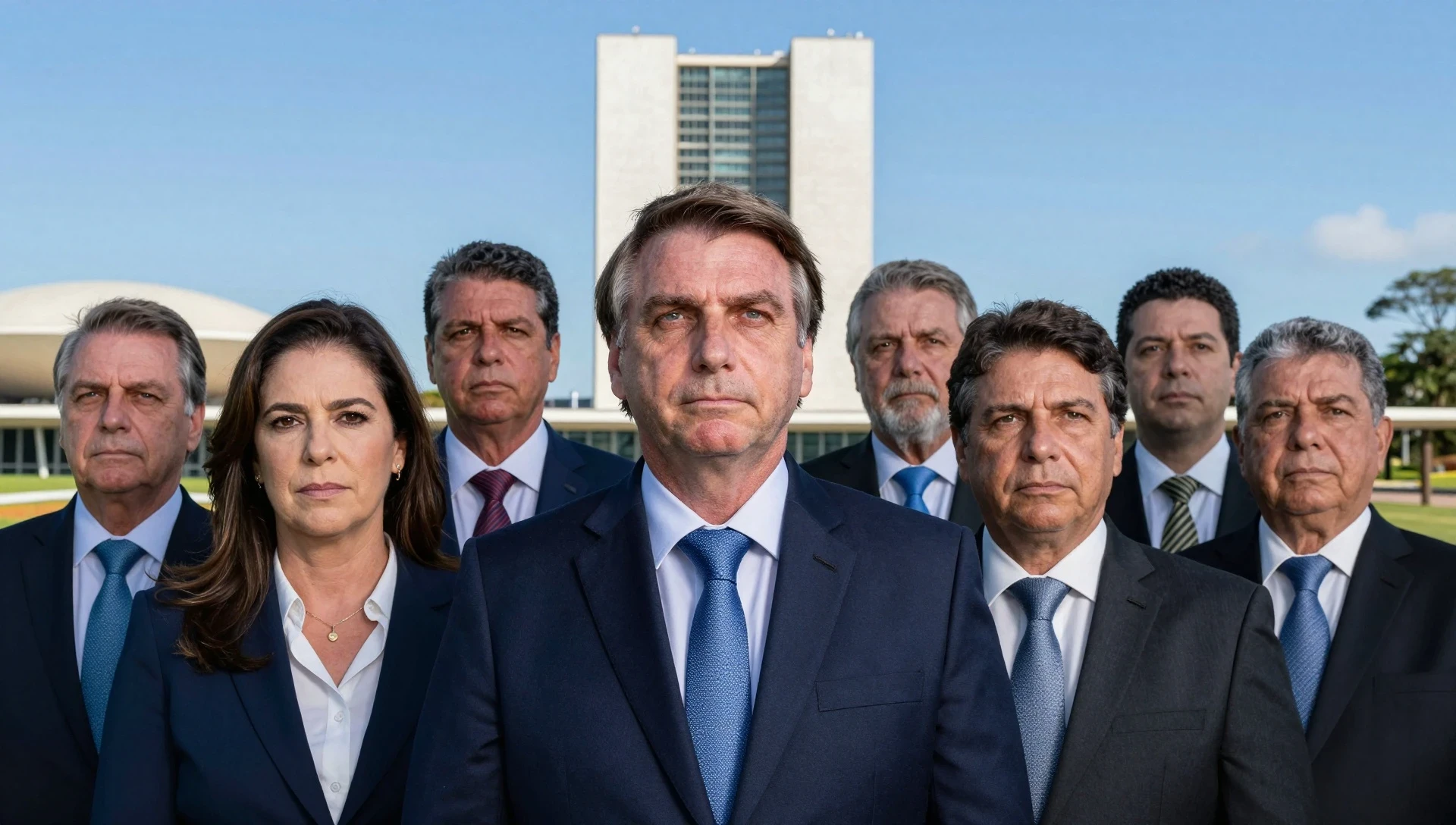
The Bolsonaro name still functions as a political brand in Brazil, and the 2026 cycle has tested that brand rather than retired it. Flávio Bolsonaro's electoral defeat and his subsequent relocation to the United States removed a senator from Brasília but did not remove the family's organizational footprint from state assemblies, municipal chambers and the conservative media ecosystem.
The Associated Press reported that the family, led by former President Jair Bolsonaro, remains a prominent force despite the setback, a reading consistent with how dynastic political machines typically survive individual losses.
What matters analytically is the distinction between electoral performance and structural influence. A single lost race measures voter sentiment in one constituency on one day; influence measures control over party machinery, donor networks, endorsements and the ability to shape the national agenda between elections.
On This Page
The Bolsonaro family retains all four levers in reduced but measurable form. Flávio's departure to the United States also creates a new variable: an exile-adjacent figure operating outside Brazilian jurisdiction while his relatives contest domestic offices.
This analysis examines the mechanics of that residual influence, the arithmetic of the family's electoral record, and the strategic consequences of dispersion across borders. It treats the Bolsonaro case as an instructive example of how personality-driven conservative movements in Latin America adapt when their central figure faces legal constraints.
The evidence points less to collapse than to reorganization, with the family converting national prominence into state-level and diaspora-based leverage.
TL;DR Flávio Bolsonaro's defeat and move to the United States did not end the Bolsonaro family's influence in Brazilian politics. The family retains party structures, conservative media reach and state-level allies, while Jair Bolsonaro's legal exposure constrains direct campaigning. The result is a movement shifting from centralized presidential politics toward distributed, family-anchored influence, with Flávio's American base adding a diaspora dimension that complicates both Brazilian oversight and future coalition arithmetic.
The Architecture of Residual Political Influence
Political dynasties rarely disappear after one bad election night. They persist because influence is stored in institutions rather than in individual candidacies: party directories, campaign finance channels, legislative caucuses and sympathetic broadcasters.
The Bolsonaro family built each of these assets during Jair Bolsonaro's presidency from 2019 to 2022, and those assets depreciate slowly. Flávio's loss removes one seat, not the network that produced it.
Party Machinery and the Liberal Party Base
The Liberal Party became the family's principal institutional vehicle, and its congressional bench remains substantial. Control over candidate selection, committee assignments and federal budget amendments gives family-aligned leaders leverage that does not require holding the presidency.
Even reduced, this machinery can deliver endorsements, airtime and logistical support to allied candidates across Brazil's 26 states and Federal District.
Brazil's fragmented party system rewards brokers who can assemble coalitions, and the Bolsonaro bloc remains one of the few identifiable conservative brands with national recognition. That recognition has monetary value in campaign terms: a single endorsement can shift polling in down-ballot races.
The family's influence therefore operates through gatekeeping rather than command, which is more durable than personal popularity alone.
Conservative Media and Digital Reach
The family's direct communication channels, including large social media followings and allied evangelical broadcasters, bypass traditional press gatekeepers. This infrastructure sustained Jair Bolsonaro's political career through censorship disputes and platform restrictions.
Digital reach converts into fundraising and mobilization capacity, both of which remain measurable even when a family member loses a conventional race.
Audience data illustrates the asymmetry. A candidate can lose an election while retaining millions of followers who constitute a ready-made distribution network for future campaigns. The family's media footprint thus functions as an asset independent of electoral outcomes, and it can be lent to allies or monetized through affiliated enterprises.
State-Level Alliances and Municipal Anchors
Bolsonaro-aligned candidates hold governorships, mayoralties and state assembly seats across conservative-leaning regions, particularly in the South and Center-West. These officeholders control local patronage and can amplify family messaging. Municipal elections provide the family with a recurring testing ground, and strong local results can rebuild national credibility faster than federal races allow.
The 2024 municipal cycle already demonstrated that the family's endorsement retained value in hundreds of races. Analysts tracking those results noted that allied candidates outperformed expectations in several state capitals. That pattern suggests the brand's floor is higher than a single Senate loss implies, though its ceiling remains contested.
Reading the 2026 Result: Loss, Relocation, Recalibration
Flávio Bolsonaro's defeat carries symbolic weight because he was the family's most prominent elected officeholder after his father left the presidency. His move to the United States adds a second layer: a senior family figure now operates from abroad, which changes how he can participate in Brazilian politics. The relocation may be personal, strategic, or both, but its political consequences are concrete.
What the Defeat Actually Measures
An electoral loss measures the preferences of one electorate at one moment. It does not measure a movement's organizational capacity, its fundraising base, or its ability to shape legislation through allied legislators.
Analysts who treat a single Senate result as a verdict on the entire Bolsonaro bloc overstate the informational content of that result and understate the bloc's institutional resilience.
Comparative evidence supports caution. Political families across Latin America, from the Fujimori dynasty in Peru to the Kirchner network in Argentina, have absorbed defeats and returned to contention within one or two cycles.
The mechanism is consistent: retain the party brand, keep allied officeholders employed, and wait for the incumbent government to accumulate unpopularity.
The Diaspora Dimension
Operating from the United States gives Flávio Bolsonaro access to Brazilian diaspora communities, particularly in Florida, Massachusetts and New Jersey, which contain significant conservative-leaning expatriate populations. Diaspora politics can supply fundraising, volunteer networks and media amplification. It also insulates a political figure from some domestic legal exposure, though not from all of it.
The arrangement mirrors patterns seen in other countries where opposition figures relocate abroad and continue to influence domestic politics through digital channels. Brazilian authorities retain jurisdiction over citizens abroad for many offenses, so the insulation is partial. Still, physical distance changes the rhythm of political engagement and can extend a career's lifespan.
Succession Questions Inside the Family
The family's internal succession is now an open question. Jair Bolsonaro's sons have each occupied distinct niches: Flávio in the Senate, Eduardo in federal politics and international outreach, Carlos in municipal politics and digital operations.
With Flávio abroad and defeated, the internal balance shifts, and the family must decide which figure anchors the next national campaign.
Succession disputes are common in dynastic movements and often resolve through polling and donor preference rather than formal hierarchy. The family's ability to manage that transition without public rupture will determine whether its influence persists at current levels or erodes over the next two cycles.
We Also Published
Strategic Implications for Brazilian Politics and Beyond
The Bolsonaro family's persistence matters beyond its own fortunes because it shapes the structure of Brazil's conservative opposition. A fragmented right benefits the incumbent left, while a unified right with a recognizable brand can contest national elections credibly.
The family's residual influence therefore functions as a coordination mechanism, and its decisions affect coalition formation across the ideological spectrum.
Coalition Arithmetic and the 2028 Horizon
Brazil's presidential elections are decided through two-round runoffs, which reward broad coalition-building. The Bolsonaro bloc's ability to deliver conservative votes in the first round makes it a valuable partner for any center-right candidate. Conversely, its refusal to endorse can fragment the anti-incumbent vote and hand victory to the governing party.
This leverage is the family's most valuable asset in the near term. Even without a family member on the presidential ticket, the bloc can negotiate cabinet positions, policy commitments and legislative priorities. The arithmetic of runoff politics gives a disciplined minority bloc disproportionate influence over outcomes.
Legal Exposure and Institutional Constraints
Jair Bolsonaro's legal proceedings constrain his direct participation in campaigns and public life. Brazilian courts have imposed restrictions that limit his ability to travel, speak publicly and hold office. These constraints push the family toward surrogates and digital channels, which are less controllable but also less subject to formal sanction.
The legal dimension also affects the family's international positioning. Flávio's presence in the United States may complicate cooperation with Brazilian investigations, though extradition treaties and mutual legal assistance frameworks remain relevant. The family's strategy appears to balance legal risk management with political continuity.
Comparative Lessons from Other Dynasties
Dynastic political movements elsewhere offer instructive parallels. The Gandhi family in India, the Trudeau family in Canada and the Aquino family in the Philippines each experienced defeats followed by returns to power. The common thread is institutional continuity: parties, media relationships and regional bases that outlast individual setbacks.
The Bolsonaro case fits this pattern with one distinctive feature: the family's reliance on digital platforms and evangelical networks rather than traditional party structures. That reliance makes the movement more resilient to formal institutional pressure but more vulnerable to platform policy changes and audience fatigue.
- 01
- 02
- 03
- 04
Quantifying the Family's Remaining Leverage
Quantification is difficult because much of the family's influence operates informally through endorsements and media appearances. Still, several measurable indicators exist: the size of the Liberal Party's congressional delegation, the number of allied governors and mayors, and the reach of family-controlled social media accounts. These indicators provide a rough index of residual capacity.
Congressional and State-Level Footprint
The Liberal Party emerged from the 2022 elections as the largest single party in the Chamber of Deputies, with a bench exceeding 90 seats. That delegation provides procedural leverage, committee chairmanships and budget amendment authority.
Even if the family's personal popularity has declined, the party's institutional weight remains a bargaining chip in legislative negotiations.
At the state level, Bolsonaro-aligned governors in São Paulo, Minas Gerais and Santa Catarina, among others, control substantial administrative resources. These governors can coordinate policy positions, mobilize municipal networks and provide platforms for family messaging. The concentration of allied governorships in economically significant states amplifies the family's national relevance.
Digital Metrics and Audience Retention
Social media follower counts provide a crude but useful proxy for reach. Jair Bolsonaro's accounts collectively command tens of millions of followers across platforms, and family members maintain substantial individual followings. Audience retention after electoral defeat is the key variable: if engagement holds, the digital asset retains value for future campaigns.
Platform policy changes pose a structural risk. Algorithmic adjustments, content moderation rules and regulatory pressure in Brazil can reduce organic reach. The family's reliance on these channels makes it sensitive to decisions made by companies outside Brazilian jurisdiction, a vulnerability that traditional party structures do not share.
Fundraising and Donor Networks
Campaign finance records show that the Bolsonaro bloc attracted significant donations from agribusiness, evangelical organizations and conservative advocacy groups. These donor networks persist beyond individual campaigns and can be redirected to allied candidates. Fundraising capacity is therefore a durable asset, though it depends on continued donor confidence in the bloc's electoral viability.
Brazil's public financing system also matters. Parties that clear electoral thresholds receive substantial public funds, and the Liberal Party's size ensures continued access to these resources. Public financing provides a floor of institutional support that reduces dependence on private donors and sustains party operations between elections.
Scenarios for the Next Electoral Cycle
Three broad scenarios frame the family's trajectory through 2028. In the first, the bloc consolidates behind a single candidate and contests the presidency credibly. In the second, internal fragmentation produces multiple conservative candidacies, splitting the anti-incumbent vote. In the third, the family recedes into a regional force concentrated in the South and Center-West.
Scenario One: Consolidation
Consolidation requires the family to resolve succession questions and secure donor confidence. If Eduardo Bolsonaro or an allied governor emerges as the consensus candidate, the bloc can present a unified front. This scenario depends on Jair Bolsonaro's legal situation stabilizing enough to permit active endorsement and on the family avoiding public disputes.
The probability of consolidation is moderate. Historical patterns suggest dynasties often unify when facing a common electoral threat, and the incumbent government provides that threat. However, personal rivalries and divergent regional interests can complicate coordination, particularly when multiple family members hold distinct power bases.
Scenario Two: Fragmentation
Fragmentation occurs when multiple conservative candidates compete for the same voter pool. Brazil's proportional representation system and fragmented party landscape make this outcome plausible. A split conservative vote in the first round can eliminate the bloc from the runoff entirely, handing the election to the governing party or a centrist alternative.
The family's incentive is therefore to act as a coordinating body, endorsing a single candidate early and disciplining allied parties. Whether it can enforce that discipline depends on its remaining leverage over donors and officeholders, which is precisely what the 2026 result tested.
Scenario Three: Regional Recession
Regional recession describes a gradual decline in national relevance while retaining strength in conservative strongholds. The family could become a regional force, influential in Santa Catarina, Paraná and parts of Minas Gerais, but unable to contest national elections independently. This outcome resembles the trajectory of several Latin American conservative movements after their peak.
Recession is the slowest scenario and the hardest to detect in real time. It manifests through declining fundraising, weaker endorsements and reduced media attention. The family's digital reach may mask this decline initially, since follower counts lag behind actual political influence.
Conclusion: Influence Without Office
The Bolsonaro family's position after Flávio's defeat and relocation illustrates a broader truth about political influence: it is stored in networks, not in titles. The family retains party machinery, media reach, donor relationships and allied officeholders. These assets do not guarantee future victories, but they ensure continued relevance in Brazilian politics.
The relocation to the United States adds a new dimension that analysts should monitor. Diaspora politics, legal insulation and international conservative networks may extend the family's influence in ways that domestic electoral defeat alone would not.
The next two cycles will reveal whether the family can convert residual influence into renewed electoral success or settle into regional prominence.
For observers of Brazilian politics, the lesson is to distinguish between a movement's peak and its persistence. The Bolsonaro era may have passed its high-water mark, but the family's institutional footprint remains substantial. That footprint will shape coalition arithmetic, conservative messaging and the balance of power in Brasília for years to come.
From our network :
- How AI Agents Will Change the Way We Manage Personal FinancesExplore how AI agents are transforming personal finance through automated budgeting, bill payment, and investment management, while examining the critical security protocols and governance frameworks required for safe deployment.
- Live Online English Classes for Kids: Do They Actually Reduce Anxiety?A ten-week study reveals that synchronous online English classes can significantly reduce child language anxiety while improving listening and reading skills. Discover what makes these programs effective and how parents can select the right one.
- The Final Descent: How ESA Retired the Legendary Cluster Constellation After 24 Years of Space Weather ScienceAfter 24 years mapping Earth’s magnetosphere, ESA’s Cluster mission concluded with a precisely controlled reentry over the South Pacific. This analysis explores the scientific legacy, engineering decisions, and debris mitigation principles behind one of space exploration’s most responsible retirements.
- CISA’s Ten-Advisory Wave: Why Generic Patching Fails in OT and How to Build Product-Specific PlaybooksCISA released ten ICS advisories in one week, exposing critical infrastructure risks. Generic patching fails in OT. Learn to build product-specific remediation playbooks.
- Mobile Learning and VR in English: What Global Evidence Reveals About Effective Language TechnologyA systematic review across 14 countries reveals which language-learning technologies genuinely work. Mobile learning, AI, and VR show measurable benefits when pedagogically integrated. This evidence-based guide helps educators and learners select technology that delivers real return on investment.
- The Hidden Cost of AI Convenience: Why Over-Permissioned Agents Are a Security Time BombDiscover why AI agents with excessive permissions create dangerous single points of failure, and learn how implementing least privilege principles can protect your organization from exploitation.
- University Language Proficiency Exams: Why Institutional Tests Demand Different Preparation Than IELTS and TOEFLDiscover why university-specific language proficiency examinations differ fundamentally from IELTS and TOEFL, and learn strategic preparation approaches for institutional assessment success.
- Committed Mediterranean Precipitation Decline: Why Emissions Cuts Alone Cannot Restore Winter RainsNew NOAA research reveals that Mediterranean winter rains may decline irreversibly even with emissions cuts. Explore the science of committed climate change and regional impacts.
- Forbidden Matrix Patterns and Visible Lattice Points: A Geometric DictionaryExplore how multidimensional 0–1 matrices encode geometric truths, linking forbidden patterns to visible lattice points and hypergraph theory, with applications in combinatorics and computational geometry.
RESOURCES
- Flavio Bolsonaro and family to receive US visas after leaving Brazil ...reuters.com4 days ago ... Brazilian Senator Flavio Bolsonaro has left the country for the United States after losing Sunday's presidential election, three sources ...
- Lula beats Bolsonaro in Brazil runoff, securing fourth presidential termpbs.orgOct 25, 2026 ... He quickly became one of former President Jair Bolsonaro's biggest critics and narrowly beat him in 2022. Lula admitted in…
- Flávio Bolsonaro arrives in Florida after fleeing Brazil - NPRnpr.org5 days ago ... U.S. offers visas to Flávio Bolsonaro family after election defeat Brazil's defeated candidate Flávio Bolsonaro ... influence. We deliver ...
- Flávio Bolsonaro seen landing in Miami with family after Brazil ... - BBCbbc.comFlávio Bolsonaro seen landing in Miami with family after Brazil presidential election defeat. 28 October 2026. Flavio Bolsonaro is seen deboarding a plane ...
- US to grant Flavio Bolsonaro visa as he flees Brazil after election lossafp.com5 days ago ... Defeated right-wing presidential candidate Flavio Bolsonaro will be granted entry into the United States, Washington said Tuesday, ...
- Flávio Bolsonaro denies fleeing Brazil after landing in Miami - BBCbbc.com4 days ago ... The defeated Brazilian candidate claims to be the victim of a coup d'état and political persecution, recycling unsubstantiated allegations ...
- Lula's Electoral Win and Bolsonaro's Departure Deepen Tensions ...wola.org3 days ago ... ... Brazil since 1989 to overcome a first-round defeat and win the runoff. ... Bolsonaro family, contrasted sharply with Flávio…
- Flávio Bolsonaro arrives in Miami after fleeing Brazil - KOLN1011now.com5 days ago ... Defeated presidential candidate Flávio Bolsonaro and his family land in Miami after leaving Brazil ... influence through BRICS, a group…
- Flávio Bolsonaro Flees Brazil After Election Defeat and Amid Fraud ...occrp.org5 days ago ... Power and Influence • Brazil. Flávio Bolsonaro Flees Brazil ... Flavio Bolsonaro and his family and allow them entry into…
- Brazil's Flávio Bolsonaro arrives in Miami after election defeatnbcnews.com4 days ago ... Bolsonaro left Brazil days after his electoral defeat and after failing to comply with a court order to turn in…
- Why defeating Bolsonaro did not defeat Bolsonarismotheloop.ecpr.euOct 16, 2026 ... Brazil's 2026 election has put the Bolsonaro family within reach of the presidency again. Gülşen Doğan argues that the deeper…
- Brazil's Flávio Bolsonaro and family will get US visas after election ...nbcmiami.com6 days ago ... ... following his 2022 election loss to Lula. After that defeat, Jair Bolsonaro fled Brazil for Florida. He returned three…
- Bolsonaro effectively concedes in Brazil after Trump suggests he ...washingtonpost.com6 days ago ... Brazil's leading right-wing politician, Flávio Bolsonaro, effectively conceded defeat ... Bolsonaro family who spoke on the condition of ...
- Flavio Bolsonaro Flees to US After Brazil Election Defeat as Trump ...moderndiplomacy.eu5 days ago ... Lula has accused Washington of working with the Bolsonaro family to restore its political influence following the election defeat. Stay ...
- Flávio Bolsonaro and his family land in Miami - Spectrum Newsspectrumlocalnews.com5 days ago ... MIAMI — Defeated Brazilian presidential candidate Flávio Bolsonaro and his family landed in Miami on Wednesday after fleeing Brazil. The ...
- 01
- 02
- 03
- 04
- 05
- 06
- 07
- 08
0 Comments